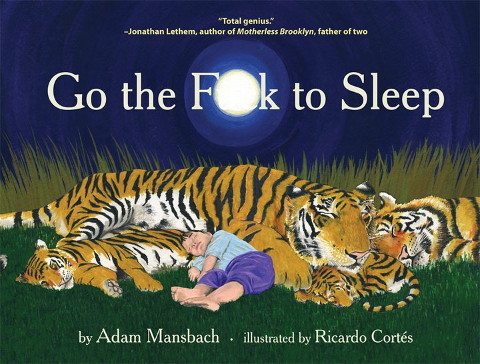
Published back in 2011, Go the F–k to Sleep, the playful children’s storybook meant for adults, became a big besteller. It topped Amazon’s bestseller list for a while. And, before you knew it, celebrities were giving public readings of the book. Perhaps you’ll recall Werner Herzog’s fun reading at The New York Public Library.
Samuel L. Jackson did the honors when the book was released in its official audio format. Now that reading is free to download thanks to Audible.com. Unabridged, it runs a mere 6 minutes. To download the audio, you will need to register with Audible. We hope you’ll get a good laugh out of it.
[PS: If you’re interested in other ways to download a free audio book from Audible, be sure to see their a 30-day free trial program. We have more info on that here.]
The Stories of John Cheever, a collection of 61 stories chronicling the lives of “the greatest generation,” was first published in 1978 with much fanfare. The critics liked it. The weighty, 700-page book won the Pulitzer Prize for Fiction in 1979. The people liked it too. The Stories of John Cheever, Michiko Kakutani wrote in Cheever’s 1982 obit, was “one of the few collections of short fiction ever to make The New York Times best-seller list.”
The collection features some of Cheever’s best-known stories: “The Enormous Radio,” “Goodbye, My Brother,” “The Five-Forty-Eight,” and “The Country Husband.” And also perhaps his most famous short piece of fiction, “The Swimmer.”
First published in The New Yorker in July, 1964, “The Swimmer” was originally conceived as a novel and ran over some 150 pages, before the author pared it down to a taut eleven pages. Those eleven pages apparently take some 25 minutes to read. Above, you can hear Cheever reading “The Swimmer,” in its entirety, at New York’s 92nd St. Y. The audio was recorded on December 19, 1977, and it’s otherwise housed in our collection, 1,000 Free Audio Books: Download Great Books for Free.
In 2009, Neil Gaimanwon the Newbery Medal for The Graveyard Book, a prestigious prize given to “the author of the most distinguished contribution to American literature for children.” The American Library Association, the organization that bestows the award, called The Graveyard Book a “delicious mix of murder, fantasy, humor and human longing,” and cited its “magical, haunting prose.” You can savor that prose by watching the playlist of videos embedded above. During the book tour for The Graveyard Book, Gaiman read a different chapter at every stop, and his publisher, HarperCollins, recorded the readings and made them available online. If you have roughly eight hours of free time, you can watch the reading from start to finish.
Though I am old with wandering
Through hollow lands and hilly lands,
I will find out where she has gone
And kiss her lips and take her hands;
And walk among long dappled grass,
And pluck till time and times are done
The silver apples of the moon,
The golden apples of the sun.
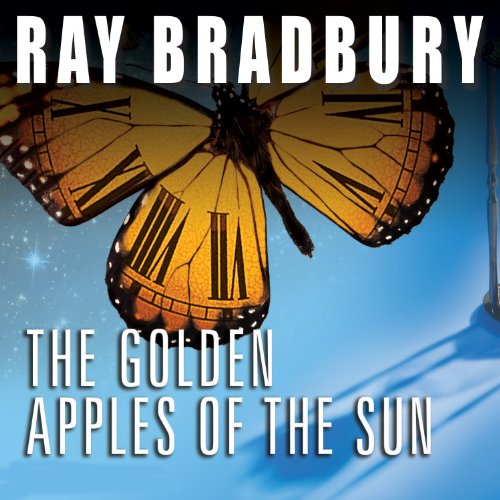
Some year later, in 1991, the BBC dramatized eight stories from Bradbury’s collection. Adapted by Lawrence Gilbert, the stories were performed by a full cast and aired on the radio. The audio, running almost two hours, can be streamed below thanks to Archive.org. It’s otherwise housed in our collection of 550 Free Audio Books. Enjoy.
Below we have some other radio dramatizations of sci-fi/dystopian classics.
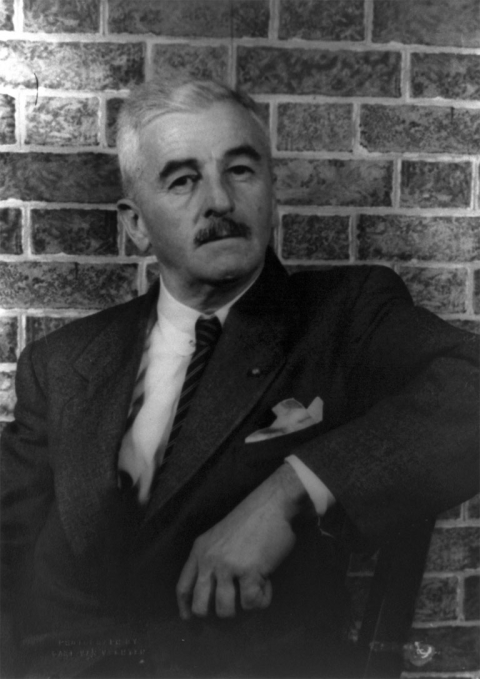
William Faulkner wrote his seventh novel As I Lay Dying in the last months of 1929, almost immediately after another stream-of-consciousness masterpiece, The Sound and the Fury. Like the Shakespearean title of that work, As I Lay Dying’s title, which comes from Homer’s Odyssey, indicates the literary ambitions of its author. Only thirty-two at the time of its writing, Faulkner composed the novel in eight weeks (six by his accounting) while working nights at the University of Mississippi’s power plant, deciding in advance that he would stake his entire reputation as a writer on the book: “Before I ever put pen to paper and set down the first words, I knew what the last word would be… Before I began I said, I am going to write a book by which, at a pinch, I can stand or fall if I never touch ink again.” His passionate conviction is evident in the original manuscript—the first and only draft—which reveals “an ease in creation unlike his other novels.”
Perhaps the most narratively straightforward of William Faulkner’s Yoknapatawpha novels—set in a fictional Mississippi region based on his own home county of Lafayette— As I Lay Dying tells the story of the Bundrens, a poor white family on a perilous journey to honor their matriarch Addie’s request for a burial in the town of Jefferson. Despite the seeming simplicity of its plot, the book’s style is incredibly complex, told from the perspective of fifteen different characters in rough-hewn country dialect and arresting lyrical fugues. It is the novel’s “coarse language and dialect,” that is “exactly Faulkner’s project,” writes Tin House editor Rob Spillman: “Faulkner, a Mississippi high school dropout, made it his mission to capture the emotional lives of the rural poor, unflinchingly writing about race, gender, sexuality, and power.” Through the power of his language and—in the words of Robert Penn Warren—the “range of effect, philosophical weight, originality of style, variety of characterization, humor, and tragic intensity,” the Southern novelist elevated his humble subjects to truly mythic status.
Thanks to HarperCollins, you can listen to Faulkner himself read from his masterpiece: .au file (4.4 Mb), .gsm file (0.9 Mb), .ra file (0.5 Mb). You’ll have to listen carefully to hear the author’s soft southern drawl, which gets lost at times in the poor quality recording. As you do, follow along with the text in Google Books. Faulkner reads from the twelfth chapter, told by Darl, Addie’s second oldest son, a sensitive, poetic thinker who narrates nineteen of the novel’s 59 chapters (and who James Franco plays in his film adaptation of the book). In this passage, Darl observes his mother’s death, and each family member’s immediate reaction, from sister Dewey Dell’s dramatic expressions of grief, to older brother Cash’s taciturn response and father Anse’s tragic-comic insensitivity: “God’s will be done…. Now I can get them teeth.”
To hear much more of Faulkner’s voice, visit Faulkner at Virginia: An Audio Archive, which catalogs and stores digital audio of the author’s lectures, readings, and question and answer sessions during his tenure as writer in residence at the University of Virginia in 1957–58. In one particular session with a group of engineering school students, Faulkner gives us a clue for how we might approach his work, which can seem so strange to those unfamiliar with the history, customs, and speech patterns of the American Deep South. Each of us, he says, “reads into the—the books, things the writer didn’t put in there, in the terms that—that his and the writer’s experience could not possibly be identical. That there are things the writer might think is in that book, which the reader doesn’t find for the same reason that—that no two experiences can be identical, but everyone reads according to—to his own—own lights, his own experience, his own observation, imagination, and experience.” For all of their provincial peculiarities, the Bundren’s epic struggle with the grief and pain of loss has universal reach and resonance.
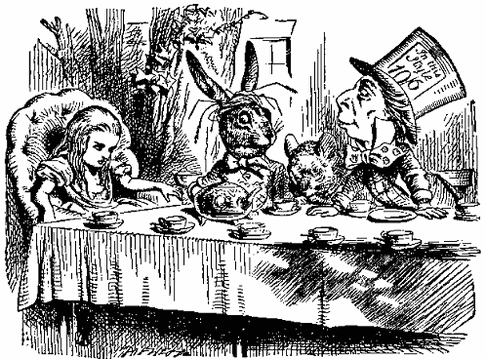
Many of us came across our favorite book serendipitously. No surprise: it’s easiest to be completely blown away by a work of art or literature when you approach it without any pre-existing expectations. For BoingBoing’s Cory Doctorow, that book was Lewis Carroll’sAlice In Wonderland. Doctorow, now a prominent author, journalist, and technology activist, first came across Carroll’s tale of a young girl who falls down a rabbit hole in 1978:
“In 1978, I walked into my Crestview Public School grade two classroom in Willowdale, a suburb of Toronto, and, on the spur of the moment, took Alice in Wonderland off the shelf. My teacher was Bev Pannikkar, who had the amazing empathy and good sense to let me be after I hunkered down behind the low bookshelf and started reading. I spent the entire day back there, reading. I never stopped.
If you’re looking for a version with a few more bells and whistles with regards to production value, we’ve included a 1996 audio version of the book, below. This one is narrated by Susan Jameson and James Saxon, two actors and veteran audiobook readers, who do a wonderful job of injecting the story’s tongue-in-cheek humor into the recording.
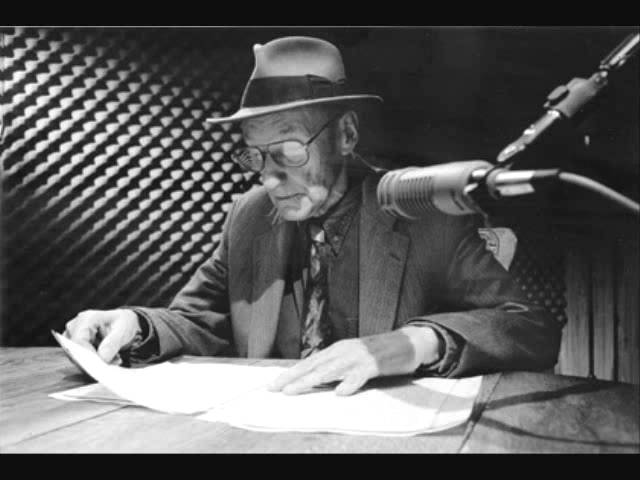
Published in 1959, Williams S. Burroughs’ Naked Lunch ranks with other mid-twentieth century books like Henry Miller’s Tropic of Cancer and the works of Jean Genet as literature that sharply divided both critical and legal opinion in arguments over style and in questions of obscenity. Among its disturbing and subversive characters is the sociopathic surgeon Dr. Benway, who inspired the medical horrors of J.G. Ballard and was inspired in turn by Aldous Huxley’s Brave New World. Benway provides some of the more satirical moments in the book, as you can hear in the section below, which Burroughs reads straight with his distinctive nasally Midwestern twang. A short film of the scene (sadly unembeddable), called “Dr. Benway Operates,” has Burroughs himself playing the doctor, in a dramatization that looks like low rent farce as directed by John Waters.
A series of loosely connected chapters that Burroughs said could be read in any order, Naked Lunch seems both fascinated and repelled by the grisly medicalized violence in scenes like those above (one vignette, for example, presents “a tract against capital punishment”). This ambivalence was not lost on writers like Norman Mailer. The highest praise of the novel probably came from Mailer during the novel’s 1966 obscenity trial before the Massachusetts Supreme Court. In one among a handful of literary depositions, including one from Allen Ginsberg, Mailer described Burroughs’ “extraordinary style,” and “exquisite poetic sense.” Despite the fact that its images were “often disgusting,” Mailer called the book “a deep work, a calculated work” that “captures that speech [‘gutter talk’] like no American writer I know.”
Perhaps one of the work’s most damning pieces of criticism comes from the Judicial Officer for the U.S. Postal Service, who called for the book’s banning, appraising the writing as “undisciplined prose, far more akin to the early work of experimental adolescents than to anything of literary merit.” Mailer, Ginsberg, and the book’s other supporters won out, a fact beat essayist Jed Birmingham laments, for a surprising reason: The unbanning of Naked Lunch led to the book’s taming, its gentrification, as it were: “The wild, exuberant offensiveness of the novel fades,” he writes, “in the face of all the legal arguments and the process of canonization.” In fact, the full novel may never have been published at all had it not been for the Post Office in Chicago seizing several hundred copies of The Chicago Review, which contained some few Naked Lunch sections. Hearing of the controversy, French publisher Maurice Girodias hastily threw together a manuscript of the first 1959 text.
And yet, prior to the mid-sixties, the decision to ban Naked Lunch, “even before it was published in book form,” meant “that questions of obscenity and censorship dictated the academic and public reception” of the book. Burroughs commented on the effects of such censorship—using an analogy to “the junk virus”—in part of a new preface to the 50th edition called “Afterthoughts on a Deposition.” The heath risks of opiates “in controlled doses,” he writes,“maybe be minimal,” yet the effects of criminalization are outsized “anti-drug hysteria,” which “poses a threat to personal freedoms and due-process protections of the law everywhere.”
Since the novel’s vindication, critical consensus has centered around sober, reverent judgments like Mailer’s—and to some lesser extent Ginsberg’s terse, irritable testimony. While there are still those who despise the book, it’s significant that Burroughs’ work—which the Washington Post called the first of his “homosexual planet-operas”—has achieved such widespread admiration amidst the notoriety. The novel deals in themes we’re still adjudicating daily in courts legal and public some 55 years later, pointing perhaps to the continued gulf between the thoughts and aims of the reading public and those of hysterical authoritarians and “the media and narcotics officials,” as Burroughs has it. After all, at its 50th anniversary in 2009, Naked Lunch was pronounced “still fresh” by such mainstream outlets as NPR and The Guardian, evidence of its persistent power, and maybe also of its domestication.
Open Culture has had a relationship with Audible.com for close to six years, and, here and there, we’ve told you about their 30-day free trial, which gives you the opportunity to download a free audio book, listen to it, and then decide whether you want to become an Audible subscriber or not. (You can keep the audio book regardless of the decision you make.) I personally became an Audible subscriber a long time ago, and while I’ve always enjoyed listening to audio books, I’ve recently realized that an Audible subscription can be a real deal if you’re a fan of big audio books and great lectures. Let me break it down for you.
If you sign up for Audible’s Gold plan, you pay $158 for 12 books over a year. (You get one book credit/download per month … and you’re billed in installments monthly.) That translates to $13.20 per book on average. That’s not a bad price (given that mainstream audio books often sell for $30). But here’s where the Audible plan becomes a great deal. Earlier this fall, I re-read Joyce’s Ulysses and wanted to listen to a professionally-read unabridged narration of the novel that runs 27 hours. For the cost of one book credit — $13.20 — I downloaded the entire audio book. Naxos, the publisher, sells it for £85.00, or $134.00. Audible sells it to non-members for $104.00.
Here’s another example. For the holidays, I’m listening to Mark Lewisohn’s new Beatles biography Tune In: The Beatles: All These Years. The well-reviewed book runs 944 pages in print and 42 hours on audio. The audio usually retails for somewhere between $53 and $63 — much more than the $13.20 you can snag it for on the Audible plan.
NB: Audible is an Amazon.com subsidiary, and we’re a member of their affiliate program.
If you would like to support the mission of Open Culture, consider making a donation to our site. It’s hard to rely 100% on ads, and your contributions will help us continue providing the best free cultural and educational materials to learners everywhere. You can contribute through PayPal, Patreon, and Venmo (@openculture). Thanks!
We're hoping to rely on loyal readers, rather than erratic ads. Please click the Donate button and support Open Culture. You can use Paypal, Venmo, Patreon, even Crypto! We thank you!
Open Culture scours the web for the best educational media. We find the free courses and audio books you need, the language lessons & educational videos you want, and plenty of enlightenment in between.