“Nobody exists on purpose, nobody belongs anywhere, everybody’s gonna die.” So, in one episode of Rick and Morty, says the fourteen-year-old Morty Smith, one of the show’s titular co-protagonists. With the other, a mad scientist by the name of Rick Sanchez, who also happens to be Morty’s grandfather, he constitutes the animated team that has entertained thousands and thousands of viewers — and made insatiable fans of seemingly all of them — over the past four years. To those few who haven’t yet seen the show, it may just look like a silly cartoon, but the true fans understand that underneath all of the memorable gags and quotable lines lies an unusual philosophical depth.
“The human desire to fulfill some special existential purpose has existed throughout history,” says video essayist Will Schoder in his analysis of the philosophy of Rick and Morty. But the titular duo’s adventures through all possible realities of the “multiverse” ensure that they experience firsthand the utter meaninglessness of each individual reality.
When Morty breaks that bleak-sounding news to his sister Summer with the now oft-quoted line above, he actually delivers a “comforting message”: once you confront the randomness of the universe, as Rick and Morty constantly do, “the only option is to find importance in the stuff right in front of you,” and their adventures show that “friends, family, and doing what we enjoy are far more important than any unsolvable questions about existence.”
Schoder, also the author of a video essay on Rick and Morty co-creator Dan Harmon’s mythological storytelling technique as well as one we’ve previously featured about David Foster Wallace’s critique of postmodernism, makes the clear philosophical connection to Albert Camus. The philosopher and author of The Stranger wrote and thought a great deal about the “contradiction between humans’ desire to find meaning in life and the meaninglessness of the universe,” and the absurdity that results, a notion the cartoon has dramatized over and over again, with an ever-heightening absurdity. We must, like Sisyphus eternally pushing his rock uphill, recognize the true nature of our situation yet defiantly continue “to explore and search for meaning.” Morty, as any fan well knows, offers Summer another solution to her despair: “Come watch TV.”
Based in Seoul, Colin Marshall writes and broadcasts on cities and culture. His projects include the book The Stateless City: a Walk through 21st-Century Los Angeles and the video series The City in Cinema. Follow him on Twitter at @colinmarshall or on Facebook.
What makes this panel the greatest? Woodring declined to elaborate, though his readers eagerly shared theories—and some befuddlement—in the comments section:
Sluggo has reached the perfect state of no-effort, the satori-like denial of the “small mind” and all of the suffering that comes with it.
… it’s the comic equivalent of a koan—something designed to tie our rational mind in knots so that we can glimpse enlightenment.
Sluggo smiles because he knows a secret. He says no because he rejects consensus reality. He floats along because he doesn’t fight life—he sees the maintenance of the harmony and is one with that harmony. He knows all paths lead away from home. Instead he goes within and knows freedom.
“I am content. I need nothing, I will do nothing, I am fine as I am.”
Another fan, Glyph Jockey’s Lex 10, took it one step further, removing the speech bubble before taking Sluggo on an animated trip through the cosmos, narrated by philosopher Alan Watts:
In the state of being in accordance with the Tao, there is a certain feeling of weightlessness, parallel to the weightlessness that people feel when they get into outer space or when they go deep into the ocean.
Gabby Pahinui’s “Pu’uanahulu” and Ramayana imagery bestow added hypnotic appeal.
Revisit this strange little animated gem the next time your head’s about to explode from stress. Don’t question or get too hung up on meanings, just go with the flow, like Sluggo and Watts.
Could other Nancy panels serve as vehicles for Taoist enlightenment? Mayhaps:
Bushmiller’s strong point was never the content of his comic strip’s jokey plots—a friend once described him as ‘a moron on an acid trip.’ In fact, the gags were even simpler than was necessary for a ‘children’s’ strip. That’s because they were just a vehicle for the controlled and brilliant manipulation of repetition and variety that gave the strip its unique visual rhythm and composition. Bushmiller choreographed his familiar formal elements inside the tightest frame of any major strip, and that helped make it the most beautiful, as a whole, of any in the papers.” — Tom Smucker, The Village Voice, 1982
Recently, Bushmiller’s Nancy has been enjoying a renaissance. The strip that many casual readers of the funny pages dismissed as boring or dumb is revered by many celebrated cartoonists, including Bill Griffith, Daniel Clowes, and Art Spiegelman.
This month sees the publication of Paul Karasik and Mark Newgarden’s How to Read Nancy, a book length analysis of one single strip, which also functions as a how-to and history of the comic medium. This hotly anticipated volume has in turn given rise to a lively online How To Read Nancy Reading Group, a hotbed of fan art, altered panels, and Nancy strips from around the world.
This comic lays out 2000 years of musical history. … Again and again there have been attempts to police music; to restrict borrowing and cultural cross-fertilization. But music builds on itself. To those who think that mash-ups and sampling started with YouTube or the DJ’s turntables, it might be shocking to find that musicians have been borrowing – extensively borrowing – from each other since music began. Then why try to stop that process? The reasons varied. Philosophy, religion, politics, race – again and again, race – and law. And because music affects us so deeply, those struggles were passionate ones. They still are.
The history in this book runs from Plato to Blurred Lines and beyond. You will read about the Holy Roman Empire’s attempts to standardize religious music using the first great musical technology (notation) and the inevitable backfire of that attempt. You will read about troubadours and church composers, swapping tunes (and remarkably profane lyrics), changing both religion and music in the process. You will see diatribes against jazz for corrupting musical culture, against rock and roll for breaching the color-line. You will learn about the lawsuits that, surprisingly, shaped rap. You will read the story of some of music’s iconoclasts – from Handel and Beethoven to Robert Johnson, Chuck Berry, Little Richard, Ray Charles, the British Invasion and Public Enemy.
To understand this history fully, one has to roam wider still – into musical technologies from notation to the sample deck, aesthetics, the incentive systems that got musicians paid, and law’s 250 year struggle to assimilate music, without destroying it in the process. Would jazz, soul or rock and roll be legal if they were reinvented today? We are not sure. Which as you will read, is profoundly worrying because today, more than ever, we need the arts.
All of this makes up our story. It is assuredly not the only history of music. But it is definitely a part – and a fascinating part – of that history…
If you would like to support the mission of Open Culture, consider making a donation to our site. It’s hard to rely 100% on ads, and your contributions will help us continue providing the best free cultural and educational materials to learners everywhere. You can contribute through PayPal, Patreon, and Venmo (@openculture). Thanks!
Those of us who can’t study in person with an educator whose department chair called her “the best classroom teacher” that he’s ever seen can happily follow along online.
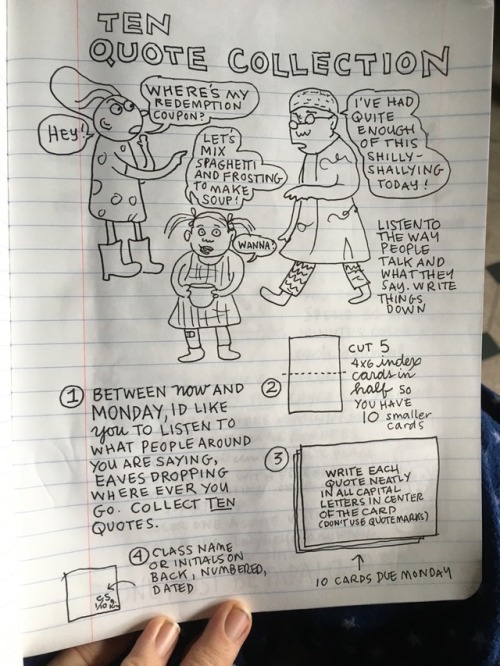
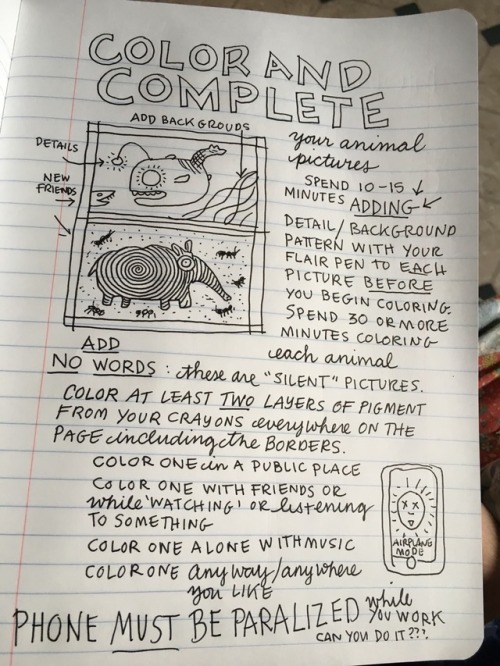
As always, her handwritten homework assignments will be posted to her Nearsighted Monkey tumblr account, along with in-class reflections and inspirational bits and bobs pulled off the Internet.
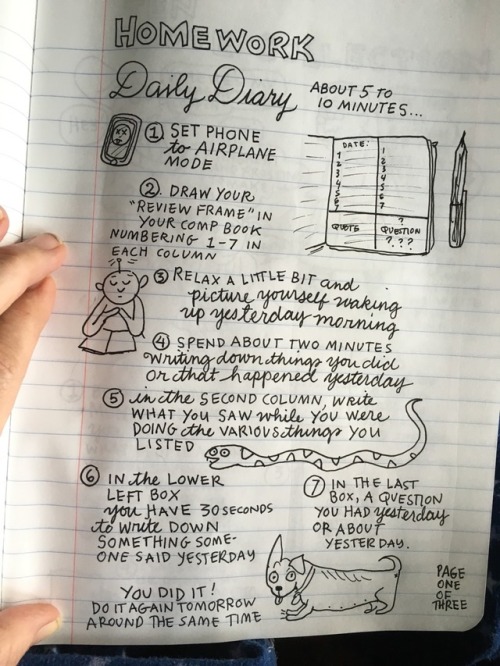
The first task, familiar to readers of her Syllabusworkbook, is to begin a daily diary practice, filling in a template frame of Barry’s own devising.
Begin by putting your phone on airplane mode. “The phone gives us a lot but it takes away three key elements of discovery: loneliness, uncertainty and boredom,” she stated last year, on a visit to NASA’s Goddard Space Flight Center. “Those have always been where creative ideas come from.”
Amen.
Any one of the exercises will renew your powers of observation and sense of connection with the world around you. Don’t be surprised if you find yourself getting up early or skipping some must-see TV in order to fully comply with Professor Skeletor’s feel-good assignments. There are no wrong answers, provided you go at the assignments with energy and a willingness to play. As Barry said in an interview:
Because we tend to give up on the arts so early in life, I became really interested in what would happen if we reintroduce the arts without the thought of ‘you’re going to do this to become a great writer or painter,’ but rather that it might help people with the other work in their field.
For added value, complete your first daily diary frame to an audio recording of Barry’s timed instruction here. (Ignore the background noise of your teacher’s life—her sneezing cat, her happy pet birds—or better yet, let her household’s zesty energy seep into your work.)
The problem is there are no Nixons around at the moment. That’s what we need — we need a real good Nixon to give something for other people to get their teeth into, to really … loathe him, to become themselves more effective as opposition leaders.
Alas, his prayers have been answered.
Steadman, who has brought his inky sensibilities to bear on such works as Animal Farm andAlice in Wonderland, has a new American president to add to the collection he discussed several years ago, in the video above.
Steadman’s pen was the sword that rendered Gerald Ford as a scarecrow, Ronald Reagan as a vampire, and George W. Bush as a monkey in a cage of his own making.
Barack Obama, one of the candidates in that comparatively bland 2012 election, is depicted as a tenacious, slender vine, straining ever upward.
Jimmy Carter, somewhat less benignly, is a puppy eagerly fetching a stick with which to pardon Nixon, the Welsh cartoonist’s dark muse, first encountered when he accompanied Thompson on the road trip that yielded Fear and Loathing: On the Campaign Trail ’72.
And now…
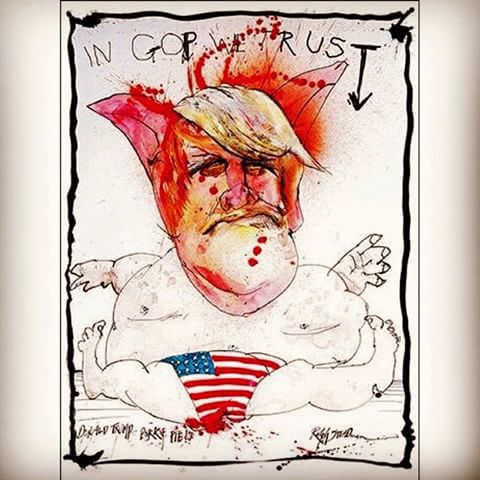
Donald Trump has given Steadman reason to come out fighting. With luck, he’ll stay out as long as his services are required. The above portrait, titled “Porky Pie,” was sent, unsolicited, to Gerry Brakus, an editor of the New Statesman, who published it on December 17, 2015.
At the time, Steadman had no reason to believe the man he’d anthropomorphized as a human pig hybrid, squeezed into bloody flag-print underpants, would become the 45th president:
Trump is unthinkable. A thug and a molester. Who wants him?
The portrait’s hideousness speaks volumes, but it’s also worth looking beyond the obvious-seeming inspiration for the title to a reference few Americans would get. “Pork pie”—or porky—is Cockney rhyming slang for “a lie.”
See a gallery of Steadman’s portraits of American presidents on his website.
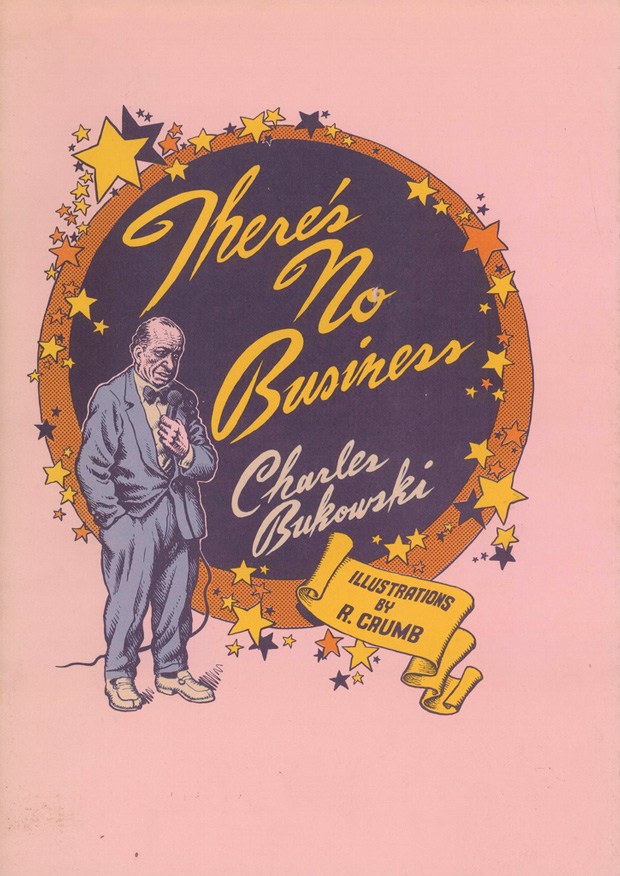
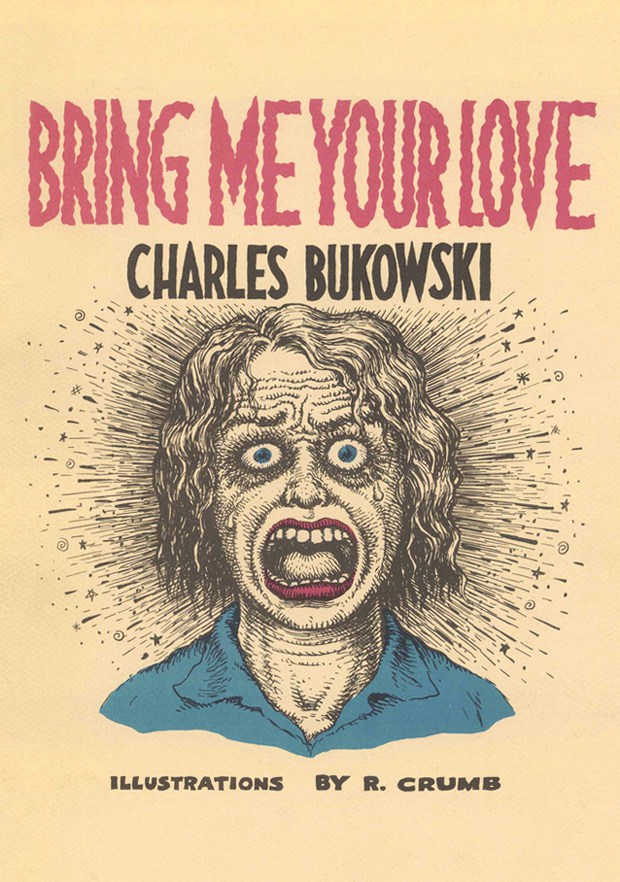
Think of the artists you know who, especially in the 1960s and 70s, portrayed an often sordid reality in detail, just as they saw it, garnering acclaim from enthusiasts, who perceived a high artistry in their seemingly rough-hewn work, and cries from countless detractors who objected to what they saw as the artists’ lazy crudity. In the realm of poetry and prose, Charles Bukowski should come to mind sooner or later; in that of comic art, who fits the bill better than Robert Crumb? It makes only good sense that the work of both men should intersect, and they did in the 1980s when Crumb illustrated two short books by Bukowski, Bring Me Your Love and There’s No Business.
“Crumb’s signature underground comix aesthetic and Bukowski’s commentary on contemporary culture and the human condition by way of his familiar tropes — sex, alcohol, the drudgery of work — coalesce into the kind of fit that makes you wonder why it hadn’t happened sooner,” writes Brain Pickings’ Maria Popova.
“In 1998, a final posthumous collaboration was released under the title The Captain Is Out to Lunch and the Sailors Have Taken Over the Ship— an illustrated selection from Buk’s previously unpublished diaries, capturing a year in his life shortly before his death in 1994.” As one student of the graphic novel summarizes Bring Me Your Love, “the main character is a man whose personality resembles the main character of most Bukowski stories. He goes through life rather aimlessly, killing time by drinking and having sex. His wife is in a mental hospital.”
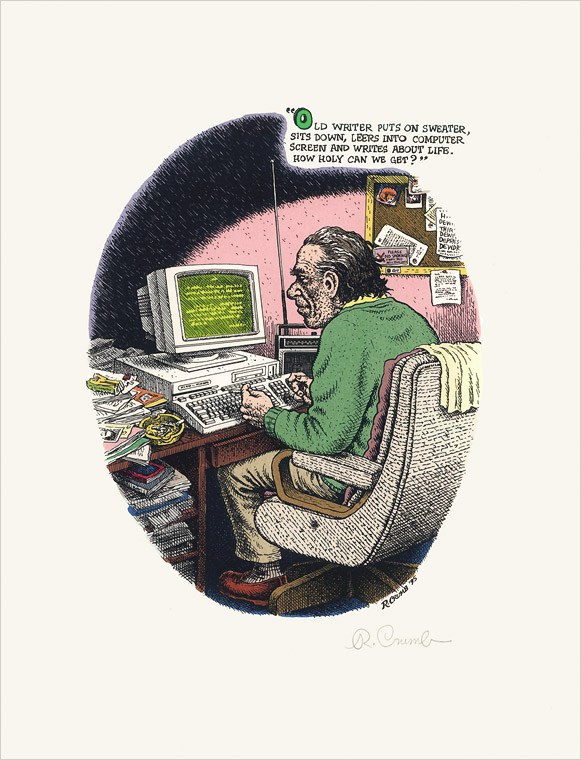
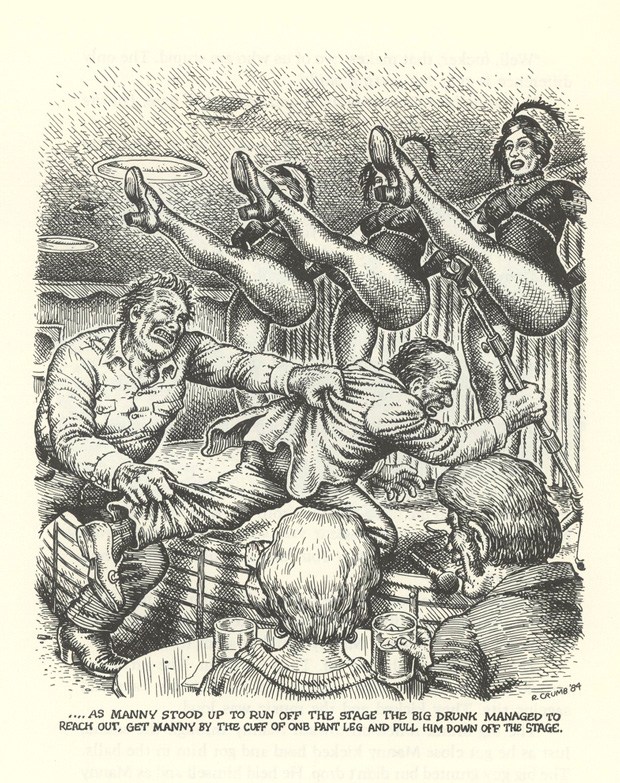
“Crumb’s illustrations give the already gritty storylines a visual context — such as a man who looks much like Buk wrestling on the floor with his ‘wife’ after a dispute involving answering the phone or various barroom skirmishes depicting a Bukowski-looking character running amok,” says Dangerous Minds. “He was a very difficult guy to hang out with in person, but on paper he was great,” Crumb once said of Bukowski, and his illustrations also reveal that he understands Bukowski’s own awareness of the difference between his page self and his real one. “Old writer puts on sweater, sits down, leers into computer screen, and writes about life,” Bukowski writes, in their third and final collaboration, above a Crumb illustration of just such a scene. “How holy can we get?”
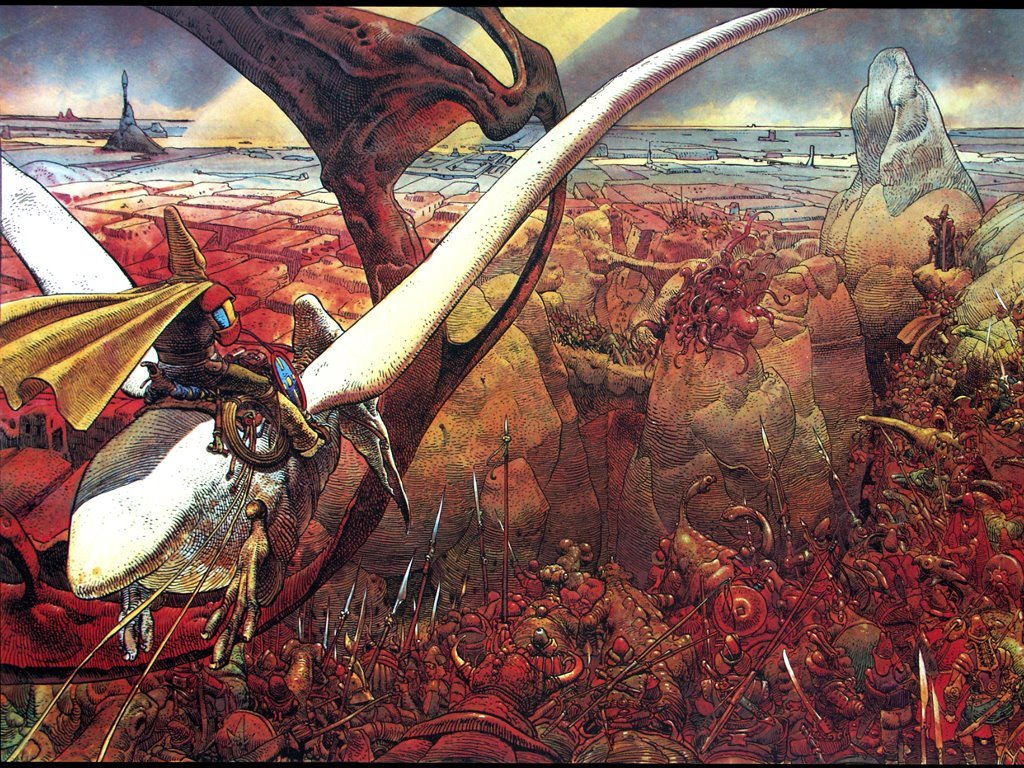
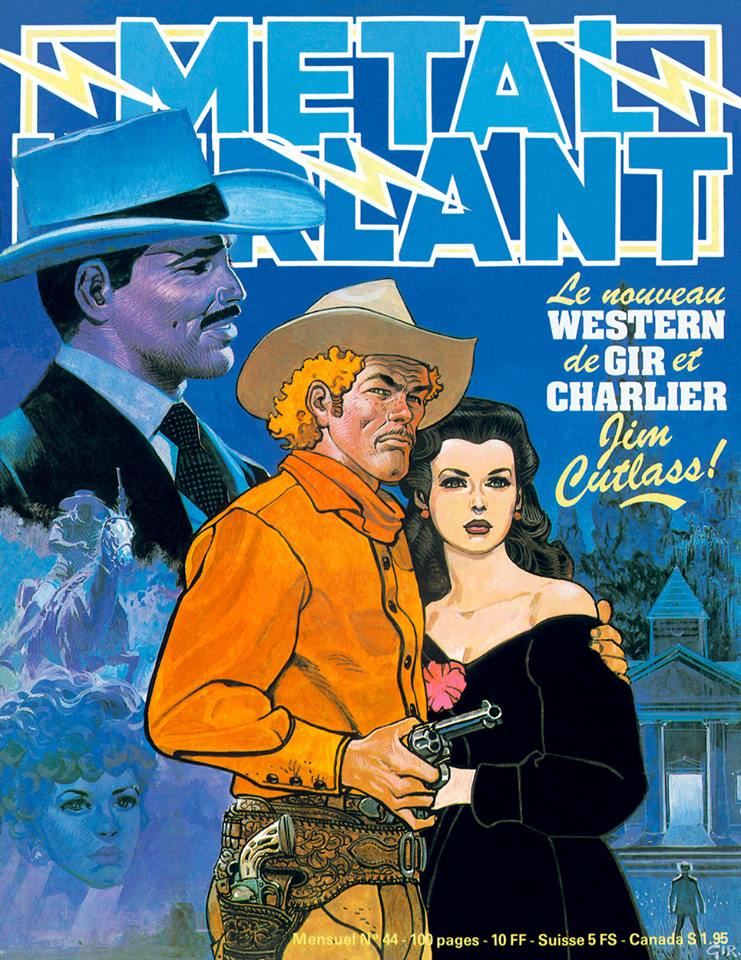
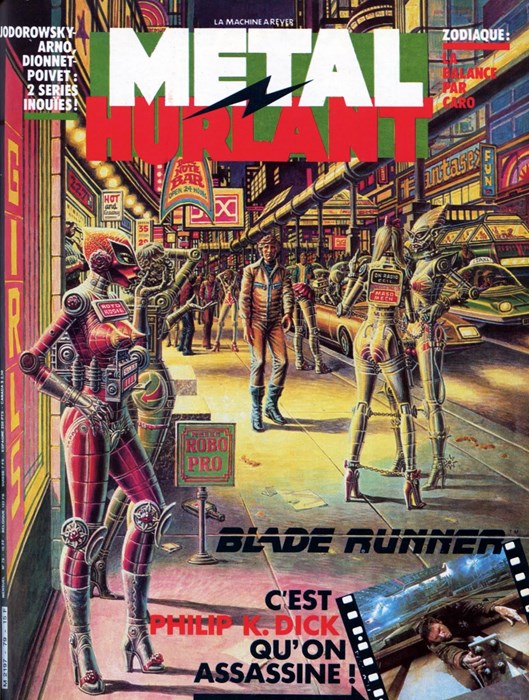
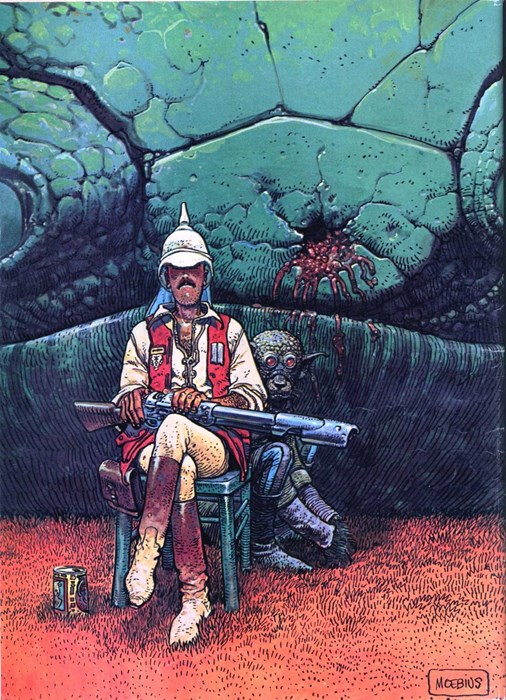
Would you believe that one particular publication inspired a range of visionary creators including Ridley Scott, George Lucas, Luc Besson, William Gibson, and Hayao Miyazaki? Moreover, would you believe that it was French, from the 1970s, and a comic book? Not that that term “comic book” does justice to Métal hurlant, which during its initial run from 1974 to 1987 not only redefined the possibilities of the medium and greatly widened the imaginative possibilities of science fiction storytelling, but brought to prominence a number of wholly unconventional and highly influential artists, chief among them Jean Giraud, best known as Moebius.
Métal hurlant, according to Tom Lennon in his history of the magazine, launched “as the flagship title of Les Humanoïdes Associés, a French publishing venture set up by Euro comic veterans Moebius, Druillet and Jean-Pierre Dionnet, together with their finance director Bernard Farkas. Influenced by both the American underground comix scene of the 1960s and the political and cultural upheavals of that decade, their goal was bold and grandiose: they were going to kick ass, take names, and make people take comics seriously.”
This demanded “artistic innovation at every level,” from high-quality, large-format paper stock to risk-taking storytelling “shot through with a rich vein of humour and delivered with a narrative sophistication previously unseen in the medium.”
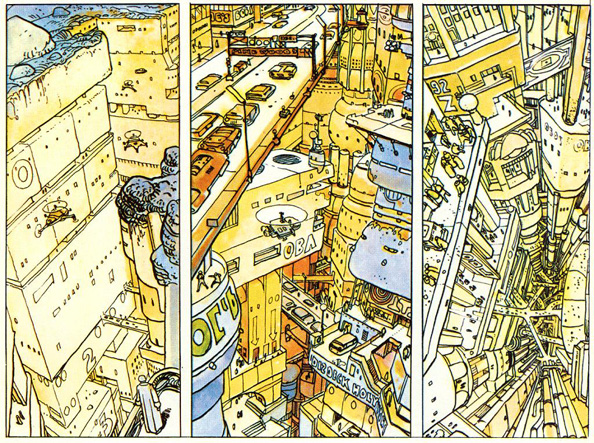
Giraud took to the possibilities of the new publication with a special avidness. Under the pen name “Gir,” writes Lennon, he “was best known as the co-creator of the popular Western series, Blueberry. By the mid-1970s, Giraud was feeling increasingly constrained by the conventions of the western genre, so decided to revive a long-dormant pseudonym to embark on more experimental work. As ‘Moebius’, Giraud not only worked in a different genre to ‘Gir’ – a deeply personal, highly idiosyncratic form of science fiction and fantasy – but his art looked like it was drawn by a completely different person,” and “unlike anything that had been seen in comics — or, for that matter, in any other medium.”
Métal hurlant saw the debuts of two of Moebius’ best-known characters: the pith-helmeted and mustachioed protector of miniature universes Major Grubert and the silent, pterodactyl-riding explorer Arzach, who bears a certain resemblance to the protagonist of Miyazaki’s 1984 film Nausicaä of the Valley of the Wind. Read through the back issues of the magazine — or its 40-years-running American version, Heavy Metal — and you’ll also glimpse, in the work of Moebius and others, elements that would later find their way into the worlds of Neuromancer, Mad Max, Alien, Blade Runner, Star Wars, and much more besides.
“A while ago, SF was filled with monstrous rocket ships and planets,” said Moebius in 1980. “It was a naive and materialistic vision, which confused external space with internal space, which saw the future as an extrapolation of the present. It was a victim of an illusion of a technological sort, of a progression without stopping towards a consummation of energy.” He and Métal hurlant did more than their part to transform and enrich that vision, but plenty of old perceptions still remain for their countless artistic descendants to warp beyond recognition.
Most young male fans from my generation failed to appreciate the gender imbalance in comic books. After all, what were the X‑Men without powerful X‑women Storm, Rogue, and, maybe the most powerful mutant of all, Jean Grey? Indie comics like Love and Rockets revolved around strong female characters, and if the legacy golden age Marvel and DC titles were nearly all about Great Men, well… just look at the time they came from. We shrugged it off, and also failed to appreciate how the hypersexualization of women in comics made many of the women around us uncomfortable and hyperannoyed.
Had we been curious enough to look, however, we would have found that golden age comics weren’t just innocent “products of their time”—they reflected a collective will, just as did the comics of our time. And the character who first challenged golden age attitudes about women—Wonder Woman, created in 1941—began her career as perhaps one of the kinkiest superheroes in mainstream comic books. What’s more, she was created by a psychologist William Moulton Marston, who first published under a pseudonym, due in part to his unconventional personal life. Marston, writes NPR, “had a wife—and a mistress. He fathered children with both of them, and they all secretly lived together in Rye, N.Y.”
The other woman in Marston’s polyamorous threesome, one of his former students, happened to be the niece of Margaret Sanger, and Marston just happened to be the creator of the lie detector. The details of his life are as odd and prurient now as they were to readers in the 1940s—partly an index of how little some things have changed. And now that Marston’s creation has finally received her blockbuster due, his story seems ripe for the Hollywood telling. Such it has received, it appears, in Professor Marston & the Wonder Women, the upcoming biopic by Angela Robinson. It’s unfair to judge a film by its trailer, but in the clips above we see much more of Marston’s dual romance than we do of the invention of his famous heroine.
Yet as political historian Jill Lepore tells it, the cultural history of Wonder Woman is as fascinating as her creator’s personal life, though it may be impossible to fully separate the two. A press release accompanying Wonder Woman’s debut explained that Marston aimed “to set up a standard among children and young people of strong, free, courageous womanhood; to combat the idea that women are inferior to men, and to inspire girls to self-confidence in athletics, occupations and professions monopolized by men.” It went on to express Marston’s view that “the only hope for civilization is the greater freedom, development and equality of women in all fields of human activity.”
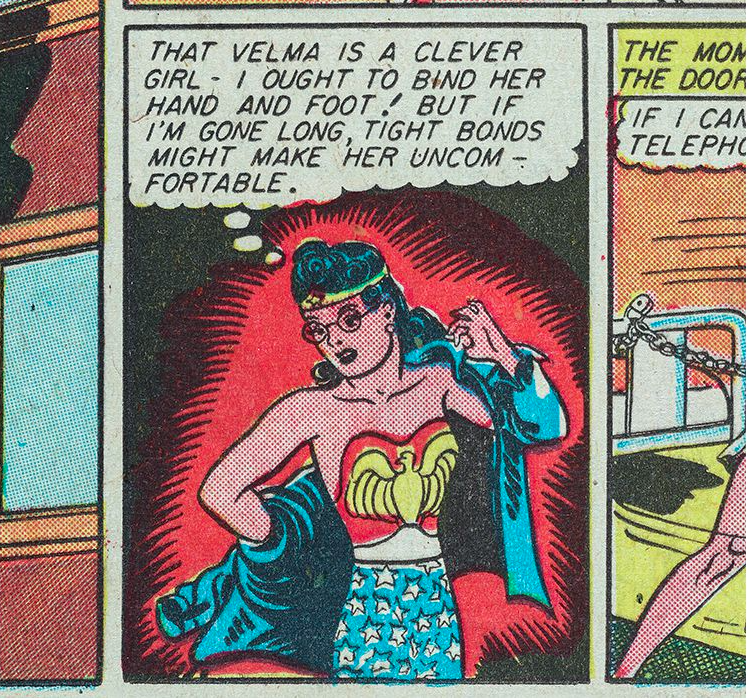
The language sounds like that of many a modern-day NGO, not a World War II-era popular entertainment. But Marston would go further, saying, “Frankly, Wonder Woman is the psychological propaganda for the new type of woman who should, I believe, rule the world.” His interest in domineering women and S&M drove the early stories, which are full of bondage imagery. “There are a lot of people who get very upset at what Marston was doing…,” Lepore told Terry Gross on Fresh Air. “’Is this a feminist project that’s supposed to help girls decide to go to college and have careers, or is this just like soft porn?’” As Marston understood it, the latter question could be asked of most comics.
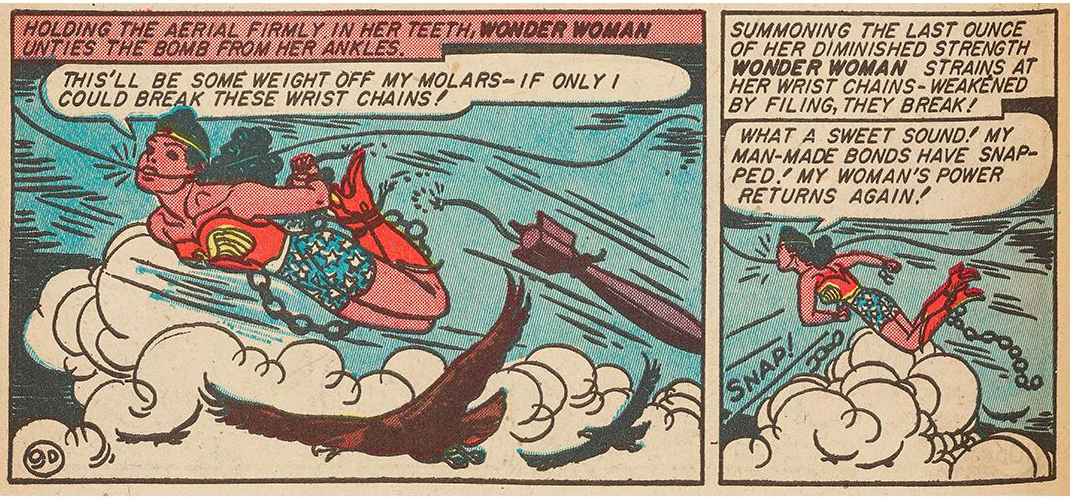
When writer Olive Richard—pen name of Marston’s mistress Olive Byrne—asked him in an interview for Family Circle whether some comics weren’t “full of torture, kidnapping, sadism, and other cruel business,” he replied, “Unfortunately, that is true.” But “the reader’s wish is to save the girl, not to see her suffer.” Marston created a “girl”—or rather a superhuman Amazonian princess—who saved herself and others. “One of the things that’s a defining element of Wonder Woman,” says Lepore, “is that if a man binds her in chains, she loses all of her Amazonian strength. So in almost every episode of the early comics, the ones that Marston wrote… she’s chained up or she’s roped up.” She has to break free, he would say, “in order to signify her emancipation from men.” She does her share of roping others up as well, with her lasso of truth and other means.
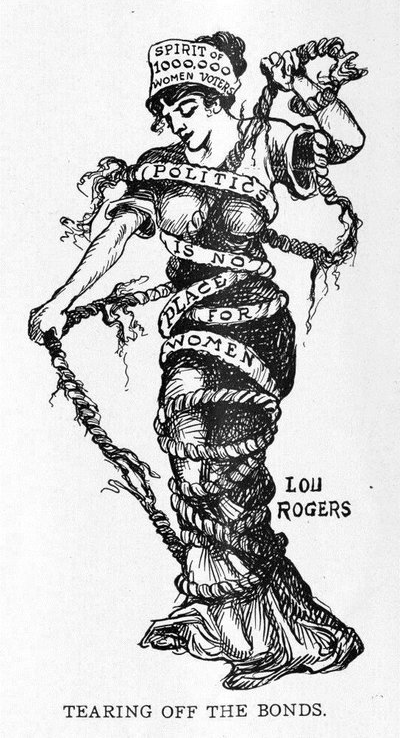
The seemingly clear bondage references in all those ropes and chains also had clear political significance, Lepore explains. During the fight for suffrage, women would chain themselves to government buildings. In parades, suffragists “would march in chains—they imported that iconography from the abolitionist campaigns of the 19th century that women had been involved in… Chains became a really important symbol,” as in the 1912 drawing below by Lou Rogers. Wonder Woman’s mythological origins also had deeper signification than the male fantasy of a powerful race of well-armed dominatrices. Her story, writes Lepore at The New Yorker, “comes straight out of feminist utopian fiction” and the fascination many feminists had with anthropologists’ speculation about an Amazonian matriarchy.
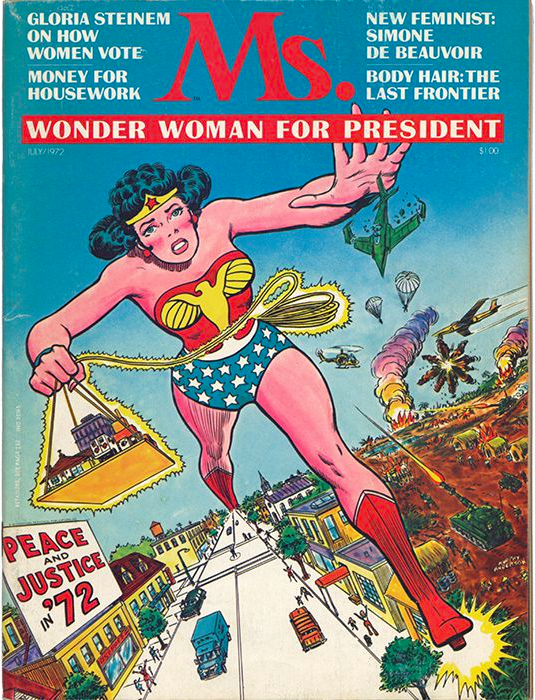
The combination of feminist symbols have made the character a redoubtable icon for every generation of activists—as in her appearance on 1972 cover of Ms. magazine, further up, an issue headlined by Gloria Steinem and Simone de Beauvoir. Marston translated the feminist ideas of the suffrage movement, and of women like Margaret Sanger, Elizabeth Cady Stanton, his wife, lawyer Elizabeth Holloway Marston, and his mistress Olive Byrne, into a powerful, long-revered superhero. He also translated his own ideas of what Havelock Ellis called “the erotic rights of women.”
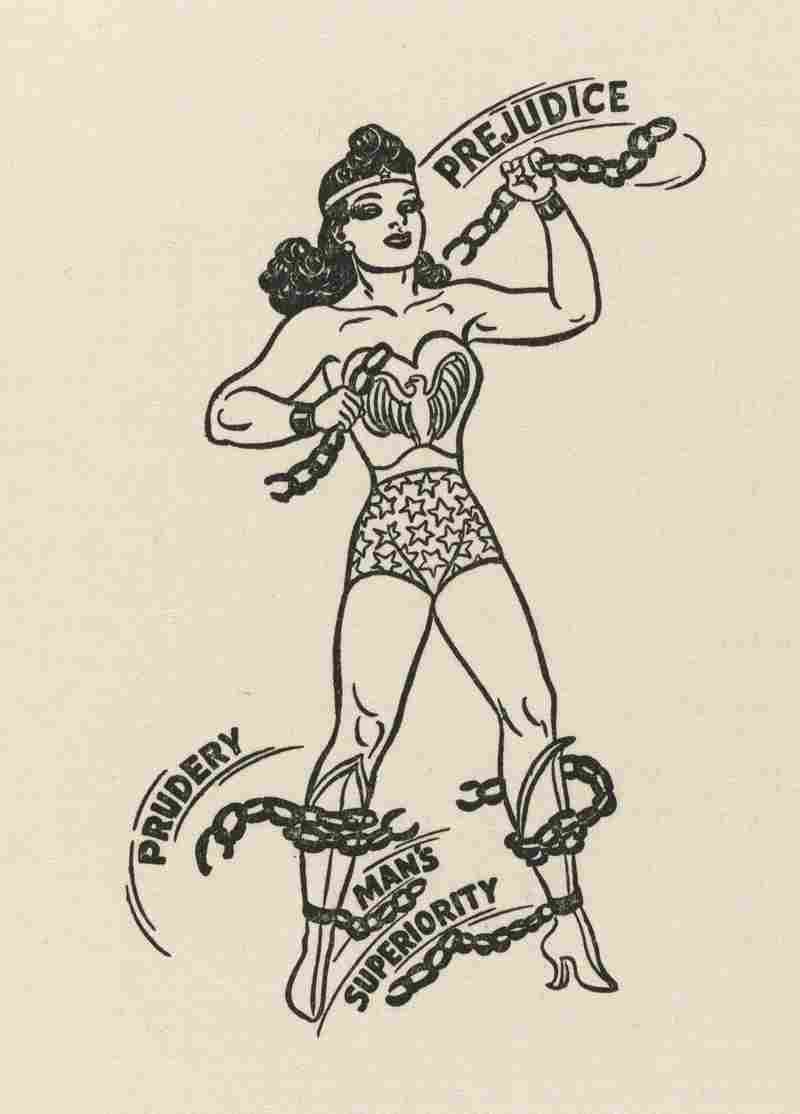
Marston’s version of Wonder Woman (he stopped writing the comic in 1947) had as much agency—sexual and otherwise—as any male character of the time. (See her breaking the bonds of “Prejudice,” “Prudery,” and “Man’s Superiority” in a drawing, below, from Marston’s 1943 article “Why 100,000 Americans Read Comics.”) The character was undoubtedly kinky, a quality that largely disappeared from later iterations. But she was not created, as were so many women in comics in the following decades, as an object of teenage lust, but as a radically liberated feminist hero. Read more about Marston in Lepore’s essays at Smithsonian and The New Yorker and in her book, The Secret History of Wonder Woman.
We're hoping to rely on loyal readers, rather than erratic ads. Please click the Donate button and support Open Culture. You can use Paypal, Venmo, Patreon, even Crypto! We thank you!
Open Culture scours the web for the best educational media. We find the free courses and audio books you need, the language lessons & educational videos you want, and plenty of enlightenment in between.