Ray Ellis had a six-decade career as a producer, arranger, and jazz composer. And while he’s best known for arranging music for Billie Holiday’s Lady in Satin(1958), he also enjoyed a long career orchestrating music for television. Working under a pseudonym “Yvette Blais” (his wife’s name), Ellis composed background music for the cartoon studio Filmation between 1968 and 1982. And, during the late 60s, he notably created the background and incidental music for the original Spider-Man cartoons.
Above, hear Ray Ellis’ Spider-Mansoundtrack. The show’s talking parts and sound effects have been removed as much as possible, then “pieced back together into complete form,” by a YouTuber who uses the moniker “11db11.” All of the music from Season 1 is included, plus many recordings from Seasons 2 and 3. It’s worth noting that the 52 episodes from the original 1967 Spider-Man TV series have been completely restored. You can purchase them on DVD online.
If you would like to sign up for Open Culture’s free email newsletter, please find it here. It’s a great way to see our new posts, all bundled in one email, each day.
If you would like to support the mission of Open Culture, consider making a donation to our site. It’s hard to rely 100% on ads, and your contributions will help us continue providing the best free cultural and educational materials to learners everywhere. You can contribute through PayPal, Patreon, and Venmo (@openculture). Thanks!
As noted in the brief history in the video above, Betty hailed from animator Max Fleischer’s Fleischer Studios and actress Margie Hines provided her voice.
Physically, she bore a close resemblance to popular singer Helen Kane. Their babyish vocal stylings were remarkably similar, too. But when Betty put the bite on a couple of Kane’s hits, below, Kane fought back with a lawsuit against Paramount and Max Fleischer Studios, seeking damages and an injunction which would have prevented them from making more Betty Boop cartoons.
The Associated Press reported that Kane confounded the court stenographer who had no idea how to spell the Boopsian utterances she reproduced before the judge, in an effort to establish ownership. Her case seemed pretty solid until the defense called Lou Bolton, a theatrical manager whose client roster had once included Harlem jazz singer,“Baby Esther” Jones.
Two years before Betty Boop debuted (as an anthropomorphic poodle) in the cartoon short, Dizzy Dishes, above, Kane and her manager took in Baby Esther’s act in New York. A couple of weeks’ later the nonsensical interjections that were part of Baby Esther’s schtick, below, began creeping into Kane’s performances.
According to the Associated Press, Bolton testified that:
Baby Esther made funny expressions and interpolated meaningless sounds at the end of each bar of music in her songs.
“What sounds did she interpolate?” asked Louis Phillips, a defense attorney.
With a bit more digging, however, you will find Gertrude Saunders — the given name of “Baby Esther” — belting it out on Spotify. Some of her intonations are a bit reminiscent of Bessie Smith… who hated her (not without reason). Saunders appeared in a few movies and died in 1991.
Ayun Halliday is an author, illustrator, theater maker and Chief Primatologist of the East Village Inky zine. Her play Zamboni Godot is opening in New York City in March 2017. Follow her @AyunHalliday.
Head over to AdultSwim.com and you can watch online 92 episodes of Space Ghost Coast to Coast. Not familiar with the show? Here’s how Vox frames it:
One of the most deceptively influential series of the past several decades, Space Ghost took the characters from a junky old Hanna-Barbera series and inserted them into the middle of a talk-show setting, where they could have the most possibility for utter strangeness. Celebrities dropped by to be interviewed, while the rest of the show’s backstage shenanigans played out with an utterly straight face, even though one of the major characters was an evil praying mantis named Zorak. Was it terribly sophisticated? No. But it invented a whole new programming bloc — Adult Swim — and proved surrealism could sell in late-night TV.
Consequence of Sound is also quick to note that Space Ghost Coast to Coast “brought an impressive lineup of musical guests to the table, including Pavement, Dave Grohl, Thurston Moore, David Byrne, Thom Yorke, Willie Nelson, and Space Ghost’s “wife”, Björk.”
If you would like to sign up for Open Culture’s free email newsletter, please find it here. It’s a great way to see our new posts, all bundled in one email, each day.
If you would like to support the mission of Open Culture, consider making a donation to our site. It’s hard to rely 100% on ads, and your contributions will help us continue providing the best free cultural and educational materials to learners everywhere. You can contribute through PayPal, Patreon, and Venmo (@openculture). Thanks!
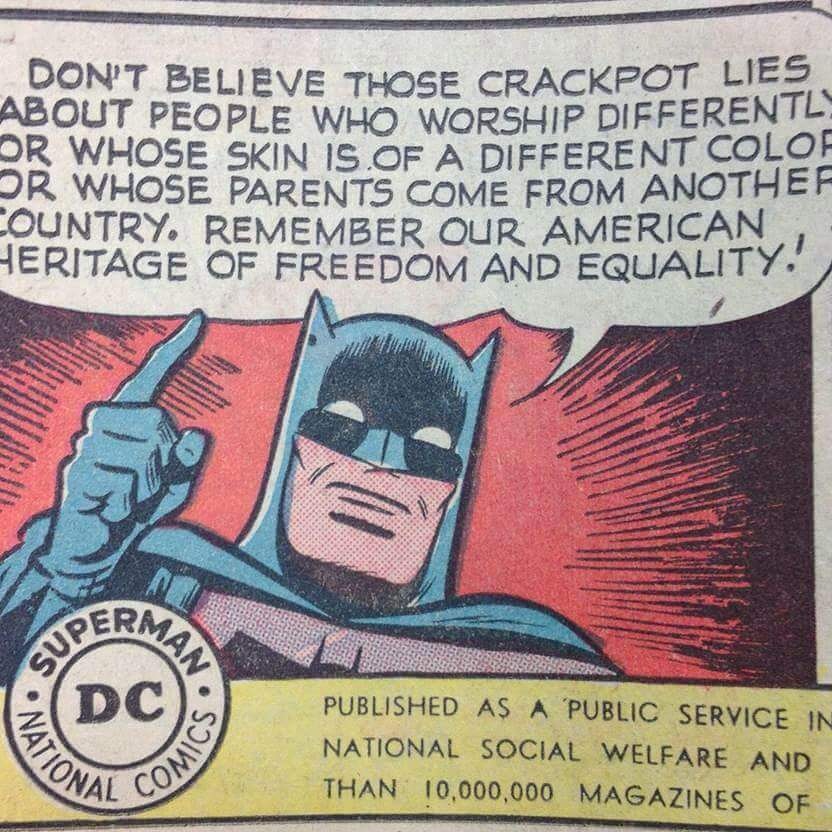
It makes sense that Superman would take a tolerant view of immigrants and other minorities, given that he himself arrived on Earth as a refugee from the planet Krypton.
“…and remember, boys and girls, your school – like our country – is made up of Americans of many different races, religions and national origins, so … If YOU hear anybody talk against a schoolmate or anyone else because of his religion, race or national origin – don’t wait: tell him THAT KIND OF TALK IS UN-AMERICAN. HELP KEEP YOUR SCHOOL ALL-AMERICAN!”
In other words, citizens must steel themselves to take action, because you can’t always count on a superhero to show up and make things right.
(Perhaps President Elect was too young to receive a copy. The back of the cover includes a grid for filling in one’s class schedule and he was but four years old at the time.)
Superman could not survive Doomsday, but the Anti-Defamation League, planet Krptyon to the illustration’s original distributer, continues to uphold the values he promotes above.
Already there have been troubling signs of a spike in hate crimes in the days after the election. As we look ahead, ADL will be vigilant against extremism and relentlessly hold the new administration accountable. You can expect ADL to be unwavering in its commitment to fighting anti-Semitism, racism and bigotry. We will monitor developments and speak out.
And wherever and whenever Jews, minority groups, immigrants, and others are marginalized or our civil liberties are threatened, ADL vigorously will defend those rights … We will not shrink from the fight ahead regardless of where it takes us.
Meanwhile, a full color version of the 66-year-old illustration has been making the rounds on social media. Let us consider it a placeholder. Eventually someone will surely take it back to the drawing board to add more girls, children with disabilities, and children of color.
Ayun Halliday is an author, illustrator, theater maker and Chief Primatologist of the East Village Inky zine. Her play Zamboni Godot is opening in New York City in March 2017. Follow her @AyunHalliday.
Today? Gangsta rap—a genre not known for its whimsy—glorifies the hardcore existence of kids whom the system has failed, trapped in a cycle of poverty, compounding the social problems that were heaped on them at birth.
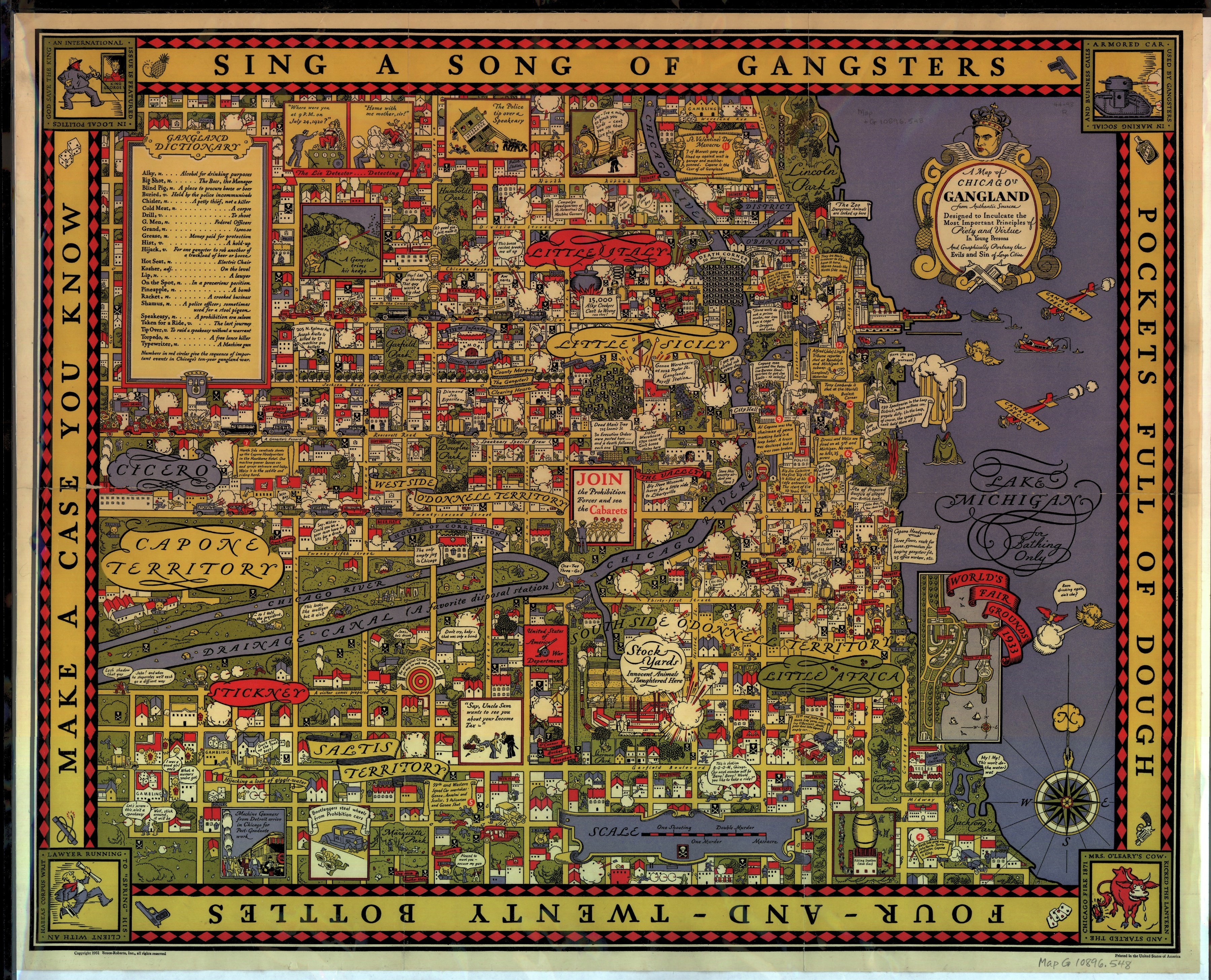
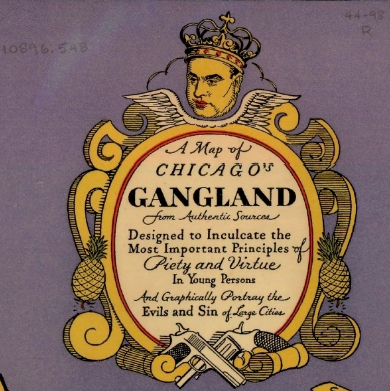
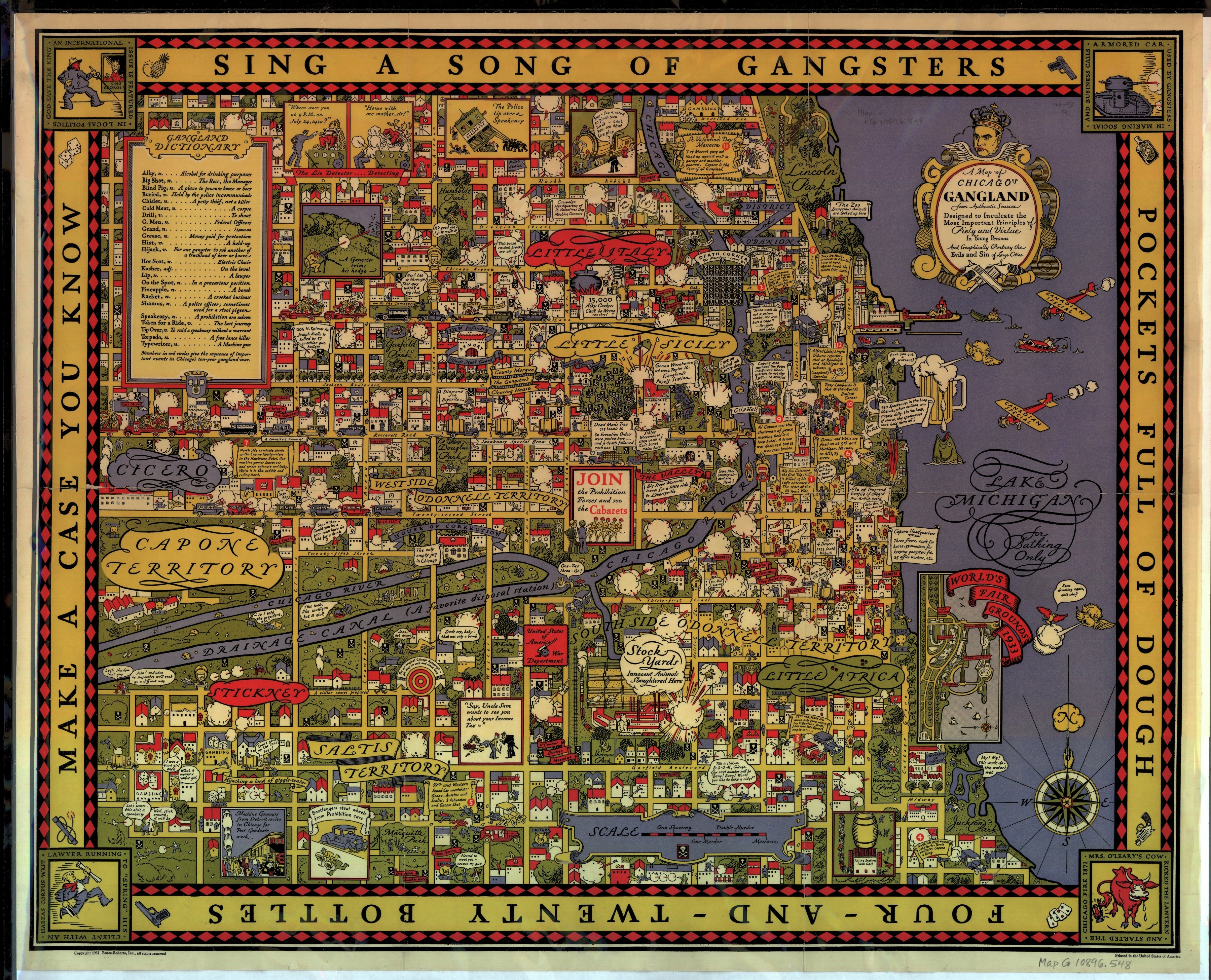
But back to 1931, the year Capone was sent to prison for tax evasion, and local firm Bruce-Roberts published Chicago’s Gangland map, above, from “authentic sources.”
As any civic minded reformer knows, the best way to “inculcate the most important principles of piety and virtue in young persons” is to pack all “the evils and sin of large cities” into something resembling a large-scale comic book.
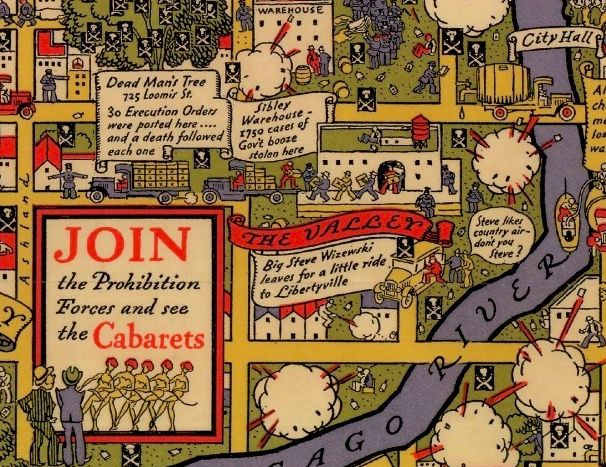
If the 30 execution orders posted on Dead Man’s Tree doesn’t scare ‘em straight, perhaps 1750 cases of government booze and some scantily clad dancing girls will!
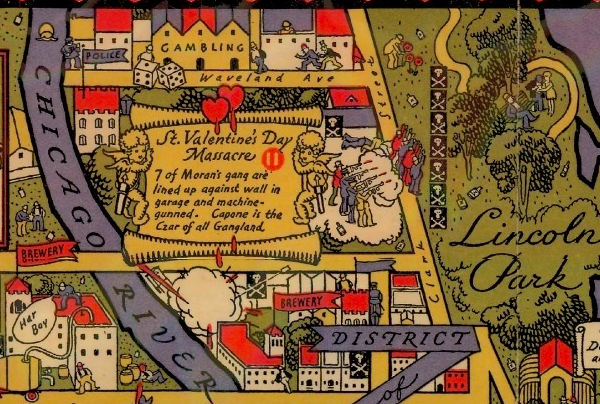
Naturally, the site of 1929’s Saint Valentine’s Day Massacre gets star treatment, with a graphic depiction guaranteed to stir the imagination far more than a visit to the actual site itself.
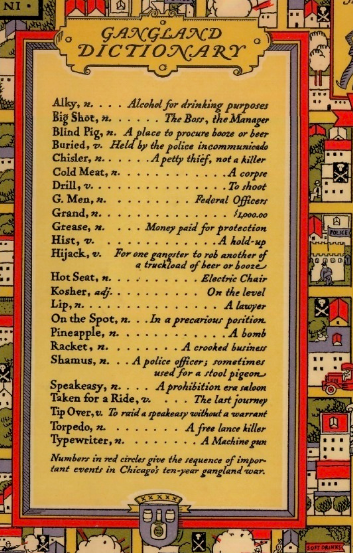
The publisher thoughtfully included a Gangland Dictionary to further inculcate the impressionable youth and explain the presence of two pineapples in the cartouche.
Ayun Halliday is an author, illustrator, theater maker and Chief Primatologist of the East Village Inky zine. Her play Zamboni Godot is opening in New York City in March 2017. Follow her @AyunHalliday.
Drawing of William S. Burroughs by Nathan Gelgud/The Paris Review
America’s political circus will soon roll through Cleveland and then Philadelphia–the sites of the Republican and Democratic National Conventions. And, not without some merit, there’s concern that the carnivals could turn violent, as happened in 1968, when Chicago’s mayor Richard Daley, backed by 23,000 police and National Guardsmen, assaulted protesters in the streets. A federal report later called it a display of “unrestrained and indiscriminate police violence.”
This week, that tumultuous ’68 convention is being commemorated in a comic over at The Paris Review. Issued in daily installments by illustrator Nathan Gelgud, the comic–simply titled “Unconventional”–looks at the writers, artists, and demonstrators who attended the convention.Part 1 features poet, singer, activist Ed Sanders. Part 2 puts Jean Genet center stage (who knew he was there?). Part 3 focuses on Norman Mailer, who was always ready for a fight. Part 4 gives us the inimitable William S. Burroughs, and Part 5, Terry Southern. You can follow the series here.
If you would like to sign up for Open Culture’s free email newsletter, please find it here. It’s a great way to see our new posts, all bundled in one email, each day.
If you would like to support the mission of Open Culture, consider making a donation to our site. It’s hard to rely 100% on ads, and your contributions will help us continue providing the best free cultural and educational materials to learners everywhere. You can contribute through PayPal, Patreon, and Venmo (@openculture). Thanks!
Nature’s way is to take away from those that have too much and give to those that have too little. Man’s way, on the contrary, is to take away from those who have too little to give more to those who already have too much.
Two and a half thousand years later, the ancient sage’s quote continues to resonate, especially in this election year.
Lest we get too gloomy, there is another quote I would like to submit:
And isn’t this a nutty kinda country where you can draw any irreverent, degrading thing about the most powerful people and nobody cares! You don’t get jailed. You don’t get persecuted. They just ice you out of the marketplace.
Crumb is to underground comix as Lao Tzu was to Taoism, but the fame Crumb achieved in the late 60s and early 70s did not protect him from the 80s, “an awful decade” as he told the Observer. His astonishing creative output never flagged, but he hated the culture and struggled to make ends meet:
…it all gradually fell apart through the 70s, and by the 80s with the rise of the yuppies, Reagan’s election and the real estate boom. In California it was always about real estate ever since the Gold Rush, but the 80’s saw a new explosion of it. They went crazy. Everybody was getting their real estate license. They kept on building these hideous housing developments where we lived. It used to be farmland there when we first arrived, then everything became a fight. Dow Chemical tried to come there, we fought that. Then the Super Collider, we fought that. It was this constant battle against these forces of development and business.
In 1991, he fled America for a small village in Southern France, a prescient move, given “Point the Finger,” a comic published two years earlier in his short-lived Hup series. The semi-fictional five-pager pits Crumb himself against real estate developer Donald Trump, billed as “one of the more visible big time predators who feed on society,” as well as “one of the most evil men alive.”
The then-42-year-old Trump is quick to take Crumb’s bait, piling on some insults of his own. He may not be familiar with the cartoonist’s work, but he knows how to mount an attack, with labels like “crass,” “venal,” “some kind of self-styled terrorist,” “the picture of negativity,” and “filled with hate.” Had Crumb set this smack down on a beach, Trump would be the bully kicking sand in the scrawny nerd’s face, as a couple of hot babes look on, admiringly.
In fact, the comic comes very close to ending on such a note. Two of Crumb’s characteristically powerfully-thighed females are on hand, ostensibly as members of his camp. Their heads are quickly turned, however, by an invitation to Mar-a-Lago, Trump’s lavish Palm Beach estate. The Donald starts looking pretty good to Tracy and Marny, bedazzled by the promise of banquets, manicures, world-class entertainment, and a hedonistic after-hours romp with Trump and his then-wife Ivana.
The cartoonist, defeated, compares the tycoon to Trimalchio, the vulgar but loaded host of Petronius’ Satyricon, before preparing to take things out with the Lao Tzu quote at the top of this post.
It’s here that things take a turn for the meta, as Stan “the Man” Shnooter, the self-assured fictional producer of Hup, rallies Crumb to assert authorial control.
Crumb rewinds to a pivotal moment. In this redo, Tracy and Marny remain steadfast. The bully is frogmarched to the toilet to be given a taste of his own medicine. The saga draws to a close with the sort of acrobatic, questionably consensual, NSFW sex that has rained feminist ire on Crumb for years, as the unlikely conquerer savors victory in his preferred style.
Is it fantasy? Reality? All just a dream?
(Any way you slice it, I’m pretty sure Tracy and Marny aren’t the winners…)
You can check out Crumb’s 1989 Trump comic in its extremely NSFW entirety here or buy Hup, Issue 3 to read it the old fashioned way. Some of the tamer panels can be sampled here.
Since Prince’s death in April, writers have been trying to sum up a life lived that was both very private and yet also felt like it existed in our DNA. Much like Bowie, the Prince we knew was the one we shared and we saw and we sang. So how to get that life into a 24 page comic book?
Released June 7th on Prince’s birthday, Tribute: Prince is a primer on the musician’s life and passing written by Michael L. Frizell and illustrated by Spanish artist Ernesto Lovera. The comic actually dates from 2013, when it was released as Fame: Prince, but Italian illustrator Vincenzo Sansone has concluded the story of his life with three extra pages now added to the tale, which alludes to Prince’s opioid use, his demanding schedule, and the public reaction to his passing.
Frizell starts the tale from a fan’s perspective, as a teen girl in 1984, secretly enjoying his music, hiding the fact from her parents. The story then jumps back to Prince’s childhood, his struggle to get a recording contract, and his explosive fame. Readers will spot numerous allusions to Prince’s lyrics in the text, as well. Frizell has also written issues of Tribute about David Bowie and Motley Crüe, and said in a promo statement, “The subjects of [Prince’s] songs spoke to me in ways I didn’t understand until I was older, but the dark poetry of them compelled me to keep listening. To this day, my iPod is full of his work and I listen to it as I write.”
Ted Mills is a freelance writer on the arts who currently hosts the artist interview-based FunkZone Podcast. You can also follow him on Twitter at @tedmills, read his other arts writing at tedmills.com and/or watch his films here.
We're hoping to rely on loyal readers, rather than erratic ads. Please click the Donate button and support Open Culture. You can use Paypal, Venmo, Patreon, even Crypto! We thank you!
Open Culture scours the web for the best educational media. We find the free courses and audio books you need, the language lessons & educational videos you want, and plenty of enlightenment in between.