Rules for Teachers in 1872 & 1915: No Drinking, Smoking, or Trips to Barber Shops and Ice Cream Parlors

1872-Rules-for-Teachers

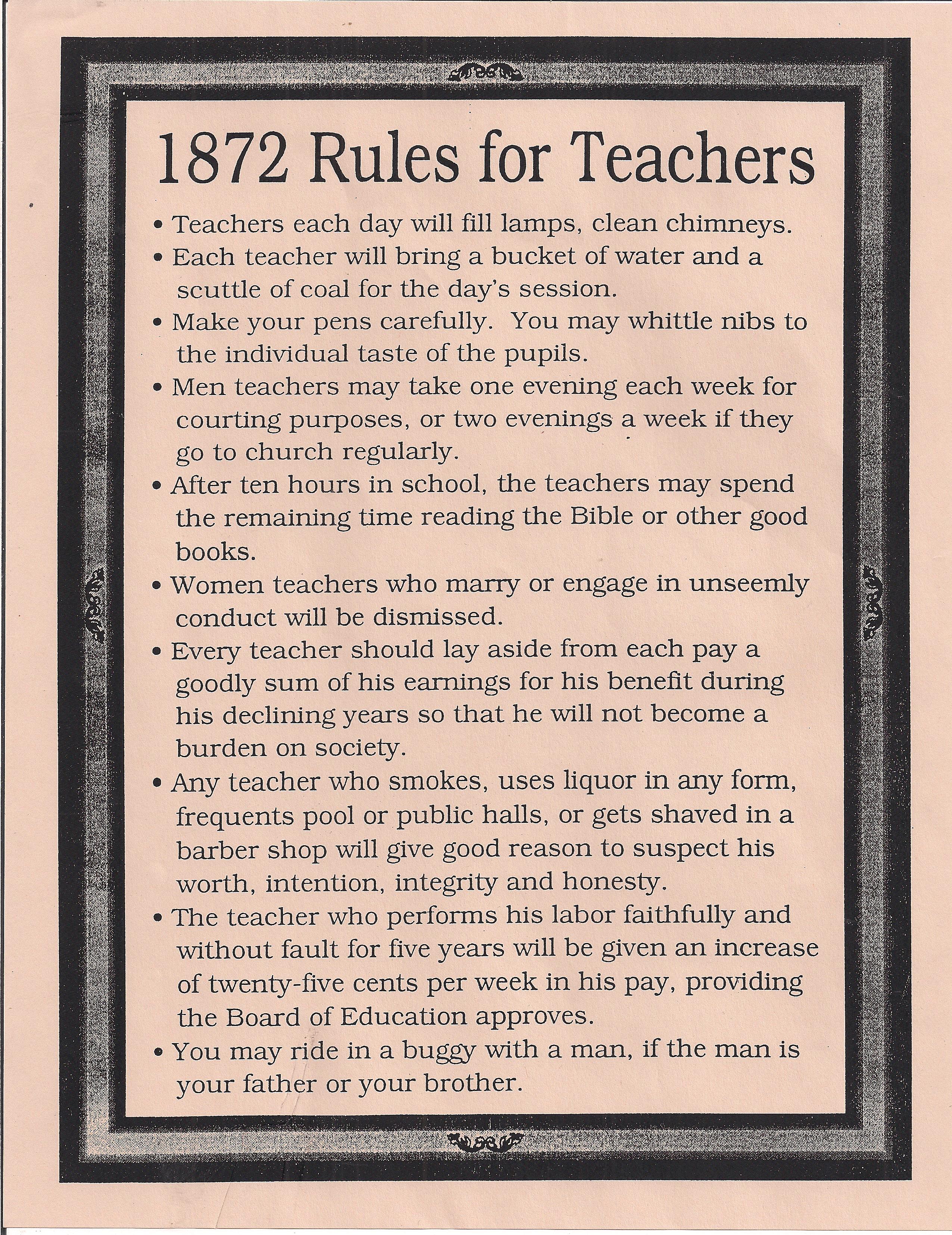
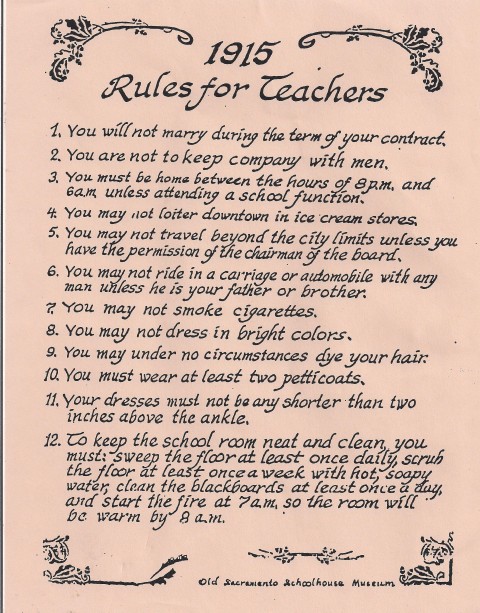
No one would call this the gold­en era of teach­ing, not with school bud­gets get­ting slashed, state gov­er­nors rou­tine­ly scor­ing polit­i­cal points at teach­ers’ expense, and the fed­er­al gov­ern­ment forc­ing schools to teach to the test. But if today’s teach­ers are feel­ing belea­guered, they can always look back to a set of his­tor­i­cal “doc­u­ments” for a lit­tle com­fort. For decades, muse­ums and pub­lish­ers have show­cased two lists — one from 1872 (above) and anoth­er from 1915 (below) — that high­light the rig­or­ous rules and aus­tere moral codes under which teach­ers once taught. You could­n’t drink or smoke. In wom­en’s cas­es, you could­n’t date, mar­ry, or fre­quent ice cream par­lors. And, for men, get­ting a shave in a bar­ber shop was strict­ly ver­boten.

But are these doc­u­ments real?

On its web site, the New Hamp­shire His­tor­i­cal Soci­ety writes that “the sources for these ‘rules’ are unknown; thus we can­not attest to their authenticity—only to their verisimil­i­tude and charm­ing quaint­ness.” “The rules from 1872 have been var­i­ous­ly attrib­uted to an 1872 post­ing in Mon­roe Coun­ty, Iowa; to a one-room school in a small town in Maine; and to an unspec­i­fied Ari­zona school­house. The 1915 rules are attrib­uted to a Sacra­men­to teach­ers’ con­tract and else­where to an unspec­i­fied 1915 mag­a­zine.” Accord­ing to Snopes, the fact-check­ing web site, the 1872 list has been “dis­played in numer­ous muse­ums through­out North Amer­i­ca,” over the past 50 years, “with each exhibitor claim­ing that it orig­i­nat­ed with their coun­ty or school dis­trict.” Heck, the lists even appeared in the ven­er­at­ed Wash­ing­ton Post not so long ago. Here are the rules:

Rules for Teach­ers — 1872

1. Teach­ers will fill the lamps and clean the chim­ney each day.
2. Each teacher will bring a buck­et of water and a scut­tle of coal for the day’s ses­sions.
3. Make your pens care­ful­ly. You may whit­tle nibs to the indi­vid­ual tastes of the pupils.
4. Men teach­ers may take one evening each week for court­ing pur­pos­es, or two evenings a week if they go to church reg­u­lar­ly.
5. After ten hours in school, the teach­ers may spend the remain­ing time read­ing the Bible or oth­er good books.
6. Women teach­ers who mar­ry or engage in improp­er con­duct will be dis­missed.
7. Every teacher should lay aside from each day’s pay a good­ly sum of his earn­ings. He should use his sav­ings dur­ing his retire­ment years so that he will not become a bur­den on soci­ety.
8. Any teacher who smokes, uses liquor in any form, vis­its pool halls or pub­lic halls, or gets shaved in a bar­ber shop, will give good rea­sons for peo­ple to sus­pect his worth, inten­tions, and hon­esty.
9. The teacher who per­forms his labor faith­ful­ly and with­out fault for five years will be giv­en an increase of twen­ty-five cents per week in his pay.

1915-Rules-for-Teachers

 Rules for Teach­ers — 1915

1. You will not mar­ry dur­ing the term of your con­tract.
2. You are not to keep com­pa­ny with men.
3. You must be home between the hours of 8 PM and 6 AM unless attend­ing a school func­tion.
4. You may not loi­ter down­town in ice cream stores.
5. You may not trav­el beyond the city lim­its unless you have the per­mis­sion of the chair­man of the board.
6. You may not ride in a car­riage or auto­mo­bile with any man except your father or broth­er.
7. You may not smoke cig­a­rettes.
8. You may not dress in bright col­ors.
9. You may under no cir­cum­stances dye your hair.
10. You must wear at least two pet­ti­coats.
11. Your dress­es may not be any short­er than two inch­es above the ankles.
12. To keep the class­room neat and clean you must sweep the floor at least once a day, scrub the floor at least once a week with hot, soapy water, clean the black­boards at least once a day, and start the fire at 7 AM to have the school warm by 8 AM.

via Peter Kauf­man, mas­ter­mind of the Intel­li­gent Chan­nel on YouTube.

Relat­ed Con­tent:

200 Free Kids Edu­ca­tion­al Resources: Video Lessons, Apps, Books, Web­sites & More

750 Free Online Cours­es from Top Uni­ver­si­ties

by | Permalink | Make a Comment ( 32 ) |

A Planetary Perspective: Trillions of Pictures of the Earth Available Through Google Earth Engine

In 1972 the Earth Resources Tech­nol­o­gy Satel­lite, or Land­sat, launched into space with a mis­sion to cir­cle the plan­et every 16 days and take pic­tures of the Earth. For more than forty years, the Land­sat pro­gram has cre­at­ed the longest ever con­tin­u­ous record of Earth’s sur­face.

Now those images are avail­able to every­one. And thanks to Google Earth Engine, it’s pos­si­ble to down­load and ana­lyze them.

Five years ago NASA and the U.S. Geo­log­i­cal Sur­vey rewrote their pro­to­cols and made the images avail­able for free, tril­lions of them, a ridicu­lous­ly mas­sive col­lec­tion of pic­tures tak­en from more than 400 miles away, some of them unrec­og­niz­able.

Is that green patch in the Ama­zon basin a for­est or a pas­ture?

But with a lit­tle help from Google’s cloud, this data has amaz­ing pow­er. It used to be that only a big insti­tu­tion, like a uni­ver­si­ty or a coun­try, had the pro­cess­ing pow­er to down­load the data. With a sin­gle CPU it would take months to suck down the images. Now, it only takes a few hours. With that free­dom, small envi­ron­men­tal watch­dog agen­cies and mon­i­tor­ing groups have access to the same data that the big guys have had for years. All they need to do is write the algo­rithms to help inter­pret what they’re see­ing.

And best of all, we can all see the results.

Watch Las Vegas grow from a dusty casi­no town into sub­ur­ban sprawl.

See the Palm Islands bloom into being off the coast of Dubai between 1984 and 2012.

One of the most dev­as­tat­ing is to watch the her­ring­bone of roads devel­op in the Ama­zon over just 28 years.

Down­load GoogleEarth’s free plu­g­in to view pre­com­put­ed datasets, like this one ren­der­ing the few remain­ing places on the Earth that are more than a kilo­me­ter from the near­est road.

Relat­ed Con­tent:

Hiroshi­ma Atom­ic Bomb­ing Remem­bered with Google Earth

Google Presents an Inter­ac­tive Visu­al­iza­tion of 100,000 Stars

Cut­ting-Edge Tech­nol­o­gy Recon­structs the Bat­tle of Get­tys­burg 150 Years Lat­er

Kate Rix writes about edu­ca­tion and dig­i­tal media. Vis­it her web­site and fol­low her on Twit­ter

Steven Pinker: “Dear Humanists, Science is Not Your Enemy”

pinker humanities

Human­ists are feel­ing a bit belea­guered these days. And who can blame them? Enroll­ments in human­i­ties cours­es are in steady decline nation­wide, and every­one’s look­ing for a cause. Some blame the decline on the tough econ­o­my and the relent­less­ly voca­tion­al focus of stu­dents. Oth­ers attribute it to the “anti-intel­lec­tu­al moment” in which we’re now liv­ing. Still oth­ers place the blame right in the laps of human­ists who have “lost faith in their own enter­prise.” They’re com­mit­ting their own form of career sui­cide. And then some fault the ever-increas­ing encroach­ment of sci­ence. For nowa­days sci­ence tries to answer all ques­tions, includ­ing what’s good, beau­ti­ful and true.

But if you lis­ten to Steven Pinker, he’ll tell you that sci­ence is not the prob­lem. Ear­li­er today, the emi­nent Har­vard psy­chol­o­gist pub­lished a piece in The New Repub­lic called Sci­ence Is Not Your Ene­my: An impas­sioned plea to neglect­ed nov­el­ists, embat­tled pro­fes­sors, and tenure-less his­to­ri­ans. And he offered these assur­ances:

[Sci­ence does­n’t have] an impe­ri­al­is­tic dri­ve to occu­py the human­i­ties; the promise of sci­ence is to enrich and diver­si­fy the intel­lec­tu­al tools of human­is­tic schol­ar­ship, not to oblit­er­ate them. And it is not the dog­ma that phys­i­cal stuff is the only thing that exists. Sci­en­tists them­selves are immersed in the ethe­re­al medi­um of infor­ma­tion, includ­ing the truths of math­e­mat­ics, the log­ic of their the­o­ries, and the val­ues that guide their enter­prise. In this con­cep­tion, sci­ence is of a piece with phi­los­o­phy, rea­son, and Enlight­en­ment human­ism. It is dis­tin­guished by an explic­it com­mit­ment to two ideals, and it is these that sci­en­tism seeks to export to the rest of intel­lec­tu­al life.

If you’re a human­ist try­ing to fig­ure out whether you can take com­fort in Pinker’s argu­ment, you can read the rest of his piece here.

Relat­ed Con­tent:

Can Sci­ence Fic­tion Save the Lib­er­al Arts? (Asks The New Repub­lic)

Ser­i­al Entre­pre­neur Damon Horowitz Says “Quit Your Tech Job and Get a Ph.D. in the Human­i­ties”

Read The Har­vard Clas­sics: A Free DIY Edu­ca­tion in the Lib­er­al Arts

by | Permalink | Make a Comment ( 3 ) |

New Archive Reveals How Scientists Finally Solved the Vexing “Longitude Problem” During the 1700s

For cen­turies, sea­far­ing explor­ers and mer­chants reck­oned with the lon­gi­tude prob­lem. It was rel­a­tive­ly easy to fig­ure out a ship’s loca­tion on a north-south axis, but near­ly impos­si­ble to deter­mine how far east or west it was. And the stakes were high. Sail too far astray and your ship (and men) could end up so far afield that get­ting home before the food and water ran out might be impos­si­ble. The sail­ing world need­ed bet­ter tools to deter­mine loca­tion at sea.

In 1714 the British gov­ern­ment estab­lished the Board of Lon­gi­tude, offer­ing a cash prize to any­one who could fig­ure out how to detect how far east or west a ship was at sea. The Board was abol­ished in 1828, but only after fos­ter­ing inno­v­a­tive tech­niques that would for­ev­er change the nature of marine nav­i­ga­tion.

Cam­bridge Uni­ver­si­ty and the Nation­al Mar­itime Muse­um at Green­wich recent­ly released an archive mak­ing all of the let­ters, objects, and doc­u­ments relat­ed to the Board’s work avail­able, along with a spiffy set of videos that brings the Board’s his­to­ry and achieve­ments to life.

Dur­ing the Board’s tenure, clock­mak­er John Har­ri­son fig­ured out that sailors could find out their loca­tion if they knew local time at sea and com­pared that to the time at a com­mon ref­er­ence point. The moon was seen as a giant clock, and its posi­tion rel­a­tive to stars was record­ed in the Nau­ti­cal Almanac, giv­ing sailors the data to com­pare against the time at sea. One of the inno­va­tions vet­ted by the Board of Lon­gi­tude is John Harrison’s Sea Clock. Also dur­ing that time, Green­wich became the prime merid­i­an.

All of this work led to more accu­rate maps. The Board spon­sored jour­neys, includ­ing some aboard Cap­tain Cook’s ships with portable obser­va­to­ries for map­mak­ers to sketch and use tri­an­gu­la­tion to deter­mine accu­rate loca­tion on voy­ages, includ­ing one to the North­west­ern Unit­ed States.

You can start rum­mag­ing through the fas­ci­nat­ing archive here.

Relat­ed Con­tent:

Caught Map­ping: A Cin­e­mat­ic Ride Through the Nit­ty Grit­ty World of Vin­tage Car­tog­ra­phy

Play Cae­sar: Trav­el Ancient Rome with Stanford’s Inter­ac­tive Map

Cut­ting-Edge Tech­nol­o­gy Recon­structs the Bat­tle of Get­tys­burg 150 Years Lat­er

Kate Rix writes about edu­ca­tion and dig­i­tal media. Fol­low her on Twit­ter @mskaterix or vis­it her on the web at .

Spike Lee Shares His NYU Teaching List of 87 Essential Films Every Aspiring Director Should See

I’m sure you’ve heard by now: wealthy, suc­cess­ful film direc­tor Spike Lee hopes to fund his next film via a Kick­starter cam­paign. Yes, that’s right, he wants you to pay for his art. His cam­paign, per­haps need­less to say, is hard­ly pop­u­lar with the aver­age film fan, many of whom find it hard enough to scrounge up the sky­rock­et­ing prices of tick­ets these days. Lee has respond­ed to his crit­ics, but some­how I doubt his rea­son­ing will go over well.

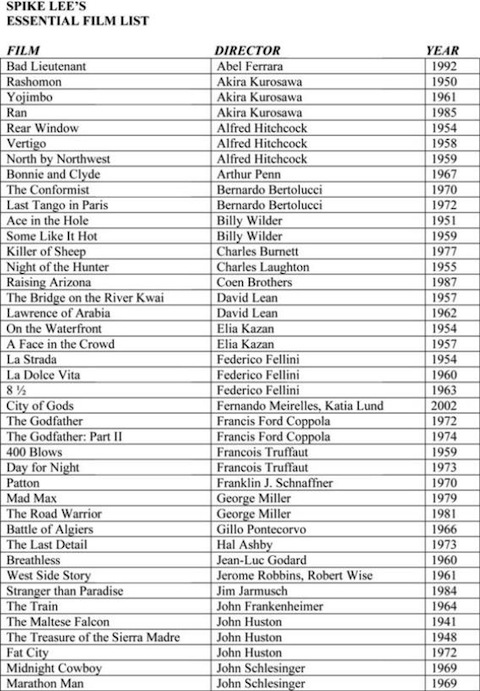
But we’re not here to talk about alleged crowd­fund­ing abus­es (have at it in the com­ments if you must). Instead, today we have for you—in the tra­di­tion of our many posts on famous teach­ers’ syl­labi—one of Lee’s teach­ing tools in his role as an NYU pro­fes­sor. Where all of our pre­vi­ous posts have fea­tured read­ing lists, Lee’s is a list of films, which he hands out to all of the stu­dents who take his grad­u­ate class–not required view­ing, but rec­om­mend­ed as “essen­tial” for every aspir­ing direc­tor.

lee essential.jpg.CROP.article568-large

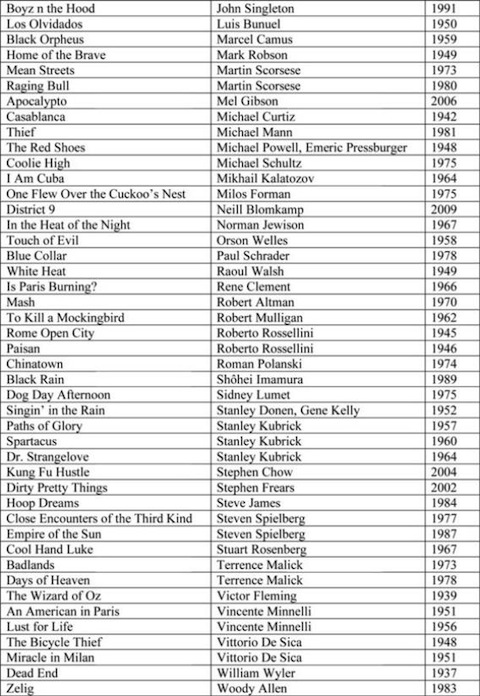
In the video at the top of the post, see Lee intro­duce the list of what he con­sid­ers, “the great­est films ever made.” “If you want to be a film­mak­er,” he says, “you should see these films.” The list, above and con­tin­ued below, includes some of the usu­al crit­i­cal favorites—Rashomon, Ver­ti­go, On the Water­front—and some pret­ty left field choic­es, like Mel Gibson’s Apoc­a­lyp­to.

Slate, which first pub­lished the list, notes the omis­sion of usu­al­ly revered direc­tors like Howard Hawks, John Ford, Fritz Lang, and Yasu­jirō Ozu as well as the paucity—or near non-existence—of female direc­tors (only one makes the list, the co-direc­tor of City of God). In addi­tion to pos­si­bly rant­i­ng about, or defend­ing, Lee’s use of Kick­starter, many of you may find your­selves quib­bling over, or defend­ing, his def­i­n­i­tion of “essen­tial.” And so, I say again, have at it, read­ers!

Note: When Spike orig­i­nal­ly released this list, many not­ed the lack of female film­mak­ers. Lee accept­ed that cri­tique and released an updat­ed list. Find it here.

lee essential 2.jpg.CROP.article568-large

Relat­ed Con­tent:

How Spike Lee Got His First Big Break: From She’s Got­ta Have It to That Icon­ic Air Jor­dan Ad

David Fos­ter Wallace’s 1994 Syl­labus: How to Teach Seri­ous Lit­er­a­ture with Light­weight Books

W.H. Auden’s 1941 Lit­er­a­ture Syl­labus Asks Stu­dents to Read 32 Great Works, Cov­er­ing 6000 Pages

Allen Ginsberg’s “Celes­tial Home­work”: A Read­ing List for His Class “Lit­er­ary His­to­ry of the Beats”

Josh Jones is a writer and musi­cian based in Wash­ing­ton, DC. Fol­low him at @jdmagness

Henry Rollins: Education is the Cure to “Disaster Capitalism”

We’ve already fea­tured for­mer Black Flag front­man and cur­rent spo­ken-word artist Hen­ry Rollins explain­ing why, to his mind, only edu­ca­tion can restore democ­ra­cy. He also believes it can cure some­thing he calls “dis­as­ter cap­i­tal­ism,” and you can hear more from him about it in the Big Think video above. He address­es, in his char­ac­ter­is­ti­cal­ly straight­for­ward man­ner, the ques­tions of what exact­ly ails the Amer­i­can econ­o­my, how that ail­ment might have come about, and how the coun­try can edu­cate itself back to health. We may indi­vid­u­al­ly get our edu­ca­tions now, he grants, but “how long will it be until Amer­i­ca fis­cal­ly turns itself around” to the point of repay­ing “the risk of the invest­ment on that stu­dent loan to get a per­son through four years of col­lege? Will that per­son get a job where pay­ing off that loan and get­ting a house and afford­ing a fam­i­ly, will that be a pos­si­bil­i­ty? In the present Amer­i­ca, it doesn’t look like it is.”

See­ing a dire nation­al sit­u­a­tion, Rollins rec­om­mends doing like Chi­na, but not in the way you might assume. He sug­gests look­ing “500 years at a time,” much far­ther up the road than we have of late. “I’d be look­ing up the road so far my eyes would fall out of my head.” He wants the coun­try to become “like Europe, where they’ll edu­cate your kid until his head explodes,” pro­duc­ing “three doc­tors per floor of every apart­ment build­ing” and doing so by mak­ing “col­lege tuition either free or real­ly low.” Gen­er­al­ly thought of as lib­er­al, Rollins sums this up in a way that might appeal to his ide­o­log­i­cal oppo­nents: “If you have a coun­try full of whip-crack smart peo­ple, you have a coun­try the rest of the world will fear. They will not invade a coun­try of edu­cat­ed peo­ple because we are so smart we’ll build a laser that will burn you, the ene­my, in your sleep before you can even mobi­lize your air force to kill us. We will kill you so fast because we are so smart and we will have for­eign pol­i­cy that will not piss you off to the point to where you have to attack us.”

Relat­ed Con­tent:

Hen­ry Rollins Pitch­es Edu­ca­tion as the Key to Restor­ing Democ­ra­cy

Hen­ry Rollins Tells Young Peo­ple to Avoid Resent­ment and to Pur­sue Suc­cess with a “Monas­tic Obses­sion”

Hen­ry Rollins Remem­bers the Life-Chang­ing Deci­sion That Brought Him From Häa­gen-Dazs to Black Flag

Col­in Mar­shall hosts and pro­duces Note­book on Cities and Cul­ture and writes essays on lit­er­a­ture, film, cities, Asia, and aes­thet­ics. He’s at work on a book about Los Ange­les, A Los Ange­les Primer. Fol­low him on Twit­ter at @colinmarshall.

Can Science Fiction Save the Liberal Arts? (Asks The New Republic)

Both the lit­er­ary and sci­ence fic­tion worlds have come out in the past few weeks with poignant trib­utes and acco­lades for recent­ly deceased Scot­tish writer Iain Banks. The remem­brances from both quar­ters are very well deserved, and very rare. Banks was an unusu­al kind of artist; he main­tained a high­ly respect­ed pres­ence as both a writer of real­ist lit­er­ary fic­tion (as Iain Banks) and superbly well-craft­ed, high­ly imag­i­na­tive sci­ence fic­tion (as Iain M. Banks). In the brief video inter­view above, you can hear Banks recount the ori­gin of the two names and make an impas­sioned case for sci­ence fic­tion as “the most impor­tant genre” of fic­tion.

Banks’ accom­plish­ments are all the more extra­or­di­nary giv­en that so-called lit­er­ary fic­tion and so-called genre writing—sci-fi, hor­ror, romance, etc.—have for so long occu­pied entire­ly dif­fer­ent cul­tur­al spheres, worlds, to use the words of Thomas Pyn­chon, as dif­fer­ent as “the hot­house and the street.” There were the obvi­ous exceptions—the work of Franz Kaf­ka, Drac­u­la and Franken­stein, 1984, Fahren­heit 451—that slipped through the gates, grand­fa­thered in as lega­cy cas­es or exem­plars of “Spec­u­la­tive Fic­tion,” the respectable term for genre writ­ing deemed “seri­ous” by aca­d­e­mics and the literati. Lit­er­ary schol­ar Fred­er­ic Jame­son has long been a fan of sci-fi. Crit­i­cal the­o­rist Felix Guatari once wrote a sci­ence fic­tion film script. Again, more excep­tions.

All of this has changed. After the suc­cess of pop­u­lar cul­ture stud­ies pro­grams in the free­wheel­ing post­mod­ern 90s, even the most tra­di­tion­al depart­ments have begun turn­ing toward genre fiction—the cur­rent pop­u­lar obses­sion with vam­pires and zom­bies, for example—as a means of re-invig­o­rat­ing the lib­er­al arts and reclaim­ing rel­e­vance. (I myself once helped an aca­d­e­m­ic press acquire and pub­lish a fun col­lec­tion called Bet­ter Off Dead: The Evo­lu­tion of the Zom­bie as Post-Human.)

FedFundingCharts

Is this a cyn­i­cal piece of strat­e­gy to mar­ket strug­gling human­i­ties pro­grams to increas­ing­ly busi­ness- and sci­ence-mind­ed stu­dents? A gen­er­a­tional turnover in the pro­fes­so­rate? An attempt to expand the mar­ket share of the human­i­ties in the over­all pic­ture of uni­ver­si­ty fund­ing? In a recent arti­cle in the New Repub­lic, sci­ence edi­tor Judith Shule­vitz argues, like Banks, that sci-fi is a genre of fic­tion that the acad­e­my should take more and more seri­ous­ly on prac­ti­cal grounds—sci-fi writ­ers show us the future of tech­nol­o­gy more accu­rate­ly than any tech­nol­o­gist. Shulavitz also writes that doing so will raise the pro­file, and fund­ing, of human­i­ties pro­grams.

As you can see from the charts above, the arts and sci­ences have reached a dire fund­ing asym­me­try. Shule­vitz quotes Vladimir Nabokov, who wrote, “There is no sci­ence with­out fan­cy and no art with­out fact” as part of her case for the impor­tance of lit­er­a­ture to the “prac­ti­cal arts” and vice-ver­sa. I don’t know if I’m entire­ly con­vinced, but Shulevitz’s argu­ment is wor­thy of con­sid­er­a­tion, unless you believe, with Oscar Wilde, that “all art is quite use­less” and in no need of an apolo­get­ics or a defense to bureau­crats.

Relat­ed Con­tent:

Free Sci­ence Fic­tion Clas­sics Avail­able on the Web (Updat­ed)

Andy Sam­berg Announces Death of Lib­er­al Arts, Cool­ness of Sci­ence Majors at Har­vard Class Day

Ser­i­al Entre­pre­neur Damon Horowitz Says “Quit Your Tech Job and Get a Ph.D. in the Human­i­ties”

Josh Jones is a writer and musi­cian based in Wash­ing­ton, DC. Fol­low him at @jdmagness

See Stevie Wonder Play “Superstition” and Banter with Grover on Sesame Street in 1973

In 1969, Sesame Street debuted and intro­duced America’s children—growing up in the midst of intense dis­putes over integration—to its urban sen­si­bil­i­ties and mul­ti­cul­tur­al cast, all dri­ven by the lat­est in child­hood devel­op­ment research and Jim Hen­son wiz­ardry. Despite the racial­ly frac­tious times of its ori­gin, the show was a suc­cess (although the state of Mis­sis­sip­pi briefly banned it in 1970), and its list of celebri­ty guests from every con­ceiv­able domain reflect­ed the diver­si­ty of its cast and hip­ness of its tone. With cer­tain excep­tions (par­tic­u­lar­ly in lat­er per­mu­ta­tions), it’s always been a show that knew how to gauge the tenor of the times and appeal broad­ly to both chil­dren and their weary, cap­tive guardians.

Being one of those weary cap­tives, I can’t say enough how grate­ful I’ve been when a rec­og­niz­able face inter­rupts Elmo’s bab­bling to sing a song or do a lit­tle com­e­dy bit, wink­ing at the par­ents all the while. These moments are few­er and far­ther between in the lat­er ages of the show, but in the sev­en­ties, Sesame Street had musi­cal rou­tines wor­thy of Sat­ur­day Night Live. Take, for exam­ple, the 1973 appear­ance of Ste­vie Won­der on the show. While I was born too late to catch this when it aired, there’s no doubt that the child me would find Won­der and his band as funky as the grown-up par­ent does. Check them out above doing “Super­sti­tion.”

Like most musi­cal artists who vis­it the show, Ste­vie also cooked some­thing espe­cial­ly for the kids. In the clip above, watch him do a lit­tle num­ber called “123 Sesame Street.” Won­der breaks out the talk box, a favorite gad­get of his (he turned Framp­ton on to it). The band gets so into it, you’d think this was a cut off their lat­est album, and the kids (the show nev­er used child actors) rock out like only sev­en­ties kids can. The show’s orig­i­nal theme song had its charm, but why the pro­duc­ers didn’t imme­di­ate­ly change it to this is beyond me. I’d pay vin­tage vinyl prices to get it on record.

Final­ly, in our last clip from Stevie’s won­der­ful guest spot, he takes a break from full-on funk and roll to give Grover a lit­tle scat les­son and show off his pipes. The great Frank Oz as the voice of Grover is, as always, a per­fect com­ic foil.

Relat­ed Con­tent:

Philip Glass Com­pos­es for Sesame Street (1979)

Mon­ster­piece The­ater Presents Wait­ing for Elmo, Calls BS on Samuel Beck­ett

Jim Hen­son Pilots The Mup­pet Show with Adult Episode, “Sex and Vio­lence” (1975)

Josh Jones is a writer and musi­cian based in Wash­ing­ton, DC. Fol­low him at @jdmagness

« Go BackMore in this category... »
Quantcast