What if I said the problem with STEM education is that it doesn’t include nearly enough art? For one thing, I would only echo what STEAM proponents have said for years. This doesn’t only mean that students should study the arts with the same seriousness as they do the sciences. But that science should be taught through the arts, as it was in the 19th century when Naturalists relied on fine art illustration.
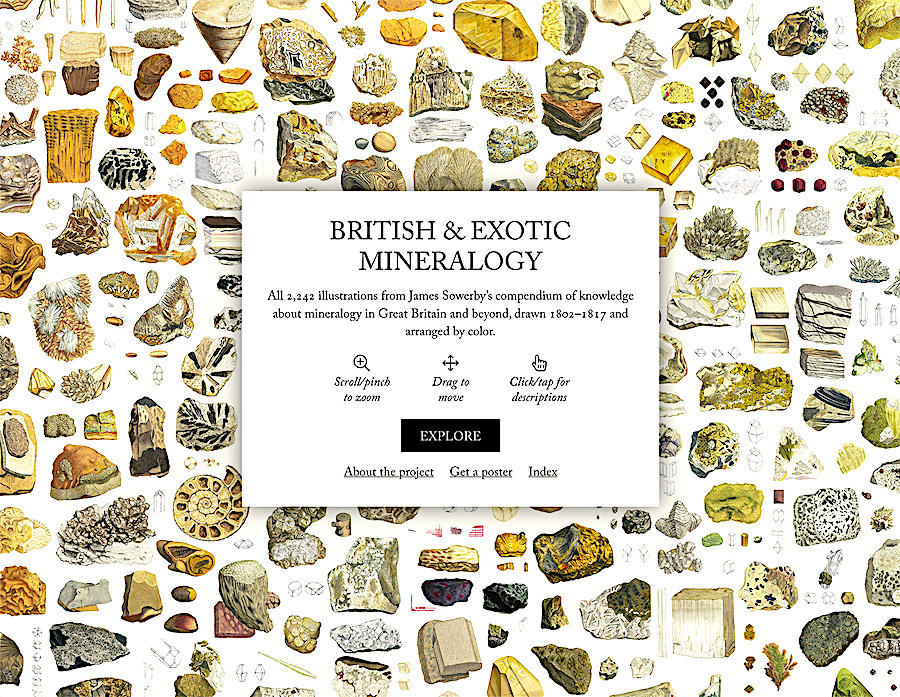
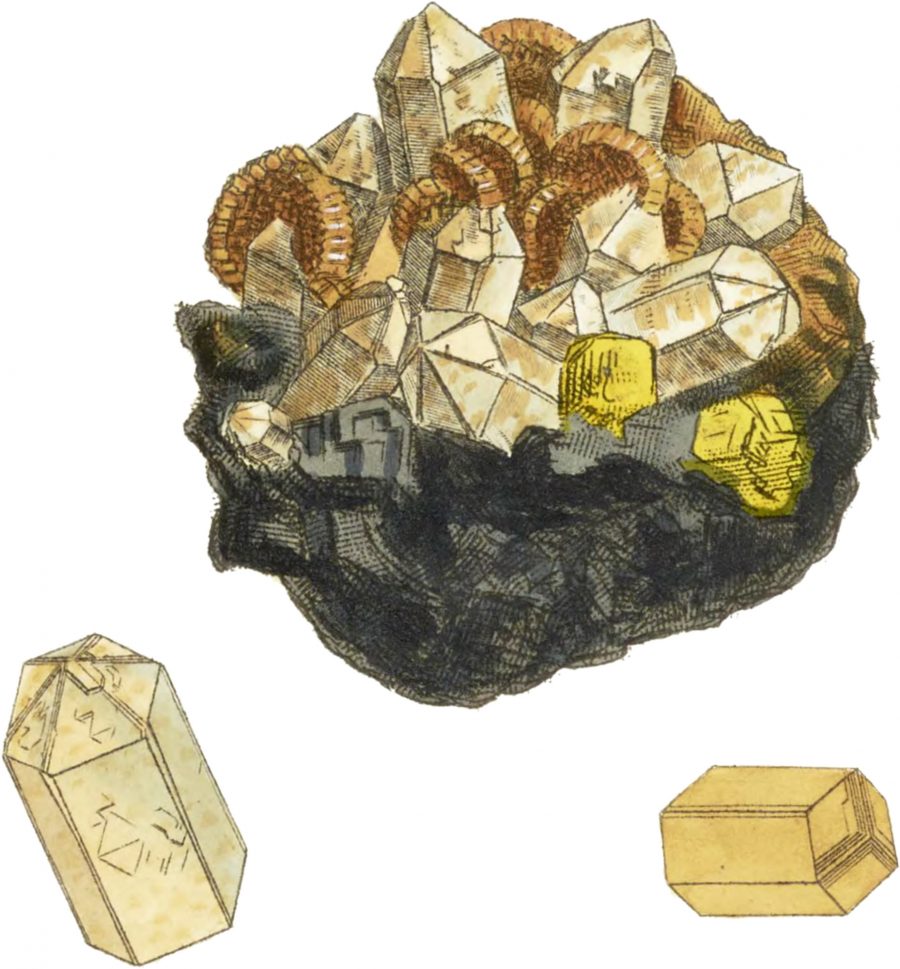
Maybe increasing complexity demands charts and graphs, but there are reasons other than hip antiquarianism to cherish 19th century scientific art, and to aim for something close to its high aesthetic standards. Humans seem to find nature far more awe-inspiring when it’s mediated by painting, poetry, narrative, music, fine art photography, etc. We want to be emotionally moved by science. As such, few guides to the natural world have elevated their subjects as highly as British & Exotic Mineralogy, a multivolume reference work for… well, rocks, to put it vulgarly, published between 1802 and 1817.
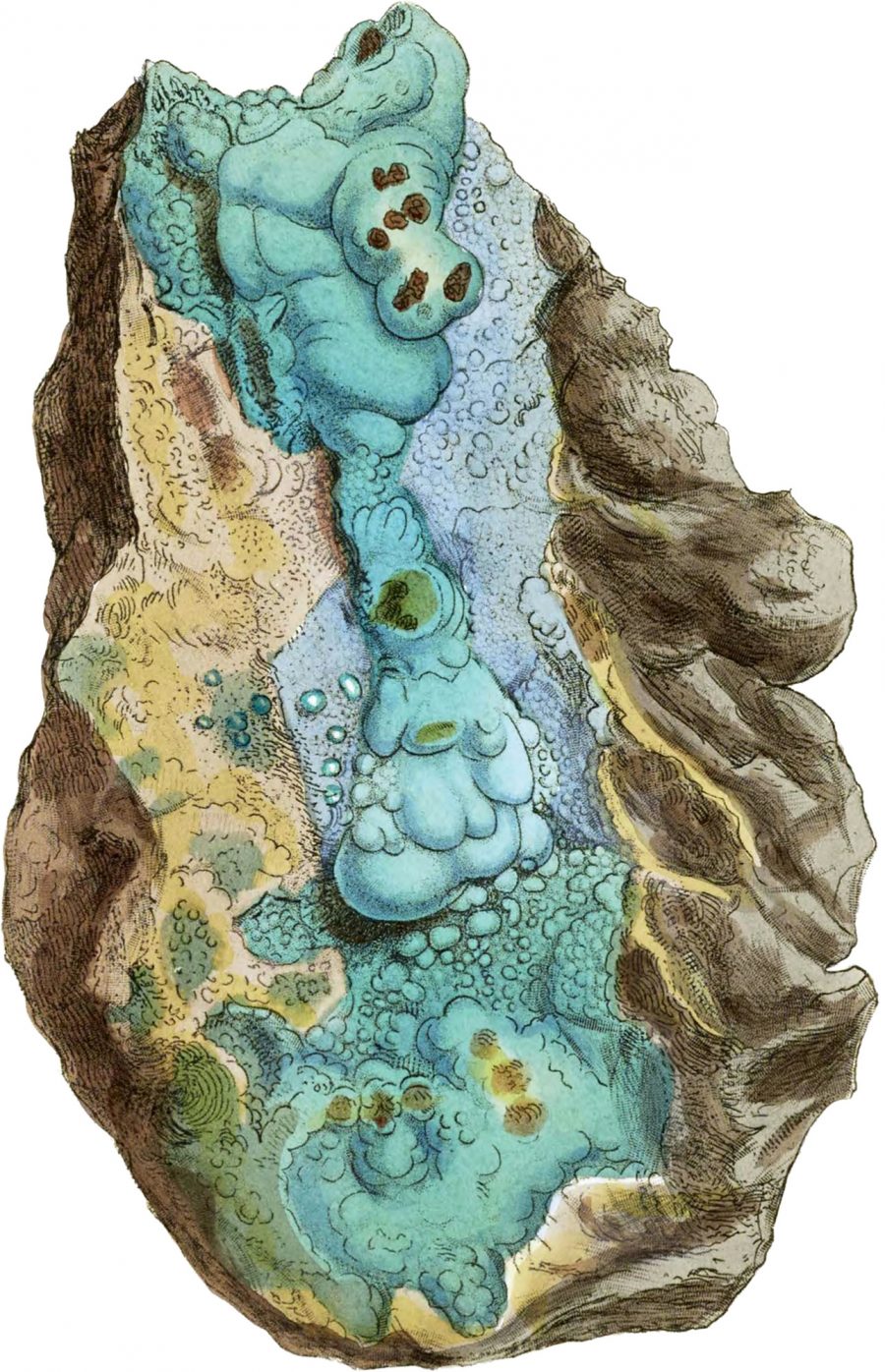
During these years, “notable naturalist, illustrator, and mineralogist James Sowerby drew intricate pictures of minerals in an effort to illustrate the topographic mineralogy of Great Britain and minerals not yet known to it,” writes Nicholas Rougeux. “These illustrations were some of the finest on the subject and are still considered by some to be to this day.” Though he was surely compensated for his work, Sowerby’s detailed drawings come across as labors of devotion.
Rather than just printing them on postcards or tote bags (though he does sell posters), Rougeux has done for Sowerby’s minerals what he had previously done for other classic textbooks and taxonomies from the past, such as the 200-year-old Werner’s Nomenclature of Colours and Euclid’s Elements from 1847. Digitizing the 718 illustrations on one sprawling interactive page allows him to retain their educational value: click on any individual mineral and you’ll bring up an enlarged image followed by excerpts from the text.
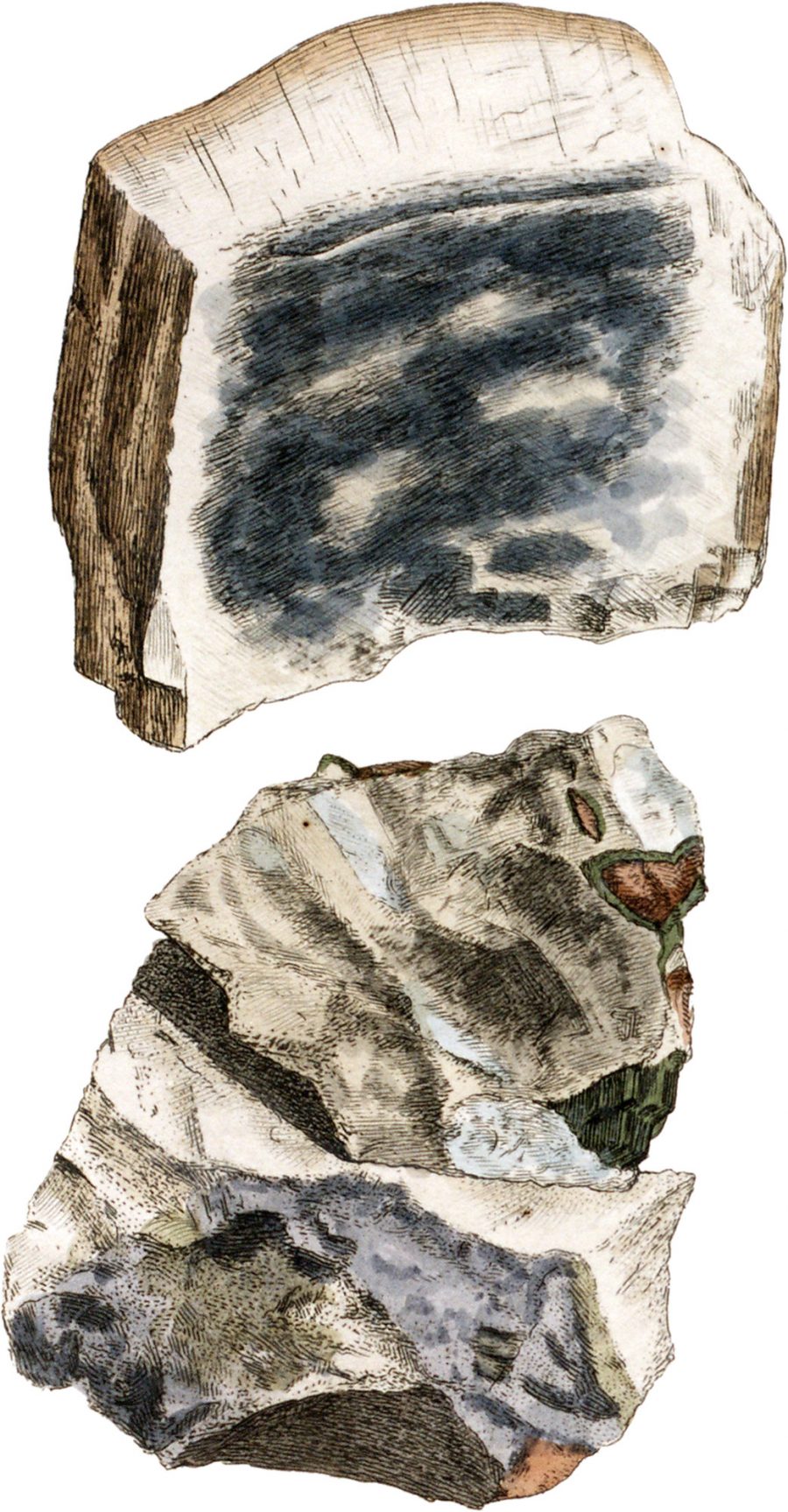
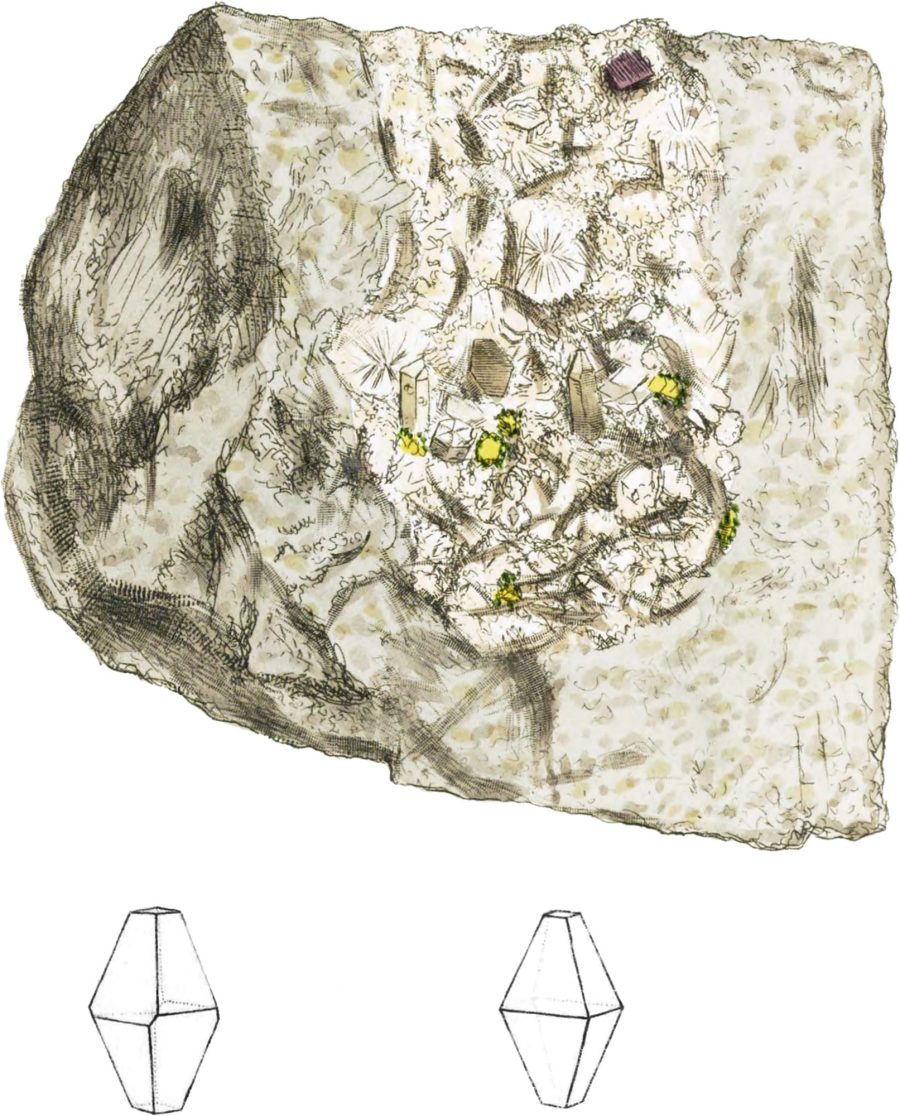
You have never seen such rocks as these, no matter how many uncut gems you’ve held in your hand. Because these illustrations turn them into something else—crystalline palaces, alien organs, petrified explosions, moldy loaves of bread… all the many shapes that time can take in rock form. They aren’t all beautiful rocks, but they are each beautifully-rendered with lines that might remind us of the most skilled comic artists, who are perhaps some of the last inheritors of this kind of graphic style. Sowerby himself illustrated several other scientific works, including series on biology, mycology, and a color system of his own devising.
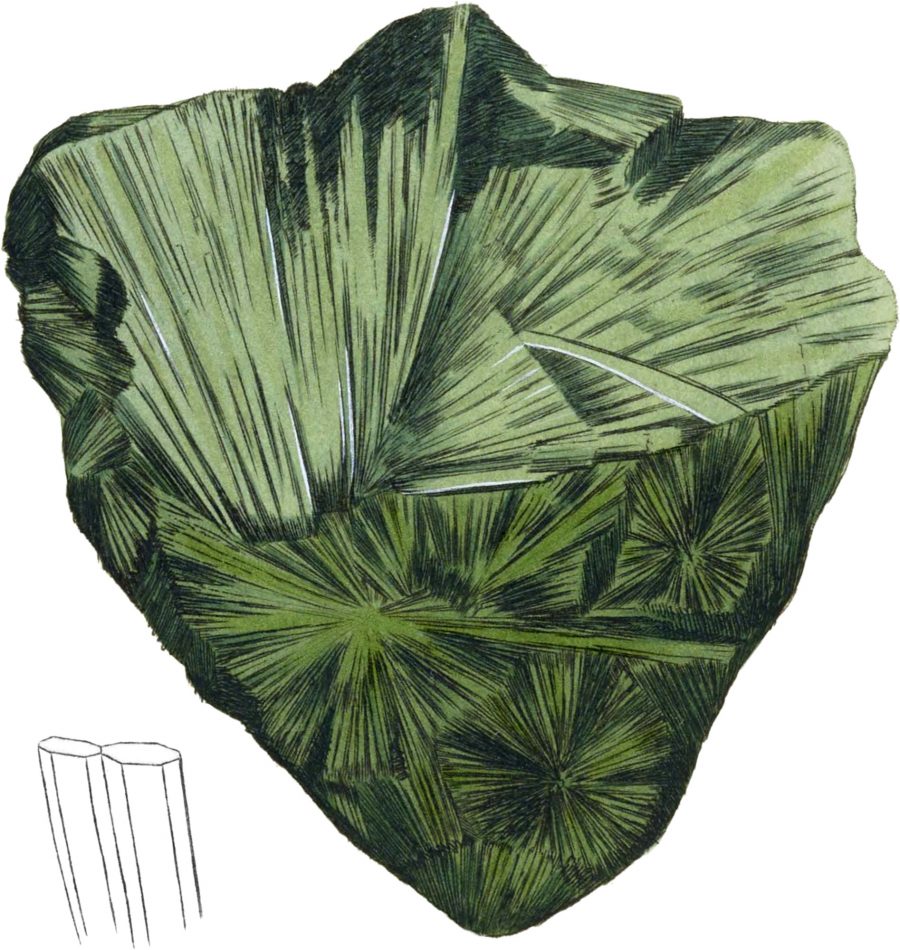
“We feel much pleasure in presenting our friends with a figure and account of the most perfect and rare specimen yet found of this substance,” begins the text accompanying Hydrargillite, above, which resembles a small, misshapen moon or asteroid. Rougeux also takes quite a bit of pleasure in his work of recovering these reference books and making them beautifully useful once again for 21st century readers. You can read his detailed account of the original illustrations and his adaptation of them for use on the webhere.
While appreciating the finer points of color, line, and composition in Rougeux’s tapestry of vintage mineral illustrations, you might just inadvertently expand your knowledge and appreciation of mineralogy. You can also read the entire British & Exotic Mineralogy, if you’ve got the time and inclination, at the Internet Archive.
Earlier this month, Stanford’s Online High School offered (in partnership with Stanford Continuing Studies) a free, five-day course “Teach Your Class Online: The Essentials.” With many schools starting the next academic year online, this course found a large audience. 7,000 teachers signed up. Aimed at middle and high school teachers, the course covered “general guidelines for adapting your course to an online format, best practices for varied situations, common pitfalls in online course design, and how to troubleshoot student issues online.”
The videos from “Teach Your Class Online: The Essentials” are all now available online. You can watch them in sequential order, moving from top to bottom, here. Or watch them on this Stanford hosted page. Day 1 (above) provides a general introduction to teaching online. See topics covered in Days 2–5 below.
Please feel free to share these videos with any teachers. And if anyone watches these lectures and takes good class notes (ones other teachers can use), please let us know. We would be happy to help share them with other teachers.
Finally, just to give you a little background, Stanford’s Online High School has operated as a fully-online, independent, accredited high school since 2006. Stanford Continuing Studies provides open enrollment courses to adults worldwide. All of its courses are currently online. For anyone interested, Coursera also offers a specialization (a series of five courses) on online learning called the Virtual Teacher. It can be explored here.
Day 2
Getting Specific: Situations and Tools
Science: Labs in Online Pedagogy
Day 3
Online Classroom Example Clips
Building and Maintaining a Classroom
Community
Day 4
Review of Submitted Sample Lesson Drafts
Troubleshooting Obstacles to Success in the Online Environment
Day 5
Math: Using Writing Tablets and Whiteboards
Modern Languages: Tips for Highly Interactive Class During Which Students Actively Speak and Write in the Target Language
Humanities: Productive Classroom Conversations About Challenging Subjects
This fall, many teachers (across the country and the world) will be asked to teach online–something most teachers have never done before. To assist with that transition, the Stanford Online High School and Stanford Continuing Studies have teamed up to offer a free online course called Teaching Your Class Online: The Essentials. Taught by veteran instructors at Stanford Online High School (OHS), this course “will help middle and high school instructors move from general concepts for teaching online to the practical details of adapting your class for your students.” The course is free and runs from 1–3 pm California time, July 13 — 17. You can sign up here.
For anyone interested, Stanford will also offer additional courses that give teachers the chance to practice teaching their material online and get feedback from Stanford Online High School instructors. Offered from July 20 — July 24, those courses cost $95. Click to this page, and scroll down to enroll.
In one cascade of events after another, people are finding out the normal they once knew doesn’t exist anymore. Instead it feels as if we’re living through several past crises at once, trying to cram as much historical knowledge as we can to make sense of the moment. 2020 especially feels like an echo of 1918–1919, when the “deadliest epidemic of all time,” as The Great Courses calls the “Spanish flu,” killed millions (then the U.S. devolved into a wave of racist violence.) By offering examples of both negative and positive responses, the history, sociology, and epidemiology of the 1918 flu can guide decision-making as we prepare for a second wave of COVID-19 infections.
The three-part lecture series here, excerpted from the larger course Mysteries of the Microscopic World (available with a Free Trial to the Great Courses Plus), begins by boldly calling this historical lacuna “A Conspiracy of Silence.” Tulane professor Bruce E. Fleury quotes Alfred Crosby, who writes in America’s Forgotten Pandemic, “the important and almost incomprehensible fact about the Spanish influenza, is that it killed millions upon millions of people in a year or less… and yet, it has never inspired awe, not in 1918 and not since.”
Epidemic diseases that have had tremendous impact in the past have become the subject of literary epics. Few epidemics have accomplished mass death “through sheer brute force” like the 1918 flu. The numbers are truly staggering, in the tens to hundreds of millions worldwide, with U.S. deaths dwarfing the combined casualties of all the country’s major wars. Yet there are only a few mentions of the flu in American literature from the time. Fleury mentions some reasons for the amnesia: WWI “took center stage,” survivors were too traumatized to want to remember. We may still wonder why we should look back over 100 years ago and learn about the past when current events are so all-consuming.
“History compels us not to look away,” professor Fleury says, “lest we fail to learn the lessons paid for by our parents and our grandparents.” Faulkner, it seems, was right that the past is never past. But we need not respond in the same failed ways each time. The ability to study and learn from history gives us critical perspective in perilous, uncertain times.
Two pieces of reading advice I’ve carried throughout my life came from two early favorite writers, Herman Melville and C.S. Lewis. In one of the myriad pearls he tosses out as asides in his prose, Melville asks in Moby Dick, “why read widely when you can read deeply?” Why spread our minds thin? Rather than agonize over what we don’t know, we can dig into the relatively few things we do until we’ve mastered them, then move on to the next thing.
Melville’s counsel may not suit every temperament, depending on whether one is a fox or a hedgehog (or an Ahab). But Lewis’ advice might just be indispensable for developing an outlook as broad-minded as it is deep. “It is a good rule,” he wrote, “after reading a new book, never to allow yourself another new one till you have read an old one in between. If that is too much for you, you should at least read one old one to every three new ones.”
Many other famous readers have left behind similar pieces of reading advice, like Edward Bulwer-Lytton, author of notorious opener “It was a dark and stormy night.” As though refining Lewis’ suggestion, he proposed, “In science, read, by preference, the newest works; in literature, the oldest. The classic literature is always modern. New books revive and redecorate old ideas; old books suggest and invigorate new ideas.”
Albert Einstein shared neither Lewis’ religion nor Bulwar-Lytton’s love of semicolons, but he did share both their outlook on reading the ancients. Einstein approached the subject in terms of modern arrogance and ignorance and the bias of presentism, writing in a 1952 journal article:
Somebody who only reads newspapers and at best books of contemporary authors looks to me like an extremely near-sighted person who scorns eyeglasses. He is completely dependent on the prejudices and fashions of his times, since he never gets to see or hear anything else. And what a person thinks on his own without being stimulated by the thoughts and experiences of other people is even in the best case rather paltry and monotonous.
There are only a few enlightened people with a lucid mind and style and with good taste within a century. What has been preserved of their work belongs among the most precious possessions of mankind. We owe it to a few writers of antiquity (Plato, Aristotle, etc.) that the people in the Middle Ages could slowly extricate themselves from the superstitions and ignorance that had darkened life for more than half a millennium.
Nothing is more needed to overcome the modernist’s snobbishness.
Einstein himself read both widely and deeply, so much so that he “became a literary motif for some writers,” as Dr. Antonia Moreno González notes, not only because of his paradigm-shattering theories but because of his generally well-rounded public genius. He was frequently asked, and happy to volunteer, his “ideas and opinions”—as the title of a collection of his writing calls his non-scientific work, becoming a public philosopher as well as a scientist.
We might credit Einstein’s liberal attitude toward reading and education—in the classical sense of the word “liberal”— as a driving force behind his endless intellectual curiosity, humility, and lack of prejudice. His diagnosis of the problem of modern ignorance may strike us as grossly understated in our current political circumstances. As for what constitutes a “classic,” I like Italo Calvino’s expansive definition: “A classic is a book that has never finished saying what it has to say.”
The late 19th Century was the time of Charles Darwin and James Clerk Maxwell, of Thomas Edison and Alexander Graham Bell. It was a golden age of science and technology. So you might wonder how hard it was to get into one of the top technical universities in that era.
The answer, according to this video? Not very hard.
At least that was the case in 1869 at the Massachusetts Institute of Technology, or MIT, as the young Australian science and math teacher Toby Hendy explains on her excellent YouTube channel, Tibees. MIT was brand new and desperate for tuition revenue in 1869, so the object of the test wasn’t to whittle a massive field of applicants down to a manageable size. It was simply to make sure that incoming students could handle the work.
MIT opened in 1865, just after the end of the Civil War. The idea was to create a European-style polytechnic university to meet the demands of an increasingly industrial economy. The original campus was in Boston, across the Charles River from its current location in Cambridge. Only 15 students signed up in 1865. Tuition was $100 for the whole year. There was no formal entrance test. According to an article from the school’s Archives and Special Collections,
The “conditions for admission” section of MIT’s catalogue for 1865–66 indicates that candidates for admission as first year students must be at least sixteen years old and must give satisfactory evidence “by examination or otherwise” of a competent training in arithmetic, geometry, English grammar, geography, and the “rudiments of French.” Rapid and legible handwriting was also stressed as being “particularly important.” By 1869 the handwriting requirement and French had been dropped, but algebra had been added and students needed to pass a qualifying exam in the required subject areas. An ancillary effect was to protect unqualified students from disappointment and professors from wasting their time.
A couple of years earlier, in 1867, the MIT Executive Committee reported that faculty members had felt it necessary to ask parents of “some incompetent and inattentive students to withdraw them from the school, wishing to spare them the mortification of an examination which it was certain they could not pass.”
Nowadays, the students who make it into MIT have average SAT and ACT scores in the 99th percentile. Of 21,312 first-year applicants hoping to join the Class of 2023, only 1,427 made it. That’s an admission rate of 6.7 percent. What a difference 150 years can make!
To take the 1869 entrance examination in English, Algebra, Geometry and Arithmetic, and to see the correct answers, visit this cached article from the MIT website.
While there are obviously much greater tragedies unfolding daily, it’s hard not to empathize with students who have watched countless special events—proms, commencements, spring sports, performances, hotly anticipated rites of passage—go poof.
In New York City, students in Parsons School of Design’s Narrative Spaces: Design Tools for Spatial Storytelling course were crestfallen to learn that their upcoming open-to-the-public exhibition of group and solo projects in the West Village—the centerpiece of the class and a huge opportunity to connect with an audience outside of the classroom—was suddenly off the menu.
Multidisciplinary artist Jeff Stark, who co-teaches the class with Pamela Parker, was disappointed on their behalves.
Stark’s own work, from Empire Drive In to Miss Rockaway Armada, is rooted in live experience, and New York City holds a special place in his heart. (He also edits the weekly email list Nonsense NYC, an invaluable resource for independent art and Do-It-Yourself events in the city.)
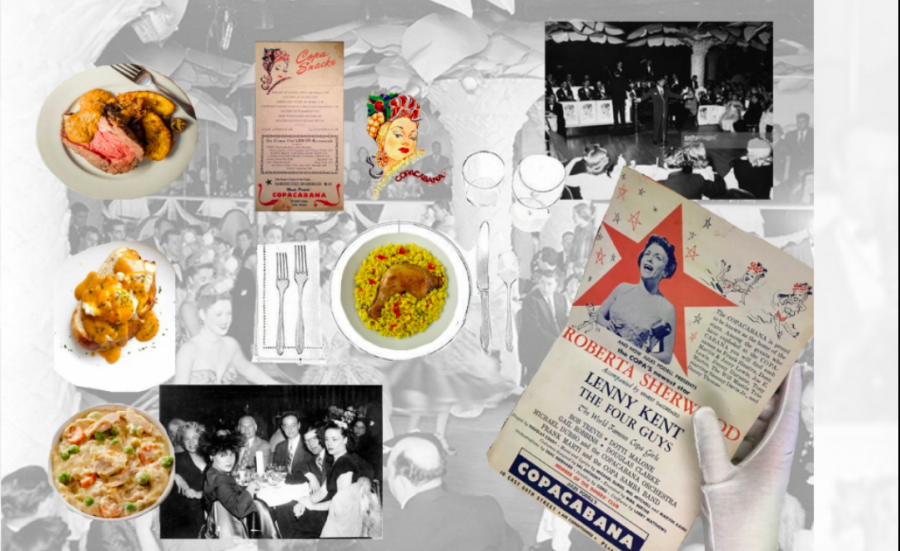
Student Rylie Cooke, an Australian who aspires to launch a design company, found that her research deepened her connection to artifacts she encountered at the Reliquary, as she came to appreciate the fabled Copacabana’s influence on the popular culture, food, and music of the period:
… with COVID-19 it became important to have this connection to the artifacts as I wasn’t able to physically touch or look at them when Parsons moved to online for the semester. I am a very hands-on creative and I love curating things, especially in an exhibit format.
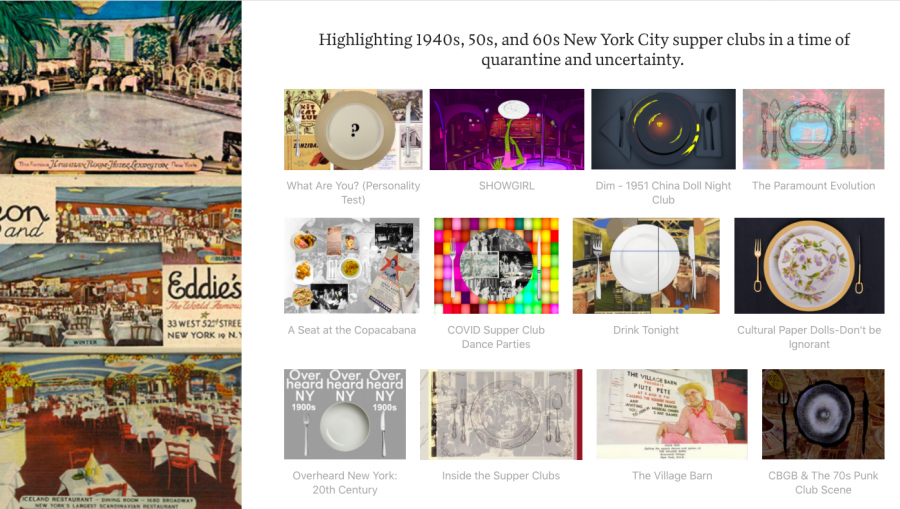
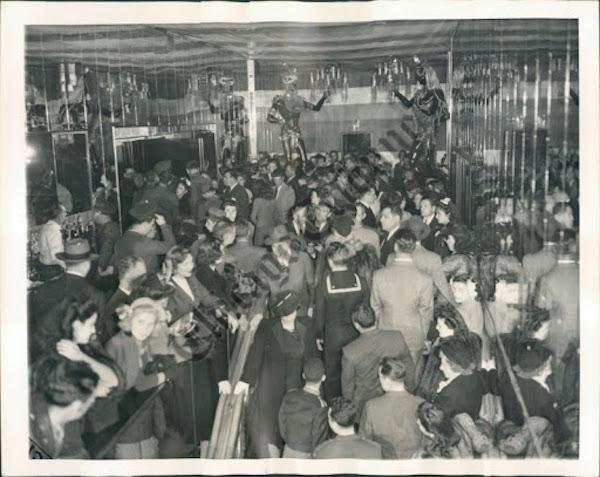
Rather than scrap their goal of public exhibition, the class decided to take things into the virtual realm, hustling to adapt their original concepts to a purely screen-based experience, The New York Supper Club: From Nightlife to Social Distancing.
The plan to wow visitors with a period-appropriate table in the center of their West Village exhibition space became a grid of digital placemats that serve as portals to each project.
Cooke’s contribution, A Seat at the Copacabana, begins with an interview in which baseball great Mickey Mantle recounts getting into a cloakroom brawl as he and fellow New York Yankees celebrated a birthday with a Sammy Davis Jr. set. Recipes for steak and potatoes, Chicken a la King, rarebit, and arroz con pollo provide flavor for a floorshow represented by archival footage of “Let’s Do the Copacabana” starring Carmen Miranda, a Martin and Lewis appearance, and a dance rehearsal from 1945. The tour ends at the Copa’s current incarnation in Times Square, with a vision of pre-socially distanced contemporary merrymakers salsa-ing the night away.
(Navigate this exhibit using toolbar arrows at the bottom of the screen.)
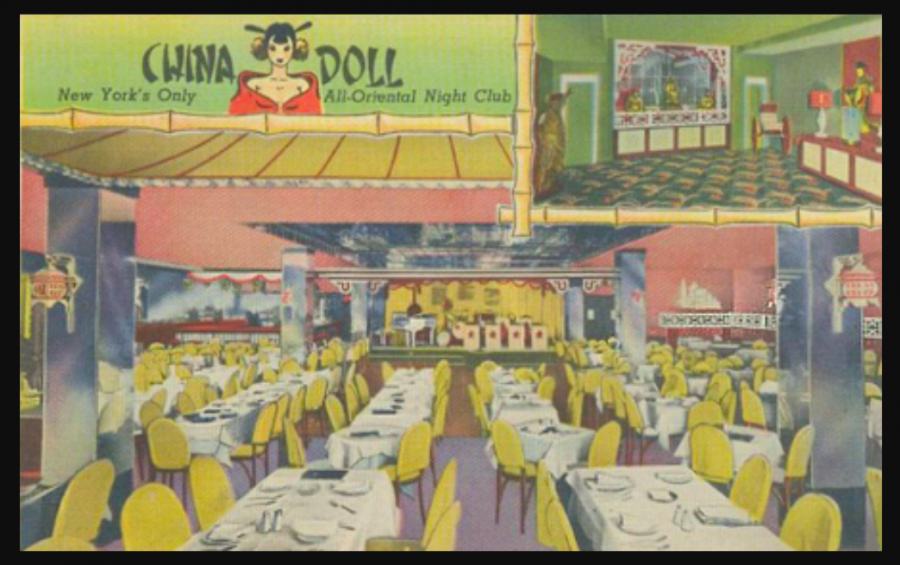
Student Hongxi Chen’s investigations into The China Doll nightclub resulted in an elaborate interactive immersive experience on the topic of cultural appropriation:
The China Doll… was founded in 1946 by Caucasian stage producer Tom Ball, who deemed it the only “all-oriental” night club in New York. While the club sometimes played off “Oriental” stereotypes, and titled one of its shows “Slant-Eyed Scandals,” they featured Asian dancers and Asian singers presenting popular songs in a way New Yorkers had never seen before. The Dim interactive experience unfolds with the story of Thomas, a waiter at the China Doll.
As a junior in Parsons’ Design and Technology program, Chen had plenty of previous experience forging virtual environments, but working with a museum collection was new to him, as was collaborating on a virtual platform.
He sought Stark’s advice on creating vivid dialogue for his fictional waiter.
Chen stayed up until 7 am for two weeks, devouring open source tutorials in an attempt to wrangle and debug the many elements of his ambitious project—audio, video, character models and animation, software, game engines, and game server platform.
As Chen noted at the exhibition’s recent Zoom opening (an event that was followed by a digital dance party), the massive game can be a bit slow to load. Don’t worry, it’s worth the wait, especially as you will have a hand in the story, steering it to one of five different endings.
Chen, an international student, could not safely return to China and has not left his student apartment since mid-March, but gamely states that remaining in the same time zone as his school allowed him to communicate efficiently with his professors and the majority of his classmates. (Cooke is back home in Australia.)
Adds Chen:
Even though we are facing a difficult circumstance under the pandemic and had to pivot our original ideas into a virtual presentation, I’m glad that our class was able to quickly change plans and adapt to the situation. This… actually inspired me a lot and opened up ways to invite and connect people with virtual artwork.
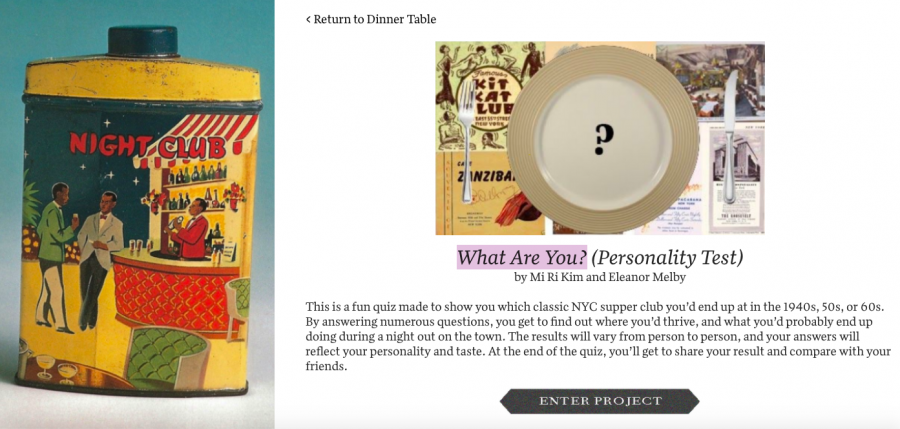
(Apparently, I’m headed to Cafe Zanzibar, below, where the drinks are cheap, the aspirin is free, and Cab Calloway is a frequent headliner.)
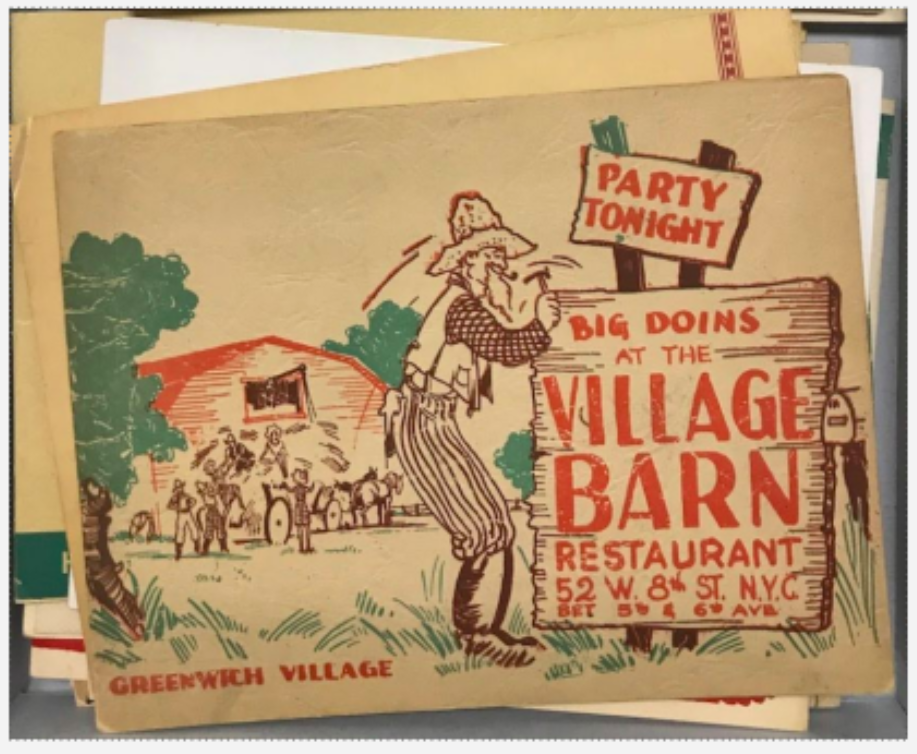
Stark admits that initially, his students may not have shared his swooning response to the source material, but they share his love of New York City and the desire to “get in the thick of it.” By bringing a Generation Z perspective to this historical ephemera, they stake a claim, making work that could help the City Reliquary connect to a new audience.
Enter The New York Supper Club: From Nightlife to Social Distancing here.
Explore the City Reliquary online here, and join in the civic pride by participating in its weekly Instagram Live events, including Thursday Collectors’ Nights.
(All images used with permission of the artists and The City Reliquary)
Many of us kept indoors by the COVID-19 pandemic for days — or rather weeks, or perhaps months — have been imbued with a new sense of wonder about our world. Specifically, we’re wondering what’s going on in it. At the same time as the global scientific community struggles to determine the nature of the new and still poorly understood virus taking lives and immobilizing economies, we hear digital word of consequent phenomena also previously unknown in our lifetimes: wild animals, for instance, making their way into the streets of major cities. We live, it turns out, in a stranger, more mysterious reality than we’d imagined. Fortunately, the internet makes it possible for us to start getting a grip on that reality here in our homes, not least through free streaming Netflix documentaries.
“In the Before Times, Netflix let teachers stream their programming in the classroom,” writes Jason Kottke. With schools out of session, “Netflix has decided to put some of their educational programming on YouTube for free (full playlist here). For instance, they’ve put all 8 episodes of David Attenborough’s nature series Our Planet online in their entirety.”
Released just last year, that Netflix debut of the highly respected natural historian and broadcaster covers in great visual detail — and, needless to say, with highly evocative narration — everywhere from forests and deserts to jungles and high seas. If as a starting point that all seems a bit epic, as they say, Netflix has also made free single-serving documentary shorts on subjects like the stock market, the exclamation point, and cricket (the British Empire sport, not the insect).
Those come from the series Explained, a collaboration between Netflix and Vox, a site known for its brief “explainer” videos on culture, science, and current events — one of which, on the coronavirus itself, we featured last month here on Open Culture. Netflix has also made free to stream on Youtube other series like Abstract, which looks at the art of design (and whose debut we featured here a few years ago), and Babies, a five-part journey into the life of the human infant. If you prefer a feature-length documentary experience to a daily view or a binge-watch, you’ll also find on the playlist Ava DuVernay’s 13th, Rachel Lears’ Knock Down the House, and Jeff Orlowski’s Chasing Coral. When the orders of “stay home” and “social-distance” come to an end, many of us will feel a stronger desire to explore and learn about the world than ever before — in part because of how much of the time indoors we’ve spent stoking our curiosity with documentaries like these. Access the playlist of documentaries here.
Based in Seoul, Colin Marshall writes and broadcasts on cities, language, and culture. His projects include the book The Stateless City: a Walk through 21st-Century Los Angeles and the video series The City in Cinema. Follow him on Twitter at @colinmarshall, on Facebook, or on Instagram.
We're hoping to rely on loyal readers, rather than erratic ads. Please click the Donate button and support Open Culture. You can use Paypal, Venmo, Patreon, even Crypto! We thank you!
Open Culture scours the web for the best educational media. We find the free courses and audio books you need, the language lessons & educational videos you want, and plenty of enlightenment in between.