Here in South Korea, where I’ve stayed for about a month, I’ve noticed people eating quite a lot of instant ramen noodles. And not just out of those pre-packaged cups you pour hot water into, which we all remember from our student days. They put the stuff in everything, especially the dishes you least expect. They’ve made something of a national culinary art form of throwing instant ramen into various traditional stews and soups, thus significantly raising the status of that ultimate low-status food. But when we talk about ramen without the “instant” in front of it, it can suddenly take us straight into the realm of the gourmet: the Ivans and the Momofukus of the worlds, for instance. In the short video above, you can see what kind of highly non-instant process Sun Noodle, the supplier to those fine U.S.-based ramen houses and others, goes through to make a first-class product.
But why pay for the best when the cost of a single meal at Momofuku could buy all the instant ramen you’d ever need? Perhaps the project above from artist and TEDxManhattan video presenter Stefani Bardin will go some way to answering the question. In it, she uses a gastrointestinal camera pill to record what it looks inside our bodies when we eat “whole foods” — hibiscus Gatorade, pomegranate and cherry juice Gummi Bears, homemade chicken stock with handmade noodles — versus when we eat “processed foods” — blue Gatorade, regular Gummi Bears, and, yes, good old instant ramen. For a far more pleasant follow-up to that harrowing visual experience, revisit how to make instant ramen courtesy of Japanese animation director Hayao Miyazaki, which we featured last year. And if it gets you feeling ambitious, why not find some more challenging ramen recipes on Cookpad, the Japanese cooking site newly launched in English? Or do as the Koreans sometimes do and combine it with fish cake, eggs, and a slice of American cheese — if you can stomach it.
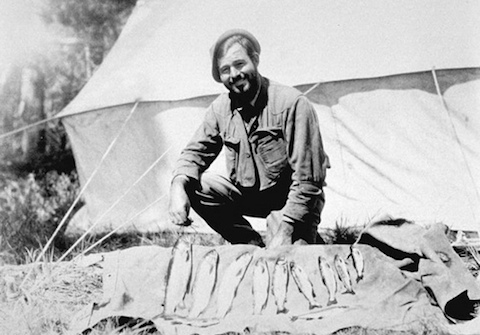
Don’t mistake that metaphor for real life, however. Judging by his 1920 Toronto Star how-to on maximizing comfort on camping vacations, he would not have stood for charred weenies and marshmallows on a stick. Rather, a little cookery know-how was something for a man to be proud of:
“…a frying pan is a most necessary thing to any trip, but you also need the old stew kettle and the folding reflector baker.”
Clearly, the man did not trust readers to independently seek out such sources as The Perry Ladies’ Cookbook of 1920 for instructions. Instead, he painstakingly details his method for successful preparation of Trout Wrapped in Bacon, including his preferred brands of vegetable shortening.
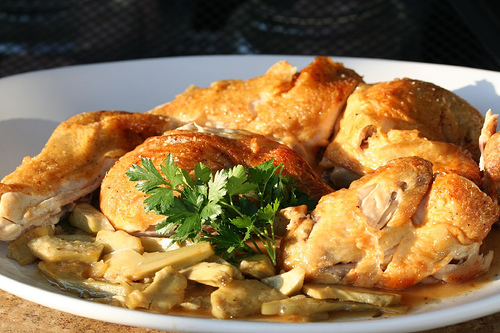
Would your mouth water less if I tell you that literary food blog Paper and Salt has updated Hem’s trout recipe à laEmeril Lagasse, omitting the Crisco and tossing in a few fresh herbs? No campfire required. You can get ‘er done in the broiler:
Bacon-Wrapped Trout: (adapted from Emeril Lagasse)
2 (10-ounce) whole trout, cleaned and gutted
1/2 cup cornmeal
Salt and ground pepper, to taste
8 sprigs fresh thyme
1 lemon, sliced
6 slices bacon
Fresh parsley, for garnish
1. Preheat broiler and set oven rack 4 to 6 inches from heat. With a paper towel, pat trout dry inside and out. Dredge outside of each fish in cornmeal, then season cavity with salt and pepper. Place 4 sprigs of thyme and 2 lemon slices inside each fish.
2. Wrap 3 bacon slices around the middle of each fish, so that the edges overlap slightly. Line a roasting pan with aluminum foil, and place fish on pan. Broil until bacon is crisp, about 5 minutes. With a spatula, carefully flip fish over and cook another 5 minutes, until flesh is firm.
Like any thoughtful hostess (simile!), Hemingway didn’t leave his guests to starve whilst waiting for the main event. His choice of hors d’oeuvres was little pancakes made from a mix, and again, he leaves nothing to chance, or Aunt Jemima’s instructions…
With the prepared pancake flours you take a cupful of pancake flour and add a cup of water. Mix the water and flour and as soon as the lumps are out it is ready for cooking. Have the skillet hot and keep it well greased. Drop the batter in and as soon as it is done on one side loosen it in the skillet and flip it over. Apple butter, syrup or cinnamon and sugar go well with the cakes.
Corn Cakes:
1 1/2 cups corn kernels (either fresh off the cob or thawed)
2 green onions, white parts only, coarsely chopped
2/3 cup flour
1/3 cup stone-ground yellow cornmeal
1 teaspoon baking powder
1/2 teaspoon red chile flakes
1/2 teaspoon salt
1 teaspoon sugar
1 egg, lightly beaten
2/3 cup buttermilk
2 tablespoons butter, melted and cooled
Canola oil, for frying
1. In a food processor, add corn and green onions and pulse 4 to 5 times, until finely chopped. In a large bowl, stir together corn mixture, flour, cornmeal, baking powder, red chile flakes, salt, and sugar.
2. In a small bowl, combine egg, buttermilk, and butter. Add to corn mixture, stirring until just combined.
3. Coat a large skillet or pancake griddle with oil. Over medium heat, spoon batter onto pan in 1/4 cups and fry until cakes are golden on both sides, 1 to 2 minutes per side.
Villeneuve opts out of recreating Hemingway’s dessert, an al fresco fruit pie so good “your pals … will kiss you” (provided, of course, that they’re Frenchmen). Because I, too, aim higher than weenies and marshmallows, here are his lengthy, rather self-congratulatory instructions:
In the baker, mere man comes into his own, for he can make a pie that to his bush appetite will have it all over the product that mother used to make, like a tent. Men have always believed that there was something mysterious and difficult about making a pie. Here is a great secret. There is nothing to it. We’ve been kidded for years. Any man of average office intelligence can make at least as good a pie as his wife.
All there is to a pie is a cup and a half of flour, one-half teaspoonful of salt, one-half cup of lard and cold water. That will make pie crust that will bring tears of joy into your camping partner’s eyes.
Mix the salt with the flour, work the lard into the flour, make it up into a good workmanlike dough with cold water. Spread some flour on the back of a box or something flat, and pat the dough around a while. Then roll it out with whatever kind of round bottle you prefer. Put a little more lard on the surface of the sheet of dough and then slosh a little flour on and roll it up and then roll it out again with the bottle.
Cut out a piece of the rolled out dough big enough to line a pie tin. I like the kind with holes in the bottom. Then put in your dried apples that have soaked all night and been sweetened, or your apricots, or your blueberries, and then take another sheet of the dough and drape it gracefully over the top, soldering it down at the edges with your fingers. Cut a couple of slits in the top dough sheet and prick it a few times with a fork in an artistic manner.
Put it in the baker with a good slow fire for forty-five minutes and then take it out.
Remember, campers: The real woodsman is the man who can be really comfortable in the bush. — Ernest Hemingway
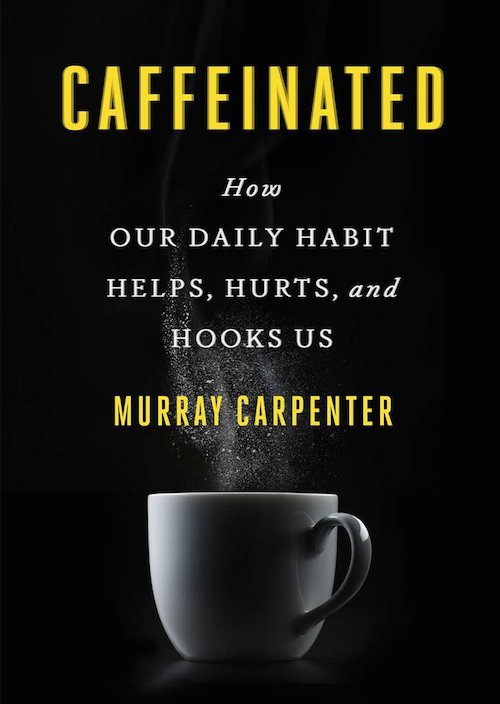
Journalist Murray Carpenter has written a new book about the world’s most popular drug — caffeine. And it answers questions that many coffee drinkers surely wonder about: Is caffeine addictive? What exactly does it do to our biochemistry? How does it gives us a jolt? And what health consequences does it have (or not have)? These questions all get answered in the book, Caffeinated: How Our Daily Habit Helps, Hurts, and Hooks Us. And much of them were discussed when Carpenter recently visited my favorite radio program in San Francisco, KQED’s Forum. You can listen to the interview below:
Earlier this year, Gregor Weichbrodt, a German college student, took all of the geographic stops mentioned in Jack Kerouac’s On the Road, plugged them into Google Maps, and ended up with a 45-page manual of driving directions, divided into chapters paralleling those of Kerouac’s original book. Now he’s back with a culinary mashup. Not mashed potatoes, but mashed up recipes for cooking chicken.
“Cooking recipes from the web have been collected and mixed randomly together,” and the result is Chicken Infinite, an avant-garde recipe for making chicken that spans some 532 pages. According to Weichbrodt, Chicken Infinite –available as a free PDF or paperback– “plays with the concept of instructions itself” that you regularly see on websites or in manuals. It’s a concept that cut-up artist William S. Burroughs could love. As for how Chicken Infinite actually tastes, someone (with a little time and a sense of adventure) will have to let us know.
Here’s a quick shot of science to start your day. The American Chemical Society, an organization representing chemists across the US, has released the latest in a series of Reactions videos. Attempting to explain the science of everyday things, previous Reactions videos have demystified the chemistry of Sriracha, Love, Pepper and more. This latest video breaks down the world’s most widely used stimulant, caffeine. If you haven’t had your morning cup of coffee, you may need to watch this video twice.
On a side note, if you live in the San Francisco Bay Area, consider spending Saturday, May 3rd at Stanford’s one-day coffee symposium. Organized by Stanford Continuing Studies, the symposium – Coffee: From Tree to Beans to Brew and Everything in Between – will feature guest speakers (historians, scientists, the CEO of Blue Bottle Coffee, etc.) talking about what goes into making this great beverage of ours. Students will also have the opportunity to participate in coffee tasting and evaluation sessions. In full disclosure, I helped put the program together. It promises to be a great day. So I had to give a plug. You can learn more and sign up here.
I can hardly think of a more appealing nexus of the sciences, for most of us and for obvious (and delicious) reasons, than food. Add a kind of engineering to the mix, and you get the study of cooking. Back in 2012, we featured the first few lectures from Harvard University’s course Science and Cooking: From Haute Cuisine to the Science of Soft Matter. Their collection of rigorous and entertaining presentations of that which we love to prepare and, even more so, to eat has since expanded to include one- to two-hour lectures delivered by sharp professors in cooperation with respected chefs and other food luminaries on culinary subjects like the science of sweets (featuring Flour Bakery’s Joanne Chang), how to do cutting-edge modernist cuisine at home (featuring Nathan Myhrvold, who wrote an enormous book on it), and the relevance of microbes, misos, and olives (featuring David Chang of Momofuku fame). You can watch all of the lectures, in order, with the playlist embedded at the top of this post.
Alternatively, you can pick and choose from the complete list of Harvard’s Science and Cooking lectures on Youtube or on iTunes. Some get deep into the natural workings of specific dishes, ingredients and preparation methods; others, like “The Science of Good Cooking” with a couple of editors from Cook’s Illustrated, take a broader view. That lecture and others will certainly help build an intellectual framework for those of us who want to improve our cooking — and even those of us who can already cook decently, or at least reliably follow a recipe — but can’t quite attain the next level without understanding exactly what happens when we flick on the heat. One school of thought holds that, to come off as reasonably skilled in the kitchen, you need only master one or two showcase meals. When asked to cook something, I, for instance, have tended to make paella almost every time, almost out of sheer habit. But now that I’ve found Raül Balam Ruscalleda’s talk on the science of that traditional Spanish dish, I can see that I must now, on several levels, raise my game. View it below, and feel free to take notes alongside me. You can find Science and Cooking in our collection of 900 Free Online Courses from Top Universities.
“Cappuccino small, low fat, extra dry.” Sorry to say, but that’s my line 2–3 times per day. That makes me almost as bad as the coffee-ordering hipsters in this new video by Nacho Punch. Let the video roll for a bit. It has its funny moments.
On a more serious note, if you live in the San Francisco Bay Area, consider spending Saturday, May 3rd at Stanford’s one-day coffee symposium. Organized by Stanford Continuing Studies, the symposium — Coffee: From Tree to Beans to Brew and Everything in Between – will feature guest speakers (historians, scientists, the CEO of Blue Bottle Coffee, etc.) talking about what goes into making this great beverage of ours. Students will also have the opportunity to participate in coffee tasting and evaluation sessions. In full disclosure, I helped put the program together. It promises to be a great day. So I had to give a plug. You can learn more and sign up here.
We're hoping to rely on loyal readers, rather than erratic ads. Please click the Donate button and support Open Culture. You can use Paypal, Venmo, Patreon, even Crypto! We thank you!
Open Culture scours the web for the best educational media. We find the free courses and audio books you need, the language lessons & educational videos you want, and plenty of enlightenment in between.