A little food for thought. The Guardian talked with a palliative nurse who has recorded the most common regrets of the dying. It’s worth giving the top five regrets a read, especially if you’re at risk of ending up in the same penitent place. Here, the nurse lists the misgiving most commonly cited by men: “I wish I hadn’t worked so hard.”
This came from every male patient that I nursed. They missed their children’s youth and their partner’s companionship. Women also spoke of this regret, but as most were from an older generation, many of the female patients had not been breadwinners. All of the men I nursed deeply regretted spending so much of their lives on the treadmill of a work existence.
It started simply enough in 1999. Jeff Harris, a photographer based in Toronto, took his first self-portrait, something he has since repeated every day. His visual diary now amounts to 4,748 photos and they tell a very personal story. They show the passing of time, some fairly normal moments, but also some difficult ones. In November 2008, Harris was diagnosed with cancer, and his experience with it — his surgery, radiation treatment, eventual paralysis in one leg — all gets visually documented by his project. The video above, originally appearing on TIME’s web site, takes you inside Harris’ project. The clip runs 5 minutes.
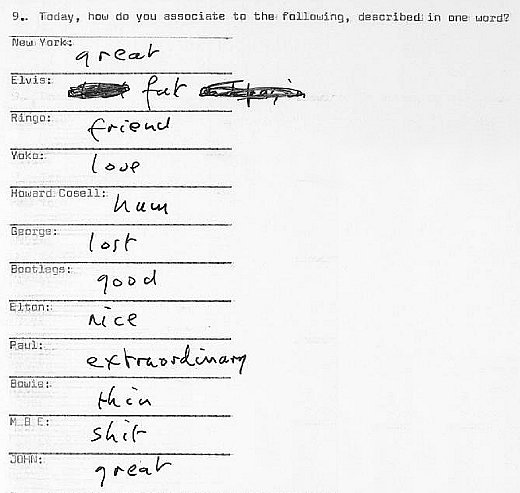
In 1976 a youthful fan named Stuart sent John Lennon a six-page list of questions. The former Beatle responded with answers, along with a child-like drawing of a lamb standing on a cloud, saying, “Hi Stuart.”
Stuart wanted to know a few things, like what sort of album Lennon was working on. “Until it’s been on tape,” Lennon replied, “I never know what it will be.” He also wondered if the famous musician was writing anything, like perhaps an autobiography. “Yes, I have been writing, but not an autobiography. I’ve noticed that people tend to DIE after writing their life story.”
The young fan included a list of words and names, along with the question: How would you characterize the following figures in one word?
John: “Great”
Paul: “Extraordinary”
George: “Lost”
Ringo: “Friend”
Elvis: “Fat”
Yoko: “Love”
Howard Cosell: “Hum”
Lennon signed off with, “It was a pleasure, hope ya dig it/John Lennon.”
Pickin’ & Trimmin’ is a documentary short film from 2008 profiling “The Barbershop” in Drexel, North Carolina, where Lawrence Anthony and David Shirley have barbered for decades, and where bluegrass musicians have jammed in the back room every weekend. Directed by Matt Morris, the award-winning film showcases the people and atmosphere of a small community in rural America, perhaps better than anything you’ve seen before. And the music played in the back room is simply wonderful.
You can find photos taken at The Barbershop on Flickr here. The film itself has been added to the Documentary section of our Free Movies collection.
Update: Lawrence Anthony, the head barber portrayed in this film, passed away in 2009. His son continues to run The Barbershop, but severe water damage has left the shop in need of repair. Here is a video showing the current situation.
By profession, Matthias Rascher teaches English and History at a High School in northern Bavaria, Germany. In his free time he scours the web for good links and posts the best finds on Twitter.
18 months after being diagnosed with oesophageal cancer, the polemical writer Christopher Hitchens has died at the age of 62. His fans began to fear the worst last month when Hitchens, suddenly hospitalized with pneumonia, couldn’t attend a widely-publicized debate in London. The promoters of the event, Intelligence², quickly turned the debate into a celebration of Hitchens’ life. Stephen Fry played host, and Richard Dawkins, Christopher Buckley, Salman Rushdie, Lewis Lapham, Martin Amis, James Fenton and Sean Penn all paid tribute. Above, we’re highlighting the poignant video once again.
Also fittingly, we’re bringing back another clip that features Hitchens discussing how his struggle with cancer affected his views on the question of an afterlife. “I would say it fractionally increases my contempt for the false consolation element of religion and my dislike for the dictatorial and totalitarian part of it,” he responded. “It’s considered perfectly normal in this society to approach dying people who you don’t know but who are unbelievers and say, ‘Now are you gonna change your mind?’ That is considered almost a polite question.” During the event taped last February (watch the full program here), Hitchens made his views pretty clear: No deathbed conversion for me, thanks, but it was good of you to ask.
And finally we cap things off with a montage of 22 comments from Christopher Hitchens. When you add them all up, you get some vintage Hitchens — everything that made him sometimes loved, sometimes hated but always respected.
If you have never spent time reading Hitch, we’re going to recommend his last piece for Vanity Fair — his reflection on Nietzsche’s famous line “Whatever doesn’t kill me makes me stronger.” It was published last week, and it’s quite the coda.
Since the late 1990′s, Alain de Botton has been breaking down difficult philosophical and literary ideas and seeing how they apply to people’s everyday lives. He did this with his 1997 bestseller, How Proust Can Change Your Life. And he took things a step further with his television series called Philosophy: A Guide to Happiness.
Then, in the summer of 2008, de Botton and some colleagues set up The School of Life, a London-based institution that offers courses “in the important questions of everyday life,” in areas we all tend to care about: careers, relationships, politics, travels, families, etc. The school also hosts a series of “Sunday Sermons” that feature “maverick cultural figures” talking about the virtues they cling to, and the vices to be wary of.
Today, we’re featuring several of these sermons. Above, the actress, writer, and director Miranda July takes an offbeat and endearing look at strangers, and the role they play in our lives. Then come some notable mentions:
When not founding tech companies, Damon Horowitz teaches philosophy through the Prison University Project, bringing college-level classes to inmates of San Quentin State Prison. In three minutes, Horowitz raps about philosophy meeting real life — about how prisoners convicted of serious crimes come to terms with Socrates (who finished his days in prison), Heidegger, Kant, categorical imperatives, questions of right and wrong, and the rest. The “talk” was originally presented at TED 2011 last March.
We're hoping to rely on loyal readers, rather than erratic ads. Please click the Donate button and support Open Culture. You can use Paypal, Venmo, Patreon, even Crypto! We thank you!
Open Culture scours the web for the best educational media. We find the free courses and audio books you need, the language lessons & educational videos you want, and plenty of enlightenment in between.
 A little food for thought. The Guardian talked with a palliative nurse who has recorded the most common regrets of the dying. It’s worth giving the top five regrets a read, especially if you’re at risk of ending up in the same penitent place. Here, the nurse lists the misgiving most commonly cited by men: “I wish I hadn’t worked so hard.”