He’s not wrong about the therapeutic benefits of group singing. Ditto the imperative to resist gathering publicly, or even in the homes of extended family and close friends, until this crisis is in the rear view.
Choir! Choir! Choir!, an ongoing community sing that’s attained global renown thanks to its frequent tours, charitable work, and the support of such starry personages as Patti Smith and David Byrne, has had to put the kibosh on live group events. (Check out their 2014 singalong of Diamond’s “Sweet Caroline,” above, for a taste of the proceedings.)
With everyone staying home, founders Nobu Adilman and Daveed Goldman quickly implemented a digital work around, inviting fans and first-timers alike to weekly online sing-ins.
Their next Social Distan-Sing-Along is coming up this Saturday, April 4th at 3pm EDT, featuring a campfire-themed playlist:
“The Weight”
“Blowin’ In The Wind”
“Our House”
“Leaving On A Jet Plane”
“Redemption Song”
“Talkin Bout A Revolution”
“Dust In The Wind”
“Cats In The Cradle”
“Wild World”
(Sadly, no “Titanic,” but perhaps that one’s more summer camp than campfire, and these days, it’s probably best to sidestep any number, no matter how silly, that springs from mass casualties…)
Participants are instructed to print a file of the song lyrics in advance and show up to the digital campfire (live streaming on YouTube or Facebook) with a couple of devices—enough to follow along with Adilman and Goldman, while simultaneously Zooming in any friends you’ve pre-arranged to sing with.
(With 1000s attending, one of Choir! Choir! Choir!’s usual joys—lifting one’s voice with a vast chorus of mostly strangers—is a logistical and technological impossibility.)
Participants are also encouraged to share footage of themselves singing along, using the hashtag #NeverStopSinging—though we remind our non-performance-oriented readers that this is merely a suggestion.
Choir! Choir! Choir in isolation may well attract shower Sinatras who’d never dream of opening their mouths at an in-person event.
It’s a golden opportunity for the vocally shy to become part of one of the biggest choirs in history, secure in the knowledge that the only people to hear them croaking away will be the cat, the dog, any human co-inhabitants… and, oh dear, what about neighbors in the immediate vicinity?
Don’t worry about the neighbors. In fact, prick up your ears—you may hear them singing the exact same tunes.
To get you in the mood, here are some of our favorites from Choir! Choir! Choir!’s classic playlist:
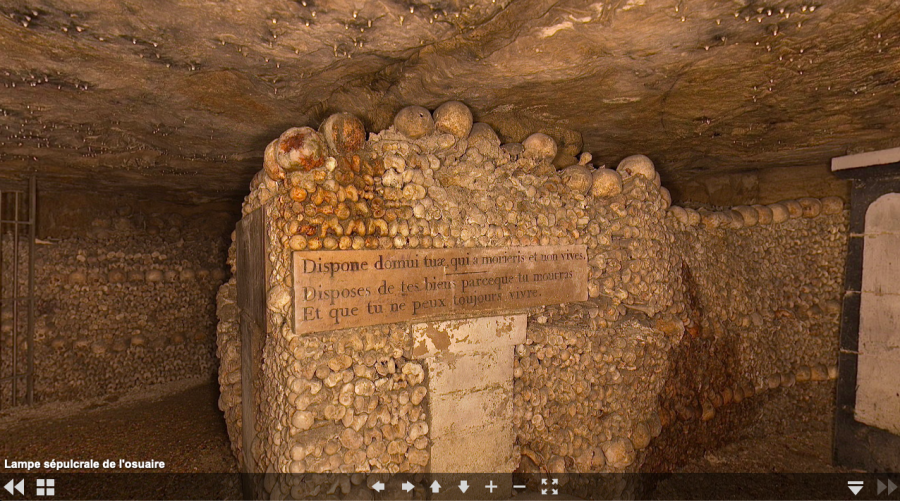
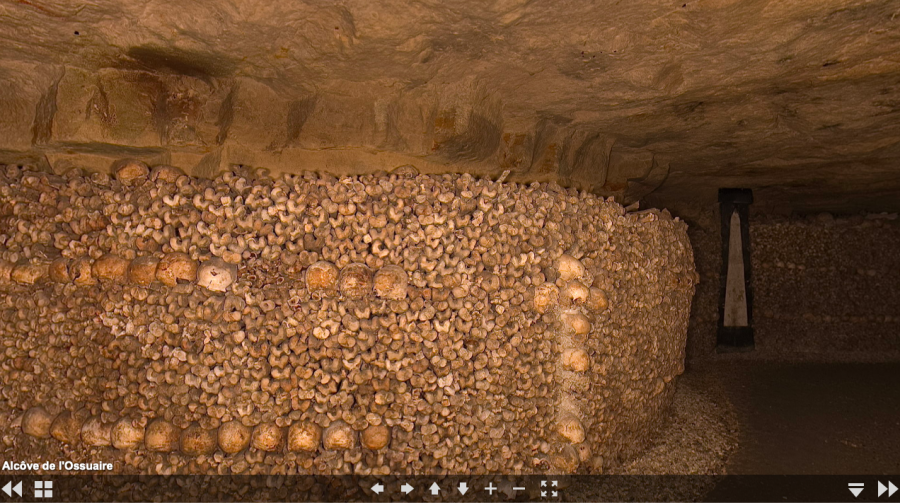
The Paris Catacombs is “one of those places,” wrote photographer Félix Nadar, “that everyone wants to see and no one wants to see again.” If anyone would know, Nadar would. He spent three months in and out of the underground city of death, with its macabre piles of skulls and crossbones, taking photographs (see here) that would help turn it into an internationally famous tourist attraction. In these days of quarantine, no one can see it; the site is closed until further notice. But if you’re the type of person who enjoys touring necropolises, you can still get your fix with a virtual visit.
Why would anyone want to do this, especially during a global outbreak? The Catacombs have attracted seekers after morbid curiosities and spiritual and philosophical truths for over two hundred years, through revolutions, massacres, and plagues.
A stark, haunting reminder of what Nadar called “the egalitarian confusion of death,” they witness mutely, without euphemism, to the future we are all assured, no matter our rank or position. They began as a disordered pile of bones in the late 18th century, transferred from overcrowded cemeteries and became a place where “a Merovingian king remains in eternal silence next to those massacred in September ‘92” during the French Revolution.
Contemplations of death, especially in times of war, plague, famine, and other shocks and crises, have been an integral part of many cultural coping mechanisms, and often involve meditations on corpses and graveyards. The Catacombs are no different, a sprawling memento mori named after the Roman catacombs, “which had fascinated the public since their discovery,” as the official site notes. Expanded, renovated, and rebuilt during the time of Napoleon and later during the extensive renovations of Paris in the mid-19th century, the site was first “consecrated as the ‘Paris Municipal Ossuary’ on April 7, 1786” and opened to the public in 1809.
It is a place that reminds us how all conflicts end. To the “litany of royal and impoverished dead from French history,” writes Allison Meier at the Public Domain Review, Nadar added in his essay on the Catacombs “the names of revolutionary victims and perpetrators like Maximilien Robespierre and Jean-Paul Marat.” Ruminations on the universal nature of death may be an odd diversion for some, and for others an urgent reminder to find out what matters to them in life. Learn more about the fascinating history of the Paris Catacombs here and begin your virtual visithere.
When I became the Kennedy Center Education Artist-in-Residence, I didn’t realize the most impactful word in that title would be “Residence.” —illustrator Mo Willems
Even as schools regroup and online instruction gathers steam, the scramble continues to keep cooped-up kids engaged and happy.
These COVID-19-prompted online drawing lessons and activities might not hold much appeal for the single-minded sports nut or the junior Feynman who scoffs at the transformative properties of art, but for the art‑y kid, or fans of certain children’s illustrators, these are an excellent diversion.
Once the design is complete, he rolls the dice to advance both his piece and that of his home viewer. A 5 lands him on the crowd-pleasing directive “fart.” Clearly the online instructor enjoys certain liberties the classroom teacher would be ill-advised to attempt.
Check out the full playlist on the Kennedy Center’s YouTube channel and download activity pages for each episode here.
#MoLunchDoodles
If the daily LUNCHDOODLES leaves ‘em wanting more, there’s just enough time for a quick pee and snack break before Lunch Lady’sJarrett J. Krosoczka takes over with Draw Everyday with JJK, a basic illustration lesson every weekday at 2pm EST. These are a bit more nitty gritty, as JJK, the kid who loved to draw and grew up to be an artist, shares practical tips on penciling, inking, and drawing faces. Pro tip: resistant Star Wars fans will likely be hooked by the first episode’s Yoda, a character Krosoczka is well versed in as the author and illustrator of the Star Wars Jedi Academy series.
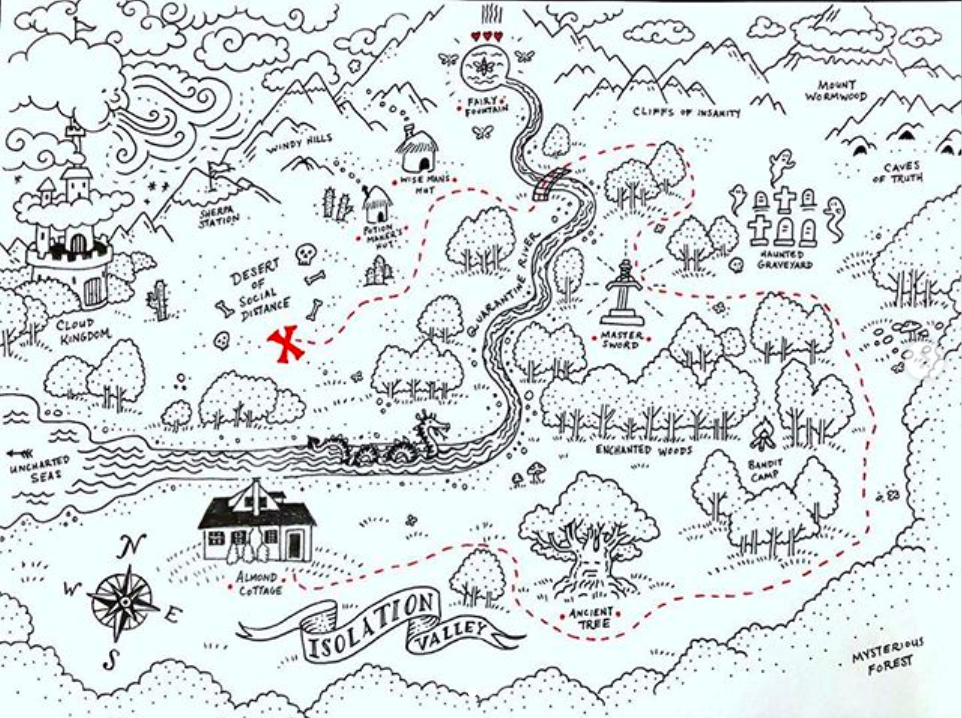
DRAW A MAP: When we think of treasure maps, we think of sea monsters, islands with palm trees, pirate ships, anthropomorphic clouds blowing gales upon white-capped seas. YOUR map can be of anywhere: an enchanted wood, a dystopian suburb, your backyard, your apartment that has never felt so small, all of the above, none of the above. Or your map can be a traditional treasure map leading to a pirate’s hoard. It’s totally up to you. Three things that you MUST include are: a compass rose (very important—look this up if you don’t know what it is), the name of the place you are mapping, and a red X.
DRAW THE TREASURE: The first part of this assignment is to draw a map with a red X to mark the location of hidden treasure. The second part of this assignment is to draw the treasure. I don’t know what the treasure is. Only you know what the treasure is. Draw it on a separate piece of paper from the map.
BONUS POINTS: If you’re going to post this on instagram, I recommend formatting it with two images. Post the map first, then the treasure which the viewer will swipe to see. This will create what we in the kids book world call AN IMPACTFUL PAGE TURN. That’s the thing that happens when you’re reading a picture book and you turn the page to discover something funny or surprising. It’s kind of hard to explain, but you know a good page turn when you’ve experienced one.
#QuarantineArtClub
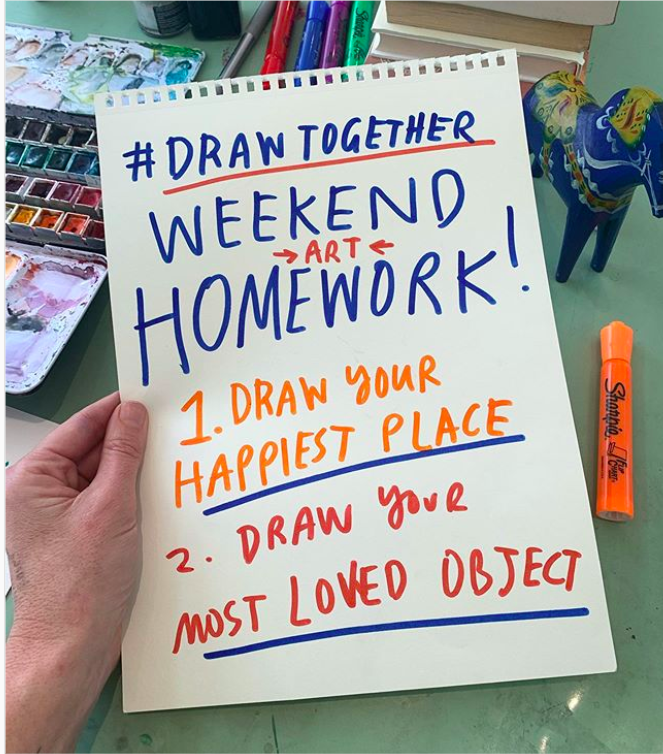
Wendy McNaughton, who specializes in drawn journalism, also likes the Instagram platform, hosting a live Draw Together session every school day, from 10–10.30 am PST. Her approach is a bit more freeform, with impromptu dance parties, special guests, and field trips to the backyard.
Her How to Watch Draw Together highlight is a hilarious crash course in Instagram Live, scrawled in magic marker by someone who’s possibly only now just getting a grip on the platform. Don’t see it? Maybe it’s the weekend, or “maybe ask a millennial for help?”
And bless E.B. Goodale, an illustrator, first time author and mother of a young son, who having counteracted the heartbreak of a cancelled book tour with a hastily launched week of daily Instagram Live Toddler Drawing Club meetings, made the decision to scale back to just Tuesdays and Thursdays:
It was fun doing it everyday but turned out to be a bit too much to handle given our family’s new schedule. We’re all figuring it out, right? I hope you will continue to join me in our unchartered territory next week as we draw to stay sane. Tune in live to make requests or watch it later and follow along at home.
(Her How to Draw a Cat tutorial, above, was likely intended for in-person bookstore events relating to her just published Under the Lilacs…)
#drawingwithtoddlers
Our personal favorite is Stickies Art School, whose online children’s classes are led not by multi-disciplinary artist Nina Katchadourian, whose Facebook page serves as the online institution’s home, but rather her senior tuxedo cat, Stickies.
Stickies, who comes to the gig with an impressive command of English, honed no doubt by frequent appearances on Katchadourian’s Instagram page, affects a diffident air to dole out assignments, the latest of which is above.
He allows his students ample time to complete their tasks—thus far all portraits of himself. The next one, to render Stickies in a costume of the artist’s choice, is due Wednesday by 9am, Berlin time.
There have been so many conversations at NYU Gallatin where I’m on the faculty about online teaching, how to do it, how to think of a studio course in this new form, etc, and I think perhaps that crossed over with the desire to cheer up some people with kids, many of whom are already Stickies fans, or so I have been told.
His child proteges are no doubt unaware that Stickies looked ready to leave the planet several weeks ago, a fact whose import will resonate with many pet owners in these dark days:
Maybe a third element was just being so glad he is still around, that having him actively “out there” feels good and life-affirming at the moment.
Stickies Art School is marvelous fun for adults to audit from afar, via Katchadourian’s public Facebook posts. If you are a parent whose child would like to participate, send her a friend request and mention that you’re doing so on behalf of your child artist.
Searching on the hashtag #artteachersofinstagram will yield many more resources.
Ayun Halliday is an author, illustrator, theater maker and Chief Primatologist of the East Village Inky zine. Given the cancellation of everything, she’s taken to Instagram to document her social distance strolls through New York City’s Central Park, using the hashtag #queenoftheapeswalk Follow her @AyunHalliday.
An embarrassment of riches for those whose experience of COVID-19 is somewhere between extended snow day and staycation…
But what about caregivers who suddenly find themselves providing 24–7 care for elders with dementia, or neuro-atypical adult children whose upended routine is wreaking havoc on their emotions?
“I know people are happy that the schools have closed but I just lost critical workday hours and if/when day hab closes I will have to take low-paid medical leave AND we will not have any breaks from caregiving someone with 24–7 needs and aggressive, loud behaviors. I feel completely defeated,” one friend writes.
24 hours later:
We just lost day hab, effective tomorrow. My messages for in-home services haven’t been returned yet. Full on panic mode.
What can we do to help lighten those loads when we’re barred from physical interaction, or entering each other’s homes?
We combed through our archive, with an eye toward the most soothing, uplifting content, appropriate for all ages, starting with pianist Paul Barton’s classical concerts for elephants in Kanchanaburi, Thailand, above.
We’ve also got a trove of free coloring books and pages, though caregivers should vet the content before sharing it with someone who’s likely to be disturbed by medical illustration and images of medieval demons…
Readers, if you know a resource that might buy caregivers and their agitated, housebound charges a bit of peace, please add it in the comments below.
This video of Tilda Swinton’s Springer Spaniels cavorting in pastoral Scotland to a Handel aria performed by countertenor Anthony Roth Costanzo won’t cure what ails you, but it is definitely good medicine.
Swinton and her partner, artist Sandro Kopp, filmed the beautiful beasts in such a way as to highlight their doggy exuberance, whether moving as a pack or taking a solo turn.
The title of the aria, “Rompo i Lacci,” from the second act of Flavio, translates to “I break the laces,” and there’s no mistaking the joy Rosy, Dora, Louis, Dot, and Snowbear take in being off the leash.
Flashbacks to their rolypoly puppy selves are cute, but it’s the feathery ears and tails of the adult dogs that steal the show as they bound around beach and field.
The filmmakers get a lot of mileage from their stars’ lolling pink tongues and willingness to vigorously launch themselves toward any out of frame treat.
We’ve never seen a tennis ball achieve such beauty.
There’s also some fun to be had in special effects wherein the dogs are doubled by a mirror effect and later, when one of them turns into a canine Rorschach blot.
The video was originally screened as part of Costanzo’s multi-media Glass Handel installation for Opera Philadelphia, an exploration into how opera can make the hairs on the back of our neck stand up.
It’s not like we’re maestros…it’s a moment of joy in this moment of anxiety. —Emma Santachiara, Rome
As reported by The New York Times, Ms. Sanachiara, age 73, has joined the vast choir of ordinary Italians taking to their balconies and windows to participate in socially distant neighborhood singalongs as coronavirus rages through their country.
The Internet has been exploding with messages of support and admiration for the quarantined citizens’ musical displays, which have a festive New Year’s Eve feel, especially when they accompany themselves on pot lids.
Three days ago, Rome’s first female mayor, Virginia Raggi, called upon residents to fling open their windows or appear on their balconies for nightly 6pm community sings.
A woman in Turin reported that the pop up musicales have forged friendly bonds between neighbors who in pre-quarantine days, never acknowledged each other’s existence.
Naturally, there are some soloists.
Tenor Maurizio Marchini serenaded Florentines to “Nessun Dorma,” the famous aria from Puccini’s opera Turandot, repeating the high B along with a final Vincerò!, which earns him a clap from his young son.
In Rome, Giuliano Sangiorgi, frontman for Negramaro, hit his balcony, guitar in hand, to entertain neighbors with Pino Daniele’s 1980 hit “Quanno Chiove” and his own band’s “Meraviglioso.”
Earlier in the year, the 11 million residents of Wuhan, China, the deadly epicenter of the coronavirus outbreak, also used music to boost morale, singing the national anthem and other patriotic songs from their individual residences. Jiāyóu, or “add oil,” was a frequent exhortation, reminding those in isolation to stay strong and keep going.
Readers, are you singing with your neighbors from a safe distance? Are they serenading you? Let us know in the comments.
Ayun Halliday is an author, illustrator, theater maker and Chief Primatologist of the East Village Inky zine. Like most of us in this crazy, historic period, all of her events have been cancelled. Follow her @AyunHalliday.
It seems ridiculous to refer to the Golden Rule as a “weapon,” but that is just what it is—a weapon that no resistance on earth can withstand! —Napoleon Hill
Napoleon Hill—whose early books The Law of Success (1928), The Magic Ladder To Success (1930), and Think and Grow Rich (1937) helped establish the self-help genre—would be considered a life coach or motivational speaker in today’s parlance.
We think it’s important to tip you off to that shady side, because Hill’s “10 Rules for Profitable Self Discipline,” above, are so sunny, they could spur you to disseminate them immediately, leaving you vulnerable to harsh words from better informed friends and, more crucially, social media followers, who are already het up about any number of things in this election year, and who enjoy the catharsis a good call out affords.
Ergo, if you’re inclined to share, investigate the well from which they sprung, and then decide whether or not you want to proceed.
Why did we proceed?
Because practiced with the purest of intentions, these rules constitute extremely humanistic advice from a man whose outward philosophy continues to be a touchstone for many in the business community.
And as evidenced by the comments left by grateful YouTube viewers, many of whom stumbled across his words by accident, people are thirsty for such explicitly positive guideposts to interpersonal dealings.
(A good number also seem quite taken with the Virginia native’s old timey speech patterns and vintage lingo.)
If nothing else, applying these rules could sweeten your next argument with someone you love, or serve as inspiration if you’re ever called upon to give a commencement speech:
Napoleon Hill’s 10 Rules for Profitable Self Discipline
Keep a cool head around hot heads. Rage doesn’t have to be contagious,.
Believe that there are three sides to every argument. If you’re in a dust-up, don’t assume that the fault lays with the other person, but rather that you both shoulder a portion of the blame. This is a pretty compassionate way of ensuring that everyone’s ass will be partially covered for both better and worse.
Never give directives to a subordinate when you are angry. Given that swift and decisive action is often required of those in leadership positions, you’ll have to learn to ice your own hot head pretty quickly to put this one into consistent play.
Treat everyone as if they were a rich relative who might leave you a sizable inheritance. Which is kind of a gross way of putting it, but otherwise, we agree with Napoleon Hill that treating others with respect and loving attention is a real “honey” of a concept, especially if the other person can offer little beyond their friendship.
When you find yourself in an unpleasant circumstance, immediately start searching for the seed of an equivalent benefit within the experience. If Novak’s Gizmodo essay is any indication, Hill probably had a lot of opportunity to put this one into practice, squeezing lemonade from lemons of his own making.
Ask questions and listen to the answer. If you find yourself inclined to disagree with a statement, employ the phrase, “How do you know?” to get the speaker to do all the heavy lifting. For example, Napoleon Hill might say to Matt Novak, “How do you know?” which would be Matt Novak’s cue to produce a mountain of documentation.
Never say or do anything before thinking if it will benefit someone or hurt them. The goal is to refrain from hurting others. Let those of us are without sin cast the first stone here. Hill’s karmic spin on this rule is that any injuries you cause that don’t immediately come around to bite you in the ass, will bite you in the ass much harder at some future point, a la compound interest.
Learn the difference between friendly analysis and unfriendly criticisms. His not entirely foolproof method for distinguishing intent is to consider the nature of your relationship with the one offering the observations, their tone of voice, manner of delivery, and somewhat quaintly, whether or not they throw in any epithets. If it’s friendly, you can set some store by it. Otherwise, disregard.
A good leader knows how to take orders cheerfully. This pairs nicely with Rule Number 3, don’t you think?
The average person believes implicitly that the photograph cannot falsify. Of course, you and I know that this unbounded faith in the integrity of the photograph is often rudely shaken, for, while photographs may not lie, liars may photograph. —Lewis Wickes Hine, “Social Photography: How the Camera May Help in the Social Uplift” (1909)
Long before Brandon Stanton’s wildly popular Humans of New York project tapped into the public’s capacity for compassion by combining photos of his subjects with some telling narrative about their lives, educator and sociologist Lewis Wickes Hine was using his camera as a tool to pressure the public into demanding an end to child labor in the United States.
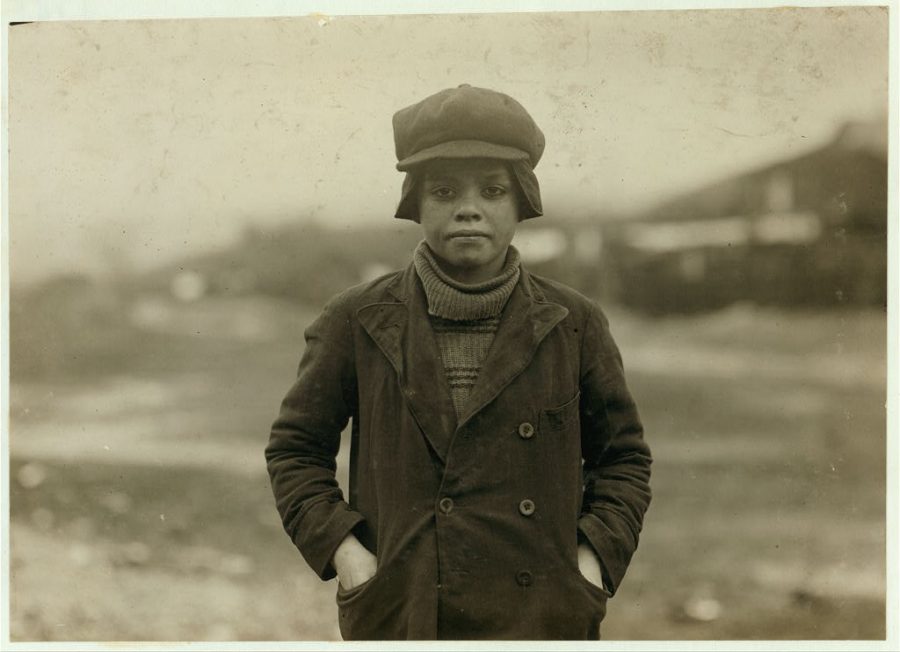
In a time when the US Federal Census reported that one in five children under the age of 16—over 1.75 million—was gainfully employed, Hines traversed the country under the auspices of the National Child Labor Committee, gathering information and making portraits of the underage workers.
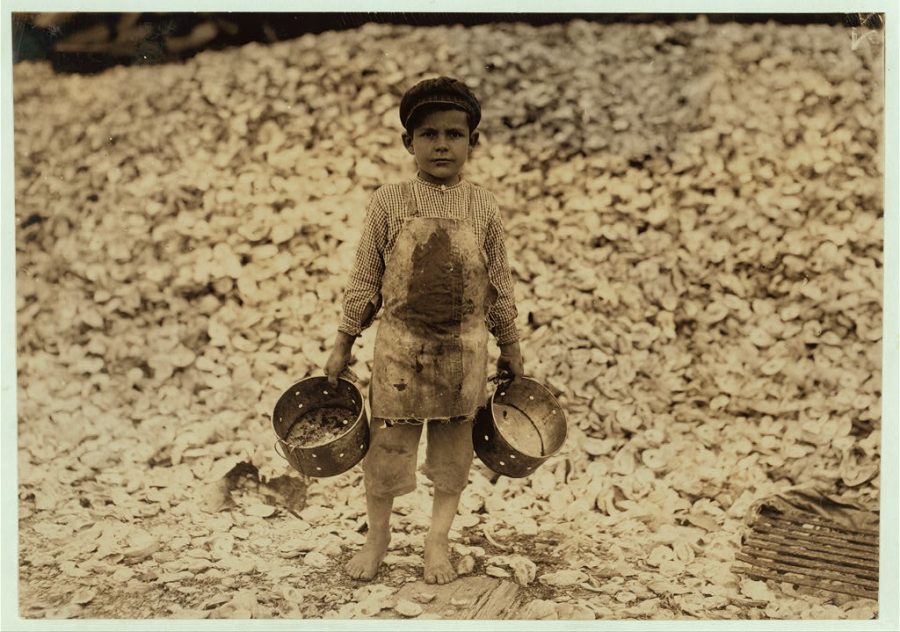
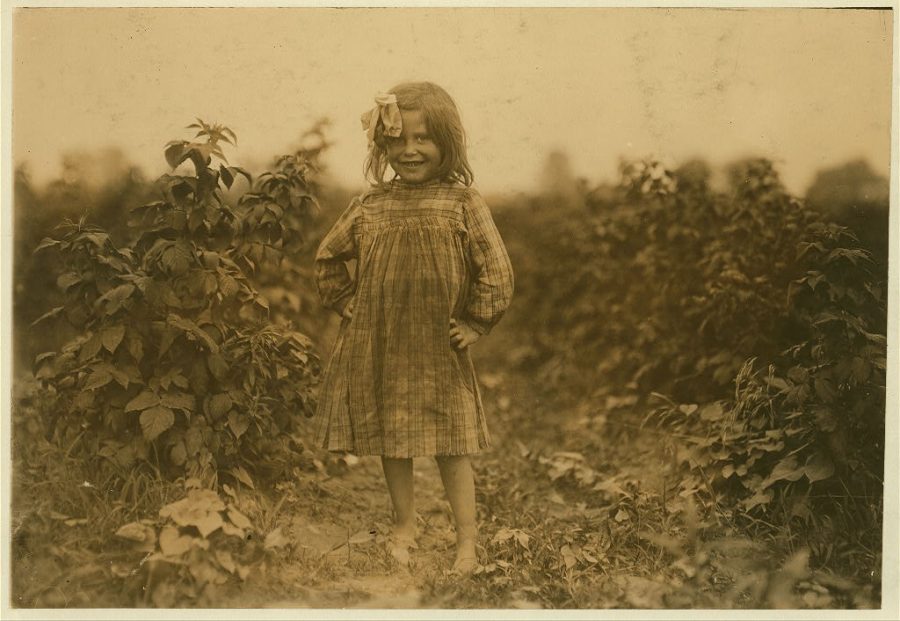
His images, made between 1911 and 1916, introduced viewers to young boys breaking up coal in Pennsylvania mines, tiny Louisiana oyster shuckers and Maine sardine cutters, child pickers in Kentucky tobacco fields and Massachusetts cranberry bogs, and newsboys in a number of cities.
Their employers actively recruited kids from poor families, wagering that they would perform repetitive, often dangerous tasks for a pittance, with little chance of unionizing.
Hine was a scrupulous documentarian, labeling each photo with crucial information gleaned from conversations with the child pictured therein: name, age, location, occupation, wages, and—horrifically—any workplace injuries.
As the Vox Darkroom segment, above, explains, Hine’s formal compositions lent additional power to his images of smudged child workers posing in their places of employment. Shallow depth of field to ensure that the viewer’s eyes would not become absorbed in the background, but rather engage with those of his subject.
But it was the accompanying narratives, which he referred to variously as “picture stories” or “photo-interpretations,” that he credited with really getting through to the hearts and minds of an indifferent public.
The text prevented viewers from easily brushing the children off as anonymous, scruffy urchins.
Here for instance is “Manuel, the young shrimp-picker, five years old, and a mountain of child-labor oyster shells behind him. He worked last year. Understands not a word of English. Dunbar, Lopez, Dukate Company. Location: Biloxi, Mississippi.”
“Laura Petty, a 6 year old berry picker on Jenkins farm, Rock Creek near Baltimore, Md. ‘I’m just beginnin.’ Picked two boxes yesterday. (2 cents a box).”
“Angelo Ross, 142 Panama Street, Hughestown Borough, a youngster who has been working in Breaker #9 Pennsylvania Co. for four months, said he was 13 years old, but very doubtful. He has a brother, Tony, probably under 14 working. Location: Pittston, Pennsylvania.”
Hine correctly figured that the combination of photo and biographical information was a “lever for the social uplift.”
Once the pictures were published in Progressive magazines, state legislatures came under immense pressure to impose minimum age requirements in the workplace, effectively ending child labor, and returning many former workers to school.
Ayun Halliday is an author, illustrator, theater maker and Chief Primatologist of the East Village Inky zine. Join her in NYC this March, when her company, Theater of the Apes, presents the world premiere of Tony Award winner Greg Kotis’ new low-budget, guitar-driven musical, I AM NOBODY. Follow her @AyunHalliday.
We're hoping to rely on loyal readers, rather than erratic ads. Please click the Donate button and support Open Culture. You can use Paypal, Venmo, Patreon, even Crypto! We thank you!
Open Culture scours the web for the best educational media. We find the free courses and audio books you need, the language lessons & educational videos you want, and plenty of enlightenment in between.