“A Short History of the Highrise,” a four-part interactive New York Times “Op-Doc” reminds me of a pop-up book. The very first lever I pulled (actually it was a wooden bucket) added a couple of stories to a medieval tower! I even snagged a couple of complimentary factoids about the Tower of Babel! Bonus!
The kids are gonna love it!
There are doors to push, scenic postcards to flip, a little Roman guy to drag to the right… what a creative use of the Times’ massive photo morgue. Director Katerina Cizek skitters throughout history and all over the globe, swinging by ancient Rome, Montezuma’s Castle cliff dwelling, China’s Fujian province, 18th century Europe, and Jacob Riis’ New York. Apparently, vertical housing is nothing new.
( I did find myself wondering what director Cizek might be angling for at the Dakota. The storied apartment building was long ago dwarfed by taller additions to New York City’s urban landscape, but its multiple appearances in the series indicate that it’s still its most desirable. Mercifully, none of the interactive features involve John Lennon.)
Would that a similar restraint had been exercised with regard to narration. I would have gladly listened to Professor Miles Glendinning, the mass housing scholar who lends his expertise to the project’s subterranean level. Alas, the non-interactive portion is marred by a bizarre rhyme scheme meant to “evoke a storybook.” If so, it’s the sort of storybook no adult (with the possible exception of the singer Feist, who was hopefully paid for her participation) wants to read aloud. A sample:
Publicly sponsored housing isn’t everywhere the diet
Beyond Europe, North America and the Soviet Union, high rise development is rampantly private.
Seriously?
Given the level of discourse, I see no reason we were deprived of a rhyme for “phallic symbol.” Those animated buildings do reach for the sky.
If it all gets a bit much you can head straight for “Home.” The final installment jettisons the cutesy-bootsy rhymes in favor of a lovely tune by Patrick Watson, which makes a pleasant soundtrack to reader-supplied photos of their balconies. The images have been arranged thematically — pets, storms, night — and the cumulative effect is charming. Click “More readers’ stories of life in high-rises” to read the first-hand accounts that go with these views. If your perch is high enough, you can submit one of your own.
You can watch a video trailer for “A Short History of the Highrise” up top and Part 1 of Cizek’s film below that. But to get the full interactive experience you’ll want to head over to the New York Times web site.
Amanda Palmer and Neil Gaiman strike me as a very happily married couple, an impression their live cover of Makin’ Whoopee supports.
What’s their secret? As anyone with an interest in romance or Earth Science will tell you, opposites attract. On the surface of things, the exhibitionistic, highly theatrical, always controversial Palmer is quite different from her unfailingly discreet husband of the last two-and-a-half years. (Watch him mine his reticence to great comic effect at the 2.52 mark.)
That’s not to say they don’t have things in common.
And while he has three children from a previous marriage, the Gaiman-Palmer union has yet to produce any little Neil or Amandas. Which brings us back to Makin’ Whoopee. Whether or not the lyrics jibe with one’s personal outlook, the song’s enduring popularity (85 years and counting) might suggest its central dilemma is evergreen. Its biological observations are certainly above reproach: sex often leads to babies, who lead to the sort of responsibilities that signal the end of the honeymoon, if not the marriage.
Perhaps an open relationship in the whoopee department will continue to keep things playful between the Gaiman-Palmers, regardless of what their future holds. It’s really none of our business, is it?
Ayun Halliday must tender her regrets as she is directing a cast of 15 home schooled teens in her husband’s musical, Yeast Nation, that night. Follow her @AyunHalliday
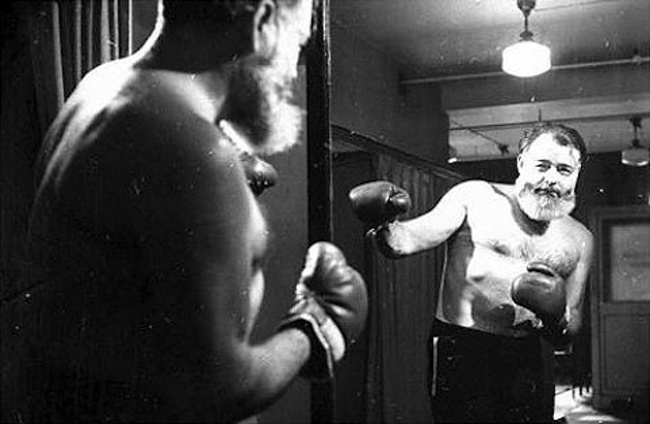
In a 1954 interview in the Paris Review, Ralph Ellison said of one of his literary heroes: “When [Ernest Hemingway] describes something in print, believe him; believe him even when he describes the process of art in terms of baseball or boxing; he’s been there.” I read this thinking that Ellison might be a bit too credulous. Hemingway, after all, has provoked no end of eye-rolling for his legendary machismo, bravado, and maybe several dozen other Latin descriptors for masculine foolhardiness and bluster. As for his “boxing,” we would be wise not to believe him. He may have “been there,” but the real boxers he encountered, and tried to spar with, would never testify he knew what he was doing
Ernest Hemingway wasn’t a boxer so much as he was a “boxer”… a legend in his own mind, a romantic. Hemingway’s friend and sometime sparring partner, novelist Morley Callaghan tells it this way: “we were two amateur boxers. The difference between us was that he had given time and imagination to boxing; I had actually worked out a lot with good fast college boxers.” Or, as the author of an article on the Fine Books & Collections site has it, “Hemingway was lost in the romance of a sport that has no romance to those seriously pursuing it; the romance strictly belongs to spectators.”
As a spectator with pretentions to greatness in the sport, Papa was prone to overestimating his abilities, at the expense of his actual skill as a writer. As he would tell Josephine Herbst, without a hint of irony, “my writing is nothing, my boxing is everything.”
Click for larger image
How did the pros evaluate his self-professed ability? Jack Dempsey, who spent time in Paris in the ‘20s being feted and fawned over, had this to say of Hemingway’s aspirations:
There were a lot of Americans in Paris and I sparred with a couple, just to be obliging…. But there was one fellow I wouldn’t mix it with. That was Ernest Hemingway. He was about twenty-five or so and in good shape, and I was getting so I could read people, or anyway men, pretty well. I had this sense that Hemingway, who really thought he could box, would come out of the corner like a madman. To stop him, I would have to hurt him badly, I didn’t want to do that to Hemingway. That’s why I never sparred with him.
Given Hemingway’s penchant for self-delusion in this matter, he may have interpreted this as Dempsey’s capitulation to his obvious prowess. An even more scathing critique of Hemingway’s bullying… I mean boxing skill … comes to us via Booktryst’s Stephen J. Gertz, who proffers an amusing dissection of the letter above, an unpublished correspondence Hemingway sent in 1943 to George Brown, the writer’s “trainer, coach, friend, and factotum.” Brown, it seems, was kindly, or prudent, enough to encourage his employer in his delusions. However, Gertz writes, “the reality was that anyone who had even the slightest idea of what they were doing in the ring could take Hemingway, who was notorious for foolishly trying to actually fight trained boxers.” He’s lucky, then, that Dempsey practiced such judicious restraint. If not, we may never have seen any fiction from Hemingway after he tried to go a round or two with the champ.
Ever wonder how famous philosophers from the past spent their many hours of tedium between paradigm-smashing epiphanies? I do. And I have learned much from the biographical morsels on “Daily Routines,” a blog about “How writers, artists, and other interesting people organize their days.” (The blog has also now yielded a book, Daily Rituals: How Artists Work.) While there is much fascinating variety to be found among these descriptions of the quotidian habits of celebrity humanists, one quote found on the site from V.S. Pritchett stands out: “Sooner or later, the great men turn out to be all alike. They never stop working. They never lose a minute. It is very depressing.” But I urge you, be not depressed. In these précis of the mundane lives of philosophers and artists, we find no small amount of meditative leisure occupying every day. Read these tiny biographies and be edified. The contemplative life requires discipline and hard work, for sure. But it also seems to require some time indulging carnal pleasures and much more time lost in thought.
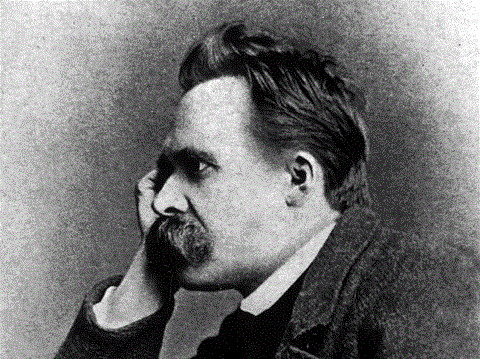
Let’s take Friedrich Nietzsche (above). While most of us couldn’t possibly reach the great heights of iconoclastic solitude he scaled—and I’m not sure that we would want to—we might find his daily balance of the kinetic, aesthetic, gustatory, and contemplative worth aiming at. Though not featured on Daily Routines, an excerpt from Curtis Cate’s eponymous Nietzsche biography shows us the curious habits of this most curious man:
With a Spartan rigour which never ceased to amaze his landlord-grocer, Nietzsche would get up every morning when the faintly dawning sky was still grey, and, after washing himself with cold water from the pitcher and china basin in his bedroom and drinking some warm milk, he would, when not felled by headaches and vomiting, work uninterruptedly until eleven in the morning. He then went for a brisk, two-hour walk through the nearby forest or along the edge of Lake Silvaplana (to the north-east) or of Lake Sils (to the south-west), stopping every now and then to jot down his latest thoughts in the notebook he always carried with him. Returning for a late luncheon at the Hôtel Alpenrose, Nietzsche, who detested promiscuity, avoided the midday crush of the table d’hôte in the large dining-room and ate a more or less ‘private’ lunch, usually consisting of a beefsteak and an ‘unbelievable’ quantity of fruit, which was, the hotel manager was persuaded, the chief cause of his frequent stomach upsets. After luncheon, usually dressed in a long and somewhat threadbare brown jacket, and armed as usual with notebook, pencil, and a large grey-green parasol to shade his eyes, he would stride off again on an even longer walk, which sometimes took him up the Fextal as far as its majestic glacier. Returning ‘home’ between four and five o’clock, he would immediately get back to work, sustaining himself on biscuits, peasant bread, honey (sent from Naumburg), fruit and pots of tea he brewed for himself in the little upstairs ‘dining-room’ next to his bedroom, until, worn out, he snuffed out the candle and went to bed around 11 p.m.
This comes to us via A Piece of Monologue, who also provide some photographs of Nietzsche’s favorite Swiss vistas and his austere accommodations. No doubt this life, however lonely, led to the production of some of the most world-shaking philosophical texts ever produced, perhaps rivaled in the nineteenth century only by the work of the prodigious Karl Marx.
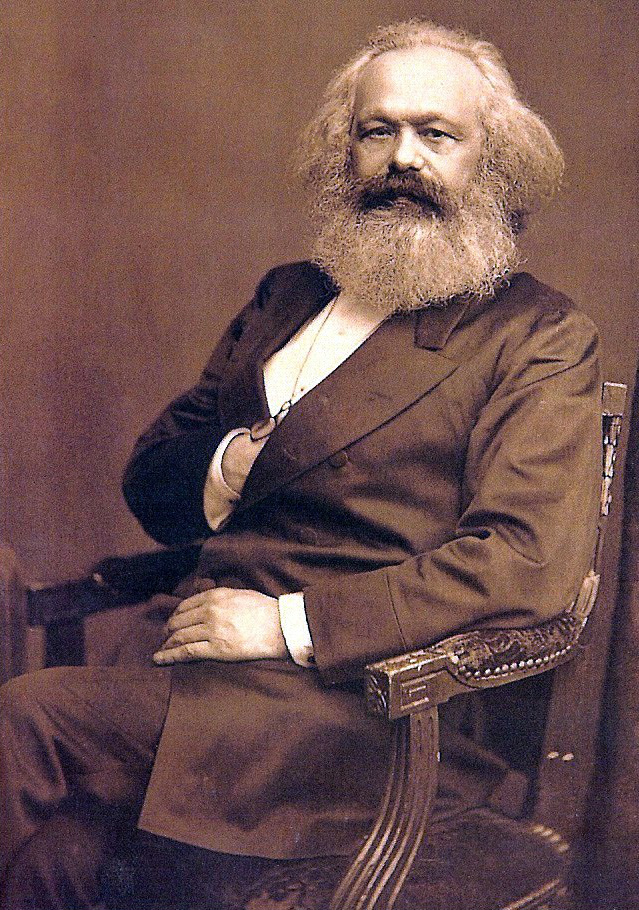
So how did Marx’s daily life compare to the morose and monkish Nietzsche? According to Isaiah Berlin, Marx also had his daily habits, though not quite so well-balanced.
His mode of living consisted of daily visits to the British Museum reading-room, where he normally remained from nine in the morning until it closed at seven; this was followed by long hours of work at night, accompanied by ceaseless smoking, which from a luxury had become an indispensable anodyne; this affected his health permanently and he became liable to frequent attacks of a disease of the liver sometimes accompanied by boils and an inflammation of the eyes, which interfered with his work, exhausted and irritated him, and interrupted his never certain means of livelihood. “I am plagued like Job, though not so God-fearing,” he wrote in 1858.
Marx’s money worries contributed to his physical complaints, surely, as much as Nietzsche’s social anxiety did to his. Not all philosophers have had such dramatic emotional lives, however.
Smoking plays a significant role as a daily aid, for good or ill, in the daily lives of many philosophers, such as that of giant of 18th century thought, Immanuel Kant. But Kant suffered from neither penury nor some severe case of unrequited love. He seems, indeed, to have been a rather dull person, at least in the biographical sketch below by Manfred Kuehn.
His daily schedule then looked something like this. He got up at 5:00 A.M. His servant Martin Lampe, who worked for him from at least 1762 until 1802, would wake him. The old soldier was under orders to be persistent, so that Kant would not sleep longer. Kant was proud that he never got up even half an hour late, even though he found it hard to get up early. It appears that during his early years, he did sleep in at times. After getting up, Kant would drink one or two cups of tea — weak tea. With that, he smoked a pipe of tobacco. The time he needed for smoking it “was devoted to meditation.” Apparently, Kant had formulated the maxim for himself that he would smoke only one pipe, but it is reported that the bowls of his pipes increased considerably in size as the years went on. He then prepared his lectures and worked on his books until 7:00. His lectures began at 7:00, and they would last until 11:00. With the lectures finished, he worked again on his writings until lunch. Go out to lunch, take a walk, and spend the rest of the afternoon with his friend Green. After going home, he would do some more light work and read.
For all of their various complaints and ailments, throughout their most productive years these highly productive writers embraced Gustave Flaubert’s maxim, “Be regular and orderly in your life, so that you may be violent and original in your work.” I have always believed that these are words to live and work by, with the addition of a little vice or two to spice things up.
If you would like to support the mission of Open Culture, consider making a donation to our site. It’s hard to rely 100% on ads, and your contributions will help us continue providing the best free cultural and educational materials to learners everywhere. You can contribute through PayPal, Patreon, and Venmo (@openculture). Thanks!
Their conversation has been resurrected as a four minute animation for PBS Digital Studios’ Blank on Blank series. The cartoon Janis bears a close resemblance to Gloria Steinem, an uncomfortable fit once the topic turns from her sadness at critical rejection to the sisterhood’s alleged withholding of affection.
Smith hits his subject with some leading questions that smack of the myriad ways Women’s Lib was distorted by even the liberal media of the time: “It seems to bother a lot of Women’s Lib people that you’re so upfront sexually,” he muses.
No need to take that one at anything less than face value…
Joplin allowed herself to be led, tossing off several statements that animator Patrick Smith faithfully illustrates. (In my opinion the wounded female drummers rock far more than pregnancy and vacuums, his shorthand for “settling.” )
When later, Joplin timidly asks if “all that $#*% I said about chicks” sounded bad, Smith reassures her that no, she said what she wanted to say. Perhaps he got what he wanted her to say.
As commenter heyitsmoiobserved on YouTube, “It’s always bothered me when people ask successful women to comment on how some other women don’t like them. I’ve yet to hear a successful man to be asked why other men don’t like him, even though there’s sure to be plenty. Women seem to constantly be put in this defensive position where they can’t answer the question without making it sound like all women are jealous beasts who can’t handle that some woman made it, and that’s simply not true.”
If you’re left feeling vaguely queasy, I suggest “Stiletto Power,” Blank on Blank’s take on Larry Grobel’s 1994 interview with Farrah Fawcett. Grobel’s approach seemed to have been one of turn on the tape recorder and then get out of the way. Mission accomplished. The resulting monologue is as ferocious as it is funny.
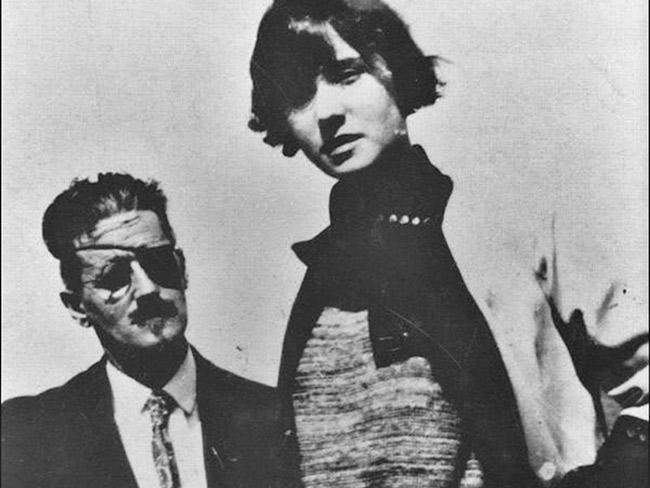
Writer and artist Alistair Gentry once proposed a lecture series he called “One Eyed Monster.” Central to the project is what Gentry calls “the cult of James Joyce,” an exemplar of a larger phenomenon: “the vulture-like picking over of the creative and material legacies of dead artists.” “Untalented and noncreative people,” writes Gentry, “are able to build lasting careers from what one might call the Talented Dead.” Gentry’s judgment may seem harsh, but the questions he asks are incisive and should give pause to scholars (and bloggers) who make their livings combing through the personal effects of dead artists, and to everyone who takes a special interest, prurient or otherwise, in such artifacts. Just what is it we hope to find in artists’ personal letters that we can’t find in their public work? I’m not sure I have an answer to that question, especially in reference to James Joyce’s “dirty letters” to his wife and chief muse, Nora.
The letters are by turns scandalous, titillating, romantic, poetic, and often downright funny, and they were written for Nora’s eyes alone in a correspondence initiated by her in November of 1909, while Joyce was in Dublin and she was in Trieste raising their two children in very straitened circumstances. Nora hoped to keep Joyce away from courtesans by feeding his fantasies in writing, and Joyce needed to woo Nora again—she had threatened to leave him for his lack of financial support. In the letters, they remind each other of their first date on June 16, 1904 (subsequently memorialized as “Bloomsday,” the date on which all of Ulysses is set). We learn quite a lot about Joyce’s predilections, much less about Nora’s, whose side of the correspondence seems to have disappeared. Declared lost for some time, Joyce’s first reply letter to Nora in the “dirty letters” sequence was recently discovered and auctioned off by Sotheby’s in 2004.
I do not excerpt here any of the language from Joyce’s subsequent letters, not for modesty’s sake but because there is far too much of it to choose from. If those prudish censors of Ulysses had read this exchange, they might have dropped dead from grave wounds to their sense of decorum. As far as I can ascertain, the letters exist in publication only in the out-of-print Selected Letters of James Joyce, edited by pre-eminent Joyce biographer Richard Ellmann, and in a somewhat truncated form on this site. Alistair Gentry has done us the favor of transcribing the letters as they appear in Ellmann’s Selected Letters on his site here. Of our interest in them, he asks:
Does anyone have the right to read things that were clearly meant only for two specific people…? Now that they have been exposed to the world’s gaze, albeit in a fairly limited fashion, does anybody except these two (who are dead) have any right to make objections about or exercise control over the manner in which these private documents and records of intimacy are used?
Questions worth considering, if not answered easily. Nevertheless, despite his critical misgivings, Gentry writes: “These letters stand on their own as brilliant and, dare I say, arousing Joycean writing. In my opinion they’re definitely worth reading.” I must say I agree. Joyce’s brother Stanislaus once wrote in a diary entry: “Jim is thought to be very frank about himself but his style is such that it might be contended that he confesses in a foreign language—an easier confession than in the vulgar tongue.” In the “dirty letters,” we get to see the great alchemist of ordinary language and experience practically revel in the most vulgar confessions.
She was receiving radiation therapy for the cancer that had just returned to her, she was living nearly homeless because she could not afford the upkeep on her home, which was literally falling in on itself, and now, she explained, she had received another indignity — a letter from Adult Protective Services telling her that someone had referred her case to them saying that she needed assistance in taking care of herself.
Vojtko had ended up in poverty after spending 25 years working as an adjunct professor of French at Duquesne University, a Catholic school located in Pittsburgh, Pa. Until she was terminated last spring, she worked “on a contract basis from semester to semester, with no job security, no benefits and with a salary of between $3,000 and just over $3,500 per three-credit course.” When teaching three classes a semester and two during the summer, Vojtko never earned more than $25,000 a year. (A pittance compared to the pay package of Duquesne’s president — reportedly about $700,000 per year in salary and benefits.) Meanwhile, Duquesne thwarted attempts by adjuncts to unionize, claiming that the school should have a religious exemption.
As Kovalik goes on to note: “Adjuncts now make up well over 50 percent of the faculty at colleges and universities.” And that statistic is bound to increase. You can — and should — read the full story at the Post-Gazette. Read Death of an Adjunct here.
In an excerpt from her memoir published in Salon last month, Najla Said—daughter of literary critic and Palestinian-American political activist Edward Said—recalls her father’s legacy:
To very smart people who study a lot, Edward Said is the “father of postcolonial studies” or, as he told me once when he insisted I was wasting my college education by taking a course on postmodernism and I told him he didn’t even know what it was:
“Know what it is, Najla? I invented it!!!”
I still don’t know if he was joking or serious.
Most likely Said was only half serious, but it’s impossible to overstate the impact of his 1978 book Orientalism on the generations of students and activists that followed. As Najla writes, it’s “the book that everyone reads at some point in college, whether in history, politics, Buddhism, or literature class.” Said’s “postmodernism,” unlike that of Francois Lyotard or many others, avoided the pejorative baggage that came to attach to the term, largely because while he called into doubt certain ossified and pernicious categorical distinctions, he never stopped believing in the positive intellectual enterprise that gave him the tools and the position to make his critiques. He stubbornly called himself a humanist, “despite,” as he writes in the preface to the 2003 edition of his most famous book, “the scornful dismissal of the term by sophisticated post-modern critics”:
It isn’t at all a matter of being optimistic, but rather of continuing to have faith in the ongoing and literally unending process of emancipation and enlightenment that, in my opinion, frames and gives direction to the intellectual vocation.
In that same preface Said also writes of his aging, of the recent death of two mentors, and of “the necessary diminutions in expectations and pedagogic zeal which usually frame the road to seniority.” He does not write about the leukemia that would take his life that same year at the age of 67, ten years ago this month.
For the interview above, however, Said’s last, he speaks candidly about his illness. Fittingly, the video opens with a quote from Roland Barthes: “The only sort of interview that one could, if forced to, defend would be where the author is asked to articulate what he cannot write.” Said tells interviewer Charles Glass that his main preoccupation in the past few months had been his illness, something he thought he had “mastered” but which had forced him to confront the incontrovertible fact of his mortality and sapped him of his will to work.
Said, as always, is articulate and engaging, and the conversation soon turns to his other preoccupations: the situation of the Palestinian people and the politics and personal toll of living “between worlds.” He also expresses his disappointment in friends who had become “mouthpieces of the status quo,” banging the drums for war and Western Imperialism in this, the first year of the war in Iraq. One suspects that he refers to Christopher Hitchens, among others, though he is too discreet to name names. Said has a tremendous amount to say on not only the current events of the time but on his entire career as a writer and thinker. Though he’s given dozens of impassioned interviews over the decades, this may be the most honest and unguarded, as he unburdens himself during his final days of those things, perhaps, he could not bring himself to write.
Thanks to Stephanos for sending this video our way.
We're hoping to rely on loyal readers, rather than erratic ads. Please click the Donate button and support Open Culture. You can use Paypal, Venmo, Patreon, even Crypto! We thank you!
Open Culture scours the web for the best educational media. We find the free courses and audio books you need, the language lessons & educational videos you want, and plenty of enlightenment in between.