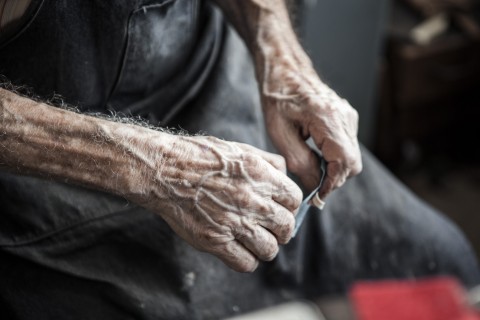
Frank Catalfumo, now 90-and-a-half years old, opened F&C Shoes in 1945, a shoe repair store in the Bensonhurst section of Brooklyn. During the past 70+ years, everything around Frank has changed. Prices have gone up; neighboring stores have come and gone, probably many times over. But one thing has remained the same. Frank “keeps moving forward,” coming to work five days a week and bringing worn souls back to life. His hands tell the story.
Pa, the horses got out of the barn again, and danged if they don’t appear to have passed through the Museum of Natural History on their way to Grand Central.
The otherworldly beasts are occupying the famed New York City transit hub’s Vanderbilt Hall this week as Heard NYC, a collaboration between artist Nick Cave and Creative Time, which commissions work for presentation in public spaces. For his latest feat, Cave took his Soundsuits—wearable sculptures with an organic sonic component—in a direction both equine and ethnographic. Sixty dancers from the Ailey School bring the herd of thirty to life, stamping raffia-sheathed legs and tossing black heads augmented with festive Rajasthani embroidery. Their twice daily performances occur during off-peak hours. Chance interactions with midday travelers are one thing, but an unscripted encounter with an exhausted commuter rushing for the Metro North bar car? That’s a horse of a different color, my friend.
Unlike the typewriter, the lowly fax machine never pulled itself out of the hive-like existence of utilitarian office machines and into literary celebrity. With their bland, functional styling, fax machines will not have their impending obsolescence capped with museum exhibitions. And as little more than conduits for wonky, unglamorous communiqués, fax machines rarely conduct a piece of text that inspires people to savor, and want to save, the words, as with personal letters. While we often feature historic correspondence of a time before email from one of our favorite sites, Letters of Note, the risible, profound, and shocking sentiments expressed by famous figures when they think that no one’s looking rarely make it into office memoranda.
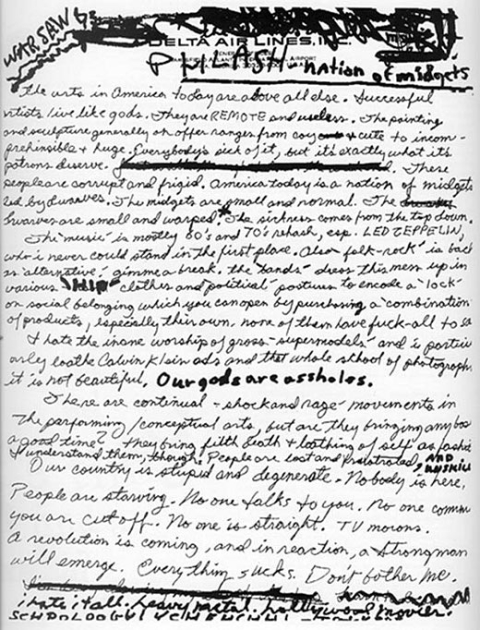
However, inspired by our recent post on Mark Twain’s typewriter, a reader alerted us to a Letters of Note subgenre of sorts, “faxes of note.” These oddball messages defy the workaday conventions of the fax. Take, for example, the fax above sent by Iggy Pop to Plazm magazine writer Joshua Berger as an addendum to a 1995 interview. Scrawled with his fevered thoughts, on Delta Airlines stationary, Pop’s fax amounts to what Letters of Note calls “a rant so rich with quotable lines, it’s amazing he was able to contain it all on a single sheet.”
You can click here for a full transcript of Iggy’s take on American cultural decadence, but here are just a few highlights from his faxed get-off-my-lawn moment: Pop—on tour in Europe at the time—calls his home country “a nation of midgets,” and decries the ‘90s rehash of ‘60s and ’70s music (“none of them have fuck-all to say”); he rails against the Calvin Klein aesthetic, adding “our gods are assholes” (maybe some professional jealousy here—Pop more or less invented heroin chic). Finally, he signs off with some cranky onomatopoeia: “i hate it all. heavy metal. hollywood movies. SCHPOLOOGY! YeHEHCHH!” This is archival-worthy vitriol, for sure.
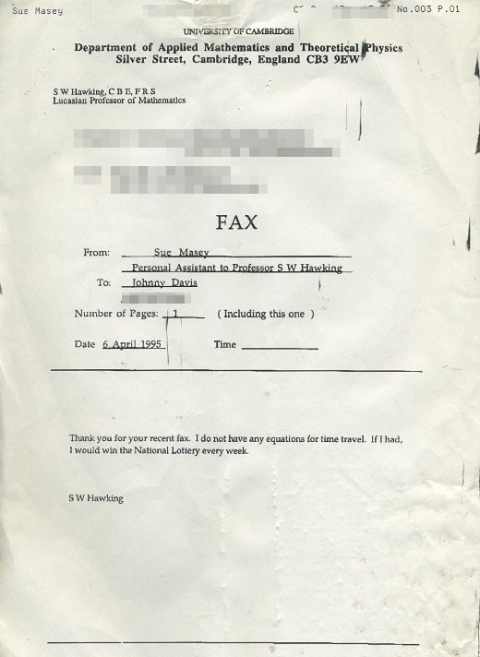
Another fax of note uses the medium to opposite effect; Stephen Hawking’s fax (above), also from 1995, responds to a request from erstwhile British music and fashion magazine The Face for the formula for time travel. Hawking replies, via his personal assistant, “Thank you for your recent fax. I do not have any equations for time travel. If I had, I would win the National Lottery every week.” Unlike Iggy’s explosion of handwritten bile, Hawking’s missive retains all the formal properties of the fax—appropriate institutional letterhead, “from” and “to” lines, etc—which makes his pithy retort all the more incongruous.
While the 1980s and ’90s were boom times for fax transmissions, the machine actually dates back to 1843, when it was patented by Scottish inventor Alexander Bain. As early as 1902, fax technology allowed photographs to be sent over telephone lines. And yes, as every frustrated administrative assistant knows too well, the humble fax machine is still in use in offices around the world, transmitting blearingly boring messages, as well as the occasional flash of individuality. For more on famous faxes, see this helpful infographic from our reader.
Doctor, what does it mean if you dream of creating a font of Freud’s handwriting?
This is exactly what German typographer Harald Geisler has in mind, and, in the spirit of self-actualization, he’s funding the project on Kickstarter. His charisma is such that he’s already raised over eight times the original $1500 goal that will allow him to travel to Vienna, where he will create the typeface in a borrowed apartment within walking distance from Freud’s former home at Berggasse 19. That address is now home to the Sigmund Freud Museum, where the romantically-minded Geisler plans to visit the hard copies of the eight letters from which his alphabet will be assembled.
Don’t let the project’s fully-in-the-black status keep you from visiting its fundraising page. In addition to being an inadvertent tutorial on the elements of a top-notch Kickstarter campaign, it also provides some interesting information with regard to penmanship, font creation, and the difference between Kurrent, the German-style script Freud learned as a schoolboy, and the Latin-style cursive that was standard among his North American patients.
Geisler says it cracks him up to imagine someone jotting a note to his or her shrink in Freud’s handwriting. Perhaps those of us not currently under the care of a psychiatry professional could use it to write our mothers.
Alan Watts began popularizing the teachings of Zen Buddhism, Hinduism, and Taoism in America during the 1950s. He taught at the Academy of Asian Studies in San Francisco, wrote Way of Zen and other bestselling books, gave talks on the radio (listen here), and developed TV programs introducing Americans to the seemingly exotic practice of meditation. Don’t miss his 1960 TV program called “The Silent Mind.”
Watts died almost 40 years ago, but his legacy remains alive, partly thanks to his son, partly thanks to vintage videos captured on YouTube, and partly thanks to people like Trey Parker and Matt Stone — that’s right, the creators of South Park. There’s not much information known about them, but somewhere back in 2007, Parker and Stone produced videos that animated (audio) lectures given by Watts many moons ago. The topics deal with music, life, and philosophical personality types. Meanwhile, the aesthetic is distinctly South Parkean, minus the outrageous potty humor, of course. The project is an old favorite of ours and today we decided to bring it back.
What if that screen you’re peering at was something akin to a one-way mirror? There’s a definite aspect of dressing room horror, viewing artist Robbie Cooper’sImmersion project, a video collection of the alternately grotesque and dull expressions appearing on people’s faces as they play video games and watch YouTube. (The viewer is never privy to what’s showing on the subjects’ screens, but one suspects it’s likely less rarified than a short animation inspired by physicist Richard Feynman’s remarks on a flower or filmmaker Miranda July’s lyrical advice to the procrastination-prone). But before we denounce the mostly underaged participants’ dead eyes and slack jaws—an effect made more disturbing by the soundtrack’s high incidence of gunfire—perhaps we should turn the web cam on ourselves.
That’s exactly what Cooper is hoping will happen, as he prepares to expand the project’s scope to include people of all ages and nationalities. “Babies being born right now arrive in a landscape where computers, smartphones, the internet, and social media already exist,” he explains, “While the oldest generation alive today can remember a time before TV was a fixture of our living room.”
To widen the net, Cooper is turning to crowd sourcing. Whether someone who knowingly trains the camera on him or herself can achieve the previous participants zoo-like lack of inhibition remains to be seen, but the Kickstarter campaign to fund this next phase lays things out on a grand scale. The plan is for the public to contribute via uploads and a social media aggregator. More excitingly, they’re encouraged to seize the reins by creating a series of instructions and prompts for those coming later to follow.
Let us hope this will lead to a more heartening variety of expressions, as well as the book, documentary, and interactive exhibits Cooper envisions.
As gearheads go, Brendan Chilcutt’s a pretty sentimental guy, and not just because he signs his correspondence with “love.” In January, 2012, he founded the Museum of Endangered Sounds to keep outmoded technology’s most iconic noises from vanishing from the collective memory. Click on any image in the museum’s online collection to be transported in the Proustian sense.
Some of the exhibits—a manual typewriter, a rotary phone—were already amply preserved, thanks to a proliferation of cinematic appearances in their heyday.
Others might well have slipped away unnoticed, if not for Chilcutt’s curatorial efforts. Remember that number you could call to have a recorded voice inform you of the correct time? How about the static of an analog TV tuned to an empty station? The hum of a malfunctioning Discman, the chirp of a Tamagotchi…wait, what’s that I hear? The disconcerting whoosh of time speeding up?
Drown it out by activating all thirty exhibits at once. Let them sound their barbaric yawps simultaneously as the kids try to figure out what that racket is.
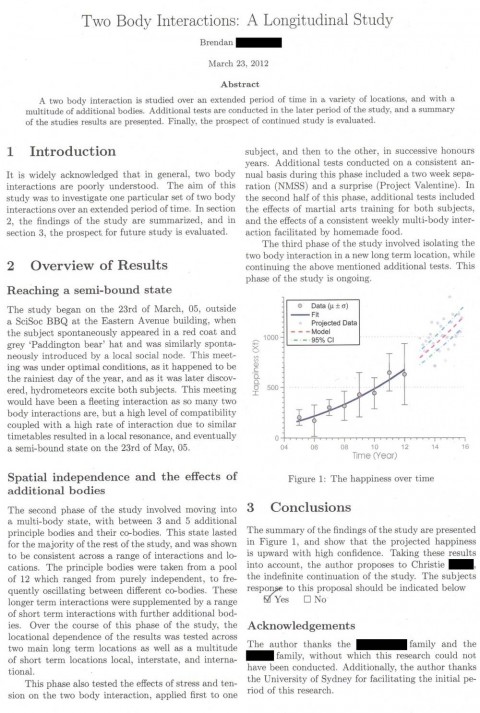
On reddit, a user wrote yesterday, “My boyfriend of 7 years and I are both physicists. Here’s how he proposed to me.” Yes, the marriage proposal is a physics paper of sorts, called “Two Body Interactions: A Longitudinal Study,” that concludes:
The summary of the findings of the study are presented in Figure 1 and that that the project happiness is upward with high confidence. Taking these results into account, the author proposes to Christie the indefinite continuation of the study. The subjects response to their proposal should be indicated below [by checking the “Yes” or “No” box].
Brendan McMonigal and Christie Nelan (pictured here) met at the University of Sydney seven years ago. They will tie the knot this coming May, and we hope you’ll wish them the best.…
We're hoping to rely on loyal readers, rather than erratic ads. Please click the Donate button and support Open Culture. You can use Paypal, Venmo, Patreon, even Crypto! We thank you!
Open Culture scours the web for the best educational media. We find the free courses and audio books you need, the language lessons & educational videos you want, and plenty of enlightenment in between.