The Stories of John Cheever, a collection of 61 stories chronicling the lives of “the greatest generation,” was first published in 1978 with much fanfare. The critics liked it. The weighty, 700-page book won the Pulitzer Prize for Fiction in 1979. The people liked it too. The Stories of John Cheever, Michiko Kakutani wrote in Cheever’s 1982 obit, was “one of the few collections of short fiction ever to make The New York Times best-seller list.”
The collection features some of Cheever’s best-known stories: “The Enormous Radio,” “Goodbye, My Brother,” “The Five-Forty-Eight,” and “The Country Husband.” And also perhaps his most famous short piece of fiction, “The Swimmer.”
First published in The New Yorker in July, 1964, “The Swimmer” was originally conceived as a novel and ran over some 150 pages, before the author pared it down to a taut eleven pages. Those eleven pages apparently take some 25 minutes to read. Above, you can hear Cheever reading “The Swimmer,” in its entirety, at New York’s 92nd St. Y. The audio was recorded on December 19, 1977, and it’s otherwise housed in our collection, 1,000 Free Audio Books: Download Great Books for Free.
(Be warned, these videos are Not Safe for Work. And unless you can deal with strong language, you should skip watching these clips.)
Last year we featured James Joyce’s “dirty letters” to his wife, originally written in 1909 but not discovered in all their cerebrally erotic glory until this century. For Valentine’s Day, the sketch comedy video site Funny or Die capitalized on the availability of these highly detailed, fantasy-saturated Joycean mash notes by having them read dramatically. For this task the producers rounded up five well-known actors, such as Martin Starr from such comedically respected television shows as Freaks and Geeks and Party Down. You can watch his reading above. “I would like you to wear drawers with three or four frills, one over the other at the knees and up the thighs, and great crimson bows in them, so that when I bend down over you to open them and” — but you don’t just want to read it. You want to hear such a masterpiece performed.
Off raising the children in Trieste, Joyce’s wife Nora wrote replies of a presumably similar ardor-saturated nature. Alas, these remain undiscovered, but that unfortunate fact doesn’t stop actresses as well as actors from providing oral renditions of their own. Just above, we have Paget Brewster from Friends and Criminal Mindsreading aloud another of Joyce’s love letters, one which moves with surprising swiftness from evoking “the spirit of eternal beauty” to evoking “a hog riding a sow.” This series of readings also includes contributions from The Middleman’s Natalie Morales, The Kids in the Hall’s Dave Foley, and Saturday Night Live’s Michaela Watkins. They all reveal that, with his textual creativity as well as his close acquaintance with those places where the romantic meets the repulsive, James Joyce would have made quite a sexter today. You can have that idea for free, literate sketch comedy video producers of the internet.
PS Apologies for the lengthy ads that precede the videos. They come from Funny or Die and we have no control over them.
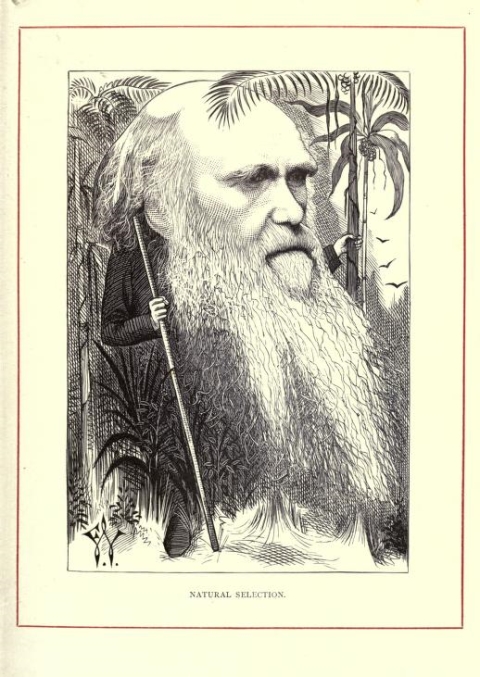
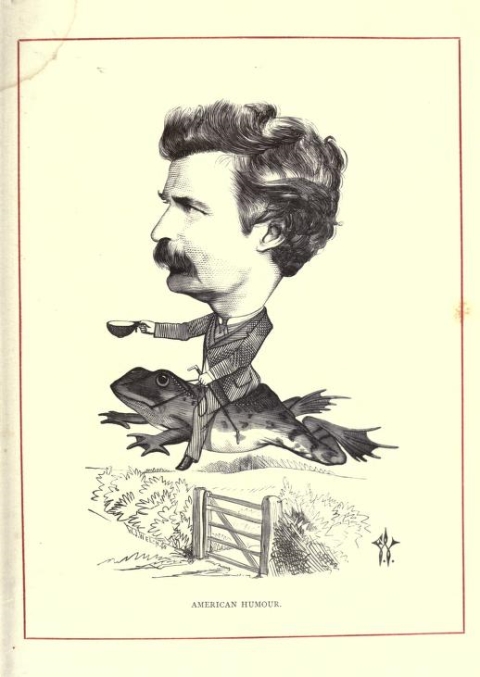
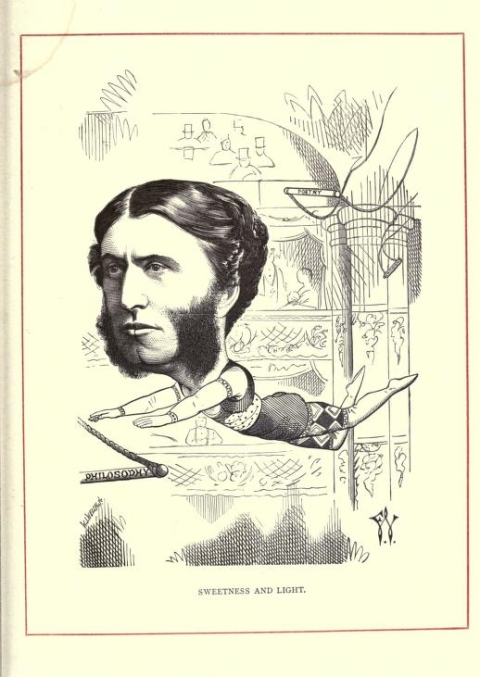
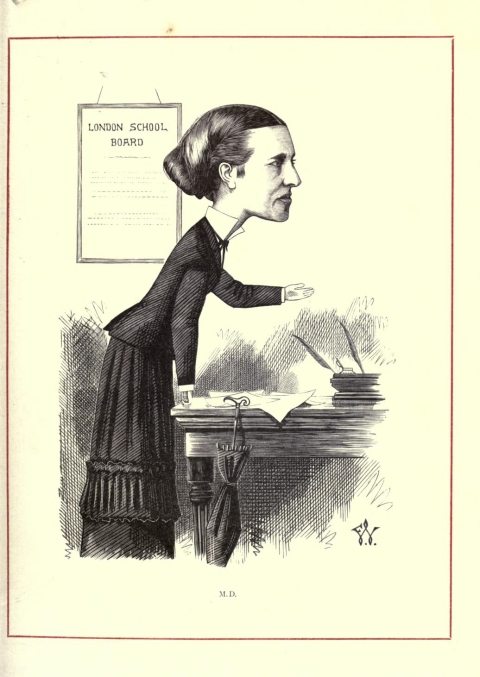
Students and lovers of Victoriana, we have a treat for you. The 1873 book above, Cartoon Portraits and Biographical Sketches of Men of the Day, offers caricatures of forty-nine prominent men, and one woman, of the 19th century, some of them less-than-famous now and some still veritable giants of their respective fields.
Accompanied by lively biographies, the portraits were all drawn by illustrator Frederick Waddy, who is perhaps best known for the drawing on page six of a white-bearded Charles Darwin (above) entitled “Natural Selection”—often reproduced in color and found hanging on the office walls of biology teachers. Darwin appears second in Cartoon Portraits, preceded only by Sir Edward Bulwer-Lytton of “It was a dark and stormy night” fame.
In addition to professor’s offices, you may also encounter some of Waddy’s work at the National Portrait Gallery in London. In his time, Waddy was one of the foremost caricaturists of the day—an important position in periodical publishing before the advent of cheaply mass-reproducible photography. All of the portraits originally appeared in a magazine called Once a Week, founded in a split between Charles Dickens and his publisher Bradbury and Evans, who started the journal with editor Samuel Lucas in 1859 to compete with Dickens’ All the Year Round. Once a Week ran until 1880, publishing pieces on history and current affairs and occasional poems by Tennyson, Swinburne, Dante Rossetti and others. Its popularity was buoyed by Waddy’s drawings and the detailed illustrations of several other graphic artists. Above, see Mark Twain riding his celebrated jumping frog, and just below, poet and critic Matthew Arnold does a high-wire act between two trapezes labelled “Poetry” and “Philosophy.” Twain’s portrait is titled “American Humour”— and he is the only American in the series—and Arnold’s is called “Sweetness and Light.”
Though the book’s title promises only “Men of the Day,” it does include one woman, Dr. Elizabeth Garrett Anderson (below, simply titled “M.D.”), the first Englishwoman to officially work as a physician. Her biographical sketch begins with a long and somewhat tortuous historical defense for female doctors, stating that “social prejudices are almost as hard to eradicate as those of religion. It was not till quite lately that the feeling against woman’s rights as regard education was successfully combated.” Once a Week was a progressive-leaning magazine, its editor a noted abolitionist, and it regularly published the work of women writers like Harriet Martineau, Isabella Blagden, and Mary Elizabeth Braddon, though one wonders why they didn’t warrant caricatures as well.
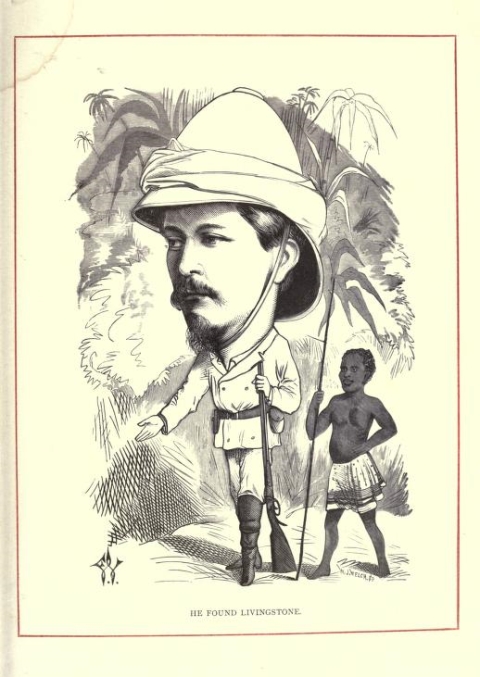
Below, see Waddy’s portrait of central African explorer Henry Morton Stanley, standing twice the height of the native African next to him. It’s a fitting image of colonial ego, though the scene may be drawn after a photo of Stanley with his adopted son Kalulu. The title refers to his search for—and famous exclamation upon discovering—Scottish missionary David Livingstone. All in all, Cartoon Portraits gives us a fascinating look at Victorian visual media and a representative sample of the most popular literary, scientific, and political figures in England during the middle of the century. While the names of Waddy and his fellow comic artists are hardly remembered now, the authors of The Smiling Muse: Victoriana in the Comic Press assert that in their day, “they were the ones who had their fingers on the pulse of what we now call the ‘popular culture’ of the time.” See The Public Domain Review for more highlights from the book.
The work of William S. Burroughs can be by turns hilarious, opaque and profane – filled with images of drugs, insects and other oddities. Though it might be fascinating, if difficult, on the page, his work really comes alive when read aloud, preferably in Burroughs’s signature deadpan drawl. And if it’s accompanied by some trippy visuals, then, all the better.
The above video is exactly that. In 1994, animator Peter Hunt made this appropriately grotesque stop motion animated film, Ah Pook is Here, with audio taken from Burroughs’s 1990 album Dead City Radio. (You can read along to the video below.) John Cale provides the music. The winner of 10 international film awards, the short film has been archived in the Goethe Institut.
Ah Pook is Here started in 1970 as a collaboration with artist Malcolm McNeil. Originally it was slated to be a magazine comic strip but when the publication folded, Burroughs and McNeil decided to turn it into a book. Ah Pook is Here and Other Texts was finally published in 1979, though without McNeil’s illustrations. You can see them here.
When I become Death, Death is the seed from which I grow…
Itzama, spirit of early mist and showers.
Ixtaub, goddess of ropes and snares.
Ixchel, the spider web, catcher of morning dew.
Zooheekock, virgin fire patroness of infants.
Adziz, the master of cold.
Kockupocket, who works in fire.
Ixtahdoom, she who spits out precious stones.
Ixchunchan, the dangerous one.
Ah Pook, the destroyer.
Hiroshima, 1945, August 6, sixteen minutes past 8 AM.
Who really gave that order?
Answer: Control.
Answer: The Ugly American.
Answer: The instrument of Control.
Question: If Control’s control is absolute, why does Control need to control?
Answer: Control… needs time.
Question: Is Control controlled by its need to control?
Answer: Yes.
Why does Control need humans, as you call them?
Answer: Wait… wait! Time, a landing field. Death needs time like a junkie needs junk.
And what does Death need time for?
Answer: The answer is sooo simple. Death needs time for what it kills to grow in, for Ah Pook’s sake.
Death needs time for what it kills to grow in, for Ah Pook’s sweet sake, you stupid vulgar greedy ugly American death-sucker.
Death needs time for what it kills to grow in, for Ah Pook’s sweet sake, you stupid vulgar greedy ugly American death-sucker… Like this.
We have a new type of rule now. Not one man rule, or rule of aristocracy, or plutocracy, but of small groups elevated to positions of absolute power by random pressures and subject to political and economic factors that leave little room for decision. They are representatives of abstract forces who’ve reached power through surrender of self. The iron-willed dictator is a thing of the past. There will be no more Stalins, no more Hitlers. The rulers of this most insecure of all worlds are rulers by accident inept, frightened pilots at the controls of a vast machine they cannot understand, calling in experts to tell them which buttons to push.
Jonathan Crow is a Los Angeles-based writer and filmmaker whose work has appeared in Yahoo!, The Hollywood Reporter, and other publications. You can follow him at @jonccrow.
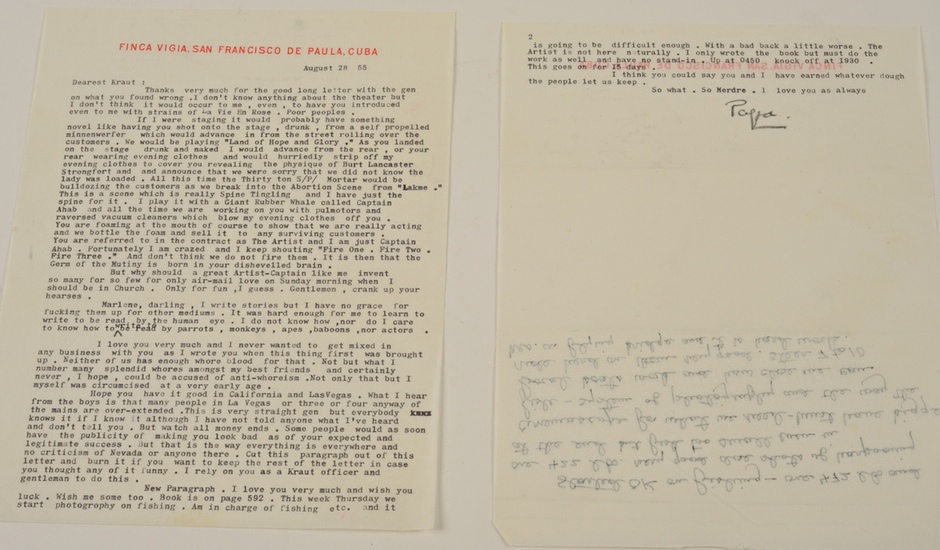
We think today of Ernest Hemingway as that most stylistically disciplined of writers, but it seems that, outside his published work and especially in his personal correspondence, he could cut pretty loose. One particularly vivid example has returned to public attention recently by appearing for sale on a site called auctionmystuff.com: a letter from Hemingway to legendary singer-actress Marlene Dietrich, dated August 28, 1955. “In the intimate, rambling and revealing letter,” writes the Wall Street Journal’s Jonathan Welsh, “Hemingway professes his love for Dietrich a number of times, though the two are said to have never consummated the relationship.” He also, Welsh notes, “talks about staging one of her performances, in which he imagines her ‘drunk and naked.’ ” The full letter, which spares no detail of this elaborate fantasy, runs as follows:
Dearest Kraut :
Thanks very much for the good long letter with the gen on what you found wrong. I don’t know anything about the theater but I don’t think it would occur to me, even, to have you introduced even to me with strains of La Vie En Rose. Poor peoples.
If I were staging it would probably have something novel like having you shot onto the stage, drunk, from a self-propelled minnenwerfer which would advance in from the street rolling over the customers. We would be playing “Land of Hope and Glory.” As you landed on the stage drunk and naked I would advance from the rear, or from your rear wearing evening clothes and would hurriedly strip off my evening clothes to cover you revealing the physique of Burt Lancaster Strongfort and announce that we were sorry that we did not know the lady was loaded. All this time the Thirty ton S/P/ Mortar would be bulldozing the customers as we break into the Abortion Scene from “Lakme.” This is a scene which is really Spine Tingling and I have just the spine for it. I play it with a Giant Rubber Whale called Captain Ahab and all the time we are working on you with pulmotors and raversed (sic) cleaners which blow my evening clothes off you. You are foaming at the mouth of course to show that we are really acting and we bottle the foam and sell it to any surviving customers. You are referred to in the contract as The Artist and I am just Captain Ahab. Fortunately I am crazed and I keep shouting “Fire One. Fire Two. Fire Three.” And don’t think we do not fire them. It is then that the Germ of the Mutiny is born in your disheveled brain.
But why should a great Artist-Captain like me invent so many for so few for only air-mail love on Sunday morning when I should be in church. Only for fun, I guess. Gentlemen, crank up your hearses.
Marlene, darling, I write stories but I have no grace for fucking them up for other mediums. It was hard enough for me to learn to write to be read by the human eye. I do not know how, nor do I care to know how to write to be read by parrots, monkeys, apes, baboons, nor actors.
I love you very much and I never wanted to get mixed in any business with you as I wrote you when this thing first was brought up. Neither of us has enough whore blood for that. Not but what I number many splendid whores amongst my best friends and certainly never, I hope, could be accused of anti-whoreism. Not only that but I was circumcised as a very early age.
Hope you have it good in California and Las Vegas. What I hear from the boys is that many people in La Vegas (sic) or three or four anyway of the mains are over-extended. This is very straightgen but everybody knows it if I know it although I have not told anyone what I’ve heard and don’t tell you. But watch all money ends. Some people would as soon have the publicity of making you look bad as of your expected and legitimate success. But that is the way everything is everywhere and no criticism of Nevada or anyone there. Cut this paragraph out of this letter and burn it if you want to keep the rest of the letter in case you thought any of it funny. I rely on you as a Kraut officer and gentlemen do this.
New Paragraph. I love you very much and wish you luck. Wish me some too. Book is on page 592. This week Thursday we start photography on fishing. Am in charge of fishing etc. and it is going to be difficult enough. With a bad back a little worse. The Artist is not here naturally. I only wrote the book but must do the work as well and have no stand-in. Up at 0450 knock off at I930. This goes on for I5 days.
I think you could say you and I have earned whatever dough the people let us keep.
So what. So Merdre. I love you as always.
Papa
“To him she was ‘my little Kraut,’ or ‘daughter,’ to her he was simply ‘Papa’ — and it was love at first sight when they met aboard a French ocean liner in 1934,” writes TheGuardian’s Kate Connolly of the two icons’ unusual relationship. “Hemingway and Dietrich started writing to each other when he was 50 and she was 47, remaining in close contact until the writer’s suicide in 1961. But they never consummated their love, because of what Hemingway referred to as ‘unsynchronised passion.’ ” A fan of both Hemingway and Dietrich could presumably desire nothing more than one of the original pieces of their correspondence, but this particular letter, with a starting price of $35,000, drew not a single bid — perhaps a sale, like the physical expression of the Old Man and the Sea author and “Lili Marleen” singer’s love, fated never to happen.
One of the great polymaths of the 19th century, Lewis Carroll (pen name of Charles Lutwidge Dodgson) —mathematician, logician, author, poet, Anglican cleric—took to the new medium of photography with the same alacrity he applied to all of his pursuits. Though he may be described as a hobbyist in the sense that he never pursued the art professionally, he nonetheless “became a master of the medium, boasting a portfolio of roughly 3,000 images and his very own studio.”
So says a recent article by Gannon Burgett on Carroll’s “24-year career as a photographer,” during which he made a number of portraits, including one of then-poet laureate of England Alfred, Lord Tennyson. His subjects also included “landscapes, dolls, dogs, statues, paintings, trees and even skeletons.”
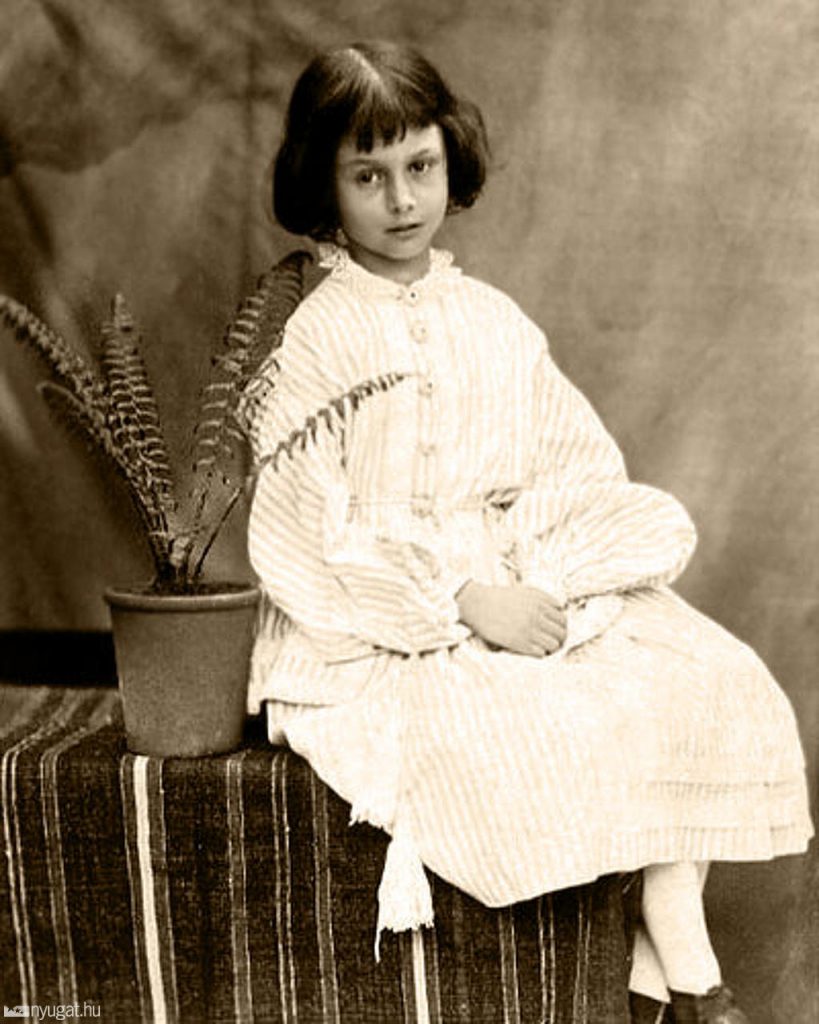
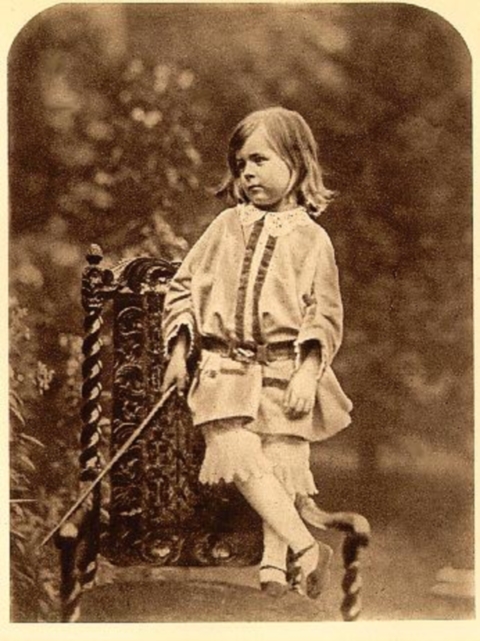
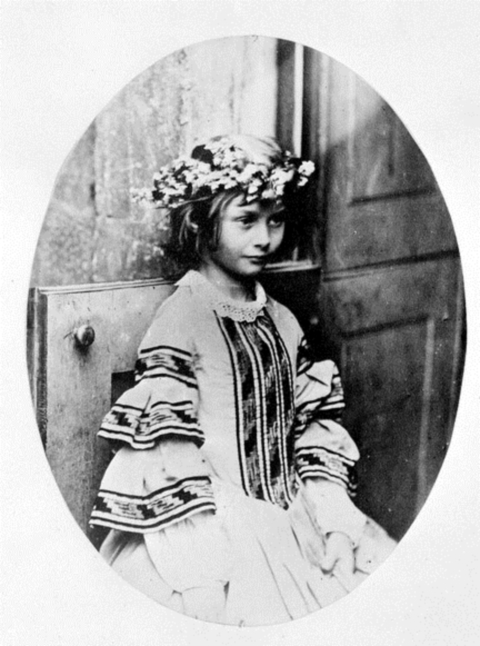
Carroll excelled at a developing method called the wet collodion process, which replaced the daguerreotype as the primary means of photographic image-making. This process seems to have been something like painting in oils, requiring a great deal of dexterity and chemical know-how, and similarly subject to decay when done improperly. Carroll particularly valued this method for its difficulty (he described it in detail in some lines added to a poem called “Hiawatha’s Photographing”)—so much so that once a dry developing process came into being, he abandoned the medium altogether, complaining that it became so easy anyone could do it. Carroll’s obsessive focus on process mirrored an obsession with his favorite photographic subjects, young children, including Tennyson’s son Hallam (above). Most famously, Carroll obsessively photographed the young Alice Liddell (top and below as “The Queen of May”), daughter of family friend Henry George Liddell and inspiration for Carroll’s most famous fictional character.
Many of Carroll’s photographs of Alice and other children can seem downright prurient to our eyes. As Carroll’s biographer Jenny Woolf writes in a 2010 essay for the Smithsonian, “of the approximately 3,000 photographs Dodgson made in his life, just over half are of children—30 of whom are depicted nude or semi-nude.”
Some of his portraits—even those in which the model is clothed—might shock 2010 sensibilities, but by Victorian standards they were… well, rather conventional. Photographs of nude children sometimes appeared on postcards or birthday cards, and nude portraits—skillfully done—were praised as art studies […]. Victorians saw childhood as a state of grace; even nude photographs of children were considered pictures of innocence itself.
Woolf admits that Carroll’s interest, as scholars have speculated for decades, may have been less than innocent, prompting Vladimir Nabokov to propose “a pathetic affinity” between Carroll and the narrator of Lolita. The evidence for Carroll’s possible pedophilia is highly suggestive but hardly conclusive. Burgett summarizes the claims as only speculative at best: “The entire controversy is an almost century-long debate, and one that doesn’t seem to be making any major progress in either direction.” In a Slate review of Woolf’s Lewis Carroll biography, Seth Lerer also acknowledges the controversy, but reads the photographs of Alice, her sisters, and friends as representative of larger trends, as “brilliant testimonies to the taste, the sentiment, and perhaps the sexuality of mid-Victorian England.”
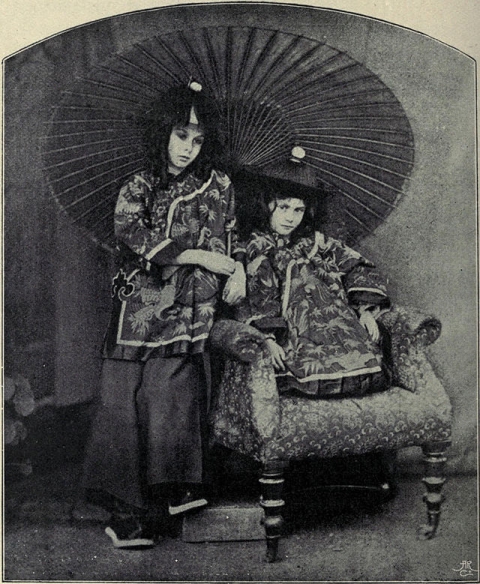
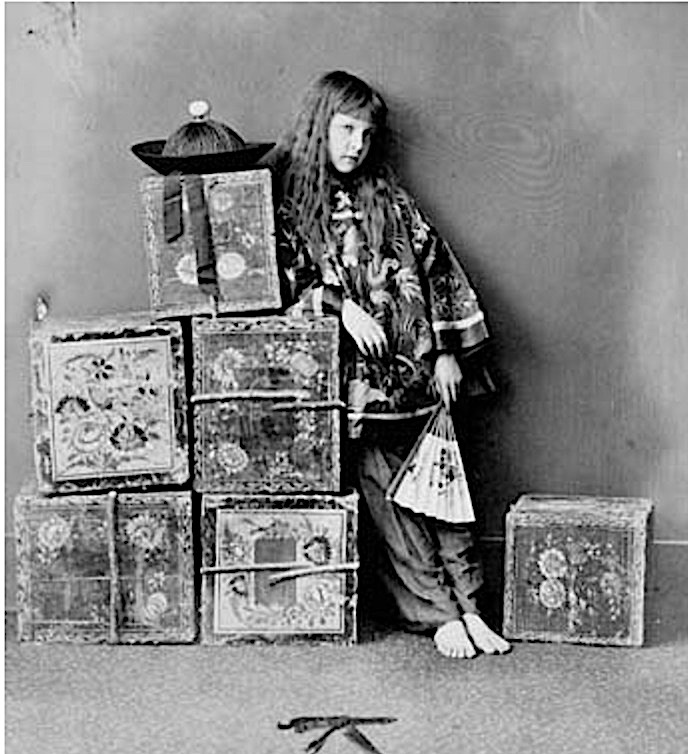
A great part of this Victorian sensibility consists of the “recognition that all life involves role-playing,” hence the recurring photos of the girls in dress-up—as figures from myth and literature and exotic Orientalist characters, such as the photo above of Alice and her sister Lorina as “Chinamen.” “These are the tableaux of Victorian melodrama,” writes Lerer, “images on stage-sets of the imagination.” We see another of Carroll’s favorite photographic subjects, Alexandra “Xie” Kitchin, daughter of a colleague, also given the Orientalist treatment below, posed as an off-duty tea merchant.
Carroll’s carefully staged child photographs are very much like those of other photographers of the period like Mary Cowden Clarke and Julia Margaret Cameron, who also photographed Alice Liddell, even into her adulthood. Cameron’s photographs also included child nudes, to a similar effect as Carroll’s—the depiction of a “state of grace” in which children appear as nymphs, “gypsies” or other such types supposedly belonging to Edenic worlds untouched by adult cares. Given the context Woolf, Lerer and others provide, it’s reasonable to view Carroll’s child photography as consistent with the tastes of the day. (Though no one suggests this as an alibi for Carroll’s possibly troubling proclivities.)
As it stands, the photographs of Alice and other children open a fascinating, if sometimes discomfiting, window on an age that viewed childhood very differently than our own. They also give us a view of Carroll’s strange inner world, one not unlike the unsettling fantasy realm of 20th century folk artist Henry Darger. Unlike Darger, Carroll’s work brought him widespread fame in his lifetime, but like that reclusive figure, the author of Alice’s Adventures in Wonderland and Through the Looking Glass was a shy, introspective man whose imaginative landscape possessed a logic all its own, charged with magic, threat, and longing for lost childhood innocence.
See a galleries of Carroll’s photographs of Alice and other children here and here, and see this site for more general info on Carroll’s photography.
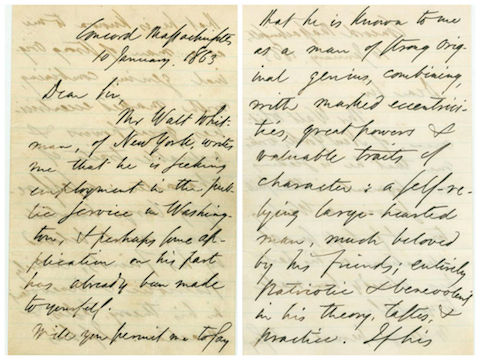
While we often recommend Letters of Note for the hits of history’s most illuminating pieces of incidental correspondence, do consider also making a regular visits to Slate’s history blog The Vault. There you’ll find such written artifacts as the one pictured in part above, astutely written up by occasional Open Culture contributor Rebecca Onion: “In 1863, as he considered seeking a government clerkship, Walt Whitman asked his friend and advocateRalph Waldo Emerson for a letter of recommendation. Emerson, for decades a respected name in American letters, knew the secretaries of state and treasury personally, and Whitman hoped that a note from him would help the younger poet secure steady employment in Washington.” This note runs, in a transcript from the Walt Whitman archive, as follows:
Concord Massachusetts 10 January 2, 1863
Dear Sir,
Mr Walt Whitman, of New York, writes me that he is seeking employment in the public service in Washington, & perhaps some application on his part has already been made to yourself. Will you permit me to say that he is known to me as a man of strong original genius, combining, with marked eccentricities, great powers & valuable traits of character: a self-relying large-hearted man, much beloved by his friends; entirely patriotic & benevolent in his theory, tastes, & practice. If his writings are in certain points open to criticism, they show extraordinary power, & are more deeply American, democratic, & in the interest of political liberty, than those of any other poet.
A man of his talents & dispositions will quickly make himself useful, and, if the government has work that he can do, I think it may easily find that it has called to its side more valuable aid than it bargained for.
With entire respect,
Your obedient servant,
R. W. Emerson.
Hon Salmon P. Chase, | Secretary of the Treasury.
Any of us, I feel certain, would love having such an eloquently praise-filled letter of recommendation sent on our behalf by a friend, a teacher, a former employer, or a pillar of American Transcendentalism. But even with that, the author of Leaves of Grass didn’t find the road to a day gig particularly smooth — in large part, of course, because of having written Leaves of Grass. Whitman, whose “reputation preceded him in job interviews, reported that Salmon Chase, the secretary of the treasury and addressee of this letter, was vehemently against the idea of employing the author of Leaves, a book that celebrated open sexuality in a way that Chase found distasteful.” He would even get fired from another job specifically “because of objections to his poetry.” Well, they can’t say Emerson didn’t warn them about Whitman’s “marked eccentricities” — such as his tendency to write some of the most enduring verse in American history.
Why study a language like French? For the unparalleled pleasure, of course, of reading a beloved, respected, and enduring novel like Madame Bovary in the original — or so literarily inclined Francophiles might argue. After all, they’d rhetorically ask, can you really say you’ve read the book if you haven’t actually read the very same words Gustave Flaubert wrote? But now, literarily inclined Francophiles who also have an enthusiasm for the web (not an overwhelmingly large group, wags may point out) can insist that you haven’t really read Madame Bovary unless you’ve read it all in the original: all 4,500 pages of it. Yes, the French do tend to write longer sentences than most, but that impressive length has less to do with a national literary style than with thoroughgoing completism, an impulse that brings together all of the 1856 novel’s originally published pages as well as all of those cut, censored, or revised, free to read online at bovary.fr.
“After a marathon effort of transcription by 130 volunteers from all over the world, including a cleaning lady, an oil prospector and several teenagers,” writes the Independent’s John Lichfield, “all the variants of Gustave Flaubert’s masterpiece can be consulted on a new website. This is believed to be the first time that the complete process of creation, and publication, of a classic novel has been made available on the internet,” much less on a site that “contains not only the published text and images of the barely legible manuscripts but interactive controls which allow the reader to re-instate passages corrected or cut by Flaubert or his publishers.” Despite this unprecedentedly vast and accessible trove of Madame Bovary resources, struggles over the proper interpretation of the once-scandalous novel will doubtless only continue, not only at the level of just which word Flaubert intended to write on the fourth draft of a particularly crucial paragraph, but at the level of whether to consider the whole book tragedy, comedy, or something in between. Enter the Madame Bovary Archive here.
We're hoping to rely on loyal readers, rather than erratic ads. Please click the Donate button and support Open Culture. You can use Paypal, Venmo, Patreon, even Crypto! We thank you!
Open Culture scours the web for the best educational media. We find the free courses and audio books you need, the language lessons & educational videos you want, and plenty of enlightenment in between.