Today marks the 100th birthday of beat writer William S. Burroughs (1914–1997). Grab a bottle of wine … preferably cheap wine … and let’s travel back to November 7, 1981. That’s when Burroughs made his first appearance on American national television. And quite appropriately, it was on the irreverent, late-night comedy show, Saturday Night Live. As you’ll see, actress Lauren Hutton made the introduction, setting up Burroughs to read from Naked Lunch (1959) and Nova Express (1964). The clip itself is an outtake from the opening scene of Burroughs, a 1983 documentary by Howard Brookner, which is currently getting restored. We originally featured this video back in early 2012. Since then we’ve brought you many other intriguing posts on Burroughs, whose life and art provides so much to talk about. See some of our favorites below:
If you would like to support the mission of Open Culture, consider making a donation to our site. It’s hard to rely 100% on ads, and your contributions will help us continue providing the best free cultural and educational materials to learners everywhere. You can contribute through PayPal, Patreon, and Venmo (@openculture). Thanks!
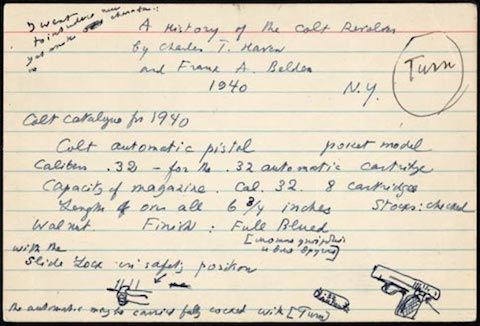
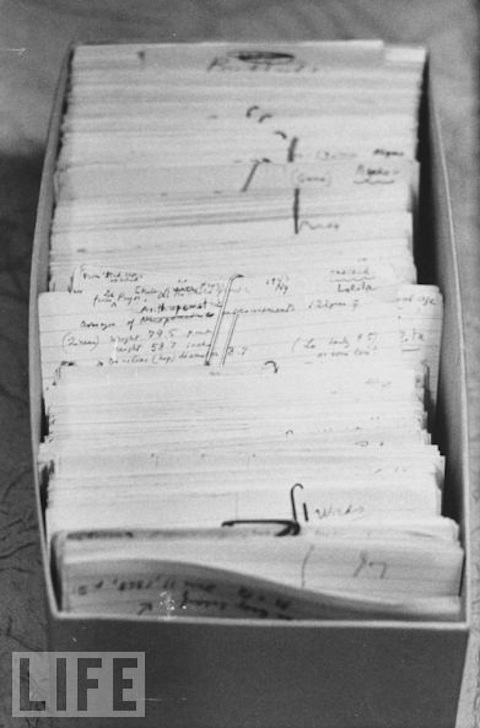
If you picked up The Original of Laura, Vladimir Nabokov’s final novel, you’ll have seen his distinctive index card-based writing method in action. Having died in 1977, Nabokov never completed the book, and so all Penguin had to publish decades later came to, as the subtitle indicates, A Novel in Fragments. These “fragments” he wrote on 138 cards, and the book as published includes full-color reproductions that you can actually tear out and organize — and re-organize — for yourself, “complete with smudges, cross-outs, words scrawled out in Russian and French (he was trilingual) and annotated notes to himself about titles of chapters and key points he wants to make about his characters.” That comes from a post by Dominic Basulto at Big Think, who highlights cards with “a full-on discussion of the precise word that Nabokov would like to describe a female character (fille, in French) and how best to render that word in English, while keeping the connotations and meaning of the word in French.” Reviewing The Original of Laura, Alexander Theroux describes the cards as a “portable strategy that allowed [Nabokov] to compose in the car while his wife drove the devoted lepidopterist on butterfly expeditions.”
Nabokov could thus, between thoughts of his winged objects of interest, use the cards for “inserting words, writing memos to himself, scribbling afterthoughts: ‘invent tradename [for a medicine], e.g., cephalopium.’ ” They also served him earlier in his career; at the Library of Congress’ site for its Manuscript Division’s Nabokov collection, you can see a couple of the cards on which he wrote his best-known novel, 1955’s Lolita. Asked about his working methods by Herbert Gold in the Paris Review, he described the method forthrightly: “The pattern of the thing precedes the thing. I fill in the gaps of the crossword at any spot I happen to choose. These bits I write on index cards until the novel is done. My schedule is flexible, but I am rather particular about my instruments: lined Bristol cards and well sharpened, not too hard, pencils capped with erasers.” For every craft, the proper tool, and Nabokov remains, fragmentary last book and all, one of western literature’s most respected craftsmen of language — or, rather, languages, plural.
This morning, we’re serving up some green eggs and ham. Or rather Neil Gaiman is. Whenever I think about someone reading Dr. Seuss’ classic children’s book, I can’t help but think back to Jesse Jackson’s classic reading on SNL in 1991. But who knows, maybe 20 years from now, another generation might call to mind this version by the unshaven Gaiman. If the reading whets your appetite a bit, don’t miss our collection of Neil Gaiman’s Free Short Stories, which includes, among other things, audio & video recordings of @neilhimself reading his own stories. We’ve got some more good Dr. Seuss material below.
If you would like to support the mission of Open Culture, consider making a donation to our site. It’s hard to rely 100% on ads, and your contributions will help us continue providing the best free cultural and educational materials to learners everywhere. You can contribute through PayPal, Patreon, and Venmo (@openculture). Thanks!
Looking for free, professionally-read audio books from Audible.com? Here’s a great, no-strings-attached deal. If you start a 30 day free trial with Audible.com, you can download two free audio books of your choice. Get more details on the offer here.
Some readers discover David Foster Wallace through his fiction, and others discover him through his essays. (Find 30 Free Stories & Essays by DFW here.) Now that the publishing industry has spent more than five years putting out everything of the late writer’s leftover material they can reasonably turn into books, new DFW fans may arrive through more forms still: his interviews, Kenyon commencement speech, philosophy thesis, etc.. And though he produced too few of them to appear collected between covers, Wallace once wrote poems as well, though judging by the handwriting of the two shown here, he seems to have both started down and abandoned that particular literary avenue in childhood. Still, that very quality — and the opportunity it holds out to see the linguistic formation of a man later regarded as a prose genius — makes them all the more intriguing. First, we have the untitled poem above, a sympathetic paean to the labors of motherhood:
My mother works so hard
And for bread she needs some lard.
She bakes the bread. And makes the bed.
And when she’s threw
She feels she’s dayd.
Second, we have ”Viking Song”, which he probably wrote later. (The Harry Ransom Center at UT-Austin, where the text resides, believes he was 6 or 7 when he wrote the poem.)
Vikings oh! They were so strong
Though there warriors won’t live so long.
For a long time they rode the stormy seas.
Whether there was a great big storm or a little breeze.
There ships were made of real strong wood
As every good ship really should.
If you were to see a Viking today
It’s best you go some other way.
Because they’d kill you very well
And all your gold they’ll certainly sell
For all these reasons stay away
From a Viking every day.
Though not what we would call mature works, these two poems still offer much of interest to the dedicated DFW exegete. “Note Wallace’s uncommon phrasing in ‘so hard and for bread,’ ” writes Justine Tal Goldberg of the first. “I can’t think of a single child who would opt for this phrasing over, say, a more simple ‘so hard to make bread,’ ” a choice that demonstrates he “was already exhibiting the masterful grasp of language for which he would later become famous.” Alex Balk at The Awl calls “Viking Poem” “ ‘charming and tragic,” adding that “the obvious enthusiasm with which he wrote it makes me reflect on the joys of childhood that we tend to forget.” Wallace’s biographer D.T. Max goes into more depth at the New Yorker, identifying “moments in these poems that herald (or just accidentally foreshadow?) the mature David’s American plainsong voice.” I’ve heard it asserted that every child has a natural capacity for poetry, but the young Wallace, preternaturally perceptive even then, must have soon realized that his textual strengths resided elsewhere.
Everyone I know has a list of least-favorite words. For various reasons, “moist” always seems to make the top three. But perhaps it takes a writer—someone who savors the sounds, textures, and histories of peculiar words—to compile a list of their most-favorites. A few I’ve placed in keepsake boxes over the years—little corrugated minerals that remind me of what words can do: “palaver,” “obdurate,” “crevasse,” “superfecund”….
I could go on, but it’s certainly not my list you’ve come for. You’re reading, I suspect, because you well know the consummate care and attention David Foster Wallace lavished on his prose—his reputation as a smith of endless creativity who, Alex Ross wrote in a series of McSweeney’s tributes, spent his time “keenly observing, forging acronyms, reanimating lifeless OED entries, and creating sentences that make us spit out our beer.”
Ross’s mention of the Oxford English Dictionary, that venerable repository of the vast breadth and depth of written English (sadly kept behind a paywall), helps us appreciate Wallace’s list, which features such archaic adverbs as “maugre” (“in spite of, notwithstanding”) and obscure adjectives as “lacinate” (“fringed”). Who has read, much less written, the Anglo-Saxon “ruck” (“a multitude of people mixed together”)? And while the equally rock-hard, monosyllabic “wrack” is familiar, I have not before encountered the lovely “primapara” (“woman who’s pregnant for the first time”).
Another page of Wallace’s list (above—click images to enlarge) includes such treasures as “tarantism,” a “disorder where you have an uncontrollable need to dance,” and “sciolism,” a “pretentious air of scholarship; superficial knowledgability.” While it is true that Wallace has been accused of the latter, I do not think this is a competent judgment. Instead, I would describe him with another of my favorite words—“amateur”—not at all, of course, in the sense of an unpaid or unskilled beginner, but rather, as it meant in French, a “devoted lover” of the English language.
These pages come to us from Lists of Note (and the Harry Ransom Center at UT-Austin), who writes that they are “just two pages from the hundreds of word lists he amassed over the years.” Perhaps one day we’ll see a published edition of David Foster Wallace’s favorite words. For the nonce, head on over to Lists of Note to see this minim of his lexicon transcribed.
I have little desire to rehash the politics, but the facts are plain: by the time I arrived in college as an undergraduate English major in the mid-90s, the idea of the “Western Canon” as a container of—in the words of a famous hymn—“all that’s good, and great, and true” was seriously on the wane, to put it mildly. And in many quarters of academia, mention of the name of Yale literary critic Harold Bloom provoked, at the very least, a raised eyebrow and pointed silence. Bloom’s reputation perhaps unfairly fell victim to the so-called “Canon Wars,” likely at times because of a misidentification with political philosopher Allan Bloom. That Bloom was himself no ideologue, writes Jim Sleeper; he was a close friend of Saul Bellow and “an eccentric interpreter of Enlightenment thought who led an Epicurean, quietly gay life.” Nonetheless, his fiery attack on changing academic values, The Closing of the American Mind, became a textbook of the neoconservative right.
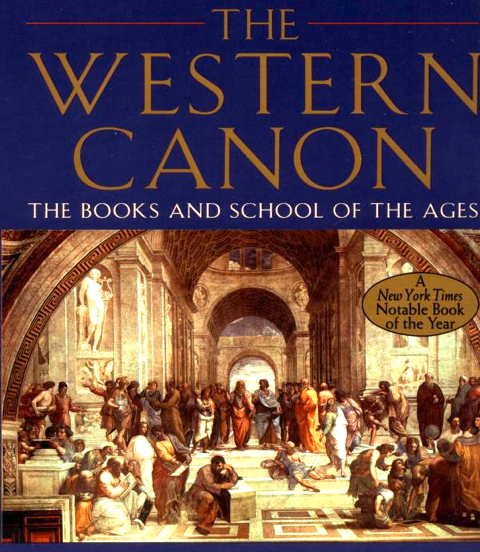
Though Harold Bloom wished to distance himself from culture war polemics, he has unapologetically practiced what Allan Bloom preached, teaching the Canonical “great books” of literature and religion and opposing all manner of critics on the left, whom he lumps together in the phrase “the School of Resentment.” Bloom’s 1973 The Anxiety of Influence has itself exerted a major influence on literary studies, and best-selling popular works, like 1998’s Shakespeare: The Invention of the Human, have kept Harold Bloom’s name in circulation even when scholarly citations of his work declined. In 1994, Bloom re-affirmed his commitment to the Canon with The Western Canon: The Books and School of the Ages, a fierce sortie against his so-called “School of Resentment” adversaries and a work University of Minnesota professor Norman Fruman called a “heroically brave, formidably learned and often unbearably sad response to the present state of the humanities.” (Hear Bloom discuss the book with Eleanor Wachtel in a 1995 CBC interview.)
The Western Canon is tightly focused on only 26 authors, but in a series of four appendices, Bloom lists the hundreds of other names he considers canonical. For all of Bloom’s ornery defensiveness, his list is surprisingly inclusive, as well as—for Fruman—surprisingly idiosyncratic. (Bloom later disavowed the list, claiming that his editor insisted on it.) Like a classical philologist, Bloom divides his Canon into four “ages” or periods: The Theocratic Age (2000 BCE-1321 CE); The Aristocratic Age (1321–1832); The Democratic Age: 1832–1900); and The Chaotic Age (20th Century). You can view the complete list here. Below, we’ve compiled a very partial, but still sizable, excerpt of texts from Bloom’s list that are available online through the University of Adelaide’s ebook library. For all of the unpopular positions he has taken over the past few decades, Bloom’s immense erudition, expansive intellect, and sincere commitment to the humanities have never been in question. As a distinguished exemplar of a fading tradition, he is an invaluable resource for students and lovers of literature.
A: “The Theocratic Age”
The Ancient Greeks
Homer (ca.800BC)
Iliad; Odyssey.
Hesiod (ca.700BC)
Works and Days; Theogony.
Sappho (ca.600BC)
Aeschylus (525 BC — 456 BC)
Oresteia; Seven Against Thebes; Prometheus Bound; Persians; Suppliant Women.
Sophocles (c. 496‑c. 405 BC)
Oedipus the King; Oedipus at Colonus; Antigone; Electra; Ajax; Women of Trachis; Philoctetes.
The Birds; The Clouds; The Frogs; Lysistrata; The Knights; The Wasps; The Assemblywomen.
Herodotus, 485–420BCE
The Histories.
Thucydides, ca.460 BCE
The Peloponnesian Wars.
Plato, c.427‑c.347 BCE
Dialogues.
Aristotle, 384–322 BCE
Poetics; Ethics.
Hellenistic Greeks
Menander, ca. 342–291 BC
The Girl from Samos.
Plutarch, 46–120
Lives; Moralia.
Aesop (620 — 560 BC)
Fables.
Petronius, c.27–66
The Romans
Terence, 195/185–159 BC
The Girl from Andros; The Eunuch; The Mother-in-Law.
Lucretius, 98?–55 BCE
The Way Things Are.
Marcus Tullius Cicero, 106–43 BCE
On the Gods.
Horace, 65–8 BCE
Odes; Epistles; Satires.
Catullus (c.84 B.C. — c.54 B.C.)
Attis and Other Poems.
Virgil (70–19 BC)
Aeneid; Eclogues; Georgics.
Ovid (43 BC — 17 AD)
Metamorphoses; The Art of Love; Heroides.
Seneca, Lucius Annaeus, ca.4 BCE–65 CE
Tragedies, particularly Medea and Hercules Furens.
Petronius, c.27–66
Satyricon.
Apuleius, c. 123/125‑c. 180
The Golden Ass.
The Middle Ages: Latin, Arabic, and the Vernacular Before Dante
Augustine of Hippo, 354–430
City of God; Confessions.
Wolfram von Eschenbach, 1170–1220
Parzival.
Chrétien de Troyes, 12th cent
Yvain: The Knight of the Lion.
Beowulf (ca.800)
B: “The Aristocratic Age”
Italy
Dante (1265 — 1321)
The Divine Comedy; The New Life.
Petrarch, 1304–1374
Lyric Poems; Selections.
Giovanni Boccaccio, 1313–1375
The Decameron.
Matteo Maria Boiardo, 1440 or 41–1494.
Orlando Innamorato.
Lodovico Ariosto, 1474–1533
Orlando Furioso.
Machiavelli, Niccolò, 1469–1527
The Prince; The Mandrake, a Comedy.
Benvenuto Cellini, 1500–1571
Autobiography.
Tommaso Campanella, 1568–1639
Poems; The City of the Sun.
Spain
Miguel de Cervantes, 1547–1616
Don Quixote; Exemplary Stories.
Pedro Calderon de la Barca, 1600–1681
Life is a Dream; The Mayor of Zalamea; The Mighty Magician; The Doctor of His Own Honor.
England and Scotland
Chaucer, Geoffrey (ca.1343–1400)
The Canterbury Tales; Troilus and Criseyde.
Thomas Malory, 1430–1471
Le Morte D’Arthur.
Thomas More, 1478–1535
Utopia.
Philip Sidney, 1554–1586.
The Countess of Pembroke’s Arcadia; Astrophel and Stella; An Apology for Poetry.
Edmund Spenser, 1552–1599
The Faerie Queene; The Minor Poems.
Christopher Marlowe, 1564–1593
Poems and Plays.
Thomas Nashe, 1567–1601
The Unfortunate Traveller.
William Shakespeare, 1564–1616
Plays and Poems.
John Donne, 1572–1631
Poems; Sermons.
Ben Jonson, 1573–1637
Poems, Plays, and Masques.
Francis Bacon, 1561–1626
Essays.
Robert Burton, 1577–1640
The Anatomy of Melancholy.
Thomas Browne, 1605–1682
Religio Medici; Hydriotaphia, or Urne-Buriall; The Garden of Cyrus.
Thomas Hobbes, 1588–1679
Leviathan.
Herrick, Robert, 1591–1674
Poems.
Andrew Marvell, 1621–1678
Poems.
John Ford, 1586-ca.1640
‘Tis Pity She’s a Whore.
John Webster, c.1580‑c.1634
The White Devil; The Duchess of Malfi.
Izaak Walton, 1593–1683
The Compleat Angler.
John Milton, 1608–1674
Paradise Lost; Paradise Regained; Lycidas, Comus, and the Minor Poems; Samson Agonistes; Areopagitica.
John Aubrey, 1626–1697
Brief Lives.
Samuel Butler, 1612–1680
Hudibras.
John Dryden, 1631–1700
Poetry and Plays; Critical Essays.
Jonathan Swift, 1667–1745
A Tale of a Tub; Gulliver’s Travels; Shorter Prose Works; Poems.
Alexander Pope, 1688–1744
Poems.
John Gay, 1685–1732
The Beggar’s Opera.
James Boswell, 1740–1795
Life of Johnson; Journals.
Samuel Johnson, 1709–1784
Works.
Edward Gibbon, 1737–1794
The History of the Decline and Fall of the Roman Empire.
Edmund Burke, 1729–1797
A Philosophical Enquiry into the Sublime and Beautiful; Reflections on the Revolution in France
Oliver Goldsmith, 1728–1774
The Vicar of Wakefield; She Stoops to Conquer; The Traveller; The Deserted Village.
Richard Brinsley Sheridan, 1751–1816
The School of Scandal; The Rivals.
William Cowper, 1731–1800
Poetical Works.
Defoe, Daniel (1661?-1731)
Moll Flanders; Robinson Crusoe; A Journal of the Plague Year.
Samuel Richardson, 1689–1761.
Clarissa; Pamela; Sir Charles Grandison.
Henry Fielding, 1707–1754
Joseph Andrews; The History of Tom Jones, a Foundling.
Tobias Smollett, 1721–1771
The Expedition of Humphry Clinker; The Adventures of Roderick Random.
Laurence Sterne, 1713–1768
The Life and Opinions of Tristram Shandy, Gentleman; A Sentimental Journey Through France and Italy.
Fanny Burney, 1752–1840
Evelina.
France
Michel de Montaigne, 1533–1592
Essays.
Francois Rabelais, 1494?-1553?
Gargantua and Pantagruel.
Marguerite de Navarre, 1492–1549
The Heptameron.
Jean de La Fontaine, 1621–1695
Fables.
Molière, 1622–1673
The Misanthrope; Tartuffe; The School for Wives; The Learned Ladies; Don Juan; School for Husbands; Ridiculous Precieuses; The Would-Be Gentleman; The Miser; The Imaginary Invalid.
Blaise Pascal, 1623–1662
Pensées.
Rousseau, Jean–Jacques, 1712–1778
The Confessions; Émile; La Nouvelle Héloïse.
Voltaire, 1694–1778
Zadig; Candide; Letters on England; The Lisbon Earthquake.
Germany
Erasmus of Rotterdam, 1466–1536
In Praise of Folly.
Johann Wolfgang von Goethe, 1749–1832
Faust, Parts One and Two; Dichtung und Wahrheit; Egmont; Elective Affinities; The Sorrows of Young Werther; Poems; Wilhelm Meister’s Apprenticeship; Wilhelm Meister’s Years of Wandering; Italian Journey; Verse Plays; Hermann and Dorothea; Roman Elegies; Venetian Epigrams; West-Eastern Divan.
Friedrich Schiller, 1759–1805
The Robbers; Mary Stuart; Wallenstein; Don Carlos; On the Naïve and Sentimental in Literature.
C: “The Democratic Age”
Italy
Giovanni Verga, 1840–1922
Little Novels of Sicily; Mastro-Don Gesualdo; The House by the Medlar Tree; The She-Wolf and Other Stories.
France
Victor Hugo, 1802–1885
The Distance, the Shadows: Selected Poems; Les Misérables; Notre-Dame of Paris; William Shakespeare; The Toilers of the Sea; The End of Satan; God.
Gautier, Théophile, 1811–1872
Mademoiselle de Maupin; Enamels and Cameos.
Balzac, Honoré de, 1799–1850
The Girl with the Golden Eyes; Louis Lambert; The Wild Ass’s Skin; Old Goriot; Cousin Bette; A Harlot High and Low; Eugénie Grandet; Ursule Mirouet.
Stendhal, 1783–1842
On Love; The Red and the Black; The Charterhouse of Parma.
Gustave Flaubert, 1821–1880
Madame Bovary; Sentimental Education; Salammbô; A Simple Soul.
George Sand, 1804–1876
The Haunted Pool.
Charles Baudelaire, 1821–1867
Flowers of Evil; Paris Spleen.
Guy de Maupassant, 1850–1893
Selected Short Stories.
Emile Zola, 1840–1902
Germinal; L’Assommoir; Nana.
Scandinavia
Henrik Ibsen, 1828–1906
Brand; Peer Gynt; Emperor and Galilean; Hedda Gabler; The Master Builder; The Lady from the Sea; When We Dead Awaken.
Great Britain
William Blake, 1757–1827
Complete Poetry and Prose.
William Wordsworth, 1770–1850
Poems; The Prelude.
Walter Scott, 1771–1832
Waverley; The Heart of Midlothian; Redgauntlet; Old Mortality.
Jane Austen, 1775–1817
Pride and Prejudice; Emma; Mansfield Park; Persuasion.
Samuel Taylor Coleridge, 1772–1834
Poems and Prose.
Hazlitt, William, 1778–1830
Essays and Criticism.
George Byron, 1788–1824
Don Juan; P oems.
Thomas de Quincey, 1785–1859
Confessions of an English Opium Eater; Selected Prose.
Maria Edgeworth, 1767–1849
Castle Rackrent.
Elizabeth Gaskell, 1810–1865
Cranford; Mary Barton; North and South.
Charles Robert Maturin, 1782–1824
Melmoth the Wanderer.
Percy Bysshe Shelley, 1792–1822
Poems; A Defence of Poetry.
Mary Shelley, 1797–1851
Frankenstein.
John Keats, 1795–1821
Poems and Letters.
Robert Browning, 1812–1889
Poems; The Ring and the Book.
Charles Dickens, 1812–1870
The Posthumous Papers of the Pickwick Club; David Copperfield; The Adventures of Oliver Twist; A Tale of Two Cities; Bleak House; Hard Times; Nicholas Nickleby; Dombey and Son; Great Expectations; Martin Chuzzlewit; Christmas Stories; Little Dorrit; Our Mutual Friend; The Mystery of Edwin Drood.
Alfred Tennyson, 1809–1892
Poems.
Dante Gabriel Rossetti, 1828–1882
Poems and Translations.
Matthew Arnold, 1822–1888
Poems; Essays.
Christina Georgina Rossetti, 1830–1894.
Poems.
Thomas Love Peacock, 1785–1866
Nightmare Abbey; Gryll Grange.
Thomas Carlyle, 1795–1881
Selected Prose; Sartor Resartus.
John Ruskin, 1819–1900
Modern Painters; The Stones of Venice; Unto This Last; The Queen of the Air.
John Stuart Mill, 1806–1873
On Liberty; Autobiography.
Anthony Trollope, 1815–1882
The Barsetshire Novels; The Palliser Novels; Orley Farm; The Way We Live Now.
Lewis Carroll, 1832–1898
Complete Works.
George Gissing, 1857–1903
New Grub Street.
Charlotte Bronte, 1816–1855
Jane Eyre; Villette.
Emily Bronte, 1818–1848
Poems; Wuthering Heights.
Anne Bronte, 1820–1849
William Makepeace Thackeray, 1811–1863
Vanity Fair; The History of Henry Esmond.
George Meredith, 1828–1909
Poems; The Egoist.
Chesterton, G. K. (Gilbert Keith), 1874–1936
Collected Poems; The Man Who Was Thursday.
Samuel Butler, 1835–1902
Erewhon; The Way of All Flesh.
Wilkie Collins, 1824–1889
The Moonstone; The Woman in White; No Name.
Thomson, James, 1834–1882
The City of the Dreadful Night.
Oscar Wilde, 1854–1900
Plays; The Picture of Dorian Gray; The Artist as Critic; Letters.
George Eliot, 1819–1880
Adam Bede; Silas Marner; The Mill on the Floss; Middlemarch; Daniel Deronda.
Robert Louis Stevenson, 1850–1894
Essays; Kidnapped; Dr. Jekyll and Mr. Hyde; Treasure Island; The New Arabian Nights; The Master of Ballantrae; Weir of Hermiston.
William Morris, 1834–1896
Early Romances; Poems; The Earthly Paradise; The Well at the World’s End; News from Nowhere.
Bram Stoker, 1847–1912
Dracula.
George MacDonald, 1824–1905
Lilith; At the Back of the North Wind.
Germany
Jakob Grimm, 1785–1863 and Grimm, Wilhelm, 1786–1859
Fairy Tales.
Hoffmann, E. T. A. (Ernst Theodor Amadeus), 1776–1822
The Devil’s Elixir; Tales.
Friedrich Nietzsche, 1844–1900
The Birth of Tragedy; Beyond Good and Evil; On the Genealogy of Morals; The Will to Power.
The Complete Tales; Dead Souls; The Government Inspector.
Mikhail Lermontov, 1814–1841
Narrative Poems; A Hero of Our Time.
Ivan Turgenev, 1818–1883
A Sportsman’s Notebook; A Month in the Country; Fathers and Sons; On the Eve; First Love.
Fyodor Dostoyevsky, 1821–1881
Notes from the Underground; Crime and Punishment; The Idiot; The Possessed (The Devils); The Brothers Karamazov; Short Novels.
Leo Tolstoy, 1828–1910
The Cossacks; War and Peace; Anna Karenina; A Confession; The Power of Darkness; Short Novels.
Anton Chekhov, 1860–1904
The Tales; The Major Plays.
The United States
Washington Irving, 1783–1859
The Sketch Book.
James Fenimore Cooper, 1789–1851.
The Deerslayers.
Ralph Waldo Emerson, 1803–1882
Nature; Essays; Representative Men; The Conduct of Life; Journals; Poems.
Emily Dickinson, 1830–1886
Complete Poems.
Nathaniel Hawthorne, 1804–1864
The Scarlet Letter; Tales and Sketches; The Marble Faun; Notebooks.
Herman Melville, 1819–1891
Moby-Dick; The Piazza Tales; Billy Budd; Collected Poems; Clarel.
Edgar Allan Poe, 1809–1849
Poetry and Tales; Essays and Reviews; The Narrative of Arthur Gordon Pym; Eureka.
Henry David Thoreau, 1817–1862
Walden; Poems; Essays.
Henry Wadsworth Longfellow, 1807–1882
Selected Poems.
Ambrose Bierce, 1842–1913
Collected Writings.
Louisa May Alcott, 1832–1888
Little Women.
Kate Chopin, 1850–1904
The Awakening.
William Dean Howells, 1837–1920
The Rise of Silas Lapham; A Modern Instance.
Henry James, 1843–1916
The Portrait of a Lady; The Bostonians; The Princess Casamassima; The Awkward Age; Short Novels and Tales; The Ambassadors; The Wings of the Dove; The Golden Bowl
Mark Twain, 1835–1910
Complete Short Stories; The Adventures of Huckleberry Finn; The Devil’s Racetrack; Number Forty-Four: The Mysterious Stranger; Pudd’nhead Wilson; A Connecticut Yankee in King Arthur’s Court.
William James, 1842–1910
The Varieties of Religious Experience; Pragmatism.
D: “The Chaotic Age”
France
Anatole France, 1844–1924
Penguin Island; Thaïs.
Marcel Proust, 1871–1922
Remembrance of Things Past (In Search of Lost Time).
Albert Camus, 1913–1960
The Stranger; The Plague; The Fall; The Rebel.
Great Britain and Ireland.
Yeats, W. B. (William Butler), 1865–1939
The Collected Poems; Collected Plays; A Vision; Mythologies.
George Bernard Shaw, 1856–1950
Major Critical Essays; Heartbreak House; Pygmalion; Saint Joan; Major Barbara; Back to Methuselah.
John Millington Synge, 1871–1909
Collected Plays.
George Douglas Brown, 1869–1902
The House with the Green Shutters.
Thomas Hardy, 1840–1928
The Well-Beloved; The Woodlanders; The Return of the Native; The Mayor of Casterbridge; Far From the Madding Crowd; Tess of the D’Urbervilles; Jude the Obscure; Collected Poems.
Rudyard Kipling, 1865–1936
Kim; Collected Stories; Puck of Pook’s Hill; Complete Verse.
Housman, A. E., 1859–1936
Collected Poems.
Joseph Conrad, 1857–1924
Lord Jim; The Secret Agent; Nostromo; Under Western Eyes; Victory.
Ronald Firbank, 1886–1926
Five Novels.
Ford Madox Ford, 1873–1939
Parade’s End; The Good Soldier.
Saki, 1870–1916
The Short Stories.
Wells, H. G., 1866–1946
The Science Fiction Novels.
David Lindsay, 1876–1945
A Voyage to Arcturus.
Arnold Bennett, 1867–1931.
The Old Wives’ Tale.
John Galsworthy, 1867–1933
The Forsyth Saga.
Lawrence, D. H., 1885–1930
Complete Poems; Studies in Classic American Literature; Complete Short Stories; Sons and Lovers; The Rainbow; Women in Love.
Virginia Woolf, 1882–1941
Mrs. Dalloway; To the Lighthouse; Orlando: A Biography; The Waves; Between the Acts.
James Joyce, 1882–1941
Dubliners; Portrait of the Artist as a Young Man; Ulysses; Finnegans Wake.
George Orwell, 1903–1950
Collected Essays; 1984.
Germany.
Franz Kafka, 1883–1924
Amerika; The Complete Stories; The Blue Octavo Notebook; The Trial; Diaries; The Castle; Parables, Fragments, Aphorisms.
Russia.
Maksim Gorky, 1868–1936
Reminiscences of Tolstoy, Chekhov, and Andreev; Autobiography.
Scandinavia.
Knut Hamsun, 1859–1952
Hunger; Pan.
Czech.
Karel Čapek, 1890–1938
War with the Newts; R.U.R.
Australia and New Zealand.
Miles Franklin, 1879–1954
My Brilliant Career.
Katherine Mansfield, 1888–1923
The Short Stories.
The United States.
Edith Wharton, 1862–1937
Collected Short Stories; The Age of Innocence; Ethan Frome; The House of Mirth; The Custom of the Country.
Willa Cather, 1873–1947
My Antonia; The Professor’s House; A Lost Lady.
Gertrude Stein, 1874–1946
Three Lives; The Geographical History of America; The Making of Americans; Tender Buttons.
Theodore Dreiser, 1871–1945
Sister Carrie; An American Tragedy.
Sinclair Lewis, 1885–1951
Babbitt; It Can’t Happen Here.
Eugene O’Neill, 1888–1953
Lazarus Laughed; The Iceman Cometh; Long Day’s Journey into Night.
Fitzgerald, F. Scott, 1896–1940
Babylon Revisited and Other Stories; The Great Gatsby; Tender is the Night.
Nathanael West, 1903–1940
Miss Lonelyhearts; A Cool Million; The Day of the Locust.
Of this last Appendix–which ends with Tony Kushner’s Angels in America and includes a great degree of diversity–Bloom writes: “I am not as confident about this list as the first three. Cultural prophecy is always a mug’s game. Not all of the works here can prove to be canonical . . . literary overpopulation is a hazard to many among them. But I have neither excluded nor included on the basis of cultural politics of any kind.” Again, the selections above are very limited. Before you ask, “what about x, y, or z!” see Bloom’s full list here. And if you still do not find authors you believe deserve inclusion in any version of the Western Canon, pick up a copy of Bloom’s book to learn more about his critical criteria.
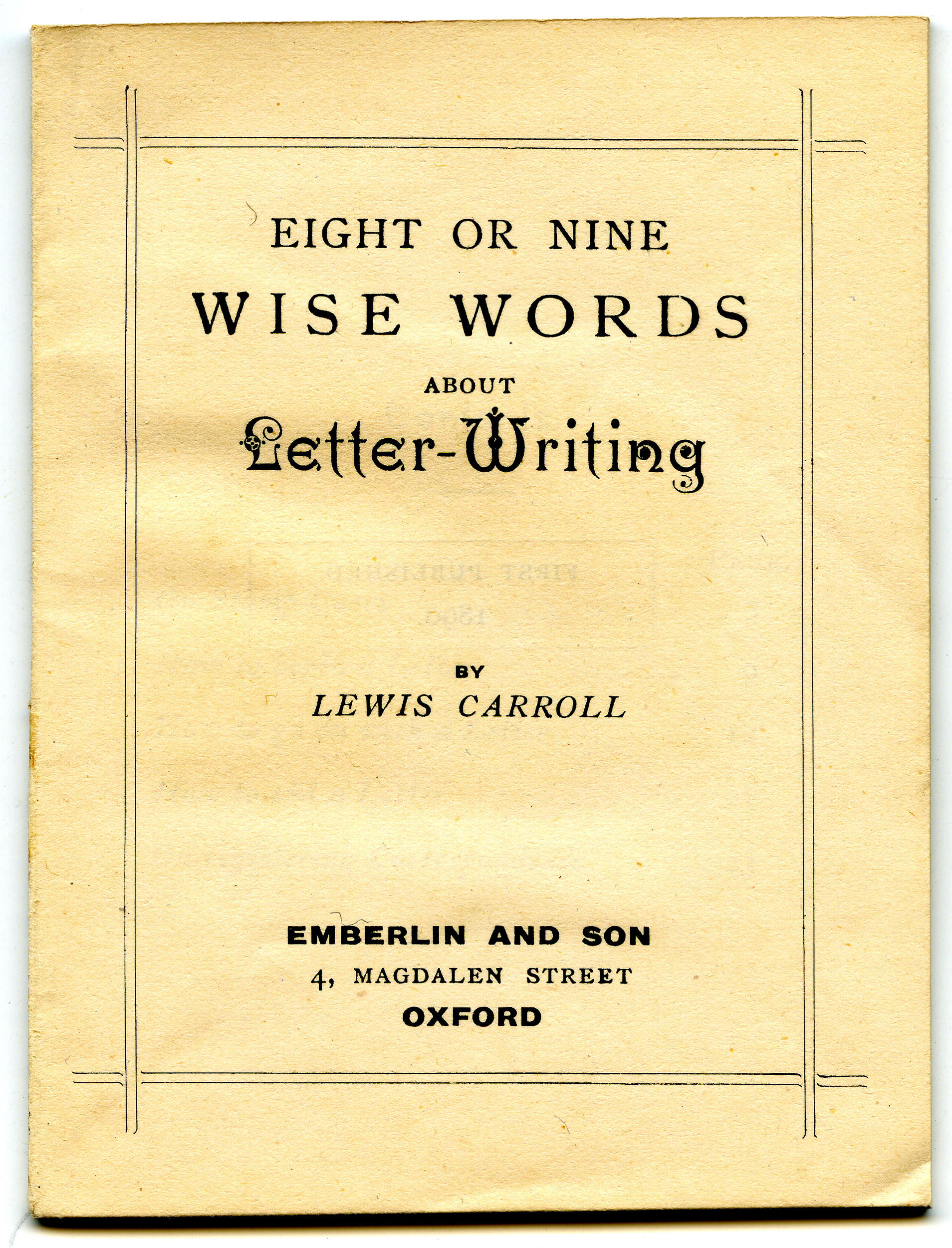
My graduate school supervisor taught me all I know about professional email etiquette. Vague language? Poor form. Typos? Nothing worse. Run-on paragraphs? A big no-no. Spelling your recipient’s name wrong? No coming back from that one. Unfortunately, hastily composed emails and ambiguous phrasing are all too common, particularly with the high volume of emails many people send daily. Skimping on the courtesy and the proofreading, however, is likely to cost you points with your recipient. Thankfully, we’ve provided a list of correspondence best practices, compiled by an authority on letters: Lewis Carroll (who, incidentally, would have celebrated his 182nd birthday today). In 1890, Carroll began to sell a Wonderland Stamp Case, which helped its users to organize their various postage stamps. Paired with the case was a short essay, entitled “Eight Or Nine Wise Words About Letter-Writing.”
The initial guide, of course, refers to pen and paper correspondence. In fact, Carroll’s foremost precept, which instructs one to write legibly, is no longer a concern in the digital age. Nevertheless, the remaining eight rules provide a clear and simple crib sheet for letter-writing that has stood the test of time remarkably well:
1) Start by addressing any questions the receiver previously had - “Don’t fill more than a page and a half with apologies for not having written sooner!
The best subject, to begin with, is your friend’s last letter. Write with the letter open before you. Answer his questions, and make any remarks his letter suggests. Then go on to what you want to say yourself. This arrangement is more courteous, and pleasanter for the reader, than to fill the letter with your own invaluable remarks, and then hastily answer your friend’s questions in a postscript. Your friend is much more likely to enjoy your wit, after his own anxiety for information has been satisfied.”
2)Don’t repeat yourself - “When once you have said your say, fully and clearly, on a certain point, and have failed to convince your friend, drop that subject: to repeat your arguments, all over again, will simply lead to his doing the same…”
3) Write with a level head — “When you have written a letter that you feel may possibly irritate your friend, however necessary you may have felt it to so express yourself, put it aside till the next day. Then read it over again, and fancy it addressed to yourself. This will often lead to your writing it all over again, taking out a lot of the vinegar and pepper, and putting in honey instead, and thus making a much more palatable dish of it!”
4) When in doubt, err on the side of courtesy - “If your friend makes a severe remark, either leave it unnoticed, or make your reply distinctly less severe: and if he makes a friendly remark, tending towards ‘making up’ the little difference that has arisen between you, let your reply be distinctly more friendly. If, in picking a quarrel, each party declined to go more than three-eighths of the way, and if, in making friends, each was ready to go five-eighths of the way—why, there would be more reconciliations than quarrels! Which is like the Irishman’s remonstrance to his gad-about daughter—‘Shure, you’re always goin’ out! You go out three times, for wanst that you come in!’ ”
5) Don’t try to have the last word — “How many a controversy would be nipped in the bud, if each was anxious to let the other have the last word! Never mind how telling a rejoinder you leave unuttered: never mind your friend’s supposing that you are silent from lack of anything to say: let the thing drop, as soon as it is possible without discourtesy: remember ‘speech is silvern, but silence is golden’! (N.B.—If you are a gentleman, and your friend a lady, this Rule is superfluous: you won’t get the last word!)”
6) Humor is hard to translate to writing. Be obvious. - “If it should ever occur to you to write, jestingly, in dispraise of your friend, be sure you exaggerate enough to make the jesting obvious: a word spoken in jest, but taken as earnest, may lead to very serious consequences. I have known it to lead to the breaking-off of a friendship. Suppose, for instance, you wish to remind your friend of a sovereign you have lent him, which he has forgotten to repay—you might quite mean the words “I mention it, as you seem to have a conveniently bad memory for debts”, in jest: yet there would be nothing to wonder at if he took offence at that way of putting it. But, suppose you wrote “Long observation of your career, as a pickpocket and a burglar, has convinced me that my one lingering hope, for recovering that sovereign I lent you, is to say ‘Pay up, or I’ll summons yer!’” he would indeed be a matter-of-fact friend if he took that as seriously meant!”
7) Don’t forget that attachment! — “When you say, in your letter, “I enclose cheque for £5”, or “I enclose John’s letter for you to see”, leave off writing for a moment—go and get the document referred to—and put it into the envelope. Otherwise, you are pretty certain to find it lying about, after the Post has gone!”
8) Using a postscript? Make it short — “A Postscript is a very useful invention: but it is not meant (as so many ladies suppose) to contain the real gist of the letter: it serves rather to throw into the shade any little matter we do not wish to make a fuss about.”
Casual Victorian-era “silly women!” sexism aside, Carroll’s tips are surprisingly fresh and applicable. If you’re planning on engaging in some serious snail-mail correspondence, we suggest you check out Carroll’s complete essay over at Project Gutenberg.
Ilia Blinderman is a Montreal-based culture and science writer. Follow him at @iliablinderman.
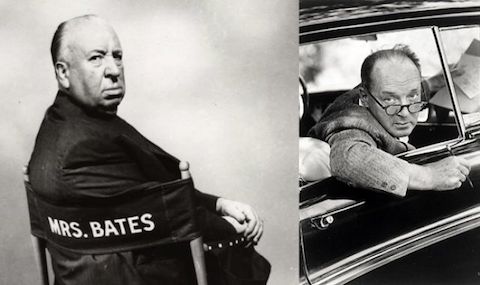
Alfred Hitchcock, writes James A. Davidson in Images, “is usually mentioned in the same breath with Cornell Woolrich, the literary ‘master of suspense,’ ” not least because he adapted a novella of Woolrich’s into Rear Window (1954).” Yet Davidson himself finds in Hitchcock “a much greater affinity with that of the Russian émigré writer Vladimir Nabokov, with whom he is not typically associated since there is no apparent connection” like the one between Nabokov and Stanley Kubrick, who brought Nabokov’s novel Lolita to the screen. Hitchcock and Nabokov never similarly collaborated, but not out of a lack of desire. Close historical contemporaries and mutual admirers, the writer and the director did once exchange letters discussing film ideas they might develop together. You’ll find the full text of both Hitchcock’s query and Nabokov’s interested response at the American Reader.
“The first idea I have been thinking about for some time is based upon a question that I do not think I have seen dealt with in motion pictures or, as far as I know, in literature,” wrote Hitchcock to Nabokov on November 19, 1964. “It is the problem of the woman who is associated, either by marriage or engagement, to a defector.” After filling out a few details, suiting the concept perfectly to what he calls “the customary Hitchcock suspense,” he lays out a second, about a young girl who, “having spent her life in a convent in Switzerland due to the fact that she had no home to go to and only had a widowed father,” suddenly finds herself released back to the hotel run by her father and his entire family. But ah, “the whole of this family are a gang of crooks, using the hotel as a base of operations,” which would lead into the telling of an “extremely colorful story.” Replying nine days later, Nabokov admits that Hitchcock’s first idea, about the defector’s wife, “would present many difficulties for me” due to his unfamiliarity with “American security matters and methods.” The one about the criminal hotel, however, strikes him as “quite acceptable,” and he goes on to make two pitches of his own.
Nabokov’s first idea, something of a reversal of Hitchcock’s first one, involves a defector from the Soviet Union in the United States. His second focuses on a starlet “courted by a budding astronaut.” When this astronaut returns home famous from a major mission, the actress, whose “starrise has come to a stop at a moderate level,” realizes “that he is not the same as he was before his flight.” Unable to put her finger on it, she “becomes concerned, then frightened, then panicky.” Nabokov tantalizingly mentions having “more than one interesting denouement for this plot,” but alas, we’ll never see them cinematized, and certainly not by the likes of Hitchcock. “One can only imagine the kind of involuted, complex, and playful work these two men would have produced,” writes Davidson. “What is left, in the end, is the work they produced, which can be well summarized by a line the fictional John Shade wrote in Pale Fire: ‘Life is a message scribbled in the dark.’ ”
We're hoping to rely on loyal readers, rather than erratic ads. Please click the Donate button and support Open Culture. You can use Paypal, Venmo, Patreon, even Crypto! We thank you!
Open Culture scours the web for the best educational media. We find the free courses and audio books you need, the language lessons & educational videos you want, and plenty of enlightenment in between.