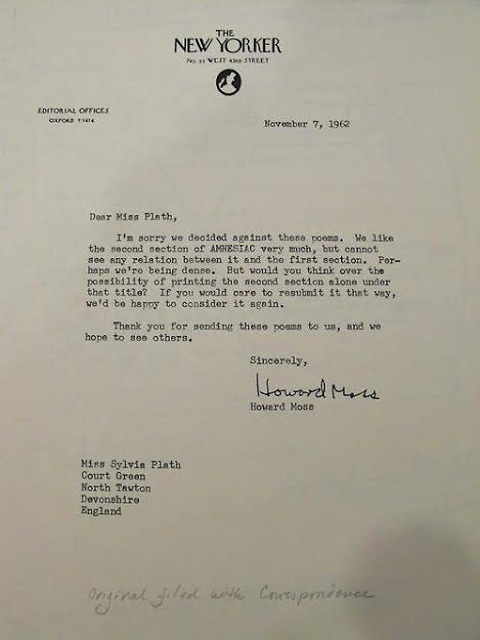
Every successful artist must master the art of accepting rejection. “Fail better,” said Beckett in his grim euphemism for perseverance. “I love my rejection slips,” wrote Sylvia Plath in every hopeful poet’s favorite quote. “They show me I try.” Plath—who also wrote “I am made, crudely, for success”—collected scores of rejection letters, receiving them even after the considerable success of 1960’s The Colossus and Other Poems. The 1962 letter above (click here to view in a larger format), from The New Yorker, doesn’t exactly reject a Plath submission, but it does recommend cutting the entire first section of “Amnesiac” and resubmitting “the second section alone under that title.” “Perhaps we’re being dense,” demurs editor Howard Moss.
The rejection must have been all the more painful since Plath was under a contract with the magazine, which entitled her to “an annual sum for the privilege of having a ‘first reading’ plus subsequent publishing rights to her new poetry,” Plath scholars tell us. And yet “much to her distress she mainly received rejections during November and December 1962.” The poem was eventually broken in two, with the first half published as “Lyonnesse,” but not by Plath herself but by publishers after her death. Hear Plath read the full poem as she intended it in her edition of Ariel, above.
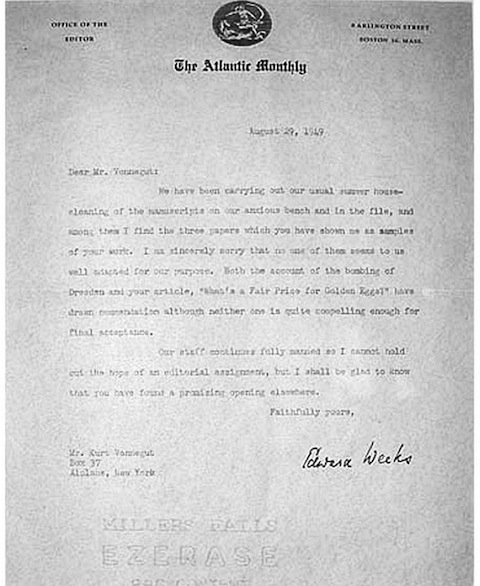
Kurt Vonnegut received an impersonal, and it would seem, long-overdue rejection letter from editor of The Atlantic Edward Weeks in 1949. Weeks writes breezily that he found Vonnegut’s “samples” during the “usual summer house-cleaning,” announcing its slush-pile status. Weeks does at least give the impression that someone, if not him, had read Vonnegut’s submissions. The aspiring writer was 27 years old, striking out “just a few years after surviving the bombing of Dresden as a POW,” Letters of Noteinforms us, and still twenty years away from publishing his groundbreaking novel Slaughterhouse Five. Letters of Note also provides us with the transcript below for the badly faded typescript.
The Atlantic Monthly
August 29, 1949
Dear Mr. Vonnegut:
We have been carrying out our usual summer house-cleaning of the manuscripts on our anxious bench and in the file, and among them I find the three papers which you have shown me as samples of your work. I am sincerely sorry that no one of them seems to us well adapted to for our purpose. Both the account of the bombing of Dresden and your article, “What’s a Fair Price for Golden Eggs?” have drawn commendation although neither one is quite compelling enough for final acceptance.
Our staff continues fully manned so I cannot hold out the hope of an editorial assignment, but I shall be glad to know that you have found a promising opening elsewhere.
Faithfully yours,
(Signed, ‘Edward Weeks’)
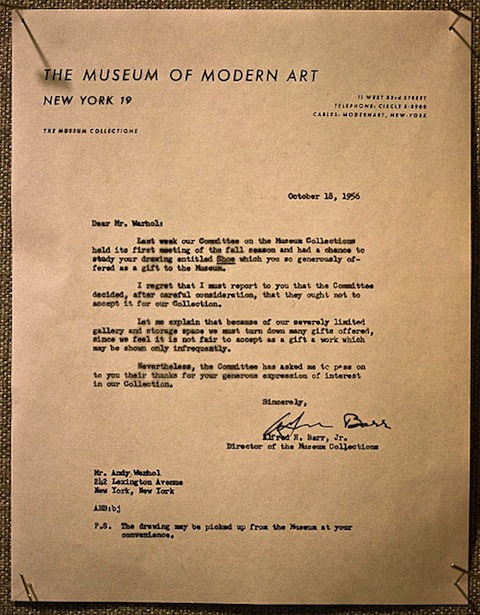
Of course visual artists are not immune. Andy Warhol received the above rejection letter from New York’s Museum of Modern Art when he attempted to donate a drawing in 1956. To its later chagrin, the museum wouldn’t let him give his work away:
Last week our Committee on the Museum Collections held its first meeting of the fall season and had a chance to study your drawing entitled Shoe which you so generously offered as a gift to the Museum.
I regret that I must report to you that the Committee decided, after careful consideration, that they ought not to accept it for our Collection.
The Warhol rejection circulated a few years ago after the MoMA tweeted Letters of Note’s post on it (read the full transcript there). Its most galling feature: a postscript that reads, with dismissive courtesy, “The drawing may be picked up from the museum at your convenience.”
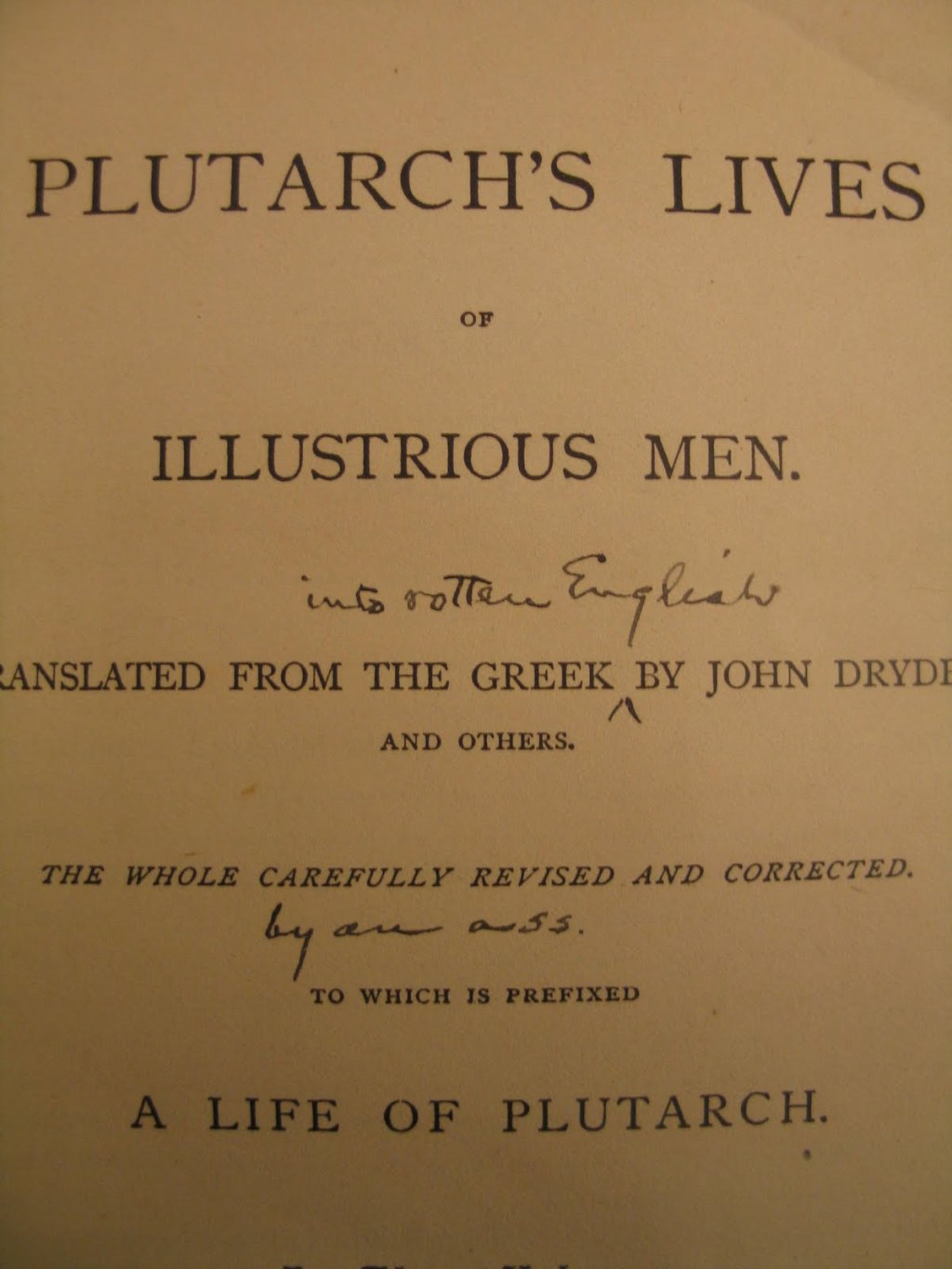
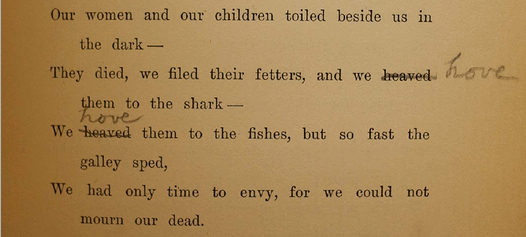
Hemingway once said that “all modern American literature comes from one book by Mark Twain called Huckleberry Finn.” Twain, however, was not only a master of subtlety and humor in fiction, but also a piercingly funny and sometimes scathing essayist whose pen ranged from politics to literary criticism. Despite publishing many biting essays, many of Twain’s best barbs never reached their targets. Instead they remained within the marginalia of his books. In a series of documents made public by the New York Times, Twain’s ire at sloppy writing makes itself known. Some comments, like this one regarding his friend, Rudyard Kipling, are fairly innocuous:
While Kipling got off lightly, John Dryden’s translation of Plutarch’s Lives seems to have hit a nerve, causing Twain to change the inscription to “translated from the Greek into rotten English by John Dryden; the whole carefully revised and corrected by an ass.” (Up top)
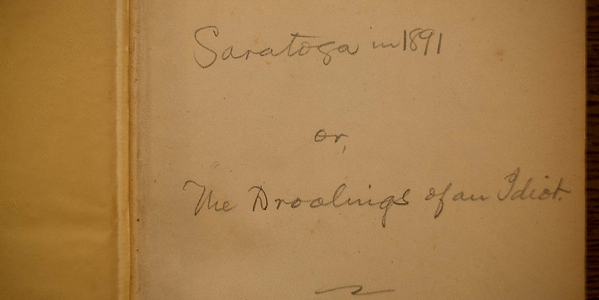
Notes in the margins of Landon D. Melville’s Saratoga in 1901 show that it fared no better. Twain, it appears, renamed the volume, dubbing it “Saratoga in 1891, or The Droolings of An Idiot.”
He also deemed some of the writings to be the “Wailings of an Idiot.”
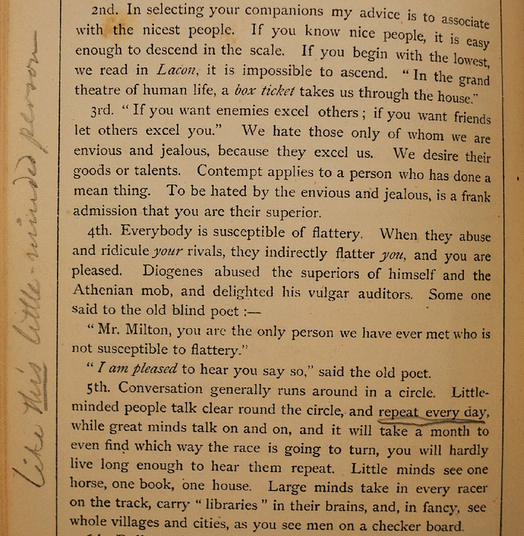
And, just so there wasn’t any ambiguity about what he thought, Twain labeled Melville a “little minded person.”
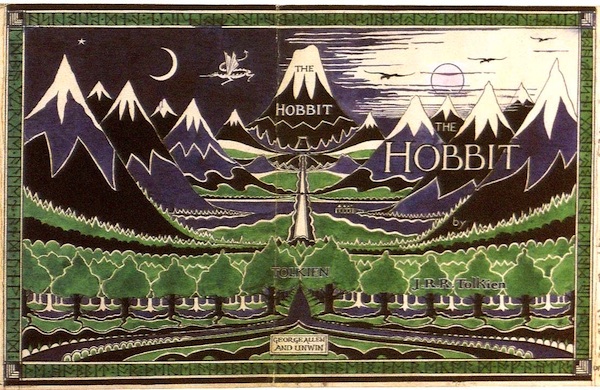
In 1937, C.S. Lewis (who would later write TheChronicles of Narnia – find it in a free audio format here)published in the Times Literary Supplement a review of The HobbitbyJ.R.R. Tolkien. Lewis and Tolkien were no strangers to one another. They had met back in 1926 at Oxford University, where they both served on the English faculty. In the years to come, they formed a close friendship and joined the Inklings, an Oxford literary group dedicated to fiction and fantasy.
Lewis’ review of The Hobbit was short, a mere three paragraphs. And it’s hard to say now whether Lewis was giving a kind review to a friend, or making some prescient literary observations. Or, perhaps, some combination of the two. The closing lines go like this:
The Hobbit … will be funnier to its youngest readers, and only years later, at a tenth or a twentieth reading, will they begin to realise what deft scholarship and profound reflection have gone to make everything in it so ripe, so friendly, and in its own way so true. Prediction is dangerous: but The Hobbit may well prove a classic.
The complete review has now been republished, and you can read it over at The Paris Review.
In 2006, a profile of Christopher Hitchens in The New Yorker noted how its subject had the tendency to drink “like a Hemingway character: continually and to no apparent effect.” Although Ernest Hemingway’s approach to alcohol informed the habits of his literary personages, it differed significantly from that of the late journalist. Hemingway, counter to his image, stood firmly against mixing writing and drinking, and when asked about combining the two exclaimed:
“Jeezus Christ! Have you ever heard of anyone who drank while he worked? You’re thinking of Faulkner. He does sometimes—and I can tell right in the middle of a page when he’s had his first one. Besides, who in hell would mix more than one martini at a time, anyway?”
Whereas Hemingway’s approach to writing and imbibing was often marked by a cautious and professional wall of separation, Hitchens had no such compunctions. The contrarian willingly admitted to drinking a fortifying mixture of wine and spirit throughout the day:
“I work at home, where there is indeed a bar-room, and can suit myself.… At about half past midday, a decent slug of Mr. Walker’s amber restorative, cut with Perrier water (an ideal delivery system) and no ice. At luncheon, perhaps half a bottle of red wine: not always more but never less. Then back to the desk, and ready to repeat the treatment at the evening meal. No “after dinner drinks”—most especially nothing sweet and never, ever any brandy. “Nightcaps” depend on how well the day went, but always the mixture as before. No mixing: no messing around with a gin here and a vodka there.”
Despite this hale and hearty routine, Hitchens claimed to be invigorated rather than impaired by his consumption:
“… on average I produce at least a thousand words of printable copy every day, and sometimes more. I have never missed a deadline. I give a class or a lecture or a seminar perhaps four times a month and have never been late for an engagement or shown up the worse for wear. My boyish visage and my mellifluous tones are fairly regularly to be seen and heard on TV and radio, and nothing will amplify the slightest slur more than the studio microphone.”
As with fishing and amorous exploits, so with drinking—one should be skeptical of bold claims. Nevertheless, Graydon Carter, the longstanding editor of Vanity Fair magazine, corroborated the robustness of Hitchens’ constitution in a fond and respectful obituary following the journalist’s death in 2011.
“He was a man of insatiable appetites—for cigarettes, for scotch, for company, for great writing, and, above all, for conversation… Pre-lunch canisters of scotch were followed by a couple of glasses of wine during the meal and a similar quantity of post-meal cognac. That was just his intake. After stumbling back to the office, we set him up at a rickety table and with an old Olivetti, and in a symphony of clacking he produced a 1,000-word column of near perfection in under half an hour.”
In the clip above, Hitchens makes his well-researched pronouncements on the world’s best Scotch whisky. Below, the former Asylum.com producer Anthony Layser sits down with Hitchens for a drink following the release of his memoir, Hitch-22. Over Hitchens’ beloved spirit, the duo discusses everything from writing, to Brazilian waxes, to waterboarding. The conversation, lasting some 14 minutes, is part of an Asylum.com series titled Drinks with Writers, which includes Layser’s interviews with Gary Shteyngart, Simon Rich, and Nick Hornby.
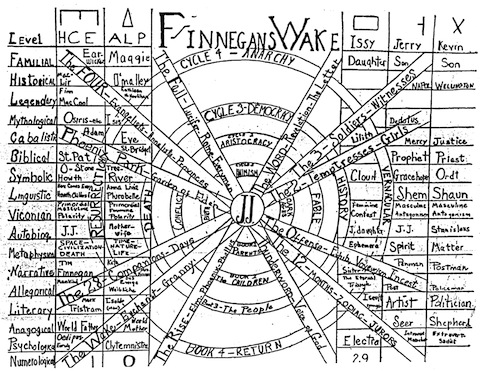
After the publication and eventual triumph of Ulysses, James Joyce spent the remainder of his life working secretively on a “Work in Progress” that he would publish in 1939 as Finnegans Wake, a novel that largely abandons the trappings of the novel and should better be called, as Anthony Burgess called it, a prose-poem—a beast that strikes the common reader as, in Burgess’ words, “too literary” and “horribly opaque.” My first encounter with this most intimidating book felt like something between hearing Italian comedian Adriano Celentano’s rapturously gibberish approximation of the sound of English in song and Michael Chabon’s detection of a “faintly Tolkienesque echo.” Like Chabon, I too could “hear the dreaming suspirations of the princess who lay sleeping in its keep.” Yet I was a bit too old for fantasy, I thought, and far too out of my depth in Joyce’s invented language, built, Burgess writes, “on the freshly uncovered roots of English.”
I’ve never lost my fear of the book, and never found it accommodating to any narrative sense. And it is fearful and unaccommodating if one approaches it like a conventional novel that will yield its secrets eventually and reward the diligent reader with some sort of singular payoff. Nevertheless, the sheer pleasure one can derive—conventional expectations duly set aside—from the almost tactile quality of Joyce’s prose, its earthy, ancient, elven sounds, seems more to the point of appreciating this odd, frustrating work. Perhaps, like any well-written poem, one simply needs to hear it read aloud. Joyce himself said so, and so you can. Ubuweb brings us the entirety of Patrick Healy’s reading of the text, recorded over a four-day period in 1992 at Dublin’s Bow Lane Recording Studios. (You can hear a small opening segment above.) Healy’s reading is not without its faults—he rushes and stumbles at times—but that seems a mean commentary on a recording of this length and difficulty. Listen to the first installment above and the rest here. You may just have an epiphany or two.
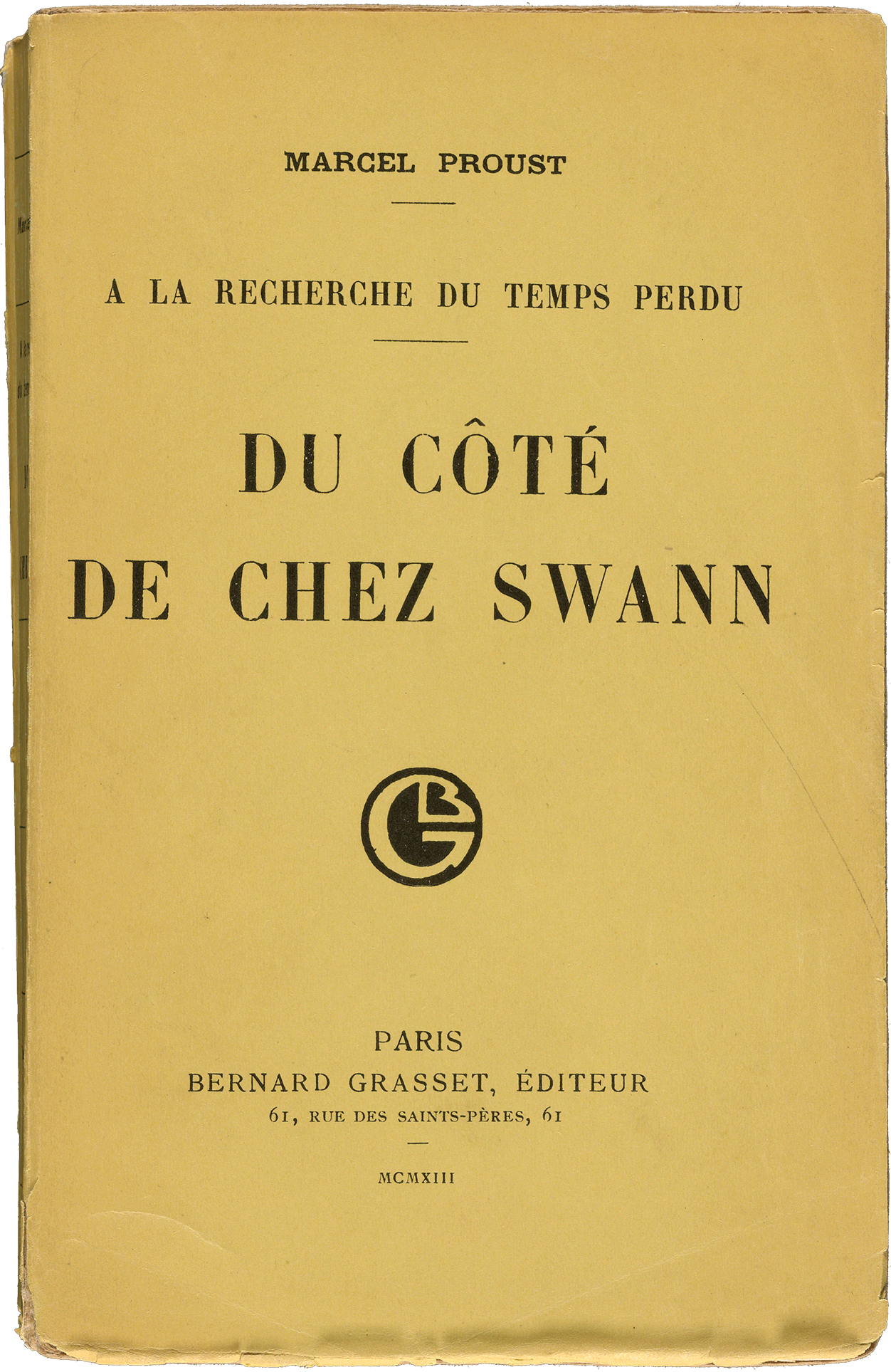
“We seem to be reaching a point in history where Ulysses (1922) is talked or written about more than read,” writes Wayne Wolfson at Outsideleft in an essay on James Joyce and Marcel Proust, whose Swann’s Way, the first in his seven-volume cycle Remembrance of Things Past (À la recherche du temps perdu), turns 100 today. This observation might have applied to Proust’s enormous modernist feat at all times in its history. Though Proust was fêted by high culture patrons and writers like Violet and Sydney Schiff, it’s hard to imagine these busy socialites secluding themselves for several months to catch up with a 4,000-page modernist masterwork. As French crime novelist Frédérique Molay glibly observes, “[Remembrance of Things Past] corresponds to a lot of lost time.”
Molay also points out that Proust’s friend and rival André Gide “didn’t like the manuscript, calling it ‘incomprehensible.’” Gide only saw volume one, Swann’s Way, though whether he actually read it or not is in some dispute. In any case, after Gide’s rejection, Proust’s publishing options narrowed to Bernard Grasset (Proust footed the bill for printing), with whom, notes The Independent, the author “engaged in a tortuous pas de deux… for most of 1913.” The back and forth included the “elaborate to-and-fro of his labyrinthine galley-proofs” (see an example above, and more here). And yet, The Independent goes on,
Swann’s Way at last appeared on 14 November in an edition of 1,750 copies (for which Proust paid more than 1,000 francs). A familiar kind of literary myth would suggest that, after a difficult birth, such a groundbreaking work must sink without trace. On the contrary.
Indeed. As a young grad student, I once walked in shame because—gasp—I had read no Proust. Not a word. I vaguely associated the name with French modernism, with a languorous, self-indulgent kind of writing that a reader like myself at the time, with a taste for the knotty, gnarled, and grotesque—for Faulkner and O’Connor, Hardy, Melville, and yes, Joyce—found disagreeable. I’d avoided Proust thus far, I reasoned, no need to rend my veil of ignorance now. Later, I defaulted to Molay’s glibness. Shrug, who has the time?
But today I feel I should revise that conclusion, at the very least because a bandwagon full of highly respected names has turned up to celebrate Proust’s achievement—or its nominal birthdate—including Ira Glass, pastry chef Dominique Ansel, who will bake madeleines (and who invented the Cronut), and novelist Rick Moody. These are but three of a cloud of “Proust fans of all kinds” participating in a “nomadic reading” of Swann’s Way in New York. It’s a showy affair, with readers gathering “over madeleines and champagne, in hotel rooms, gardens and nightclubs, from the Bronx to Brooklyn.”
By contrast, Antonin Baudry, one of the event’s organizers tells us, “In France, ordinary people are more likely just to read Proust at home.” (You can see clips of everyday French people reading Proust here, in fact.) Given the famously hypochondriac and reclusive author’s penchant, I may also spend the day at home, reading Proust, in bed, inspired also by Rick Moody’s observation: “As a young writer, I felt there were two kinds of people: Joyce people and Proust people.… For a long time, I would’ve asserted my allegiance to Joycean qualities. But in my galloping middle age, Proust calls to me more fervently.”
If you feel likewise inspired today, you can read all of Proust’s literary feast—or just sample it in bites. Find links to all seven volumes of Remembrance of Things Past below. They’re otherwise housed in our collection, 800 Free eBooks for iPad, Kindle & Other Devices.
Book lists, despite what younger readers born into Buzzfeed’s ruthless listsicle monopoly may think, have always been popular. Some, like David Bowie’s Top 100 Books, give us a sense of the artist’s development. Others, like Joseph Brodsky’s List of 84 Books for Basic Conversation, provide a Nobel prize-winning benchmark for knowledge. Even though the books are within the reach of most readers, systematically digesting such lists often tries one’s patience. Despite the lack of will or interest in working through someone else’s literary education, however, glancing through such personal anthologies provides us with a glimpse into the maker’s life—be it their private tastes, or their social mores.
In late October, The Times Literary Supplement’s Michael Caines unearthed another Top 100 list; this one, however, has the distinction of hailing from 1898. At the turn of the 20th century, a journalist and author of numerous books on the Brontë sisters named Clement K. Shorter tried his hand at compiling the 100 Best Novels for a journal called The Bookman. The ground rules were simple: the list could feature only one novel per novelist, and living authors were excluded. Today, Shorter’s compendium looks somewhat hit-or-miss. There are some indisputable classics (many of which can be found in our Free eBooks and Free Audio Books collections) and some other texts that have faded into oblivion. Still—one can’t help but experience a certain historical frisson at a 19th century listsicle. Here it goes:
1. Don Quixote — 1604 — Miguel de Cervantes
2. The Holy War — 1682 — John Bunyan
3. Gil Blas — 1715 — Alain René le Sage
4. Robinson Crusoe — 1719 — Daniel Defoe
5. Gulliver’s Travels — 1726 — Jonathan Swift
6. Roderick Random — 1748 — Tobias Smollett
7. Clarissa — 1749 — Samuel Richardson
8. Tom Jones — 1749 — Henry Fielding
9. Candide — 1756 — Françoise de Voltaire
10. Rasselas — 1759 — Samuel Johnson
11. The Castle of Otranto — 1764 — Horace Walpole
12. The Vicar of Wakefield — 1766 — Oliver Goldsmith
13. The Old English Baron — 1777 — Clara Reeve
14. Evelina — 1778 — Fanny Burney
15. Vathek — 1787 — William Beckford
16. The Mysteries of Udolpho — 1794 — Ann Radcliffe
17. Caleb Williams — 1794 — William Godwin
18. The Wild Irish Girl — 1806 — Lady Morgan
19. Corinne — 1810 — Madame de Stael
20. The Scottish Chiefs — 1810 — Jane Porter
21. The Absentee — 1812 — Maria Edgeworth
22. Pride and Prejudice — 1813 — Jane Austen
23. Headlong Hall — 1816 — Thomas Love Peacock
24. Frankenstein — 1818 — Mary Shelley
25. Marriage — 1818 — Susan Ferrier
26. The Ayrshire Legatees — 1820 — John Galt
27. Valerius — 1821 — John Gibson Lockhart
28. Wilhelm Meister — 1821 — Johann Wolfgang von Goethe
29. Kenilworth — 1821 — Sir Walter Scott
30. Bracebridge Hall — 1822 — Washington Irving
31. The Epicurean — 1822 — Thomas Moore
32. The Adventures of Hajji Baba — 1824 — James Morier (“usually reckoned his best”)
33. The Betrothed — 1825 — Alessandro Manzoni
34. Lichtenstein — 1826 — Wilhelm Hauff
35. The Last of the Mohicans — 1826 — Fenimore Cooper
36. The Collegians — 1828 — Gerald Griffin
37. The Autobiography of Mansie Wauch — 1828 — David M. Moir
38. Richelieu — 1829 — G. P. R. James (the “first and best” novel by the “doyen of historical novelists”)
39. Tom Cringle’s Log — 1833 — Michael Scott
40. Mr. Midshipman Easy — 1834 — Frederick Marryat
41. Le Père Goriot — 1835 — Honoré de Balzac
42. Rory O’More — 1836 — Samuel Lover (another first novel, inspired by one of the author’s own ballads)
43. Jack Brag — 1837 — Theodore Hook
44. Fardorougha the Miser — 1839 — William Carleton (“a grim study of avarice and Catholic family life. Critics consider it the author’s finest achievement”)
55. The Three Musketeers — 1845 — Alexandre Dumas
56. The Wandering Jew — 1845 — Eugène Sue
57. Emilia Wyndham — 1846 — Anne Marsh
58. The Romance of War — 1846 — James Grant (“the narrative of the 92nd Highlanders’ contribution from the Peninsular campaign to Waterloo”)
59. Vanity Fair — 1847 — W. M. Thackeray
60. Jane Eyre — 1847 — Charlotte Brontë
61. Wuthering Heights — 1847 — Emily Brontë
62. The Vale of Cedars — 1848 — Grace Aguilar
63. David Copperfield — 1849 — Charles Dickens
64. The Maiden and Married Life of Mary Powell — 1850 — Anne Manning (“written in a pastiche seventeenth-century style and printed with the old-fashioned typography and page layout for which there was a vogue at the period …”)
65. The Scarlet Letter — 1850 — Nathaniel Hawthorne
66. Frank Fairleigh — 1850 — Francis Smedley (“Smedley specialised in fiction that is hearty and active, with a strong line in boisterous college escapades and adventurous esquestrian exploits”)
67. Uncle Tom’s Cabin — 1851 — H. B. Stowe
68. The Wide Wide World — 1851 — Susan Warner (Elizabeth Wetherell)
69. Nathalie — 1851 — Julia Kavanagh
70. Ruth — 1853 — Elizabeth Gaskell
71. The Lamplighter — 1854 — Maria Susanna Cummins
72. Dr. Antonio — 1855 — Giovanni Ruffini
73. Westward Ho! — 1855 — Charles Kingsley
74. Debit and Credit (Soll und Haben) — 1855 — Gustav Freytag
75. Tom Brown’s School-Days — 1856 — Thomas Hughes
77. John Halifax, Gentleman — 1857 — Dinah Mulock (a. k. a. Dinah Craik; “the best-known Victorian fable of Smilesian self-improvement”)
78. Ekkehard — 1857 — Viktor von Scheffel
79. Elsie Venner — 1859 — O. W. Holmes
80. The Woman in White — 1860 — Wilkie Collins
81. The Cloister and the Hearth — 1861 — Charles Reade
82. Ravenshoe — 1861 — Henry Kingsley (“There is much confusion in the plot to do with changelings and frustrated inheritance” in this successful novel by Charles Kingsley’s younger brother, the “black sheep” of a “highly respectable” family)
83. Fathers and Sons — 1861 — Ivan Turgenieff
84. Silas Marner — 1861 — George Eliot
85. Les Misérables — 1862 — Victor Hugo
86. Salammbô — 1862 — Gustave Flaubert
87. Salem Chapel — 1862 — Margaret Oliphant
88. The Channings — 1862 — Ellen Wood (a. k. a. Mrs Henry Wood)
89. Lost and Saved — 1863 — The Hon. Mrs. Norton
90. The Schönberg-Cotta Family — 1863 — Elizabeth Charles
91. Uncle Silas — 1864 — Joseph Sheridan Le Fanu
92. Barbara’s History — 1864 — Amelia B. Edwards (“Confusingly for bibliographers, she was related to Matilda Betham-Edwards and possibly to Annie Edward(e)s …”)
93. Sweet Anne Page — 1868 — Mortimer Collins
94. Crime and Punishment — 1868 — Feodor Dostoieffsky
95. Fromont Junior — 1874 — Alphonse Daudet
96. Marmorne — 1877 — P. G. Hamerton (“written under the pseudonym Adolphus Segrave”)
97. Black but Comely — 1879 — G. J. Whyte-Melville
98. The Master of Ballantrae — 1889 — R. L. Stevenson
99. Reuben Sachs — 1889 — Amy Levy
100. News from Nowhere — 1891 — William Morris
In addition to the canon, Shorter—unable to heed his own cautious counsel and throwing the door open to the winds of literary passion—included 8 books by living novelists whom he called “writers whose reputations are too well established for their juniors to feel towards them any sentiments other than those of reverence and regard:”
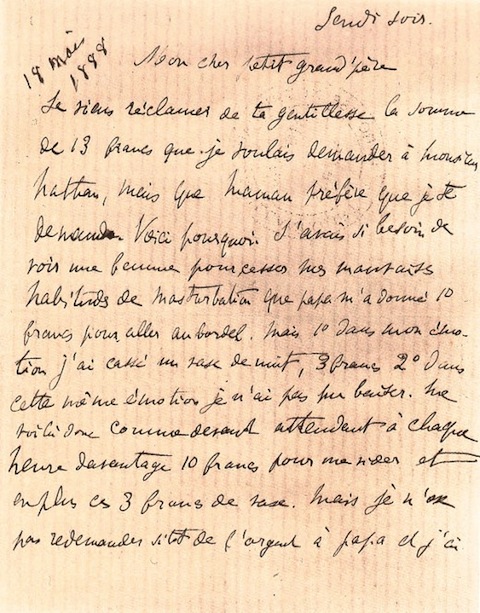
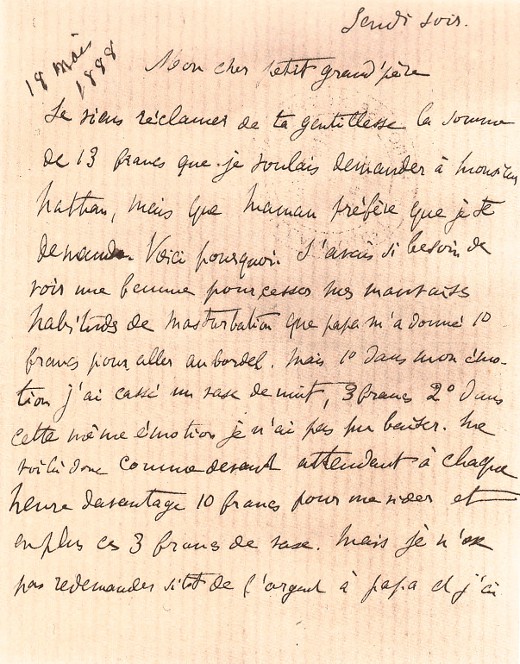
“One can say anything so long as one does not say ‘I.’ ” Marcel Proust wrote these words to his fellow Frenchman of letters André Gide, and they constitute valuable advice for any novelist as well as a useful key to understanding Proust’s own work. We think of Proust — especially today, the hundredth anniversary of Swann’s Way, which opens his masterwork Remembrance of Things Past (À la recherche du temps perdu) — as an important French novelist, an important modern novelist, an important fin-de-siècle novelist, and so on. We also think of Proust as an important gay novelist. And we owe that, in some sense, to Gide, who revealed the closeted Proust’s homosexuality in their published correspondence after Proust’s death. Sexuality has since become a major element of the robust field of Proust criticism, and the letter above surely gives its scholars material — or at least those scholars willing to examine the author’s biography alongside his work.
The author of Remembrance of Things Pastonce suffered, according to Letters of Note, from an obsession with masturbation. “As a teenager this caused problems for his family, not least his father, a professor of hygiene, who like many of the day believed that such a worrying habit could cause homosexuality if left unchecked.” Given 10 francs by Proust père, Marcel went off to the neighborhood brothel to, in theory, get himself set straight. And the outcome of this “cure”? We defer to the sixteen-year-old Proust himself, who in the letter above tells the whole sordid story to his grandfather:
18 May 1888
Thursday evening.
My dear little grandfather,
I appeal to your kindness for the sum of 13 francs that I wished to ask Mr. Nathan for, but which Mama prefers I request from you. Here is why. I so needed to see if a woman could stop my awful masturbation habit that Papa gave me 10 francs to go to a brothel. But first, in my agitation, I broke a chamber pot: 3 francs; then, still agitated, I was unable to screw. So here I am, back to square one, waiting more and more as hours pass for 10 francs to relieve myself, plus 3 francs for the pot. But I dare not ask Papa for more money so soon and so I hoped you could come to my aid in a circumstance which, as you know, is not merely exceptional but also unique. It cannot happen twice in one lifetime that a person is too flustered to screw.
I kiss you a thousand times and dare to thank you in advance.
I will be home tomorrow morning at 11am. If you are moved by my situation and can answer my prayers, I will hopefully find you with the amount. Regardless, thank you for your decision which I know will come from a place of friendship.
Marcel.
Many thanks to Letters of Note for uncovering this illuminating and — intentionally? unintentionally? — comedic piece of correspondence from literary history, and to Fabien Bonnet and Larst Onovich, to whom Letters of Note, in turn, gives credit.
We're hoping to rely on loyal readers, rather than erratic ads. Please click the Donate button and support Open Culture. You can use Paypal, Venmo, Patreon, even Crypto! We thank you!
Open Culture scours the web for the best educational media. We find the free courses and audio books you need, the language lessons & educational videos you want, and plenty of enlightenment in between.