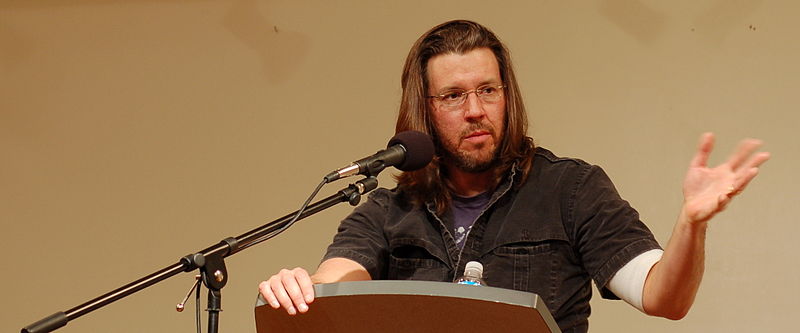
Let me start with the first lines that appeared in The New York Times five years ago: “David Foster Wallace, whose prodigiously observant, exuberantly plotted, grammatically and etymologically challenging, philosophically probing and culturally hyper-contemporary novels, stories and essays made him an heir to modern virtuosos like Thomas Pynchon and Don DeLillo, an experimental contemporary of William T. Vollmann, Mark Leyner and Nicholson Baker and a clear influence on younger tour-de-force stylists like Dave Eggers and Jonathan Safran Foer, died on Friday at his home in Claremont, Calif. He was 46.” It’s not your conventional obituary. No, it has a literary style befitting the writer we lost on September 12, 2008. And five years after DFW’s death, we might want to pause and revisit his many stories and essays still available on the web. To mark this mournful occasion, we’ve updated and expanded our list, 30 Free Essays & Stories by David Foster Wallace on the Web, which features some timely and memorable pieces — “9/11: The View From the Midwest,”“Consider the Lobster,” and Federer as Religious Experience,” just to name just a few. Below we’ve also highlighted some of our favorite David Foster Wallace posts published over the years. Hope you enjoy visiting or revisiting this material as much as I have.
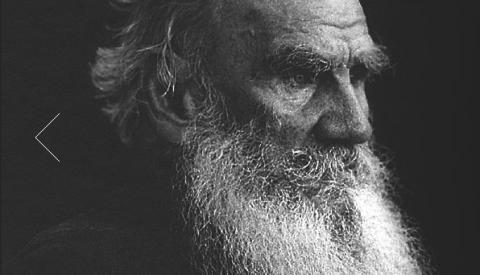
This is surely worth a quick heads up: Leo Tolstoy’s entire body of work – all 46,000 pages of it – will appear on the Tolstoy.ru web site. According to Tolstoy’s great-great-granddaughter Fyokla Tolstaya, all of the author’s novels, short stories, fairy tales, essays and personal letters will be made freely available in PDF, FB2 and EPUB formats (which you can easily load onto a Kindle, iPad or almost any other ebook reader). She goes on to tell the Russian newspaper RIA Novosti that the “90-volume edition was scanned and proofread three times by more than 3,000 volunteers from 49 countries.” Truly an incredible crowdsourcing feat.
What’s the rub? You have to read Russian. Yes, it’s potentially a downer. But you can always find Tolstoy’s major works in translation in our Free eBooks and Free Audio Books collections.
And if that doesn’t make you feel better, see the excellent bonus material below.
Lest you remain unaware, Jane Eyrehas a vlog. And though I would fain speak well of it, the truth must out. I prefer my Jane with bonnet strings knotted firmly beneath her chin. This Jane, as embodied by project co-creator, Alysson Hall, often seems like a fan putting together a homemade audition tape for Girls.
In addition to the YouTube channel, Jane tweets to over 1500 followers, and uploads photos to Instagram. Her video diary might not be my cup of tea, but I must confess, I do rather enjoy her tumblr. Perhaps not as much as I’d enjoy rereading the novel (find it in our collection Free eBooks and Free Audio Books collections), but it’s not a bad way to while away a minute or two.
Put another way, anyone who likes reading Brontë is probably amenable to pictures of tea cups, dead trees, and Tim Burton’s animated dolls.
Jane’s embrace of social media is shared by many in her orbit, including Mr. Rochester’s employee, Grace Poole, and his 8‑year-old daughter, Adele, whose (illegal) Twitter feed will appeal to any precocious little smartypants eager for random facts regarding Bernese Mountain Dogs and Uranus’ moons.
The veil is lifted somewhat on the series’ Facebook page, where the creators interact with fans out-of-character and address modern technical difficulties, such as software issues and audio glitches.
In Jorge Luis Borges’ short story “The Library of Babel,” the titular library contains “all that it is given to express, in all languages”:
Everything: the minutely detailed history of the future, the archangels’ autobiographies, the faithful catalogue of the Library, thousands and thousands of false catalogues… the translation of every book in all languages, the interpolations of every book in all books.
As well as an ironic allegorical take on the Newtonian notion of the universe as legible and organized, Borges’ story enacts his experience of a life lived almost entirely inside literature as one of the most erudite writers, essayists, and librarians of all time. Borges was not only intimidatingly widely-read, but his critical opinions were notoriously idiosyncratic and contrarian. He preferred the obscure to the widely celebrated, castigating, for example, admirers of Baudelaire as “imbeciles” (according to his longtime friend and biographer Adolfo Bioy Casares) while professing his own admiration for Baudelaire’s onetime friend, the morose and unpleasant zealous Catholic convert Leon Bloy.
But in addition to his penchant for writers no one reads, Borges also loved more populist writers like G.K. Chesterton and Rudyard Kipling and had the canons of several European literatures memorized, not to mention the labyrinthine works of several medieval Catholic philosophers and all of Spinoza. In short, his tastes were unpredictable and entirely his own, untainted by any gestures toward fashion or public sentiment. And that is why he is an excellent guide to the genre of writing that his name has become associated with more than any other: that of speculative fiction or “fantastic tales.” In 1979, Borges edited a collection of such writing, in 33 volumes, in Spanish (though perhaps originally in Italian). Each volume is devoted to a selection of works from a single author (including Borges himself, volume 2) or to a geographical distribution, such as “Russian Tales” (volume 29) and “Argentinian Tales” (volume 30).
In a 2009 piece for The Rumpus, Grant Monroe details his attempt to track down the contents of this massive anthology, called, after Borges’ story, The Library of Babel. While the collection is considerably less impenetrable, “indefinite and perhaps infinite” than the library-world of his famous story, it is nonetheless daunting, and one could get lost in its corridors for several months. Below, you can find a list of seven selected stories—with links to online versions—very roughly representative of the breadth and strange depths of Borges’ curatorial imagination. Then see the full contents of The Library of Babel anthology below the jump.
A contemporary and friend of Borges’ detested Baudelaire, Villiers de l’Isle-Adam was just the kind of down-at-heel aristocratic roué whom everyone imagines when thinking of French symbolist poetry. Greatly influenced by Poe, his Cruel Tales, from which the story above comes, is a collection of mostly mystical stories.
Hinton, a British mathematician and sci-fi writer who was much interested in the fourth dimension and who coined the word “tesseract,” wrote speculative fiction deeply informed by physics and mathematics, often complete with diagrams, as in the above short work, one of nine pamphlets published as Scientific Romances. Hinton is mentioned in at least two of Borges’ stories.
One does not generally think of Dostoevsky as a writer of “fantastic tales,” nor, for that matter, of short fiction. But Borges includes this little-known short in his volume of Russian Tales.
Briefly associated with British occultists like A.E. Waite and exerting a great deal of influence on Aleister Crowley, H.P. Lovecraft, and generations of genre writers, Welsh writer Arthur Machen was also a favorite of Borges.
Everyone is familiar with Voltaire the philosopher and satirist, but few know of his contribution to the development of science fiction with his seven-part story “Micromegas,” the tale of a 20,000 foot tall alien banished from his world for heresy.
This Argentinian writer was a major influence on Borges. Although he receives his own edited volume in the anthology (volume 19), this story appears in volume 30, “Argentinian Tales.”
An Interview with Borges, with Maria Esther Vasquez
A Chronology of J.L. Borges’ Life, from Siruela Magazine
The Ruler and Labyrinth: An Approximation of J.L Borges’ Bibliography, by Fernandez Ferrer
3. Gustav Meyrink, Cardinal Napellus
“Der Kardinal Napellus”
“J.H. Obereits Besuch bei den Zeitegeln”
“Der Vier Mondbrüder”
4. Léon Bloy, Disagreeable Tales
“La Taie d’Argent”
“Les Captifs de Longjumeau”
“Une Idée Médiocre”
“Une Martyre”
“La Plus Belle Trouvaille de Caïn”
“On n’est pas Parfait”
“La Religion de M. Pleur”
“Terrible Châtiment d’un Dentiste”
“La Tisane”
“Tout Ce Que Tu Voudras!”
“La Dernière Cuite”
“Le Vieux de la Maison”
5. Giovanni Papini, The Mirror That Fled
“Il Giorno Non Restituito”
“Due Immagini in una Vasca”
“Lo Specchio che Fugge”
“Storia Completamente Assurda”
“Il Mendicante di Anime”
“Una Morte Mentale”
“Non Voglio Più Essere Ciò che Sono”
“Chi Sei?”
“Il Suicida Sostituto”
“L’ultima Visita del Gentiluomo Malato”
6. Oscar Wilde, Lord Arthur Savile’s Crime
“Lord Arthur Savile’s Crime”
“The Canterville Ghost”
“The Selfish Giant”
“The Happy Prince”
“The Nightingale and the Rose”
7. Villiers de L’Isle-Adam, El Convidado de las Últimas Festivas
“L’Aventure de Tsé-i-la”
“Le Convive des Dernières Fêtes”
“A Torture By Hope”
“La Reine Ysabeau”
“Sombre Récit Conteur Plus Sombre”
“L’Enjeu”
“Véra”
8. Pedro Antonio de Alarcón, El Amigo de la Muerte
“El Amigo de la Muerte” [or “The Strange Friend of Tito Gil”]
“The Tall Woman”
9. Herman Melville, Bartleby the Scrivener
“Bartleby, the Scrivener: A Story of Wall-Street”
10. William Beckford, Vathek
Vathek, a novella.
11. H.G. Wells, The Door in the Wall
“The Plattner Story”
“The Story of Late Mr. Elvesham”
“The Crystal Egg”
“The Country of the Blind”
“The Door in the Wall”
12. Pu Songling, The Tiger Guest
“The Buddhist Priest of Ch’ang-Ch’ing”
“In the Infernal Regions”
“The Magic Mirror”
“A Supernatural Wife”
“Examination for the Post of Guardian Angel”
“The Man Who Was Changed into a Crow”
“The Tiger Guest”
“Judge Lu”
“The Painted Skin”
“The Stream of Cash”
“The Invisible Priest”
“The Magic Path”
“The Wolf Dream”
“Dreaming Honors”
“The Tiger of Chao-Ch’ëng”
“Taking Revenge”
13. Arthur Machen, The Shining Pyramid
“The Novel of the Black Seal”
“The Novel of the White Powder”
“The Shining Pyramid”
14. Robert Louis Stevenson, The Isle of Voices
“The Bottle Imp”
“The Isle of Voices”
“Thrawn Janet”
“Markheim”
15. G.K. Chesterton, The Eye of Apollo
“The Duel of Dr Hirsch”
“The Queer Feet”
“The Honor of Israel Gow”
“The Eye of Apollo”
“The Three Horsemen of the Apocalypse”
16. Jacques Cazotte, The Devil in Love
The Devil in Love, a novella.
“Jacquez Cazotte,” an essay by Gerard de Nerval
17. Franz Kafka, The Vulture
“The Hunger Artist”
“First Sorrow” [or “The Trapeze Artist”]
“The Vulture”
“A Common Confusion”
“Jackals and Arabs”
“The Great Wall of China”
“The City Coat of Arms”
“A Report to the Academy”
“Eleven Sons”
“Prometheus”
18. Edgar Allan Poe, The Purloined Letter
“The Purloined Letter”
“Ms. Found in a Bottle”
“The Facts in the Case of M. Valdemar”
“The Man in the Crowd”
“The Pit and the Pendulum”
19. Leopoldo Lugones, The Pillar of Salt
“The Pillar of Salt”
“Grandmother Julieta”
“The Horses of Abdera”
“An Inexplicable Phenomenon”
“Francesca”
“Rain of Fire: An Account of the Immolation of Gomorra”
20. Rudyard Kipling, The Wish House
“The Wish House”
“A Sahib’s War”
“The Gardener”
“The Madonna of the Trenches”
“The Eye of Allah”
21. The Thousand and One Nights, According to Galland
“Abdula, the Blind Beggar”
“Alladin’s Lamp”
22. The Thousand and One Nights, According to Burton
“King Sinbad and His Falcon”
“The Adventures of Bululkia”
“The City of Brass”
“Tale of the Queen and the Serpent”
“Tale of the Husband and the Parrot”
“Tale of the Jewish Doctor”
“Tale of the Ensorcelled Prince”
“Tale of the Prince and the Ogres”
“Tale of the Wizir and the Wise Duban”
“The Fisherman and the Genii”
23. Henry James, The Friends of the Friends
“The Friends of the Friends”
“The Abasement of the Northmores”
“Owen Wingrave”
“The Private Life”
24. Voltaire, Micromegas
“The Black and the White”
“The Two Conforters”
“The History of the Travels of Scaramentado”
“Memnon the Philosopher”
“Micromegas”
“The Princess of Babylon”
25. Charles Hinton, Scientific Romances
“A Plane World”
“What is the Fourth Dimension?”
“The Persian King”
26. Nathaniel Hawthorne, The Great Stone Face
“Mr. Higginbotham’s Catastrophe”
“The Great Stone Face”
“Earth’s Holocaust”
“The Minister’s Black Veil”
“Wakefield”
27. Lord Dunsany, The Country of Yann
“Where the Tides Ebb and Flow”
“The Sword and the Idol”
“Carcassonne”
“Idle Days on the Yann”
“The Field”
“The Beggars”
“The Bureau d’Echange de Maux”
“A Night at an Inn”
28. Saki, The Reticence of Lady Anne
“The Story-Teller”
“The Lumber Room”
“Gabriel-Ernest”
“Tobermory”
“The Background” [translated as “El Marco” (or “The Frame”)]
“The Unrest Cure”
“The Interlopers”
“Quail Seed”
“The Peace of Mowsle Barton”
“The Open Window”
“The Reticence of Lady Anne”
“Sredni Vashtar”
29. Russian Tales
“Lazarus”, Leonid Andreyev
“The Crocodile”, Fydor Doestoevsky
“The Death of Ivan Illitch”, Leo Tolstoy
30. Argentinean Tales
“El Calamar Opta por su Tinta,” Adolfo Bioy Casares
“Yzur,” Leopoldo Lugones [See above.]
“A House Taken Over”, Julio Cortazar
“La Galera,” Manuel Mujica Láinez
“Los Objectos,” Silvina D’acampo
“El Profesor de Ajedrez,” Federico Peltzer
“Pudo Haberme Ocurrido,” Manuel Peyrou
“El Elegido,” Maria Esther Vasquez
31. J.L. Borges and Adolfo Bioy Casares, New Stories of H. Bustos Domecq
32. The Book of Dreams (A Collection of Recounted Dreams)
List of Authors: Francisco de Quevedo y Villegas, Alexandra David-Néel, Alfonso X, Alfred de Vigny, Aloysius Bertrand, Antonio Machado, Bernabé Cobo, D. F. Sarmiento, Eliseo Díaz, Francisco Acevedo, François Rabelais, Franz Kafka, Friedrich Nietzsche, Gastón Padilla, Giuseppe Ungaretti, Gottfried Keller, H. Desvignes Doolittle, Herbert Allen Giles, Herodotus, H. Garro, Horace, Ibrahim Zahim [Ibrahim Bin Adham], James G. Frazer, Jorge Alberto Ferrando, Jorge Luis Borges, José Ferrater Mora, José María Eça de Queiroz, Joseph Addison, Juan José Arreola, Lewis Carroll, Lao Tzu, Louis Aragon, Luigi Pirandello, Luis de Góngora, Mircea Eliade, Mohammad Mossadegh, Nemer ibn el Barud [no Wiki entry; see Amazon comment field], O. Henry, Otto von Bismarck, Paul Groussac, Plato, Plutarch, Rabbi Nissim ben Reuven, Raymond de Becker, Rodericus Bartius, Roy Bartholomew, Samuel Taylor Coleridge, Sebastián de Covarrubias Orozco, Thornton Wilder, Lucretius, Tsao Hsue Kin [Cao Xueqin], Ward Hill Lamon, William Butler Yeats, Wu Cheng’en, Giovanni Papini, Nathaniel Hawthorne, Charles Baudelaire
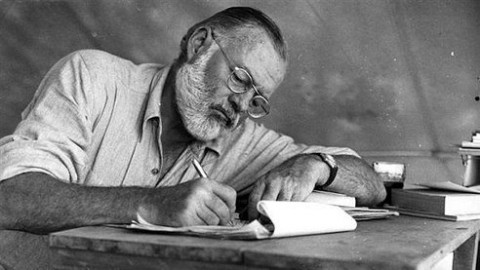
In the 1930s, Ernest Hemingway wrote a series of short pieces for Esquire magazine called the “Key West Letters.” One of those pieces, the 1935 “Remembering Shooting-Flying” has an interesting premise—Hemingway claims that remembering and writing about shooting are more pleasurable than shooting itself. Or at least that he’d rather remember shooting pheasant than actually shoot clay pigeons. In the next paragraph, this nostalgia for good shooting gets tied up with good books, such that the essay betrays its true desire—to be a meditation on reading. Before he catches himself and gets back on topic, Hemingway launches into a long parenthetical:
I would rather read again for the first time Anna Karenina, Far Away and Long Ago, Buddenbrooks, Wuthering Heights, Madame Bovary, War and Peace, A Sportsman’s Sketches, The Brothers Karamazov, Hail and Farewell, Huckleberry Finn, Winesburg, Ohio, La Reine Margot, La Maison Tellier, Le Rouge et le Noire, La Chartreuse de Parme, Dubliners, Yeat’s Autobiographies and a few others than have an assured income of a million dollars a year.
Is this hyperbole? Literary bluster? The genuine desire to encounter again “for the first time” the literature that transformed and widened his world? Maybe all of the above. Better to stay home and remember the greats—write about them and hope for a time when they’re new again—than to fill one’s time with mediocre and forgettable books. At least that seems to be his argument. And while I’m sure you have your own lists (feel free to add them to the comments section below!), some of you may wish to take a shot at Hemingway’s and savor those works that for him overshadowed nearly every other.
To that end, we’ve compiled a list of the books he names, with links to online texts and audio, where available. Enjoy them for the first time, or read (and listen) to them once again. And remember that the texts are permanently housed in our collections of Free Book Audio Books and Free eBooks.
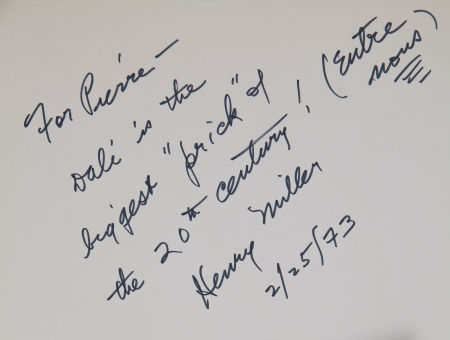
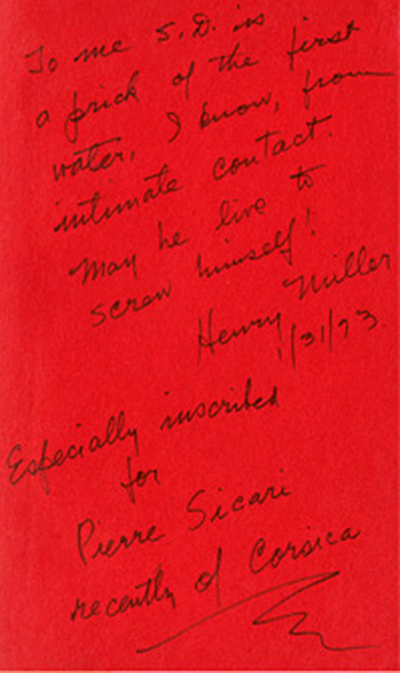
There’s no two ways about it. Henry Miller had a way with words. He could be blunt, lewd, cutting, all in one short sentence. You want a little case study? Ok, how about the notes Miller scrawled back in 1973, when he called Salvador Dalí “the biggest ‘prick” of the 20th century” (or, in another instance a “prick of the first water”). What was his beef with the Spanish surrealist? It all started in 1940, when Miller and his lover, the incomparable Anaïs Nin, spent some time cooped up in the same house with Dalí, who turned out to be an insufferable prima donna. Their time together ended in a wild shouting match, with Miller and Nin storming out of the home and holding a grudge for decades to come. The story is nicely recounted by Book Tryst, a site that has recently become a new favorite of ours.
The poet Wallace Stevens‘ reclusiveness would have made him an unlikely candidate for karaoke, but death is a great leveler. One who’s shuffled off this mortal coil can no longer claim to be publicity shy or highly protective of his privacy. Nor can he object if a living author—Rob Sheffield, say—selects a song for him to hypothetically butcher.
This is how a quiet poet-accountant of Stevens’ stature finds himself holding the mic in a beyond-the grave karaoke suite, facing the scrolling lyrics of The Velvet Underground’s“Sunday Morning” (above).
It’s all in fun, naturally, but Sheffield, the music journalist and karaoke convert, is not just having an ironic laugh at his favorite poet’s expense. (Though no doubt Stevens’ poem, “Sunday Morning,” factored heavily into the decision-making process.)
Here’s how we know Sheffield is sincere. Karaoke became his unlikely emotional rescuer following the untimely death of his first wife, and helped forge bonds with a new romantic partner. Listen to his passionate description of its transformative effects in the video below. He could be a poet describing his muse. Even die hard karaoke resistors may be moved to give it a whirl after hearing him speak.
May we suggest “Sunday Morning” for your first outing? If you’re feeling nervous, dedicate it to Wallace Stevens. There in spirit, surely.
If certain well-known writers come off as a bit paranoid, they may have good cause. Then again, the Powers That Be conduct their surveillance in mysterious ways, never targeting quite whom you’d expect. William T. Vollmann, for instance, a novelist known less for his paranoia than his productivity, recently revealed in Harper’s that the Federal Bureau of Investigation, on the lookout for Unabomber suspects, built up quite a file on him. “Individuals this bright are capable of most anything,” reads one of its starkly typewritten pages. “By all accounts, VOLLMANN is exceedingly intelligent and possessed with an enormous ego.” Perhaps writerly ego, albeit of an entirely different stripe, also got post office-working poet Charles Bukowski in trouble. “In 1968 various branches of the U.S. government performed an investigation into the background of civil servant Charles Bukowski,” according to bukowski.net. “Apparently the FBI and the Postal Service took offense to some of his writing (mainly the Notes From a Dirty Old Man column he wrote for the Los Angeles hippie tabloid Open City),” the page continues, “and had their ‘informants’ report Bukowski to higher-ups in the post office.”
Bukowski.net offers 113 pages of Bukowski’s FBI file, directly scanned. “He stated that BUKOWSKI is an excellent tenant who never associates with any of his neighbors,” one page reports, apparently from an interview with the landlord of Bukowski’s now-famous bungalow at 5124 De Longpre in Los Angeles. And from an interrogation of the writer himself: “He explained that these articles are ‘an inter-mixture of fiction and fact’ and are ‘highly romanticized in order to give the story juice.’ ” Released FBI files of this type tend to give an impression of fruitlessness and ineptitude, but at least Bukowski’s did make one discovery that may fascinate avid fans: “Bukowski claimed he was married to Jane Cooney,” says bukowski.net. “Every Bukowski biography written thus far names Barbara Frye as his first wife. However, in 1952 (three years before his marriage to Barbara Frye) Bukowski stated that he was married to Jane Cooney Baker — the ‘Jane’ of many of his most heartfelt works.” Once America puts its terrorism problems behind it, perhaps the FBI can devote its resources to more literary research — albeit of a non-invasive variety.
We're hoping to rely on loyal readers, rather than erratic ads. Please click the Donate button and support Open Culture. You can use Paypal, Venmo, Patreon, even Crypto! We thank you!
Open Culture scours the web for the best educational media. We find the free courses and audio books you need, the language lessons & educational videos you want, and plenty of enlightenment in between.
 Let me start with the first lines that appeared in The New York Times five years ago: “David Foster Wallace, whose prodigiously observant, exuberantly plotted, grammatically and etymologically challenging, philosophically probing and culturally hyper-contemporary novels, stories and essays made him an heir to modern virtuosos like Thomas Pynchon and Don DeLillo, an experimental contemporary of William T. Vollmann, Mark Leyner and Nicholson Baker and a clear influence on younger tour-de-force stylists like Dave Eggers and Jonathan Safran Foer, died on Friday at his home in Claremont, Calif. He was 46.” It’s not your conventional obituary. No, it has a literary style befitting the writer we lost on September 12, 2008. And five years after DFW’s death, we might want to pause and revisit his many stories and essays still available on the web. To mark this mournful occasion, we’ve updated and expanded our list, 30 Free Essays & Stories by David Foster Wallace on the Web, which features some timely and memorable pieces — “9/11: The View From the Midwest,” “Consider the Lobster,” and Federer as Religious Experience,” just to name just a few. Below we’ve also highlighted some of our favorite David Foster Wallace posts published over the years. Hope you enjoy visiting or revisiting this material as much as I have.