Nina Simone Writes an Admiring Letter to Langston Hughes: “Brother, You’ve Got a Fan Now!” (1966)

Nina Simone’s cre­ative and polit­i­cal com­mu­ni­ty meant every­thing to her, and the many loss­es she suf­fered in the 60s sent her deep­er into the depres­sion of the last decades of her life. “Langston Hugh­es, James Bald­win, and Lor­raine Hans­ber­ry [were] promi­nent,” writes Malik Gaines at LitHub, “among… social­ly engaged writ­ers and drama­tists” whom she con­sid­ered not only her “polit­i­cal tutors” but also her heroes and clos­est friends. She nev­er stopped griev­ing the loss of Hans­ber­ry and Hugh­es and fre­quent­ly memo­ri­al­ized them in trib­utes like “Back­lash Blues.”

Writ­ten by Hugh­es, and one of Simone’s fiercest and most time­ly civ­il rights songs, “Back­lash Blues” rep­re­sents the sig­nif­i­cant influ­ence the poet had on her and her art. In a live 1967 record­ing, she sings, “When Langston Hugh­es died—He told me many months before—Nina keep work­ing until they open up that door.” The two first met when Simone was still Eunice Way­mon from Try­on, North Car­oli­na: an aspir­ing clas­si­cal pianist, “pres­i­dent of the 11th-grade class and an offi­cer with the school’s NAACP chap­ter,” explains Andrew J. Fletch­er, a board mem­ber of the Nina Simone Project in Asheville.

This was 1949, and Hugh­es had come to Asheville to address Allen High School, the pri­vate school for African Amer­i­can girls Simone attend­ed through a schol­ar­ship that her music teacher and ear­ly cham­pi­on col­lect­ed from her home­town. The poet “could not have known,” Maria Popo­va writes at Brain Pick­ings, “that [Simone] would soon rev­o­lu­tion­ize the music canon under her stage name.” But near­ly ten years lat­er, he rec­og­nized her tal­ent imme­di­ate­ly.

On the release of Simone’s first album, Lit­tle Girl Blue, Hugh­es was “so stunned that he laud­ed it with lyri­cal ardor” in his col­umn for the Chica­go Defend­er.

She is dif­fer­ent. So was Bil­lie Hol­i­day, St. Fran­cis, and John Donne. So in Mort Sahl. She is a club mem­ber, a coloured girl, an Afro-Amer­i­can, a homey from Down Home. She has hit the Big Town, the big towns, the LP discs and the TV shows — and she is still from down home. She did it most­ly all by her­self. Her name is Nina Simone.

They would become close friends and mutu­al admir­ers. Hugh­es sent her “books he thought would inspire her,” includ­ing sev­er­al of his own, and wrote “words for her to set to song.” She wrote to him with earnest expres­sions of appre­ci­a­tion, espe­cial­ly in the let­ter here, penned in 1966 just before Hugh­es’ death.

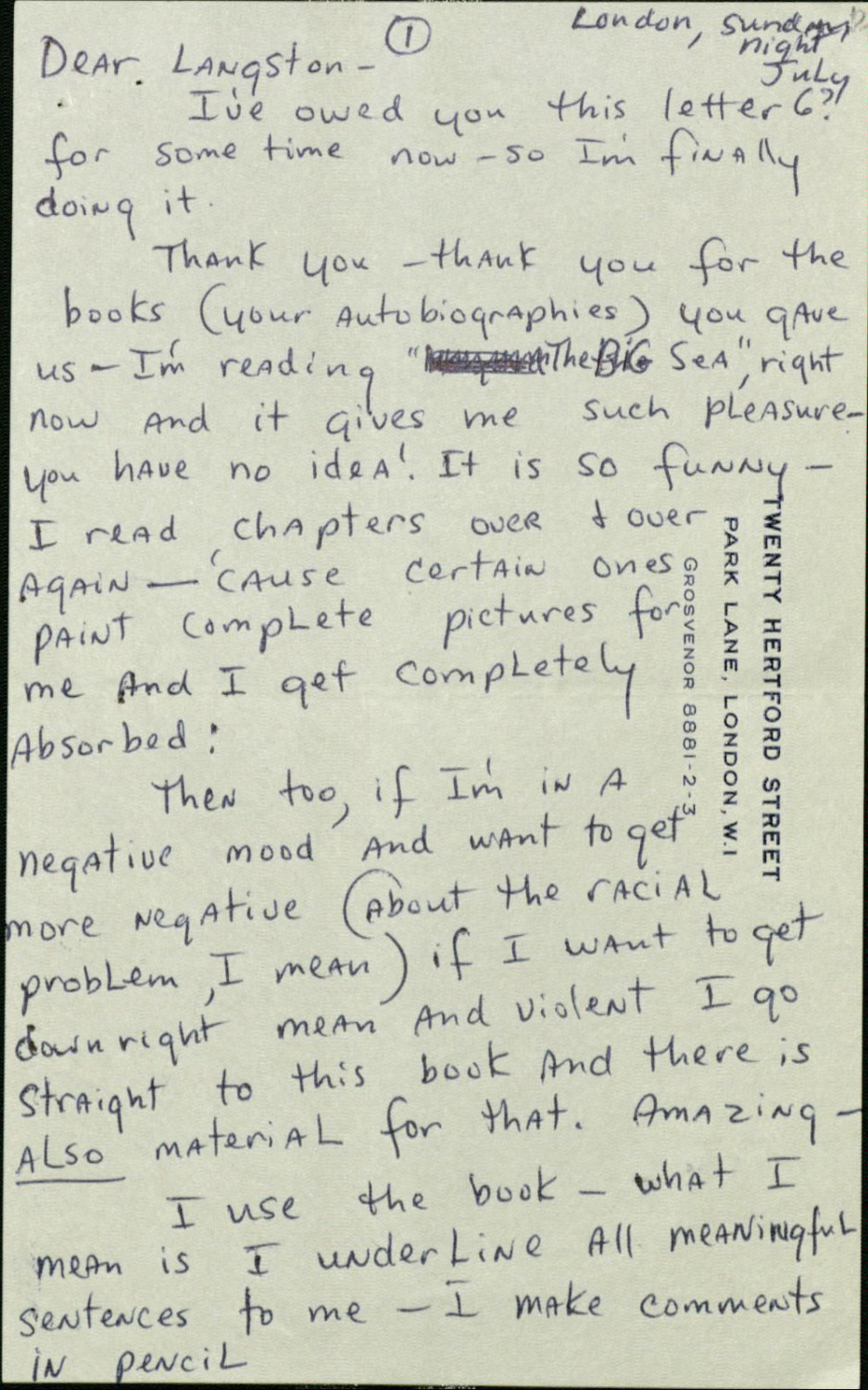
Simone had just read Hugh­es’ auto­bi­og­ra­phy The Big Sea. The book, she says, “gives me such pleasure—you have no idea! It is so fun­ny.” She also writes, with can­dor:

Then too, if I’m in a neg­a­tive mood and want to get more neg­a­tive (about the racial prob­lem, I mean) if I want to get down­right mean and vio­lent I go straight to this book and there is also mate­r­i­al for that. Amaz­ing—

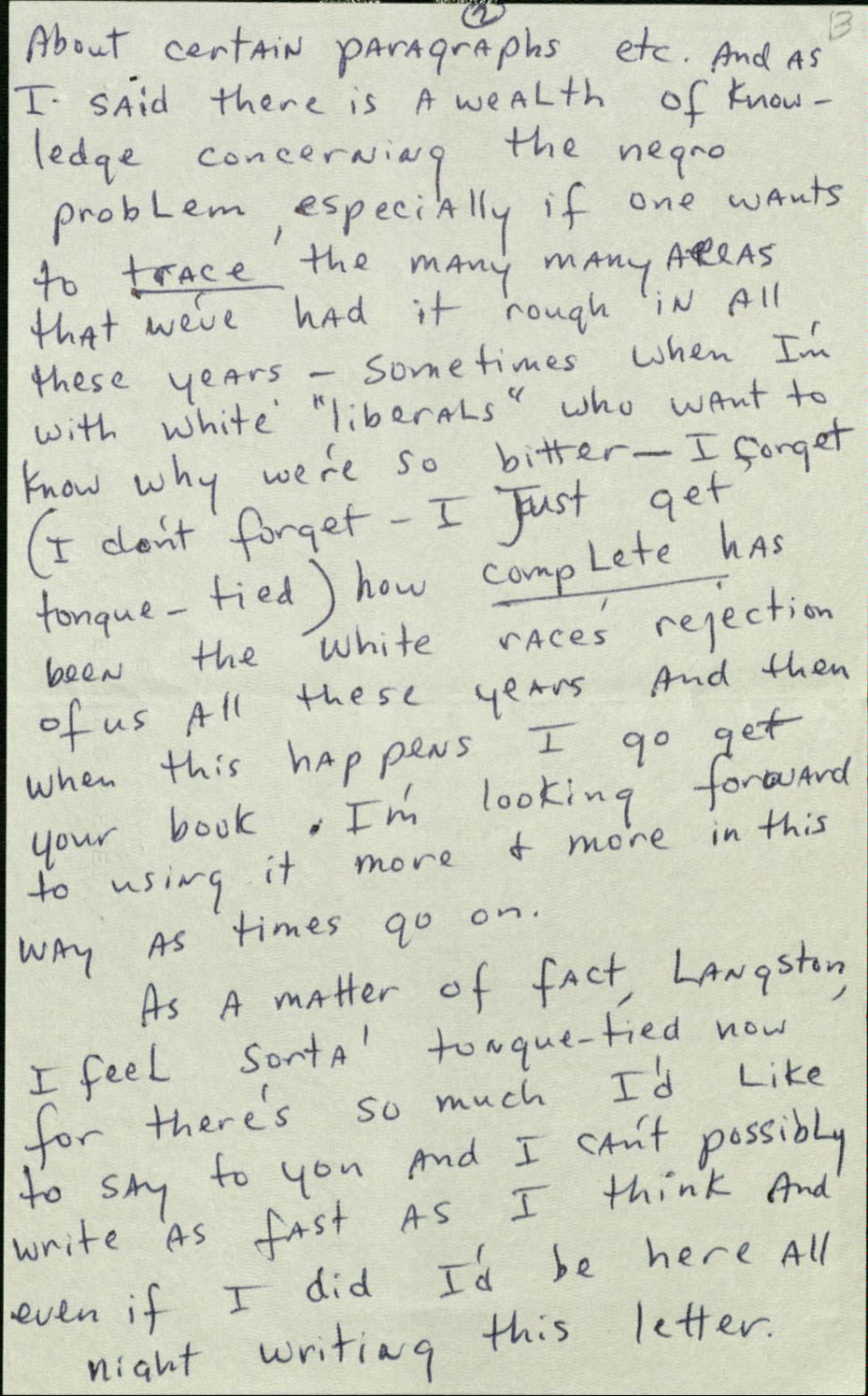
I use the book—what I mean is I under­line all mean­ing­ful sen­tences to me…. And as I said there is a wealth of knowl­edge con­cern­ing the negro prob­lem, espe­cial­ly if one wants to trace the many many areas that we’ve had it rough in all these years—sometimes when I’m with white “lib­er­als” who want to know why we’re so bitter—I for­get (I don’t forget—I just get tongue-tied) how com­plete has been the white races’ rejec­tion of us all these years and then when this hap­pens I go get your book.

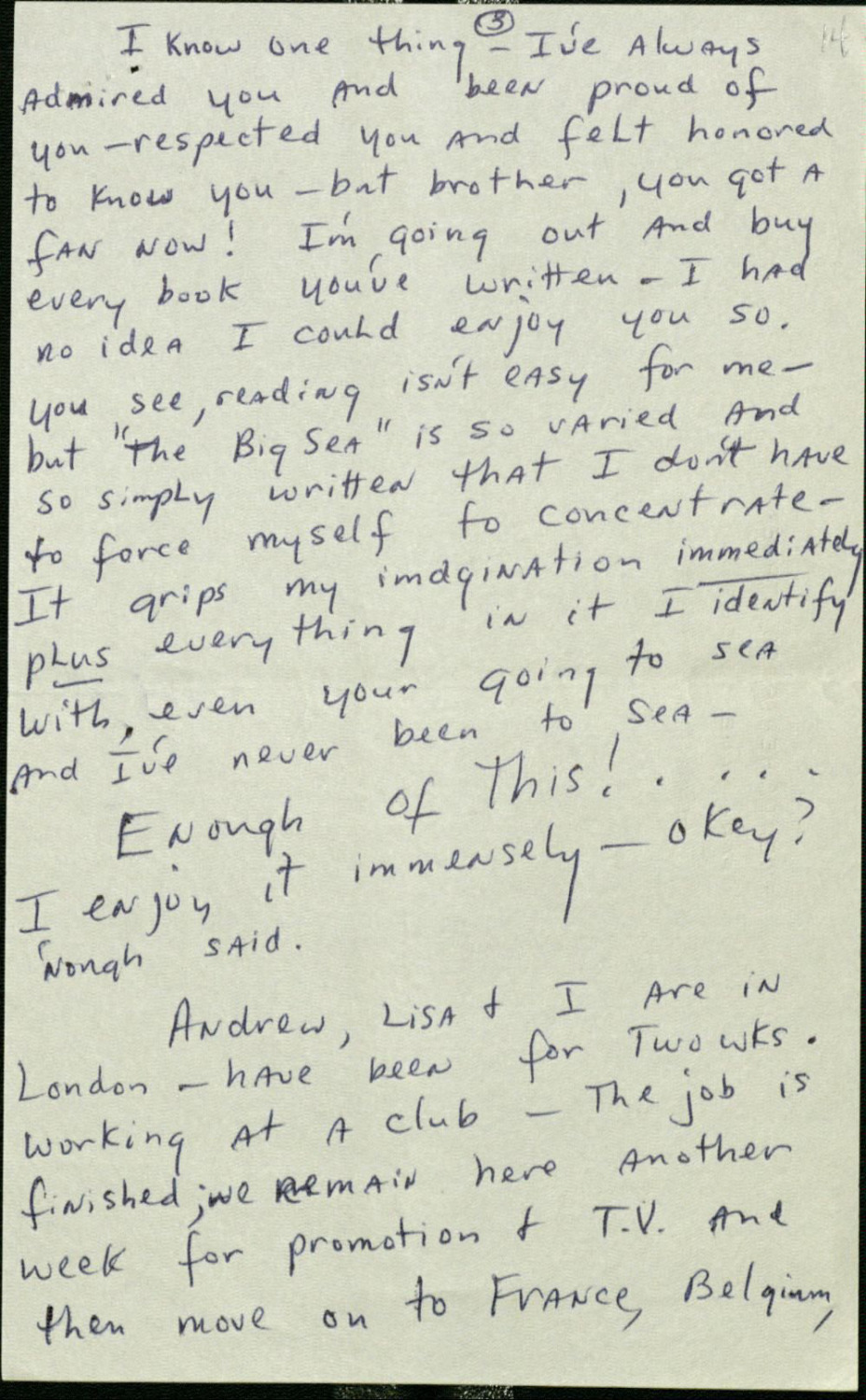
Hugh­es’ is rarely “mean and vio­lent,” but Simone brought to her read­ing her own despair and rage and raw sense of rejec­tion, emo­tions she was nev­er afraid to explore in her work or talk about with humor and fierce ire in her life. “Broth­er, you’ve got a fan,” she gush­es. The Big Sea “grips my imag­i­na­tion imme­di­ate­ly plus every­thing in it I iden­ti­fy with, even your going to sea and I’ve nev­er been to sea.” She had not been to sea, but she had been adrift, “depressed, alien­at­ed and low,” as she sang at More­house Col­lege in 1969 in a per­for­mance of her civ­il rights anthem and trib­ute to Lor­raine Hans­ber­ry, “To Be Young, Gift­ed and Black.”

The adlib framed Simone’s feel­ings with the same “emo­tion­al and polit­i­cal dimen­sions,” writes Gaines, she found in Hugh­es’ work. Though she does not men­tion it in her let­ter, her anno­tat­ed copy of The Big Sea sure­ly marks up the pas­sage below, in which Hugh­es’ describes his ear­ly unhap­pi­ness and his trans­for­ma­tive encounter with art:

When I was in the sec­ond grade, my grand­moth­er took me to Lawrence to raise me. And I was unhap­py for a long time, and very lone­some, liv­ing with my grand­moth­er. Then it was that books began to hap­pen to me, and I began to believe in noth­ing but books and the won­der­ful world in books–where if peo­ple suf­fered, they suf­fered in beau­ti­ful lan­guage, not in mono­syl­la­bles, as we did in Kansas.

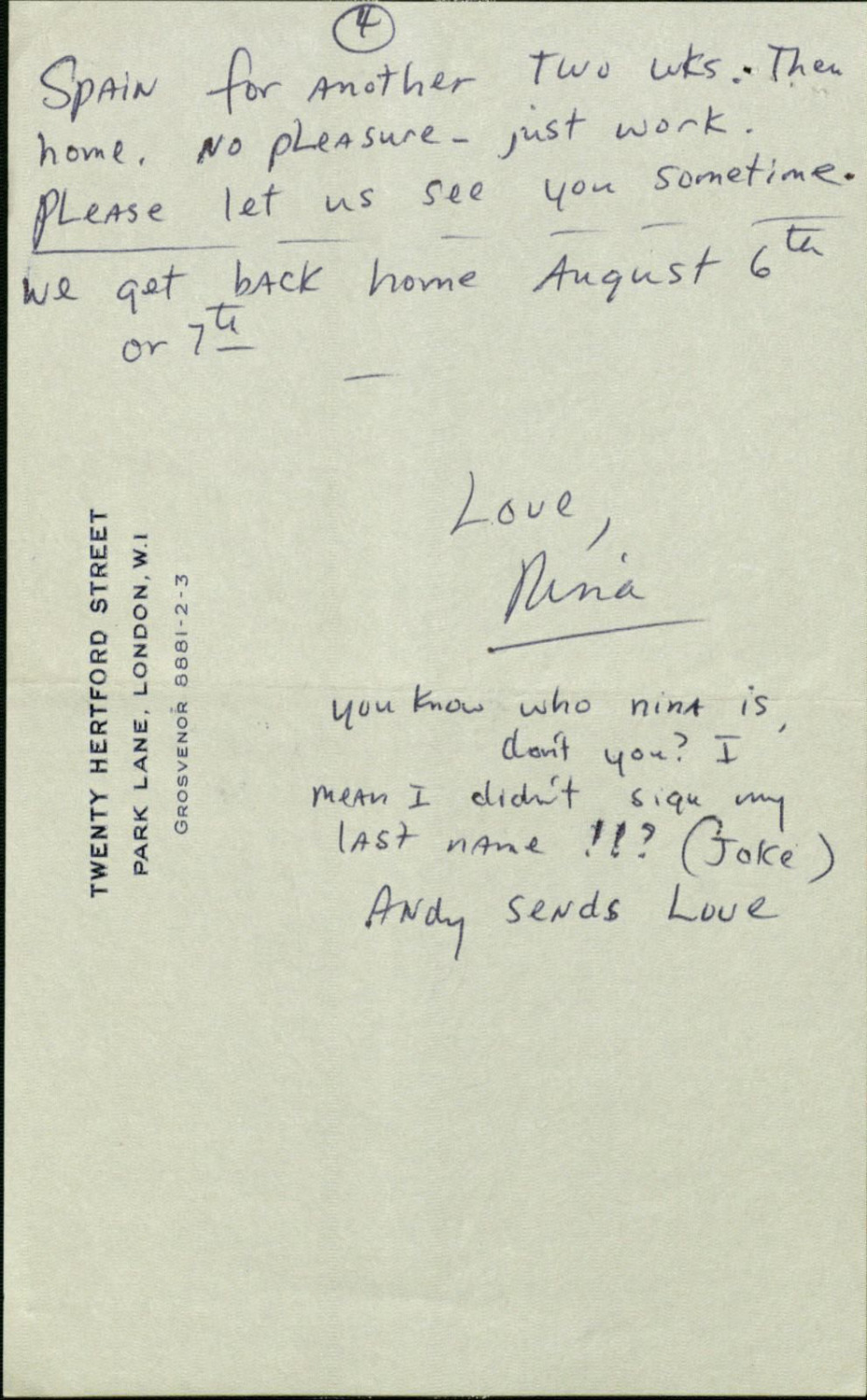
For Simone, music gave her suf­fer­ing pur­pose, but not the music she played for audi­ences and on record. One of the sad­dest ironies of her career is that the woman dubbed “The High Priest­ess of Soul” had lit­tle inter­est in play­ing soul. She embarked on her pop­u­lar music career to fund her clas­si­cal edu­ca­tion. How­ev­er, the oppor­tu­ni­ties to play the way she want­ed to did not arise. “Nina closed her let­ter on a strange­ly down note,” writes Nadine Coho­das in Princess Noire: The Tumul­tuous Reign of Nina Simone. “Her melan­choly over­whelmed any excite­ment about play­ing for the first time in France and Bel­gium. ‘No plea­sure,’ she told Langston, ‘just work.’”

So much of Simone’s frus­tra­tion and burnout in the music indus­try came out of a deep sense of alien­ation from her work. The shy Eunice Way­mon had nev­er craved the spot­light, some­thing Hugh­es must have come to know about her in the years of their acquain­tance. In his first note of praise, how­ev­er, he gets one thing wrong. As she was always the first to point out, Simone did not do it “most­ly all by her­self.”

The sup­port of her moth­er, her teacher, and her small “down home” com­mu­ni­ty took her as far as it could. Her rela­tion­ships with Hans­ber­ry, Hugh­es, and oth­er artists/activists car­ried her the rest of the way. Until they were gone. But when Hugh­es died, Popo­va writes, “a dev­as­tat­ed Simone turned her cov­et­ed set at the New­port Jazz Fes­ti­val into a trib­ute and closed it with an exhor­ta­tion to the audi­ence: ‘Keep him with you always. He was a beau­ti­ful, a beau­ti­ful man, and he’s still with us, of course.’” See much more of their cor­re­spon­dence at the Bei­necke.

via the Bei­necke

Relat­ed Con­tent:    

Nina Simone’s Live Per­for­mances of Her Poignant Civ­il Rights Protest Songs

Nina Simone Song “Col­or Is a Beau­ti­ful Thing” Ani­mat­ed in a Gor­geous Video

Langston Hugh­es Reads Langston Hugh­es

Josh Jones is a writer and musi­cian based in Durham, NC. Fol­low him at @jdmagness

Back to the Arena: Battling the Hunger Games Prequel with Pretty Much Pop: A Culture Podcast (#57)

Remem­ber when The Hunger Games was every­where? Its author Suzanne Collins has decid­ed that young peo­ple could ben­e­fit from more explo­ration of Just War The­o­ry through the world of Panem, and so has pub­lished The Bal­lad of Song­birds and Snakes, a pre­quel cov­er­ing the ear­ly years of future pres­i­dent Cori­olanus Snow dur­ing the 10th Hunger Games.

Pret­ty Much Pop hosts Mark Lin­sen­may­er, Eri­ca Spyres, and Bri­an Hirt give their spoil­er-free reviews of the new book and look back on the orig­i­nal book tril­o­gy and its adap­ta­tion into four films (and do spoil those, in case you want to go watch them). We talk about what makes these nov­els “YA,” the func­tion of adapt­ing them to film, and the lim­its of the fran­chise’s premise and world-build­ing. Does the work cri­tique yet glo­ri­fy vio­lence at the same time? Will the film ver­sion of the new nov­el be our next Phan­tom Men­ace?

Some arti­cles we looked at includ­ed:

Learn more at prettymuchpop.com. This episode includes bonus dis­cus­sion that you can only hear by sup­port­ing the pod­cast at patreon.com/prettymuchpop. This pod­cast is part of the Par­tial­ly Exam­ined Life pod­cast net­work.

Pret­ty Much Pop: A Cul­ture Pod­cast is the first pod­cast curat­ed by Open Cul­ture. Browse all Pret­ty Much Pop posts.

Dessert Recipes of Iconic Thinkers: Emily Dickinson’s Coconut Cake, George Orwell’s Christmas Pudding, Alice B. Toklas’ Hashish Fudge & More

Image via Wiki­me­dia Com­mons

Of all the desserts to attain cul­tur­al rel­e­vance over the past cen­tu­ry, can any hope to touch Alice B. Tok­las’ famous hashish fudge? Call­ing for such ingre­di­ents as black pep­per­corns, shelled almonds, dried figs, and most vital of all Cannabis sati­va, the recipe first appeared in 1954’s The Alice B. Tok­las Cook Book. (Tok­las would read the recipe aloud on the radio in the ear­ly 1960s, a time when the fudge’s key ingre­di­ent had become an object of much more intense pub­lic inter­est.) More than a how-to on Tok­las’ favorite dish­es, the book is also a kind of mem­oir, includ­ing rec­ol­lec­tions of her life with Gertrude Stein — her­self the author of the osten­si­ble Auto­bi­og­ra­phy of Alice B. Tok­las.

This puts us in the realm of seri­ous lit­er­a­ture where sweets, you might assume, are scarce­ly to be found. But bak­ing con­sti­tut­ed a part of the cre­ative process of no less a lit­er­ary mind than Emi­ly Dick­in­son, whose hand­writ­ten recipe for coconut cake appears above.

That same sheet of a paper’s reverse side, which you can see in our ear­li­er post about it, bears the first lines of her poem “The Things that nev­er can come back, are sev­er­al.” Dick­in­son also, as we’ve pre­vi­ous­ly post­ed here on Open Cul­ture, had her very own recipes for gin­ger­bread, donuts, and some­thing requir­ing five pounds of raisins called “black cake.”

It may seem obvi­ous that women like Tok­las and Dick­in­son, born and raised in the 19th cen­tu­ry, would have been expect­ed to learn this sort of thing. But a fair few of the lit­er­ary men of gen­er­a­tions past knew some­thing of their way around the kitchen as well. George Orwell, for instance, wrote an essay on “British cook­ery,” ear­ly in which he states that “in gen­er­al, British peo­ple pre­fer sweet things to spicy things.” While describ­ing “sweet dish­es and con­fec­tionery – cakes, pud­dings, jams, bis­cuits and sweet sauces” as the “glo­ry of British cook­ery,” he admits that “the nation­al addic­tion to sug­ar has not done the British palate any good.” And so he includes the recipe for a Christ­mas pud­ding which, sub­tle by that stan­dard, calls for only half a pound of the stuff.

Born a gen­er­a­tion after Orwell, Roald Dahl made no secret of his own sug­ar-addict­ed British palate. In his book Char­lie and the Choco­late Fac­to­ry Dahl had “daz­zled young read­ers with visions of Cav­i­ty-Fill­ing Caramels, Ever­last­ing Gob­stop­pers, and snozzber­ry-fla­vored wall­pa­per,” writes Open Cul­ture’s own Ayun Hal­l­i­day. But his own can­dy of choice was “the more pedes­tri­an Kit-Kat bar. In addi­tion to savor­ing one dai­ly (a lux­u­ry lit­tle Char­lie Buck­et could but dream of, pri­or to win­ning that most gold­en of tick­ets) he invent­ed a frozen con­fec­tion called ‘Kit-Kat Pud­ding,’ ” whose sim­ple recipe is as fol­lows: “Stack as many Kit-Kats as you like into a tow­er, using whipped cream for mor­tar, then shove the entire thing into the freez­er, and leave it there until sol­id.”

If you’re look­ing for a slight­ly more chal­leng­ing dessert that still comes with a cul­tur­al fig­ure’s impri­matur, you might give Nor­mal Rock­well’s favorite oat­meal cook­ies a try. Going deep­er into Amer­i­can his­to­ry, we’ve also got Thomas Jef­fer­son­’s recipe for ice cream, the taste for which he picked up while liv­ing in France in the 1780s. That same coun­try’s cui­sine also inspired Ernest Hem­ing­way’s fruit pie, meant for sum­mer-camp­ing with one’s pals: “If your pals are French­men,” Hem­ing­way adds, “they will kiss you.” Alas, if any­one has deter­mined the exact recipe for the most famous dessert in all of French lit­er­a­ture, Mar­cel Proust’s mem­o­ry-trig­ger­ing madeleines, they haven’t released it to the hun­gry pub­lic.

Relat­ed Con­tent:

The Recipes of Icon­ic Authors: Jane Austen, Sylvia Plath, Roald Dahl, the Mar­quis de Sade & More

Ernest Hemingway’s Sum­mer Camp­ing Recipes

82 Vin­tage Cook­books, Free to Down­load, Offer a Fas­ci­nat­ing Illus­trat­ed Look at Culi­nary and Cul­tur­al His­to­ry

His­toric Mex­i­can Recipes Are Now Avail­able as Free Dig­i­tal Cook­books: Get Start­ed With Dessert

Wagashi: Peruse a Dig­i­tized, Cen­turies-Old Cat­a­logue of Tra­di­tion­al Japan­ese Can­dies

Ani­mat­ed Noir: Key Lime Pie

Based in Seoul, Col­in Mar­shall writes and broad­casts on cities, lan­guage, and cul­ture. His projects include the book The State­less City: a Walk through 21st-Cen­tu­ry Los Ange­les and the video series The City in Cin­e­ma. Fol­low him on Twit­ter at @colinmarshall, on Face­book, or on Insta­gram.

Raymond Chandler’s 36 Great Unused Titles: From “The Man With the Shredded Ear,” to “Quick, Hide the Body”

For Chan­dler’s birth­day today. He was born on this day in 1888.

via Chris Pow­er

Relat­ed Con­tent:

Ray­mond Chandler’s Ten Com­mand­ments for Writ­ing a Detec­tive Nov­el

Hear Ray­mond Chan­dler & Ian Fleming–Two Mas­ters of Suspense–Talk with One Anoth­er in Rare 1958 Audio

Watch Ray­mond Chandler’s Long-Unno­ticed Cameo in Dou­ble Indem­ni­ty


by | Permalink | Make a Comment ( 1 ) |

When Astronomer Johannes Kepler Wrote the First Work of Science Fiction, The Dream (1609)

The point at which we date the birth of any genre is apt to shift depend­ing on how we define it. When did sci­ence fic­tion begin? Many cite ear­ly mas­ters of the form like Jules Verne and H.G. Wells as its prog­en­i­tors. Oth­ers reach back to Mary Shelley’s 1818 Franken­stein as the gen­e­sis of the form. Some few know The Blaz­ing World, a 1666 work of fic­tion by Mar­garet Cavendish, Duchess of New­cas­tle, who called her book a “her­maph­ro­dit­ic text.” Accord­ing to the judg­ment of such experts as Isaac Asi­mov and Carl Sagan, sci-fi began even ear­li­er, with a nov­el called Som­ni­um (“The Dream”), writ­ten by none oth­er than Ger­man astronomer and math­e­mati­cian Johannes Kepler. Maria Popo­va explains at Brain Pick­ings:

In 1609, Johannes Kepler fin­ished the first work of gen­uine sci­ence fic­tion — that is, imag­i­na­tive sto­ry­telling in which sen­si­cal sci­ence is a major plot device. Som­ni­um, or The Dream, is the fic­tion­al account of a young astronomer who voy­ages to the Moon. Rich in both sci­en­tif­ic inge­nu­ity and sym­bol­ic play, it is at once a mas­ter­work of the lit­er­ary imag­i­na­tion and an invalu­able sci­en­tif­ic doc­u­ment, all the more impres­sive for the fact that it was writ­ten before Galileo point­ed the first spy­glass at the sky and before Kepler him­self had ever looked through a tele­scope.

The work was not pub­lished until 1634, four years after Kepler’s death, by his son Lud­wig, though “it had been Kepler’s intent to per­son­al­ly super­vise the pub­li­ca­tion of his man­u­script,” writes Gale E. Chris­tian­son. His final, posthu­mous work began as a dis­ser­ta­tion in 1593 that addressed the ques­tion Coper­ni­cus asked years ear­li­er: “How would the phe­nom­e­na occur­ring in the heav­ens appear to an observ­er sta­tioned on the moon?” Kepler had first come “under the thrall of the helio­cen­tric mod­el,” Popo­va writes, “as a stu­dent at the Luther­an Uni­ver­si­ty of Tübin­gen half a cen­tu­ry after Coper­ni­cus pub­lished his the­o­ry.”

Kepler’s the­sis was “prompt­ly vetoed” by his pro­fes­sors, but he con­tin­ued to work on the ideas, and cor­re­spond­ed with Galileo 30 years before the Ital­ian astronomer defend­ed his own helio­cen­tric the­o­ry. “Six­teen years lat­er and far from Tübin­gen, he com­plet­ed an expand­ed ver­sion,” says Andrew Boyd in the intro­duc­tion to a radio pro­gram about the book. “Recast in a dream­like frame­work, Kepler felt free to probe ideas about the moon that he oth­er­wise couldn’t.” Not con­tent with cold abstrac­tion, Kepler imag­ined space trav­el, of a kind, and peo­pled his moon with aliens.

And what an imag­i­na­tion! Inhab­i­tants weren’t mere recre­ations of ter­res­tri­al life, but entire­ly new forms of life adapt­ed to lunar extremes. Large. Tough-skinned. They evoked visions of dinosaurs. Some used boats, imply­ing not just life but intel­li­gent, non-human life. Imag­ine how shock­ing that must have been at the time.

Even more shock­ing to author­i­ties were the means Kepler used in his text to reveal knowl­edge about the heav­ens and trav­el to the moon: beings he called “dae­mons” (a Latin word for benign nature spir­its before Chris­tian­i­ty hijacked the term), who com­mu­ni­cat­ed first with the hero’s moth­er, a witch prac­ticed in cast­ing spells.

The sim­i­lar­i­ties between Kepler’s pro­tag­o­nist, Dura­co­tus, and Kepler him­self (such as a peri­od of study under Dan­ish astronomer Tycho Bra­he) led the church to sus­pect the book was thin­ly veiled auto­bi­o­graph­i­cal occultism. Rumors cir­cu­lat­ed, and Kepler’s moth­er was arrest­ed for witch­craft and sub­ject­ed to ter­ri­tio ver­balis (detailed descrip­tions of the tor­tures that await­ed her, along with pre­sen­ta­tions of the var­i­ous devices).  It took Kepler five years to free her and pre­vent her exe­cu­tion.

Kepler’s sto­ry is trag­ic in many ways, for the loss­es he suf­fered through­out his life, includ­ing his son and his first wife to small­pox. But his per­se­ver­ance left behind one of the most fas­ci­nat­ing works of ear­ly sci­ence fiction—published hun­dreds of years before the genre is sup­posed to have begun. Despite the fan­tas­ti­cal nature of his work, “he real­ly believed,” says Sagan in the short clip from Cos­mos above, “that one day human beings would launch celes­tial ships with sails adapt­ed to the breezes of heav­en, filled with explor­ers who, he said, would not fear the vast­ness of space.”

Astron­o­my had lit­tle con­nec­tion with the mate­r­i­al world in the ear­ly 17th cen­tu­ry. “With Kepler came the idea that a phys­i­cal force moves the plan­ets in their orbits,” as well as an imag­i­na­tive way to explore sci­en­tif­ic ideas no one would be able to ver­i­fy for decades, or even cen­turies. Hear Som­ni­um read at the top of the post and learn more about Kepler’s fas­ci­nat­ing life and achieve­ments at Brain Pick­ings.

Relat­ed Con­tent:

Mary Shelley’s Hand­writ­ten Man­u­script of Franken­stein: This Is “Ground Zero of Sci­ence Fic­tion,” Says William Gib­son

Stream 47 Hours of Clas­sic Sci-Fi Nov­els & Sto­ries: Asi­mov, Wells, Orwell, Verne, Love­craft & More

The Ency­clo­pe­dia of Sci­ence Fic­tion: 17,500 Entries on All Things Sci-Fi Are Now Free Online

Free Sci­ence Fic­tion Clas­sics Avail­able on the Web (Updat­ed)

Josh Jones is a writer and musi­cian based in Durham, NC. Fol­low him at @jdmagness

How Vladimir Nabokov Wrote Lolita, “My Most Difficult Book”: A 1989 Documentary

How many of us could write a book with the impact of Loli­ta? The task, as revealed in the BBC Omnibus doc­u­men­tary above, lay almost beyond even the for­mi­da­ble lit­er­ary pow­ers of Vladimir Nabokov — almost, but obvi­ous­ly not quite. It did push him into new aes­thet­ic, cul­tur­al, and com­po­si­tion­al realms, as evi­denced by his mem­o­ries of draft­ing the nov­el on index cards in road­side motels (and when faced with espe­cial­ly noisy or drafty accom­mo­da­tions, in the back­seat of the parked car) while road-trip­ping though the Unit­ed States. The doc­u­men­tary’s sub­ject is the exiled aris­to­crat nov­el­ist’s expe­ri­ence writ­ing and pub­lish­ing Loli­ta, the book that would make him world-famous — as well as the expe­ri­ence that brought him to the time and place that made such a cul­tur­al coup pos­si­ble.

Aired in 1989, a dozen years after Nabokov’s death, My Most Dif­fi­cult Book fea­tures inter­views with the nov­el­ist’s Fer­rari-dri­ving son and trans­la­tor Dmitri, his schol­ar-biog­ra­ph­er Bri­an Boyd, and his younger admir­er-col­leagues includ­ing Mar­tin Amis, A.S. Byatt, and Edmund White. That last describes Nabokov’s nov­els as “great sys­tems of mean­ing in which every ele­ment refers to every oth­er one,” and Loli­ta marked a new height in his achieve­ment in that form.

But the book’s pop­u­lar­i­ty, or at least its ini­tial wave of pop­u­lar­i­ty, may be bet­ter explained by the con­tro­ver­sy sur­round­ing the ele­ments of its by now well-known premise: the refined mid­dle-aged Euro­pean nar­ra­tor, the coarse twelve-year-old step­daugh­ter whom he con­trives to sex­u­al­ly pos­sess — and suc­ceeds in sex­u­al­ly pos­sess­ing — as they dri­ve across Amer­i­ca, a vast land whose look, feel, and lan­guage Nabokov took pains to cap­ture and repur­pose.

“There are a lot of lit­er­al­ists out there,” says Amis, “who will think that you can’t write a nov­el like Loli­ta with­out being a secret slaver after young girls.” That was as true in 1989 as it was in 1955, when the book was first pub­lished, and indeed as true as it is today. Well into mid­dle age, we learn in the doc­u­men­tary, strangers would ask Dmitri what it was like to be the son of a “dirty old man,” and in archive inter­view footage we see Nabokov address the pub­lic con­fla­tion of him­self and Hum­bert Hum­bert, Loli­ta’s pedophil­i­ac nar­ra­tor. A seri­ous chess enthu­si­ast, Nabokov describes him­self as writ­ing nov­els as he would solve chess prob­lems he posed to him­self. What could present a more rig­or­ous chal­lenge than to tell a sto­ry, at a high artis­tic lev­el, from the per­spec­tive of a mon­ster? But Nabokov, as he admit­ted to one inter­view­er, was indeed a mon­ster, at least accord­ing to one def­i­n­i­tion offered by his much-con­sult­ed Eng­lish dic­tio­nary: “A per­son of unnat­ur­al excel­lence.”

Relat­ed Con­tent:

Nabokov Reads Loli­ta, and Names the Great­est Books of the 20th Cen­tu­ry

Hear Vladimir Nabokov Read From the Penul­ti­mate Chap­ter of Loli­ta

Vladimir Nabokov on Loli­ta: Just Anoth­er Great Love Sto­ry?

The Note­cards on Which Vladimir Nabokov Wrote Loli­ta: A Look Inside the Author’s Cre­ative Process

Vladimir Nabokov’s Script for Stan­ley Kubrick’s Loli­ta: See Pages from His Orig­i­nal Draft

Vladimir Nabokov Mar­vels Over Dif­fer­ent Loli­ta Book Cov­ers

Based in Seoul, Col­in Mar­shall writes and broad­casts on cities, lan­guage, and cul­ture. His projects include the book The State­less City: a Walk through 21st-Cen­tu­ry Los Ange­les and the video series The City in Cin­e­ma. Fol­low him on Twit­ter at @colinmarshall, on Face­book, or on Insta­gram.

29 Free Short Stories from Some of Today’s Most Acclaimed Writers: Margaret Atwood, David Mitchell & More

Let us call your atten­tion to 29 free short sto­ries, writ­ten by some of today’s most acclaimed writ­ers. They come cour­tesy of The New York Times’ Decameron Project. They write:

Inspired by Gio­van­ni Boccaccio’s “The Decameron,” a 14th-cen­tu­ry col­lec­tion of tales told by a group of 10 char­ac­ters tak­ing shel­ter in an Ital­ian vil­la dur­ing the Black Plague, this [col­lec­tion] fea­tures sto­ries from Mar­garet Atwood, David Mitchell, Téa Obre­ht, Karen Rus­sell, Tom­my Orange, Yiyun Li and oth­ers. The so-called Decameron Project is the first time in the magazine’s mod­ern his­to­ry that an entire issue is devot­ed to new fic­tion.

You can read the sto­ries online here. And if you pre­fer audio, hear two sto­ries read aloud by Tom­my Orange and Edwidge Dan­ti­cat here.

If you would like to sup­port the mis­sion of Open Cul­ture, con­sid­er mak­ing a dona­tion to our site. It’s hard to rely 100% on ads, and your con­tri­bu­tions will help us con­tin­ue pro­vid­ing the best free cul­tur­al and edu­ca­tion­al mate­ri­als to learn­ers every­where. You can con­tribute through Pay­Pal, Patre­on, and Ven­mo (@openculture). Thanks!

Relat­ed Con­tent:

1,000 Free Audio Books: Down­load Great Books for Free

Audi­ble Pro­vid­ing Free Audio Books to Kids & Teens: Intro­duc­ing the New Ser­vice, Audi­ble Sto­ries

Read 9 Sto­ries By Haru­ki Muraka­mi Free Online

10 Free Sto­ries by George Saun­ders, Author of Tenth of Decem­ber, “The Best Book You’ll Read This Year”


Orson Welles Narrates Animations of Plato’s Cave and Kafka’s “Before the Law,” Two Parables of the Human Condition

You’re held cap­tive in an enclosed space, only able faint­ly to per­ceive the out­side world. Or you’re kept out­side, unable to cross the thresh­old of a space you feel a des­per­ate need to enter. If both of these sce­nar­ios sound like dreams, they must do so because they tap into the anx­i­eties and sus­pi­cions in the depths of our shared sub­con­scious. As such, they’ve also proven reli­able mate­r­i­al for sto­ry­tellers since at least the fourth cen­tu­ry B.C., when Pla­to came up with his alle­go­ry of the cave. You know that sto­ry near­ly as sure­ly as you know the ancient Greek philoso­pher’s name: a group of human beings live, and have always lived, deep in a cave. Chained up to face a wall, they have only ever seen the images of shad­ow pup­pets thrown by fire­light onto the wall before them.

To these iso­lat­ed beings, “the truth would be lit­er­al­ly noth­ing but the shad­ows of the images.” So Orson Welles tells it in this 1973 short film by ani­ma­tor Dick Oden. In his time­less­ly res­o­nant voice that com­ple­ments the pro­duc­tion’s haunt­ing­ly retro aes­thet­ic, Wells then speaks of what would hap­pen if a cave-dweller were to be unshack­led.

“He would be much too daz­zled to see dis­tinct­ly those things whose shad­ows he had seen before,” but as he approach­es real­i­ty, “he has a clear­er vision.” Still, “will he not be per­plexed? Will he not think that the shad­ows which he for­mer­ly saw are truer than the objects which are now shown to him?” And if brought out of the cave to expe­ri­ence real­i­ty in full, would he not pity his old cave­mates? “Would he not say, with Homer, bet­ter to be the poor ser­vant of a poor mas­ter and to endure any­thing rather than think as they do and live after their man­ner?”

Pla­to’s cave was­n’t the first para­ble of the human con­di­tion Welles nar­rat­ed. Just over a decade ear­li­er, he engaged pin­screen ani­ma­tor Alexan­dre Alex­eieff (he of Night on Bald Moun­tain and and “The Nose,” pre­vi­ous­ly fea­tured here on Open Cul­ture) to illus­trate his read­ing of Franz Kafka’s sto­ry “Before the Law.” The law, in Kafka’s telling, is a build­ing, and before that build­ing stands a guard. “A man comes from the coun­try, beg­ging admit­tance to the law,” says Welles. “But the guard can­not admit him. May he hope to enter at a lat­er time? That is pos­si­ble, said the guard.” Yet some­how that time nev­er comes, and he spends the rest of his life await­ing admis­sion to the law. “Nobody else but you could ever have obtained admit­tance,” the guard admits to the man, not long before the man expires of old age. “This door was intend­ed only for you! And now, I’m going to close it.”

“Before the Law” describes a grim­ly absurd sit­u­a­tion, as does Welles’ The Tri­al, the film to which it serves as an intro­duc­tion. Adapt­ed from anoth­er work of Kafka’s, specif­i­cal­ly his best-known nov­el, it also con­cerns itself with the legal side of human affairs, at least on the sur­face. But when it becomes clear that the crime with which its bureau­crat pro­tag­o­nist Josef K. has been charged will nev­er be spec­i­fied, the sto­ry plunges into an alto­geth­er more trou­bling realm. We’ve all, at one time or anoth­er, felt to some degree like Joseph K., per­se­cut­ed by an ulti­mate­ly incom­pre­hen­si­ble sys­tem, legal, social, or oth­er­wise. And can we help but feel, espe­cial­ly in our high­ly medi­at­ed 21st cen­tu­ry, like Pla­to’s immo­bi­lized human, raised in dark­ness and made to build a world­view on illu­sions? As for how to escape the cave — or indeed to enter the law — it falls to each of us indi­vid­u­al­ly to fig­ure out.

Relat­ed Con­tent:

Hear John Malkovich Read Plato’s “Alle­go­ry of the Cave,” Set to Music Mixed by Ric Ocasek, Yoko Ono & Sean Lennon, OMD & More

Plato’s Cave Alle­go­ry Ani­mat­ed Mon­ty Python-Style

Plato’s Cave Alle­go­ry Brought to Life with Clay­ma­tion

The Phi­los­o­phy of The Matrix: From Pla­to and Descartes, to East­ern Phi­los­o­phy

Franz Kafka’s Exis­ten­tial Para­ble “Before the Law” Gets Brought to Life in a Strik­ing, Mod­ern Ani­ma­tion

Kafka’s Night­mare Tale, “A Coun­try Doc­tor,” Told in Award-Win­ning Japan­ese Ani­ma­tion

Based in Seoul, Col­in Mar­shall writes and broad­casts on cities, lan­guage, and cul­ture. His projects include the book The State­less City: a Walk through 21st-Cen­tu­ry Los Ange­les and the video series The City in Cin­e­ma. Fol­low him on Twit­ter at @colinmarshall, on Face­book, or on Insta­gram.

« Go BackMore in this category... »
Quantcast