Multi-award winning German design collective URBANSCREEN specializes in large-scale projection on urban surfaces. Their first great international success was “555 KUBIK — How it would be if a house was dreaming,” a brilliant media installation using the façade of the Kunsthalle Hamburg. This project quickly found its way to all major blogs and sites on the Internet and gained so much fame that it surpassed the popularity of lolcat videos for almost an hour.
This year, URBANSCREEN was commissioned to transform the sails of the iconic Sydney Opera House as part of Vivid Sydney, a festival of light, music and ideas. The truly amazing projections explore the sculptural form of the Opera House and its place as a home for music, dance and drama. The conclusion is not to be missed.
By profession, Matthias Rascher teaches English and History at a High School in northern Bavaria, Germany. In his free time he scours the web for good links and posts the best finds on Twitter.
For my money, “I don’t necessarily agree with everything I say” tops the list of Marshall McLuhan-isms, followed closely and at times surpassed by “You don’t like those ideas? I got others.” Many prefer the immortal “You know nothing of my work!”, the line McLuhan delivers during his brief appearance in Woody Allen’s Annie Hall. In 1977, the same year Allen’s protagonist would summon him to defeat that pontificating academic, McLuhan flew to Sydney to deliver a lecture. Then, for the Australian Broadcasting Corporation’s Radio National, he recorded a program answering questions from students, nuns, and others about his views on media. (Find Part 1 above, and Parts 2 and 3 here and here.) McLuhan happened to view media in a way nobody else did at the time, and the fields of media studies and media theory would go on to develop in large part from his work. This Joyce-loving, God-fearing, sixteenth-century-pamphlet-studying professor of English literature nevertheless deployed modern sound bites with as much industry as he scrutinized them. Hence the endurance, over thirty years after his death and over forty years past the peak of his popularity, of “The medium is the message,” a phrase that, seemingly since the moment McLuhan first uttered it, has stood as a lightning rod to his detractors.
Very often, someone will insist that, no, the content of a message matters too, making the pronouncement with the attitude of having seen through the emperor’s clothes. A disembodied voice makes a similar criticism of McLuhan’s critics in The Medium is the Massage, the 1968 album that mirrors both the content and the dense, experimental visual collage form of McLuhan and graphic designer Quentin Fiore’s eponymous book. Listen to the album (side A, side B) at UBUweb’s Marshall McLuhan sound archive and get an aural glimpse into the mind that, upon receiving a proof of his book back from the printer’s with the title misspelled, suddenly realized that only the word Massage, with connotations of the mass media in whose age he lived, expressed the full extent of his meaning. But he did believe that the very existence of the telephone or television, and the effects of their existence on humanity as a whole, made for an infinitely richer object of study than whatever content humans happened to send across them. Through the pieces of media in this post, you can see and hear McLuhan expand upon this idea in his deliberate, oratorically metaphorical, sometimes maddeningly oblique manner. He works through the implications of, extensions of, and possible contradictions to this oddly robust notion, which some, in our hypercommunicative, endlessly mediated internet age, would in hindsight call prophecy.
This weekend, Mike Wallace died at the age of 93. As The New York Times observes in its obit, Wallace was “a pioneer of American broadcasting who confronted leaders and liars for 60 Minutes over four decades.” But before he became a fixture on 60 Minutes, Mike Wallace hosted his own short-lived TV show in the late 1950s, The Mike Wallace Interview, which let Americans get an up-close and personal view of some legendary figures — Frank Lloyd Wright, Eleanor Roosevelt, Reinhold Niebuhr, Aldous Huxley, Erich Fromm, Ayn Rand and Gloria Swanson.
Above, we’re bringing back Mike Wallace’s memorable interview with Salvador Dali in 1958. For the better part of a half hour, Wallace tried to demystify “the enigma that is Salvador Dali,” and it didn’t go terribly well. It turns out that surrealist painters give surreal answers to conventional interview questions too. Pretty quickly, Wallace capitulates and says, “I must confess, you lost me halfway through.” Happily for us, the video makes for some good viewing more than 50 years later.
Some of the big websites are going black today to protest SOPA, the Stop Online Piracy Act, that has been winding its way through Congress. We’re going to handle things in our own way — by illuminating the matter with a little intelligent media.
Backed by the Motion Picture Association of America, SOPA is designed to debilitate and effectively shut down foreign-based websites that sell pirated movies, music and other goods. That all sounds fine on the face of things. But the legislation, if enacted, would carry with it a series of unexpected consequences that could change the internet as we know it. Among other things, the law could be used to shut down American sites that unwittingly host or link to illegal content — and without giving the sites due process, a real day in court. Big sites like YouTube and Twitter could fall under pressure, and so could countless small sites. Needless to say, that could have a serious chilling effect on the openness of the web and free speech.
To give a quick example: It could conceivably be the case that Stanford might object to my featuring their video above, file a claim, and shut the site down without giving me notice and an opportunity to remove the material (as exists under current law). It’s not likely. But it is possible, and the risk increases with every post we write. If this law passes, the amount of material we could truly safely cover would become ludicrously small, so much so that it wouldn’t be worth running the site and using the web as an educational medium.
The Obama administration has come out against SOPA and PIPA, sidelining the legislation for now. But you can almost guarantee that revisions will be made, and the bills will return soon. So, while other sites go black, we’re going to do what we do best. We’re featuring video of an event held in December by the Stanford Center for Internet and Society (SCIS). What’s Wrong with SOPA brings together a series of informed opponents to SOPA, including Stanford law professors and business leaders within Silicon Valley. (Find their bios below the jump.) Some of the most incisive comments are made by Fred von Lohmann, a Google lawyer, starting at the 19:10 mark.
Note: If you’re looking to understand the debate from the perspective of copyright holders, then we’d recommend you spend time watching, Follow the Money: Who Profits from Piracy?, a video that tracks the theft of one movie, making it a microcosm of a larger problem.
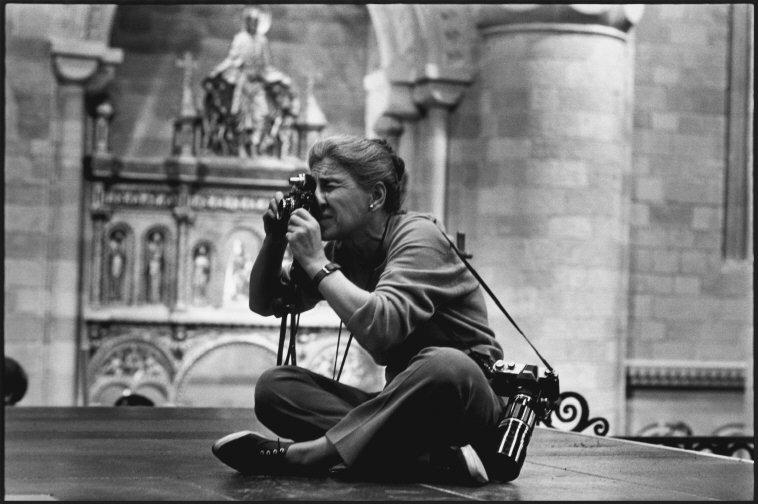
Eve Arnold, one of the pioneering women of photojournalism, died Wednesday at the age of 99.
Widely known for her photographs of Marilyn Monroe and other celebrities, Arnold just as often photographed the poor and the unknown. “I don’t see anybody as either ordinary or extraordinary,” she told the BBC in 1990. “I see them simply as people in front of my lens.”
Born Eve Cohen in Philadelphia on April 21, 1912, she was one of nine children of Ukrainian immigrant parents. When she was 28 years old she gave up plans to become a doctor after a boyfriend gave her a camera. She studied photography for a brief time under Alexey Brodovitch at the New School for Social Research before going out on her own and finding her style.
“I didn’t work in a studio, I didn’t light anything,” Arnold would later say. “I found a way of working which pleased me because I didn’t have to frighten people with heavy equipment. It was that little black box and me.”
A series of photographs Arnold took of fashion shows in Harlem attracted the attention of Henri Cartier-Bresson, one of the founders of Magnum Photos, and she was invited to contribute to the agency. In 1957 Arnold became the first woman photographer to join Magnum as a full member. She worked often for Life and later, after moving to England in 1961, for The Sunday Times Magazine, traveling to places like Afghanistan, South Africa, Mongolia and Cuba while always maintaining a personal point of view. In her 1976 book, The Unretouched Woman, Arnold wrote:
Themes recur again and again in my work. I have been poor and I wanted to document poverty; I had lost a child and I was obsessed with birth; I was interested in politics and I wanted to know how it affected our lives; I am a woman and I wanted to know about women.
Arnold published 15 books in her lifetime, including the National Book Award-winning In China. In 2003 she was awarded the Order of the British Empire by Queen Elisabeth II, whom she had once photographed. In the 2007 book Magnum Magnum, photographer Elliott Erwitt summed things up:
Eve Arnold’s legacy is as varied as it is fascinating. It is hard to fathom how one person’s work can be so diverse. I covers the humblest to the most exalted, the meanest to the kindest, and everything in between. The subjects are all there in Eve Arnold’s photographs and they are treated with intelligence, consideration and sympathy. Most important is Eve’s ability to visually communicate her concerns directly, without fanfare or pretense, in the best humanistic tradition.
Most of these “crazy ones, misfits, rebels and rule breakers” have been featured on Open Culture throughout the years (click the links above), and what make this ad special is that Steve Jobs narrates it himself. The original TV ad — the one that made it on air — had Richard Dreyfuss doing the voiceover…
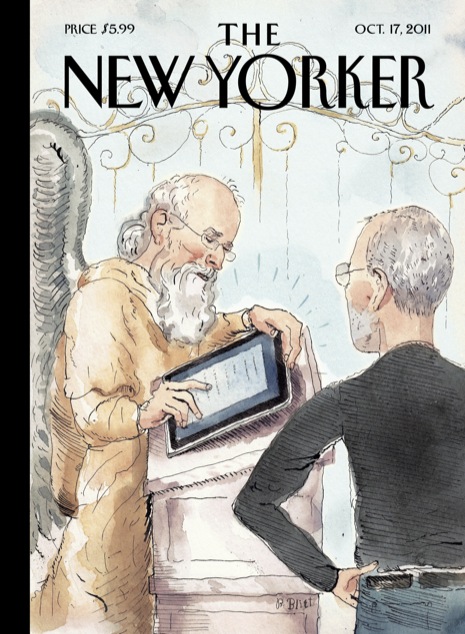
One drawing by The New Yorker cartoonists says it all. Brilliantly done. You can find the original cover here, and watch how the cartoonists go about their work here.
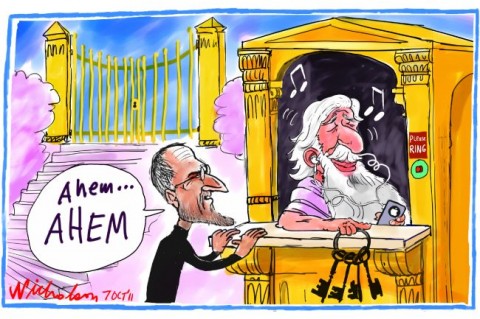
And then from across the very big pond, we have Australian cartoonist Peter Nicholson offering another creative take on Mr. Jobs’ meeting with St. Peter. Find original here, and thanks Geoff for sending…
We're hoping to rely on loyal readers, rather than erratic ads. Please click the Donate button and support Open Culture. You can use Paypal, Venmo, Patreon, even Crypto! We thank you!
Open Culture scours the web for the best educational media. We find the free courses and audio books you need, the language lessons & educational videos you want, and plenty of enlightenment in between.