Enjoy, but the rule is once you start, you have to listen through to the very, very end. :)
Enjoy, but the rule is once you start, you have to listen through to the very, very end. :)
I’ve had Trout Mask Replica in my collection for years. I can’t say I regularly pull it out to give it a listen, but I know I’d never get rid of it. It’s a sometimes impenetrable slab of genius, wrought from endless sessions and then a short burst of recording, led by a man who couldn’t read music, was prone to fits of violent anger, but dammit knew what he wanted. (And Zappa produced.) When I learned later that the house where a lot of this went down was located in the hills behind the suburbs of Woodland Hills, it made the insurrection of the album all the more magical.
But yes, it’s a hard one to get into. There are no “hits.” There’s no foot tappin’ pop (well, mayyyyybe “Ella Guru,” and only because I knew it first as a cover by XTC.) It’s discordant. Don Van Vliet aka Captain Beefheart sounds possessed by Howlin’ Wolf trying to sing nursery rhymes on acid, and it often plays like members of the band are in different areas of the house with a vague idea of what the others are doing. (This is actually a bit close to the truth).
Vox’s continuing series “Earworm,” hosted by Estelle Caswell, attempts to convert listeners who may have never heard of the album, by taking apart the opening track, “Frownland.”
As Caswell explains, with help from musicologists Samuel Andreyev and Susan Rogers, Van Vliet melded blues and free jazz, and played it with a deconstructed rock band instrumentation. Drums and bass did not lock down a rhythm–they played independent of the others, with the bass even playing chords. Rhythm and lead guitar played two different time signatures each, and neither were easy, 4/4 rhythms. And then there’s the saxophone work, dropping in to squonk and thrash like Ornette Coleman. As Magic Band members point out, Van Vliet didn’t understand that a bass or a guitar did not have the same range of notes as an 88-key piano, which was Van Vliet’s songwriting instrument.
However, only jazzbos dig on learning about polyrhythms. There’s so many other reasons to appreciate Trout Mask. For one, it’s in the proud tradition of European surrealism but also comes from a particular “old weird America” that produced some of our most brilliant nutcases. (How many people, learning that Van Vliet was raised near Joshua Tree, nodded in enlightenment? Of course he was.) You want drug music, the album says…well then, this is the uncut stuff.
And then sometimes it really just hits hard: “Moonlight On Vermont” is relentless, with a corruscating guitar line and Beefheart worked up into a lather over “that old time religion.” He quotes Blind Willie Johnson, conflates paganism and Puritanism, and transcends both. (Maybe this is the gateway song for newbies?)
The Vox video precedes its defense with some negative reviews from the contemporary press, but this Dick Larson review from the time understood it from the get go, who writes about it as a giant step forward after Beefheart’s two previous, more accessible albums:
Dylan would sympathise with Beefheart’s ‘nature-and-love-trips’, but the Captain is faster and more bulbous (and he’s got his band). But this is it. In straightening out his music, he’s found some kind of religion. It may be in hair pies (yes!) or in Frownland, but mainly it’s people, children and country men and women. And this is a new delight for Beefheart – a rough outdoor humanity blended with humour and a rich verbal vomit of imagery.
It is a wild album, literally. There are field recordings in between the music, with sounds of crickets and a plane passing overhead. The LP art shows the band standing, crouching, and hiding in the overgrown backyard of the house. There’s mysterious things in the stream below and only some of them are fish.
Related Content:
Tom Waits Makes a List of His Top 20 Favorite Albums of All Time
Hear a Rare Poetry Reading by Captain Beefheart (1993)
Captain Beefheart Issues His “Ten Commandments of Guitar Playing”
Ted Mills is a freelance writer on the arts who currently hosts the artist interview-based FunkZone Podcast and is the producer of KCRW’s Curious Coast. You can also follow him on Twitter at @tedmills, read his other arts writing at tedmills.com and/or watch his films here.
The Endless Summer is over. The archetypal 1966 surf documentary might have been scored by The Sandals, but the sound and the cultural dominance of surf culture would perhaps never come into being, and may not have survived the decade, without Dick Dale, who died on March 18th at the age of 81. His gnarly, menacing guitar on songs like “Miserlou” and “Pipeline” turned a fad dominated by the teen anthems of The Beach Boys and Annette Funicello’s post-Mouseketeers bikini and beehive into genuinely gritty rock and roll.
Dale’s sound defined the risky wanderlust of surfing that early skateboarders picked up on in the 70s and 80s, snowboarders in the 90s, and so on. Hundreds of guitarists stole from his distinctive technique long after the 60s surf rock craze died at the hands of British invaders. Dale rode the sound into the 21st century, touring and performing across a United States whose popular culture he helped invent by appearing on (where else) The Ed Sullivan Show.
But it’s arguable whether his fame would have survived as long without Quentin Tarantino’s shrewd use of “Misirlou” in Pulp Fiction’s opening credits. It so happens that Dale almost didn’t survive past the sixties himself. If he had died from what seemed like a terminal cancer in 1965, it’s possible surf guitar would have died with him, become a curious relic rather than a living tradition.
Jimi Hendrix thought so—at least according to Dale in the liner notes to 1997’s Better Shred Than Dead: The Dick Dale Anthology. “Then you’ll never hear surf music again,” Hendrix supposedly said. Maybe in the purest sense, it’s true. Only Dale truly “transferred,” as he put it, the “tremendous amount of power” of surfing into the guitar. His playing was an extreme sport; his shows were “stomps”; the audience never stopped moving for a minute, whooping and hollering along with him.
And still, his cavernous guitar filled ballrooms. He pushed Fender to build louder and louder amplifiers, and everyone else along with them. Like Hendrix, he was a lefty who played a flipped-over right-handed Fender Strat. Yet Dale didn’t restring the guitar, effectively playing it upside-down. He used the heaviest strings he could find, the loudest amps that could be made, and more reverb than anyone had previously thought advisable. “Bands like the Beach Boys,” writes Amanda Petrusich at The New Yorker, “often sang about surfing,” but the genre Dale invented “was wet and gnarly and unconcerned with romance or sweetness.”
His style earned Dale the title of “King of the Surf Guitar,” also the title of his second album and a fact he liked to trumpet as often as he could, along with claims that he was called the “Father of Heavy Metal.” (Link Wray might like a word.) He was a tireless promoter and performer without whose influence there may’ve been no Endless Summer-scoring Sandals or Surfaris’ “Wipe Out”—surf culture essentials that traveled the world.
Surf rock became a niche sound, popular with increasingly specialized audiences, before Quentin Tarantino made it cool again. Pulp Fiction’s use of the song was not an ironic detournement, but a genuine reminder of how dangerous Dale sounded. He buzzsawed through the early-sixties scene of skinny ties and big hair. The footage of him above playing “Misirlou” with The Del Tones—all of whom wear terrified smiles and identical suits, above—is strangely Lynchian.
Part of the incongruity comes from watching square white Americans bounce through a haunting Egyptian folk song, while looking like they should be playing “Mr. Sandman.” Dale made 50s pop seem childish, and sound-tracked the entry of mildly adult situations in 60s surf movies. He deserved to have fared better from his influence and fame.
Dale’s last couple decades were spent like too many other people in the U.S. He couldn’t stop touring, he said, “because I will die. Physically and literally, I will die.” After his first recovery from colorectal cancer in 1965, he continued to battle the disease,” writes The Washington Post. “Up until the end of his life, Dale was explicit that he toured to fund his treatment” after his cancer returned. He couldn’t retire even when his career rebounded, twice after his early sixties’ heyday: first in 1987 when he recorded “Pipeline” (further up) with Stevie Ray Vaughan and again after Pulp Fiction.
His fans continued to support him not because he was a hip nostalgia act, but, he said, because he grew and branched out as a guitar player and he was honest about his difficulties, and people connected. He was an American original. The son of Lebanese immigrants, he took the music of his parents’ home country, blended it with country swing and blues, and played it dirty, wet, and as loud as it could go, something no one had quite done before and thousands have done since.
Related Content:
Quentin Tarantino Explains The Art of the Music in His Films
The Beach Party Film: A Short Appreciation of One of the Oddest Subgenres in Film History
A History of Rock ‘n’ Roll in 100 Riffs
Josh Jones is a writer and musician based in Durham, NC. Follow him at @jdmagness
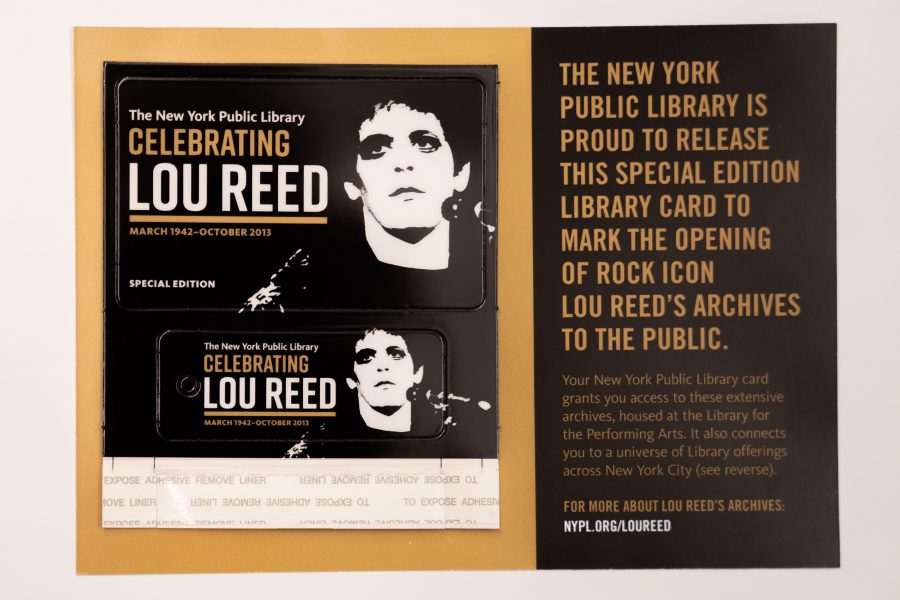
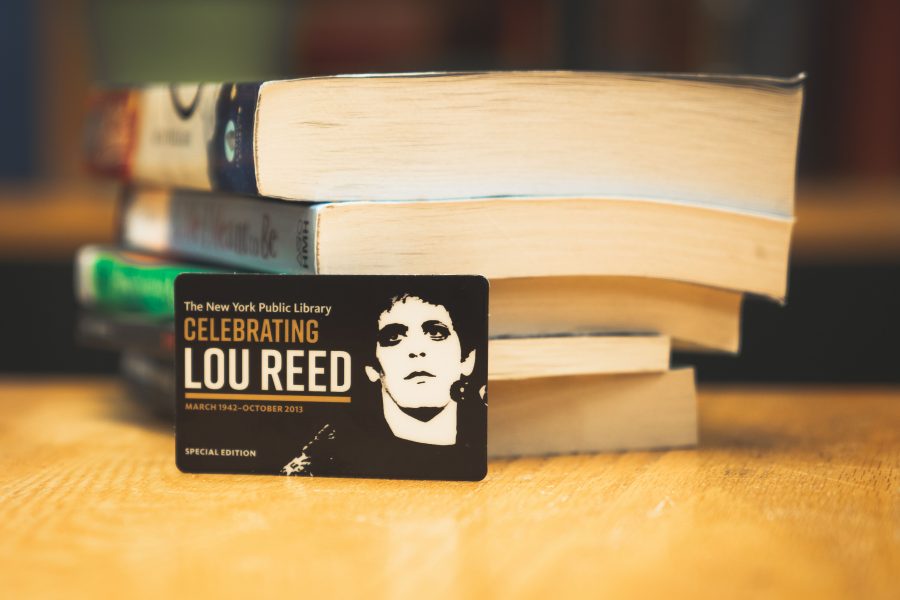
This past October marked the fifth anniversary of Lou Reed’s death. This month marks what would have been his 77th birthday. It seems like as good a time as any to revisit his legacy. As of this past Friday, anyone can do exactly that in person at the New York Public Library. And they can do so with their own special edition NYPL Lou Reed library card. The NYPL has just opened to the public the Lou Reed Archive, “approximately 300 linear feet,” the library writes in a press release, “of paper records, electronic records, and photographs, and approximately 3,600 audio and 1,300 video recordings.”
These artifacts span the musician, writer, photographer, and “tai-chi student”’s life from his 1958 high school band The Shades to “his job as a staff songwriter for the budget music label, Pickwick Records, and his rise to prominence through the Velvet Underground and subsequent solo career, to his final performance in 2013.”
It is more than fitting that they should find a home at the New York institution, in the city where Lou Reed became Lou Reed, “the most literary of rock stars,” writes Andrew Epstein for the Poetry Foundation, “one who aspired to make rock music that could stand on the same plane as works of literature.” See a list of the Lou Reed Archive collections below:
Reed left his first “lasting legacy” at Syracuse University, as Syracuse itself affirmed after his death in 2013, as “a criminal, a dissident and a poet.” There, he studied under his literary hero, Delmore Schwartz, was reportedly expelled from ROTC for holding an unloaded gun to his superior’s head, and was supposedly turned away from his graduation by police. Once in New York, however, Reed not only piloted the Velvet Underground into everlasting cult infamy, jumpstarting waves of punk, post-punk, new wave, and a few dozen other subgenres. He also carried forth the legacy of the New York poetry, Epstein argues.
He had “serious connections to the poetry world”—not only to Schwartz, but also to the Beats and the New York School—to poets who “played a surprisingly large role in the emergence of the Velvet Underground.” Like all great art, Reed’s best work was more than the sum of its “multiple and complex influences.” But it should be appreciated alongside mid-century New York poets as much as jazz experimentalists like Ornette Coleman and Cecil Taylor who inspired his freeform approach. “Reed’s body of work,” writes Epstein, “represents a crucial but overlooked instance of poetry’s rich back-and-forth dialogue with popular culture.”
Similar things might be said about Reed’s engagements with film, theater, the visual arts, and the New York avant-garde generally, which he also transmuted and translated into his scuzzy brand of rock and roll. The NYPL archive documents his relationships with not only his bandmates and manager/patron Andy Warhol, but also Robert Quine, John Zorn, Robert Wilson, Julian Schnabel, and Laurie Anderson. And yet, despite the many rivers he waded into in his long career, immersing in some more deeply than others, it was the New York literary world whom he most wanted to embrace his work.
Accepting an award in 2007 from Syracuse, Reed said, “I hope, Delmore, if you’re listening you are finally proud as well. My name is finally linked to yours in the part of heaven reserved for Brooklyn poets.” Head over to The Library for the Performing Arts in Lincoln Center to get your own Lou Reed library card. If you’re lucky enough to spend some time with this extensive collection, maybe consider how all Reed’s work was, in some way or another, informed by a lifelong devotion to New York poetry.
Related Content:
Lou Reed Sings “Sweet Jane” Live, Julian Schnabel Films It (2006)
Josh Jones is a writer and musician based in Durham, NC. Follow him at @jdmagness
What have we here?
Evidence that the Maestro is a monster?
Or a behind the scenes reminder that Arrested Development’s wannabe actor Tobias Fünke is not too far off base when he says that to make it in “this business of show, you have to have the heart of an angel and the hide… of an elephant.”
Both? Neither? Any way you slice it, the recording session above is not for your typical cast album.
West Side Story, with a book by Arthur Laurents, music by Leonard Bernstein, and lyrics by Stephen Sondheim, opened on Broadway in 1957.
The film, starring Natalie Wood and Richard Beymer as star-crossed lovers Maria and Tony, came along four years later.
After which it’s been an endless round of community, college, and high school productions.
Are you a Jet or a Shark?
The celebrated tenor José Carreras does not make a particularly believable Jet.
While untold numbers of white kids have attempted Puerto Rican accents to play Maria, Bernardo, Anita, and Chino, that knife has seldom cut the other way.
Perhaps a dialect coach could have transformed Carreras’ thick Spanish accent into Tony’s New York street punk vernacular, but the prep time for these September 1984 recording sessions was minimal, and not tied to any actual production.
Carreras was also, at 38, a bit long in the tooth to be tackling the part.
But what might have been deal breakers for a Broadway revival were permissible for this weeklong special event in which world-caliber artists, “whose main reason for existing,” according to Bernstein, was their singing, would be laying down the score in the studio, backed by a full orchestra.
As he told his associate and eventual biographer, classical music television presenter Humphrey Burton:
l’d always thought of West Side Story in terms of teenagers and there are no teenage opera singers, it’s just a contradiction in terms. But this is a recording and people don’t have to look 16, they don’t have to be able to dance or act a rather difficult play eight times a week. And therefore we took this rather unorthodox step of casting number-one world-class opera singers. I suppose the only foreseeable problem was that they might sound too old—but they don’t, they just sound marvelous!
Bernstein’s approving mood is nowhere in evidence in the above clip, in which he hectors Carreras for screwing up the tempo, as the instrumentalists and sound engineers squirm.
Carreras’ discomfort and chagrin is so palpable that you can find the sequence on YouTube under the title “Tenor Keeps Screwing Up while Bernstein Conducts—Awkward Sequence,” as if he were some weedy upstart, still wet behind the ears, when in fact, he had just flown in from Verona, where he’d been appearing as Don José in Carmen.
Dame Kiri Te Kanawa, Carreras’ Maria, supplied a taste of what it was like to sing for the composer:
He’s a man of many emotions. You can see his moods, his frustrations, his happiness, his wanting to perform to people. That’s the thing that makes the man interesting. One is constantly trying to read him, but he’s on another planet!
In the end, Bernstein declared himself pleased with what had been accomplished, or at least with the enduring power of the material.
But readers with an anti-authoritarian streak may not feel satisfied until they’ve seen the clip below, in which a rogue BBC Orchestra trumpet isn’t quite so deferential in the face of the Maestro’s criticism.
Listen to the 1984 recording of West Side Story for free on Spotify.
Related Content:
Watch Leonard Bernstein Conduct the Vienna Philharmonic Using Only His Eyebrows
Leonard Bernstein Presents “The Greatest 5 Minutes in Music Education”
Ayun Halliday is an author, illustrator, theater maker and Chief Primatologist of the East Village Inky zine. Join her for the next installment of her book-based variety show, Necromancers of the Public Domain in New York City this April. Follow her @AyunHalliday.
Steve Reich’s Clapping Music is one of the simplest scores of modern classical music, and as you might soon find out, one of the most difficult to perform. Written in 1972 while on a European tour and after a night of mediocre flamenco, Clapping Music is for two players. One claps a steady rhythm (technically an African Bell Rhythm).
A second performer claps in unison in the same pattern for eight bars. At the end of the eighth bar, the second performer goes out of sync for one eighth note and after another eight bars, goes out of sync again. This continues until both players are back in unison. (The above video explains this technique visually).
For Reich it was a simpler evolution of “phase” compositions that he had been creating since 1965. The earlier example was “It’s Gonna Rain,” which used two tape loops of a Pentecostal street preacher’s rant going slowly out of sync with each other, revealing first an echo and then, as the two loops wind up 180 degrees out of sync, pure apocalyptic cacophony.
The sync issues were due to the vagaries of the analog machines themselves, but Reich moved on to recreating phase music with actual instruments. In 1967 he composed “Piano Phase,” in which a simple melody is played by two musicians first in unison, and then slowly out of sync. Reich followed up with “Reed Phase” and “Violin Phase,” the latter of which was set to dance by Anne Teresa of Keersmaeker.
Asked about performing “Clapping Music” live, Reich told ClassicFM:
It’s a piece that I’m always standing up there doing, and it makes me nervous every time because you’re very exposed, as it’s just you and the other guy. If you make one little hesitation you can find yourself at a place in the piece where you have to figure out where you are to get things right. So it never ceases to be a challenge; it’s easy on one level, but it’s challenging on another.
If you’d like to have a go at Clapping Music, there is a free app from the London Sinfonietta and Touchpress that plays the steady loop while you try to go out of phase. (It tracks and rates your performance, with the hope you’ll perfect it.) I haven’t had a chance myself to try it out, but if you have, let us know in the comments.
Related Content:
Steve Reich is Calling: A Minimalist Ringtone for the iPhone
Ted Mills is a freelance writer on the arts who currently hosts the artist interview-based FunkZone Podcast and is the producer of KCRW’s Curious Coast. You can also follow him on Twitter at @tedmills, read his other arts writing at tedmills.com and/or watch his films here.
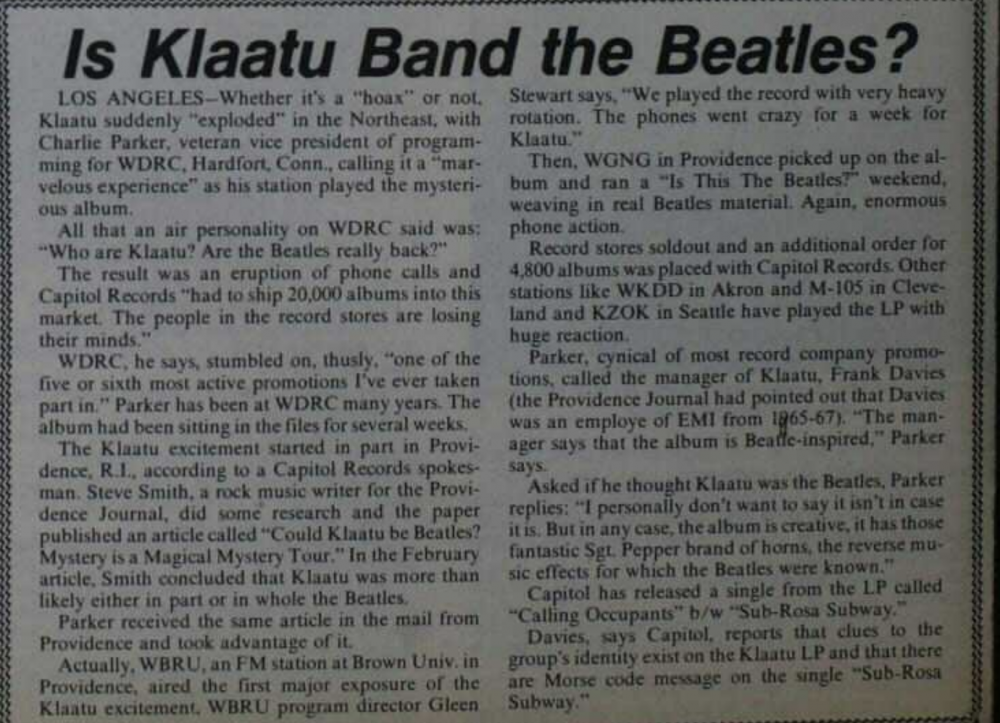
In 1976, hundreds of diehard Beatles fans became convinced that the mysterious album 3:47 EST by the band Klaatu was actually a new release from The Beatles in disguise, after a DJ in Providence, Rhode Island played one of its songs on the radio. Shortly afterward, Steve Smith discovered the album at the newspaper he worked for, Rhode Island’s The Providence Journal, listened to it, and became immediately intrigued.
The album contained no photographs, no identifying information at all, and the band’s The Day the Earth Stood Still reference echoed the cover of Ringo Starr’s album Goodnight Vienna. Smith heard Starr’s drumming, Harrison’s guitars, Lennon and McCartney’s voices in the psychedelic songs. Though he wasn’t a music critic or reporter himself, he persuaded the paper to publish a feature in which he suggested Klaatu could be The Beatles.
The “Klaatu Konspiracy” spread. An Australian fan issued a 34-page booklet on the case. Executives at Klaatu’s label, Capital Records Canada, refused to confirm or deny, enjoying the publicity, as Smith recalled in a 1997 interview.
More specifically, “hedging his bets,” writes Ken Raisanen for WOAS FM, Smith concluded that “the mystery band could be 1) The Beatles. 2) A couple of the Beatles with other people. 3) A Beatles-backed band. 4) A completely unknown but ingenious and talented band.” If the American Smith had caught an episode of Keith Hampshire’s Music Machine on CBC two years earlier, he would have seen the evidence of number four (see the real Klaatu play “California Jam” in 1974, above). But the band otherwise made an effort to obscure their identity.
As Klaatu bassist Jon Woloshuck told Goldmine magazine in 2013, one reason for the air of mystery they cultivated is that “we were just three guys from Toronto.” They wanted the music to speak for itself, and “nobody knew who were anyway.” They were amused by the rumor. “It caught us by surprise,” says drummer Terry Draper, but they “didn’t think much of it at the time…. We were all big Beatles fans, and we were hoping they would reunite. At the time, the idea of a reunited Beatles wasn’t all that far-fetched at all.”
These attitudes may have been prevalent, but Klaatu wasn’t deliberately setting out to tap into them, they say, but to “do music that was on par” with “late ‘60s progressive bands like King Crimson and The Moody Blues.” They’re clearly also channeling The Beatles, whether they admit it or not. Still the “rumor did us as much harm as good,” says guitarist Dee Long. “It got us noticed, which was great, but also led to a situation where we could not ever really measure up to expectations.” Hear what Beatles fans and Klaatu conspiracists heard in 1976 in the song “Sub Rosa Subway” above from 3:47 EST, and learn more about the Klaatu conspiracy theory in the Polyphonic video at the top.
Related Content:
Josh Jones is a writer and musician based in Durham, NC. Follow him at @jdmagness
The legend of Queen is immortal. It needs no further burnishing, not even, some might argue, by the most recent Oscar-winning biopic. The film may gamely recreate the stagecraft of Britain’s most operatic export. But once you’ve seen the real thing, what need of a substitute? For the millions who loved them before Wayne’s World brought them back to global consciousness, and the millions who came to love them afterward, the only thing that could be better than watching live Queen is watching more live Queen.
If you’re one of those millions, you’ll thrill at this concert film of Queen live in Montreal in 1981, “at their near peak,” writes Twisted Sifter. The footage you see here has been lovingly restored from an original release that chopped two different nights’ performances together in a hash the band hated.
The restoration, as Brian May himself explained in 2007, is now “much much more true to what actually happened at any given moment…. And I do find that once I’m five minutes into the film, I’m caught up in it as a real live show.” It is, he says, “a great piece of work.”
Directed by Saul Swimmer, the documentarian who made George Harrison’s Concert for Bangladesh, the film was plagued by misunderstanding and hostility, as May describes it. Freddie Mercury hated the experience and the director. “What you will see,” says the guitarist, “is a very edgy, angry band, carving out a performance in a rather uncomfortable situation.” But what performances they are. “High energy, real, and raw.”
Yet no justice was done to the electric rage they brought to the stage those two nights. The film was shot on very high-quality 35mm, then very badly edited with poor attempts at matching sound and video from different performances. In 1984, an even worse VHS version titled We Will Rock You appeared, then it went to DVD in 2001. The band protested but could only remedy the situation when they bought the rights to the film.
In describing the restoration process, May, the irrepressible scientist, gets most excited:
The surviving negative went to be doctored in the USA – by a process using algorithms invented by John D Lowry of NASA for rescuing the film from the Apollo Moon missions. (Astrophysics gets everywhere!) You know how quick computers are these days…? Well, to give you an idea of the huge number-crunching involved, it took 700 Apple Mac G5’s one MONTH to process this film.
From the original 24-track audio, all the songs, which had been edited, were restored to their full length, and what footage wasn’t cut and discarded was rejoined “with modern digital artistry” into full performances.
Given that the outtakes had disappeared, the result “is a document which concentrates on Freddie,” says May, but no one in the band “is upset” about that. I doubt any Queen fans will be overly upset either. See and hear the gloriously restored film and live audio from Montreal in 1981 here: a fast version of “We Will Rock You,” “Somebody to Love,” “Killer Queen,” “Bohemian Rhapsody,” “Another One Bites the Dust,” the slow version of “We Will Rock You,” and “We Are the Champions,” below.
via Twisted Sifter
Related Content:
Scenes from Bohemian Rhapsody Compared to Real Life: A 21-Minute Compilation
Josh Jones is a writer and musician based in Durham, NC. Follow him at @jdmagness


Open Culture scours the web for the best educational media. We find the free courses and audio books you need, the language lessons & educational videos you want, and plenty of enlightenment in between.

©2006-2026 Open Culture, LLC.
All rights reserved.
