Alice’s Restaurant. It’s now a Thanksgiving classic, and something of a tradition around here. Recorded in 1967, the 18+ minute counterculture song recounts Arlo Guthrie’s real encounter with the law, starting on Thanksgiving Day 1965. As the long song unfolds, we hear all about how a hippie-bating police officer, by the name of William “Obie” Obanhein, arrested Arlo for littering. (Cultural footnote: Obie previously posed for several Norman Rockwell paintings, including the well-known painting, “The Runaway,” that graced a 1958 cover of The Saturday Evening Post.) In fairly short order, Arlo pleads guilty to a misdemeanor charge, pays a $25 fine, and cleans up the thrash. But the story isn’t over. Not by a long shot.
Later, when Arlo (son of Woody Guthrie) gets called up for the draft, the petty crime ironically becomes a basis for disqualifying him from military service in the Vietnam War. Guthrie recounts this with some bitterness as the song builds into a satirical protest against the war: “I’m sittin’ here on the Group W bench ’cause you want to know if I’m moral enough to join the Army, burn women, kids, houses and villages after bein’ a litterbug.” And then we’re back to the cheery chorus again: “You can get anything you want, at Alice’s Restaurant.”
We have featured Guthrie’s classic during past years. But, for this Thanksgiving, we give you the illustrated version. As a sad post script, Alice Brock, the owner of Alice’s Restaurant–died last week at the age of 83.
If you would like to support the mission of Open Culture, consider making a donation to our site. It’s hard to rely 100% on ads, and your contributions will help us continue providing the best free cultural and educational materials to learners everywhere. You can contribute through PayPal, Patreon, and Venmo (@openculture). Thanks!
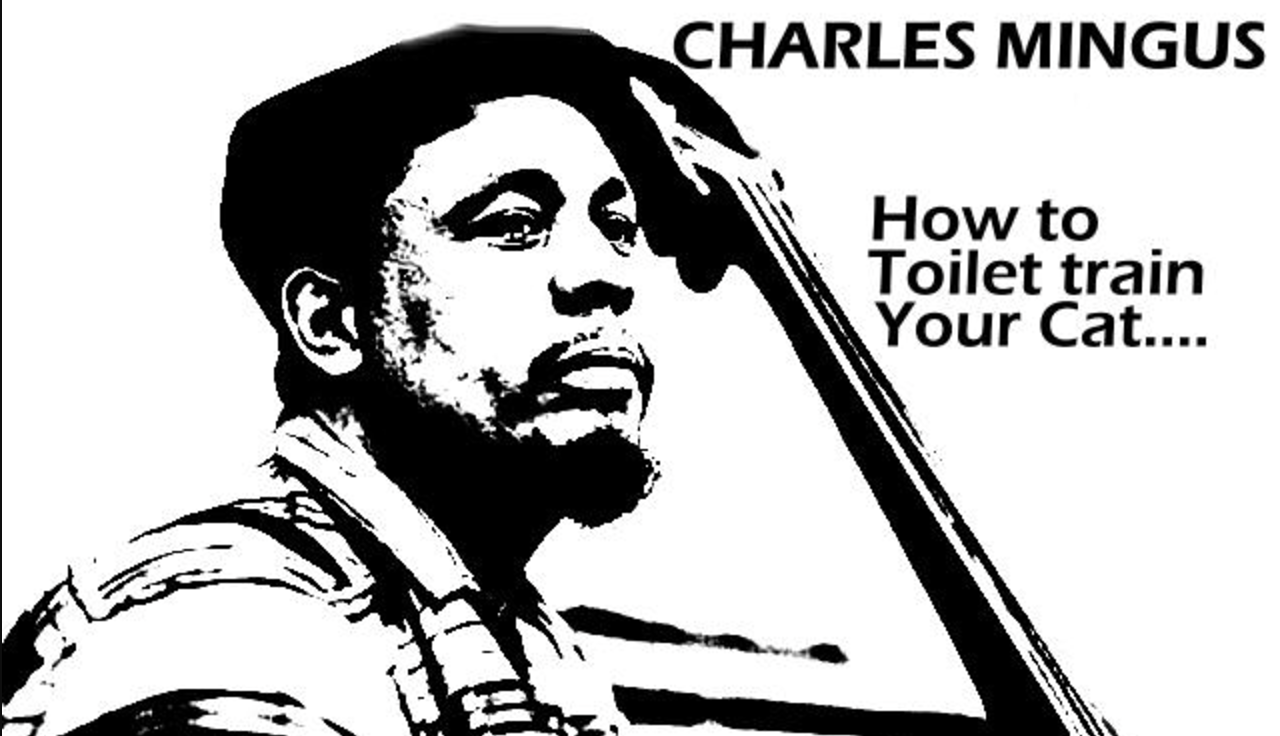
Charles Mingus, the innovative jazz musician, was known for having a bad temper. He once got so irritated with a heckler that he ended up trashing his $20,000 bass. Another time, when a pianist didn’t get things right, Mingus reached right inside the piano and ripped the strings out with his bare hands — a true story mentioned in the BBC documentary, 1959: The Year that Changed Jazz.
But Mingus had a softer, nurturing side too. If you head to the official Charles Mingus website, you will find a copy of the Charles Mingus Cat Toilet Training Program, a loving little guide created for cat owners everywhere. The trick to potty training your cat comes down to edging the litter box closer to the bathroom, eventually placing the box on the potty, and then cutting a hole in the center of the box. Expect to spend about three weeks making the transition. And who knows, Mingus says, your cat may even learn to flush. The full guide appears here. Or read it below:
1
First, you must train your cat to use a home-made cardboard litter box, if you have not already done so. (If your box does not have a one-piece bottom, add a cardboard that fits inside, so you have a false bottom that is smooth and strong. This way the box will not become soggy and fall out at the bottom. The grocery store will have extra flat cardboards which you can cut down to fit exactly inside your box.)
Be sure to use torn up newspaper, not kitty litter. Stop using kitty litter. (When the time comes you cannot put sand in a toilet.)
Once your cat is trained to use a cardboard box, start moving the box around the room, towards the bathroom. If the box is in a corner, move it a few feet from the corner, but not very noticeably. If you move it too far, he may go to the bathroom in the original corner. Do it gradually. You’ve got to get him thinking. Then he will gradually follow the box as you move it to the bathroom. (Important: if you already have it there, move it out of the bathroom, around, and then back. He has to learn to follow it. If it is too close to the toilet, to begin with, he will not follow it up onto the toilet seat when you move it there.) A cat will look for his box. He smells it.
2
Now, as you move the box, also start cutting the brim of the box down, so the sides get lower. Do this gradually.
Finally, you reach the bathroom and, eventually, the toilet itself. Then, one day, prepare to put the box on top of the toilet. At each corner of the box, cut a little slash. You can run string around the box, through these slashes, and tie the box down to the toilet so it will not fall off. Your cat will see it there and jump up to the box, which is now sitting on top of the toilet (with the sides cut down to only an inch or so.)
Don’t bug the cat now, don’t rush him, because you might throw him off. Just let him relax and go there for awhile-maybe a week or two. Meanwhile, put less and less newspaper inside the box.
3
One day, cut a small hole in the very center of his box, less than an apple-about the size of a plum-and leave some paper in the box around the hole. Right away he will start aiming for the hole and possibly even try to make it bigger. Leave the paper for awhile to absorb the waste. When he jumps up he will not be afraid of the hole because he expects it. At this point you will realize that you have won. The most difficult part is over.
From now on, it is just a matter of time. In fact, once when I was cleaning the box and had removed it from the toilet, my cat jumped up anyway and almost fell in. To avoid this, have a temporary flat cardboard ready with a little hole, and slide it under the toilet lid so he can use it while you are cleaning, in case he wants to come and go, and so he will not fall in and be scared off completely. You might add some newspaper up there too, while you are cleaning, in case your cat is not as smart as Nightlife was.
4
Now cut the box down completely until there is no brim left. Put the flat cardboard, which is left, under the lid of the toilet seat, and pray. Leave a little newspaper, still. He will rake it into the hole anyway, after he goes to the bathroom. Eventually, you can simply get rid of the cardboard altogether. You will see when he has got his balance properly.
Don’t be surprised if you hear the toilet flush in the middle of the night. A cat can learn how to do it, spurred on by his instinct to cover up. His main thing is to cover up. If he hits the flush knob accidentally and sees that it cleans the bowl inside, he may remember and do it intentionally.
Also, be sure to turn the toilet paper roll around so that it won’t roll down easily if the cat paws it. The cat is apt to roll it into the toilet, again with the intention of covering up- the way he would if there were still kitty litter.
It took me about three or four weeks to toilet train my cat, Nightlife. Most of the time is spent moving the box very gradually to the bathroom. Do it very slowly and don’t confuse him. And, remember, once the box is on the toilet, leave it a week or even two. The main thing to remember is not to rush or confuse him.
Bonus: Below you can hear The Wire’s Reg E. Cathey read “The Charles Mingus CAT-alog for Toilet Training Your Cat.”
If you would like to support the mission of Open Culture, consider making a donation to our site. It’s hard to rely 100% on ads, and your contributions will help us continue providing the best free cultural and educational materials to learners everywhere. You can contribute through PayPal, Patreon, and Venmo (@openculture). Thanks!
Just by chance, could you use a song about perseverance and overcoming adversity? Something to give you a little encouragement and reassurance? Then we submit to you “Don’t Give Up,” featuring the isolated vocals of Peter Gabriel and Kate Bush.
When he released the song on his 1986 album So, Gabriel told NME: “The catalyst for ‘Don’t Give Up’ was a photograph I saw by Dorothea Lange,… which showed the dust-bowl conditions during the Great Depression in America. Without a climate of self-esteem it’s impossible to function.” Elsewhere, on hiswebsite, Gabriel explained that the song was also “informed by the high levels of unemployment under the Conservative government of Margaret Thatcher of the 1980s.” Whatever the challenges they’ve faced, listeners have sought solace in this song for the past 38 years. No doubt, for some, it will come in handy during the weeks and months ahead.
Last Friday, The Cure celebrated the release of their new album, Songs of a Lost World, with a three-hour set at the Troxy in London. The band kicked off the show by performing all eight tracks from the album, before then playing another 23 songs, mostly hits from their large catalog of music. Originally live streamed on YouTube, you can now watch the entire show online. Just click play above.
If you would like to support the mission of Open Culture, consider making a donation to our site. It’s hard to rely 100% on ads, and your contributions will help us continue providing the best free cultural and educational materials to learners everywhere. You can contribute through PayPal, Patreon, and Venmo (@openculture). Thanks!
This past Friday, the bassist of The Grateful Dead, Phil Lesh, passed away at age 84. Almost immediately the tributes poured in, most recognizing that Lesh wasn’t your ordinary bassist. As Jon Pareles wrote in the New York Times, Phil Lesh held songs “aloft.” His “bass lines hopped and bubbled and constantly conversed with the guitars of Jerry Garcia and Bob Weir. His tone was rounded and unassertive while he eased his way into the counterpoint, almost as if he were thinking aloud. [His] playing was essential to the Dead’s particular gravity-defying lilt, sharing a collective mode of rock momentum that was teasing and probing, never bluntly coercive.”
My first encounter with the Grateful Dead came when I was 16 years old. I vividly remember the guy who played bongos on my friend’s head when we arrived at the show. I also remember the spinners tripping on acid, dancing down the halls and short-circuiting my little mind. But the concert itself remains only a hazy memory. And certainly the artistry of Lesh, Garcia, Weir, and the drummers was lost on me. Only years later, did it all start to click. That’s when I dialed into the Barton Hall concert at Cornell (May 8, 1977) and encountered Lesh’s bass lines at the start of “Scarlet Begonias.” Once you hear them, they’re hard to shake. The video above zooms into that performance, exploring the development of Lesh’s bass playing throughout the spring of ’77. The next video down lets you hear the complete Barton Hall performance of “Scarlet Begonias” in all of its glory.
When others try to capture what made Phil, Phil, they’ll feature another beloved show–Veneta, OR (6/27/72). Below, you can hear isolated tracks of Phil’s bass work on “Bertha” and “China Cat Sunflower/I Know You Rider.” (Click the links in the prior sentence to hear Lesh and the band performing the songs together–so you can hear how the bass ties in.) Trained in free jazz and avant-garde classical music, Lesh infused rock with the influences of Coltrane, Mingus, and Stravinsky–not to mention others. And, with that, the bass was never the same.
Haruki Murakami’s hit novel 1Q84features a memorable scene in a taxicab on a gridlocked freeway whose radio is playing Leoš Janáček’s Sinfonietta. “It is, as the book suggests, truly the worst possible music for a traffic jam,” writes Sam Anderson in aNew YorkTimes Magazine profile of the novelist: “busy, upbeat, dramatic — like five normal songs fighting for supremacy inside an empty paint can.” Murakami tells Anderson that he “chose the Sinfonietta because that is not a popular music at all. But after I published this book, the music became popular in this country… Mr. Seiji Ozawa thanked me. His record has sold well.”
In addition to being a world-famous conductor, the late Ozawa was also, as it happens, a personal friend of Murakami’s; the two even published a book, Absolutely on Music, that transcribes a series of their conversations about the former’s vocation and the latter’s avocation, a distinction with an unclear boundary in Murakami’s case.
“I have lots of friends who love music, but Haruki takes it way beyond the bounds of sanity,” writes Ozawa, and indeed, Murakami has always made music a part of his work, both in his process of creating it and in its very content. His books offer numerous references to Western pop (especially of the nineteen-sixties), jazz, and also classical recordings — fifteen of which you can hear in the video from NTS radio above.
We’ve previously featured NTS, the London-based online radio station known for its deep dives on themes from spiritual jazz to Hunter S. Thompson, for its “Haruki Murakami Day” broadcast of music from his novels. Opening with Le mal du pays from Franz Liszt’s Années de pèlerinage, the NTS Guide to Classical Music from Murakami Novels continues on to “Vogel als Prophet” from Robert Schumann’s Waldszenen, and thereafter includes Beethoven’s Symphony No. 7 In A Major, Mendelssohn’s Cleveland Quartet, Wagner’s Der Fliegende Holländer, and much else besides. You may not be able to recall where you’ve seen all of these pieces mentioned in Murakami’s work right away, but you’ll surely recognize the Sinfonietta the moment it comes along.
Based in Seoul, Colin Marshall writes and broadcasts on cities, language, and culture. His projects include the Substack newsletterBooks on Cities and the book The Stateless City: a Walk through 21st-Century Los Angeles. Follow him on Twitter at @colinmarshall or on Facebook.
The scene is Farm Aid, 1985, attended by a crowd of 80,000 people. The song is “How Blue Can You Get.” And the key moment comes at the 3:10 mark, when the blues legend B.B. King breaks a guitar string, then manages to replace it before the song finishes minutes later. All the while, he keeps the song going, never missing a beat and singing the blues. Enjoy.
If you would like to support the mission of Open Culture, consider making a donation to our site. It’s hard to rely 100% on ads, and your contributions will help us continue providing the best free cultural and educational materials to learners everywhere. You can contribute through PayPal, Patreon, and Venmo (@openculture). Thanks!
Luciano Pavarotti and James Brown are remembered as larger-than-life performers with an almost mythical-seeming presence and distinctiveness. But it wasn’t so very long ago that both of them were active — and even active onstage together. In the video above, the King of the High Cs and the Godfather of Soul get together on “It’s a Man’s World” in 2002. It happened at the penultimate Pavarotti & Friends concert, one of a series of yearly benefit shows that ran between 1992 and 2003, and also featured the likes of Andrea Bocelli, Grace Jones, Sting, and Lou Reed.
“It’s a remarkable performance on so many levels,” writes Tom Teicholz at Forbes.com. “James Brown is in top form, his voice strong and pure. He commands the stage, and he dominates — he is in every sense an equal to Pavarotti, who sings in Italian with great subtlety, finesse, and emotion. The video is filled with moments of grace — such as when Brown, with a magisterial wave of his arm cedes the stage to Pavarotti to sing his solo, or when Brown says ‘my Bible says Noah made the Ark’ as if it was truly HIS Bible.”
What’s more, this is hardly the James Brown only slightly exaggerated by Eddie Murphy in those Saturday Night Live hot tub sketches a couple of decades earlier. “Brown’s performance is not about his staged theatrics, not about his dancing, not even really about Brown’s trademark grunts and growls,” Teicholz writes. “This is about singing and getting the song across,” a mission certainly not hindered by the kind of of orchestral backing they have. “It’s a Man’s World” might seem like the kind of song you “couldn’t sing today,” at least if you take its title at face value. But in any case, how many singers today would want to be subject to comparison with this particular rendition if they did so?
Based in Seoul, Colin Marshall writes and broadcasts on cities, language, and culture. His projects include the Substack newsletterBooks on Cities and the book The Stateless City: a Walk through 21st-Century Los Angeles. Follow him on Twitter at @colinmarshall or on Facebook.
We're hoping to rely on loyal readers, rather than erratic ads. Please click the Donate button and support Open Culture. You can use Paypal, Venmo, Patreon, even Crypto! We thank you!
Open Culture scours the web for the best educational media. We find the free courses and audio books you need, the language lessons & educational videos you want, and plenty of enlightenment in between.