“If I am condemned, I shall be annihilated to nothing: but my ambition is such, as I would either be a world, or nothing.” — Margaret Cavendish (1623–1673)
Project Vox seeks to resurrect their overlooked-to-the-point-of-undiscovered contributions by publishing their long out of print texts, some translated into English for the first time. Biographical information and secondary resources will provide a sense of each philosopher as well as her philosophy.
Eventually, the site will include a forum where teachers can share lesson plans and articles. Male philosophy doctorates currently outnumber their female counterparts by an overwhelming number, but that may change as young women begin to see themselves reflected in the curriculum.
Backstories of famously accomplished people seem incomplete without some past difficulty or failure to be overcome. In narrative terms, these incidents provide biographies with their dramatic tension. We see Abraham Lincoln rise to the highest office in the land despite the humblest of origins; Albert Einstein rewrites theoretical physics against all academic odds, given his supposed early childhood handicaps. In many cases, these stories are apocryphal, or exaggerated for effect. But whatever their accuracy, they always seem to reflect undeniable character traits of the person in question.
In the case of influential philosopher Jacques Derrida, progenitor of the both beloved and reviled critical theory known as “Deconstruction,” the stories of academic struggle and great mental suffering are well-documented. Furthermore, their details accord perfectly well with the mature thinker who, remarks the site Critical Theory, “can’t answer a simple god-damned question.” The good-natured snark on display in this description more or less sums up the feedback Derrida received during some formative years of schooling while he prepared for his entrance exams to France’s university system in 1951 at the age of 20.
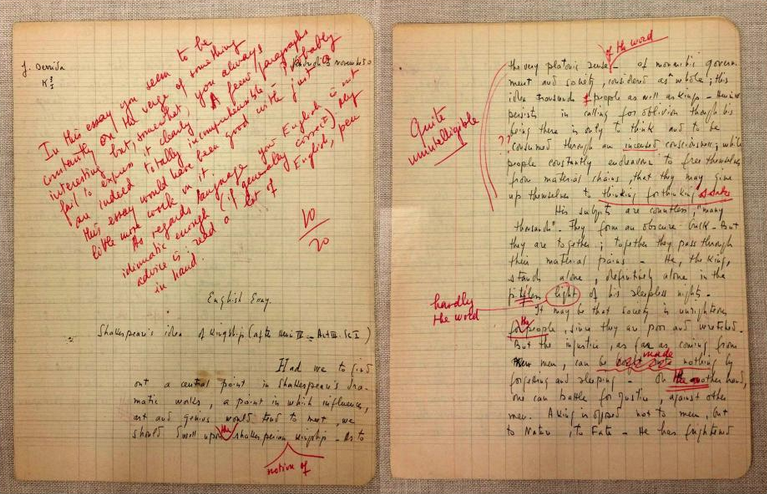
Derrida may have “left as big a mark on humanities departments as any single thinker of the past forty years,” writes The New York Review of Books, but during this period of his life, he failed his exams twice before finally gaining admittance. Once, he “choked and turned in a blank sheet of paper. The same month, he was awarded a dismal 5 out of 20 on his qualifying exam for a license in philosophy.” One essay he submitted on Shakespeare, written in English (above), received a 10 out of 20. The feedback from Derrida’s instructor will sound very familiar to perplexed readers of his work. “Quite unintelligible,” writes the evaluator in one marginal comment. The main comment at the top of the paper reads in part:
In this essay you seem to be constantly on the verge of something interesting but, somewhat, you always fail to explain it clearly. A few paragraphs are indeed totally incomprehensible.
Another examiner—points out the NYRB—left a comment on his work “that has since become a commonplace”:
An exercise in virtuosity, with undeniable intelligence, but with no particular relation to the history of philosophy… Can come back when he is prepared to accept the rules and not invent where he needs to be better informed.
As it turns out, Derrida was not particularly interested in the rules, but in inventing a new method. Even if his “apostasy” caused him great mental anguish—“nausea, insomnia, exhaustion, and despair” (all normal features of any higher educational experience)—it’s probably fair to say he could not do otherwise. Although his intellectual biography, like the history of any revered figure, is unlikely to offer a blueprint for success, there is perhaps at least one lesson we may draw: Whatever the difficulties, you’re probably better off just being yourself.
The science of argumentation can seem complicated, but in day-to-day terms, it quite often comes down to competing emotions. Political disagreements thrive on disgust and fear; we shut down our reasoning when we feel stressed or angry; and it is difficult to get opponents to hear us, whether they agree or not, if we do not exhibit any sympathy for their position, hard as that may be.
However, subjects in tests told not to feel anything about an issue before viewing media about it tend to be more supportive. They’ve had some opportunity to access higher order thinking skills and to override knee-jerk reactions. Most arguments take place in the fray—family dinners, online forum wars—but even in these cases, applying the best of our reasoning, before, during, or after, can put us in better stead. As Ali Almossawi, author of An Illustrated Book of Bad Arguments (read online version here) puts it in his preface:
… formalizing one’s reasoning [can] lead to useful benefits such as clarity of thought and expression, objectivity and greater confidence. The ability to analyze arguments also help[s] provide a yardstick for knowing when to withdraw from discussions that would most likely be futile.
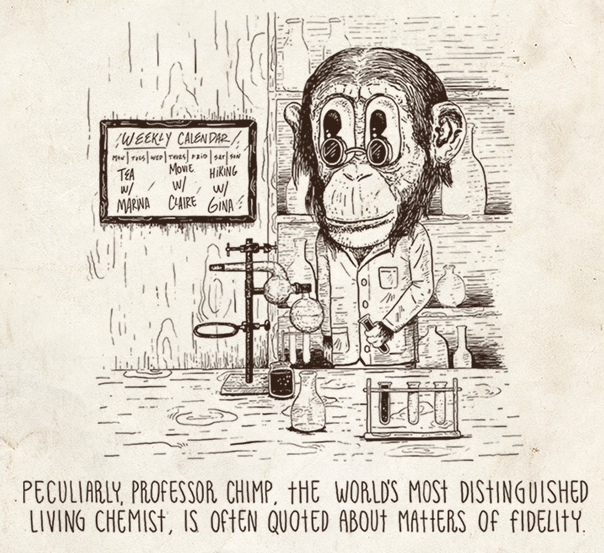
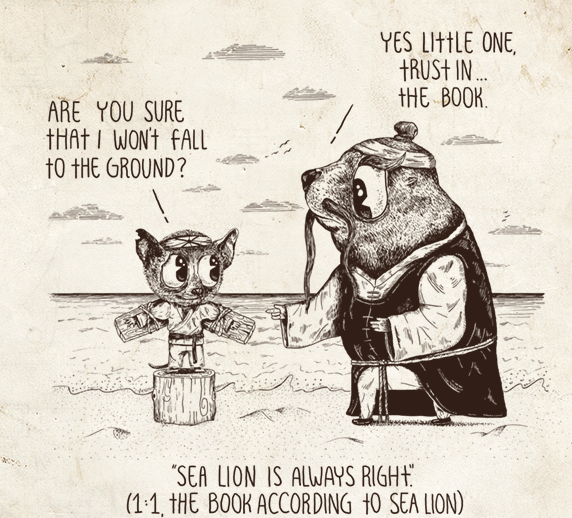
Almossawi’s strategy to mitigate bad, or wasted, thinking comes in the form of an inoculation. He quotes Stephen King, who “describes his experience of reading a particularly terrible novel as, ‘the literary equivalent of a smallpox vaccination.’” Rather than a Ciceronian treatise on what makes a good argument, Almossawi presents us with nineteen examples of the bad: informal logical fallacies we may be familiar with—Appeal to Authority (below), Circular Reasoning (further down), Slippery Slope (bottom)—as well as many we may not be.
The twist here is in Alejandro Giraldo’s playful illustrations, and the memorable examples that follow Almossawi’s descriptions. Inspired partly by “allegories such as Orwell’s Animal Farm and partly by the humorous nonsense of works such as Lewis Carroll’s stories and poems,” the drawings are also highly reminiscent, if not very much inspired by, the baroque cartoons of Tony Millionaire. The art is rich and full of surprises; the sample arguments silly but effective at making the point.
The next time you find yourself melting down over a disagreement, it will likely help to take a time out and refresh yourself with this useful primer. If nothing else, it will give you some insight into the shortcomings of your own arguments, and maybe some measure of when to drop the subject altogether. As Richard Feynman—quoted in an epilogue to the book—once remarked, “The first principle is that you must not fool yourself and you are the easiest person to fool.” Find the book online here, or purchase a copy here.
Wonderful, presumably. You’re wealthy, well respected, and highly sought. Your random real world cameos bring joy to scores of unsuspecting mortals.
He doesn’t care about what just happened. He doesn’t think about what’s going to happen. He doesn’t even book round-trip tickets. Bill buys one-ways and then decides when he wants to go home.
A stunningly good use of wealth and power. If he were anyone but the inimitable Bill Murray, I bet we’d be seething with envious class rage.
He devises the rules by which he plays, from the way he rubs shoulders with the common man to the toll free number that serves as his agent to indulging in creative acts of rebellion that could get a younger, less nuanced star labelled bratty, if not mentally ill, and desperately in need of rehab.
I’ve retired a couple of times. It’s great, because you can just say, “Oh, I’m sorry. I’m retired.” And people will actually believe that you’ve retired. There are nutters out there that will go, “Oh, okay!” and then leave you alone.
…someone told me some secrets early on about living, and that you just have to remind yourself … you can do the very best you can when you’re very very relaxed. No matter what it is, whatever your job is, the more relaxed you are the better you are. That’s sort of why I got into acting. I realized the more fun I had the better I did it and I thought, that’s a job I can be proud of. If I had to go to work and no matter what my condition, no matter what my mood is, no matter how I feel … if I can relax myself and enjoy what I’m doing and have fun with it, I can do my job really well. It has changed my life, learning that.
When the question was put to him at the 2014 Toronto International Film Festival, Murray led a guided meditation, below, to help the audience get a feel for what it feels like to be as relaxed and in the moment as Bill Murray. Putting all joking to the side, he shares his formula as sincerely as Mr. Rogers addressing his young television audience. Don’t forget that this is a man who read the poetry of Emily Dickinson to a roomful of rapt construction workers with a straight and confident face. Complete text is below.
Let’s all ask ourselves that question right now: What does it feel like to be you? What does it feel like to be you? Yeah. It feels good to be you, doesn’t it? It feels good, because there’s one thing that you are — you’re the only one that’s you, right?
So you’re the only one that’s you, and we get confused sometimes — or I do, I think everyone does — you try to compete. You think, damn it, someone else is trying to be me. Someone else is trying to be me. But I don’t have to armor myself against those people; I don’t have to armor myself against that idea if I can really just relax and feel content in this way and this regard.
If I can just feel… Just think now: How much do you weigh? This is a thing I like to do with myself when I get lost and I get feeling funny. How much do you weigh? Think about how much each person here weighs and try to feel that weight in your seat right now, in your bottom right now. Parts in your feet and parts in your bum. Just try to feel your own weight, in your own seat, in your own feet. Okay? So if you can feel that weight in your body, if you can come back into the most personal identification, a very personal identification, which is: I am. This is me now. Here I am, right now. This is me now. Then you don’t feel like you have to leave, and be over there, or look over there. You don’t feel like you have to rush off and be somewhere. There’s just a wonderful sense of well-being that begins to circulate up and down, from your top to your bottom. Up and down from your top to your spine. And you feel something that makes you almost want to smile, that makes you want to feel good, that makes you want to feel like you could embrace yourself.
So, what’s it like to be me? You can ask yourself, “What’s it like to be me?” You know, the only way we’ll ever know what it’s like to be you is if you work your best at being you as often as you can, and keep reminding yourself: That’s where home is.
Marshall McLuhan and Tom Wolfe: both writers, both astute observers of modern humanity, and both public figures whose work has, over the years, enjoyed high fashionability and endured high unfashionability. You might think the connection between them ends there. But when the 100th anniversary of McLuhan’s birth and the centennial-celebrating site Marshall McLuhan Speaks came about, whose eloquent introduction to the thinker (who famously declared the world a “global village” where “the medium is the message”) got used there? Why, the man in white’s.
In the 20-minute video above, Wolfe lays out not just a précis of the insights that made McLuhan “the first seer of cyberspace,” but gets into his biography as well: his humbly respectable origins in Edmonton, his background as a literary scholar, his conversion to Catholicism, the beginnings of his teaching career in Cambridge and Wisconsin, his “extracurricular gatherings devoted to the folklore of industrial man,” his struggle to reconcile his interest in the writings of philosopher-paleontologist Pierre Teilhard de Chardin with his own religious convictions, and the considerable fame he accrued making pronouncements on the media in the media.
“No doubt the internet would have delighted him,” says Wolfe. “He would have seen it as a fulfillment of prophecies he had made thirty years before it was born, as an instrument for the realization of his dream of the mystical unity of all mankind. [Watch him predict the world would be knitted into a global village by digital technology in some vintage video.] Here, in a specific, physical, electronic form, was the seamless web of which he had so often spoken. Today thousands of young internet apostles are familiar with Marshall McLuhan, and are convinced his light shines round about them. From the editors of Wired magazine to the most miserable dot-com lizards of the chat room, they have made him their patron saint.”
To get an even deeper sense of how much Wolfe has thought about McLuhan, have a look at his first annual Marshall McLuhan Lecture, delivered at Fordham University in 1999. And unlike many intellectuals who only turned back to re-examine McLuhan after the age of the internet had retroactively validated even some of his wildest-sounding speculations, Wolfe has been tuned in to McLuhan’s frequency since way back. In 1970, the two even got together for a televised chat in McLuhan’s back yard (a clip of which you can watch just above), which revealed that, for all the fascination Wolfe had with McLuhan, the interest was mutual.
The history of moral philosophy in the West hinges principally on a handful of questions: Is there a God of some sort? An afterlife? Free will? And, perhaps most pressingly for humanists, what exactly is the nature of our obligations to others? The latter question has long occupied philosophers like Immanuel Kant, whose extreme formulation—the “categorical imperative”—flatly rules out making ethical decisions dependent upon particular situations. Kant’s famous example, one that generally gets repeated with a nod to Godwin, involves an axe murderer showing up at your door and asking for the whereabouts of a visiting friend. In Kant’s estimation, telling a lie in this case justifies telling a lie at any time, for any reason. Therefore, it is unethical.
In the video at the top of the post, Harry Shearer narrates a script about Kant’s maxim written by philosopher Nigel Warburton, with whimsical illustrations provided by Cognitive. Part of the BBC and Open University’s “A History of Ideas” series, the video—one of four dealing with moral philosophy—also explains how Kant’s approach to ethics differs from those of utilitarianism.
In the video above, Shearer describes that most utilitarian of thought experiments, the “Trolley Problem.” As described by philosopher Philippa Foot, this scenario imagines having to sacrifice the life of one for those of many. But there is a twist—the second version, which involves the added crime of physically murdering one person, up close and personal, to save several. An analogous but converse theory is that of Princeton philosopher Peter Singer (below) who proposes that our obligations to people in peril right in front of us equal our obligations to those on the other side of the world.
Finally, the last video surveys one of the thorniest issues in moral philosophical history—the “is/ought” divide, as problematic as the ancient Euthyphro dilemma. How, asked David Hume, are we to deduce moral principles from facts about the world that have no moral dimension? Particularly when those facts are never conclusive, are subject to revision, and when new ones get uncovered all the time? The question introduces a seemingly unbridgeable chasm between facts and values. Moral judgments founded on what is or isn’t “natural” flounder before our terror of much of what nature does, and the very partial and fallible nature of our knowledge of it.
The problem is as startling as Hume’s critique of causality, and in part caused Kant to remark that Hume had awakened him from a “dogmatic slumber.” What may strike viewers of the series is just how abstract these questions and examples are—how divorced from the messiness of real world politics, with the exception, perhaps, of Peter Singer. It may be instructive that political philosophy forms a separate branch in the West. While these problems are certainly difficult enough to trouble the sleep of just about any thoughtful person, in our day-to-day lives, our decision making process seems to be much messier, and much more situational, than we’re probably ever aware of.
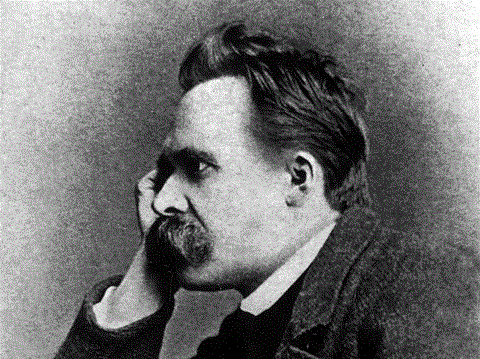
Whether they submit to his mighty philosophical influence, resist it with all their own might, or fall somewhere in between, everyone who’s read the pronouncements of Friedrich Nietzsche (find his ebooks here) recognizes his voice — well, his textual voice, that is. Having died in 1900 after spending the last decade of his life in a mental breakdown, the author of Thus Spake Zarathustra and Beyond Good and Evilhas an excuse for not leaving behind much in the way of audio material. But love Nietzsche or hate him, a reader has to wonder: what did the guy actually sound like?
Here to satiate our curiosity come Flavia Montaggio, Patricia Montaggio, and Imp Kerr, authors of the Investigative Genetics paper “DNA-based prediction of Nietzsche’s voice,” which supposedly offers a scientific means of doing just that. “We collected trace amounts of cellular material (Touch DNA) from books that belonged to the philosopher Friedrich Nietzsche,” reads the abstract, which goes on to describe the gathering of Nietzsche-related data eventually “converted into bio-measures that were used to 3D-print a vocal tract and larynx through which phonation was organically generated.” The result, after running everything through a series of text-to-speech simulations: “the first attempt at simulating the voice of a deceased person”:
It all seems legit, right? Or maybe you German-speakers out there will suspect something fishy, starting with the unlikely name of Imp Kerr. It actually belongs to “a Swedish-French artist living in New York City, mostly known for her fake American Apparel advertisement campaign,” or so reads the Wikipedia page quoted by a Language Log post on the project. “I have no idea whether anything in the Wikipedia article about Imp Kerr is true,” writes author Mark Liberman, “but it’s clear from internal evidence that the alleged Investigative Genetics article is a piece of performance art.”
Liberman breaks down the paper’s humorous elements, from its “many segments that display quasi-scientific terminology in meaningless or contradictory ways” to its simple inability to “restrain a certain telltale playfulness” (as when it deals with a resonance “lower than expected in regards of Nietzsche’s robust mandibles”). All this may remind you of the famous hoax wherein physicist Alan Sokal published a paperful of sheer nonsense in a respected cultural-studies journal. Or you may think of the film above, which purports, questionably, to show Nietzsche’s last days. It just goes to show that, if your ideas live on, you live on — or your readers will try to make you do so.
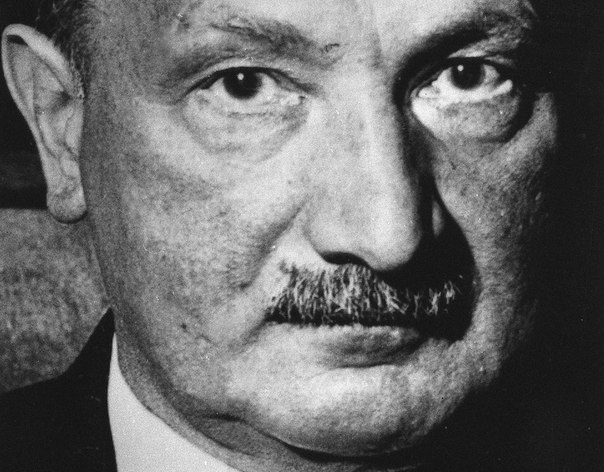
German philosopher Martin Heidegger, widely considered one of the most influential philosophers of the 20th century, was a Nazi, a fact known to most anyone with more than a passing knowledge of the subject. In a New York Review of Books essay, Harvard intellectual historian Peter E. Gordon points out that “the philosopher’s complicity with the Nazis first became a topic of controversy in the pages of Les Temps modernes shortly after the war.” The issue arose again when a former student of Heidegger published “a vigorous denunciation” in 1987. In these cases, and others—like his protégé and onetime lover Hannah Arendt’s defense of her former teacher—the scandal tends to “always end with the same unsurprising discovery that Heidegger was a Nazi.”
What stirs up controversy isn’t Heidegger’s membership in the party, but his motivations. Was he simply a shrewd, if craven, careerist, or a genuinely hateful anti-Semite, or a little from each column? Whatever the explanation, Heideggerians have been able to wall off the philosophy from supposed moral or political lapses in judgment. Arendt did so by claiming that Heidegger, and all of philosophy, was politically naïve. Recalls Adam Kirsch in the Times:
The seal was set on his absolution by Hannah Arendt, in a birthday address broadcast on West German radio. Heidegger’s Nazism, she explained, was an “escapade,” a mistake, which happened only because the thinker naïvely “succumbed to the temptation … to ‘intervene’ in the world of human affairs.” The moral to be drawn from the Heidegger case was that “the thinking ‘I’ is entirely different from the self of consciousness,” so that Heidegger’s thought cannot be contaminated by the actions of the mere man.
The publication of Heidegger’s so-called “black notebooks,” journals that he kept assiduously from 1931–1941, may change all that. They show Heidegger formulating a philosophy of anti-Semitism—using the central categories of his thought—one that operates, as Michel Foucault might say, along “the rules of exclusion.”
In published excerpts of a translation by Richard Polt, an executive member of the Heidegger Circle, Critical Theory shows how much Heidegger turned his own conceptual apparatus against Jews. At one point, he writes:
One of the most secret forms of the gigantic, and perhaps the oldest, is the tenacious skillfulness in calculating, hustling, and intermingling through which the worldlessness of Jewry is grounded.
In this short passage alone, Heidegger invokes lazy stereotypes of Jews as “calculating” and “hustling.” He also, more importantly, describes the Jewish people as “worldless.” As Critical Theory writes, “Being-in-the-world (In-der-Welt-sein) is the basic activity of human existing. To say that the Jews are ‘worldless’… is more than a confused stereotype.” It is Heidegger’s way of casting Jews out of Dasein, his most important category, a word that means something like “being-there” or “presence.” Jews, he writes, are “historyless” and “are not being, but merely ‘calculate with being.’”
Moreover, Heidegger took up the Nazi characterization of Jews as corrupt underminers of society. As representatives of modernity, and its technocratic domination of humanity, the Jews threatened “being” in another way:
What is happening now is the end of the history of the great inception of Occidental humanity, in which inception humanity was called to the guardianship of be-ing, only to transform this calling right away into the pretension to re-present beings in their machinational unessence…
The except goes on at length in this vein, with Jewish “technological machinery” posing a threat to civilization. Perhaps most shockingly, Heidegger attributed Nazi concentration camps to “self-destruction,” completely absolving by omission, and minimizing and excusing, the crimes of his party. An article in Italian newspaper Corriere Della Sera documents Heidegger’s defense of Nazism and his claim in 1942 that “the community of Jews” is “the principle of destruction” and that the camps were only a logical outcome of this principle, the “supreme fulfillment of technology,” “corpse factories.” The real victims, of course, are the Germans, and the Allies are guilty of ”repressing our will for the world.”
Heidegger intended the “black notebooks,” so damning that several scholars of Heidegger fought their publication, to be released after all of his work was published. As with all of the philosopher’s difficult work, the notebooks are often obscure; it is not always clear what he means to say. But major Heidegger scholars have responded in a variety of ways—including resigning a chairship of the Martin Heidegger Society—that suggest the worst. According to Daily Nous, a website about the philosophy profession, when Günter Figal resigned his position in January as chair of the Martin Heidegger Society, he said:
As chairman of a society, which is named after a person, one is in certain way a representative of that person. After reading the Schwarze Hefte [Black Notebooks], especially the antisemitic passages, I do not wish to be such a representative any longer. These statements have not only shocked me, but have turned me around to such an extent that it has become difficult to be a co-representative of this.
Whether or not this new evidence will cause more of his adherents to renounce his work remains to be seen, but the notebooks, writes Peter Gordon, will surely “cast a dark shadow over Heidegger’s legacy.” A very dark shadow.
We're hoping to rely on loyal readers, rather than erratic ads. Please click the Donate button and support Open Culture. You can use Paypal, Venmo, Patreon, even Crypto! We thank you!
Open Culture scours the web for the best educational media. We find the free courses and audio books you need, the language lessons & educational videos you want, and plenty of enlightenment in between.