As children’s television has demonstrated since the beginning of the medium, sometimes the best way to make an unfamiliar concept understandable is to articulate it through the mouth — and the body — of a puppet. Most all of us alive today had some experience with that back when we were still getting our ABCs and 123s down. Yet even in adulthood, we continue to find ourselves confronted with ideas we may find difficult to grasp, especially in the domain of philosophy, with no explanation offering-puppets to be found — or at least there weren’t, not before the launch of Theoretical Puppets on Youtube.
Each month, Theoretical Puppets brings on a notable thinker or two, the current lineup of whom includes the likes of Walter Benjamin, Hannah Arendt, Gilles Deleuze, and Michel Foucault, all of them reconstructed out of cloth and wire.
These puppets are recognizable as the individuals who inspired them, and also recognizable as homages to the puppet aesthetic popularized by a certain long-running program on American television — a form of broadcasting, incidentally, that Benjamin never knew. He did, however, have serious thoughts about radio, the mass media of his day, some of which he — or rather, his puppet — articulates in the video just above.
Other episodes of Theoretical Puppets include Foucault on discourse, Deleuze on Power, Arendt on natality (and smoking), and even the late Bruno Latour on actor-network theory. Among the channel’s most-viewed videos are meetings of the minds both historical and fictional: between Deleuze and Foucault, (a re-creation of a 1963 radio interview), between Foucault and Benjamin, between Sigmund Freud and Salvador Dalí (which includes a discussion of the latter’s depiction of the former’s head as a “snail-like structure”). To varying extents, these dialogues are rooted in the words these figures wrote and spoke in their lifetimes; like most puppet-based productions, they also take place in the realm of fantasy. There’s humor in the incongruity, to be sure, but then, it must have demanded no small amount of imagination to produce such enduring bodies of theory in the first place.
Based in Seoul, Colin Marshall writes and broadcasts on cities, language, and culture. His projects include the Substack newsletterBooks on Cities, the book The Stateless City: a Walk through 21st-Century Los Angeles and the video series The City in Cinema. Follow him on Twitter at @colinmarshall or on Facebook.
Nearly two centuries after his death, the eighteenth-century utilitarian philosopher and social reformer Jeremy Bentham — or most of him, anyway — still sits in state in the main building of University College London. For a time in the mid-twenty-tens, he was equipped with the PanoptiCam, “an online camera that streams what Bentham sees while sitting in his cabinet at UCL.” That most everyone gets the joke behind its name speaks to the enduring relevance of one of Bentham’s ideas in particular: the Panopticon, “a prison designed so that a prison guard could look into all cells at any time, and ensure that prisoners modified their behavior for the better.”
In Bentham’s Panopticon, many prisoners could be monitored effectively by just a few unseen guards. This accords, as Michel Foucault writes in 1975’s Discipline and Punish, with the principle that “power should be visible and unverifiable. Visible: the inmate will constantly have before his eyes the tall outline of the central tower from which he is spied upon. Unverifiable: the inmate must never know whether he is being looked at any one moment; but he must be sure that he may always be so.” Foucault drew connections between the Panopticon and the complex, large-scale societies that had developed since Bentham’s day. Imagine if he’d lived to see the rise of social media.
In a series of posts by Philosophy for Change, Tim Rayner takes up just such an exercise. “By making our actions and shares visible to a crowd, social media exposes us to a kind of virtual Panopticon,” he writes. “This is not just because our activities are monitored and recorded by the social media service for the purposes of producing market analysis or generating targeted advertising.” But “the surveillance that directly affects us and impacts on our behavior comes from the people with whom we share.” In the online Panopticon, “we are both guards and prisoners, watching and implicitly judging one another as we share content.” Rayner wrote these words more than a decade ago, but anyone who has experienced life on social media then can hardly deny the parallels with Bentham’s vision.
Far from improving our behavior, however, this constant online surveillance has in a fair few cases made it considerably less appealing. Whatever the nature of its actual effects on those who inhabit it, the Panopticon is an undeniably powerful structure, at least metaphorically speaking. But we should remember that Bentham intended it to be a real, physical structure, one that could contain not just prisons but other types of institutions as well. Whether a Panopticon has ever been wholly built to his specifications seems to be a matter of debate, but we can see what one would look like in the 3D rendering by Myles Zhang at the top of the post: an appropriate medium, after all, in which to perceive an idea most fully realized in the digital realm.
Based in Seoul, Colin Marshall writes and broadcasts on cities, language, and culture. His projects include the Substack newsletterBooks on Cities, the book The Stateless City: a Walk through 21st-Century Los Angeles and the video series The City in Cinema. Follow him on Twitter at @colinmarshall or on Facebook.
Here’s a vintage football [aka soccer] post in celebration of the World Cup…
Albert Camus once said, “After many years in which the world has afforded me many experiences, what I know most surely in the long run about morality and obligations, I owe to football.”
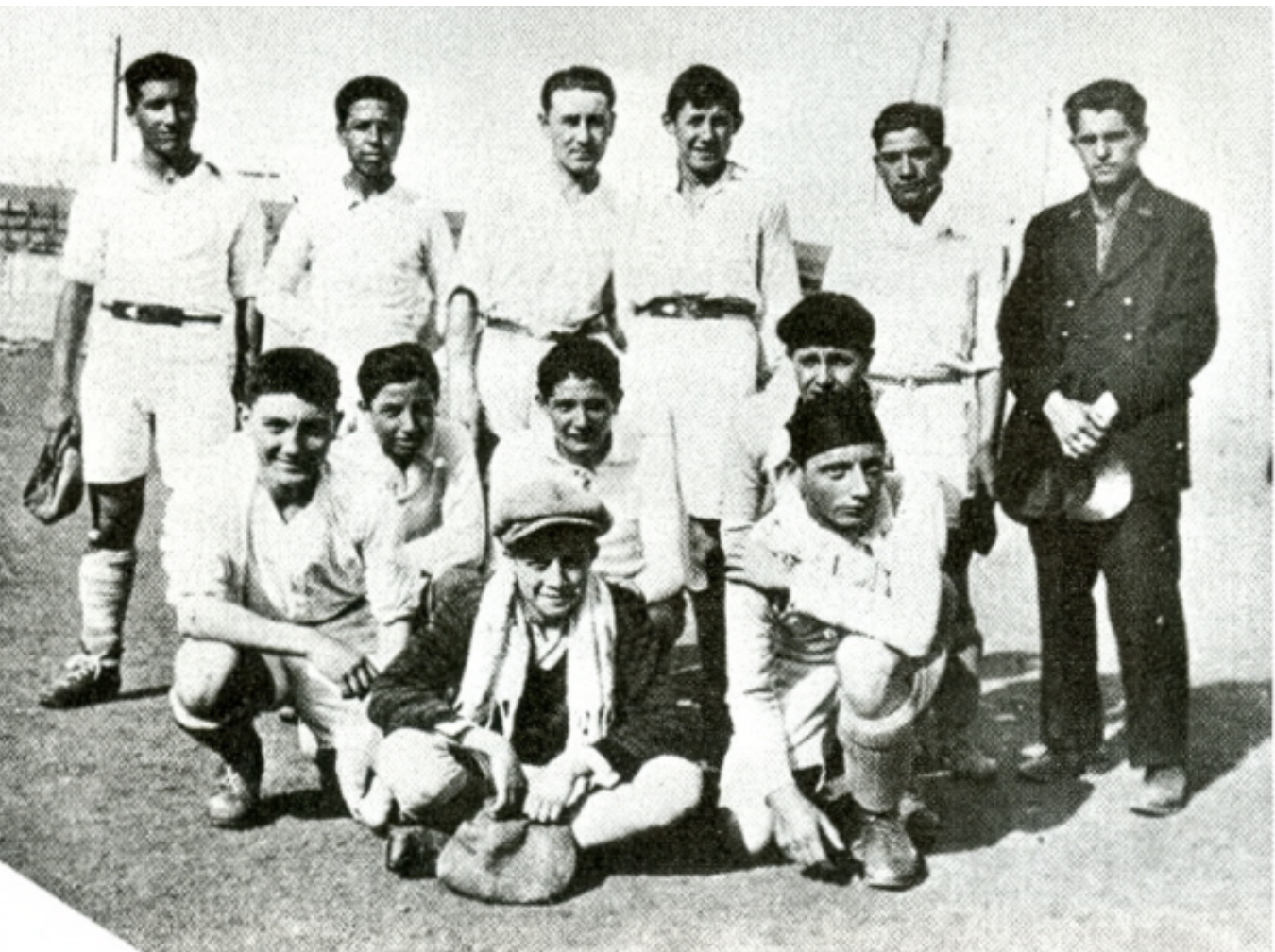
He was referring to his college days when he played goalie for the Racing Universitaire d’Alger (RUA) junior team. Camus was a decent player, though not the great player that legend later made him out to be.
[T]here is something appropriate about a philosopher like Camus stationing himself between the sticks [that is, in goal]. It is a lonely calling, an individual isolated within a team ethic, one who plays to different constraints. If his team scores, the keeper knows it is nothing to do with him. If the opposition score, however, it is all his fault. Standing sentinel in goal, Camus had plenty of time to reflect on the absurdist nature of his position.
And perhaps the absurdist nature of life itself…
Camus — who appears in the picture up top, wearing the dark color jersey in the front row — contracted tuberculosis when he was only 18 years old. His lungs too damaged to continue playing sports, the young man turned to philosophy. When Camus moved from Algeria to France, he learned that philosophy was a rough and tumble game too — something his soccer days prepared him for. He once quipped, “I learned … that a ball never arrives from the direction you expected it. That helped me in later life, especially in mainland France, where nobody plays straight.”
If you would like to support the mission of Open Culture, consider making a donation to our site. It’s hard to rely 100% on ads, and your contributions will help us continue providing the best free cultural and educational materials to learners everywhere. You can contribute through PayPal, Patreon, and Venmo (@openculture). Thanks!
During his final decade, Friedrich Nietzsche’s worsening constitution continued to plague the philosopher. In addition to having suffered from incapacitating indigestion, insomnia, and migraines for much of his life, the 1880s brought about a dramatic deterioration in Nietzsche’s eyesight, with a doctor noting that his “right eye could only perceive mistaken and distorted images.”
Nietzsche himself declared that writing and reading for more than twenty minutes had grown excessively painful. With his intellectual output reaching its peak during this period, the philosopher required a device that would let him write while making minimal demands on his vision.
So he sought to buy a typewriter in 1881. Although he was aware of Remington typewriters, the ailing philosopher looked for a model that would be fairly portable, allowing him to travel, when necessary, to more salubrious climates. The Malling-Hansen Writing Ball seemed to fit the bill:
In Dieter Eberwein’s free Nietzches Screibkugel e‑book, the vice president of the Malling-Hansen Society explains that the writing ball was the closest thing to a 19th century laptop. The first commercially-produced typewriter, the writing ball was the 1865 creation of Danish inventor Rasmus Malling-Hansen, and was shown at the 1878 Paris Universal Exhibition to journalistic acclaim:
“In the year 1875, a quick writing apparatus, designed by Mr. L. Sholes in America, and manufactured by Mr. Remington, was introduced in London. This machine was superior to the Malling-Hansen writing apparatus; but the writing ball in its present form far excels the Remington machine. It secures greater rapidity, and its writing is clearer and more precise than that of the American instrument. The Danish apparatus has more keys, is much less complicated, built with greater precision, more solid, and much smaller and lighter than the Remington, and moreover, is cheaper.”
Despite his initial excitement, Nietzsche quickly grew tired of the intricate contraption. According to Eberwein, the philosopher struggled with the device after it was damaged during a trip to Genoa; an inept mechanic trying to make the necessary repairs may have broken the writing ball even further. Still, Nietzsche typed some 60 manuscripts on his writing ball, including what may be the most poignant poetic treatment of typewriters to date:
“THE WRITING BALL IS A THING LIKE ME:
MADE OF IRON YET EASILY TWISTED ON JOURNEYS.
PATIENCE AND TACT ARE REQUIRED IN ABUNDANCE
AS WELL AS FINE FINGERS TO USE US.”
In addition to viewing several of Nietzsche’s original typescripts at the Malling-Hansen Society website, those wanting a closer look at Nietzsche’s model can view it in the video below.
Note: This post originally appeared on our site in December 2013.
Ilia Blinderman is a Montreal-based culture and science writer. Follow him at @iliablinderman.
As of late 2022, it’s cheap and easy to produce AI-generated content that is superficially good and surprisingly similar to “the real thing”. This applies to videos resembling celebrities (commonly known as Deepfakes) or, as in the case of the Infinite Conversation, speech.
This project aims to raise awareness about the ease of using tools for synthesizing a real voice. Right now, any motivated fool can do this with a laptop in their bedroom. This changes our relationship with the media we consume online and raises questions about the importance of authoritative sources, breach of trust and gullibility.
Will this technology lead to a massive proliferation of sub-optimal-quality content? Should we simply distrust anything we see online? As new tools are developed to help identify generated content, I recommend maintaining a skeptical stance, particularly when the source/channel of information doesn’t seem reliable and when the claims seem preposterous or outrageous.
Ultimately, I don’t see this as a technical problem, but as a human one. We all share a duty to educate the coming generations about the new paradigm while focusing on forming compassionate individuals who would not misuse these awesome powers.
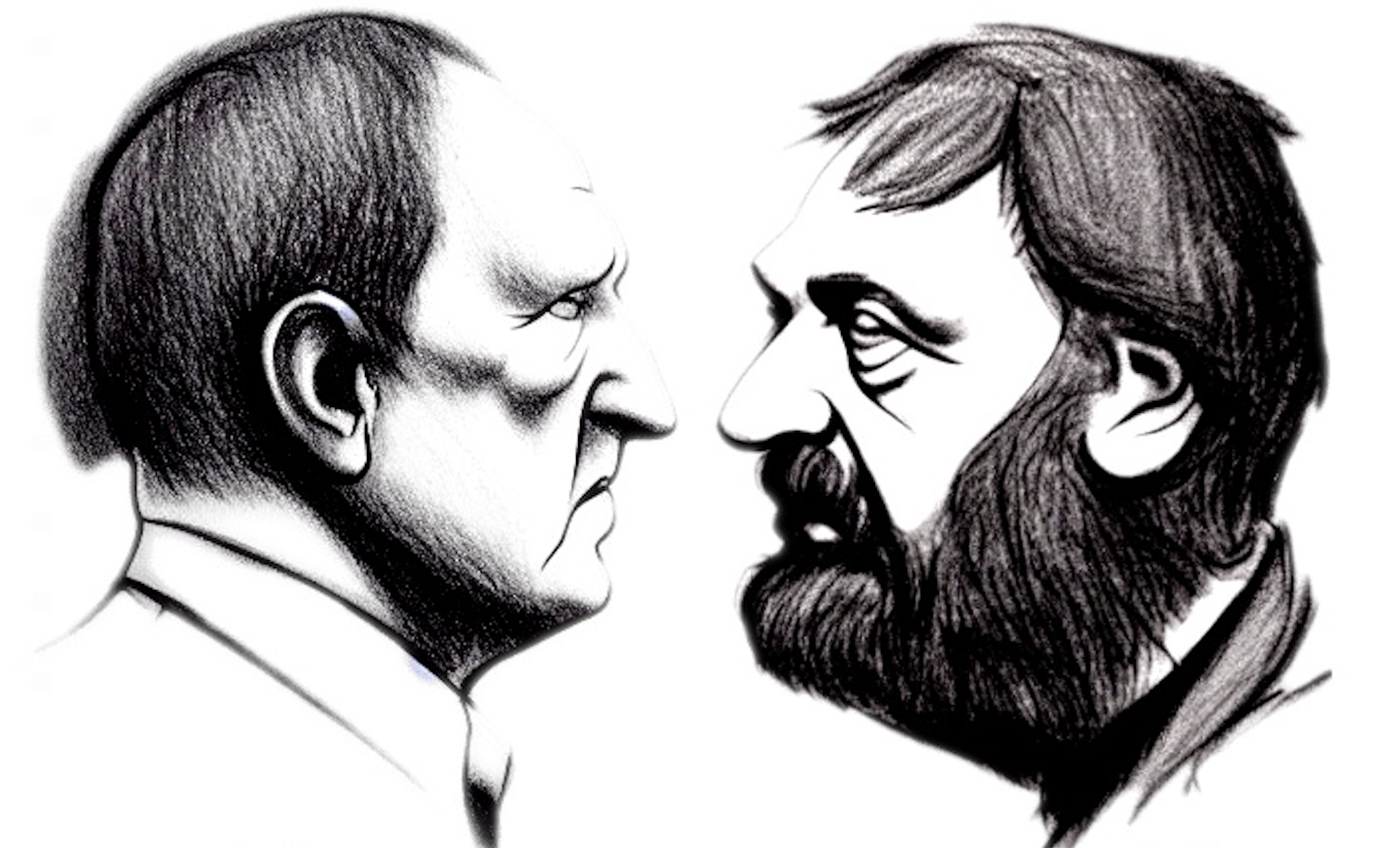
As an AI optimist, I remain hopeful that we will be able to regulate ourselves, and that we will take experiments such as the Infinite Conversation for what they are: a playful way to help us imagine what our favorite people would do, if we had unlimited access to their minds. Art and Philosophy, here exemplified by Bavarian director Werner Herzog and Slovenian philosopher Slavoj Žižek, can guide us while navigating these treacherous waters.
If you would like to support the mission of Open Culture, consider making a donation to our site. It’s hard to rely 100% on ads, and your contributions will help us continue providing the best free cultural and educational materials to learners everywhere. You can contribute through PayPal, Patreon, and Venmo (@openculture). Thanks!
Søren Kierkegaard died in 1855, but if he’d glimpsed our modern-day landscape of dating apps, he probably would’ve understood it. “People who otherwise pride themselves on their lack of prejudice will apply terrifyingly strict criteria to their choice of partner,” says Alain de Botton in the animated School of Life video above. “They want someone with just a certain sort of face or income or sense of humor. They think of themselves as kind and tolerant, but when it comes to love, they have all the broad-mindedness of a believer in ‘a caste system whereby men are inhumanly separated through the distinctions of earthly life.’ ”
Kierkegaard noticed these human tendencies even in his day, and to his mind, they had nothing at all to do with love — true Christian love, that is, which he spent a good bit of his philosophical career trying to elucidate. He insisted, de Botton explains, “that most of us have no idea what love is, even though we refer to the term incessantly.”
Whether in Europe of the nineteenth century or most anywhere in the world today, we believe in romantic love, which involves “the veneration and worship of one very special person with whose soul and body we hope to unite our own.” But this, Kierkegaard argued, results in “a narrow and impoverished sense of love should actually be.”
The version of Christian love for which Kierkegaard advocated “commands us to love everyone, starting, most arduously, with all those who we by instinct consider to be unworthy of love.” In this conception, those we believe are “mistaken, ugly, irritating, venal, wrong-headed, or ridiculous” are exactly the people to whom we should “extend our compassion,” identifying and understanding the difficulties that made them what they are and offering our kindness and forgiveness accordingly. The ultimate goal, according to Kierkegaard, is to “love everyone without exception,” which may well sound like an unreasonable demand. But how much less reasonable is it than the checklists with which so many of us screen our potential matches?
To delve deeper, read Kierkegaard’s book, Works of Love.
Based in Seoul, Colin Marshall writes and broadcasts on cities, language, and culture. His projects include the Substack newsletterBooks on Cities, the book The Stateless City: a Walk through 21st-Century Los Angeles and the video series The City in Cinema. Follow him on Twitter at @colinmarshall or on Facebook.
France has long been known for the cultural prominence it grants to its philosophers. Even so, such prominence doesn’t simply come to every French philosopher, and some have had to work tirelessly indeed to achieve it. Take Simone de Beauvoir, who most powerfully announced her arrival on the intellectual scene with Le Deuxième Sexe and its famous declaration, “On ne naît pas femme, on le devient.” Those words remain well known today, 36 years after their author’s death, and their implications about the nature of womanhood still form the intellectual basis for many observers of the feminine condition, in France and elsewhere.
Le Deuxième Sexe was first published in English in 1953, as The Second Sex. By that point de Beauvoir had already traveled extensively in the United States (and even written a book, America Day by Day, about the experience), but her readership in that country had only just begun to grow. An avowed feminist, she would through the subsequent decades become a more and more oft-referenced figure among American writers and readers who sought to apply that label to themselves as well.
One such feminist was the psychologist Dorothy Tennov, who’s best remembered for coining the term limerence. A few years before she did that, she traveled to France to conduct an interview with de Beauvoir — and indeed “in her Paris apartment, provided the TV crew was all-female.”
Aired on public television station WNED in 1976, this wide-ranging conversation has Beauvoir laying out her views on a host of subjects, from abortion to homosexuality to feminism itself. “What do you think women feel most about feminism?” Tennov asks. “They are jealous of the women who are not just the kind of servant and the slaves and objects — they are themselves,” de Beauvoir says. “They fear to feel an infériorité in regard with the women who work outside, and who do as they want and who are free. And maybe they are afraid of the freedom which is made possible for them, because freedom is something very precious, but in a way a little fearful, because you don’t know exactly what to do with it.” Here we see one reason de Beauvoir’s work has endured: she understood that man’s fear of freedom is also woman’s.
Based in Seoul, Colin Marshall writes and broadcasts on cities, language, and culture. His projects include the Substack newsletterBooks on Cities, the book The Stateless City: a Walk through 21st-Century Los Angeles and the video series The City in Cinema. Follow him on Twitter at @colinmarshall or on Facebook.
Every revolutionary age produces its own kind of nostalgia. Faced with the enormous social and economic upheavals at the nineteenth century’s end, learned Victorians like Walter Pater, John Ruskin, and Matthew Arnold looked to High Church models and played the bishops of Western culture, with a monkish devotion to preserving and transmitting old texts and traditions and turning back to simpler ways of life. It was in 1909, the nadir of this milieu, before the advent of modernism and world war, that The Harvard Classics took shape. Compiled by Harvard’s president Charles W. Eliot and called at first Dr. Eliot’s Five Foot Shelf, the compendium of literature, philosophy, and the sciences, writes Adam Kirsch in Harvard Magazine, served as a “monument from a more humane and confident time” (or so its upper classes believed), and a “time capsule…. In 50 volumes.”
What does the massive collection preserve? For one thing, writes Kirsch, it’s “a record of what President Eliot’s America, and his Harvard, thought best in their own heritage.” Eliot’s intentions for his work differed somewhat from those of his English peers. Rather than simply curating for posterity “the best that has been thought and said” (in the words of Matthew Arnold), Eliot meant his anthology as a “portable university”—a pragmatic set of tools, to be sure, and also, of course, a product. He suggested that the full set of texts might be divided into a set of six courses on such conservative themes as “The History of Civilization” and “Religion and Philosophy,” and yet, writes Kirsch, “in a more profound sense, the lesson taught by the Harvard Classics is ‘Progress.’” “Eliot’s [1910] introduction expresses complete faith in the ‘intermittent and irregular progress from barbarism to civilization.’”
In its expert synergy of moral uplift and marketing, The Harvard Classics (find links to download them as free ebooks below) belong as much to Mark Twain’s bourgeois gilded age as to the pseudo-aristocratic age of Victoria—two sides of the same ocean, one might say.
The idea for the collection didn’t initially come from Eliot, but from two editors at the publisher P.F. Collier, who intended “a commercial enterprise from the beginning” after reading a speech Eliot gave to a group of workers in which he “declared that a five-foot shelf of books could provide”
a good substitute for a liberal education in youth to anyone who would read them with devotion, even if he could spare but fifteen minutes a day for reading.
Collier asked Eliot to “pick the titles” and they would publish them as a series. The books appealed to the upwardly mobile and those hungry for knowledge and an education denied them, but the cost would still have been prohibitive to many. Over a hundred years, and several cultural-evolutionary steps later, and anyone with an internet connection can read all of the 51-volume set online. In a previous post, we summarized the number of ways to get your hands on Charles W. Eliot’s anthology:
In addition to these options, Bartleby has digital texts of the entire collection of what they call “the most comprehensive and well-researched anthology of all time.” But wait, there’s more! Much more, in fact, since Eliot and his assistant William A. Neilson compiled an additional twenty volumes called the “Shelf of Fiction.” Read those twenty volumes—at fifteen minutes a day—starting with Henry Fielding and ending with Norwegian novelist Alexander Kielland atBartleby.
What may strike modern readers of Eliot’s collection are precisely the “blind spots in Victorian notions of culture and progress” that it represents. For example, those three harbingers of doom for Victorian certitude—Marx, Nietzsche, and Freud—are nowhere to be seen. Omissions like this are quite telling, but, as Kirsch writes, we might not look at Eliot’s achievement as a relic of a naively optimistic age, but rather as “an inspiring testimony to his faith in the possibility of democratic education without the loss of high standards.” This was, and still remains, a noble ideal, if one that—like the utopian dreams of the Victorians—can sometimes seem frustratingly unattainable (or culturally imperialist). But the widespread availability of free online humanities certainly brings us closer than Eliot’s time could ever come.
If you would like to support the mission of Open Culture, consider making a donation to our site. It’s hard to rely 100% on ads, and your contributions will help us continue providing the best free cultural and educational materials to learners everywhere. You can contribute through PayPal, Patreon, and Venmo (@openculture). Thanks!
We're hoping to rely on loyal readers, rather than erratic ads. Please click the Donate button and support Open Culture. You can use Paypal, Venmo, Patreon, even Crypto! We thank you!
Open Culture scours the web for the best educational media. We find the free courses and audio books you need, the language lessons & educational videos you want, and plenty of enlightenment in between.