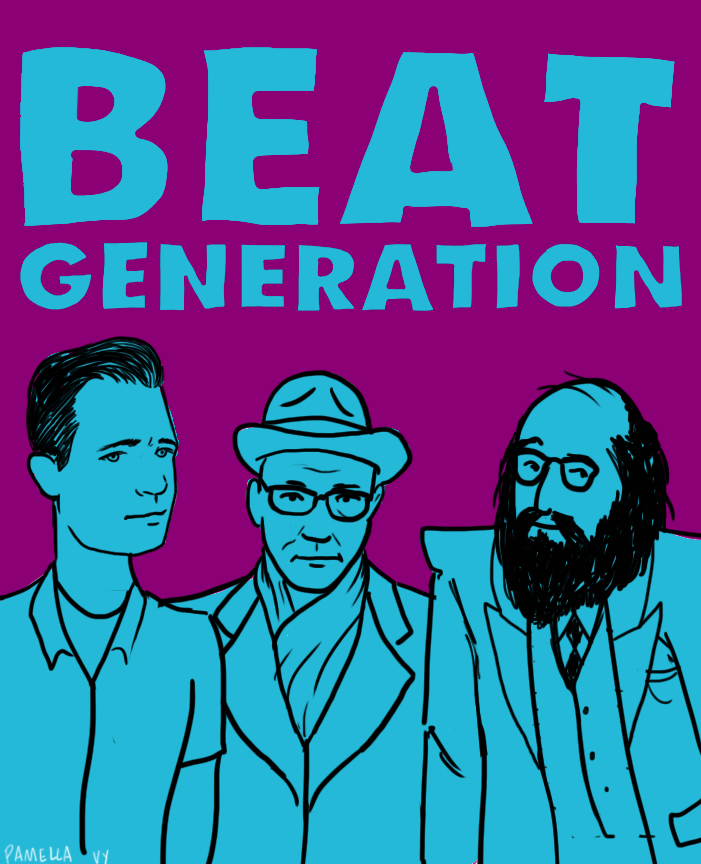
Plenty of us get tuned in to the Beats through print — maybe a yellowed copy of Howl, a mass-market Naked Lunch, a fifth- or sixth-handOn the Road — but sometimes the verse or prose that so thrills us on those pages fairly demands to be spoken aloud, preferably by the Beat in question. That may have proven a tricky desire to fulfill in decades past, but now Spotify has made it nearly effortless to hear the Beats whenever we like: you can find over eighteen hours of material on a playlist called, straightforwardly enough, The Beats.
These 249 tracks include not just figures like the previously alluded to Allen Ginsberg, William S. Burroughs, and Jack Kerouac, but other beloved Beats such as Gregory Corso, Peter Orlovsky — and Charles Bukowski, not a figure one necessarily associates closely with that movement. Some Bukowski and/or Beat enthusiasts will tell you that each would have nothing to do with the other. Yet the hard-living poet and self-confessed “dirty old man” occasionally admitted to something approaching fondness for certain members of the supposedly higher-minded counterculture: “He’s better to have around than not to have around,” Bukowski once said of Ginsberg. “Without his coming through, none of us would be writing as well as we are doing now, which is not well enough, but we hang on.”
With the Beats’ Spotify playlist, you can judge for yourself not only whether they and Bukowski wrote “well enough” (though literary history seems to have proven that piece of self-deprecation wrong), but also whether they spoke well enough — or rather, whether they performed their own work in the way you’d always imagined it in your head. Whatever your assessment, rest assured you won’t hear voices like Ginsberg’s, Burroughs’ and especially Bukowski’s anywhere else. If you don’t have the Spotify software itself yet, no problem: you can download it free here.
Every period of literary history has its share of bawdy, satirical poetry, from Mesopotamia, to Rome, to the age of Jonathan Swift. Every period, it often seems, but one: The late Victorian era in England and America often appears to us like a dry, humorless time for English poetry. Two of the most renowned poets, Alfred Tennyson and Henry Wadsworth Longfellow are, fairly or unfairly, viewed as wordy, sentimental, and didactic. At the dawn of the new century, tough-minded modernists like William Carlos Williams, Ezra Pound, and T.S. Eliot remedied these failings, the story goes. And yet, despite their symbolist influences, these would-be radicals can seem themselves pretty conservative, turning Tennyson and Wadsworth’s affirmations of an ordered world into maudlin, and reactionary, laments over its loss.
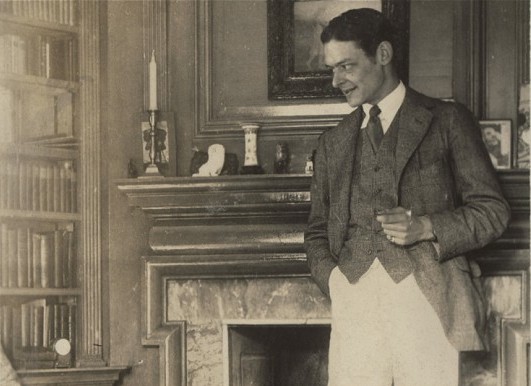
Eliot’s work is especially characteristic of this high church disdain for social change. Eliot, writes Mental Floss, was “stodgy.” Adam Kirsch in Harvard Magazine writes of Eliot’s “almost papal authority in the world of literature” and his “magisterial criticism”—hardly descriptions of a revolutionary. “Looking at the severe, bespectacled face of the elderly poet on the cover of his Complete Poems and Plays,” writes Kirsch, “it is hard to imagine that he was ever young.” But young he was, and while always pedantic in the most fascinating way, Eliot was also once a writer of very bawdy verse.
He was also, unfortunately, a composer of racist verse, a fact which many readers of Eliot will not find overly surprising. Mental Floss quotes from one of those ugly early works, featuring “the racist caricature of a well-endowed ruler named ‘King Bolo.’” But it also quotes from an early poem said to contain the first use of a word that aptly describes the language in that first distasteful poem. According to Language Log, a site maintained by University of Pennsylvania professor Mark Liberman, who source their etymology from the Oxford English Dictionary, the word “bullsh*t” originated with Eliot’s poem “The Triumph of Bullsh*t.”
Wyndham Lewis first mentions the poem, which he calls a bit of “scholarly ribaldry,” in 1915, but it was probably written in 1910. With its first three stanzas addressed to “Ladies,” and all four ending with “For Christ’s sake stick it up your ass,” the poem piles up line after rhyming line of archaic, Latinate words, undercutting their obscurantism with lowbrow crudeness. The third stanza becomes more direct, less laden with clever diction, as Eliot lays out the conflict:
Ladies who think me unduly vociferous Amiable cabotin making a noise That people may cry out “this stuff is too stiff for us” - Ingenuous child with a box of new toys Toy lions carnivorous, cannons fumiferous Engines vaporous — all this will pass; Quite innocent — “he only wants to make shiver us.” For Christ’s sake stick it up your ass.
“The Triumph of Bullsh*t” functions as a bratty riposte to Eliot’s critics. (It was, in fact, originally addressed to “Critics,” then changed to “Ladies” in 1916.) Language Log questions whether Eliot “really invented bullsh*t in 1910,” since he “could hardly have aimed to shock the ‘ladies’ by naming his little poem ‘The Triumph of Bullsh*t’ if the term had not already been a commonplace vulgarity.” Perhaps. But according to Wyndham Lewis and the OED, he was the first to use the word on record. Harvard Magazine’s Kirsch calls these early poems (collected here)—and others such as the profane “Inventions of the March Hare”—the last manifestations of the “American Eliot” before he went off and became the “British Eliot” who would not deign to utter such vulgarities so freely.
The word in question never appears in the poem itself, only the title, and given the speaker’s literary chest-thumping, we might even speculate that “Bullsh*t” is a proper name, or a personification, and his triumph consists of a gleeful middle finger to Victorian decorum. It’s language only slightly more exaggerated than some of Mark Twain’s or Herman Melville’s characterizations, marking Eliot’s kinship with a particularly American sense of humor. The poet, writes Kirsch, later “buried his Americanness deep enough that it takes some digging to recognize it.” In these poems, we see it—juvenile insults, grotesque, sexualized racial caricatures, a crude defiance of tradition—and women’s opinions.… And yes, whether he invented the word or just did us the honor of popularizing it, a snide elevation of what he rightly called “bullsh*t.”
Opportunities to meet one’s heroes can go any number of ways. They can be underwhelming and disappointing, embarrassing and awkward, or—as Tom Waits found out in meeting Keith Richards and Charles Bukowski—completely overwhelming. Both encounters became too much for Waits for the same reason: when you “try to match them drink for drink,” he says in an interview, “you’re a novice, you’re a child. You’re drinking with a roaring pirate.” Waits “wasn’t able to hang in there” with these veteran imbibers—“They’re made out of different stock. They’re like dockworkers.” But of course it wasn’t just their legendary drinking that impressed the sandpaper-voiced L.A. troubadour.
Waits calls both Richards and Bukowski artistic “father figures”—two of many stand-ins for his own absent father—but it’s Bukowski who had the most profound effect on the singer and songwriter. Both Southern California natives, both keen observers of America’s seedier side, as writers they share a number of common themes and obsessions.
When he discovered Bukowski through the poet’s “Notes of a Dirty Old Man” column in the LA Free Press, Waits observed that he “seemed to be a writer of the common people and street people, looking in the dark corners where no one seems to want to go.” Waits has gone there, and always—like his literary hero—returned with a hell of a story. His songwriting voice can channel “Hank,” as Bukowski’s friends knew him, and his speaking voice can too—with sharp glints of dry, sardonic humor and surprising vulnerability, though much more ragged and pitched several octaves lower.
Waits’ artistic kinship with Bukowski makes him better-suited than perhaps anyone else to read the down-and-out, Dostoevsky-loving, alcoholic’s work. At the top of the post, hear him read Bukowski’s “The Laughing Heart,” a poem of weary, almost resigned exhortation to “be on the watch / There are ways out / There is light somewhere,” in the midst of life’s darkness. Below it, Waits reads “Nirvana,” a poem we’ve featured before in several renditions. Here, the poet tells a story—of loneliness, impermanence, and a brief moment of solace. For comparison, hear Bukowski himself, in his high, nasally voice, read “The Secret of My Endurance” above. Waits almost became more than just a Bukowski lover and reader; he was once up for the role of Bukowski’s alter-ego Henry Chinaski in Barbet Schroeder’s 1987 Bukowski adaptation, Barfly. “I was offered a lot of money,” says Waits, “but I just couldn’t do it.” Mickey Rourke could, and did, but as I hear Waits read these poems, I like to imagine the film that would have been had he taken that part.
Everyone’s favorite mystical poet, Jalāl ad-Dīn Muḥammad Rūmī, probably could not have predicted how much global influence his work would have eight centuries after his death. Nor could he have appreciated the irony of his 13th century Islamic Persian verse making him the best-selling poet in the U.S. And yet, a huge part of Rumi’s appeal to the majority of his readers, religious and non‑, comes from his non-traditionalism, his anti-dogmatism, gentle iconoclasm, and romanticism.
Claims that the poet was gay may be contentious, but there’s no getting away from the eroticism, much of it homoeroticism, in much of Rumi’s poetry. Rumi also inspired the hardly orthodox Sufi sect known as “Whirling Dervishes,” who invoke a trance-like state through a rhythmic spinning ritual based on the poet’s own devotional practices.
But Rumi did not begin his career as a mystic, or as a poet. Author Brad Gooch, who is writing a biography of Rumi, describes him as “a traditional Muslim preacher and scholar, as his father and grandfather had been.” That is until age 37, when in 1244, he met a mystic called Shams of Tabriz. “The two of them have this electric friendship for three years—lover and beloved [or] disciple and sheikh, it’s never clear,” says Gooch.
After Shams’ death, possibly by murder, Rumi began writing poetry. “Most of the poetry we have comes from age 37 to 67. He wrote 3,000 [love songs] to Shams, the prophet Muhammad and God. He wrote 2,000 rubayat, four-line quatrains. He wrote in couplets a six-volume spiritual epic, The Masnavi.” These poems, writes the BBC, are “recited, chanted, set to music and used as inspiration for novels, poems, music, films, YouTube videos and tweets.” Today we bring you some of those contemporary appropriations of Rumi’s work.
At the top of the post, hear actress Tilda Swinton—who has her own global cult of admirers—read Rumi’s “Like This.” Swinton recently turned to Rumi’s poetry to promote her line of fragrances. Below Swinton’s reading, celebrity spiritual adventurer (some might say spiritual tourist) Madonna reads Rumi’s “Bitter Sweet” with her guru Deepak Chopra.
It was recorded for the album, A Gift Of Love: Deepak & Friends Present Music Inspired By The Love Poems Of Rumi. And just above, we have two very devoted scholars and interpreters of Rumi’s work, Coleman Barks (who translated the poem Swinton reads) and poet Robert Bly, accompanied by tablas, sitar, and drums. Barks has done much to explain the global reach of Rumi’s poetry, writing in the introduction to The Illuminated Rumi that the poet’s “whole life was a witness to the boundless universality of the Heart…. His vision was a whole-world work and the poetry was part of the soul-unfolding done in a learning community.” When Rumi died, Barks tells us, “he was mourned by Christians and Jews, as well as Muslims and Buddhists.” Below, hear Barks attempt to expound on Rumi’s very non-traditional, non-Western, and difficult-to-translate view of love.
If you would like to support the mission of Open Culture, consider making a donation to our site. It’s hard to rely 100% on ads, and your contributions will help us continue providing the best free cultural and educational materials to learners everywhere. You can contribute through PayPal, Patreon, and Venmo (@openculture). Thanks!
Very few people can offer us a satisfying definition of poetry. Enumerating the technical qualities of literary verse, as English teachers do each day, seems like a paltry explanation of what poetry is and does. Even the poets themselves have struggled mightily to find the contours of their art, only to end in gnomic koans or exasperated sighs. “A poem should not mean / But be,” concludes Archibald MacLeish’s “ Ars Poética,” after telling us a poem should be “dumb,” “silent,” and “wordless.” MacLeish’s contemporary Marianne Moore famously spent five decades revising her attempt, “Poetry.” Finally, she reduced it to three irritable lines in which she confesses her “dislike” and “perfect contempt” for her own art, however “genuine” it may be.
These pinched modernists not only resisted didactic conceptions of poetry put forth by the ancients, but they also turned away from the grandiose rhetoric of the Romantics, who saw poets, in Percy Shelley’s unforgettable phrase, as the “unacknowledged legislators of the world.” Perhaps they were right to do so. Perhaps also, there is another way to approach the subject, a way open to one poet only—Jorge Luis Borges. No one but Borges could make the claims for poetry as he does in his “Arte Poética” in such a moving and persuasive way: Poetry, he tells us, is the knowledge of time, of death, of infinity, and of our very selves. “Humble and immortal,” poetry allows us “To see in every day and year a symbol”
Of all the days of man and his years And convert the outrage of the years Into a music, a sound, and a symbol
To see in death a dream, in the sunset A golden sadness, such is poetry
With reference to the mystical pre-Socratic philosopher Heraclitus in the first and last stanza, Borges makes his case with statements that seem the very opposite of humility, and yet feel utterly right; poetry is immortal, it is “a green eternity,” like Ulysses’ Ithaca, it is “endless like a river flowing.” Or at least we feel it should be. Borges gives us a Platonic ideal of poetry, and it is one he might say, humbly, every poet should aspire to.
At the top of the post, you can hear Borges himself read his poem, in Spanish with English titles, in a video shot in Uruguay and Borges’ native Argentina and featuring a stirring Spanish guitar score augmenting Borges’ solemn voice. Be sure to read the full text of Borges’ poem. As readers often do after finishing one of the Argentine master’s profoundly poetic works, you may find yourself for some time afterwards under a kind of spell, from an incantation that seems, at last, to unlock the secrets of art, of poetry, and of so much more.
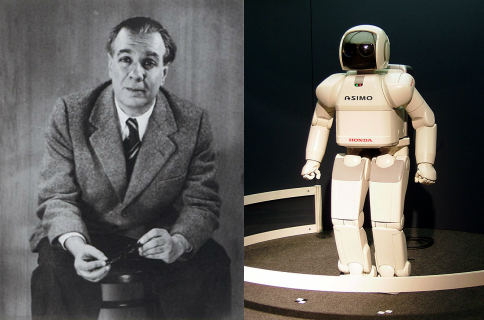
Jorge Luis Borges, as any reader of his stories knows, had a lot of ideas. Some of his ideas must have seemed pretty fantastical when he wrote stories around them from the 1920s to the 1950s. But their mythic qualities have made them endure, and now Borges’ imaginative, technology-rich 21st-century fans have started to put their philosophical speculations into practice: you may remember, for instance, the online Library of Babel, ultimately to contain every possible 410-page book, which we featured in April.
Borges also came up with intriguing and then-untestable notions about, in the words of Vice’s Daniel Oberhaus, “the importance of metaphor and its limitless possibilities in language. Borges theorized [listen above] that despite these boundless possibilities for poetic language, there were nevertheless distinct patterns of metaphors that kept cropping up — a favorite example of his being the metaphorical equivalence of ‘stars’ and ‘eyes.’ ” Now a site called Poetry for Robots, a joint effort between Neologic, Webvisions, and The Center for Science and the Imagination at Arizona State University, “seeks to put Borges’ theory to the test, asking on their website whether it is possible to teach machines the poetic quality of human language.”
“What if we used poetry and metaphor as metadata?” asks Poetry for Robots’ front page. “Would a search for ‘eyes’ return images of stars?” To find out, the site has begun crowdsourcing poetry from its users, who they’ve asked to submit pieces of verse (150 characters or fewer) prompted by a series of images posted there: you can write your poetry in response to the open ocean, an urban landscape, a cappuccino, paths diverging in a wood, or 117 other actual images meant to draw out textual imagery.
Then comes the test: can computers learn to make the same poetic associations humans do between word and image, image and word? If the Borgesian vision of metaphors existing in patterns holds true, then they will — computers perform few tasks better than pattern recognition, after all. This could lead not just to, say, artificial intelligence that can compose and even appreciate poetry, but poetic-language search engines — a deeply artistic extension of the seemingly frustrated natural-language search engine efforts pioneered by the likes of Ask Jeeves.
And if none of that works out, we’ll still have witnessed a fascinating thought experiment, just like Borges’ stories themselves. The writer’s original thoughts on the subject will certainly remain compelling, and you can hear them in his 1967–8 Harvard lectures on poetry (from where the clip above came) that we first featured here a few years back. Who knows — they might even give literature-inclined computer science students, or computer science-inclined literature students, the idea for their next big project.
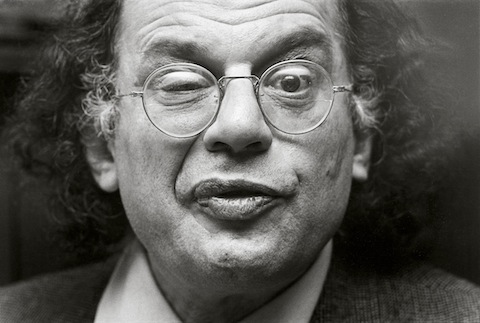
Although the boundaries of what should pass for free speech in high school English classrooms will be forever in debate, most everyone would agree some boundaries must exist. But what of the speech of famous authors? Of towering figures of 20th century poetry? Should their speech be subject to review? What of an English teacher who allows the most risqué Beat poem you’ve ever heard to be read aloud in class by the poet himself, Allen Ginsberg, via an online video (perhaps this one)? Award-winning English teacher David Olio, a beloved 19-year veteran, did just that when a student asked to share Ginsberg’s ecstatic, and very explicit, poem “Please Master” with the class.
After complaints from several students, the school administration suspended Olio, then forced him to resign. Whether or not this decision was just is a debate that extends beyond the scope of this post. The variables are many, as Slate’s sympathetic Mark Joseph Stern admits, including the fact that Olio did not exactly prepare his students for what was to come, nor give them the opportunity to opt out. The high school seniors—on the threshold of adulthood and some already with one foot in college—may not have had their “emotional health” endangered, as Olio’s termination letter alleged, but it’s little wonder some of them found the material shocking.
Ginsberg’s poem, which you can hear him read above, describes a “fantasized sexual encounter between Ginsberg and Neal Cassady, the inspiration for the Dean Moriarty character in Jack Kerouac’s On the Road.” It is graphic, writes Stern, but “not obscene.” Instead—in its allusions to St. Teresa’s angelic visitation in a “profane description of anal sex as a nearly divine act”—Ginsberg’s poem is “dangerous because it juxtaposes tenderness with masochism; dangerous because it rapturously celebrates a vision of same-sex intimacy we are only supposed to whisper about.” Read the poem, listen to Ginsberg read it, and judge for yourself.
Of course, this is hardly the first time Ginsberg’s work has caused controversy. His Beat epic “Howl” (1955), with its sexually charged lines, irked the U.S. government, who seized copies of the poem and put its publisher, poet and City Lights’ bookseller Lawrence Ferlinghetti, on trial for obscenity. Well over sixty years later, Ferlinghetti has written in defense of David Olio. We can safely assume that Ginsberg, who died in 1997, also would approve. And while we have every right to be shocked by Ginsberg’s poem, or not, and find the decision to fire Olio warranted, or not, I tend to agree with Stern when he writes “if every English teacher were that enthusiastic about his subject, America would be a much more literate, educated and interesting place.”
“On April 24th,” writes TheNew Yorker’s John Kleiner, “Samantha Cristoforetti, Italy’s first female astronaut, took time off from her regular duties in the International Space Station to read from the Divine Comedy.” You can watch a clip of that reading of the first canto of the Paradiso above. “As Cristoforetti spun around the globe at the rate of seventeen thousand miles an hour, her reading was beamed back to earth and shown in a movie theater in Florence.”
While that stands alone as a neat event in and of itself, more celebration of the epic Italian poem followed. “Ten days later,” Kleiner continues, “the actor Roberto Benigni recited the last canto of Paradiso in the Italian Senate” to a standing ovation. Benigni, one of world cinema’s best-known representatives of Italian culture, seems to have a particularly strong appreciation for Dante Alighieri, the best-known representative of Italian literature; you can see him recite the first canto of the Inferno just above.
The occasion? Dante’s 750th birthday. Though you’ll find no unsuitable occasion to celebrate the Divine Comedy (find it in our collection of 700 Free eBooks), this past month has proven a particularly rich one. Today we’ve gathered a few more pieces of Danteiana so you can conduct your own personal appreciation. You might consider as a first stop the Princeton Dante Project, which “combines a traditional approach to the study of Dante’s Comedy with new techniques of compiling and consulting data, images, and sound,” featuring a searchable new verse translation, texts of Dante’s minor works (with translations), historical and interpretive lectures, more than seventy commentaries, and links to Dante sites from all over the world.
“When Dante began work on the Comedy [circa 1308], none of the different dialects spoken in Italy’s many city-states had any particular claim to preeminence,” writes Kleiner for The New Yorker. “Such was the force and influence of the Comedy that the Tuscan dialect became Italy’s literary language and, eventually, its national one.” But if you don’t speak Italian (as much as the linguistic importance of the Divine Comedy might inspire you to learn it), you might prefer an English reading, which you’ll find here.
Dante has, for so many of us, shaped our very notions of heaven and hell, but perhaps more impressively, as the poet’s 750th birthday passes, his major work shows no signs of falling into irrelevance. No matter how many of us now have different visions of the afterlife than he did, and no matter how many of us have no visions of it at all, we keep reading Dante — whether in Italian or English, whether in the Senate or on the internet, whether on Earth or in space.
We're hoping to rely on loyal readers, rather than erratic ads. Please click the Donate button and support Open Culture. You can use Paypal, Venmo, Patreon, even Crypto! We thank you!
Open Culture scours the web for the best educational media. We find the free courses and audio books you need, the language lessons & educational videos you want, and plenty of enlightenment in between.