Can a computer game teach writing and free up the creative mind? Elegy for a Dead World, a Kickstarter-funded game for Steam PC, Mac and Linux systems, hopes to do so. The creators Ichiro Lambe and Ziba Scott brought the game to E3 last year and debuted it with a brief introductory walkthrough.
Players explore the world by walking and flying through it like a regular platform game, but encounter writing prompts that begin to flesh out the backstory with the help of the player’s imagination. The developers hope that by the third or forth prompt, the player will be invested in the tale they are telling and perhaps ignore the prompts altogether.
Players can share their stories with friends. They can also print out their finished work through sites like Blurb and Lulu.
It’s hard to know without spending the $14.99 whether or not Elegy really can lead you to some decent writing. Experienced writers may find the worlds too limiting, but perhaps for a beginning writer it might help with the fear of the blank page. A lot was promised in the Kickstarter campaign:
You can read other players’ works, browsing through the most-recent, the best-loved, and recently-trending stories. In our gameplay tests so far, players have expressed a variety of thoughts about what happened in each world — the silhouette of what looks like a telescope to one player looks like a rocket ship to another, and a planet-destroying weapon to yet another.
In a larger context, Elegy is another attempt by game designers to free players from the determination of goal-based, narrative video games. Leave a comment if you’ve played Elegy for a Dead World and if you created something out of it. In the meantime, watch game reviewer NateWantsToBattle for his own experience, and just revel in the beautiful graphics. We’re a long way from Type!
Ted Mills is a freelance writer on the arts who currently hosts the FunkZone Podcast. You can also follow him on Twitter at @tedmills, read his other arts writing at tedmills.com and/or watch his films here.
Are we to look at cherry blossoms only in full bloom, the moon only when it is cloudless? To long for the moon while looking on the rain, to lower the blinds and be unaware of the passing of spring—these are even more deeply moving. Branches about to blossom or gardens strewn with faded flowers are worthier of our admiration.
The only thing one can be certain of is a mob scene, as ardent flower-viewers of all ages stampede toward the cotton candy-colored trees, devices in hand. Modern hanami practice would surely confound the elite of the 8th Century Imperial Court. They wouldn’t have understood the concept of “selfie” if it bit ‘em in the shakuhachi.
Of course, for every determined 21st-century soul who makes a point of admiring the blossoms during their brief appearance, there are thousands more who, in the words of bureaucrat-turned-monk, Kenko, “lower the blinds…unaware of the passing of spring.”
Perhaps this latter group is who Dave Allen, the Brooklyn Botanic Garden’s former webmaster, had in mind when he installed a camera in a weatherproof box near the Cherry Esplanade. Every 3 minutes, the shutter snapped, capturing not just the glorious Prunus ‘Kanzan’ (aka Sekiyama) that line the walkways, but also a wide range of visitors who flocked to the garden between April 18 to April 26, 2008, seeking respite from the pressures of urban living.
The time lapse video Allen assembled from 3000 captured moments takes slightly more than a minute to view. I think we have time to spare…
Watch it once for the main attraction…
And then again for the (pixillated) people. Randomly press “pause” to catch a kissing couple, a Hasidic man in a shtreimel, and a little girl in pink who somehow found herself the sole human on the path…
Then one more time for the shadows of the clouds. Ah… That’s likely the time-strapped virtual viewer’s best chance for achieving the sort of mindset one might ascribe to The Tale of Genji.
(Though perhaps a calm and contemplative mood was never the goal. As ninth century aristocratic poet Ariwara no Narihira wrote (in translation by Hiroaki Sato & Burton Watson):
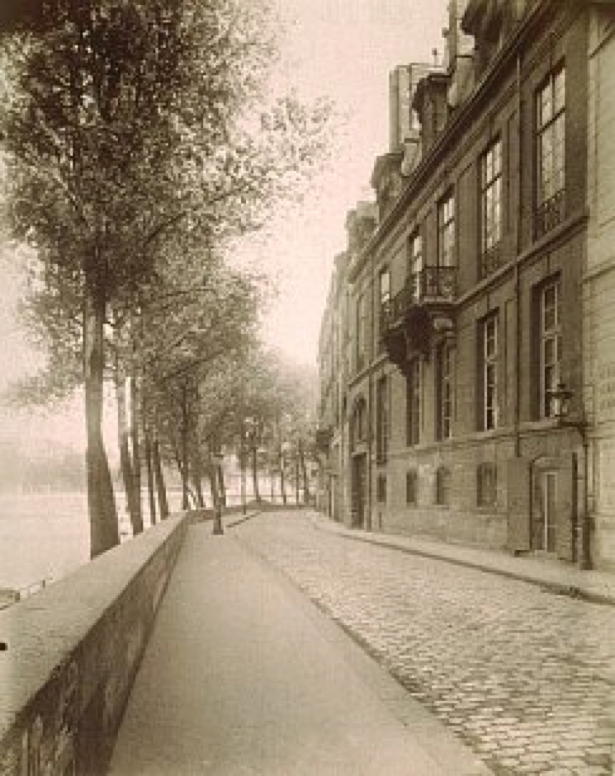
Hôtel de Lauzun, the meeting place of the Club des Hachichins
It may be cliché to say so, but there does seem to be a strong correlation between experiments with mind-altering chemicals and some of the most intriguing experiments in literary style. Samuel Taylor Coleridge, Arthur Rimbaud, William S. Burroughs, Hunter S. Thompson…. Of course, it is necessary to point out that these talented writers were already that—talented writers—substances or no. As one of Rimbaud’s modern children, Patti Smith, declares, drugs are “not really how one accesses the imagination. It can be a tool, but when that tool starts to master you, you’ll lose touch with your craft.”
This seems to have happened to Smith’s literary idol. One of Rimbaud’s literary heroes, Charles Baudelaire, also eventually succumbed to his excessive use of laudanum, alcohol, and opium. But at one time, Baudelaire dabbled with a much less destructive drug, hashish, along with a coterie of other artists, including Alexandre Dumas, Gérard de Nerval, Victor Hugo, Honoré de Balzac, and painter Eugène Delacroix. The French greats gathered in a gothic house, from 1844–1849, under the moniker Club des Hachichins and partook of the drug, introduced to it by medical doctor Jacques-Joseph Moreau and writer and journalist Théophile Gautier. Writes The Guardian:
…ritualistically garbed in Arab clothing, they drank strong coffee, liberally laced with hashish, which Moreau called dawamesk, in the Arabic manner. It looked, reported the members, like a greenish preserve, its ingredients a mixture of hashish, cinnamon, cloves, nutmeg, pistachio, sugar, orange juice, butter and cantharides. Some of them would write of their “stoned” experiences, although not all. Balzac attended the club but preferred not to indulge, though some time in 1845 the great man cracked and ate some. He told fellow members he had heard celestial voices and seen visions of divine paintings.
Baudelaire declared the hash admixture “the playground of the seraphim” and “a little green sweetmeat.” And yet, like Balzac, he “rarely, if indeed ever, indulged.” Gautier would write of the poet, “It is possible and even probable that Baudelaire did try hascheesh once or twice by way of physiological experiment, but he never made continuous use of it. Besides, he felt much repugnance for that sort of happiness, bought at the chemist’s and taken away in the vest-pocket.”
This “repugnance” did not keep Baudelaire from other drugs. And it did not keep him from writing a short book in 1860 on hash and opium, Artificial Paradises(Les Paradis Artificiels). The Paris Reviewreprints an excerpt of one section, “The Poem of Hashish”—not in fact a poem, but a descriptive essay. Translated by Aleister Crowley—another writer whose experiments with chemical excess contributed to some of the strangest books written in English—Baudelaire’s prose is almost medical in its precision. In part a response to Thomas de Quincy’s 1821 drug memoir Confession’s of an English Opium Eater, the symbolist poet’s treatise does not draw the conclusions one might expect.
Though he writes stunningly vivid, almost seductive, descriptions of hash intoxication, instead of praising the creative effects of drugs, Baudelaire disparages their use and warns of addiction, especially for the artist. At one point, he writes, “He who would resort to a poison in order to think would soon be incapable of thinking without the poison. Can you imagine this awful sort of man whose paralyzed imagination can no longer function without the benefit of hashish or opium?” Baudelaire recognized these stifling effects even as he lapsed into addiction himself, describing in withering terms the search “in pharmacy” for an escape from “his habitaculum of mire.”
You can read an excerpt of the Crowley-translated “The Poem of Hashish” at The Paris Review’s site and the full translation here. Those who have indulged in their own cannabis experiments—legally or otherwise—will surely recognize the poetic accuracy of his hash portrait, so perfect that it’s hard to believe he didn’t partake at least once or twice at the all-star Club des Hachichins:
Hashish often brings about a voracious hunger, nearly always an excessive thirst … Such a state would not be supportable if it lasted too long, and if it did not soon give place to another phase of intoxication, which in the case above cited interprets itself by splendid visions, tenderly terrifying, and at the same time full of consolations. This new state is what the Easterns call Kaif. It is no longer the whirlwind or the tempest; it is a calm and motionless bliss, a glorious resignèdness. Since long you have not been your own master; but you trouble yourself no longer about that. Pain, and the sense of time, have disappeared; or if sometimes they dare to show their heads, it is only as transfigured by the master feeling, and they are then, as compared with their ordinary form, what poetic melancholy is to prosaic grief.
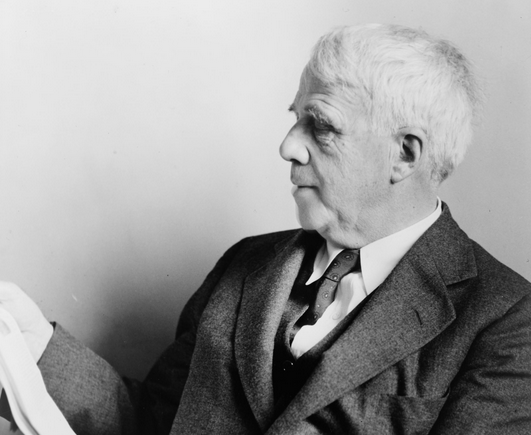
Image by Fred Palumbo, made available by the Library of Congress.
Put THIS in your pocket. The Library of Congress is celebrating National Poetry Month by launching its new Archive of Recorded Poetry and Literature. It debuts with 50 choice poetry recordings, spanning 75 years of time. In the past, you’d have had to visit the library in person to listen to these goodies on reel-to-reel tape. Now you can take them to the gym, plug in as you wash dishes, post online links for your minions to enjoy.
Newly ensconced Consultant in Poetry Gwendolyn Brooks (was there ever a more recognizable voice?) prefaces her reading by pledging her intention to register “on the public consciousness and conscience the generally neglected richness of ‘minority poetry.’”
Robert Frost tells Randall Jarrell of his desire to identify American antiquity — to feature in his poetry a woodchopper’s hut that looks “as old as Babylon.”
Paul Muldoon shares the story of how he came to own the eelskin bag that is the star of “The Briefcase.”
As part of its ongoing commitment to the form, the Library will be adding to the online archive on a monthly basis. Let every month be Poetry Month! You can stream the complete collection here.
If you have to ask what jazz is, Louis Armstrong supposedly said, you’ll never know. But the poet Langston Hughes, who in his 1955 First Book of Jazz reveals himself as a great enthusiast of Armstrong indeed, seems to have operated on a very different premise. Hughes pitched that book, which we featured last month, toward children, an audience that, at their best, embodies inquisitiveness: they have to ask what everything is. And before Hughes could explain jazz to them, he had to explain rhythm.
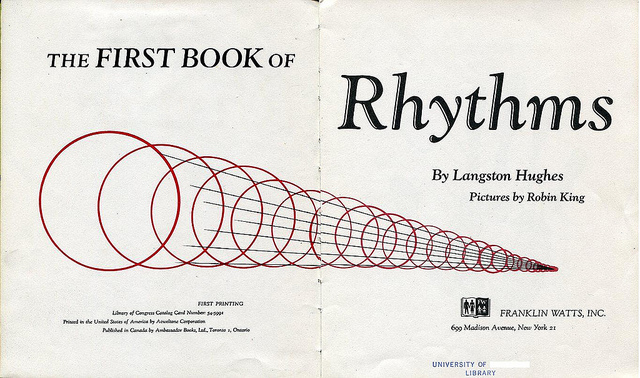
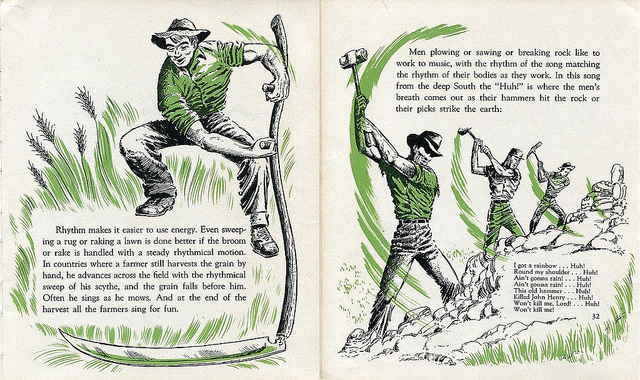
“Rhythm is something we share in common, you and I,” Hughes writes in 1954’s The First Book of Rhythm, “with all the plants and animals and people in the world, and with the stars and moon and sun, and all the whole vast wonderful universe beyond this wonderful earth which is our home.” It doesn’t just belong in music, he says; it belongs pretty much everywhere, from the realm of nature to those of athletics, machines, furniture — everything in “this wonderful world,” in his view, has its own rhythm.
If explaining jazz to kids strikes you as a daunting task, then just imagine explaining this more abstract foundational quality of jazz, finding it in a host of different domains, and then laying it all out in terms that will engage an elementary schooler. But only such a master of language and lover of sound like Hughes could do it with such overall vitality and concision, even if the subject, as Ariel S. Winter writes at We Too Were Children, Mr. Barrie, moves Hughes to get “too lyrical, too abstract, caught up in his song of the world,” somehow drifting from an observation of the rhythm of knitting needles to the conclusion that everyone “should arrange her hair to suit the shape of her face.”
In 2001 or 2002, guitarist and singer David Gilmour of Pink Floyd recorded a musical interpretation of William Shakespeare’s “Sonnet 18” at his home studio aboard the historic, 90-foot houseboat the Astoria. This video of Gilmour singing the sonnet was released as an extra on the 2002 DVD David Gilmour in Concert, but the song itself is connected with When Love Speaks, a 2002 benefit album for London’s Royal Academy for the Dramatic Arts.
The project was organized by the composer and conductor Michael Kamen, who died a little more than a year after the album was released. When Love Speaks features a mixture of dramatic and musical performances of Shakespeare’s Sonnets and other works, with artists ranging from John Gielgud to Ladysmith Black Mambazo.
Kamen wrote much of the music for the project, including the arrangement for Sonnet 18, which is sung on the album by Bryan Ferry. A special benefit concert to celebrate the release of the album was held on February 10, 2002 at the Old Vic Theatre in London, but Ferry did not attend. Gilmour appeared and sang the sonnet in his place. It was apparently around that time that Gilmour recorded his own vocal track for Kamen’s song.
“Sonnet 18” is perhaps the most famous of Shakespeare’s 154 sonnets. It was written in about 1595, and most scholars now agree the poem is addressed to a man. The sonnet is composed in iambic pentameter, with three rhymed quatrains followed by a concluding couplet:
Shall I compare thee to a summer’s day? Thou art more lovely and more temperate: Rough winds do shake the darling buds of May, And summer’s lease hath all too short a date; Sometime too hot the eye of heaven shines, And often is his gold complexion dimm’d; And every fair from fair sometime declines, By chance or nature’s changing course untrimm’d But thy eternal summer shall not fade, Nor lose possession of that fair thou ow’st; Nor shall death brag thou wander’st in his shade, When in eternal lines to time thou grow’st: So long as men can breathe or eyes can see, So long lives this, and this gives life to thee.
This post was originally published on Open Culture on April 5, 2013. We’re bringing it back today for Gilmour’s 69th birthday.
Kagonada, the video-essayist behind the cinematic supercuts of Kubrick’s “One-Point Perspective” and Ozu’s “Passageways” returns with a look at mirrors in the films of Ingmar Bergman, set to a plaintive Vivaldi work for two mandolins, and a reading of Sylvia Plath’s “Mirror.”
Mirrors and reflections turn up right in the beginning of Bergman’s films as a motif, when Jenny, the middle-aged protagonist of Crisis exclaims to her image, “You can’t see from the outside, but beneath this face … oh, my God!” Mirrors show their viewers a true face behind the mask in his films, mortality, failure, duplicity–everything fake stripped away. It’s a time to take stock and a time to break down.
It’s quite lovely, this cut, with Plath’s description of her wall “pink, with speckles” matching the color shot from Fanny & Alexander; or “Faces and darkness separate us over and over” as Nine-Christine Jönsson draws a frowny face and writes “lonely” on her reflection from Port of Call. The video is also a tribute to Bergman’s favorite actresses, from Harriet Andersson to Liv Ullmann.
Incidentally, Sylvia Plath was not just a fan of the filmmaker, she based her poem “Three Women” on Bergman’s film So Close to Life (aka Brink of Life) which she had seen in a London cinema in either 1961 or 1962.
If you would like to support the mission of Open Culture, consider making a donation to our site. It’s hard to rely 100% on ads, and your contributions will help us continue providing the best free cultural and educational materials to learners everywhere. You can contribute through PayPal, Patreon, and Venmo (@openculture). Thanks!
Ted Mills is a freelance writer on the arts who currently hosts the FunkZone Podcast. You can also follow him on Twitter at @tedmills and/or watch his films here.
Founded in 1931, the Woodberry Poetry Room at Harvard University features (among other things) 6,000 recordings of poetry from the 20th and 21st centuries. There you can find some of the earliest recordings of W. H. Auden, Elizabeth Bishop, T. S. Eliot, Denise Levertov, Robert Lowell, Anais Nin, Ezra Pound, Robert Penn Warren, Tennessee Williams and many others.
In the “Listening Booth,” a section of the Poetry Room website, you can listen to recordings of classic readings by nearly 200 authors, including John Berryman, Robert Bly, Jorge Luis Borges, Joseph Brodsky, Jorie Graham, Seamus Heaney, Jack Kerouac, Adrienne Rich, Anne Sexton, Wallace Stevens, Dylan Thomas, Anne Waldman, William Carlos Williams and more. The sound files are all free to stream. And if this is your kind of thing, make sure you visit the Penn Sound archive at the University of Pennsylvania, which is an equally rich and amazing audio archive. We previously featured it here.
If you would like to support the mission of Open Culture, consider making a donation to our site. It’s hard to rely 100% on ads, and your contributions will help us continue providing the best free cultural and educational materials to learners everywhere. You can contribute through PayPal, Patreon, and Venmo (@openculture). Thanks!
We're hoping to rely on loyal readers, rather than erratic ads. Please click the Donate button and support Open Culture. You can use Paypal, Venmo, Patreon, even Crypto! We thank you!
Open Culture scours the web for the best educational media. We find the free courses and audio books you need, the language lessons & educational videos you want, and plenty of enlightenment in between.