Permit us to stay on our recent sci-fi tangent just a tad bit longer.…
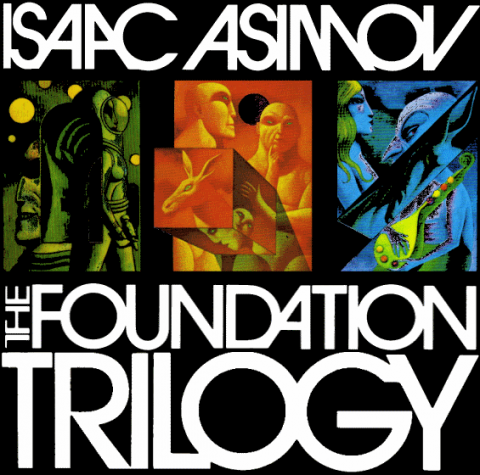
Between 1951 and 1953, Isaac Asimov published three books that formed the now legendary Foundation Trilogy. Many considered it a masterwork in science fiction, and that view became official doctrine in 1966 when the trilogy received a special Hugo Award for Best All-Time Series, notably beating out Tolkien’s The Lord of the Rings. (Don’t miss the vintage Tolkien documentary we featured yesterday.)
Eventually, the BBC decided to adapt Asimov’s trilogy to the radio, dramatizing the series in eight one-hour episodes that aired between May and June 1973. Years later, you can buy the radio drama on iTunes for $9.99. Or your can stream it on Spotify (above) or via the Internet Archive below.
96 years ago today, Orson Welles, the “ultimate auteur,” was born in Kenosha, Wisconsin. Hence his early nickname, The Kenosha Kid. Nowadays, we remember Welles as arguably the greatest director of the 20th century, a superb actor on stage and screen, and a pioneering radio dramatist. To celebrate his 96th birthday, we have dipped into our archives and pulled together some of Welles’ finest artistic works, all now freely available online:
The Stranger
Welles’ third film, The Stranger, a 1946 film noir thriller, was a commercial success upon release. The same couldn’t be said for Citizen Kane. The Stranger features Edward G. Robinson hunting a Nazi fugitive (Welles himself) who marries the daughter (Loretta Young) of a Supreme Court justice. The film, now available online in its entirety, is one of the first post WWII films to show footage of concentration camps. You can find this film, and others mentioned below, in our collection of Free Movies Online.
Welles famously starred in The Third Man, a must-see noir film, which won the Grand Prix at the 1949 Cannes Film Festival and an Academy Award for Best Black and White Cinematography in 1950. A half century later, the British Film Institute namedThe Third Man the best British film of the 20th century. Quite a statement. You can watch it here.
Freedom River
Almost 40 years (and seven presidential administrations) have passed since Orson Welles narrated Freedom River. And although the animation shows some age, the parable, a commentary on America, still resonates today. Or, at least I suspect many viewers will think so. You can get the backstory on this intriguing little project here.
The War of the Worlds
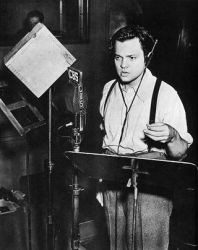
Back in the late 1930s, Orson Welles launched The Mercury Theatre on the Air, a radio program dedicated to bringing dramatic productions to the American airwaves. The show had a fairly short run. It lasted from 1938 to 1941. But it made its mark. During these few years, The Mercury Theatre aired The War of the Worlds, an episode narrated by Welles that led many Americans to believe their country was under Martian attack. The legendary production was based on H.G. Wells’ early sci-fi novel, and you can listen to it here. We have more links to Mercury Theatre productions here.
Welles Reads Moby Dick
He only gives you two tantalizing minutes. And he’s paraphrasing more than reading the text itself. But it’s vintage Welles. You can find him reading another passage from Melville’s classic here…
Last year, filmmakers Will Hoffman, Daniel Mercadante, and Julius Metoyer III produced their first conceptual video based on a RadioLab episode called “Words.” Now the trio is back, playing on ideas explored in a new RadioLab episode, Desperately Seeking Symmetry, which meditates on how “symmetry shapes our very existence–from the origins of the universe, to what we see when we look in the mirror.” You can watch their latest video above, and stream below the radio episode upon which it is based. And if you’re not familiar with RadioLab, a program that’s changing the medium, then definitely check out this profile in The New York Times.
Back in the early 1990s, while most of us were still trying to wrap our heads around this new thing called the internet (don’t miss this amusing bit), NPR’s Science Friday started pushing the envelope and hosting the first internet-based radio talk show. This marked the first time that listeners could “phone into” a program via the web and talk together – in this case about the creative uses of this emerging technology. The broadcast, which singlehandedly brought the internet to a crawl, has now resurfaced online. You can listen below (or here).
Since 1995, Ira Glass has hosted and produced This American Life (iTunes — Feed — Web Site), the award-winning radio show that presents masterfully-crafted stories to almost 2 million listeners each week. What’s the secret sauce that goes into making a great story, particularly one primed for radio or TV? Glass spells it out in four parts. Watch them all above.
If you would like to support the mission of Open Culture, consider making a donation to our site. It’s hard to rely 100% on ads, and your contributions will help us continue providing the best free cultural and educational materials to learners everywhere. You can contribute through PayPal, Patreon, and Venmo (@openculture). Thanks!
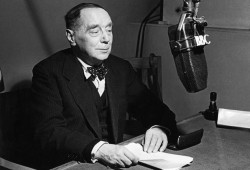
H.G. Wells (1866–1946) gave us The Time Machine, The Invisible Man, and The War of the Worlds and practically invented science fiction as we know it. (Find his classic texts in our Free Audio Books and Free eBooks collections.) Now, thanks to the BBC, you can travel back in time and get a glimpse into Wells’ creative mind. During the 1930s and 1940s, Wells made regular radio broadcasts for the BBC, where he had the freedom to range widely, to talk about “world politics, the history of the printing press, the possibilities of technology and the shape of things to come…” Nine recordings now appear online. You can start listening here, or dip into an archive of Wells’ personal letters.
Finally, don’t miss one of my personal favorites. Orson Welles reading a dramatized version of H.G. Wells’ The War of the Worlds in 1938. It’s perhaps the most famous radio broadcast in American history and it drove America into a bout of mass hysteria, at least for a night …
H/T to @fionaatzler for flagging these BBC audio recordings.
You never saw this coming, right? A little hip hop for NPR listeners. Adam Cole, a Stanford student, raps it out with Jenna Sullivan. Get the lyrics for “Good Radiation” below the jump… (more…)
During the 1930’s and 1940’s, Raymond Chandler gave life to the detective Philip Marlowe, perhaps the most memorable character of the hardboiled crime fiction tradition. Marlowe took center stage in Chandler’s influential novels, The Big Sleep and The Long Goodbye. And, before too long, he started appearing in adaptations for radio and cinema. Humphrey Bogart played Marlowe in 1946, and Elliot Gould tackled the character in 1973. Meanwhile, The Adventures of Philip Marlowe took to the radio airwaves in the summer of 1947.
The initial episodes didn’t quite gel and NBC quickly yanked the show. But, a year later, CBS revived the radio production with new writers and actors, and, by 1949, the show had the largest radio audience in the US. Thanks to the Internet Archive, The Adventures of Philip Marlowe can now be accessed online for free. Find them on the IA site, or stream them below. We’ve also embedded of YouTube playlist of 72 episodes above. Each episode runs about 25 minutes. Find them added to our collection, 1,000 Free Audio Books: Download Great Books for Free.
If you would like to support the mission of Open Culture, consider making a donation to our site. It’s hard to rely 100% on ads, and your contributions will help us continue providing the best free cultural and educational materials to learners everywhere. You can contribute through PayPal, Patreon, and Venmo (@openculture). Thanks!
We're hoping to rely on loyal readers, rather than erratic ads. Please click the Donate button and support Open Culture. You can use Paypal, Venmo, Patreon, even Crypto! We thank you!
Open Culture scours the web for the best educational media. We find the free courses and audio books you need, the language lessons & educational videos you want, and plenty of enlightenment in between.