If you’re applying to Stanford, this is what you’re up against. Undergrads like Ravi Fernando (Class of 2014) who can solve a Rubik’s Cube … while juggling. You might want to have a safety school!
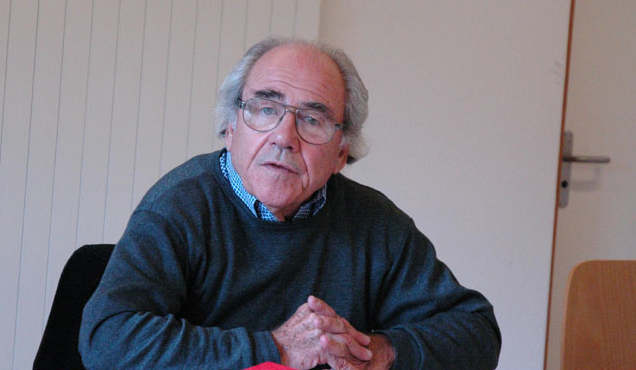
French post-structuralist philosopher/sociologist Jean Baudrillard—usually identified with his postmodern theories of simulacra—is a little bit of a fringe figure in pop culture. Known to hip academic types and avant-garde-ists, he’s maybe the kind of thinker who gets name-dropped more than read (and he’s no easy read).
But in the audio clip above, Baudrillard reads to us, from his poetry no less, while backed by the swirling abstract sounds of The Chance Band, an all art-star ensemble featuring Tom Watson (of The Missingmen), George Hurley (of The Minutemen and fIREHOSE), Lynn Johnston, Dave Muller, Amy Stoll, and guest vocalist, theorist Allucquère Rosanne (“Sandy”) Stone. It’s an odd, one-time, assemblage of artists and thinkers UbuWeb describes as “unbelievable but true!”:
Recorded live as part of the Chance Festival at Whiskey Pete’s Casino in Stateline Nevada, 1996. You’ve never heard Baudrillard like this before! Music to read Nietzsche to.
Look at what Neels Castillon unexpectedly captured on film while doing some shooting at a Marseille airport. Birds doing a pretty incredible ballet in the sky. If you enjoy watching murmurations, you’ll want to watch this other footage shot in Rome and especially this breathtaking (no hyperbole here) clip from Ireland. It’s all quite stunning.
Likely you envisioned a fat cat with a designer checkbook. It’s the accepted image, but not every benefactor fits the mold.
Take Mark Landis, a gentle soul who’s spent three decades surprising the staffs of small American museums with artwork presented out of the blue. Not just any artwork, and certainly not the nineteenth-century originals they were represented as—in every case, donor Landis was eventually revealed to be the artist.
In Terri Timely’s documentary glimpse, “Father Philanthropy” (above, with a deleted scene below), Landis obligingly guides viewers through the multi-step process by which his forgeries are created, but he reveals little about his motivation, beyond a desire to honor the memory of his parents (Mother looms large here.)
His fakes don’t add up to a grand conceptual piece, a la artist J. S. G. Boggs’ incredibly detailed, far-more-valuable-than-the-items-they-were-used-to-purchase banknotes. He seems indifferent to the possibility of high profile, if ill gotten, prestige. He is, quite simply a giver. His gifts cost the recipients professional pride and unexpected fees associated with ferreting out the truth, but they seem malice-free. “About all I’ve got is an ability to draw and paint,” he states, “So naturally it led me to give away drawing and paintings.”
The quick backstory: “Dean Potter walks a highline at Cathedral Peak as the sun sets and the moon rises. Shot from over 1 mile away with a Canon 800mm and 2X by Mikey Schaefer. This shot was part of a bigger project for National Geographic called The Man Who Can Fly. ”
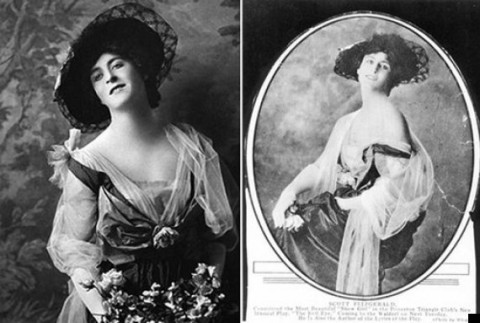
It has been said that the dominant influences on F. Scott Fitzgerald were literature, Zelda, alcohol, and Princeton. The photos above were taken during the novelist’s Princeton days, where he played an active role in The Princeton Triangle Club, writing scripts and lyrics for what’s now the oldest collegiate musical-comedy troupe in the US. After Fitzgerald failed several exams, he was barred from performing in the club’s 1916 musical production, The Evil Eye!. A shame, given that he co-wrote the script. But F. Scott wasn’t going to be completely denied. Yes, he posed in drag for a publicity photo that appeared in The New York Times on January 2, 1916. The newspaper called him “the most beautiful” girl in the show.
Say chowder out loud: chowder. The word sounds like food. Not an appetizer either. An entree in a small crock topped with broken crackers.
As with so many things related to food, chowder is a storied dish. It hails from New England and northeastern Canada, its first written reference dating back to 1732 when a journalist recalls dining on a “fine chowdered cod.”
There are as many types of chowder as there are soup, though a true chowder is more like a stew than a soup. Some purists would rather eat slugs than a chowder with tomatoes in it or whose name references New York. But all chowders must feature the following: broth, salt pork, biscuit and seafood.
Aside from that, all bets are off. Chow down.
Of course a regional dish with this long a history and which leaves this much room for interpretation deserves a history of its own, and so the good people at the University of Massachusetts, Amherst created the New England Chowder Compendium, a collection of recipes and ephemera exploring how chowder rose to become a staple of New England cookery.
Culled from cookbooks held by the university’s Beatrice McIntosh Cookery Collection, the compendium chronicles chowder recipes from the 1700s to the 1970s, through lean times and fat, through recipes heavy with cream and without.
And so, as readers click through featured chowder recipes from the 1920s on through to the 1940s, they’re sure to notice the ways ingredients vary. Use evaporated milk and a little water, if cream is not available. Housewives were wise in the 1940s to be thrifty while making fresh stock from knuckles: Save that fat that rose to the top and sell it to your meat dealer.
We thought that Brazenhead Books might qualify as the quirkiest bookstore we’ve encountered. After all, it’s run out of Michael Seidenberg’s apartment in New York City. But get a load of this: The Monkey’s Paw, which calls itself “Toronto’s most idiosyncratic second-hand bookshop,” has installed the Biblio-mat, a vending machine that dispenses random books for a very nominal fee — $2 per book. (If you’re looking for $0, see our lists below.) In a recent interview with QuillandQuire.com, Stephen Fowler, the bookstore’s owner, explained the story behind the Biblio-mat:
I went fishing this past summer with Craig Small, co-founder of The Juggernaut, an animation studio in Toronto. I had this idea that I would love to have a vending machine that gave out random books. I pictured it as a painted refrigerator box with one of my assistants inside; people would put in a coin and he would drop a book out. But Craig is more pragmatic and visionary then I am. He said, “You need to have an actual mechanical vending machine.” That was beyond my wildest imaginings, but not Craig’s, so he just built it for me.
Thanks to Small, you can now watch the Biblio-mat in action above. It whirrs. It vibrates. And it finally delivers a book with a satisfying clunk.
We're hoping to rely on loyal readers, rather than erratic ads. Please click the Donate button and support Open Culture. You can use Paypal, Venmo, Patreon, even Crypto! We thank you!
Open Culture scours the web for the best educational media. We find the free courses and audio books you need, the language lessons & educational videos you want, and plenty of enlightenment in between.