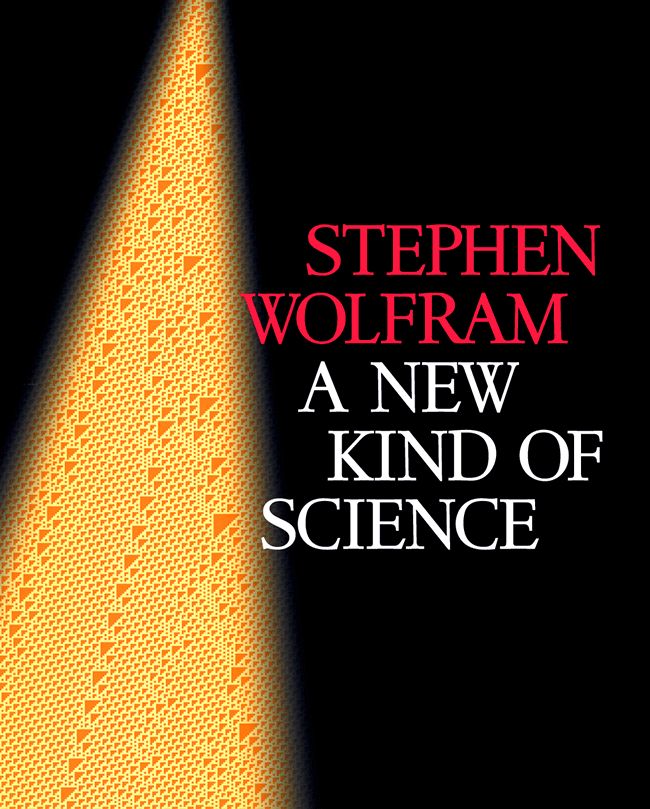
It’s been 15 years since computer scientist and physicist Stephen Wolfram published his bestselling book A New Kind of Science. And now Wolfram has put his book online. It’s available in its entirety, all 1,200 pages, including the superb graphics. Feel free to read the pages on the web. Or download them as PDFs.
It’s also worth reading Wolfram’s new blog post where, in announcing the new online edition, he revisits the intellectual contributions he made with the book.
If you would like to support the mission of Open Culture, consider making a donation to our site. It’s hard to rely 100% on ads, and your contributions will help us continue providing the best free cultural and educational materials to learners everywhere. You can contribute through PayPal, Patreon, and Venmo (@openculture). Thanks!
Upon arriving in Venice in the late 1930s, columnist and Algonquin Round Table regular Robert Benchley immediately sent a telegram back home to America: “Streets full of water. Please advise.” The line has taken its place in the canon of American humor, but in more recent times the image of water-filled streets — unintentionally water-filled streets, that is — has arisen most often in the conversation about climate change. Some of the potential disaster scenarios envision every major coastal city on Earth eventually turning into a kind of Venice, albeit a much less pleasant version thereof.
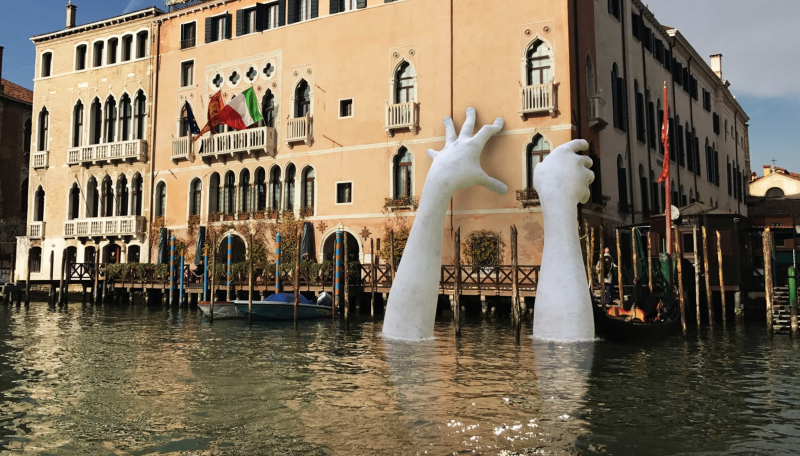
And so what better place than the one that hosts perhaps the world’s best known art exhibition, the Venice Biennale, to express climate-change anxiety in the form of public sculpture? “Venice is known for its gondolas, canals, and historic bridges,” writes Condé Nast Traveler’s Sebastian Modak, “but visitors will now also be greeted by another, albeit temporary, reminder of the city’s intimate relationship with water: a giant pair of hands reaching out of the Grand Canal and appearing to support the walls of the historic Ca’ Sagredo Hotel.” The piece is called Support, and it’s created by Barcelona-based Italian sculptor Lorenzo Quinn.
“I have three children, and I’m thinking about their generation and what world we’re going to pass on to them,” Quinn told Mashable’s Maria Gallucci. “I’m worried, I’m very worried.” The hands of his 11-year-old son actually provided the model for the polyurethane-and-resin hands of Support, weighing 5,000 pounds each, that stand on 30-foot pillars at the bottom of the Grand Canal. Modak quotes one of Quinn’s Instagram posts which describes the work as speaking to the people “in a clear, simple and direct way through the innocent hands of a child and it evokes a powerful message, which is that united we can make a stand to curb the climate change that affects us all.”
Those arguing in favor of more aggressive political measures to counteract the effects of climate change have gone to great lengths to point out what forms those effects have so far taken. But the fact that, apart from a stretch of hot summers, few of those effects have yet manifested undeniably in most people’s lives has certainly made their job harder. But nobody who visits Venice during the Biennale could fail to pause before Support, a work whose visual drama demands a reaction that temperature charts or data-filled studies can’t hope to provoke by themselves. And even apart from the issue at hand, as it were, Quinn’s sculpture reminds us that art, even in as deeply historical a setting as Venice, can also keep us thinking about the future.
Astrophysicist Neil deGrasse Tyson has won a reputation as a genial, yet pedantic nerd, a scientific gadfly whose point of view may nearly always be technically correct, but whose mode of delivery sometimes misses the point, like someone who explains a joke. His earnestness is endearing; it’s what makes him so relatable as a science educator. He’s wholeheartedly devoted to his subject, like his boyhood hero Carl Sagan, whose shoes Tyson did his best to fill in a remake of the classic Cosmos series. Tyson’s countrymen and women, however, have made his job a lot harder than they did in Sagan’s day, when ordinary Americans were hungry for scientific information.
The change has been decades in the making. Like Sagan, Tyson’s voice fills with awe as he contemplates the mysteries of nature and wonders of science, and with alarm as he comments on widespread American ignorance and hostility to critical inquiry and the scientific method. These attitudes have led us to a crisis point. Elected and appointed officials at the highest levels of government deny the facts of climate change and are actively gutting all efforts to combat it. The House of Representatives’ Committee on Science, Space, and Technology mocks climate science on social media even as NASA announces that the evidence is “unequivocal.”
How did this happen? Are we rapidly returning, as Sagan warned before his death, to an age of “superstition and darkness”? Tyson has recently addressed these questions with earnestness and urgency in a short video called “Science in America,” which you can watch above, “containing,” he wrote on Facebook, “what may be the most important words I have ever spoken.” He opens with a statement that echoes Sagan’s dire predictions: “It seems to me that people have lost the ability to judge what is true and what is not.” The problem is not simply an academic one, but a pressingly political one: “When you have people,” says Tyson, “who don’t know much about science, standing in denial of it, and rising to power, that is a recipe for the complete dismantling of our informed democracy.”
One must ask if the issue solely comes down to education. We are frequently reminded of how much denial is motivated and willful when, for example, a government official begins a completely unsupported claim with, “I’m not a scientist, but….” We know that fossil fuel companies like Exxon have known the facts about climate change for forty years, and have hidden or misrepresented them. But the problem is even more widespread. Evolutionary biology, vaccines, GMOs… the amount of misinformation and “alternative fact” in the public sphere has drowned out the voices of scientists. “That’s not the country I remember growing up in,” Tyson laments.
There are plenty of good philosophical reasons for skepticism, such as those raised by David Hume or by critical theorists and historians who point out the ways in which scientific research has been distorted and misused for some very dark, inhumane purposes. Yet critiques of methodology, philosophy, and ethics only strengthen the scientific enterprise, which—as Tyson passionately explains—thrives on vigorous and informed debate. We cannot afford to confuse thoughtful deliberation and honest reflection with specious reasoning and willful ignorance.
I imagine we’ll have a good laugh at creative redeployments of some classic Tyson harangues. (“This is science! It’s not something to toy with!”) And a good laugh sometimes feels like all we can do to relieve the tension. The real danger is that many people will dismiss his message as “politicizing” science rather than defending the very basis of its existence. We must agree on the basis of scientific truth, as discoverable through reason and evidence, Tyson warns, before we can even get to the political questions over climate change, vaccines, etc. Whether Americans can still do that has become an unsettlingly open question.
The debate will likely rage as long as there’s a faith-based camp to square off against the evidence-based camp.
With that in mind, and the weekend looming, we’re inclined to go with the Claymation camp, in the form of Time Chicken, Nick Black’s 6‑minute stop-motion meditation, above.
Described by its creator as a “philosophical-action-fantasy into the world of science, religion, knowledge and creation,” Time Chicken benefits from an appropriately bombastic original score performed by the Prague Symphony Orchestra and the seeming-eyewitness testimony of its admittedly clay-based, all-poultry cast.
Kudos to the filmmaker, too, for eschewing the uncredited dubbing that made fellow claymator Nick (Park)’s Chicken Run a crossover hit, trusting instead in the (unsubtitled) original language of his subjects.
Readers, watch this hilarious little film and weigh in. Which came first? The chicken? Or the egg?
Last summer, astronomer Michael Summer wrote that, despite a relatively low profile, NASA and its international partners have been “living Carl Sagan’s dream for space exploration.” Summers’ catalogue of discoveries and groundbreaking experiments—such as Scott Kelly’s yearlong stay aboard the International Space Station—speaks for itself. But for those focused on more earthbound concerns, or those less emotionally moved by science, it may take a certain eloquence to communicate the value of space in words. “Perhaps,” writes Summers, “we should have had a poet as a member of every space mission to better capture the intense thrill of discovery.”
Sagan was the closest we’ve come. Though he never went into space himself, he worked closely on NASA missions since the 1950s and communicated better than anyone, in deeply poetic terms, the beauty and wonder of the cosmos. Likely you’re familiar with his “pale blue dot” soliloquy, but consider this quote from his 1968 lectures, Planetary Exploration:
There is a place with four suns in the sky — red, white, blue, and yellow; two of them are so close together that they touch, and star-stuff flows between them. I know of a world with a million moons. I know of a sun the size of the Earth — and made of diamond. There are atomic nuclei a few miles across which rotate thirty times a second. There are tiny grains between the stars, with the size and atomic composition of bacteria. There are stars leaving the Milky Way, and immense gas clouds falling into it. There are turbulent plasmas writhing with X- and gamma-rays and mighty stellar explosions. There are, perhaps, places which are outside our universe. The universe is vast and awesome, and for the first time we are becoming a part of it.
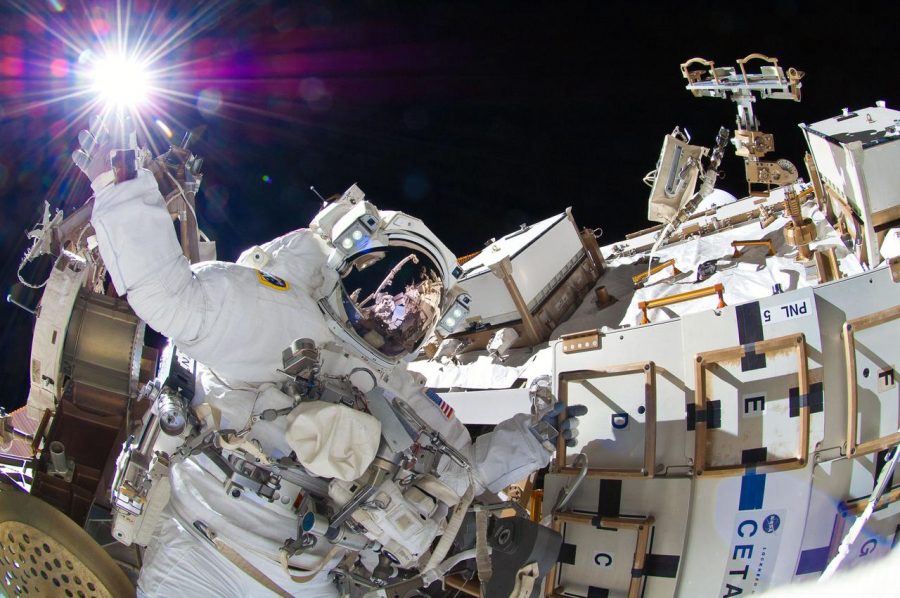
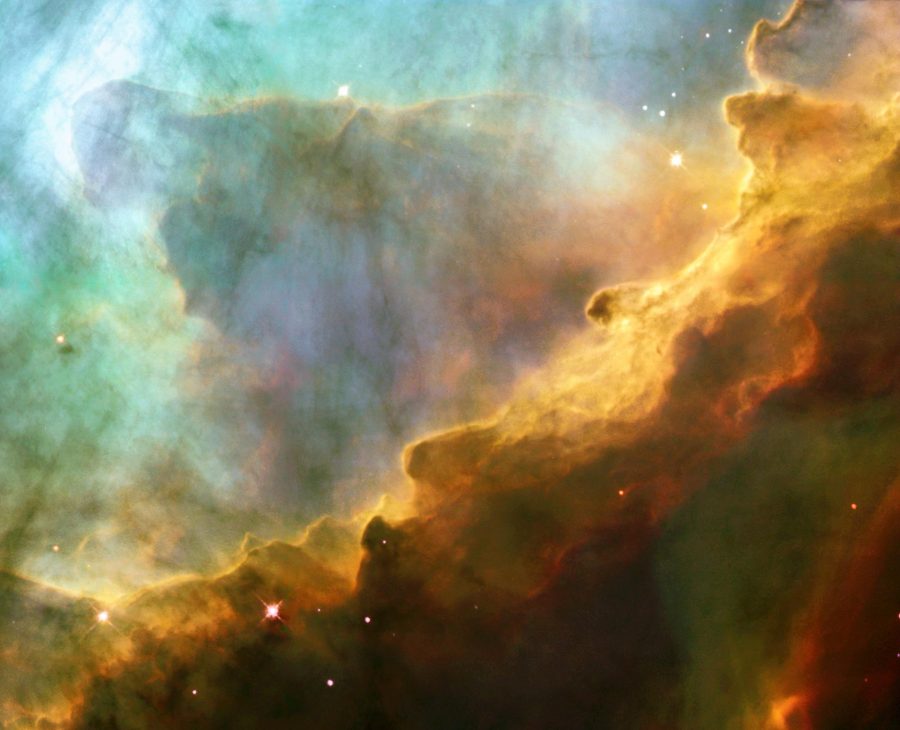
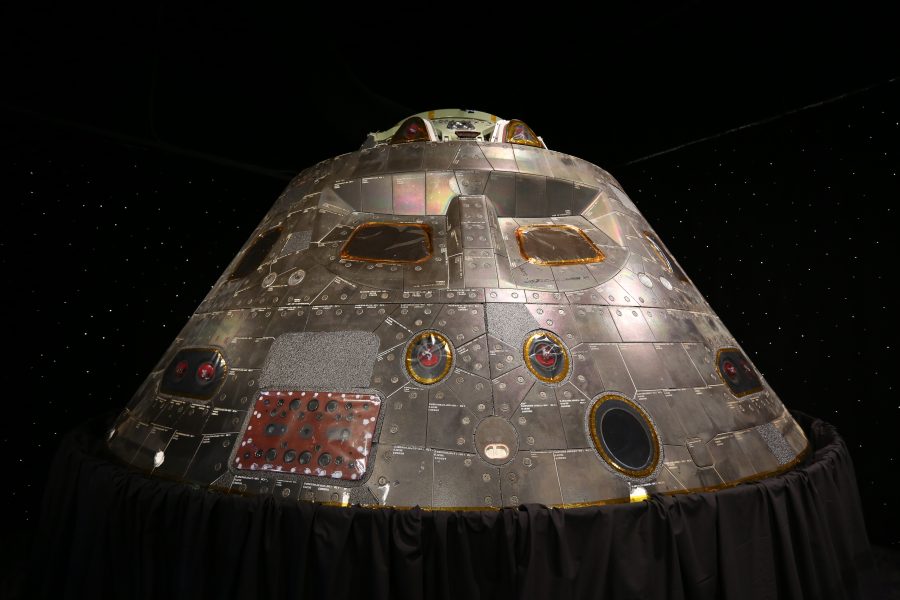
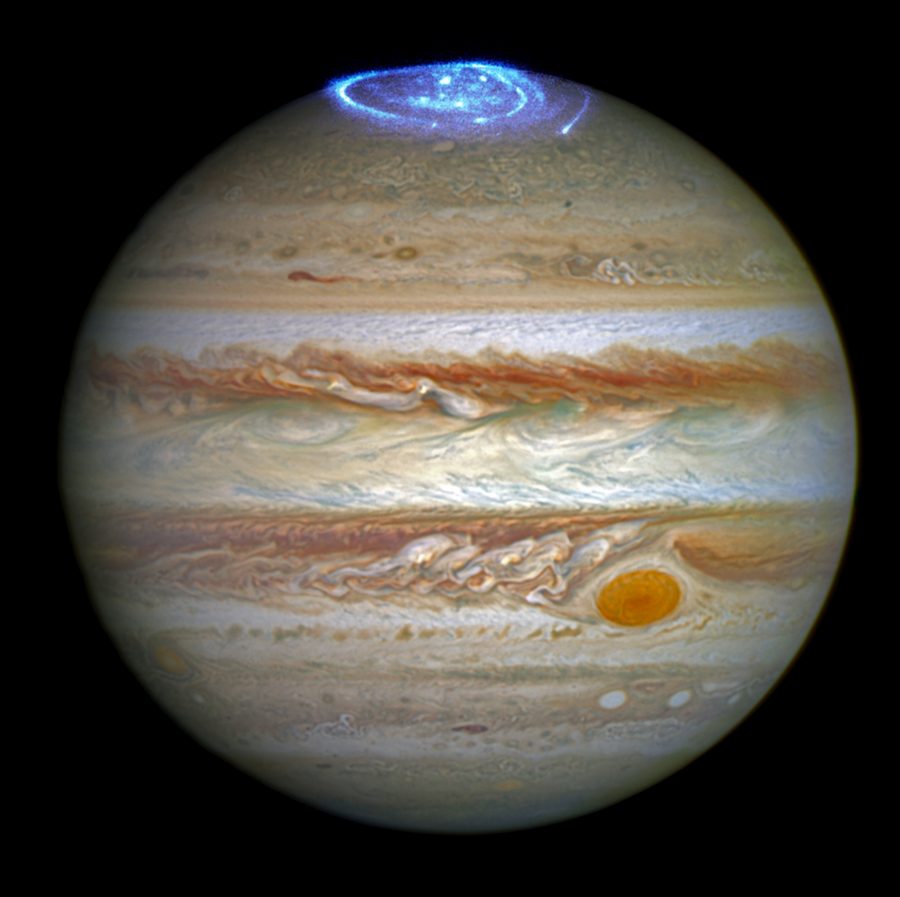
Sagan’s lyrical prose alone captured the imagination of millions. But what has most often made us to fall in love with, and fund, the space program, is photography. No mission has ever had a resident poet, but every one, manned and unmanned, has had multiple high-tech photographers.
NASA has long had “a trove of images, audio, and video the general public wanted to see,” writes Eric Berger at Ars Technica. “After all, this was the agency that had sent people to the Moon, taken photos of every planet in the Solar System, and launched the Hubble Space Telescope.”
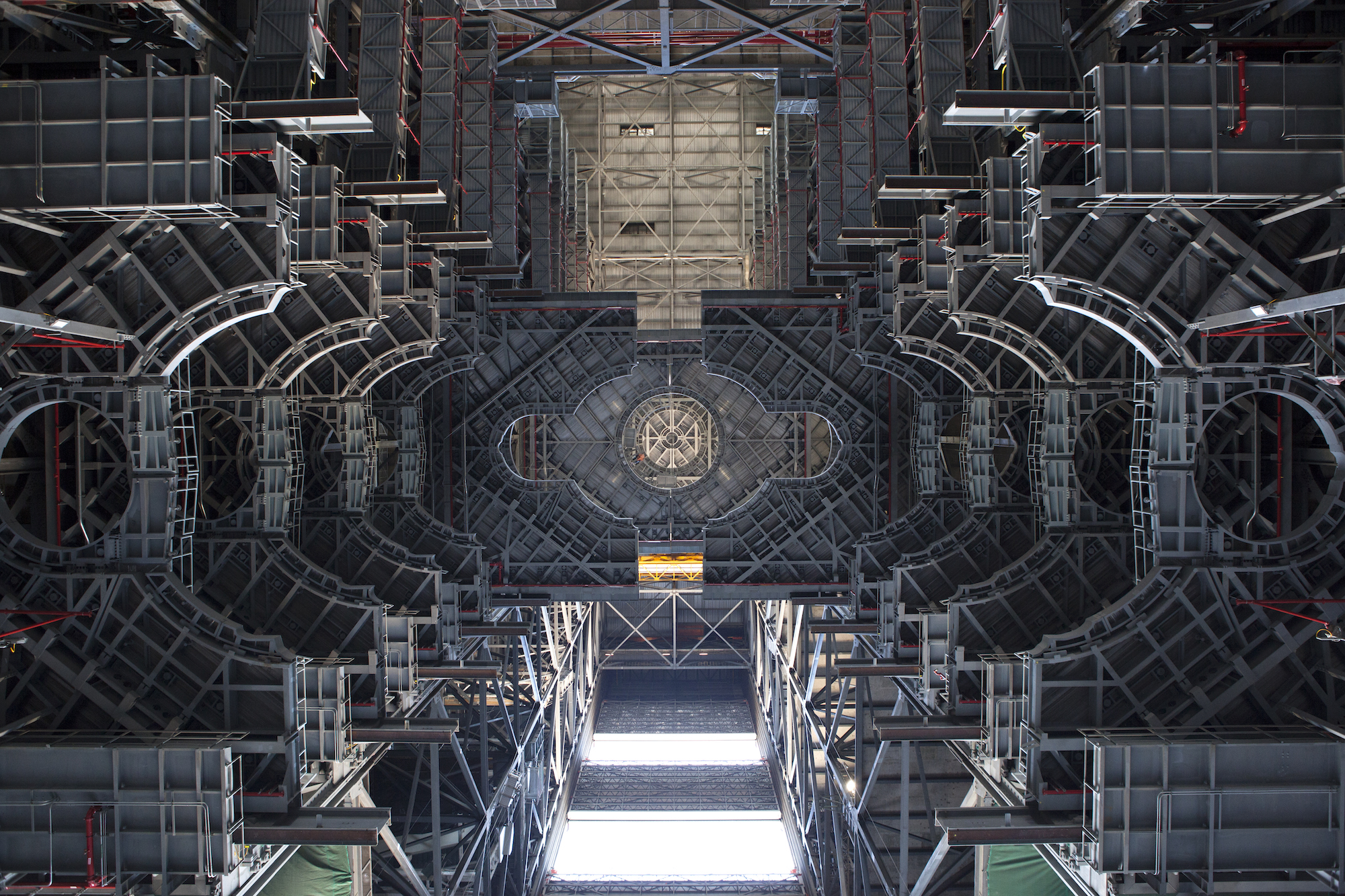
Until the advent of the Internet, only a few select, and unforgettable, images made their way to the public. Since the 1990s, the agency has published hundreds of photos and videos online, but these efforts have been fragmentary and not particularly user-friendly. That changed this month with the release of a huge photo archive—140,000 pictures, videos, and audio files, to be exact—that aggregates materials from the agency’s centers all across the country and the world, and makes them searchable. The visual poetry on display is staggering, as is the amount of technical information for the more technically inclined.
Since Summers lauded NASA’s accomplishments, the fraught politics of science funding have become deeply concerning for scientists and the public, provoking what will likely be a well-attended march for science tomorrow. Where does NASA stand in all of this? You may be surprised to learn that the president has signed a bill authorizing considerable funding for the agency. You may be unsurprised to learn how that funding is to be allocated. Earth science and education are out. A mission to Mars is in.
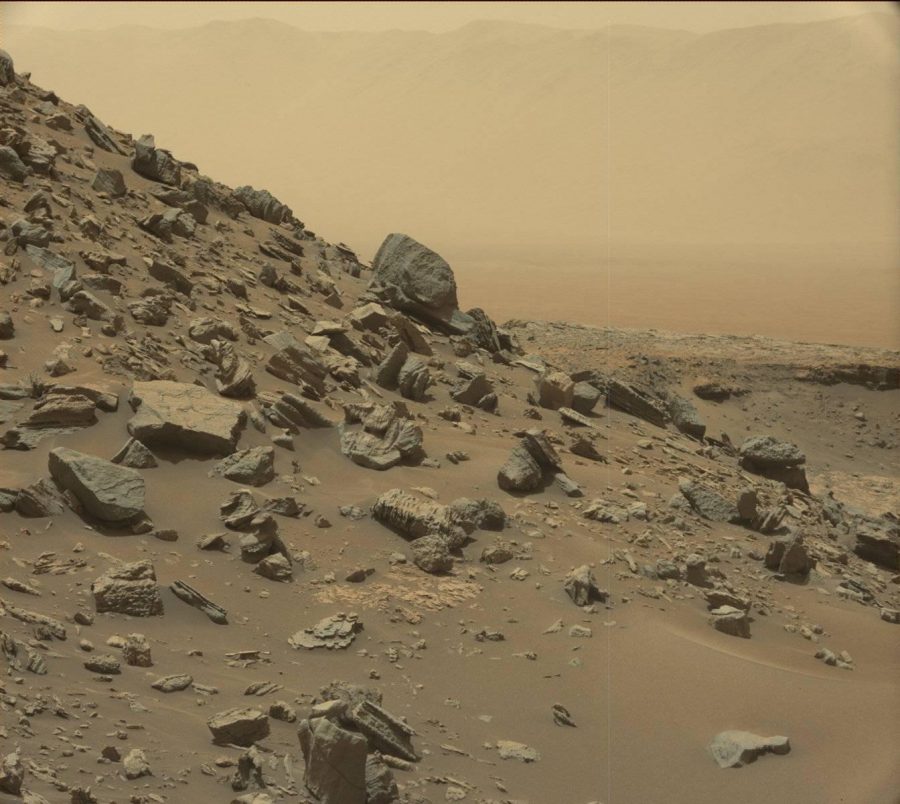
As I perused the stunning NASA photo archive, picking my jaw up from the floor several times, I found in some cases that my view began to shift, especially while looking at photos from the Mars rover missions, and reading the captions, which casually refer to every rocky outcropping, mountain, crater, and valley by name as though they were tourist destinations on a map of New Mexico. In addition to Sagan’s Cosmos, I also began to think of the colonization epics of Ray Bradbury and Kim Stanley Robinson—the corporate greed, the apocalyptic wars, the history repeating itself on another planet….
It’s easy to blame the current anti-science lobby for shifting the focus to planets other than our own. There is no justification for the mutually assured destruction of climate science denialism or nuclear escalation. But in addition to mapping and naming galaxies, black holes, and nebulae, we’ve seen an intense focus on the Red Planet for many years. It seems inevitable, as it did to the most far-sighted of science fiction writers, that we would make our way there one way or another.
We would do well to recover the sense of awe and wonder outer space used to inspire in us—sublime feelings that can motivate us not only to explore the seemingly limitless resources of space but to conserve and preserve our own on Earth. Hopefully you can find your own slice of the sublime in this massive photo archive.
As the co-founders of Impactstory describe it, Unpaywall is “an extension for Chrome and Firefox that links you to free full-text as you browse research articles. Hit a paywall? No problem: click the green tab and read it free!”
Their FAQ gets into the mechanics a little more, but here’s the gist of how it works: “When you view a paywalled research article, Unpaywall automatically looks for a copy in our index of over 10 million free, legal fulltext PDFs. If we find one, click the green tab to read the article.”
While many science publishers put a paywall in front of scientific articles, it’s often the case that these articles have been published elsewhere in an open format. “More and more funders and universities are requiring authors to upload copies of their papers to [open] repositories. This has created a deep resource of legal open access papers…” And that’s what Unpaywall draws on.
This seems like quite a boon for researchers, journalists, students and policymakers. You can download the Unpaywall extension for Chrome and Firefox, or learn more about the new service at the Unpaywall website.
If you would like to support the mission of Open Culture, consider making a donation to our site. It’s hard to rely 100% on ads, and your contributions will help us continue providing the best free cultural and educational materials to learners everywhere. You can contribute through PayPal, Patreon, and Venmo (@openculture). Thanks!
What do we live in: the only universe that exists, or an elaborate computer simulation of a universe? The question would have fascinated Isaac Asimov, and that presumably counts as one of the reasons the Isaac Asimov Memorial Debate took it as its subject last year. Though the so-called “simulation hypothesis” has, in various forms, crossed the minds of thinkers for millennia, it’s enjoyed a particular moment in the zeitgeist in recent years, not least because Elon Musk has publicly stated his view that, in all probability, we do indeed live in a simulation. And, if you can’t trust the guy who hit it big with Tesla and PayPal on the nature of reality, who can you?
Well, you might also consider listening to the perspectives of New York University philosopher David Chalmers, MIT cosmologist Max Tegmark, and three theoretical physicists, James Gates of the University of Maryland, Lisa Randall of Harvard, and Zohreh Davoudi of MIT.
They, with moderation by Neil DeGrasse Tyson, dig into the simulation hypothesis for two hours, approaching from all different angles its origin, its plausibility, and its implications. Davoudi, who has done serious research on the question, brings her work to bear; Randall, who finds little reason to credit the notion that we live in a simulation in the first place, has more of an interest in why others find it so compelling all of a sudden.
Whether you believe it, reject it, or simply enjoy entertaining the idea, you can’t help but feel a strong reaction of one kind or another to the simulation hypothesis, and Tyson contributes his usual humor to knock the discussion back down to Earth whenever it threatens to become too abstract. But how should we respond to the possibility of living in computed reality in the here and now (or “here” and now,” if you prefer)? The Matrixproposed a kind of simulation-hypothesis world whose heroes break out, but we may ultimately have no more ability to see the hardware running our world than Mario can see the hardware running his. “If you’re not sure whether you’re actually simulated or not,” says Tegmark, “my advice to you is to go out there and live really interesting lives and do unexpected things so the simulators don’t get bored and shut you down.” In these unreal times, you could certainly do worse.
Appearing at Oxford’s Sheldonian Theater in 2013, evolutionary biologist Richard Dawkins fielded a question that’s now being asked unnervingly often in our anti-Enlightenment age.
Audience member: “The question is about the nature of scientific evidence. You both said, and I think most people here would agree with you, that we’re justified in holding a belief if there is evidence for it, or there are logical arguments we can find that support it. But it seems like this in itself is a belief, which would require some form of evidence. If so, I’m wondering what you think would count as evidence in favour of that and, if not, how do we justify choosing that heuristic without appealing to the same standard that we are trying to justify?”
Dawkins: “How do we justify, as it were, that science would give us the truth? It works. Planes fly, cars drive, computers compute. If you base medicine on science, you cure people; if you base the design of planes on science, they fly; if you base the design of rockets on science, they reach the moon. It works … bitches.”
We're hoping to rely on loyal readers, rather than erratic ads. Please click the Donate button and support Open Culture. You can use Paypal, Venmo, Patreon, even Crypto! We thank you!
Open Culture scours the web for the best educational media. We find the free courses and audio books you need, the language lessons & educational videos you want, and plenty of enlightenment in between.