Buzz Aldrin and Thomas Dolby Geek Out and Sing “She Blinded Me With Science”

Buzz Aldrin is maybe the coolest ex-astro­naut alive, with the pos­si­ble excep­tion of Sto­ry Mus­grave. Both of these guys are forg­ing ahead with life at the age when less­er humans pack it in. At 77, Mus­grave has a five-year-old son and plans to go back into space soon (as a tourist); 83-year-old Aldrin is devel­op­ing a new sci-fi series based on his 1996 nov­el Encounter with Tiber. Cool, right? Just maybe don’t ask Buzz to dance to ‘80s syn­th­pop. He does have a great sense of humor, though.

Watch Aldrin duet with Thomas Dol­by on “She Blind­ed Me With Sci­ence” above. Buzz gets to shout “Sci­ence!” and bop back and forth like your grand­fa­ther rock­ing out at your wed­ding recep­tion. It’s cute. The per­for­mance hap­pened dur­ing a day­long Smith­son­ian con­fer­ence called “The Future is Here.” Aldrin was one of the four­teen fea­tured speak­ers who deliv­ered “nar­ra­tive talks that focused on both great tri­umphs and future inno­va­tions in sci­ence and tech­nol­o­gy.”

via Boing Boing

Relat­ed Con­tent:

The Moon Dis­as­ter That Wasn’t: Nixon’s Speech In Case Apol­lo 11 Failed to Return

Live: Watch NASA’s Cov­er­age of Aster­oid As It Buzzes By Earth

Josh Jones is a writer and musi­cian based in Wash­ing­ton, DC. Fol­low him at @jdmagness

The Beauty of Space Photography

So many of the images we see of out­er space are either cold and flat—a plan­et sphere sur­round­ed by scores of pin­point stars against the back­drop of black space—or they’re artists’ ren­der­ings.

The pic­tures fea­tured in The Beau­ty of Space Pho­tog­ra­phy are nei­ther of those. They’re more like con­cep­tu­al art: beau­ti­ful, mys­te­ri­ous, and intrigu­ing.

The video above is the lat­est episode of PBS’s Off Book, a web series that explores new Inter­net cul­ture. In this episode, the pro­duc­ers inter­view three astro­physi­cists, and they are any­thing but the pock­et-pro­tec­tor types. These sci­en­tists are artic­u­late, thought­ful, and pas­sion­ate about space and about pho­tograph­ing what they see through super-pow­er­ful tele­scopes.

Work­ing for dif­fer­ent insti­tu­tions, each sci­en­tist uses pho­tog­ra­phy as a major tool to study space. The images have func­tion­al val­ue of course, to assist with mea­sur­ing and doc­u­ment­ing find­ings. But there’s no deny­ing their beau­ty. Astro­physics also touch­es on philo­soph­i­cal ques­tions, so the pic­tures trig­ger a sense of awe that bor­ders on the exis­ten­tial.

The blue and pink swirls of cloud dust and deep spi­ral-shaped galax­ies in these pic­tures are breath­tak­ing because, as astro­physi­cist Emi­ly Rice says, we know what they are and yet they are unfath­omable.

The images are of such high qual­i­ty that they con­vey some of the depth and grandeur of space. The pic­tures seem to con­tain the unbe­liev­able immen­si­ty and allow us to focus in on just a small, beau­ti­ful piece of what is all around out there.

But that’s just part of the fun of this short video. Lis­ten­ing to the sci­en­tists talk about their work is like hav­ing an expert guide you through the uni­verse, a docent who’s excit­ed and edu­cat­ed about things that none of us can tru­ly com­pre­hend even as we gape at their beau­ty.

The oth­er sci­en­tists fea­tured in this short are David Hogg (NYU) and Zolt Lev­ay (Space Tele­scope Sci­ence Insti­tute).

Relat­ed Con­tent:

Find Cours­es on Astron­o­my and Physics in our Col­lec­tion of 700 Free Online Cours­es

125 Great Sci­ence Videos: From Astron­o­my to Physics & Psy­chol­o­gy

The Won­der, Thrill & Mean­ing of See­ing Earth from Space. Astro­nauts Reflect on The Big Blue Mar­ble

An Ani­mat­ed Visu­al­iza­tion of Every Observed Mete­orite That Has Hit Earth Since 861 AD

Kate Rix writes about dig­i­tal media and edu­ca­tion. Vis­it her web­site or fol­low her on Twit­ter @mskaterix.

Watch Isabella Rossellini Embody the Animal Kingdom’s Most Shocking Maternal Instincts in Mammas

Moth­er’s Day can elic­it com­pli­cat­ed emo­tions in the human ani­mal. Not so Moth­er Ham­ster. While you were out to brunch, she was mat­ter-of-fact­ly devour­ing the run­ti­est of her lit­ter. And not because he failed to present her with a bou­quet and flow­ery card. “It’s a good morsel to recoup some of the vit­a­mins and pro­tein that are lost dur­ing child­birth,” she explains with a shrug.

This heart­warm­ing vignette is but one of the rev­e­la­tions in Mam­mas, the lat­est web series from the inquis­i­tive and extreme­ly game Isabel­la Rosselli­ni. Hav­ing embod­ied a vari­ety of insects, arach­nids, and marine life in the sci­ence-based Green Porno and its fol­low-up Seduce Me, the moth­er of two is cur­rent­ly suit­ing up to play some of the Ani­mal King­dom’s most noto­ri­ous moth­ers, from the oppor­tunis­tic Cuck­oo to the self-sac­ri­fic­ing Aus­tralian sub­so­cial crab spi­der (Diaea ergan­dros).

The com­i­cal­ly inven­tive cos­tumes are an added bonus, par­tic­u­lar­ly for any human moth­er (or father) with an aver­sion to dress­ing their ani­mal-lov­ing off­spring in store bought dis­guis­es, come Hal­loween. Catch the com­plete series here.

Relat­ed Con­tent:

The Wild King­dom: Brought to You by Mutu­al of Oma­ha (and YouTube)

Film­ing a Sprint­ing Chee­tah at 1,200 Frames Per Sec­ond

Rainn Wil­son Talks About Life’s Big Ques­tions in His Web Series Meta­phys­i­cal Milk­shake

Ayun Hal­l­i­day thinks Isabel­la Rosselli­ni is the bee’s knees, espe­cial­ly when her glass legs are filled with beer. Fol­low her @AyunHalliday

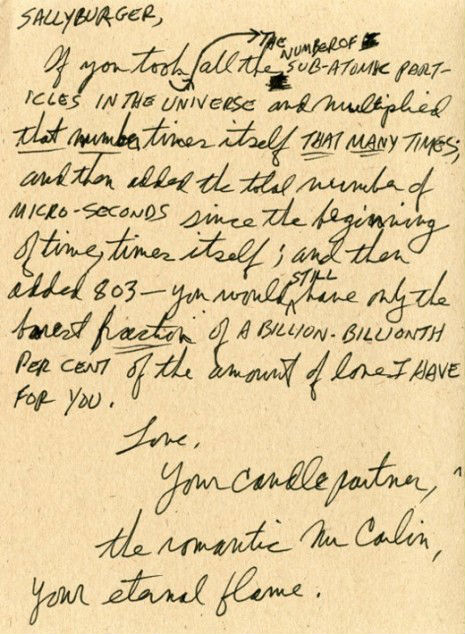
The Romantic George Carlin Writes a Nano-Powered, Sub Atomic-Filled Love Letter to His Wife

Carlin Letter

George Car­lin was more than a Class Clown. He was also a class act, as evi­denced by this undat­ed mis­sive to com­e­dy writer Sal­ly Wade, with whom he shared the final decade of his life. The man who once parsed the Sev­en Words You Can Nev­er Say on Tele­vi­sion show­ered his “spouse with­out papers” with such notes dai­ly.

Giv­en such a prodi­gious out­put, he wise­ly turned to sci­ence to quan­ti­fy his ardor in the repro­duc­tion above. (His physi­cian’s scrawl can be dif­fi­cult to deci­pher — a tran­scrip­tion is sup­plied below.)

SALLYBURGER,

If you took THE NUMBER OF SUB-ATOMIC PARTICLES IN THE UNIVERSE and mul­ti­plied that num­ber times itself THAT MANY TIMES; and then added the total num­ber of MICRO-SECONDS since the begin­ning of time, times itself; and then added 803—you would STILL have only the tini­est frac­tion of A BILLION-BILLIONTH PER CENT of the amount of love I HAVE FOR YOU.

Love,

your can­dle part­ner,
the roman­tic Mr Car­lin,
your eter­nal flame

A por­tion of these sweet noth­ings were col­lect­ed in The George Car­lin Let­ters. Its sub­ti­tle, The Per­ma­nent Courtship of Sal­ly Wade, was tak­en from the note he left on her com­put­er the day he died, two days shy of their 10th anniver­sary.

via Dan­ger­ous Minds

Relat­ed Con­tent:

RIP: George Car­lin on the Tonight Show (1966)

How the Great George Car­lin Showed Louis CK the Way to Suc­cess (NSFW)

George Car­lin: The Mod­ern Man in Three Min­utes

Ayun Hal­l­i­day has been lov­ing on Greg Kotis since 1991. Such notes as there are remain pri­vate, but you can fol­low her @AyunHalliday

An Animated Visualization of Every Observed Meteorite That Has Hit Earth Since 861 AD

Car­lo Zap­poni, a data visu­al­iza­tion design­er at Nokia, has cre­at­ed a pret­ty splen­did visu­al­iza­tion of the 1,042 mete­orites that humans have wit­nessed hit­ting our plan­et since 861 AD. If you click the image above, you will see the visu­al­iza­tion in full screen mode. And if you then click on var­i­ous points along the time­line, you’ll get essen­tial data (pro­duced by The Mete­orit­i­cal Soci­ety) about each observed mete­or strike. Most are clus­tered in the 19th and 20th cen­turies. The last is the ter­ri­fy­ing rock that blast­ed through Siberia ear­li­er this year.

Note: A total of 34,513 mete­orites have hit our plan­et since 2500 BC. But the vast major­i­ty were nev­er observed. They were only lat­er found.

via The Guardian 

Oth­er Great Visu­al­iza­tions:

Per­pet­u­al Ocean: A Van Gogh-Like Visu­al­iza­tion of Our Ocean Cur­rents

Visu­al­iz­ing WiFi Sig­nals with Light

Watch a Cool and Creepy Visu­al­iza­tion of U.S. Births & Deaths in Real-Time

Stephen Hawking’s Uni­verse: A Visu­al­iza­tion of His Lec­tures with Stars & Sound

by | Permalink | Make a Comment ( 1 ) |

Neil deGrasse Tyson Explains Why He’s Uncomfortable Being Labeled an ‘Atheist’

The evo­lu­tion­ary biol­o­gist Stephen Jay Gould famous­ly said that sci­ence and reli­gion are “nonover­lap­ping mag­is­te­ria”:

The net of sci­ence cov­ers the empir­i­cal uni­verse: what is it made of (fact) and why does it work this way (the­o­ry). The net of reli­gion extends over ques­tions of moral mean­ing and val­ue. These two mag­is­te­ria do not over­lap, nor do they encom­pass all inquiry (con­sid­er, for starters, the mag­is­teri­um of art and the mean­ing of beau­ty). To cite the arch clich­es, we get the age of rocks, and reli­gion retains the rock of ages; we study how the heav­ens go, and they deter­mine how to go to heav­en.

But sci­ence and reli­gion, as it is wide­ly prac­ticed, do over­lap. They both make spe­cif­ic claims about the nature and his­to­ry of the Uni­verse. Some reli­gion­ists do indeed make claims about the age of rocks.

Giv­en the obvi­ous over­lap, it’s not sur­pris­ing that scientists–particularly those who work in the most fun­da­men­tal and gen­er­al of fields, like physics and cosmology–are often asked for their views on reli­gion. In this short video from Big Think, astro­physi­cist and pop­u­lar sci­ence writer Neil deGrasse Tyson explains why he is loathe to take sides on the issue, and why he dis­likes the word “athe­ist.”

“The moment when some­one attach­es you to a phi­los­o­phy or a move­ment,” says Tyson, “then they assign all the bag­gage, and all the rest of the phi­los­o­phy that goes with it, to you. And when you want to have a con­ver­sa­tion, they will assert that they already know every­thing impor­tant that there is to know about you because of that asso­ci­a­tion. And that’s not the way to have a con­ver­sa­tion.”

Relat­ed Con­tent:

Neil deGrasse Tyson Lists 8 (Free) Books Every Intel­li­gent Per­son Should Read

Neil deGrasse Tyson Deliv­ers the Great­est Sci­ence Ser­mon Ever

Alain de Bot­ton Wants a Reli­gion for Athe­ists: Intro­duc­ing Athe­ism 2.0

Stephen Col­bert Talks Sci­ence with Astro­physi­cist Neil deGrasse Tyson

If Astronauts Cry in Space, Will Their Tears Fall?

The astro­nauts aboard the Inter­na­tion­al Space Sta­tion work every day on all kinds of exper­i­ments, from work­ing with robots to prepar­ing for space­walks. But when they get a break, they often field ques­tions from school chil­dren and adults about life in space.

Com­man­der Chris Had­field recent­ly video­taped him­self demon­strat­ing a sim­ple exper­i­ment inspired by a com­mon ques­tion: If an astro­naut cries in space, do their tears fall?

On Earth, of course, it’s grav­i­ty that caus­es tears to roll down the cheek. In a micro­grav­i­ty envi­ron­ment, if an astro­naut is sad or gets some­thing in his/her eye, tears will cer­tain­ly well up, but there will be none of what Smokey Robinson’s tears made on his face.

Had­field, pos­si­bly the most social media-savvy astro­naut ever with more than 500,000 Twit­ter fol­low­ers, game­ly demon­strates that tears do pool under the eye but they make no tracks. Squirt­ing water into his right eye, he rolls his head around, caus­ing the pud­dle of “tears” to shift back and forth and even roll over the bridge of his nose.

Tears don’t fall, he con­cludes, so bring a han­ky.

Had­field is no stranger to demon­strat­ing, or dis­cussing, human bod­i­ly func­tions in space. Speak­ing before the Ontario Space Cen­tre a few years ago, he dis­cussed some­thing that you may have won­dered about: going to the bath­room in space.

Kate Rix writes about dig­i­tal media and edu­ca­tion. Vis­it her web­site: .

The Popular Science Digital Archive Lets You Explore Every Science and Technology-Filled Edition Since 1872

popsci

Pop­u­lar Sci­ence is the fifth old­est con­tin­u­ous­ly-pub­lished month­ly magazine—a long way of say­ing that the mag­a­zine has done a fine job of main­tain­ing a niche in a crazi­ly fast-paced indus­try. Found­ed in 1872 by sci­ence writer Edward Youmans to reach an audi­ence of edu­cat­ed laypeo­ple, Pop­u­lar Sci­ence today com­bines reviews of the lat­est gad­gets with sto­ries about inno­va­tion in design and sci­ence. It’s an orga­nized mish­mash of news about “the future now,” lib­er­al­ly defined. A recent issue includ­ed sto­ries about the military’s use of 3‑D print­ing and an astro­physi­cist who ques­tions whether Shake­speare wrote the entire Folio.

With that kind of breadth, the magazine’s archives cov­er just about every­thing. And it’s easy to browse through back issues, dat­ing all the way back to 1872, since the mag­a­zine teamed up with Google to put a search­able archive on the web. The ear­li­est issues, like this one from Feb­ru­ary 1920, fea­ture col­or cov­ers that bring to mind sci­ence fic­tion with a fas­ci­na­tion for the imag­ined future.

One of the cool things about the mag­a­zine is its equal atten­tion to new and old tech­nol­o­gy. Search for “scis­sors” and you will find this 1964 arti­cle about the mechan­ics of sharp­en­ing your own scis­sors. The archive also offers anoth­er search tool that returns results in a visu­al word fre­quen­cy grid, which is espe­cial­ly cool if you click the “ani­mate” but­ton. Any social his­to­ri­ans out there able to explain why the word “scis­sor” would appear so often in the mid-20th cen­tu­ry?

Inter­est­ing­ly, although the word “inter­net” dates back to the 1960s, the word did­n’t appear in the magazine’s pages until 1989.

Peri­od adver­tise­ments are includ­ed, which adds to the fun. This issue from Sep­tem­ber, 1944 includes a house-adver­tise­ment on the table of con­tents page call­ing for all col­lec­tors of back issues to con­sid­er sur­ren­der­ing them for the war cause. “There’s a war going on and this is no time for sen­ti­ment,” the ad urges. “Grit your teeth and dig out those stacks of back num­bers. Then turn them over to your local paper sal­vage dri­ve!” Enter the archive here.

Relat­ed Con­tent:

Cor­nell Launch­es Archive of 150,000 Bird Calls and Ani­mal Sounds, with Record­ings Going Back to 1929

The Alan Lomax Sound Archive Now Online: Fea­tures 17,000 Record­ings

NASA Archive Col­lects Great Time-Lapse Videos of our Plan­et

« Go BackMore in this category... »
Quantcast