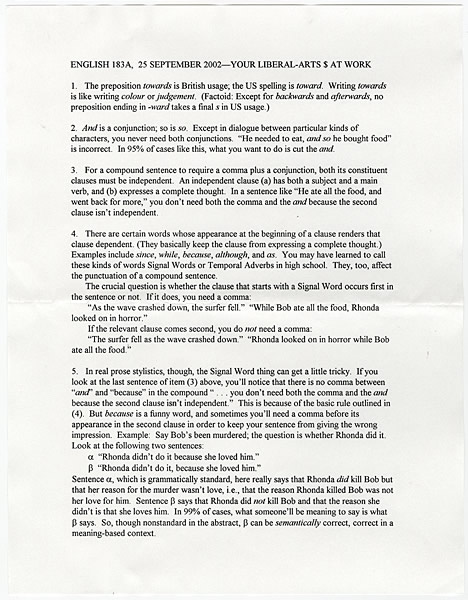
What advantage, I recently asked a trilingual writer, could you possibly find in using such an improvised, confusing, irregular patchwork of a language as English? She replied that this very improvisation, irregularity, and even confusion comes from the vast freedom of expression (and of invention of new expressions) that English offers over other European tongues. This goes even more so for American English, the variant with whose combination of carefully shaded nuances and smashing colloquialisms David Foster Wallace so dazzled his readers. Like many writers, Wallace also taught writing, but those of us not lucky enough to receive his direct instruction can still behold his teaching materials, archived online at the University of Texas at Austin’s Harry Ransom Center.
See, for instance, Wallace’s handout on five common usage mistakes, from his Fall 2002 section of English 183A at Pomona College (an advanced fiction writing class, taught last Spring by Jonathan Lethem). “The preposition towards is British usage; the US spelling is toward.” Fair enough. “And is a conjunction; so is so,” he continues. “Except in dialogue between particular kinds of characters, you never need both conjunctions.” Handy to know! Then, things get more technical: “For a compound sentence to require a comma plus a conjunction, both its constituent clauses must be independent.” As Wallace goes deeper, I feel even more sympathy for those who learn English as a second language, as I did when I read “Tense Present,” his Harper’s review of Bryan A. Garner’s A Dictionary of Modern American Usage. If the hardcore grammar talk tires you, feel free to peruse the Ransom Center’s other artifacts of Wallace’s time in the classroom—which we covered in a post last week—such as his syllabus for English 102: Literary Analysis, his guidelines for papers, and the marginalia in his copy of Carrie.
Colin Marshall hosts and produces Notebook on Cities and Culture and writes essays on literature, film, cities, Asia, and aesthetics. He’s at work on a book about Los Angeles, A Los Angeles Primer. Follow him on Twitter at @colinmarshall.
Jamaica Kincaid is out with her first novel in ten years, See Now Then, but she hasn’t been idle, steadily publishing non-fiction and essays in the span between 2002’s Mr. Potter and now. Kincaid is a many-faceted woman: Antiguan native, contented Vermont gardener, improbable literary success story, fierce critic of European colonialism. She is also, most likely, one of the most anthologized writers of the past few decades. Anyone who’s taken a writing or intro lit class recently has no doubt read her short story (or prose-poem) “Girl.”
With Kincaid in the news for her new book, the New Yorker’s Page-Turner blog caught up with one of her admirers, Haitian-American author and fellow New Yorker columnist Edwidge Danticat and asked her to read two of Kincaid’s classic stories, “Girl” and “Wingless,” published in the New Yorker in 1978 and ’79, for their fiction podcast. Danticat gladly obliged (hear the audio above), but not before briefly discussing her relationship to Kincaid and her work.
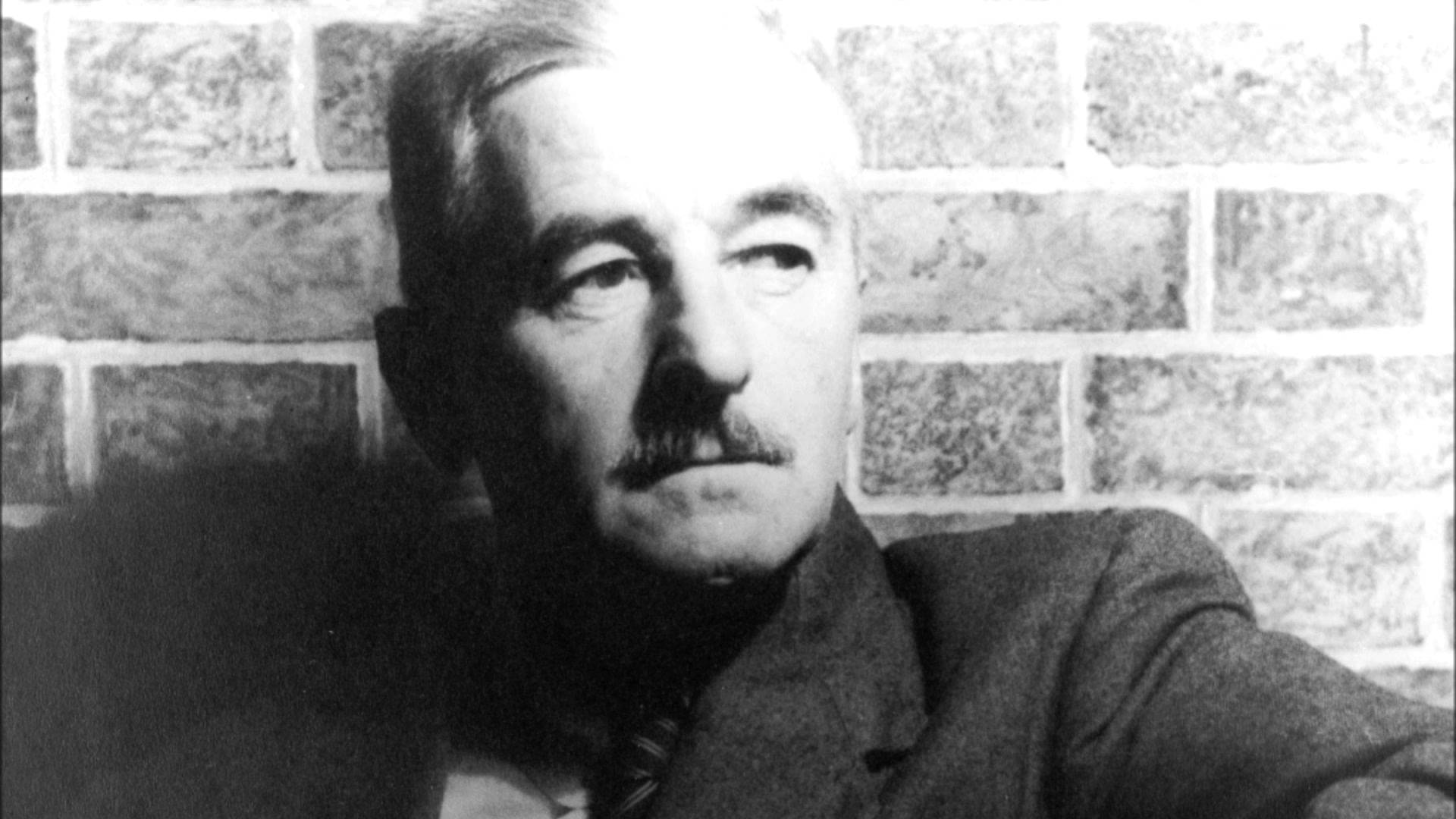
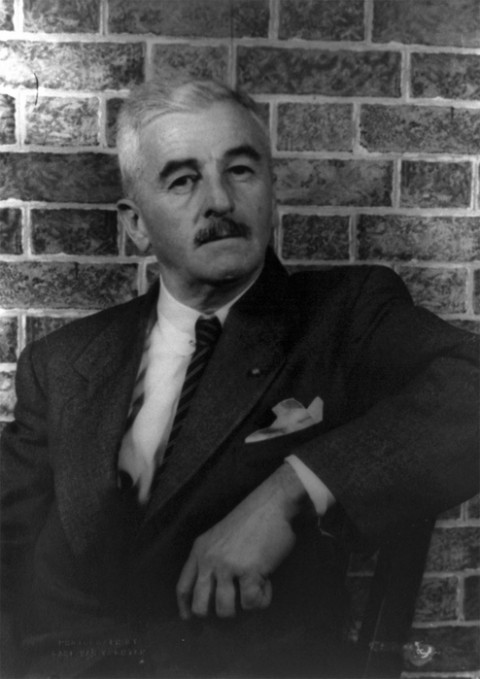
“The young writer would be a fool to follow a theory,” said the Nobel Prize-winning author William Faulkner in his 1958 Paris Review interview. “Teach yourself by your own mistakes; people learn only by error. The good artist believes that nobody is good enough to give him advice.”
All the same, Faulkner offered plenty of advice to young writers in 1957 and 1958, when he was a writer-in-residence at the University of Virginia. His various lectures and public talks during that time–some 28 hours of discussion–were tape recorded and can now be heard at the university’s Faulkner audio archive. We combed through the transcripts and selected seven interesting quotations from Faulkner on the craft of writing fiction. In most cases they were points Faulkner returned to again and again. Faulkner had a way of stammering when he composed his words out loud, so we have edited out the repetitions and false starts. We have provided links to each of the Virginia audio recordings, which are accompanied by word-for-word transcripts of each conversation.
1: Take what you need from other writers.
Faulkner had no qualms about borrowing from other writers when he saw a device or technique that was useful. In a February 25, 1957 writing class he says:
I think the writer, as I’ve said before, is completely amoral. He takes whatever he needs, wherever he needs, and he does that openly and honestly because he himself hopes that what he does will be good enough so that after him people will take from him, and they are welcome to take from him, as he feels that he would be welcome by the best of his predecessors to take what they had done.
2: Don’t worry about style.
A genuine writer–one “driven by demons,” to use Faulkner’s phrase–is too busy writing to worry about style, he said. In an April 24, 1958 undergraduate writing class, Faulkner says:
I think the story compels its own style to a great extent, that the writer don’t need to bother too much about style. If he’s bothering about style, then he’s going to write precious emptiness–not necessarily nonsense…it’ll be quite beautiful and quite pleasing to the ear, but there won’t be much content in it.
3: Write from experience–but keep a very broad definition of “experience.”
Faulkner agreed with the old adage about writing from your own experience, but only because he thought it was impossible to do otherwise. He had a remarkably inclusive concept of “experience.” In a February 21, 1958 graduate class in American fiction, Faulkner says:
To me, experience is anything you have perceived. It can come from books, a book that–a story that–is true enough and alive enough to move you. That, in my opinion, is one of your experiences. You need not do the actions that the people in that book do, but if they strike you as being true, that they are things that people would do, that you can understand the feeling behind them that made them do that, then that’s an experience to me. And so, in my definition of experience, it’s impossible to write anything that is not an experience, because everything you have read, have heard, have sensed, have imagined is part of experience.
4: Know your characters well and the story will write itself.
When you have a clear conception of a character, said Faulkner, events in a story should flow naturally according to the character’s inner necessity. “With me,” he said, “the character does the work.” In the same February 21, 1958 American fiction class as above, a student asked Faulkner whether it was more difficult to get a character in his mind, or to get the character down on paper once he had him in his mind. Faulkner replies:
I would say to get the character in your mind. Once he is in your mind, and he is right, and he’s true, then he does the work himself. All you need to do then is to trot along behind him and put down what he does and what he says. It’s the ingestion and then the gestation. You’ve got to know the character. You’ve got to believe in him. You’ve got to feel that he is alive, and then, of course, you will have to do a certain amount of picking and choosing among the possibilities of his action, so that his actions fit the character which you believe in. After that, the business of putting him down on paper is mechanical.
5: Use dialect sparingly.
In a pair of local radio programs included in the University of Virginia audio archive, Faulkner has some interesting things to say about the nuances of the various dialects spoken by the various ethnic and social groups in Mississippi. But in the May 6, 1958 broadcast of “What’s the Good Word?” Faulkner cautions that it’s important for a writer not to get carried away:
I think it best to use as little dialect as possible because it confuses people who are not familiar with it. That nobody should let the character speak completely in his own vernacular. It’s best indicated by a few simple, sparse but recognizable touches.
The only rule I have is to quit while it’s still hot. Never write yourself out. Always quit when it’s going good. Then it’s easier to take it up again. If you exhaust yourself, then you’ll get into a dead spell and you’ll have trouble with it.
7: Don’t make excuses.
In the same February 25, 1957 writing class, Faulkner has some blunt words for the frustrated writer who blames his circumstances:
I have no patience, I don’t hold with the mute inglorious Miltons. I think if he’s demon-driven with something to be said, then he’s going to write it. He can blame the fact that he’s not turning out work on lots of things. I’ve heard people say, “Well, if I were not married and had children, I would be a writer.” I’ve heard people say, “If I could just stop doing this, I would be a writer.” I don’t believe that. I think if you’re going to write you’re going to write, and nothing will stop you.
Here’s a quick video that serves as an addendum to last week’s post, “Don’t Try”: Charles Bukowski’s Concise Philosophy of Art and Life. As you’ll recall, Bukowski’s headstone is engraved with the simple saying, “Don’t Try,” and, if you look back at his letters, the cryptic expression could be interpreted in any number of ways. (See our summary.) But, thanks to Andrew Sullivan, we can take another good whack at making sense of Bukowski’s immortal words. Released in a posthumously published collection in 2003, the Bukowski poem “So You Want to be a Writer?” (above) warns the reader:
if you have to sit for hours
staring at your computer screen
or hunched over your
typewriter
searching for words,
don’t do it.
if you’re doing it for money or
fame,
don’t do it.
if you’re doing it because you want
women in your bed,
don’t do it.
Later, the poem continues:
when it is truly time,
and if you have been chosen,
it will do it by
itself and it will keep on doing it
until you die
or it dies in you.
So here’s another way to interpret, “Don’t try.” Either you’ve got it, or you don’t. And you’ll know it if you do.
The video above comes from the Spoken Verses YouTube collection. Tom O’Bedlam always does a nice job with the readings. In this case, I’m not so sure about the visual selections in the clip. But it’s not a perfect world.
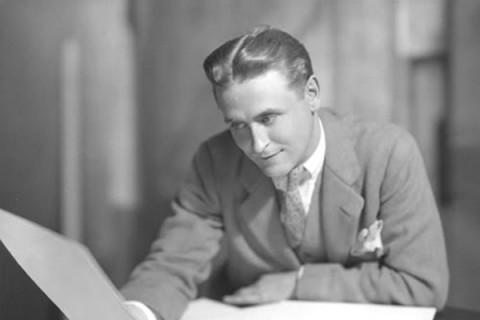
F. Scott Fitzgerald is often portrayed as a natural-born writer. “His talent,” says Ernest Hemingway in A Moveable Feast, “was as natural as the pattern that was made by the dust on a butterfly’s wings.” But Fitzgerald saw himself in a different light. “What little I’ve accomplished,” he said, “has been by the most laborious and uphill work.”
Last week we brought you Seven Tips From Ernest Hemingway on How to Write Fiction. Today we’re back with a similar list of advice from Hemingway’s friend and rival Fitzgerald. We’ve selected seven quotations from F. Scott Fitzgerald on Writing, which was edited by Larry W. Phillips and published in 1985 as a companion to the Hemingway book. As in the previous post, we’ve organized the advice under our own headings and added some brief commentary.
1: Start by taking notes.
Fitzgerald made a habit of recording his stray thoughts and observations in notebooks. He organized the entries into categories like “Feelings and emotions,” “Conversations and things overheard” and “Descriptions of girls.” When Fitzgerald was giving writing advice to his mistress Sheilah Graham in the late 1930s, he advised her to do the same. In her 1940 memoir, Beloved Infidel, Graham quotes Fitzgerald as saying:
You must begin by making notes. You may have to make notes for years.… When you think of something, when you recall something, put it where it belongs. Put it down when you think of it. You may never recapture it quite as vividly the second time.
2: Make a detailed outline of your story.
When Fitzgerald was working on a novel, he would surround himself with charts outlining the various movements and histories of his characters. In a 1936 letter to novelist John O’Hara, he advises the younger novelist to start with a big outline:
Invent a system Zolaesque…but buy a file. On the first page of the file put down an outline of a novel of your times enormous in scale (don’t worry, it will contract by itself) and work on the plan for two months. Take the central point of the file as your big climax and follow your plan backward and forward from that for another three months. Then draw up something as complicated as a continuity from what you have and set yourself a schedule.
3: Don’t describe your work-in-progress to anyone.
Fitzgerald’s policy was never to talk with other people about the book he was working on. In a 1940 letter to his daughter Scottie, he says:
I think it’s a pretty good rule not to tell what a thing is about until it’s finished. If you do you always seem to lose some of it. It never quite belongs to you so much again.
4: Create people, not types.
Fitzgerald was known for creating emblematic characters, but he said it was accidental. “I had no idea of originating an American flapper when I first began to write,” he said in a 1923 interview for Metropolitan magazine. “I simply took girls who I knew very well and, because they interested me as unique human beings, I used them for my heroines.” In the opening sentence of his 1926 short story, “The Rich Boy,” Fitzgerald explains the principle:
Begin with an individual, and before you know it you find that you have created a type; begin with a type, and you find that you have created–nothing.
5: Use familiar words.
In a 1929 letter to his college friend and fellow writer John Peale Bishop, Fitzgerald says:
6: Use verbs, not adjectives, to keep your sentences moving.
In a 1938 letter to his daughter, Fitzgerald writes:
About adjectives: all fine prose is based on the verbs carrying the sentences. They make sentences move. Probably the finest technical poem in English is Keats’ “Eve of Saint Agnes.” A line like “The hare limped trembling through the frozen grass,” is so alive that you race through it, scarcely noticing it, yet it has colored the whole poem with its movement–the limping, trembling and freezing is going on before your own eyes.
7: Be ruthless.
A writer has to make some hard choices. Fitzgerald warns about the danger of becoming too attached to something you’ve written. Keep an objective eye on the whole piece, he says, and if something isn’t working get rid of it. In a 1933 Saturday Evening Post article titled “One Hundred False Starts,” he writes:
I am alone in the privacy of my faded blue room with my sick cat, the bare February branches waving at the window, an ironic paper weight that says Business is Good, a New England conscience–developed in Minnesota–and my greatest problem:
“Shall I run it out? Or shall I turn back?”
Shall I say:
“I know I had something to prove, and it may develop farther along in the story?”
Or:
“This is just bullheadedness. Better throw it away and start over.”
The latter is one of the most difficult decisions that an author must make. To make it philosophically, before he has exhausted himself in a hundred-hour effort to resuscitate a corpse or disentangle innumerable wet snarls, is a test of whether or not he is really a professional. There are often occasions when such a decision is doubly difficult. In the last stages of a novel, for instance, where there is no question of junking the whole, but when an entire favorite character has to be hauled out by the heels, screeching, and dragging half a dozen good scenes with him.
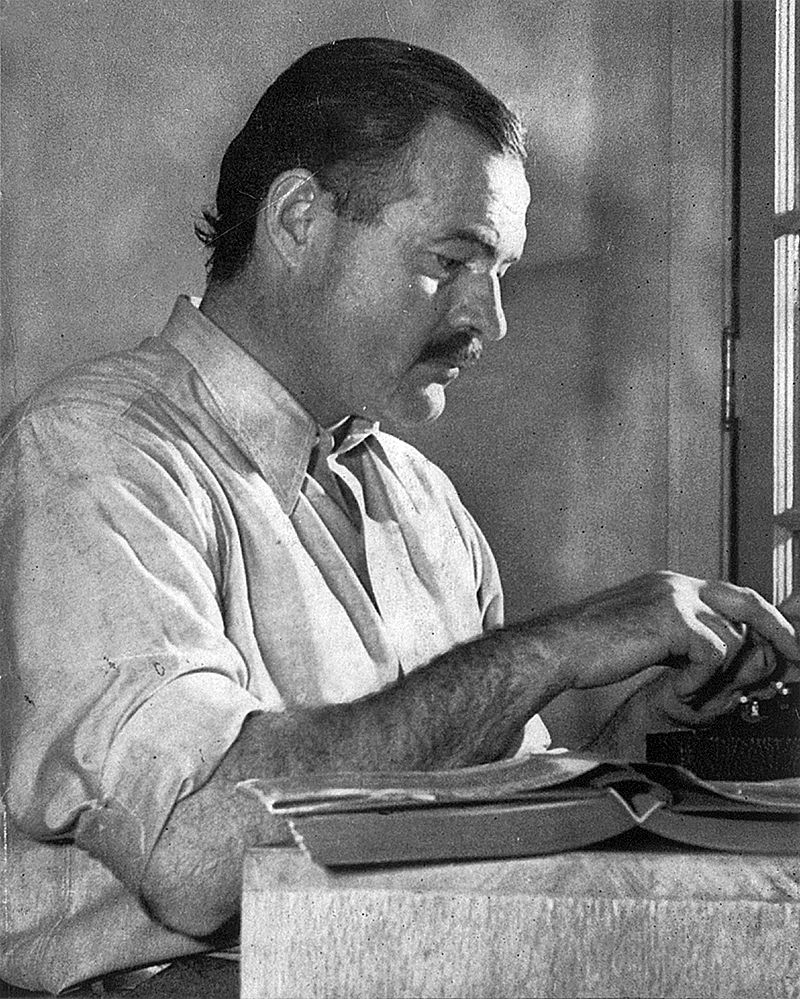
Before he was a big game hunter, before he was a deep-sea fisherman, Ernest Hemingway was a craftsman who would rise very early in the morning and write. His best stories are masterpieces of the modern era, and his prose style is one of the most influential of the 20th century.
Hemingway never wrote a treatise on the art of writing fiction. He did, however, leave behind a great many passages in letters, articles and books with opinions and advice on writing. Some of the best of those were assembled in 1984 by Larry W. Phillips into a book, Ernest Hemingway on Writing. We’ve selected seven of our favorite quotations from the book and placed them, along with our own commentary, on this page. We hope you will all–writers and readers alike–find them fascinating.
1: To get started, write one true sentence.
Hemingway had a simple trick for overcoming writer’s block. In a memorable passage in A Moveable Feast, he writes:
Sometimes when I was starting a new story and I could not get it going, I would sit in front of the fire and squeeze the peel of the little oranges into the edge of the flame and watch the sputter of blue that they made. I would stand and look out over the roofs of Paris and think, “Do not worry. You have always written before and you will write now. All you have to do is write one true sentence. Write the truest sentence that you know.” So finally I would write one true sentence, and then go on from there. It was easy then because there was always one true sentence that I knew or had seen or had heard someone say. If I started to write elaborately, or like someone introducing or presenting something, I found that I could cut that scrollwork or ornament out and throw it away and start with the first true simple declarative sentence I had written.
2: Always stop for the day while you still know what will happen next.
There is a difference between stopping and foundering. To make steady progress, having a daily word-count quota was far less important to Hemingway than making sure he never emptied the well of his imagination. In an October 1935 article in Esquire ( “Monologue to the Maestro: A High Seas Letter”) Hemingway offers this advice to a young writer:
The best way is always to stop when you are going good and when you know what will happen next. If you do that every day when you are writing a novel you will never be stuck. That is the most valuable thing I can tell you so try to remember it.
3: Never think about the story when you’re not working.
Building on his previous advice, Hemingway says never to think about a story you are working on before you begin again the next day. “That way your subconscious will work on it all the time,” he writes in the Esquire piece. “But if you think about it consciously or worry about it you will kill it and your brain will be tired before you start.” He goes into more detail in A Moveable Feast:
When I was writing, it was necessary for me to read after I had written. If you kept thinking about it, you would lose the thing you were writing before you could go on with it the next day. It was necessary to get exercise, to be tired in the body, and it was very good to make love with whom you loved. That was better than anything. But afterwards, when you were empty, it was necessary to read in order not to think or worry about your work until you could do it again. I had learned already never to empty the well of my writing, but always to stop when there was still something there in the deep part of the well, and let it refill at night from the springs that fed it.
4: When it’s time to work again, always start by reading what you’ve written so far.
T0 maintain continuity, Hemingway made a habit of reading over what he had already written before going further. In the 1935 Esquire article, he writes:
The best way is to read it all every day from the start, correcting as you go along, then go on from where you stopped the day before. When it gets so long that you can’t do this every day read back two or three chapters each day; then each week read it all from the start. That’s how you make it all of one piece.
5: Don’t describe an emotion–make it.
Close observation of life is critical to good writing, said Hemingway. The key is to not only watch and listen closely to external events, but to also notice any emotion stirred in you by the events and then trace back and identify precisely what it was that caused the emotion. If you can identify the concrete action or sensation that caused the emotion and present it accurately and fully rounded in your story, your readers should feel the same emotion. In Death in the Afternoon, Hemingway writes about his early struggle to master this:
I was trying to write then and I found the greatest difficulty, aside from knowing truly what you really felt, rather than what you were supposed to feel, and had been taught to feel, was to put down what really happened in action; what the actual things were which produced the emotion that you experienced. In writing for a newspaper you told what happened and, with one trick and another, you communicated the emotion aided by the element of timeliness which gives a certain emotion to any account of something that has happened on that day; but the real thing, the sequence of motion and fact which made the emotion and which would be as valid in a year or in ten years or, with luck and if you stated it purely enough, always, was beyond me and I was working very hard to get it.
6: Use a pencil.
Hemingway often used a typewriter when composing letters or magazine pieces, but for serious work he preferred a pencil. In the Esquire article (which shows signs of having been written on a typewriter) Hemingway says:
When you start to write you get all the kick and the reader gets none. So you might as well use a typewriter because it is that much easier and you enjoy it that much more. After you learn to write your whole object is to convey everything, every sensation, sight, feeling, place and emotion to the reader. To do this you have to work over what you write. If you write with a pencil you get three different sights at it to see if the reader is getting what you want him to. First when you read it over; then when it is typed you get another chance to improve it, and again in the proof. Writing it first in pencil gives you one-third more chance to improve it. That is .333 which is a damned good average for a hitter. It also keeps it fluid longer so you can better it easier.
7: Be Brief.
Hemingway was contemptuous of writers who, as he put it, “never learned how to say no to a typewriter.” In a 1945 letter to his editor, Maxwell Perkins, Hemingway writes:
It wasn’t by accident that the Gettysburg address was so short. The laws of prose writing are as immutable as those of flight, of mathematics, of physics.
If you would like to support the mission of Open Culture, consider making a donation to our site. It’s hard to rely 100% on ads, and your contributions will help us continue providing the best free cultural and educational materials to learners everywhere. You can contribute through PayPal, Patreon, and Venmo (@openculture). Thanks!
And make sure you always take two sharpened Number 2 pencils with you on airplanes (Margaret Atwood).
Like I said, it’s all pretty nuts-and-bolts advice. But if you’re looking for something a little more colorful and outside-the-box, then look no further than William Faulkner’s 1956 interview with the Paris Review. When asked “Is there any possible formula to follow in order to be a good novelist?,” Faulkner perhaps surprised his interviewer, Jean Stein, when he said:
An artist is a creature driven by demons… He is completely amoral in that he will rob, borrow, beg, or steal from anybody and everybody to get the work done.
Elaborating, Faulkner continued:
The writer’s only responsibility is to his art. He will be completely ruthless if he is a good one. He has a dream. It anguishes him so much he must get rid of it. He has no peace until then. Everything goes by the board: honor, pride, decency, security, happiness, all, to get the book written. If a writer has to rob his mother, he will not hesitate.…
If Stein hoped to get Faulkner back into more practical territory with her next question, she was disappointed. To the question, “Then what would be the best environment for a writer?,” Faulkner offered this:
If you mean me, the best job that was ever offered to me was to become a landlord in a brothel. In my opinion it’s the perfect milieu for an artist to work in. It gives him perfect economic freedom; he’s free of fear and hunger; he has a roof over his head and nothing whatever to do except keep a few simple accounts and to go once every month and pay off the local police. The place is quiet during the morning hours, which is the best time of the day to work. There’s enough social life in the evening, if he wishes to participate, to keep him from being bored.… My own experience has been that the tools I need for my trade are paper, tobacco, food, and a little whiskey.
If you want to translate this into practical advice, you get something like this. What should a young novelist aspire to? Basically being a Machiavellian-type in a cat house. Not a pretty idea, but that’s how one of America’s pre-eminent writers saw the literary life. And if you strip things down to their rawest essentials, you might find some wisdom there. Live for your art, and give yourself the economic freedom to write. Nothing more. Nothing less.
If you only know John Hodgman as the earnestly inept “P.C.” of those “I’m a Mac” Apple television commercials, you may wonder why you’d go to him for writing advice. Or maybe you’ve read his books The Areas of My Expertise, More Information Than You Require, and That is All. But just because a man can pen three satirical volumes of made-up knowledge doesn’t mean he can teach you how to properly cast your own ideas into print. No, to do that, Hodgman draws on his shadowy past as a literary agent, “a bold seven-year attempt to convince myself I didn’t want to be a writer.” Remembering that stint spent reading through piles upon piles of submissions, “the most elaborate procrastination technique that I came up with to avoid writing,” he confirms what we all suspect: a great many people want to write for a living, “but luckily, very few of them are sane.” And among that same minority, the “medium- to low-talented but persistent” succeed where the “merely super-talented” don’t.
Here we have an adaptation of a theory I’ve often heard, living as I do in Los Angeles, applied to film and television: while millions of hopefuls turn up every year trying to make it in The Industry, most of them are idiots. Hodgman delivers his version of these sage words with a newish look, miles away from the deliberately stodgy, poorly-tailored appearance with which he pitched the dubious virtues of the P.C. Behind his ascot, rounded mustache, and orange-tinted aviator glasses, he looks like nothing so much as a faintly disreputable Hollywood mogul of the seventies. But the subtle outlandishness of his self-presentation belies the sense of his advice. Whatever your level of talent, put yourself in the running with “the people who keep submitting and keep doing and keep making.” And make sure that, while writing what you know, you also know what you know.
Colin Marshall hosts and produces Notebook on Cities and Cultureand writes essays on literature, film, cities, Asia, and aesthetics. He’s at work on a book about Los Angeles, A Los Angeles Primer. Follow him on Twitter at @colinmarshall.
We're hoping to rely on loyal readers, rather than erratic ads. Please click the Donate button and support Open Culture. You can use Paypal, Venmo, Patreon, even Crypto! We thank you!
Open Culture scours the web for the best educational media. We find the free courses and audio books you need, the language lessons & educational videos you want, and plenty of enlightenment in between.