On Friday, the world had its eyes focused on the big asteroid flyby. For weeks, we knew it was coming, and we watched it buzz by with mild curiosity. But, that same day, we were all caught off guard by a ten-ton meteorite that blasted into the Siberian town of Chelyabinsk, injuring 1,200 people and causing considerable structural damage. (Watch footage here.) This abrupt and unexpected event has given governments a reason to start taking the risk of asteroid impacts a bit more seriously. And it might renew interest in a tool created by scientists at Purdue University and Imperial College London in 2010.
In a nutshell,Impact: Earth! is an interactive tool that lets anyone calculate the damage a comet or asteroid would cause if it happened to collide with our planet. You can customize the size and speed of the incoming object, and then find out if mankind survives. (Usually it does.) A grainy primer appears below. You can enter the website and start running your own scenarios right here.
Watch it anyway, for the interviewees thoughts on the state of illustration.
Professor Steven Guarnaccia of the The New School’s Illustration Program describes how illustration’s creative potential exploded once photography became the prime way of documenting celebrity appearances and other such newsworthy visuals.
Editorial Illustrator Yuko Shimisu internalizes those observations, throwing shade on any idea she feels would look better in photo form. Shimisu, like all of the artists featured in the short video, uses traditional media to make her drawings, but colors them digitally. The form may predate photography, but Shimisu implies that any practitioner unwilling to embrace the trend toward new media will find themselves going the way of the dodo, as editorial gigs migrate onto tablets and even smaller digital devices.
Meanwhile over at DC Comics, Sean Murphy has yet to discover a superpower capable of speeding up the work that goes into rendering a story in comic book format. The facial expressions, grand perspectives, and moody lighting that are his stock in trade could theoretically be captured with a shutter click, but at what cost to the overall narrative?
And then there’s the inimitable Molly Crabapple, purveyor of Victorian-flavored kink and founder of Dr. Sketchy’s Anti-Art School, whose Occupy Wall Street posters challenged the visual boundaries of activist art. Finding a personal style one can blow up into a brand is not just a choice, she implies. It’s one’s best hope of survival in a sea flooded with competitors.
- Ayun Halliday publishes her illustrated zine, The East Village Inky the old fashioned way, then promotes it across all manner of digital platforms, including @AyunHalliday.
Over this Presidents’ Day weekend, Hulu is streaming all of the Criterion Collection movies for free. That’s right, free! We’re talking hundreds of films by the likes of Ingmar Bergman, Andrei Tarkovsky, Charlie Chaplin, Jean-Luc Godard, Akira Kurosawa, David Lynch, Nagisa Oshima, François Truffaut, and Orson Welles. So cancel your weekend plans, wish your friends and family well, and start packing in as many classic films as you can. We recommend getting started with Kurosawa’s Seven Samurai, Godard’sBreathless, David Lynch’s Eraserheador Bergman’s The Seventh Seal.
Unfortunately, this collection is only accessible to viewers in the United States. We usually don’t feature geo-restricted material, but this seemed too good to pass up. In the meantime, if you live outside of the U.S., we’d encourage you to visit our collection of 500 Free Movies Online, where you’re bound to find something you’ll enjoy. Or you can check out our specialized film collections by Andrei Tarkovsky, Alfred Hitchock, Charlie Chaplin and John Wayne, not to mention our collection of Film Noir Classics.
Like the idea of totalitarianism, perhaps best articulated by Hannah Arendt in her post-war Origins of Totalitarianism, George Orwell’s post-war scrutiny of repressive governments has become a staple, catch-all reference for pundits on either side of the political spectrum, particularly the concepts of doublespeak, doublethink, historical revisionism, and the hyper-intrusive Big Brother, all from the 1949 novel 1984. In fact, few adjectives seem to get deployed with more frequency in urgent political discourse of all kinds than “Orwellian.” But the name George Orwell, pen name of journalist Eric Blair, hides an enigma: Orwell identified himself explicitly as a Democratic Socialist of a particularly English bent (most notably in his essay “The Lion and the Unicorn”), but his scathing critiques of nearly every existing institution sometimes make it hard to pin him down as a partisan of anything but the kind of freedom and openness that everyone vaguely wants to advocate. That ambiguity is a strength; despite his steadfast leftist roots, Orwell would not be a partisan hack—where he saw stupidity, avarice, and brutal inhumanity, he called it out, no matter the source.
The seeming contradictions and ironies that permeate Orwell’s thought and fiction are also what keep his work perennially interesting and worth rereading and revisiting. He was a probing and unsentimental critic of the motives of propagandists of all stripes, both left and right. Beginning in late January, BBC Radio 4 launched a month-long series on Orwell, with the avowedly ironic name, “The Real George Orwell.” Part of the irony comes from the fact that Orwell (or Blair) once worked as a propagandist for the BBC during WWII, and later based the torture area in 1984, Room 101, on a meeting room he recalled from his time there. His experiences with the state broadcasting network were not pleasant in his memory. Nonetheless, his former employer honors him this month with an extensive retrospective, including readings and dramatizations of his essays and journalism, his semi-autobiographical accounts Down and Out in Paris and Londonand Homage to Catalonia, and his novels Animal Farm and 1984.
In this latest dramatization of Orwell’s most famous novel, protagonist Winston Smith is voiced by actor Christopher Eccleston, who has inhabited another key post-war character in English fiction, Dr. Who (Pippa Nixon voices Julia). In a brief discussion of what he takes away from the novel, Eccleston (above) draws out some of the reasons that 1984 appeals to so many people who might agree on almost nothing else. At the heart of the novel is the kind of humanist individualism that Orwell never abandoned and that he championed against Soviet-style state communism and hard-right imperialist authoritarianism both. Winston Smith is an embodiment of human dignity, celebrated for his struggle to “love, remember, and enjoy life,” as Eccleston says. “It’s the human story that means that we keep coming back to it and that keeps it relevant.” Listen to a brief clip of the 1984 dramatization at the top of this post, and visit BBC Radio 4’s site to hear parts one and two of the full broadcast, which is available online for the next year. When Europe and America both seem rent in two by competing and incompatible social and political visions, it’s at least some comfort to know that no one wants to live in the world Orwell foresaw. Despite his novel’s deeply pessimistic ending, Orwell’s own career of fierce resistance to oppressive regimes offers a model for action against the dystopian future he imagined.
For other free, online readings of Orwell’s work, you can visit our archives of Free Audio Books, where you’ll find
NASA Television will provide commentary starting at 11 a.m. PST (2 p.m. EST) on Friday, Feb. 15, during the close, but safe, flyby of a small near-Earth asteroid named 2012 DA14. NASA places a high priority on tracking asteroids and protecting our home planet from them. This flyby will provide a unique opportunity for researchers to study a near-Earth object up close.
The half-hour broadcast from NASA’s Jet Propulsion Laboratory in Pasadena, Calif., will incorporate real-time animation to show the location of the asteroid in relation to Earth, along with live or near real-time views of the asteroid from observatories in Australia, weather permitting.
At the time of its closest approach to Earth at approximately 11:25 a.m. PST (2:25 p.m. EST / 19:25 UTC), the asteroid will be about 17,150 miles (27,600 kilometers) above Earth’s surface.
The commentary will be available via NASA TV and streamed live online at: https://www.nasa.gov/ntv and https://www.ustream.tv/nasajpl2
We don’t need to tell you, an Open Culture reader, about the richness of David Lynch’s contribution to motion pictures. But the auteur also has an ongoing relationship with still photography which the past decade has seen emerge into public light. Years ago, I attended an opening in Los Angeles—the city so thoroughly captured by Lynch’s surrealism—of an exhibition of his own shots. Now, the Los Angeles Review of Books presents Lynch’s commentary, in the video above, on 99 pictures taken by others. Listen to him describe his viewing approach—that of a voyeuristic, all-feeling detective—and you’ll never look the same way at curtains, women’s shoes, stone Buddhas, and festering sores again.
Lynch selected these favorite 99 photos from the thousand presented at 2012’s Paris Photo, the international photography fair that happens each November during the European Month of Photography. He arrived as the inaugural selection of “Paris Photo vu par…,” a new tradition that will each year compile a book of images, their selection “entrusted to a different personality each year.” Die-hard fans will surely need to own their idol’s edition, and in late April they can make a pilgrimage to Lynch’s town for the launch of Paris Photo Los Angeles. Its location? The lot of Paramount Pictures, distributor of Lynch’s photographically striking The Elephant Man.
Colin Marshall hosts and produces Notebook on Cities and Culture and writes essays on literature, film, cities, Asia, and aesthetics. He’s at work on a book about Los Angeles, A Los Angeles Primer. Follow him on Twitter at @colinmarshall.
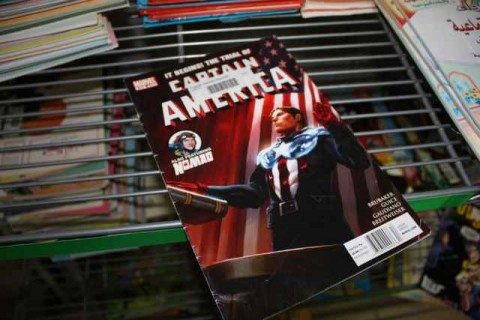
Nike footwear and celebrity athletes usually go hand-in-hand. When you think Nike, you think of Michael Jordan, Bo Jackson and Mia Hamm. And let’s not forget the now troubled duo of Tiger Woods and Lance Armstrong too. Fit, lithe bodies generally sell sneakers, we know that.
But then there’s the bizarre, odd exception. Let’s rewind the videotape to 1994, when Nike enlisted William S. Burroughs to sell its Air Max shoes. That’s right a decrepit 79-year-old Beat writer, known for his heroin addiction, manslaughter conviction and cut up writing. William S. Burroughs is pretty much the anti-Mia Hamm. And yet the ad works in its own way. Just like the Gap could use Jack Kerouac to lend hipster cred to its stodgy khakis, so Burroughs could bring a mainstreamed counterculture cool to Nike shoes as his head, appearing in a TV set proclaims, “The purpose of technology is not to confuse the brain, but to serve the body, to make life easier, to make anything possible. It’s the coming of the new technology.” That new technology being, I guess, the cutting edge cushions in Nike’s shoes?
Want to know what’s going on the poetry world? Ask University of Pennsylvania professor Al Filreis. A national treasure for modern American poetry, Filreis serves as Faculty Director of the Kelly Writers House, Director of UPenn’s Center for Programs in Contemporary Writing, and Co-Director of the excellent poetry recording series and archive PennSound. He also teaches a Coursera massive open online course, “ModPo,” which has reached over 36,000 students, bringing his thirty years of seminar-style teaching experience to the masses. On top of all that, Filreis is the publisher of contemporary poetry webzine Jacket 2, which hosts a podcast called “PoemTalk.”
“PoemTalk” brings together poets, writers, and teachers to informally discuss a single poem. Like Filreis’ classes—in which he prefers lively discussions over long lectures—these seminar-like sessions involve a lot of friendly disagreement and serendipitous insights, with many pearls of poetic wisdom scattered throughout. The first episode of “PoemTalk” (above), from December 2007, took on William Carlos Williams’ fragmentary modernist provocation “Between Walls”:
Between Walls
the back wings
of the
hospital where
nothing
will grow lie
cinders
in which shine
the broken
pieces of a green
bottle
If you don’t see much in this little imagist exercise, you might just want to read it again, several times, after listening to Filreis, Saigon-born poet Linh Dinh, teacher and poet Randall Couch, and poet Jessica Lowenthal unpack the poem’s many resonances and reflections. (Or you might have had your fill by then). Williams’ approach was completely innovative, stripping all of the rhetorical excesses from American poetry, which suffered from a kind of Victorian hangover into the first decades of the twentieth century until those nasty modernists finished roughing it up. As the episode’s page points out, “‘Between Walls’ has had a huge influence on poetry and photography since its first publication in 1934.” Listen to the discussion above to find out why such a seemingly straightforwardly unsentimental, un-“poetic” piece of writing had such an impact.
Since this inaugural episode, “PoemTalk” has covered several dozen contemporary, living poets, as well as such notables as Ezra Pound, John Ashbery, Adrienne Rich, Allen Ginsberg, and Wallace Stevens. By the way, as an added bonus, all of the poems discussed on “PoemTalk” are available as audio recordings on PennSound, read by the poets themselves. Here’s Williams reading “Between Walls.”
“PoemTalk”’s most recent episode takes as its text Charles Alexander’s “Near or Random Acts.” You can listen through the website or subscribe on iTunes.
It’s Valentine’s Day and love is in the air. Or at least something is in the air in this deleted scene from the 1999 cult film Mystery Men. We’re not sure exactly what. In the film, Tom Waits plays the mad scientist Dr. Heller, inventor of “Fog-in-a-Tube” and “Truthpaste,” among other things. For another strange scene of cupid’s arrow gone badly astray, see our post from last year, David Lynch Falls in Love: A Classic Scene From Twin Peaks.
If you would like to sign up for Open Culture’s free email newsletter, please find it here. It’s a great way to see our new posts, all bundled in one email, each day.
If you would like to support the mission of Open Culture, consider making a donation to our site. It’s hard to rely 100% on ads, and your contributions will help us continue providing the best free cultural and educational materials to learners everywhere. You can contribute through PayPal, Patreon, and Venmo (@openculture). Thanks!
In a terrific historical prank that sent Nazi Propaganda Minister Joseph Goebbels storming out of the screening room, British minister Charles A. Ridley edited together scenes from the film Triumph of the Will with the music from the musical Me and My Girl to create a spoof that infuriated leaders of the Third Reich.
Lambeth Walk—Nazi Style was released in 1941 to newsreel companies. It was billed as “Schichlegruber Doing the Lambeth Walk, Assisted by the Gestapo Hep Cats,” and lays the catchy tune against images of Hitler and Nazi soldiers from Leni Riefenstahl’s seminal propaganda film.
The story goes that the parody enraged Goebbels to such an extent that he ran out of the screening room, kicking at chairs and screaming obscenities.
“The Lambeth Walk” tune was written for the 1937 musical, about a Cockney boy who inherits a fortune and must leave behind his working-class ways to become a gentleman. Nazi party officials called the tune “Jewish mischief and animalistic hopping,” making it even funnier as the background music for Nazi soldiers parading.
The name “Schichlegruber,” by the way, was also a dig at Hitler. It was the name of his maternal grandmother, whose son Alois (Hitler’s father) was an illegitimate child. Oops!
“Imagine, if you will, sitting down to your morning coffee, turning on your home computer to read the day’s newspaper.” A flamboyantly speculative-sounding notion, no doubt, were you watching this television news broadcast back when it aired in 1981. A production of San Francisco’s KRON, the segment takes a look at how the city’s newspapers, displaying admirable farsightedness, were then “investing a lot of money to try and get a service just like that started.” We see North Beach resident Richard Halloran (he of the immortally meme-worthy onscreen identifier, “Owns Home Computer”) dialing, on his rotary telephone, “a local number that will connect him with a computer in Columbus, Ohio.” We also see the editors of the San Francisco Examiner “programming today’s copy of the paper into that same Ohio computer.” Halloran plops the phone’s receiver into his modem’s acoustic coupler, presumably pours his morning coffee, and downloads the day’s paper — which takes two hours, at a cost of five dollars an hour.
“This is only the first step in newspapers by computer,” says KRON science reporter Steve Newman. “Engineers now predict the day will come when we get all out newspapers and magazines by home computer.” We see footage of a traditional newspaper vendor: “But that’s a few years off, so for the moment, at least, this fellow isn’t worried about being out of a job.” That day came over a decade ago, and that fellow surely worries now, as do the publishers of his wares. We who start each day reading the news on our “home computers” laugh at the newspaper industry’s evident hubristic self-destruction by its failure to understand the internet, much less engage with it. But this report shows us that certain papers — the eight that Halloran’s menu offered him, at least — seemingly had their eyes on the ball long before we did. Do we see here an industry sowing the seeds of its own inevitable destruction, or evidence that things could have turned out differently?
Colin Marshall hosts and produces Notebook on Cities and Culture and writes essays on literature, film, cities, Asia, and aesthetics. He’s at work on a book about Los Angeles, A Los Angeles Primer. Follow him on Twitter at @colinmarshall.
We're hoping to rely on loyal readers, rather than erratic ads. Please click the Donate button and support Open Culture. You can use Paypal, Venmo, Patreon, even Crypto! We thank you!
Open Culture scours the web for the best educational media. We find the free courses and audio books you need, the language lessons & educational videos you want, and plenty of enlightenment in between.