You might have seen a new type of ancient human on the news recently, nicknamed, affectionately, ‘the hobbit’ (not because they were taking the ring to Mordor, but because of their rather diminutive stature).
If you didn’t, here’s the news in brief: a team of scientists went digging for the first Australians and instead found a completely new (and tiny) ancient human. Since then they’ve been trying to work out what happened to these small ancestors of ours.
To share their findings, some of the scientists involved in understanding ‘the hobbit’ have put together a 4 week free online course to explain how the discovery unfolded…
The course has been created with FutureLearn and will take you inside the world of this new species, giving you a run through modern scientific archaeological techniques along the way.
Here’s what’s on the syllabus:
Week 1 — Human Origins and Introduction to Archaeology
Learn about where you, me and everyone came from — before getting onto the moment ‘the hobbit’ was discovered.
Week 2 — Archaeological Methods: In the Cave
You think a festival is bad? Get to grips with how science translates in somewhere without electricity or water.
Week 3 — Archaeological Science: In the Lab
Understand what happens once all the archaeological finds are delicately hauled back to the lab.
Week 4 — Future Directions
‘The Hobbit’, despite it’s size, is having a big impact in the world of archaeology — find out exactly what this little ancient human might mean for the story of our origins.
Intrigued? Join the course today — it started this week, and you’re not too late to join.
Jess Weeks is a copywriter at FutureLearn. She has never conducted ground-breaking science in a cave, or discovered a new species, but there’s still time.
William S. Burroughs may have died almost twenty years ago, but that doesn’t mean his fans have gone entirely without new material since. This year, for instance, has seen the release of the Naked Lunchauthor’s new spoken word album Let Me Hang You, which you can listen to free on Spotify. (If you don’t have Spotify’s free software, download it here.) Its content, in fact, comes straight from that form- and taboo-breaking 1959 novel, which Burroughs committed to tape — along with a trio of accomplished experimental musicians — not long before his passing, and which thus got lost along the way to commercial release.
“But more than 20 years later,” writes the New York Times’ Joe Coscarelli, “those surreal recordings — which featured music from the guitarist and composer Bill Frisell, along with the pianist Wayne Horvitz and the violist Eyvind Kang — are getting a second life as an album with an assist from the independent musician King Khan, best known for his raucous live shows as an eccentric punk and soul frontman.” Fans of Burroughs’ roughest-edged material can rest assured that, in these sessions, the writer focused on speaking the “unspeakable” parts of Naked Lunch: “think sex, drugs, and defecation,” Coscarelli says.
Hard as it may seem to believe that a novel written well over half a century ago, let alone one written by an author born more than a century ago, could retain its power to shock, this newly published musical interpretation of Burrough’s substance-inspired, random-access, “obscenity”-laden text freshens its transgressive impact. “One particularly jagged track on the record is ‘Clem Snide the Private Ass Hole,’ ” writes Rolling Stone’s Kory Grow. “As Burroughs stiltedly reads his own bizarre prose in which the titular Snide recites every lurid, gritty detail he notices while watching a junky ‘female hustler,’ Khan and his fellow musicians play a brittle, upbeat groove and funky, bluesy guitar solos.” Finally, someone has taken this work of the most offbeat of all the Beats and set it to a beat.
You’ve likely heard a good deal recently—especially if you hang around these parts—about the 100th anniversary of Dada, supposedly begun when poet and Cabaret Voltaire owner Hugo Ball penned his manifesto in 1916 and began disseminating the ideas of the nascent anti-art movement. This makes a convenient origin story, as they say in the comics, and helps us contextualize the avant-garde explosion that followed. But, historically speaking, there is no such thing as creation ex nihilo, and the beginnings of Dada—before Ball coined the name—lie further back in time. (We might refer to the distinction Edward Said makes between a divine “origin” and a secular “beginning.”)
We could, as many do, situate the beginnings of Dada in the previous century, in Alfred Jarry’s bizarre 1896 play Ubu Roi or Erik Satie’s minimalist late 19th century Gymnopedies. We might also refer to an arts magazine in New York that preceded Tristan Tzara’s Dada and Ball’s single issue Cabaret Voltaire. Edited by famed photographer and art promoter Alfred Stieglitz, the journal 291 ran for 12 issues between 1915 and 1916 and is known, writes Dada-Companion.com, as “the first expression of the dada esthetic in the United States; proto-dada, actually, dada avant la lettre, before dada had started in Zürich in 1916.” Along with the University of Iowa, Ubuweb hosts the entire 12-issue print run, “a financial fiasco” in its day, “failing to sell more than eight subscriptions on vellum and a hundred on ordinary paper…. In the end Stieglitz sold the entire backstock to a ragpicker for $5.80.”
Despite this inglorious end, 291 is notable not only for its proto-dada status—and for featuring the work of modernists like Georges Braque, Guillaume Apollinaire, and later Dada and Surrealist artist Francis Picabia; the magazine also “occupies an interesting position among the journals of modernist art” as “the first magazine to style itself as a work of art in its own right.” You can get a sense of its artistry in the covers you see here, and download every issue of the magazine at Ubuweb or at the University of Iowa’s International Dada Archive. You’ll also see the magazine’s unusual format—from odd little topical items of the sort you’d find in a local newspaper to fascinating visual poetry like “Mental Reactions,” below, by Agnes Ernst Meyer. What we can’t get from the digital copies, unfortunately, is the full sense of 291’s “dramatic form” in its “gigantic folio format.”
The modernist journal “took its original inspiration from Apollinaire’s Soirées de Paris,” a journal founded in 1912 by the French poet and critic and his friends, “emphasizing caligrammatic texts and an abstracted kind of satirical drawing.” And though 291 may have had a very limited reach during its material existence, its influence continued into the era of Dada when Francis Picabia styled his own journal, 391, after Steiglitz’s publication. “Published 1917–1924 in Barcelona, New York, Zürich, and Paris in nineteen issues,” writes Booktryst, 391 helped Picabia distribute his own take on Dada, until he denounced the movement in 1921 and “issued a personal attack against [Surrealist Andre Breton] in the final issue.” The University of Iowa also hosts digital versions of all 19 issues of Picabia’s 391, which you can view and download here.
You don’t have to, like, stretch your brain or anything to rattle off a list of Keith Richards’ influences. If you’ve ever heard a Rolling Stones song, you’ve heard him pull out his Muddy Waters and Chuck Berry riffs, and he’s never been shy about supporting and naming his idols. He’s played with Waters, Berry, and many more blues and early rock and roll greats, and after borrowing heavily from them, the Stones gave back by promoting and touring with the artists who provided the raw material for their sound.
Then there’s the 2002 compilation The Devil’s Music, culled from Richards’ personal favorite collection of blues, soul, and R&B classics, and featuring big names like Robert Johnson, Little Richard, Bob Marley, Albert King, and Lead Belly, and more obscure artists like Amos Milburn, and Jackie Brenston. You may also recall last year’s Under the Influence, a Netflix documentary by 20 Feet From Stardom director Morgan Neville, in which Richards namechecks dozens of influential musicians—from his mum’s love of Sarah Vaughan, Ella Fitzgerald, and Billie Holiday, to his and Jagger’s youthful adoration of Waters and Berry, to his rock star hangouts with Willie Dixon and Howlin’ Wolf.
Point is, Keith Richards loves to talk about the music he loves. A big part of the Stones’ appeal—at least in their 60s/early 70s prime—was that they were such eager fans of the musicians they emulated. Yes, Jagger’s phony country drawls and blues howls could be a little embarrassing, his chicken dance a little less than soulful. But the earnestness with which the young Englishmen pursued their Americana ideals is infectious, and Richards has spread his love of U.S. roots music through every medium, including his 2010 memoir Life, a wickedly ironic title—given Richards’ No. 1 position on the “rock stars most-likely-to-die list,” writes Michiko Kakutani, “and the one life form (besides the cockroach) capable of surviving nuclear war.”
It’s also a very poignant title, given Richards’ single-minded pursuit of a life governed by music he’s loved as passionately, or more so, as the women in his life. Richards, Kakutani writes, dedicated himself “like a monk to mastering the blues.” Of this calling, he writes, “you were supposed to spend all your waking hours studying Jimmy Reed, Muddy Waters, Little Walter, Howlin’ Wolf, Robert Johnson. That was your gig. Every other moment taken away from it was a sin.” In the course of the book, Richards mentions over 200 artists, songs, and recordings that directly inspired him early or later in life, and one enterprising reader has compiled them all, in order of appearance, in the Spotify playlist above.
You’ll find here no surprises, but if you’re a Stones fan, it’s hard to imagine you wouldn’t put this one on and listen to it straight through without skipping a single track. When it comes to blues, soul, reggae, country, and rock and roll, Keith Richards has impeccable taste. Scattered amidst the Aaron Neville, Etta James, Gram Parsons, Elvis, Wilson Pickett, etc. are plenty of classic Stones recordings that feel right at home next to their influences and peers.
With the exception of reggae artists like Jimmy Cliff and Sly & Robbie, most of the tracks are from U.S. or U.S.-inspired artists (Tom Jones, Cliff Richard). Again, no surprises. Not everyone Richards appropriated has appreciated the homage (Chuck Berry long held a grudge), but were it not for his fandom and apprenticeship, it’s possible a great many blues records would have gone unsold, and some artists may have faded into obscurity. Thanks to playlists like these, they can live on in a digital age that doesn’t always do so well at acknowledging or remembering its history.
Jeff Buckley released just one studio album, Grace, before the emerging star died unexpectedly in May, 1997, drowning while swimming in the waters flowing from the Mississippi River. He was only 30 years old.
Given his painfully short discography, fans will delight in the newly-dropped album, You and I, which features, among other things, previously-unreleased Buckley covers of songs originally recorded by Bob Dylan (“Just Like a Woman”); Sly & the Family Stone (“Everyday People”); Led Zeppelin (“Night Flight”) and more. The album is now streaming on Spotify.
Starved for some more Buckley music? Then you’ll also want to check out this new interactive website which lets you browse/stream every album in Buckley’s varied vinyl record collection. Miles Davis, Billie Holiday, Siouxsie and the Banshees, Van Morrison, the Stones, Dylan, Bowie, Coltrane and The Clash–they’re all part of the collection. The video above shows you how to take full advantage of the new site. Enjoy.
If you would like to sign up for Open Culture’s free email newsletter, please find it here. It’s a great way to see our new posts, all bundled in one email, each day.
If you would like to support the mission of Open Culture, consider making a donation to our site. It’s hard to rely 100% on ads, and your contributions will help us continue providing the best free cultural and educational materials to learners everywhere. You can contribute through PayPal, Patreon, and Venmo (@openculture). Thanks!
The mind of Kurt Vonnegut, like the protagonist of his best-known novel Slaughterhouse-Five, must have got “unstuck in time” somewhere along the line. How else could he have managed to write his distinctive brand of satirical but sincere fiction, hyper-aware of past, present, and future all at once? It must have made him a promising contributor indeed for Volkswagen’s 1988 Time magazine ad campaign, when the company “approached a number of notable thinkers and asked them to write a letter to the future — some words of advice to those living in 2088, to be precise.”
The beloved writer’s letter to the “Ladies & Gentlemen of A.D. 2088” begins as follows:
It has been suggested that you might welcome words of wisdom from the past, and that several of us in the twentieth century should send you some. Do you know this advice from Polonius in Shakespeare’s Hamlet: ‘This above all: to thine own self be true’? Or what about these instructions from St. John the Divine: ‘Fear God, and give glory to Him; for the hour of His judgment has come’? The best advice from my own era for you or for just about anybody anytime, I guess, is a prayer first used by alcoholics who hoped to never take a drink again: ‘God grant me the serenity to accept the things I cannot change, courage to change the things I can, and wisdom to know the difference.’
Our century hasn’t been as free with words of wisdom as some others, I think, because we were the first to get reliable information about the human situation: how many of us there were, how much food we could raise or gather, how fast we were reproducing, what made us sick, what made us die, how much damage we were doing to the air and water and topsoil on which most life forms depended, how violent and heartless nature can be, and on and on. Who could wax wise with so much bad news pouring in?
For me, the most paralyzing news was that Nature was no conservationist. It needed no help from us in taking the planet apart and putting it back together some different way, not necessarily improving it from the viewpoint of living things. It set fire to forests with lightning bolts. It paved vast tracts of arable land with lava, which could no more support life than big-city parking lots. It had in the past sent glaciers down from the North Pole to grind up major portions of Asia, Europe, and North America. Nor was there any reason to think that it wouldn’t do that again someday. At this very moment it is turning African farms to deserts, and can be expected to heave up tidal waves or shower down white-hot boulders from outer space at any time. It has not only exterminated exquisitely evolved species in a twinkling, but drained oceans and drowned continents as well. If people think Nature is their friend, then they sure don’t need an enemy.
You can read the whole thing at Letters of Note, where Vonnegut goes on to give his own interpretation of humanity’s perspective at the time, when “we were seeing ourselves as a new sort of glacier, warm-blooded and clever, unstoppable, about to gobble up everything and then make love — and then double in size again.” He puts the question to his future-inhabiting readers directly: “Is it possible that we aimed rockets with hydrogen bomb warheads at each other, all set to go, in order to take our minds off the deeper problem—how cruelly Nature can be expected to treat us, Nature being Nature, in the by-and-by?”
Finally, Vonnegut issues seven commandments — as much directed to readers of the late 20th century as to readers of the late 21st, or indeed to those of the early 21st in which you read this now — intended to help humanity avert what he sees as the utter catastrophe looming ahead:
Reduce and stabilize your population.
Stop poisoning the air, the water, and the topsoil.
Stop preparing for war and start dealing with your real problems.
Teach your kids, and yourselves, too, while you’re at it, how to inhabit a small planet without helping to kill it.
Stop thinking science can fix anything if you give it a trillion dollars.
Stop thinking your grandchildren will be OK no matter how wasteful or destructive you may be, since they can go to a nice new planet on a spaceship. That is really mean, and stupid.
And so on. Or else.
Volkswagen had asked him to look one hundred years into the future. As of this writing, 2088 lies less than 75 years ahead, and how many of us would agree that we’ve heeded most or even any of his prescriptions? Then again, Vonnegut grants that pessimism may have got the better of him; perhaps the future will bring with it a utopia after all, one where “nobody will have to leave home to go to work or school, or even stop watching television. Everybody will sit around all day punching the keys of computer terminals connected to everything there is, and sip orange drink through straws like the astronauts,” a comically dystopian utopia, and not an entirely un-prescient one — a Vonnegutian vision indeed.
I was surprised there’s an actual, medical name for it: pareidolia, defined by Merriam-Webster as “the tendency to perceive a specific, often meaningful, image in a random or ambiguous visual pattern.”
Thomas Lamadieu, the artist whose work is showcased above, has a different, but not wholly unrelated condition.
Most of us prefer to contemplate the heavens in a bucolic setting. Lamadieu’s art compels him to look upwards from a more urban landscape. The tops of the buildings hemming him in supply with irregularly shaped frames, which he captures using a fish eye lens. Later, he fills them in with Microsoft Paint drawings, which frequently feature a bearded man whose t‑shirt is striped in sky blue. Negative space, not Crayola, supplies the color here.
Think of it as street art in the sky.
Not every day can be a brilliant azure, but it hardly matters when even Lamadieu’s grayest views exhibit a determined playfulness. It takes a very unique sort of eye to tease a pink nippled, stripe-limbed bunny from a steely UK sky.
Like many street artists, he takes a global approach, traveling the world in search of giant unclaimed canvases. His portfolio contains vistas originally captured in Hong Kong, South Korea, Germany, Spain, Austria, Canada, Belgium, and the United States, as well as his native France.
“The bearded man in my images stands for the sky itself,” he told The Independent, adding that his is a wholly secular vision.
The inner critic creates writer’s block and stifles adventurous writing, hems it in with safe clichés and overthinking. Every writer has to find his or her own way to get free of that sourpuss rationalist who insists on strangling each thought with logical analysis and fitting each idea into an oppressive predetermined scheme or ideology. William S. Burroughs, one of the most adventurous writers to emerge from the mid-20th century, famously employed what he called the cut-up method.
Developed by Burroughs and painter Brion Gysin, this literary take on the collage technique used by avant-garde artists like Georges Braque originated with Surrealist Tristan Tzara, who “proposed to create a poem on the spot by pulling words out of a hat.” The suggestion was so provocative, Burroughs claims in his essay “The Cut-Up Method,” that cut-ups were thereafter “grounded… on the Freudian couch.”
Since Burroughs and Gysin’s literary redeployment of the method in 1959, it has proved useful not only for poets and novelists, but for songwriters like David Bowie and Kurt Cobain. And any frustrated novelist, poet, or songwriter may use it to shake off the habitual thought patterns that cage creativity or choke it off entirely. How so?
Well, it’s best at this point to defer to the authority, Burroughs himself, who explains the cut-up technique thus:
The method is simple. Here is one way to do it. Take a page. Like this page. Now cut down the middle and cross the middle. You have four sections: 1 2 3 4 … one two three four. Now rearrange the sections placing section four with section one and section two with section three. And you have a new page. Sometimes it says much the same thing. Sometimes something quite different–(cutting up political speeches is an interesting exercise)–in any case you will find that it says something and something quite definite. Take any poet or writer you fancy. Heresay, or poems you have read over many times. The words have lost meaning and life through years of repetition. Now take the poem and type out selected passages. Fill a page with excerpts. Now cut the page. You have a new poem. As many poems as you like.
Burroughs gives us “one way” to do it. There may be infinite others, and it’s up to you to find what works. I myself have pushed through a creative funk by making montages from scraps of ancient poetry and phrases of modern pop, clichés ripped from the headlines and esoteric quotes from obscure religious texts—pieced together more or less at random, then edited to fit the form of a song, poem, or whatever. Virtual cut-and-paste makes scissors unnecessary, but the physical act may precipitate epiphanies. “Images shift sense under the scissors,” Burroughs writes; then he hints at a synesthesia experience: “smell images to sound sight to sound sound to kinesthetic.”
Who is this method for? Everyone, Burroughs asserts. “Cuts ups are for everyone,” just as Tzara remarked that “poetry is for everyone.” No need to have established some experimental art world bona fides, or even call oneself an artist at all; the method is “experimental in the sense of being something to do.” In the short video at the top, you can hear Burroughs explain the technique further, adding his occult spin on things by noting that many cut-ups “seem to refer to future events.” On that account, we may suspend belief.
As Jennie Skerl notes in her essay on Burroughs, cut-up theory “parallels avant-garde literary theory” like Jacques Derrida’s Deconstruction. “All writing is in fact cut ups,” writes Burroughs, meaning not that all writing is pieced together with scissors and glue, but that it’s all “a collage of words read heard overheard.” This theory should liberate us from onerous notions of originality and authenticity, tied to ideas of the author as a sui generis, all-knowing god and the text as an expression of cosmically ordered meaning. (Another surrealist writing method, the game of Exquisite Corpse, makes the point literal.) All that metaphysical baggage weighs us down. Everything’s been done—both well and badly—before, Burroughs writes. Follow his methods and his insistent creative maxim and you cannot make a mistake—“Assume that the worst has happened,” he writes, “and act accordingly.”
If you have any entrepreneurial aspirations, you’ve likely heard of Y Combinator (YC), an accelerator based in Silicon Valley that’s been called “the world’s most powerful start-up incubator” (Fast Company) or “a spawning ground for emerging tech giants” (Fortune). Twice a year, YC carefully selects a batch of start-ups, gives them $120,000 of seed funding each (in exchange for some equity), and then helps nurture the fledgling ventures to the next stage of development. YC hosts dinners where prominent entrepreneurs come to speak and offer advice. They hold “Demo Days,” where the start-ups can pitch their concepts and products to investors, and they have “Office Hours,” where budding entrepreneurs can work through problems with the seasoned entrepreneurs who run YC. Then, with a little luck, these new start-ups will experience the same success as previous YC companies, Dropbox and Airbnb.
Given Y Combinator’s mission, it makes perfect sense that YC has ties with Stanford University, another institution that has hatched giant tech companies–Google, Cisco, Yahoo and more. Back in 2014, Sam Altman (the president of Y Combinator) put together a course at Stanford called “How to Start a Start-Up,” which essentially offers students an introduction to the key lessons taught to YC companies. Altman presents the first two lectures. Then some of the biggest names in Silicon Valley take over. Dustin Moskovitz (Facebook co-founder), Peter Thiel (PayPal co-founder), Marc Andreessen (Netscape creator/general partner of Andreessen Horowitz), Marissa Mayer (Yahoo CEO, prominent Googler), Reid Hoffman (LinkedIn co-founder), Ron Conway (Silicon Valley super angel), Paul Graham (YC founder)–they all make an appearance in the course.
If you would like to sign up for Open Culture’s free email newsletter, please find it here. It’s a great way to see our new posts, all bundled in one email, each day.
If you would like to support the mission of Open Culture, consider making a donation to our site. It’s hard to rely 100% on ads, and your contributions will help us continue providing the best free cultural and educational materials to learners everywhere. You can contribute through PayPal, Patreon, and Venmo (@openculture). Thanks!
Over on iTunes, you can find a short course (8 lectures in total) on the age-old mystery: How did Hannibal and his elephants cross the Alps during the Second Punic War? The course was presented by archeologist Patrick Hunt in the Continuing Studies program at Stanford University, back in 2007. Here’s the description for the course:
Hannibal is a name that evoked fear among the ancient Romans for decades. His courage, cunning and intrepid march across the dangerous Alps in 218 BCE with his army and war elephants make for some of the most exciting passages found in ancient historical texts written by Polybius, Livy, and Appian. And they continue to inspire historians and archaeologists today. The mystery of his exact route is still a topic of debate, one that has consumed Patrick Hunt (Director of Stanford’s Alpine Archaeology Project) for more than a decade. This course examines Hannibal’s childhood and his young soldierly exploits in Spain. Then it follows him over the Pyrenees and into Gaul, the Alps, Italy, and beyond, examining his victories over the Romans, his brilliance as a military strategist, and his legacy after the Punic Wars. Along the way, students will learn about archaeologists’ efforts to retrace Hannibal’s journey through the Alps and the cutting-edge methods that they are using. Hunt has been on foot over every major Alpine pass and has now determined the most probable sites where archaeological evidence can be found to help solve the mystery.
If you live in the San Francisco Bay Are, you’ll definitely want to check out the courses offered by Stanford Continuing Studies (where I also happen to work). The program also regularly offers online courses, for students living anywhere on this planet.
If you would like to sign up for Open Culture’s free email newsletter, please find it here. It’s a great way to see our new posts, all bundled in one email, each day.
If you would like to support the mission of Open Culture, consider making a donation to our site. It’s hard to rely 100% on ads, and your contributions will help us continue providing the best free cultural and educational materials to learners everywhere. You can contribute through PayPal, Patreon, and Venmo (@openculture). Thanks!
It’s fair to say that every period which has celebrated the literature of antiquity has held epic Roman poet Virgil in extremely high regard, and that was never more the case than during the early Christian and medieval eras. Born in 70 B.C.—writes Clyde Pharr in the introduction to his scholarly Latin text—“Vergil was ardently admired even in his own day, and his fame continued to increase with the passing centuries. Under the later Roman Empire the reverence for his works reached the point where the Sortes Virgilianae came into vogue; that is, the Aeneid was opened at random, and the first line on which the eyes fell was taken as an omen of good or evil.”
This cult of Virgil only grew until “a great circle of legends and stories of miracles gathered around his name, and the Vergil of history was transformed into the Vergil of magic.” The spelling of his name also transformed from Vergil to Virgil, “thus associating the great poet with the magic or prophetic wand, virgo.” Pharr quotes from J.S. Tunison’s Master Virgil, a study of the poet “as he seemed in the Middle Ages”:
The medieval world looked upon him as a poet of prophetic insight, who contained within himself all the potentialities of wisdom. He was called the Poet, as if no other existed; the Roman, as if the ideal of the commonwealth were embodied in him; the Perfect in Style, with whom no other writer could be compared; the Philosopher, who grasped the ideas of all things…
Virgil, after all, acted as the wise guide through the Inferno for late medieval poet Dante, who was accorded a similar degree of reverence in the early modern period.
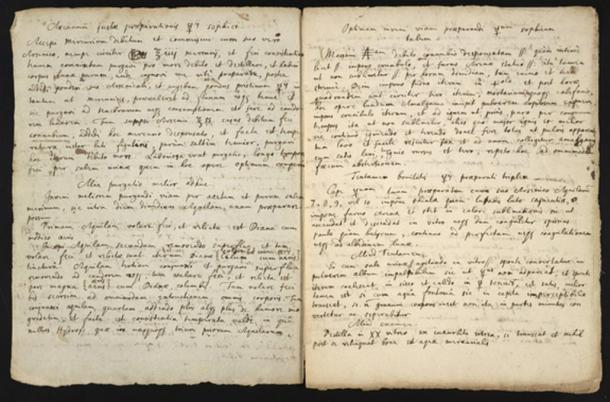
We should keep the cult of Virgil, and of his epic poem The Aeneid, in mind as we survey the text you see represented here—an illuminated manuscript from Rome created sometime around the year 400 (view the full, digitized manuscript here). Beginning at the end of another great epic—The Iliad—Virgil’s long poem connects the world of Homer to his own through Aeneas and his companions, Trojan refugees and mythical founders of Rome. It is somewhat ironic that the Christian world came to venerate the poem for centuries—claiming that Virgil predicted the birth of Christ—since the Roman poet’s purpose, writes Pharr, was “to see effected… a revival of faith in the old-time religion”—the old-time pagan religion, that is.
But the careful preservation of this ancient manuscript, some 1,600 years old, testifies to the Catholic church’s profound respect for Virgil. “Known as the Vergilius Vaticanus,” writes Hyperallergic, it’s one of the world’s oldest versions of the Latin epic poem, and you can browse it for free online” at Digita Vatica, a nonprofit affiliated with the Vatican Library.
Written by a single master scribe in rustic capitals, an ancient Roman calligraphic script, and illustrated by three different painters, Vergilius Vaticanus is one of only three illuminated manuscripts of classic literature. Granulated gold, applied with a brush, highlights meticulously colored images of famous scenes from the poem: Creusa as she tries to keep her husband Aeneas from going into battle; the islands of the Cyclades and the city of Pergamea destroyed by pestilence and drought; Dido on her funeral pyre, speaking her final soliloquy.
Hyperallergic describes the painstaking care a Tokyo-based firm took in digitizing the fragile text. Digita Vaticana is currently in the midst of scanning its entire collection of 80,000 delicate, ancient manuscripts, a process expected to take 15 years and cost 50 million euros.
Should you wish to contribute to the effort, you can make a donation to the project. The first 200 donors willing and able to fork over at least 500 euros (currently about $533), will receive a printed reproduction of the Vergilius Vaticanus, sure to impress the classics lovers in your life. Should you wish to read the Aeneid in its original language, a true undertaking of love, you can’t go wrong with Pharr’s excellent scholarly text of the first six books (or see an online Latin text here). If you’d rather skip the genuinely difficult and laborious translation, you can always read John Dryden’s translation free online.
We're hoping to rely on loyal readers, rather than erratic ads. Please click the Donate button and support Open Culture. You can use Paypal, Venmo, Patreon, even Crypto! We thank you!
Open Culture scours the web for the best educational media. We find the free courses and audio books you need, the language lessons & educational videos you want, and plenty of enlightenment in between.