Alice Babette Toklas met Gertrude Stein in 1907, the day she arrived in Paris. They remained together for 39 years until Stein’s death in 1946. While Stein became the center of the avant-garde art world, hosting an exclusive salon that welcomed the likes of Ernest Hemingway, Pablo Picasso, James Joyce, Ezra Pound and F. Scott Fitzgerald, Toklas largely preferred to stay in Stein’s shadow, serving as her secretary, editor and assistant.
That changed in 1933 when Stein wrote The Autobiography of Alice B. Toklas(read it online)– a retelling of the couple’s life together with Toklas serving as narrator. The book is Stein’s most accessible and best-selling work. It also turned the shy, self-effacing Toklas into a literary figure.
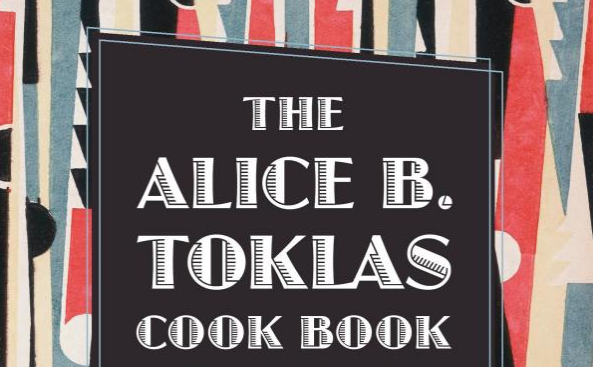
After Stein’s death, Toklas published The Alice B. Toklas Cookbook in 1954, which combined personal recollections of her time with Stein along with recipes and musings about French cuisine. Yet it wasn’t her stories about tending to the wounded during WWI or her opinions on mussels that made the book famous. Instead, it was the inclusion of a recipe given to her by Moroccan-based artist Brion Gysin called “Hashish Fudge.”
In this 1963 recording from Pacifica Radio, Toklas reads her notorious recipe. The snack “might provide an entertaining refreshment for a Ladies’ Bridge Club or a chapter meeting of the DAR,” Toklas notes in her reedy, dignified voice. Then she gets on to the recipe itself:
Take one teaspoon black peppercorns, one whole nutmeg, four average sticks of cinnamon, one teaspoon coriander. These should all be pulverized in a mortar. About a handful each of stoned dates, dried figs, shelled almonds and peanuts: chop these and mix them together. A bunch of Cannabis sativa can be pulverized. This along with the spices should be dusted over the mixed fruit and nuts, kneaded together. About a cup of sugar dissolved in a big pat of butter. Rolled into a cake and cut into pieces or made into balls about the size of a walnut, it should be eaten with care. Two pieces are quite sufficient.
Toklas concedes that getting the key ingredient “can present certain difficulties” and recommends finding the stuff in the wild, which might have been possible to do in the early 1960s. Nowadays, the best course of action is to move to Washington, Colorado or Uruguay.
In the recording, Toklas then goes on to recall how hashish fudge came to be included into her book.
“The recipe was innocently included without my realizing that the hashish was the accented part of the recipe,” she says without a trace of facetiousness. “I was shocked to find that America wouldn’t accept it because it was too dangerous.”
“It never went into the American edition,” she says. “The English are braver. We’re not courageous about that sort of thing.”
Jonathan Crow is a Los Angeles-based writer and filmmaker whose work has appeared in Yahoo!, The Hollywood Reporter, and other publications. You can follow him at @jonccrow.
The Wellcome Library, in London, specializes in the history of medicine. While the institution has long offered a good digital collection for browsing, the library announced yesterday that they are making more than 100,000 historical images free to download under a Creative Commons CC-BY license. (Users can distribute, edit, or remix at will; the license even allows for commercial use, with attribution.)
The Wellcome’s holdings represent the institution’s long-term interest in collecting art related to medicine, the body, public health, and medical science. The drop-down menu labeled “Technique” in the standard search box returns a staggering array of types of visual culture, from aquatint to carving to fresco to X‑ray. The library reports that the earliest image available is from 400 AD: a fragment of papyrus from an illustrated herbal manuscript, featuring a faded color drawing of a plant.
Browsers interested in dipping a toe into the stream of images may try out the galleries listed on the Images homepage. The “Olympic Sports” gallery offers an 1829 engraving of the famous conjoined twins Chang and Eng holding badminton rackets, and an 1870 illustration of recommended ring exercises for lady gymnasts. The “Witchcraft” collection (under the “Favourites” tab) contains many illustrations from historical books covering witchcraft in Europe and the American colonies, along with a more surprising 19th-century Malayan black-magic charm.
Rights-managed images are marked as such in the thumbnail results that appear after a search. Although the archive requires you to enter a CAPTCHA to access the free images, you can select several thumbnails on the search-results page in order to bulk-download files for many images at the same time. The sample files I requested arrived on my desktop at 300 dpi.
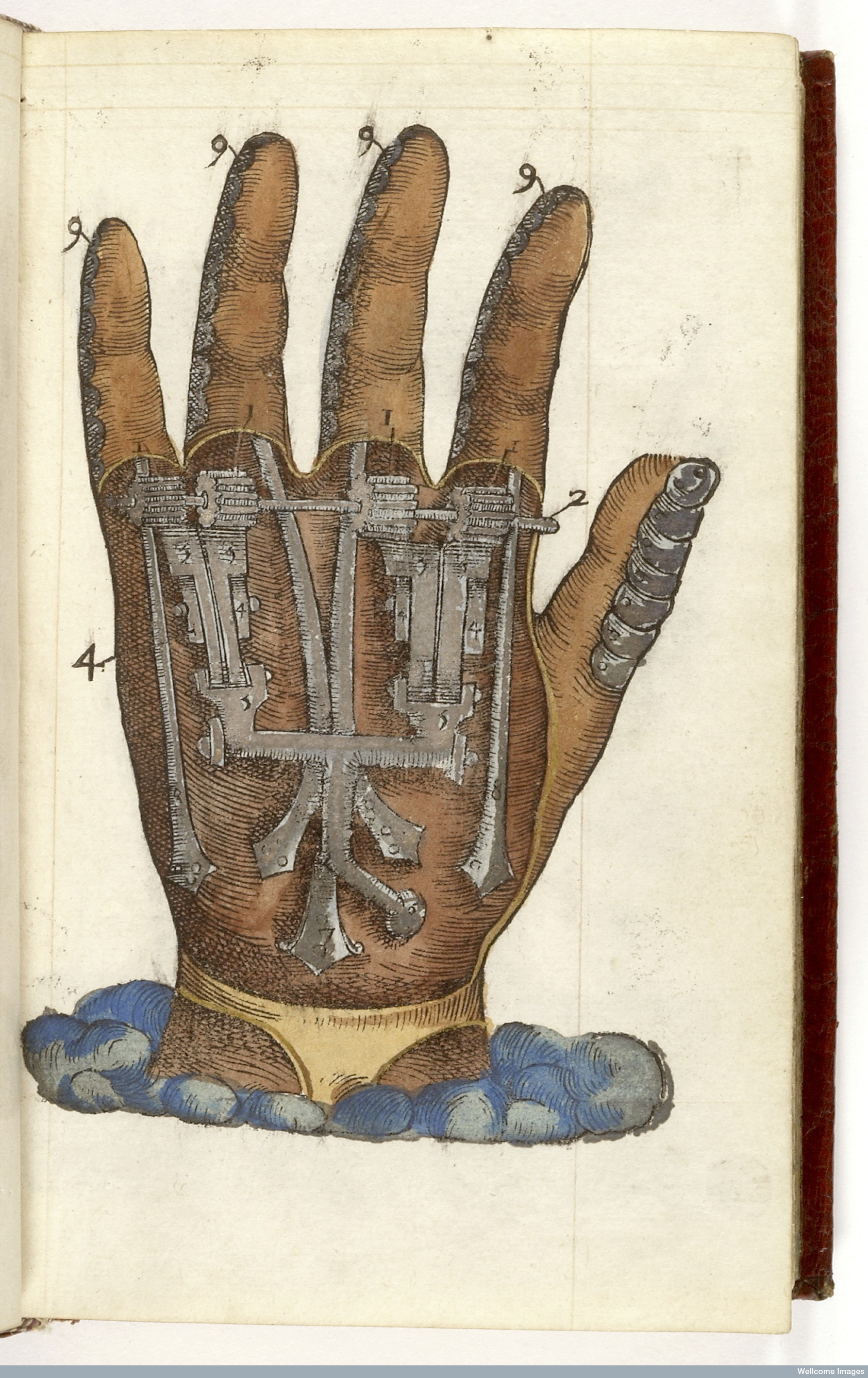
The image above is an illustration of a mechanical hand from 1564.
Rebecca Onion is a writer and academic living in Philadelphia. She runs Slate.com’s history blog, The Vault. Follow her on Twitter: @rebeccaonion.
The state of music has changed radically in recent years. Of course, the largest change that springs to mind is Napster, the program that made collective musical sharing possible and triggered the inexorable decline in record sales in the early 2000s. Business model aside, however, the music industry has also weathered tremendously volatile changes in taste over the past half-century.
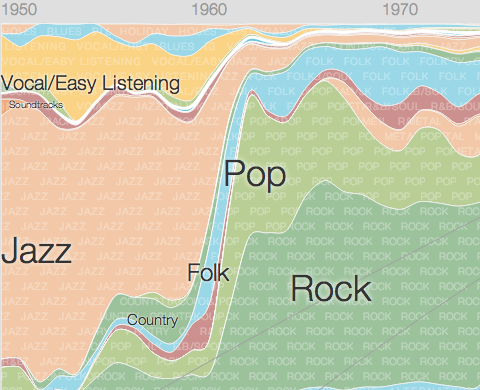
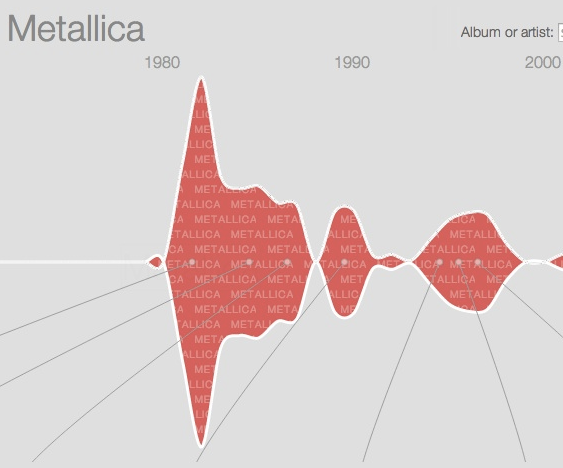
To see just how dramatic the changes in musical fashion have been, check out Google’s new Music Timeline, pictured above. This simple, color-coded chart displays the popularity of various genres from 1950 onwards (pre-50s sales data is just too spotty and inconsistent). While jazz record sales held the lion’s share of the market throughout much of the 1950’s, the advent of rock and pop acts such as the Beatles in the 1960s relegated jazz to the minor leagues.
The timeline also allows you to look at the popularity of various bands throughout the course of their careers. Metallica, the litigious critics of Napster’s file-sharing ways, are an interesting example of the waxing and waning of a particular band’s success. Initial spike of popularity aside, as is clear from the image right above, the band had been relatively successful with each of their studio albums. After the release of their cover album in 1998, entitled Garage Inc., things quickly headed south. Whether it’s because of the Napster debacle of 2000, when the band’s lawsuit effectively shut down the company, or a regrettable change of direction, many former fans simply weren’t interested anymore.
Before fans come to the defense of whichever bands were slighted by Google’s visualization, a few caveats: the data used to judge relative success is derived from Google Play user libraries. The more users have an album, the more successful it’s deemed by the algorithm. Additionally, if you’re a classical music fan, you’re out of luck. For various logistical reasons, Google decided against its inclusion in the timeline.
For more information about Google’s Music Timeline, click here. For a Michael Hann’s first look review over at The Guardian’s music blog, which discusses the possible skews in the data, head this way.
Ilia Blinderman is a Montreal-based culture and science writer. Follow him at @iliablinderman.
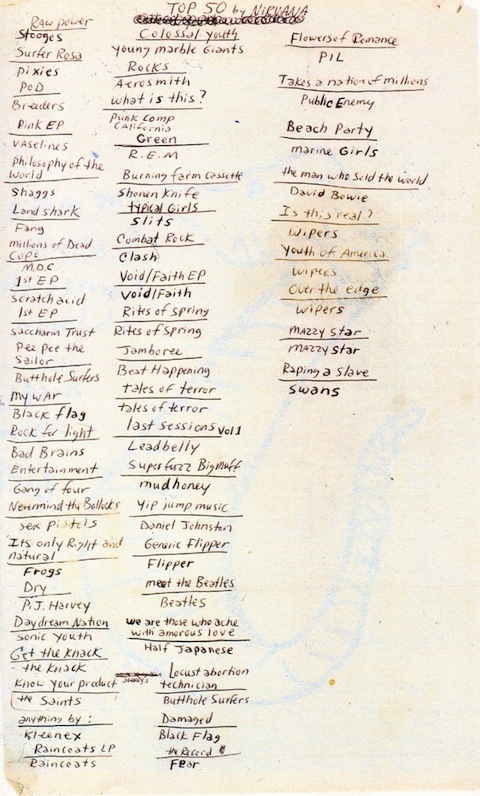
Circulating ‘round the internet recently is, wouldn’t you know it, yet another famous list of favorites. But it’s not a “listicle,” I’d say, one of those concocted clickbait hodgepodges that crop up in every corner with sometimes only the most tenuous, or lurid, of organizing principles. While we do have a tradition of showcasing lists here, they are generally on the order of those organically compiled by singular creative minds ranking and ordering their universes. I would say these things are true of Kurt Cobain’s list of albums above, which he titles “Top 50 by Nirvana” (see a full transcription at the bottom of the post, courtesy of Brooklyn Vegan). It not only presents a picture of the late Cobain and his bandmates’ musical heritage, it also offers us a genuine sampler of a generation’s protest music—plenty of classic angry ’80s hardcore punk and post-punk, lo-fi indie, a smattering of classic rock, some fringe outsiders like The Shaggs, and a rap album at #43, the fiercely political Public Enemy’s It Takes a Nation of Millions to Hold Us Back, a record beloved of almost all children of the 80s.
Having had an almost identical musical education as Cobain, it seems from the list, I can’t say that I find any of the choices here particularly surprising. It almost looks to me like the ideal code for producing a 90s alternative star—just add talent, teen angst, and the look of a bedraggled homeless puppy. But a Flavorwire take on the list does call Public Enemy (see their “Fight the Power” video above) one of a handful of “fascinating surprises.” Other than this stylistic departure, many of the selections from the list are particularly significant as influences on Cobain’s songwriting, and some of the artists listed are those the band covered on occasion.
One of Cobain’s major influences can also be easily claimed by nearly every indie artist of the 90s: Austin, Texas’ Daniel Johnston, a savant songwriter who has weathered a lifelong struggle with bipolar disorder yet produced one of the most honest, touching, and funny bodies of work in the past few decades. Cobain namechecks Johnston’s 1983 Yip Jump Music, from which comes the song above, “Worried Shoes,” an almost perfect example of his poignant lyricism and deft handling of emotional disaffection. One can see the appeal of Johnston’s spare homemade folk-blues to a sensibility like Cobain’s: “I took my lucky break / And I broke it in two / Put on my worried shoes / My worried shoes.” Johnston’s reaction to the interest of artists like Nirvana, Mudhoney, Beck, the Butthole Surfers, and Wilco is typically understated. “Ah, it’s pretty cool,” he says, “The attention was nice, ya know. Sells a few records.”
Cobain’s debt to David Bowie is evident in his swiping of some of Bowie’s chord changes and melodic phrasing. A touchstone for the grunge star was “The Man Who Sold the World,” which of course the band covered (above, unplugged) and which many a naïve Nirvana fan assumes was a Cobain original. Cobain places the album, The Man Who Sold the World at #45. Bowie is quoted in rock bio Nirvana: The Chosen Rejects as saying he was “simply blown away” when he found out that Cobain liked his work. Bowie “always wanted to talk to him about his reasons for covering ‘The Man Who Sold the World’’ and said “it was a good straight forward rendition and sounded somehow very honest.” He also expressed surprise at being “part of America’s musical landscape.” However, when young fans would approach Bowie and compliment him on his cover of a “Nirvana song” after he played the tune, his reactions were less than polite. According to Nicholas Pegg, Bowie said, “kids that come up afterwards and say, ‘It’s cool you’re doing a Nirvana song.’ And I think, ‘Fuc& you, you little tosser!’”
No shortage of ’90s artists, like their ’60s folk-rock forebears, named Leadbelly as a primary influence. Cobain places the iconic bluesman’s Leadbelly’s Last Sessions Vol. 1 at number 33. Whether or not anyone can hear acoustic Delta blues in Nirvana, most people are familiar with their unplugged cover of the Leadbelly standard “In the Pines,” aka “Where Did You Sleep Last Night” (Cobain learned the song from Screaming Trees singer Mark Lanegan). Above is a rare, much darker, Nirvana cover of the song from a bootleg album of live recordings called Ultra Rare Trax, performed at Pachyderm Studios in Cannon Falls, MN in 1993. (We will never know, of course, what Leadbellly would have thought of Kurt Cobain, though your guesses are appreciated.)
If the Nirvana list did not include Black Flag, someone would have to add it. Cobain places the L.A. hardcore band’s My War at number 11 on the list (first place is reserved for Iggy and the Stooges Raw Power). Above, former Black Flag vocalist Henry Rollins explains in a 1992 segment of MTV’s late-night alternative video show 120 Minutes what he thought were the reasons for the band’s phenomenal success. “It doesn’t take an idiot to realize that the mass media continually underestimates the intelligence of their audience,” he says, “You know how dissatisfied you’ve been with a lot of mainstream rock and roll.” Rollins goes on: “When a band like Nirvana comes along who are kicking the real thing, you like it because it’s real.”
Not every one of the artists Cobain lists had such nice things to say about him in return, however. The Sex Pistols’ Never Mind the Bullocks gets slotted at #14 on the list. In his autobiography, former Pistols leader and infamous contrarian John Lydon apparently “reserved some venom for the likes of Nirvana,” writes reviewer Tim Kennedy, “comparing them to the clueless metal bands [the Sex Pistols] were up against in the seventies.” For all the millions of Nirvana fans during the band’s heyday, there was also a small contingent of kids who felt similarly, no matter how rarified or representative Cobain’s musical tastes. In some of those cases, no doubt, rival bands felt that way because, as Henry Rollins describes it, while they were still taking the bus, “the other guy is sneering at you from a block-long limo.”
Kurt Cobain’s Favorite Albums
1. Iggy and the Stooges, “Raw Power”
2. Pixies, “Surfer Rosa”
3. The Breeders, “Pod”
4. The Vaselines, “Pink EP”
5. The Shaggs, “Philosophy of the World”
6. Fang, “Landshark”
7. MDC, “Millions of Dead Cops”
8. Scratch Acid, “Scratch Acid EP”
9. Saccharine Trust, “Paganicons”
10. Butthole Surfers, “Pee Pee the Sailor” aka “Brown Reason to Live”
11. Black Flag, “My War”
12. Bad Brains, “Rock for Light”
13. Gang of Four, “Entertainment!”
14. Sex Pistols, “Never Mind the Bollocks”
15. The Frogs, “It’s Only Right and Natural”
16. PJ Harvey, “Dry”
17. Sonic Youth, “Daydream Nation”
18. The Knack, “Get the Knack”
19. The Saints, “Know Your Product”
20. anything by Kleenex
21. The Raincoats, “The Raincoats”
22. Young Marble Giants, “Colossal Youth”
23. Aerosmith, “Rocks”
24. Various Artists, “What Is It”
25. R.E.M., “Green”
26. Shonen Knife, “Burning Farm”
27. The Slits, “Typical Girls”
28. The Clash, “Combat Rock”
29. The Faith/Void, “Split EP”
30. Rites of Spring, “Rites of Spring”
31. Beat Happening, “Jamboree”
32. Tales of Terror, “Tales of Terror”
33. Leadbelly, “Leadbelly’s Last Sessions Vol. 1”
34. Mudhoney, “Superfuzz Bigmuff”
35. Daniel Johnston, “Yip/Jump Music”
36. Flipper, “Generic Flipper”
37. The Beatles, “Meet the Beatles”
38. Half Japanese, “We Are They Who Ache With Amorous Love”
39. Butthole Surfers, “Locust Abortion Technician”
40. Black Flag, “Damaged”
41. Fear, “The Record”
42. PiL, “Flowers of Romance”
43. Public Enemy, “It Takes a Nation of Millions to Hold Us Back”
44. Marine Girls, “Beach Party”
45. David Bowie, “The Man Who Sold the World”
46. Wipers, “Is This Real?”
47. Wipers, “Youth of America”
48. Wipers, “Over the Edge”
49. Mazzy Star, “She Hangs Brightly”
50. Swans, “Young God”
Surely most ardent readers of Jack Kerouac’s novel On the Road have tried to map Sal Paradise and Dean Moriarty’s American journey. Above, partially alleviating your own need to take the pains of sketching out that great Beat journey yourself, we have a map drawn by the author himself. Pulled from Kerouac’s diary, it traces the route of a hitchhiking trip of July through October 1948, which no doubt fueled the still-potent literary impact of his best-known book, which would see publication almost a decade later in 1957. Each stop has a label, from the iconic American metropolises of New York City, Chicago, San Francisco, Los Angeles, and Washington, D.C. to the less-known but no less evocative smaller towns like Des Moines, North Platte, Laramie, and Selma.
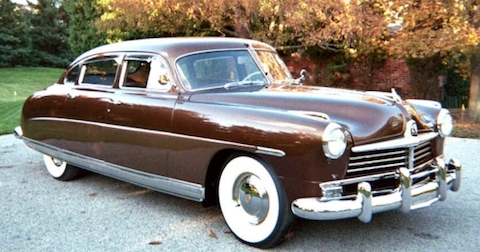
For a representation more strictly reflecting the fiction, see Michael J. Hess’ map of Paradise and Moriarty’s route across the country. It offers passages straight from Kerouac’s text about all the places they stopped briefly, stayed a while, or only mentioned, like Salt Lake City, “a city of sprinklers” at dawn; Flagstaff, whose “every bump, rise, and stretch mystified my longing”; Omaha, home to “the first cowboy I saw”; and the Indianapolis Paradise enters on a bus which has just “roared through Indiana cornfields.” Writer Dennis Mansker, on his own site, has created four separate interactive maps, each covering one of the novel’s parts. He also includes a rundown of the road story’s four major vehicles, including the 1949 Hudson seen just above. “This is the car in which they blast off to New Orleans and the West Coast, January 1949,” Mansker notes. “Like all of Dean’s cars, this one really took a beating.” But Dean’s cars just had to take it, since, as the band Guided by Voices once sang, “Kerouac Never Drove, So He Never Drove Alone.”
You liked our Facebook page. Now you’re expecting to see our material in your Facebook news feed. It’s not an unreasonable expectation. But it’s also very unlikely to happen. As Derek Muller, the curator of science video blog Veritasium, explains very articulately in the video above, “The problem with Facebook is that it’s keeping things from you. You don’t see most of what’s posted by your friends or the pages you follow.” And that’s partly because, Muller goes on to explain, Facebook is overwhelmed by content, and busy trying to find ways to monetize its newsfeed. Following a change to an algorithm in December, the problem has only gotten worse. (We have 245,000 followers, and maybe 7,000 — or 2% — see a post on average in January, as compared to 30,000 in November.) If you care about how you use Facebook — either to connect with friends, or gather information — the video is well worth watching. It clearly lets you know that Facebook is controlling your social media experience, when it should be you.
Note: If you want to make sure you receive all of our posts, get our daily email or sign up for our RSS feed. Facebook doesn’t control those … yet.
From the paranoid fundamentalist tracts of Jack Chick, to Ronald McDonald promoting scouting, to an upcoming graphic novel explaining the science of climate change, comics and graphic novels have long been a means of both proselytizing and informing, condensing complex narratives into a digestible format with broad appeal. The medium is so elastic, it can seemingly adapt itself to any kind of story, even the most soberly serious and historically significant. For example, Georgia Congressman John Lewis, veteran of the Civil Rights movement, chose to tell his story—in collaboration with co-writer Andrew Aydin and artist Nate Powell—as a graphic novel called March (making him the first lawmaker to appear at a Comic-Con). Part one of three was published late last year and rose to the top of the New York Times and Washington Post bestseller lists. March has also become an important resource for teachers and librarians (download a free 11-page teachers guide from publisher Top Shelf here).
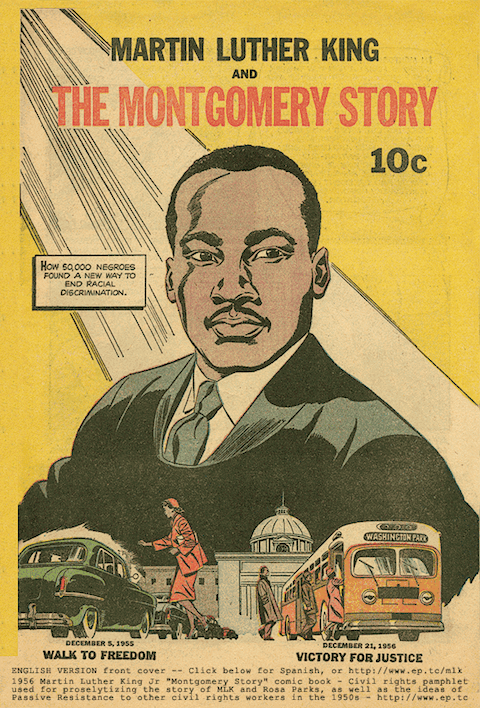
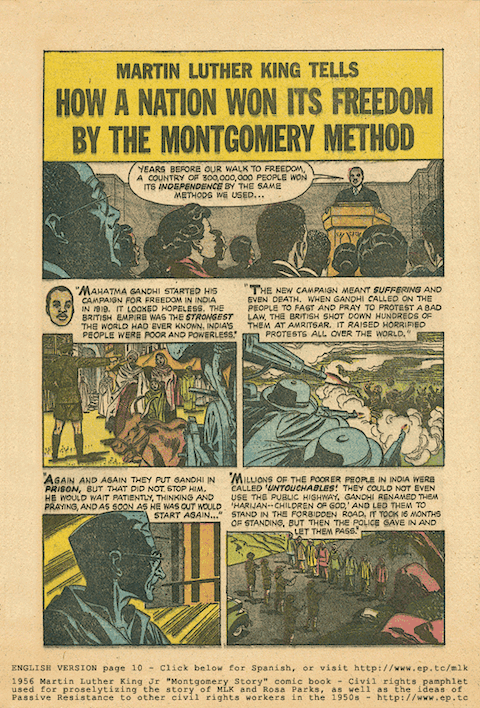
Lewis’ choice of medium may seem motivated by the current esteem in which the form is held in scholarly and popular circles alike, but he was primarily influenced by a much earlier civil rights comic book, Martin Luther King and the Montgomery Story. (See cover up top. Read it onlinehere.) Begun just five months after Rosa Parks’ historic refusal, the comic aimed to disseminate the epic tale of the Montgomery, AL bus boycott throughout the South. A section called “The Montgomery Method” (first page above) instructs readers on the nonviolent resistance techniques employed by civil rights workers in Alabama, with a primer on Gandhi and his influence on King. In the short video below, see NYU professor and King scholar Sylvia Rhor explain the genesis of the comic in the work of Alfred Hassler, then leader of Civil Rights organization Fellowship of Reconciliation. Hassler, a little-known figure who died in 1991, is now receiving more recognition through similar means. He himself recently became the subject of a graphic novel project (and now documentary) called The Secret of the 5 Powers about his work with Buddhist peace activists Thich Nhat Hanh and Sister Chan Khong during the Vietnam War.
As Rhor notes above, the King comic has had tremendous influence, not only in the past, and not only on Rep. Lewis in the present. In 2003–2004, The Montgomery Story was translated into Arabic, and Egyptian revolutionaries during the Arab Spring found inspiration in the comic book that “turned Martin Luther King into a superhero”
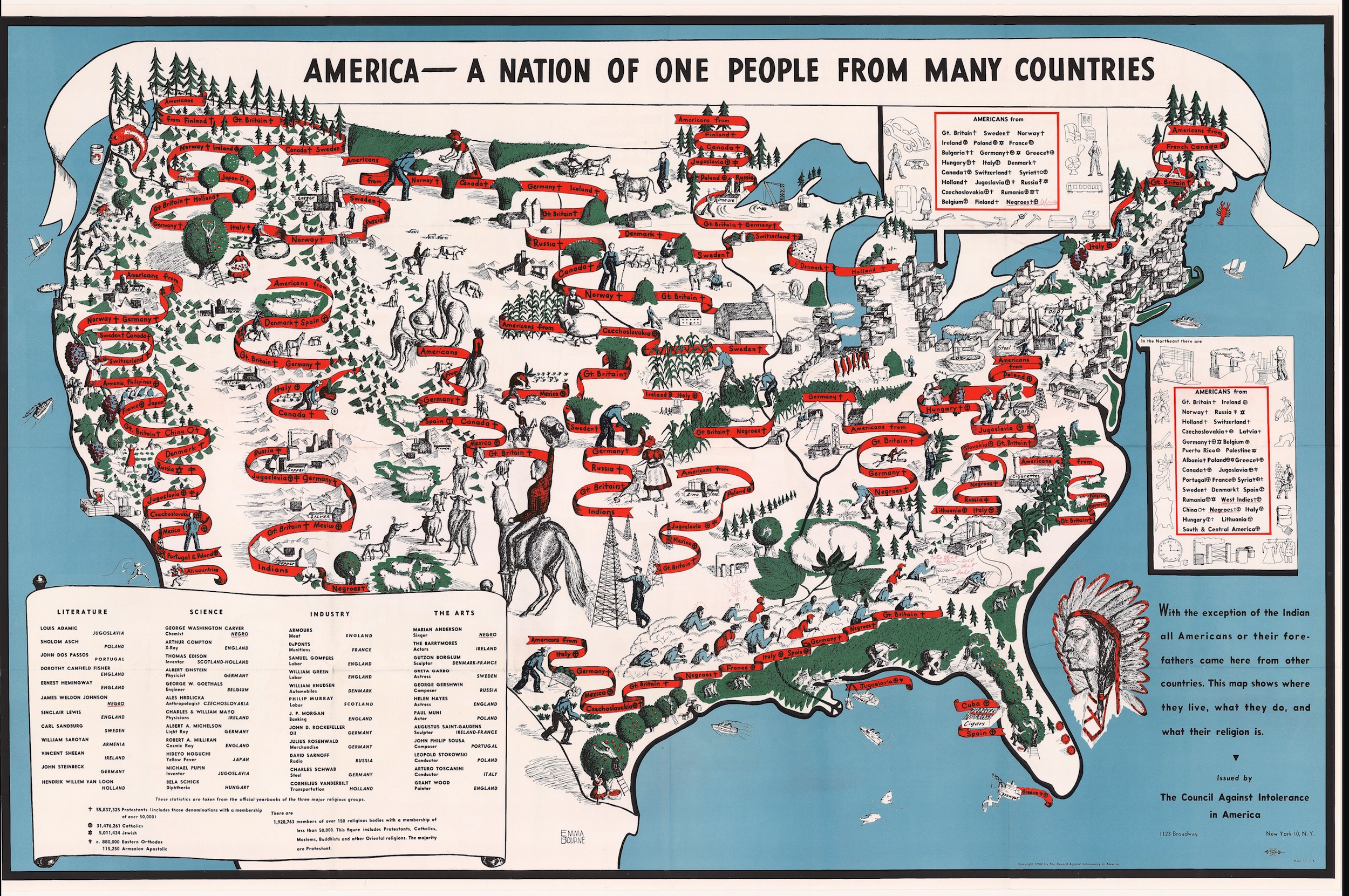
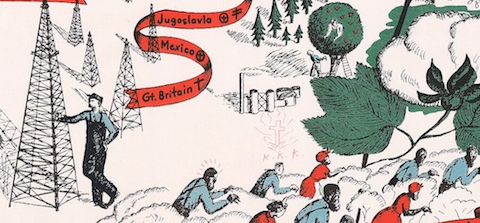
Rebecca Onion, who occasionally contributes to Open Culture, runs The Vault, a blog residing at Slate.com that’s “dedicated to history at its most beautiful, strange, funny, and moving.” It’s a great place to spend time if you enjoy revisiting archival documents of historical interest — photographs, pamphlets, buttons, toys and, yes, maps, like the one above. Featured on The Vault last week, this curious map was issued by the Council Against Intolerance in America in 1940 and depicts the “geographical locations, typical employment, and religious commitments” of ethnic groups living in the United States at the time time. A copy of the map was owned and annotated by poet Langston Hughes, the American poet, social activist, playwright, who was a leading figure in the Harlem Renaissance. If you enlarge the image (click here, then click again) and look carefully, you can see that he annotated the map with a red pen. One such annotation — where he placed a burning cross and “K.K.K.” in the vicinity of African Americans living in the South — appears in the image below. Head over to The Vault to get more on this story.
If you would like to support the mission of Open Culture, consider making a donation to our site. It’s hard to rely 100% on ads, and your contributions will help us continue providing the best free cultural and educational materials to learners everywhere. You can contribute through PayPal, Patreon, and Venmo (@openculture). Thanks!
Today, I was eavesdropping on a young couple in a cafe. The man asked the woman to recommend a book, something he wouldn’t be able to put down on a long, upcoming plane ride. The woman seemed stymied by this request. Exhausted, even. (A stroller in which a fairly newborn baby slumbered was parked next to them).
It must’ve been obvious that my wheels were turning for the woman turned to me, remarking, “He doesn’t like books.”
“I’m all about magazines,” the man chimed in.
Hmm. Perhaps Katherine Anne Porter’s Ship of Foolswasn’t such a good idea after all. What would this stranger like? Without giving it very much thought at all, I reached for The Spirit Catches You And You Fall Down, Anne Fadiman’s National Book Critics Circle Award-winning non-fiction account of a Western doctor’s tussle with the family of an epileptic Hmong child. It seems unlikely my impromptu elevator pitch convinced him to nip round the corner to see if Greenlight Bookstore had a copy in stock. More probably, I impressed him as one of those New Age‑y matrons eager to publicly identify with whatever tribal culture lays within reach.
(Lest you think me an insufferable busybody, the man at the next table horned in on the conversation too, recommending a collection of modern-day Sherlock Holmes stories and a novel, which we all said sounded great. Because really, what else were we going to say?
A reader’s taste is so subjective, is it any wonder I felt leery going into “How to Build a Fictional World,” an animated Ted-Ed talk by children’s book author and former middle school teacher, Kate Messner? The titles she name-checks—The Lord of the Rings, The Matrix, and the Harry Potter series—are all wildly successful, and far—as in light years—from of my cup of tea.
That’s not to say I’m opposed to fantasy. I adore Dungeon, Lewis Trondheim and Joann Sfar’s outrageously funny, anthropomorphic graphic novel series. Animal Farm… A Clockwork Orange…all of these personal favorites are easy to deconstruct using Messner’s recipe for fictional world-building. (Those whose tastes run similar to mine may want to jump ahead to the 3:15 minute mark above.)
Kudos to animator Avi Ofer, for the wit with which he conceptualizes Messner’s ideas. The way he chooses to represent the inhabitants’ relationships with the plants and animals of their fictional world (4:13) is particularly inventive. His contributions alone are enough to make this must-see viewing for any reluctant — or stuck — creative writer.
For those of you who enjoy fantasy and science fiction, how do your favorite titles cleave to Messner’s guidelines? Let us know in the comments below.
We’ve previously brought you the origin story of Ziggy Stardust, David Bowie’s first and most flamboyant rock & roll character, as well as his later recollections of those times in a 1977 interview on Canadian television. Above, see the documentary that marked the end of that pivotal era, D.A. Pennebaker’s Ziggy Stardust and the Spiders from Mars, a concert film of Bowie’s last show as the glam rock kabuki space alien. (Part 1 can be found above, remaining parts reside here.) Bowie had grown tired of the character, feeling forced by his manager Tony DeFries to put on bigger, more elaborate stage shows (though there is speculation that record company RCA refused to finance planned US and Canadian stadium shows). In a later recollection, Bowie stated he was ready to move on:
I wanted the whole MainMan thing away from me. It was circusy. I was never much of an entourage person — I hated all of that. It’s a relief for all these years … not have a constant stream of people following me around to the point where, when I sat down, fifteen other people sat down. It was unbearable. I think Tony [DeFries] saw himself as a Svengali type, but I think I would have done okay anyway. Now, I look back on it with amusement more than anything else.
Along with brothers Albert and David Maysles, who made Gimme Shelter, Pennebaker had an uncanny knack for being in the right place at exactly the right time in music history. His Dont Look Back defined Bob Dylan for a generation and launched the much-imitated proto-music video with cue cards for “Subterranean Homesick Blues.”
The eponymous Monterey Pop documented the explosive 1967 festival that “crystallize[d] the energy of a counterculture that by then seemed both blessedly inevitable and dangerously embattled,” according to Robert Christgau. In 1973, Pennebaker found himself again positioned perfectly to document a pivotal moment—the end of Bowie’s Ziggy Stardust persona at London’s Hammersmith Odeon in what became known as “The Retirement Gig.”
Pennebaker, who’d only just signed on during the final London leg of the tour to make a full-length film and who knew little of Bowie’s music, was as surprised as anyone when Bowie announced Ziggy’s retirement by saying “this show will stay the longest in our memories, not just because it is the end of the tour but because it is the last show we’ll ever do.” No one knew at the time that Bowie would return, transformed into Aladdin Sane in an album of the same name that year (with the same band—watch them do a version of Lou Reed’s “White Light/White Heat” above at 1:18:10, a track recorded for, but cut from, 1973 covers album Pin Ups). The farewell concert opened with a medley of Bowie songs on solo piano performed by Mike Garson, who called the show “phenomenal” (hear Garson’s medley above, beginning at 2:30, after the introduction).
The retirement gig was the 60th of 40 tour dates on the third Ziggy UK tour and was, in fact, a replacement for a cancelled gig at Earl’s Court. Find a full list of the set here. Bowie and the Spiders were joined onstage by Jeff Beck for two songs before Bowie’s farewell speech, but Beck later had himself cut from Pennebaker’s film, unhappy with his solos, and perhaps his wardrobe. Though Beck was Bowie guitarist Mick Ronson’s hero, Ronson remembers being too distracted to be overwhelmed: “I was too busy looking at his flares. Even by our standards, those trousers were excessive!” See grainy bootleg footage from the show of Beck and his trousers in “Jean Genie,” and a snippet of “Love Me Do” (above), and Chuck Berry’s “Round and Round” (below).
We're hoping to rely on loyal readers, rather than erratic ads. Please click the Donate button and support Open Culture. You can use Paypal, Venmo, Patreon, even Crypto! We thank you!
Open Culture scours the web for the best educational media. We find the free courses and audio books you need, the language lessons & educational videos you want, and plenty of enlightenment in between.