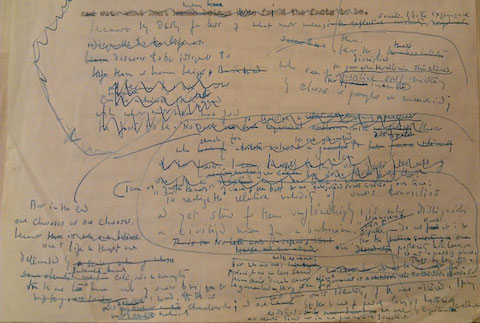
Can you beat the Mind Boggler, the world’s “most fiendish philosophical brain-teaser” brought to you by Philosophy in the City, a project created out of the Department of Philosophy at the University of Liverpool? Wanting to bring philosophy into “the real world,” Philosophy in the City created a free app that presents a new puzzle each week, in the form of a “jumbled-up philosophical quote.” All you have to do is correctly re-order the puzzle to unlock further reading, including information about the philosopher in the spotlight that particular week, plus exclusive commentary and analysis provided by scholars from the University of Liverpool. You can play the game in “easy mode” or “hard mode,” and also against the clock, just to add a bit of pressure. Right now, the app is only available on the Apple platform. Hopefully Android is around the corner.
Record engineer Steve Albini got a fair amount of press last month when the music world celebrated the 20th anniversary of Nirvana’s In Utero, an album Albini helped usher into the world in 1993. It would be Nirvana’s last studio recording.
Journeyman record producer Steve Albini … is perhaps the crankiest man in rock. This is not an effect of age. He’s always been that way, since the emergence of his scary, no-frills post-punk band Big Black and later projects Rapeman and Shellac. In his current role as elder statesman of indie rock and more, Chicago’s Albini has developed a reputation as kind of a hardass. He’s also a consummate professional who musicians want to know and work with.
In the video above created by legendary comic outfit Second City, Albini sits down (literally) to talk with a standing, awkward Tucker Woodley. It’s amusing, certainly uncomfortable, and occasionally Not Safe for Work. We also have Woodley’s interview with Fred Schneider, of the B‑52s, below.
Thanks to our reader Nate D. for sending this along.
We Wes Anderson-watchers have only just begun eagerly anticipating the The Grand Budapest Hotel, the director’s next live-action film staring Ralph Fiennes, F. Murray Abraham, and newcomer Tony Revolori (and featuring, need we even add, a certain Bill Murray). But seeing as it won’t appear in theaters until March of next year, we’ll for now have to busy ourselves with its trailer and various other pieces of Andersoniana. Among the most intriguing new items in this group we have a book called The Wes Anderson Collection, an in-depth examination of Anderson’s filmography built around a book-length conversation (think Hitchcock/Truffaut, albeit possessed of a different sensiblity, to put it mildly) with critic Matt Zoller Seitz. The videos here from his blog on RogerEbert.com adapt certain sections of the book on Anderson’s first five pictures: Bottle Rocket, Rushmore, The Royal Tenenbaums, The Life Aquatic with Steve Zissou, and The Darjeeling Limited.
“The Wes Anderson Collection is a book that was about twenty years in the making,” says Zoller Seitz in the book’s trailer. “When Wes and Owen Wilson got their short film Bottle Rocket into the Sundance Film Festival, I went to meet them at a burger joint in Dallas. We were playing pool together. I’m pretty sure Wes won. About three years ago, our paths crossed again, and the result was this book. I love Wes’ style. I think if he were a writer, he’d be somebody like a Hemingway, who doesn’t use a lot of adjectives. He takes various influences and turns them into something that’s uniquely his. There’s a charm, and a familiarity, and an easygoing quality to all his movies. His movies reward rewatching.”
Some complain that Anderson “just makes the same movie over and over again,” but given what the filmmaker has demonstrated of his command of cinema at this point in his career, you almost might as well also accuse Ozu of just making the same movie over and over again. “I think the detail-obsessed fetishists are really going to dig this book,” Zoller Seitz adds. If Anderson happens to count any of those among his fans, this book may well have a chance.
… Hold the phones. The final installments are now out, and we’ve added them to the post.
A recent Metafilter post introduces us to Galeazzo Frudua, a musician from Bologna, Italy who, “possesses an uncannily good ear for harmony, and has produced a series of videos that painstakingly and expertly analyze and demonstrate for you the vocal harmonies employed in various Beatles songs.” These detailed tutorials, writes the Metafilter poster, are made all the more watchable by Frudua’s “perceptive commentary, capable singing voice, unassuming manner, impressive video editing skills and, hey, his charming Italian accent.”
In his first tutorial, for “Nowhere Man” (above), Frudua begins by introducing “Lennon voice”: “Lennon voice is very simple, and it goes like this.” And, handily, flawlessly, it does. Frudua, who seems to be recording in the back of a restaurant, matches the tone of Lennon, McCartney, and Harrison’s harmonies separately and together impressively. He particularly favors Rubber Soul. Hear his “In My Life” below. He calls it “one of the best performances ever of John Lennon in the Beatles” as well as “a fantastic campus on learning how to sing.”
Anecdotally, having worked with choir singers, opera singers, and a capella singers, I can say that Frudua’s ability is not particularly rare but is the effect of constant practice. One Metafilter poster puts it well: “It’s not hard if you have a bit of an ear, and some experience.… Harmonies are a kind of language. Spend some time learning the grammar and a few phrases and it can open up quickly.” Frudua’s not only a master of vocal harmony, he’s also an expert luthier and builds custom guitars for dozens of Italian artists. In his breakdown below of “You Never Give Me Your Money,” the intro to the Abbey Road medley, Frudua takes on a particularly difficult harmony, as he explains in great detail in his careful introduction to the song’s harmonic grammar. He tells us we can use this tutorial “as a guide for your Beatles’ tribute band or reproduce them in your home recording.” You may do those things if you wish. Or you could watch Frudua do them better. See his full series here.
FreeVintagePosters.com offers “hundreds of high quality printable posters in advertising, travel, food/drink, art, movies, westerns, military, magic and much more.” You may have an interest in all those facets of human experience, but we imagine you’ll find especially appealing the site’s selection of high-resolution film posters, suitable for printing at home or elsewhere and hanging on walls in need of cinephilic flair.
You might, for example, choose to put up the original poster for George Cukor’s The Philadelphia Story, which promises you a “Howl with Your Favorite Hollywood Stars” — Cary Grant, Katharine Hepburn, and James Stewart, in this case. Or if you prefer westerns to comedies, perhaps you’d like to print out one of the three available posters of 1971’s John Wayne-starring Big Jake, my favorite of which pitches the movie with a simple if odd equation: “Big John = Big Jake = Big Western.” (Note: you can watch 21 John Wayne westerns here.)
Though the site’s collection slants toward classic American films, it also has sheets used to advertise them abroad. Below you see the photocollage-like Japanese poster for Billy Wilder’s Some Like It Hot. And the lover of camp will find much to enjoy as well. Might I suggest Attack of the Crab Monsters? Whatever your taste, if you decide to head out to the print shop and commission a paper version of any of these image files in a larger size than you can print at home, do consult StandardPosterSize.net, which, true to its name, provides all manner of information on the various sizings of U.S. standard posters, metric standard posters, U.S. movie posters, and U.K. movie posters. If that sounds like a little too much hassle, you could always just download your favorite poster and set it as your desktop background. Before you sign off, make sure you check out our collection 575 Free Movies Online: Great Classics, Indies, Noir, Westerns, etc. It’s something no cinema lover should miss.
Israeli musician and video artist Ophir Kutiel, akaKutiman, gained notice culling and remixing unrelated performers’ Youtube videos for his extremely collaborative-feeling Thru You project.
With 2011’s Thru Jerusalem, the urge to connect fellow musicians went live, as he left his computer to film local instrumentalists performing tunes of their choice in various city settings. Back in Tel Aviv, he edited the results into one of his signature mashups, not to mention a virtuoso musical travelogue.
Now he’s traveled even further afield to Tokyo, capturing forms both traditional and ultra-modern, for the first in a new series of original shorts from PBS Digital Studios.
Mayuko Kobayashi plucks serenely at the strings of a koto. Turntablist KEIZOmachine!, half of the breakbeat duo Hifana, scratches in his studio. The diminutive Ishii Chizuru pounds a taiko drum. Inventor Maywa Denki (aka Novumichi Tosa) demonstrates his adorable Otama-Tone. (Currently marked down in the Museum of Modern Art’s gift shop, for those looking ahead to their holiday shopping lists.)
The desire to integrate the ancient and the new is best embodied by kimono-clad Makoto Takei, who closes his eyes on a high-rise balcony as he plays a shakuhachi flute, the vertical city serving as backdrop.
Add a pink haired Harajuku girl, a string of red lanterns, innumerable cell phones, some pixellated video game characters, an aged temple or two, and several teeming intersections, then blend at top speed!
The product may be a bit earsplitting at times, but that in itself is fitting given the location. Thru Tokyo is a marvelous audio-visual postcard from 21st-century Edo, Japan.
I’m going to make your Friday, right here, right now. Above, we have a clip of David Sedaris doing a dead-on Billie Holiday impression while singing the famous Oscar Mayer theme song. The clip is an outtake from a 1998 episode of This American Life where Sedaris talks about his childhood fantasy of singing commercial jingles in Holiday’s voice. You can catch the jingles around the 9:00 mark (listen here) … and again at the 17:45 mark. But I’d really encourage you to listen to the full tale from the very start (6:00). Day made?
If you would like to sign up for Open Culture’s free email newsletter, please find it here. It’s a great way to see our new posts, all bundled in one email, each day.
If you would like to support the mission of Open Culture, consider making a donation to our site. It’s hard to rely 100% on ads, and your contributions will help us continue providing the best free cultural and educational materials to learners everywhere. You can contribute through PayPal, Patreon, and Venmo (@openculture). Thanks!
Once upon a time Blotto Design, a design firm based in Berlin, wondered: what would happen if you printed an entire book on a single poster? Could you still read it? How would it look when framed and hung on a wall?
And so they developed a prototype, liked what they saw, and have since turned 20 large books into posters — books like Homer’s Iliad, Jane Austen’s Pride and Prejudice, Melville’s Moby Dick, and Joyce’s Ulysses, all 265,222 words of it. Posters cost 20 euros a piece. Browse through the shop here. And get more backstory from Wired here.
We don’t often write up videos posted by 9–11 Truthers, but you can watch an interesting exchange when this particular Truther confronts well-known linguist and political observer Noam Chomsky during the question session after the latter’s talk at the University of Florida. “You’ve mentioned quite a few contradictions from the media and their presentations on things, and I think the most notorious case of this is with September 11, 2001,” says the Truther after taking the microphone. “You wanted to see a consensus of engineers and specialists that understand the actual structures of these buildings and their possible collapse, and there is such a group. It’s called Architects and Engineers for 9–11 Truth.” As the Truther gets into the “consensus of over 2000 of them,” the moderator interrupts, wondering if he actually has a question. (Surely we’ve all endured these moments in question segment.) But the Truther continues: “This consensus shows that Building 7, the third building that fell on 9/11, fell in freefall speed as the [National Institute of Standard and Technology] report acknowledges. Are you ready to come forward and jump on board with 9/11?” Thus asked to comment on whether the media has covered up the manner in which this particular building collapsed, Chomsky replies with a defense of standard scientific procedures.
“In fact, you’re right that there’s a consensus among a miniscule number of architects and engineers. They are not doing what scientists and engineers do when they think they’ve discovered something. What you do is write articles in scientific journals, give talks at the professional societies, go to the civil engineering department at MIT or Florida or wherever you are, and present your results, then proceed to try to convince the national academies, the professional society of physicists and civil engineers, the departments of the major universities, that you’ve discovered something. There happen to be a lot of people around who spend an hour on the internet and think they know a lot physics, but it doesn’t work like that. There’s a reason there are graduate schools in these departments.” But hasn’t the government intimidated those who know the real story from speaking out against the official line? “Anybody who has any familiarity with political activism knows that this is one of the safest things you can do. It’s almost riskless. People take risks far beyond this constantly — including scientists and engineers.” Chomsky has more to say about the facts we can use, the opinions he disavows, and the forces driving the Iraq War in the remainder of the seven-minute clip. “We will let you be the judge of his response,” say the video’s notes. Indeed.
Founded by Rick Prelinger in 1983, The Prelinger Archives have amassed thousands of “ephemeral” films — advertising, educational, industrial, and amateur films of “historic significance” that haven’t been collected elsewhere. We’ve featured some gems from the Archive in months past. Remember How to Spot a Communist (1955) or Have I Told You Lately I Love You (1958)?
Among other things, the archive features some 2,000 public domain films, which people are free to remix and mashup however they like. Some time ago, Shaun Clayton got into the spirit, took a series of 1950’s and 60’s-era coffee commercials from the Archives (like the one below), and “edited them down to just the moments when the guys were the biggest jerks to their wives about coffee.” The point of the exercise, I’d like to think, wasn’t just to show men being jerks for the sake of it, but to throw into stark relief the disturbing attitudes coursing through American advertising and culture during that era. And nothing accomplishes that better than mashing up the scenes, placing them side by side, showing them one after another. It gives a clear historical reality to views we’ve seen treated artistically in shows like Mad Men.
Just for the record, I make my own coffee.
If you would like to sign up for Open Culture’s free email newsletter, please find it here. It’s a great way to see our new posts, all bundled in one email, each day.
If you would like to support the mission of Open Culture, consider making a donation to our site. It’s hard to rely 100% on ads, and your contributions will help us continue providing the best free cultural and educational materials to learners everywhere. You can contribute through PayPal, Patreon, and Venmo (@openculture). Thanks!
Here’s a challenge: for every book recommended to you by Amazon, pick one from the site Neglected Books. No fancy algorithms here, just old-fashioned serendipity, and you’re unlikely to see much overlap. You will be rewarded with book after fascinating book that has slipped through the usual marketing channels and fallen into obscurity. Most of the authors come recommended by well-known names, making them writers’ writers—people whose writerly difficulty or peculiar subject matter can narrow their readership.
This is not entirely a fair assessment, and in many cases, the work that achieves literary notoriety does so by chance, not mass appeal, but it is undoubtedly the case that certain kinds of writers write for certain kinds of readers. The literary editor Malcolm Cowley, helming The New Republic in 1934, thought so, and lamented a system that prevented books from reaching their intended readers. In a call to “America’s leading novelists and critics,” Cowley asked for lists of such books—and in perhaps a retroactive vindication of the listicle—published them in two articles, “Good Books That Almost Nobody Has Read” and “More About Neglected Books.” Neglected Books, the website, quotes Cowley’s announcement:
Each year… a few good books get lost in the shuffle. It may not be the fault of the publisher, the critic, the bookseller, it may not be anybody’s fault except that of the general system by which too many books are distributed with an enormous lot of ballyhoo to not enough readers. Most of the good books are favorably reviewed, yet the fact remains that many of them never reach the people who would like and profit by them, the people for whom they are written.
Cowley asked his targets to suggest “two or three or four” names and “a few sentences identifying them.” He got lists from about a dozen writers, including lions like F. Scott Fitzgerald, John Dos Passos, Sinclair Lewis, Thornton Wilder and critic Edmund Wilson, who gets a mention in both Fitzgerald’s and Dos Passos’ lists. (Fitzgerald also offered three other titles Miss Lonelyhearts by Nathanael West; Sing Before Breakfast by Vincent McHugh and Through the Wheat by Thomas Boyd.) Dos Passos, unlike most of the men, names a few women writers, including Agnes Smedley, now revealed to have been a triple agent for the Soviets, the Chinese, and Indian nationalists, “one of the most prolific female spies of the 20th century.” Dos Passos’ commentary on her autobiography Daughter of Earth—which he misremembers as Woman of Earth—is mostly understated: “An uneven but impressive I suppose autobiographical narrative of a young woman’s life in a Western mining camp and in New York.”
Libertarian journalist Susan La Follette, one of the few women writers surveyed, offers only one suggestion, Ilya Ilf and Evgeny Petrov’s 1931 comedic Russian novel The Golden Calf. The description alone in this L.A. Times review of a 2010 translation has me thinking this may indeed be an overlooked masterwork of totalitarian satire. La Follette said as much three years after its publication, writing of her disappointment, “I take this quite personally, because so few people even know about it that I rarely find anyone who can laugh over it with me.”
While The New Republic is well-known as a left-of-center publication, the meaning of the American Left in the thirties was much more inclusive, even of avowed Marxists like The New Masses editor Isidor Schneider, who names Imperialism, and The State and Revolution by Lenin and Leninism by Joseph Stalin. Next to the irony of naming two books that thousands have been coerced to read, Schneider contrarily names the The Poems of Gerard Manley Hopkins, from the aesthetically radical, but earnestly religiously conservative Irish Jesuit poet. (The latter two suggestions did not make publication since Schneider’s list was already quite long.)
As interesting as the lists themselves is the selection of responses to the second article. William Saroyan writes in to recommend Grace Stone Coates’ Black Cherry as the “finest prose you ever saw.” And legendary publisher Alfred A. Knopf writes with a lengthy and detailed explanation of the books listed that he published. Of one book named, Franz Kafka’s The Castle, Knopf writes, “The Castle is one of my really inglorious failures. It is, as Conrad Aiken says, a masterpiece. But in the original edition it sold only 715 copies, and since January 3, 1933, we have been offering it at the reasonable price of $1 and only 120 copies have been purchased.”
We're hoping to rely on loyal readers, rather than erratic ads. Please click the Donate button and support Open Culture. You can use Paypal, Venmo, Patreon, even Crypto! We thank you!
Open Culture scours the web for the best educational media. We find the free courses and audio books you need, the language lessons & educational videos you want, and plenty of enlightenment in between.