Miles Davis’ Kind of Blue changed jazz. It changed music, period. So I take it very seriously. But when I see the animated sheet music of the first cut, “So What,” I can’t help but think of Charles Schultz’s Peanuts cartoons, and their Vince Guaraldi compositions. I mean no offense to Miles. His modal jazz swings, and it’s fun, as fun to listen to as it is to watch in rising and falling arpeggios. The YouTube uploader, Dan Cohen, gives us this on his channel Animated Sheet Music, with apologies to Jimmy Cobb for the lack of drum notation.
Also from Cohen’s channel, we have Charlie Parker’s music animated. Never one to keep up with his admin, Parker left his estate unable to recuperate royalties from compositions like “Confirmation” (above).
Nonetheless, everyone knows it’s Bird’s tune, and to see it animated above is to see Parker dance a very different step than Miles’ post-bop cool, one filled with complex melodic paragraphs instead of chordal phrases.
And above, we have John Coltrane’s massive “Giant Steps,” with its rapid-fire bursts of quarter notes, interrupted by half-note asides. Coltrane’s iconic 1960 composition displays what Ira Gitler called in a 1958 Downbeat piece, “sheets of sound.” Gitler has said the image he had in his head was of “bolts of cloth undulating as they unfurled,” but he might just as well have thought of sheets of rain, so multitude and heavy is Coltrane’s melodic attack.
See Cohen’s Animated Sheet Music channel for two more Charlie Parker pieces, “Au Privave” and “Bloomdido.”
If you would like to support the mission of Open Culture, consider making a donation to our site. It’s hard to rely 100% on ads, and your contributions will help us continue providing the best free cultural and educational materials to learners everywhere. You can contribute through PayPal, Patreon, and Venmo (@openculture). Thanks!
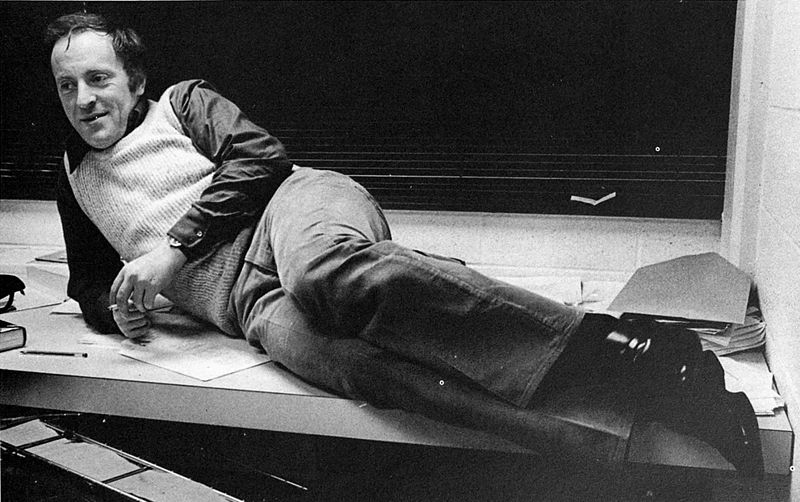
In 1955, a mere two months into eighth grade, a 15-year-old teenager dropped out of a Leningrad school. He had already repeated seventh grade; the thought of another boring year was unbearable. He wandered into work at a factory, but only lasted six months. For the next seven years, he drifted in and out of menial jobs at a lighthouse, a crystallography lab, and a morgue. For a time, he worked as a manual laborer on geological expeditions and as a stoker at a public bathhouse. Still, it wasn’t a wholly inauspicious start—by the end of his life, he had taught at Yale, Columbia, Cambridge, Michigan, and Mount Holyoke. He had also been awarded the Nobel Prize for literature.
Despite spurning his own formal education, Russian poet and Soviet dissident Joseph Brodsky immediately rose to the highest academic echelon when he arrived in America in 1972. By all accounts, the autodidact held his classes to a high standard, frequently dismissing any student arguments about literary greatness unless they centered on Milosz, Lowell, or Auden.
Monica Partridge, a former student in his class, told Open Culture, “I took a poetry class with [Joseph Brodsky] at Mount Holyoke College my freshman year… It was all 19th [century] Russian poetry, and he would give us four pages of poems to memorize overnight. We would have to come in the next [morning] and transcribe the poems we had memorized. Very Russian.”
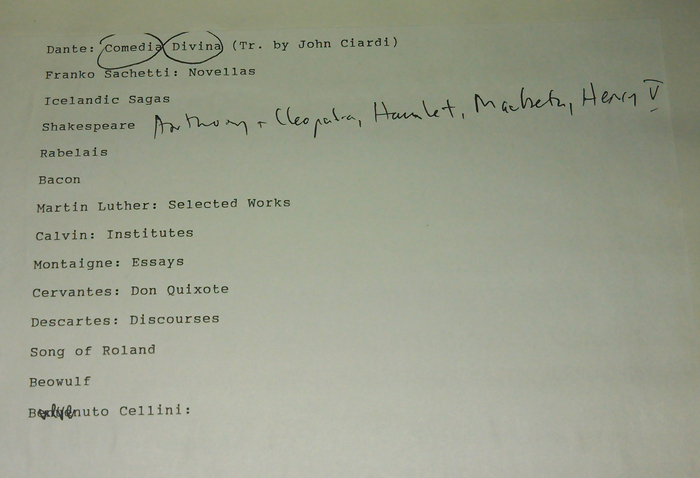
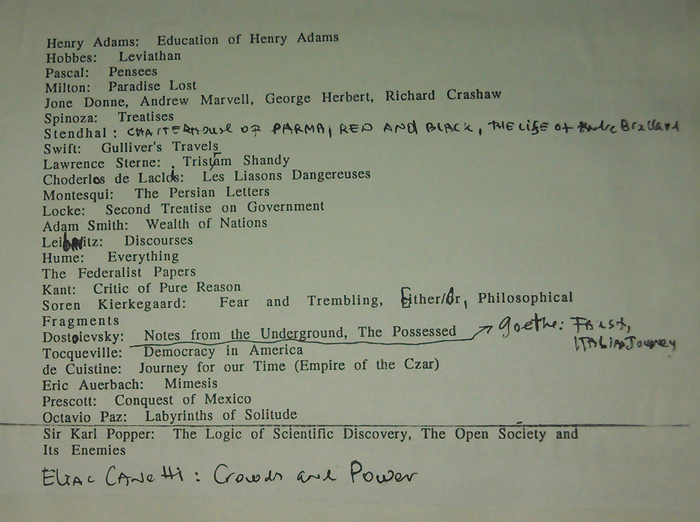
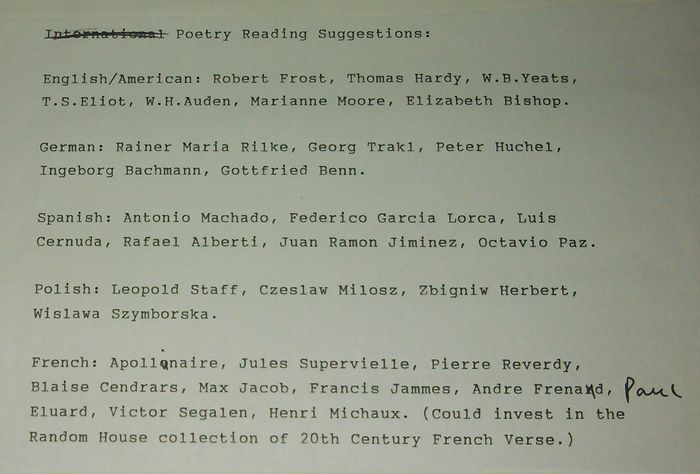
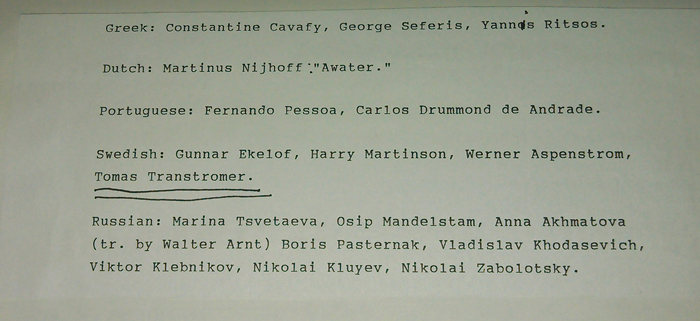
No less impressive was the list of books that Brodsky distributed to Partridge’s class.
1. Bhagavad Gita
2. Mahabharata
3. Gilgamesh
4. The Old Testament
5. Homer: Iliad, Odyssey
6. Herodotus: Histories
7. Sophocles: Plays
8. Aeschylus: Plays
9. Euripides: Plays (Hippolytus, The Bachantes, Electra, The Phoenician Women)
10. Thucydides: The Peloponnesian War
11. Plato: Dialogues
12. Aristotle: Poetics, Physics, Ethics, De Anima
13. Alexandrian Poetry: The Greek Anthology
14. Lucretius: On the Nature of Things
15. Plutarch: Lives [presumably Parallel Lives]
16. Virgil: Aeneid, Bucolics, Georgics
17. Tacitus: Annals
18. Ovid: Metamorphoses, Heroides, Amores
19. The New Testament
20. Suetonius: The Twelve Caesars
21. Marcus Aurelius: Meditations
22. Catullus: Poems
23. Horace: Poems
24. Epictetus: Discourses
25. Aristophanes: Plays
26. Claudius Aelianus: Historical Miscellany, On the Nature of Animals
27. Apollonius Rhodius: Argonautica
28. Michael Psellus: Fourteen Byzantine Rulers
29. Edward Gibbon: The Rise and Fall of the Roman Empire
30. Plotinus: The Enneads
31. Eusebius: Ecclesiastical History
32. Boethius: Consolations of Philosophy
33. Pliny the Younger: Letters
34. Byzantine verse romances
35. Heraclitus: Fragments
36. St. Augustine: Confessions
37. Thomas Aquinas: Summa Theologica
38. St. Francis of Assisi: The Little Flowers
39. Niccolò Machiavelli: The Prince
40. Dante Alighieri: Divine Comedy (Tr. By John Ciardi)
41. Franco Sacchetti: Novelle
42. Icelandic sagas
43. William Shakespeare (Anthony and Cleopatra, Hamlet, Macbeth, Henry V)
44. François Rabelais
45. Francis Bacon
46. Martin Luther: Selected Works
47. John Calvin: Institutio Christianae religionis
48. Michel de Montaigne: Essays
49. Miguel de Cervantes: Don Quixote
50. René Descartes: Discourses
51. Song of Roland
52. Beowulf
53. Benvenuto Cellini
54. Henry Adams: Education of Henry Adams
55. Thomas Hobbes: The Leviathan
56. Blaise Pascal: Pensées
57. John Milton: Paradise Lost
58. John Donne
59. Andrew Marvell
60. George Herbert
61. Richard Crashaw
62. Baruch Spinoza: Treatises
63. Stendhal: Charterhouse of Parma, Red and Black, The Life of Henry Brulard
64. Jonathan Swift: Gulliver’s Travels
65. Laurence Sterne: Tristram Shandy
66. Choderlos de Laclos: Les Liaisons Dangereuses
67. Baron de Montesquieu: Persian Letters
68. John Locke: Second Treatise on Government
69. Adam Smith: The Wealth of Nations
70. Gottfried Wilhelm Leibniz: Discourse on Metaphysics
71. David Hume: Everything
72. The Federalist Papers
73. Immanuel Kant: Critique of Pure Reason
74. Søren Kierkegaard: Fear and Trembling, Either/Or, Philosophical Fragments
75. Fyodor Dostoevsky: Notes From the Underground, The Possessed
76. Alexis de Tocqueville: Democracy in America
77. Johann Wolfgang von Goethe: Faust, Italian Journey
78. Astolphe-Louis-Léonor, Marquis de Custine: Empire of the Czar: A Journey Through Eternal Russia
79. Eric Auerbach: Mimesis
80. William H. Prescott: Conquest of Mexico
81. Octavio Paz: Labyrinths of Solitude
82. Sir Karl Popper: The Logic of Scientific Discovery, The Open Society and Its Enemies
83. Elias Canetti: Crowds and Power
“Shortly after the class began, he passed out a handwritten list of books that he said every person should have read in order to have a basic conversation,” Partridge writes on the Brodsky Reading Group blog. “At the time I was thinking, ‘Conversation about what?’ I knew I’d never be able to have a conversation with him, because I never thought I’d ever get through the list. Now that I’ve had a little living, I understand what he was talking about. Intelligent conversation is good. In fact, maybe we all need a little more.”
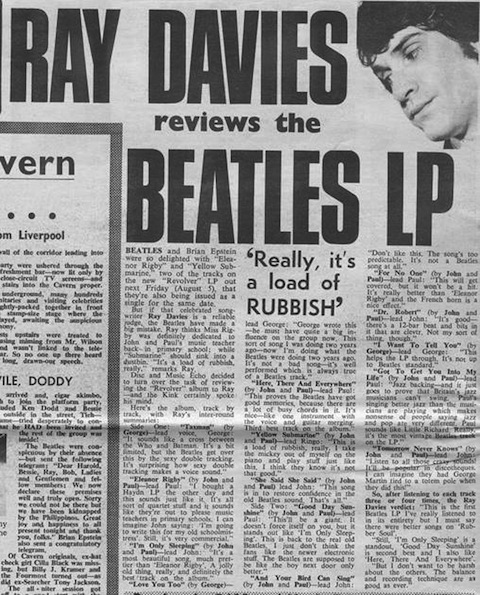
The Beatles’ Revolver has garnered some of the highest praises rock critics can offer. But not everyone loved the record when it came out. In a 1966 issue of Disc and Music Echomagazine, the Kinks’ Ray Davies wrote a snarky, unsparing review of the album, tackling each song in a few sentences. In high contrast to the current sentiments of Rolling Stone or Allmusic, Davies only seems to have liked a few tracks, and those the most traditionally upbeat: He called “I’m Only Sleeping,” “a most beautiful song” and “the best track on the album.” He also quite liked “Good Day Sunshine,” writing “this is back to the real old Beatles. I just don’t like the electronic stuff. The Beatles were supposed to be like the boy next door only better.” And “Here There and Everywhere” Davies calls the “third best track on the album.”
That’s mostly the end of Davies’ felicity. His review savages some of the most popular songs on the record. Of “Eleanor Rigby” he writes. “it sounds like they’re out to please music teachers in primary schools.” The best he can bring himself to say of the track is that “it’s very commercial.” “Yellow Submarine,” Davies writes, “is a load of rubbish, really.” And his take on the trippy “Tomorrow Never Knows” cuts the song’s ambitions down to size: “Listen to all those crazy sounds! It’ll be popular in discotheques. I can imagine they had George Martin tied to a totem pole when they did this.” Maybe the cranky Davies was motivated by professional jealousy; maybe he’s one of the most honest reviewers of the record—his take uncolored by starstruckness. Who knows? He does admit that it’s “the first Beatles LP I’ve really listened to in its entirety.” Read Davies’ full review here.
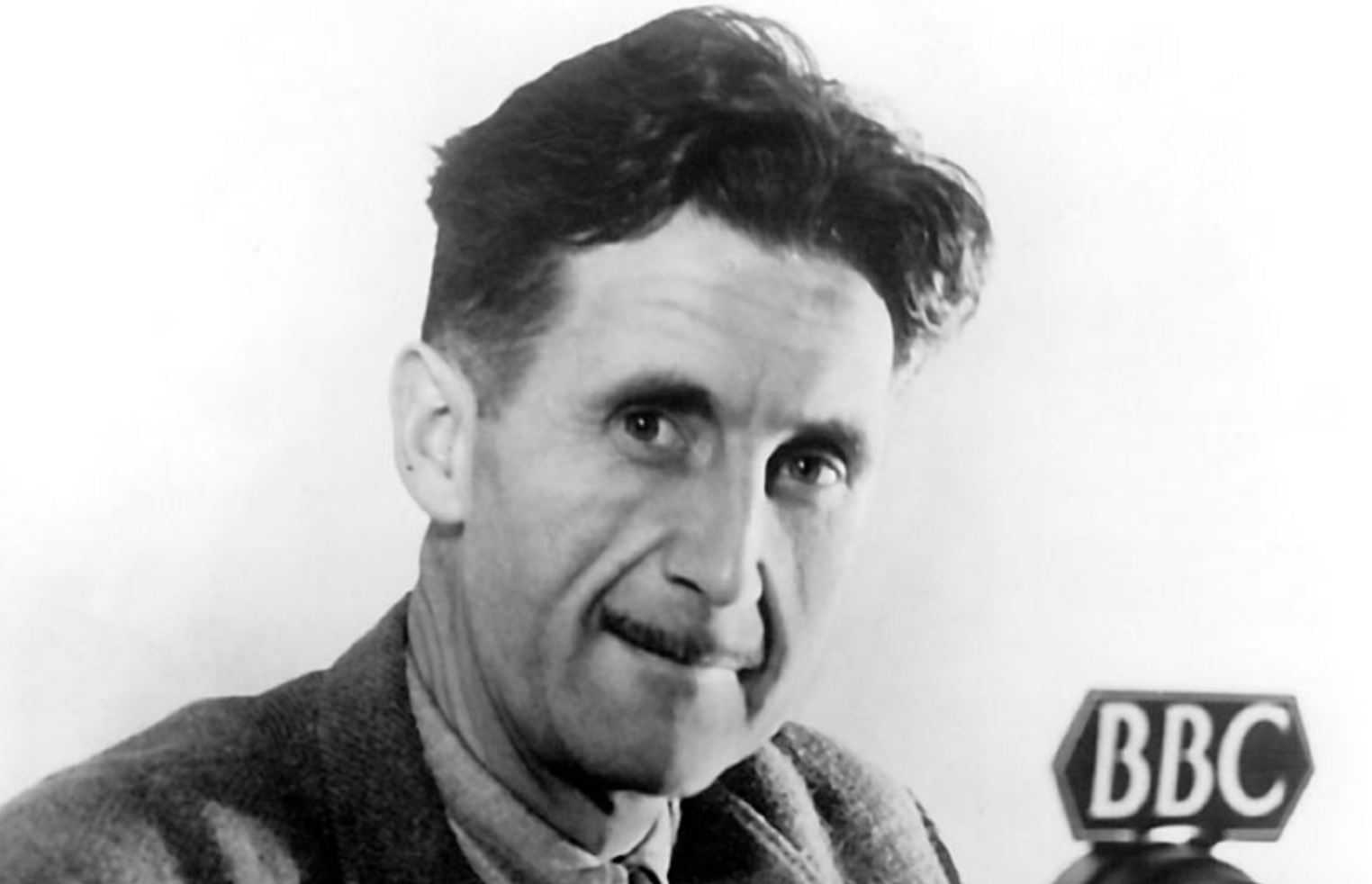
Every time I’ve taught George Orwell’s famous 1946 essay on misleading, smudgy writing, “Politics and the English Language,” to a group of undergraduates, we’ve delighted in pointing out the number of times Orwell violates his own rules—indulges some form of vague, “pretentious” diction, slips into unnecessary passive voice, etc. It’s a petty exercise, and Orwell himself provides an escape clause for his list of rules for writing clear English: “Break any of these rules sooner than say anything outright barbarous.” But it has made us all feel slightly better for having our writing crutches pushed out from under us.
Orwell’s essay, writes the L.A. Times’ Pulitzer-Prize winning columnist Michael Hiltzik, “stands as the finest deconstruction of slovenly writing since Mark Twain’s “Fenimore Cooper’s Literary Offenses.” Where Twain’s essay takes on a pretentious academic establishment that unthinkingly elevates bad writing, “Orwell makes the connection between degraded language and political deceit (at both ends of the political spectrum).” With this concise description, Hiltzik begins his list of Orwell’s five greatest essays, each one a bulwark against some form of empty political language, and the often brutal effects of its “pure wind.”
One specific example of the latter comes next on Hiltzak’s list (actually a series he has published over the month) in Orwell’s 1949 essay on Gandhi. The piece clearly names the abuses of the imperial British occupiers of India, even as it struggles against the canonization of Gandhi the man, concluding equivocally that “his character was extraordinarily a mixed one, but there was almost nothing in it that you can put your finger on and call bad.” Orwell is less ambivalent in Hiltzak’s third choice, the spiky 1946 defense of English comic writer P.G. Wodehouse, whose behavior after his capture during the Second World War understandably baffled and incensed the British public. The last two essays on the list, “You and the Atomic Bomb” from 1945 and the early “A Hanging,” published in 1931, round out Orwell’s pre- and post-war writing as a polemicist and clear-sighted political writer of conviction. Find all five essays free online at the links below. And find some of Orwell’s greatest works in our collection of Free eBooks.
The world tends to think rather loosely about the concepts of Los Angeles, Hollywood, and the motion picture industry, throwing them around, running them together, naming one when they mean another — still, nothing a bracing splash of Charles Bukowski can’t sort out. Above, the famous Los Angeles-resident poet, a figure as shambolically glorious and stealthily inspiring as much of the city itself, gives a brief back-seat tour of Hollywood. No, he doesn’t take us past the movie studios, nor the Walk of Fame, nor the site of Schwab’s Pharmacy. He stays closer to home — his home, the storied bungalow at 5124 De Longpre Avenue. We see his neighborhood, his neck of Hollywood, the northwestern district of vast Los Angeles that contains much less of the capital‑I Industry than you’d think, but more of genuine (if often grotesque) interest.
“That’s a lady fortune teller there,” Bukowski says, gesturing toward one of the modest houses around him. “I went in there one time. She read my palm. She said, ‘You’re an alcoholic.’ ‘Really? Do I gamble, too?’ ‘Yes, you gamble. That’ll be five dollars.’ ” The driver continues down Hollywood’s eponymous boulevard, passing Western Avenue, which gets the poet remembering more: “There used to be cement benches out front, and all the insane people would sit there. The street people. They’d talk to each other all day long.” We pass important landmarks as well: “There’s the old Sex Shop. Keeps changing hands.” He even points out the wheelers and dealers living amid this stretch of bars, brothels, and burger stands: “There’s a woman who’s not a hooker. There’s a dope dealer.” Give me Bukowski’s Hollywood tour over those double-decker buses you see around town, their conductors barking about minor celebrity sightings, any day. “I’ve been to this liquor store many a time,” Bukowski notes. “Many a time.”
If you would like to support the mission of Open Culture, consider making a donation to our site. It’s hard to rely 100% on ads, and your contributions will help us continue providing the best free cultural and educational materials to learners everywhere. You can contribute through PayPal, Patreon, and Venmo (@openculture). Thanks!
Domino magicians “Hevesh5” and “Millionendollarboy” teamed up to create a pretty epic domino rally. It took 3 months and 25,000 dominoes to make the video you’re watching above. Actually you’re really watching two videos in one. The first part was made by Hevesh5 in the US. Then, at the 1:35 mark, it switches to millionendollarboy’s segment created in Germany. It’s amazing to watch the domino structures come down. A little more amazing to think about them going up. Enjoy.
Pshaw! As she’s very likely aware, there’s not a thing wrong with her dancing. If there were, I doubt she’d be sporting saucy hot pants in the above video for the first single off of the Plastic Ono Band’s Take Me to the Land of Hell.
Her 80-year-old stems are in fantastic shape. Mayhaps this youthful vibe is a reflection of the company she keeps. A bunch of nifty pals from Generations X and Y showed up to shake their tail feathers on camera—the surviving Beastie Boys (who also produced), Reggie Watts, Cibo Matto’s Yuka Honda and Miho Hatori, gender-bending performer Justin Vivian Bond, and public radio star Ira Glass, to name but a few.
Apparently, she’s not quite as tight with all her dance partners as the video would imply. Glass describes his involvement thusly:
She’s gracious, has to be reminded by a handler who in the world I am. Then totally acts nice, says something along the lines of “I appreciate the work you do” which either means she’s heard my work or she hasn’t…. The song is called “Bad Dancer” so I’m the perfect participant because—though I love to dance, I have no illusions. I’m a spaz. I stand in front of the camera and 20 handlers and hipsters and publicists and crew and Yoko Ono and I think a reporter from Rolling Stone and I tell myself to pretend I can do this and I dance.
Perhaps declaring herself a Bad Dancer is Ono’s way of encouraging self-conscious wall huggers to drop their inhibitions and join in the fun. It’s an approach to life, and aging, that made a cult classic of Harold and Maude.
On June 1, 1997, Mary Schmich, Chicago Tribune columnist and Brenda Starr cartoonist, wrote a column entitled “Advice, like youth, probably just wasted on the young.” In her introduction to the column she described it as the commencement speech she would give to the class of ’97 if she were asked to give one.
The first line of the speech: “Ladies and gentlemen of the class of ’97: Wear sunscreen.”
If you grew up in the 90s, these words may sound familiar, and you would be absolutely right. Australian film director Baz Luhrmann used the essay in its entirety on his 1998 album Something for Everybody, turning it into his hit single “Everybody’s Free (To Wear Sunscreen).” With spoken-word lyrics over a mellow backing track by Zambian dance music performer Rozalla, the song was an unexpected worldwide hit, reaching number 45 on the Billboard Hot 100 in the United States and number one in the United Kingdom.
The thing is, Luhrmann and his team did not realize that Schmich was the actual author of the speech until they sought out permission to use the lyrics. They believed it was written by author Kurt Vonnegut.
For Schmich, the “Sunscreen Controversy” was “just one of those stories that reminds you of the lawlessness of cyberspace.” While no one knows the originator of the urban legend, the story goes that Vonnegut’s wife, the photographer Jill Krementz, had received an e‑mail in early August 1997 that purported to reprint a commencement speech Vonnegut had given at MIT that year. (The actual commencement speaker was the United Nations Secretary General Kofi Annan.) “She was so pleased,” Mr. Vonnegut later told the New York Times. “She sent it on to a whole of people, including my kids – how clever I am.”
The purported speech became a viral sensation, bouncing around the world through e‑mail. This is how Luhrmann discovered the text. He, along with Anton Monsted and Josh Abrahams, decided to use it for a remix he was working on but was doubtful he could get Vonnegut’s permission. While searching for the writer’s contact information, Luhrmann discovered that Schmich was the actual author. He reached out to her and, with her permission, recorded the song the next day.
What happened between June 1 and early August, no one knows. For Vonnegut, the controversy cemented his belief that the Internet was not worth trusting. “I don’t know what the point is except how gullible people are on the Internet.” For Schmich, she acknowledged that her column would probably not had spread the way it did without the names of Vonnegut and MIT attached to it.
In the end, Schmich and Vonnegut did connect after she reached out to him to inform him of the confusion. According to Vonnegut, “What I said to Mary Schmich on the telephone was that what she wrote was funny and wise and charming, so I would have been proud had the words been mine.” Not a bad ending for a column that was written, according to Schmich, “while high on coffee and M&Ms.”
We’ve seen plenty of post-modern decay in writers before George Saunders—in Don DeLillo, J.G. Ballard—but never has it been filled with such puckish warmth, such whimsical detail, and such empathy, to use a word Saunders prizes. As a writer, Saunders draws readers in close to a very human world, albeit a fragmented, burned out, and frayed one, and it seems that he does so as a teacher as well. Since 1997, Saunders has taught creative writing at Syracuse University, where he received his M.A. in 1988, and where he remains, despite being awarded a MacArthur “Genius” Fellowship in 2006 and publishing steadily throughout the last decade and a half. To sit in a class with Saunders, according to his onetime student Rebecca Fishow, is to visit with a daring practitioner of the short form, one whose “words seem a lot like the transfer of secrets through a chain-link of writers.”
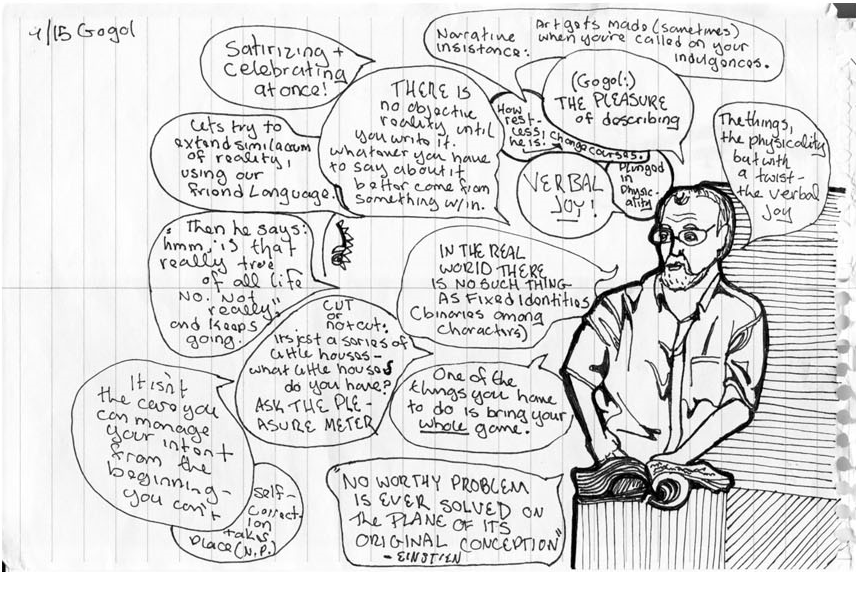
While attending one of Saunders’ semester-length writing seminars, writer and artist Fishow compiled the notes and sketches you see here (and several more at The Believer’s Logger site). In each sketch, Saunders teaches from one of his favorite classic Russian short story writers. At the top, see him expound on Turgenev’s method, proffering epiphanies, keen observations on craft, and writerly advice in word bubbles—“You are allowed to manipulate,” “Tecnician vs. Artist” [sic], “Instantaneous micro-re-evaluation (@end of story)”—while surrounded by a fringy aura. Above, Fishow reconstructs Saunders’ take on Chekhov’s “Lady with the Pet Dog” around a portrait of a pensive Saunders (looking a bit like Chekhov).
Fishow’s reconstructions are obviously very partial, and it’s not clear if she took them down on the spot or scribbled from memory (the misspellings make me think the former). In the sketch above, Saunders’ explicates Gogol, with phrases like “VERBAL JOY!” and an Einstein quote: “No worthy problem is ever solved on the plane of its original conception.” The latter is an interesting moment of Saunders’ scientific background slipping into his pedagogy. Before he was a MacAurthur winner and an enthusiastic teacher, Saunders worked as an environmental engineer. Of his science background, he has said:
…any claim I might make to originality in my fiction is really just the result of this odd background: basically, just me working inefficiently, with flawed tools, in a mode I don’t have sufficient background to really understand. Like if you put a welder to designing dresses.
As a teacher, at least in Fishow’s notes, Saunders celebrates “working inefficiently.” As she puts it: “His wisdom confirms that flaw and uncertainty and variety and empathy (especially empathy) are positive aspects of the writing process.” Fishow’s portraits go a long way toward conveying those qualities in Saunders as a presence in the classroom.
FYI: Apple officially released iOS7, the latest operating system for the iPhone and iPad, on September 18. Almost simultaneously, Stanford began offering a course teaching students how to design apps in the new environment. Although the course is still in progress, the initial video lectures are now available online, you guessed it, on iTunesU.
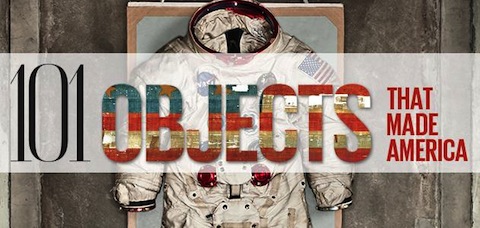
The Smithsonian’s 19 museums, 9 research centers, and 140-plus affiliates boast the world’s largest collection—137 million items, in addition to a staggering array of photos, documents, films, and recordings. Choosing which to include in The Smithsonian’s History of America in 101 Objects (published on October 29)from such a wealth of options was no easy task. (On the other hand, the Director of the British Museum Neil MacGregor did manage to encapsulate two million years of world history in one object less…)
Anthropologist Richard Kurin, the Smithsonian Institution’s Under Secretary for History, Art, and Culture, prioritized objects with vivid biographies. There may be no way for a museum to recreate the Civil War, as he notes, but a “hand-drawn battle map of the time, a bullet or gunnery shelf, a uniform bearing evidence of wounds, and broken metal shackles are all objects that, having been present at the event depicted, can speak to the larger story. The parts stand for the whole.”
Celebrity may have factored into the selection process, too. Not every entry is bespangled with a famous name, but one can’t overlook the vicarious thrill inherent in Cesar Chavez’s union jacket, Abraham Lincoln’s top hat, Helen Keller’s watch, or Marian Anderson’s mink coat. Who can say whether these resonances will lose their luster in the future. In his introduction, Kurin uses the steering wheel of the U.S.S. Maine, once an object of keen national interest due to its role in the Spanish-American War, to exemplify the descent into obscurity.
To celebrate the publication of The Smithsonian’s History of America in 101 Objects, the Smithsonian Channel will be profiling some of the items in a four-part series, Seriously Amazing™ Objects (love the trademark, guys).
Or enjoy these three samples, selected by yours truly for their unifying roundness. (I could never accomplish anything on the order of Kurin’s feat, but encourage the Smithsonian to get in touch whenever they’re in the market for someone who could repackage their collection as board books for infants…)
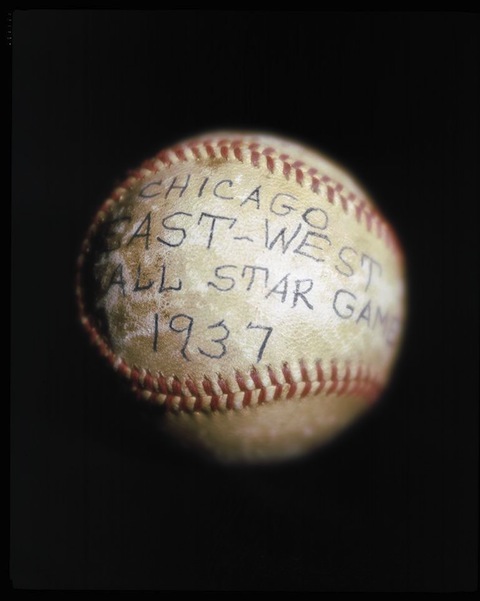
Negro League Baseball
1937, American History Museum
Sportswriter Frank Deford fulfills Kurin’s biographic requirements with an essay on the larger social implications behind this artifact, which scored a home run for Buck Leonard and the East lineup in the ’37 Comiskey All-Star game.
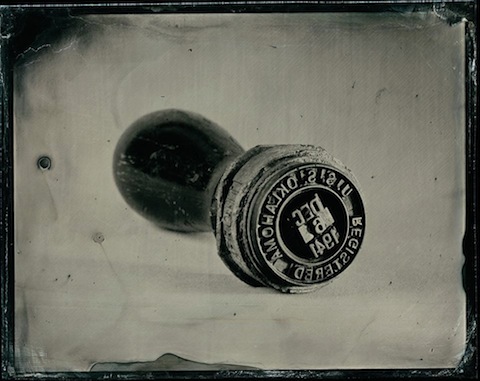
USS Oklahoma Stamp
1941, Postal Museum
“To record when a piece of mail was processed aboard ship, the Navy used wooden postmark stamps. This one bears an ominous date: Dec 6, 1941 PM. It was recovered from the battleship Oklahoma after it was hit by several torpedoes, listed to a 45-degree angle, capsized and sank in the attack on Pearl Harbor on December 7, 1941. The Oklahoma lost 429 sailors and Marines, a third of its crew.”
Wow.
The Pill
c. 1965 American History Museum
As Natalie Angier, author of Woman: An Intimate Geography pointed out in a recent article in Smithsonian magazine, “when people speak of the Pill, you know they don’t mean aspirin or Prozac but rather that mother of all blockbuster drugs, the birth control pill.” A pinnacle of both medical and feminist history, its significance extends well beyond the national borders.
How about you, readers? What item from a museum collection would you include in a book on American History?
We're hoping to rely on loyal readers, rather than erratic ads. Please click the Donate button and support Open Culture. You can use Paypal, Venmo, Patreon, even Crypto! We thank you!
Open Culture scours the web for the best educational media. We find the free courses and audio books you need, the language lessons & educational videos you want, and plenty of enlightenment in between.