In November of 1969 Thelonious Monk appeared at the Berliner Jazztage (“Berlin Jazz Days,” now known as JazzFest Berlin) and played a series of Duke Ellington pieces on solo piano. Monk brought his own quirky genius — his jagged-edged, percussive playing style and harmonic dissonance — to Ellington’s elegant melodies. The result was magic.
In the video above, Monk plays four compositions by Ellington — “Satin Doll,” “Sophisticated Lady,” “Caravan” and “Solitude” — followed by one of his own, “Crepuscule With Nellie,” before joining the Joe Turner Trio in a performance of “Blues for Duke.” The trio includes Turner on Piano, Hans Rettenbacher on bass and Stu Martin on drums. The performances are available on the DVD Monk Plays Ellington: Solo Piano in Berlin ’69.
If you’re going through Breaking Bad withdrawal, here’s a small way to fill the void. Audible.com has made available a recording of Bryan Cranston, the actor behind Walter White, reading the first chapter from The Things They Carried, Tim O’Brien’s famous story collection that offers a chilling, boots-on-the-ground portrayal of soldiers’ experience during the Vietnam War. A finalist for the 1990 Pulitzer Prize and the National Book Critics Circle Award, the book has sold over 2 million copies worldwide and is now a staple of college and high school English classes across America. Cranston’s reading runs over 47 minutes.
Cranston actually narrates the entire book, and if you’re interested in downloading it, there’s a way to do it for free. Just head over to Audible.com and register for a 30-day free trial. You can download any audio book for free, including The Things They Carried. Then, when the trial is over, you can continue your Audible subscription, or cancel it, and still keep the audio book. The choice is yours. And, in full disclosure, let me tell you that we have a nice arrangement with Audible. Whenever someone signs up for their amazing service, it helps support Open Culture. Get more information on Audible’s free trial here.
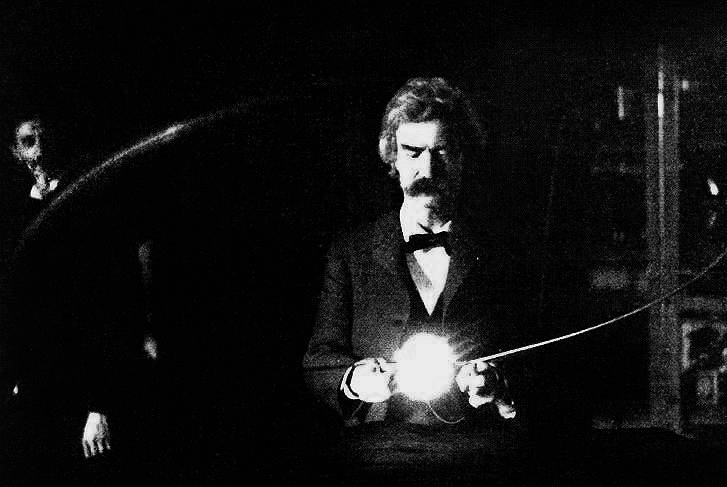
You’ll get a charge out this picture taken long ago. It captures Mark Twain, a literary giant of the 19th century, tinkering in the laboratory of the great inventor, Nikola Tesla. According to the University of Virginia, the photo was taken in the spring of 1894, when Century Magazine published an article called “Tesla’s Oscillator and other Inventions.” Still available online, the article begins:
[Mr. Tesla] invites attention to-day, whether for profound investigations into the nature of electricity, or for beautiful inventions in which is offered a concrete embodiment of the latest means for attaining the ends most sought after in the distribution of light, heat, and power, and in the distant communication of intelligence. Any one desirous of understanding the trend and scope of modern electrical advance will find many clues in the work of this inventor. The present article discloses a few of the more important results which he has attained, some of the methods and apparatus which he employs, and one or two of the theories to which he resorts for an explanation of what is accomplished.
Below, we’ve got more vintage Twain (including Twain topless), plus some choice Tesla picks:
Graham Nash, of Crosby, Stills, Nash & Young, has a new book out, Wild Tales: A Rock & Roll Life. And that means he’s doing interviews, many interviews. A couple of weeks ago, he spent an excellent hour on The Howard Stern Show (seriously). Next, it was off to chat with the more cerebral Terry Gross on NPR’s Fresh Air.
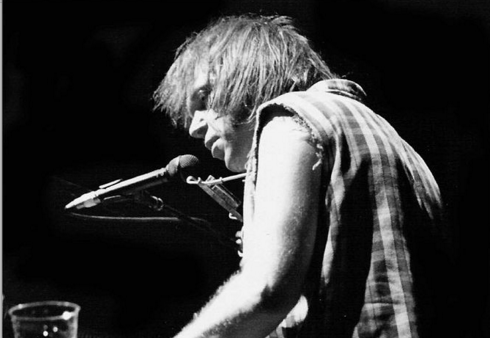
In the midst of the interview (listen online here), Gross asked Nash to talk about his friendship with Neil Young, a man Nash has called “the strangest of my friends.” Just what makes him strange? Nash explains:
The man is totally committed to the muse of music. And he’ll do anything for good music. And sometimes it’s very strange. I was at Neil’s ranch one day just south of San Francisco, and he has a beautiful lake with red-wing blackbirds. And he asked me if I wanted to hear his new album, “Harvest.” And I said sure, let’s go into the studio and listen.
Oh, no. That’s not what Neil had in mind. He said get into the rowboat.
I said get into the rowboat? He said, yeah, we’re going to go out into the middle of the lake. Now, I think he’s got a little cassette player with him or a little, you know, early digital format player. So I’m thinking I’m going to wear headphones and listen in the relative peace in the middle of Neil’s lake.
Oh, no. He has his entire house as the left speaker and his entire barn as the right speaker. And I heard “Harvest” coming out of these two incredibly large loud speakers louder than hell. It was unbelievable. Elliot Mazer, who produced Neil, produced “Harvest,” came down to the shore of the lake and he shouted out to Neil: How was that, Neil?
And I swear to god, Neil Young shouted back: More barn!
To that we say, more Neil Young! Find more Neil right below.
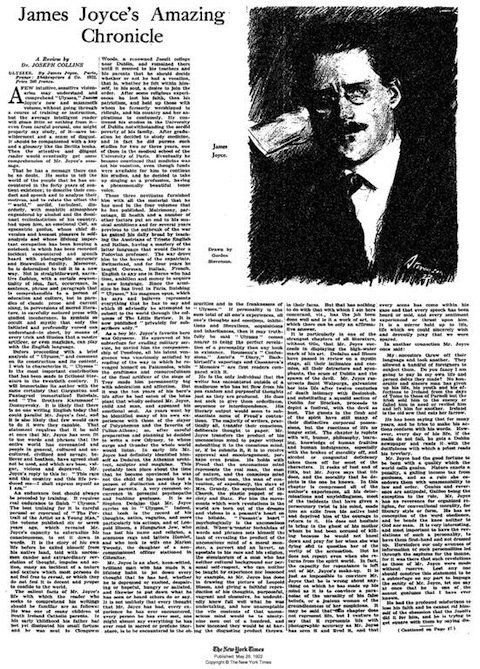
We’ve recently discussed the reactions of James Joyce’s literary contemporaries to the 1922 publication of Ulysses. T.S. Eliot was floored, and told all of his friends, including Virginia Woolf. Woolf wrestled with the book and either found it too dull or too overwhelming to finish. Whatever the reaction, Joyce’s peers took notice. But what did people who weren’t soon to be the subject of thousands of dissertations think? Of the few non-modernist masters who read Joyce, his first professional critics offer evidence. Take the review of Dr. Joseph Collins in The New York Times (above—see the full text here). Collins begins with a very prescient statement, one most readers of Joyce will likely agree with in some part:
Few intuitive, sensitive visionaries may understand and comprehend “Ulysses,” James Joyce’s new and mammoth volume, without going through a course of training or instruction, but the average intelligent reader will glean little or nothing from it- even from careful perusal, one might properly say study, of it- save bewilderment and a sense of disgust. It should be companioned with a key and a glossary like the Berlitz books. Then the attentive and diligent reader would eventually get some comprehension of Mr. Joyce’s message.
Collins then goes on to praise Joyce’s greatness in no uncertain terms:
Before proceeding with a brief analysis of “Ulysses,” and a comment on its construction and content, I wish to characterize it. “Ulysses” is the most important contribution that has been made to fictional literature in the twentieth century. It will immortalize its author with the same certainty that Gargantua and Pantagruel immortalized Rabelais, and “The Brothers Karamazof” Dostoyevsky. It is likely that there is no one writing English today that could parallel Joyce’s feat.
Such incredibly high praise it sounds like flattery, especially since Joyce’s book had not even weathered a few weeks among the reading public. For a more sober and careful assessment, see the great literary critic Edmund Wilson’s July, 1922 review in the New Republic. In Wilson’s ambivalent assessment: “The thing that makes Ulysses imposing is, in fact, not the theme but the scale upon which it is developed. It has taken Mr. Joyce seven years to write Ulysses and he has done it in seven hundred and thirty pages which are probably the most completely “written” pages to be seen in any novel since Flaubert.” If this seems like faint praise, it sets up some of Wilson’s “complaints” to come. And yet, “for all its appalling longueurs,” he writes, “Ulysses is a work of high genius. [It] has the effect at once of making everything else look brassy.”
Of course there were those who hated the book, like Harvard’s Irving Babbitt, who said it could only have been written “in an advanced stage of psychic disintegration.” And there were the puritans and philistines who found the novel’s scatological humor, frank depictions of sex, and near constant erotic charge a scandal. Yet it was the opinions, however qualified, of Joyce’s peers and most of his critics that moved U.S. Judge John Monro Woolsey eleven years later to rule that the book was not obscene and could be legally sold in America. Wrote Woolsey in his decision, “The reputation of ‘Ulysses’ in the literary world… warranted my taking such time as was necessary… In ‘Ulysses,’ in spite of its unusual frankness, I do not detect anywhere the leer of the sensualist.” Good thing Woolsey didn’t read Joyce’s letters to his wife.
Nowadays, most of us who still religiously attend screenings of films by the most respected European directors of the twentieth century have circled the wagons: even if we far prefer, say, Fellini to Truffaut, we’ll more than likely still turn up for the Truffaut, even if only out of cinephilic solidarity. But in the fifties, sixties, and seventies — or so I’ve read, anyway — discussions of such filmmakers’ relative merits could turn into serious intellectual shoving matches, and even many of the luminaries themselves would evaluate their colleagues’ work candidly. At the Ingmar Bergman fan site Bergmanorama, you can read what the maker of The Seventh Seal, Wild Strawberries, and Persona had to say about the makers of movies like L’Avventura, Breathless, Vertigo, The Exterminating Angel, The 400 Blows, and Stalker.
Regarding Jean Luc Godard: “I’ve never been able to appreciate any of his films, nor even understand them… I find his films affected, intellectual, self-obsessed and, as cinema, without interest and frankly dull… I’ve always thought that he made films for critics.”
Michelangelo Antonioni, thought Bergman, had “never properly learnt his craft. He’s an aesthete. If, for example, he needs a certain kind of road for The Red Desert, then he gets the houses repainted on the damned street. That is the attitude of an aesthete. He took great care over a single shot, but didn’t understand that a film is a rhythmic stream of images, a living, moving process; for him, on the contrary, it was such a shot, then another shot, then yet another. So, sure, there are some brilliant bits in his films… [but] I can’t understand why Antonioni is held in such high esteem.”
Alfred Hitchcock struck him as “a very good technician. And he has something in Psycho, he had some moments. Psycho is one of his most interesting pictures because he had to make the picture very fast, with very primitive means. He had little money, and this picture tells very much about him. Not very good things. He is completely infantile, and I would like to know more — no, I don’t want to know — about his behaviour with, or, rather, against women. But this picture is very interesting.”
You’ll find more quotes on F.W. Murnau, teller of image-based tales with “fantastic suppleness”; Marcel Carné and Julien Duvivier, “decisive influences in my wanting to become a filmmaker”; Federico Fellini, the sheer heat from whose creative mind “melts him”; François Truffaut, with his fascinating “way of relating with an audience”; and Andrei Tarkovsky, “the greatest of them all,” at Bergmanorama. His comments on Luis Buñuel offer especially important advice for creators in any medium, of any age. He quotes a critic who wrote that “with Autumn Sonata Bergman does Bergman” and admits the truth in it, but he adds that, at some point, “Tarkovsky began to make Tarkovsky films and that Fellini began to make Fellini films.” Buñuel, alas, “nearly always made Buñuel films.” The lesson: if you must do a pastiche, don’t do a pastiche of your own style — or, as I once heard the writer Geoff Dyer (himself a great fan of midcentury European cinema) call it, “self-karaoke.”
“Wishing to get a better view than I had yet had of the ocean, which, we are told, covers more than two thirds of the globe, but of which a man who lives a few miles inland may never see any trace…I have spent, in all, about three weeks on the Cape; walked from Eastham to Provincetown twice on the Atlantic side, and once on the Bay side also…but having come so fresh to the sea, I have got but little salted.”
You can click the image above to see it in a larger format. For many other maps made by Thoreau, visit the “Thoreau Lands and Property Survey” collection at the Concord Free Public Library. Also find works by Thoreau in our collection of Free eBooksand Free Audio Books.
If you would like to support the mission of Open Culture, consider making a donation to our site. It’s hard to rely 100% on ads, and your contributions will help us continue providing the best free cultural and educational materials to learners everywhere. You can contribute through PayPal, Patreon, and Venmo (@openculture). Thanks!
You’ve heard of London Calling by the Clash. But what about Camden Beckons, by Ian Rubbish & the Bizzaros?
That’s one of the weird creations of comedian Fred Armisen, who first introduced his Spinal Tap-like punk character Ian Rubbish earlier this year on Saturday Night Live. Armisen has just released this mock documentary for Funny or Die featuring a tongue-in-cheek interview and jam session with two of the surviving members of the Clash: guitarist Mick Jones and bassist Paul Simonon. The legendary rockers, who have been busy lately promoting the new Clash boxed set Sound System, go along with the joke as Armisen describes the influence the Bizarros had on the Clash. “In a way,” he says, “they did a sort of past-tense copying of us.”
For more on Ian Rubbish & the Bizarros, including free downloads, see the official Web site.
Maybe the Yo Gabba Gabba of its day, the Sunday morning kids’ show Kids are People Too ran from 1978 to 1982, during which time it attracted such guests as Cheap Trick and KISS to its studio. KISS was virtually a cartoon already, and Cheap Trick definitely had its kid-friendly elements, but one of the show’s musical guests probably didn’t reach into a lot kids’ bedrooms with her blasphemous take on Van Morrison’s “Gloria,” her “Hey Joe / Piss Factory,” or her spoken word open letter to Patty Hearst. But the lengthy Q&A with Patti Smith before she sings, with host Michael Young prompting questions from excited audience members, leaves me with the impression that she was more popular with America’s youth than I thought.
Maybe it was her 1978 hit “Because the Night,” written by Bruce Springsteen, that tempted Kids are People Too’s producers to invite Smith on the show to sing another cover, “You Light Up My Life,” with composer Joe Brooks. It’s a pretty weird moment in pop culture history, especially considering the strange turns both musicians’ lives took. Smith went on to win a National Book Award and remains vital and creative. Brooks went on to a very sordid, ignominious end. But here, they cross paths after Brooks won an Oscar for his song and Smith had recovered from a disastrous fall from the stage and rebooted her career in a more pop direction. Despite her greater mass appeal, Young still assumes that Patti Smith means one thing. He even asks the kids in the studio audience, “didn’t you say Patti Smith, punk rock, right?” The kids all yell back, “Yeah!” Hip kids or very effective teleprompter? You be the judge.
*Note, an earlier version of this post identified the host as Bob McAllister and stated that “Hearst went on to win a National Book Award.” As some readers have pointed out, the host was Michael Young, and it was Smith, of course, not Patty Hearst, who won the National Book Award in 2010.
“I love the smell of napalm in the morning.” There we have undoubtedly the most famous quote of what must count as one of Robert Duvall’s finest performances, and surely his most surprising: that of Lieutenant Colonel Bill Kilgore in Francis Ford Coppola’s Apocalypse Now. As you’ll no doubt recall — and if you don’t recall it, minimize your browser for a few hours and make your way to a screening, or at least watch it online — Captain Benjamin Willard’s Conradian boat journey into the Vietnam War’s dark heart hits a snag fairly early in the picture: they need to pass through a coastal area under tight Viet Cong control.
Kilgore, initially reluctant to call in his helicopters to back up Willard’s dubious mission, changes his mind when he realizes that Willard counts among his own small crew famed professional surfer Lance B. Johnson. The Lieutenant Colonel, it turns out, loves to surf. He also loves to blast Richard Wagner’s “Ride of the Valkyries” from helicopter-mounted speakers. “It scares the hell out of the slopes,” he explains. “My boys love it.”
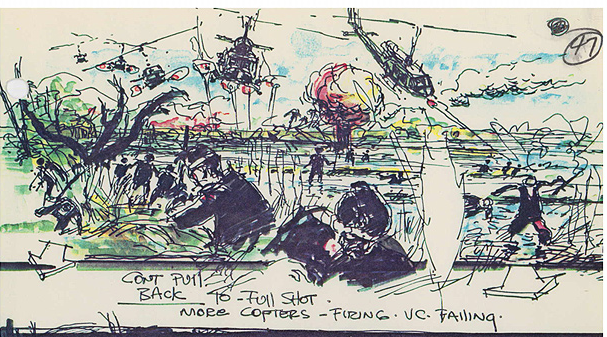
At the top, you can watch the fruits of Willard and Kilgore’s cooperation, an operatic napalm airstrike that takes the entire beach: not an easy thing to accomplish, and certainly not an easy thing to film. As anyone acquainted with the making of Apocalypse Now has heard, the production tended to turn as complicated, confusing, and perilous as the Vietnam War itself, but not necessarily for lack of planning.
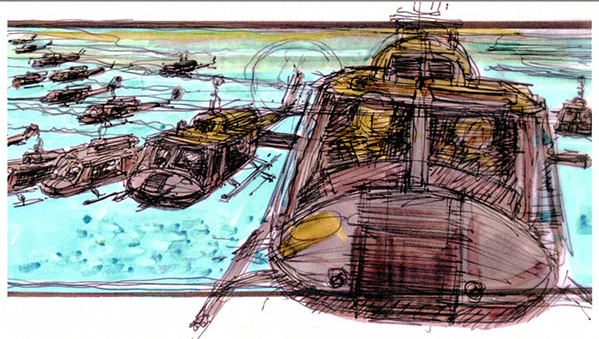
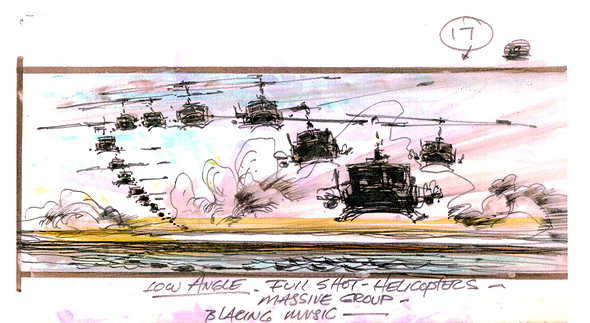
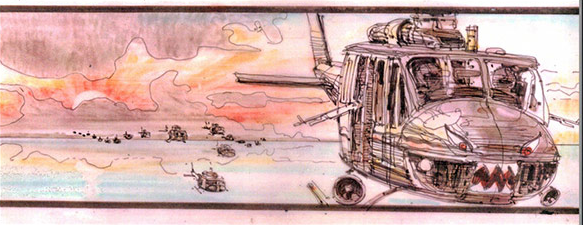
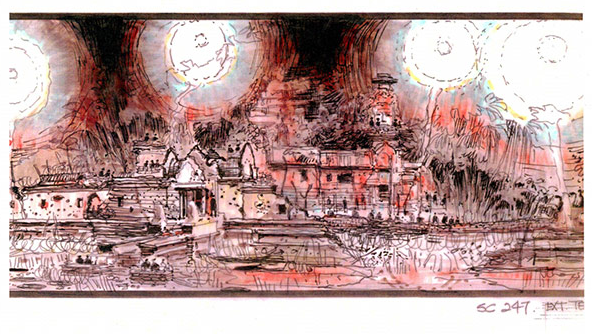
At Empire, you can view the scene’s original storyboards and read alongside them a brief interview with Doug Claybourne, who on the film had the enviable title of Helicopter Wrangler. Arriving to the Philippines-based shoot (in “the middle of nowhere”), Claybourne found Coppola on the beach with a bullhorn, Martin Sheen just replacing Harvey Keitel in the role of Willard, choppers borrowed from President Ferdinand Marcos (who periodically took them back to use against insurrections elsewhere), a coming typhoon, and “a lot of chaos.”
But Coppola, Claybourne, and the rest of the team saw it through, achieving results even more striking, in moments, than these storyboards suggest. As for the unflappable Kilgore, well, we all remember him rushing to catch a tantalizing wave even before the fighting subsides. After all, to quote his second-most famous line, “Charlie don’t surf!”
Despite some of the stranger circumstances of Philip K. Dick’s life, his reputation as a paranoid guru is far better deserved by other science fiction writers who lost touch with reality. Dick was a serious thinker and writer before pop culture made him a prophet. Jonathan Letham wrote of him, “Dick wasn’t a legend and he wasn’t mad. He lived among us and was a genius.” It’s a fashionable opinion these days, but his genius went mostly unrecognized in his lifetime—at least in his home country—except among a subset of sci-fi readers. But Dick considered himself a literary writer. He left the University of California after less than a semester, but the “consummate autodidact” read widely and deeply, favoring the giants of European philosophy, theology, and literature. For this reason, Dick suspected that his tepid reception in the U.S., by comparison with the warm regard of the French, showed a “flawed” anti-intellectualism in Americans that prevented them from appreciating his work. In the 1977 edited interview above with Dick in France, you can hear him lay out his theory in detail, offering insights along the way into his literary education and influences.
Dick identifies two strains of anti-intellectualism in the U.S. The first, he says, prevents American readers from appreciating “novels of ideas.” Science fiction, he says, “is essentially the field of ideas. And the anti-intellectualism of Americans prohibits their interest in imaginative ideas and interesting concepts.”
I don’t find Dick particularly persuasive here, but I live in a time when he has been fully embraced, if only in adaptation. Dick’s more specific take on what may be a root cause for Americans’ lack of curiosity has to do with the reading habits of Americans.
There’s another facet as regards my particular work say compared to other science fiction writers. I grew up in Berkeley and my education was not limited at all to reading other science fiction novels preceding my own, such as van Vogt, or Heinlein, or people of that kind… Padgett, and so on…. Bradbury. What I read, because it’s a university city, was Flaubert, Stendhal, Balzac… Proust, and the Russian novelists influenced by the French. Turgenev. And I even read Japanese novels, modern Japanese novels, novelists who were influenced by the French realistic writers.
Dick says his “slice of life” novels were well received in France because he based them on 19th French realist novels. His favorite, he tells the interviewer, were Madame Bovary and The Red and the Black, as well as Turgenev’s Fathers and Sons — all found in our collection of Free eBooks and Free Audio Books. Perhaps a little self-importantly, in his particular conception of himself as a literary writer, Dick distances himself from other American science fiction authors, whom he alleges share the American reader’s anti-intellectual propensities. “I think this applies to me more than other American science fiction writers,” says Dick, “In fact, I think that it’s a great flaw in American science fiction writers, and their readers, that they are insulated from the great literature of the world.”
We're hoping to rely on loyal readers, rather than erratic ads. Please click the Donate button and support Open Culture. You can use Paypal, Venmo, Patreon, even Crypto! We thank you!
Open Culture scours the web for the best educational media. We find the free courses and audio books you need, the language lessons & educational videos you want, and plenty of enlightenment in between.





.jpg)