Just How Small are Atoms? Mind Blowing TEDEd Animation Puts It All Into Perspective
In this new video from TED Education, teacher and author Jonathan Bergmann uses colorful analogies to help us visualize the scale of the atom and its nucleus. Bergmann is a pioneer of the “Flipped Classroom” teaching method, which inverts the traditional educational model of classroom lectures followed by homework. In a flipped classroom there are no lectures. Instead, teachers assign video lessons like the one above as homework, and devote their classroom time to helping students work their way through problems. To learn more about the flipped classroom method you can read a recent article co-authored by Bergmann in The Daily Riff. And to see more TED Education videos, which come with quizzes and other supplementary teaching materials, visit the TEDEd YouTube channel.
PS Find 31 Free Physics Courses in our Collection of 450 Free Courses Online. They’re all from top universities — MIT, Stanford, Yale and the rest.
via BoingBoing
Read More...Celebrate Samuel Beckett’s Birthday with Waiting For Godot (the Film) and Harold Pinter’s Memories
Today is the 106th anniversary of the birth of Samuel Beckett, whose pared-down prose and plays are among the greatest achievements of late modernism.
At a young man Beckett moved to Paris, where he befriended another Irish exile, James Joyce. As a writer, Beckett realized early on that he would never match Joyce’s “epic, heroic” achievement. Where Joyce was a synthesizer, Beckett once said, he was an analyzer. “I realized that my own way was impoverishment,” he said, “in lack of knowledge and in taking away, subtracting rather than adding.”
To celebrate Beckett’s birthday we bring you a pair of videos, including an excellent 2001 film version (above) of the most famous of his enigmatic creations, Waiting for Godot. It’s the centerpiece of Beckett on Film, a series of adaptions of all 19 of Beckett’s plays, organized by Michael Colgan, artistic director of the Gate Theatre in Dublin. The film features Barry McGovern as Vladimir, Johnny Murphy as Estragon, Alan Stanford as Pozzo and Stephen Brennan as Lucky. It was directed by Michael Lindsay-Hogg, who describes Waiting for Godot as being “like Mozart–too easy for children, too difficult for adults.” He goes on:
The play is what it is about. Samuel Beckett would have said it’s about two men waiting on the side of the road for someone to turn up. But you can invest in the importance of who is going to turn up. Is it a local farmer? Is it God? Or is it simply someone who doesn’t show up? The important thing is the ambiguity–the fact that it doesn’t really state what it is. That’s why it’s so great for the audience to be part of–they fill in a lot of the blanks. It works in their imaginations.
You can order the 19-film boxed set of Beckett on Film here, and listed to a CBC audio recording of Waiting for Godot here.
Harold Pinter in A Wake for Sam:
In early 1990, less than two months after Beckett’s death on December 22, 1989, the British playwright Harold Pinter paid tribute to his friend and hero as part of a BBC series called A Wake for Sam. Pinter begins by telling the story of the night in 1961 when he first met Beckett, while in Paris for a performance of The Caretaker:
I’d known his work for many years of course but it hadn’t led me to believe that he’d be such a very fast driver. He drove his little Citroen from bar to bar throughout the whole evening, very quickly indeed. We were together for hours, and finally ended up in a place in Les Halles eating onion soup at about four o’clock in the morning and I was by this time overcome–through, I think, alcohol and tobacco and excitement–with indigestion and heartburn, so I lay down on the table. I can still see the place. When I looked up he was gone. As I say, it was about four o’clock in the morning. I had no idea where he’d gone and he remained away and I thought, “Perhaps this has all been a dream.”
The conclusion of Pinter’s story (you’ll have to watch the video) reveals something of Beckett’s character. Pinter then goes on to read an eloquent, oft-quoted passage from a letter he wrote to a friend as a young man, in 1954, assessing Beckett’s power as a writer:
The farther he goes the more good it does me. I don’t want philosophies, tracts, dogmas, creeds, ways out, truths, answers, nothing from the bargain basement. He is the most courageous, remorseless writer going and the more he grinds my nose in the shit the more I am grateful to him. He’s not fucking me about, he’s not leading me up any garden path, he’s not slipping me a wink, he’s not flogging me a remedy or a path or a revelation or a basinful of breadcrumbs, he’s not selling me anything I don’t want to buy–he doesn’t give a bollock whether I buy or not–he hasn’t got his hand over his heart. Well, I’ll buy his goods, hook, line and sinker, because he leaves no stone unturned and no maggot lonely. He brings forth a body of beauty. His work is beautiful.
The 13-minute film concludes with a dramatic reading by Pinter of the final section of Beckett’s experimental novel The Unnamable, which was completed the same year as Waiting for Godot, in 1953. The passage builds in a crescendo of doubt and despair, with a sliver of resolve at the end:
Perhaps it’s done already, perhaps they have said me already, perhaps they have carried me to the threshold of my story, before the door that opens on my story, that would surprise me, if it opens, it will be I, it will be the silence, where I am, I don’t know, I’ll never know, in the silence you don’t know, you must go on, I can’t go on, I’ll go on.
Related Content:
Read More...Alan Watts On Why Our Minds And Technology Can’t Grasp Reality
“The world is a marvelous system of wiggles,” says Alan Watts in a series of lectures I keep on my iPod at all times. He means that the world, as it really exists, does not comprise all the lines, angles, and hard edges that our various systems of words, symbols, and numbers do. Were I to distill a single overarching argument from all I’ve read and heard of the body of work Watts produced on Zen Buddhist thought, I would do so as follows: humanity has made astounding progress by creating and reading “maps” of reality out of language, numbers, and images, but we run an ever more dangerous risk of mistaking these maps for the land. In this 1971 National Educational Television program, A Conversation With Myself, Watts claims that our comparatively simple minds and the simple technologies they’ve produced have proven desperately inadequate to handle reality’s actual complexity. But what to do about it?
Using an aesthetic now rarely seen on television, A Conversation With Myself captures, in only two unbroken shots, an informal “lecture” delivered by Watts straight to the viewer. Speaking first amid the abundant greenery surrounding his Mount Tamalpais cabin and then over a cup of ceremonial Japanese green tea (“good on a cold day”), he explains why he thinks we have thus far failed to comprehend the world and our interference with it. In part, we’ve failed because our “one-track” minds operating in this “multi-track” world insist on calling it interference at all, not realizing that the boundaries between us, one another, our technology, and nature don’t actually exist. They’re only artifacts of the methods we’ve used to look at the world, just like the distortions you get when digitizing a piece of analog sight or sound. Like early digitization systems, the crude tools we’ve been thinking with have, in Watts’ view, forced all of reality’s “wiggles” into unhelpful “lines and rows.” He sums up the problem with a memorable dash of Buddha-by-way-of-Britain wit: “You’re trying to straighten out a wiggly world, and now you’re really in trouble.”
(If you’d like a side of irony, ponder for a moment the implications of absorbing all this not only through human language, but through technology like iPods and Google Video!)
Related Content:
Alan Watts Introduces America to Meditation & Eastern Philosophy (1960)
Colin Marshall hosts and produces Notebook on Cities and Culture. Follow him on Twitter at @colinmarshall.
Read More...How the Titanic Sank: James Cameron’s New CGI Animation
It was 100 years ago next Sunday that the luxury liner Titanic struck an iceberg and sank in the North Atlantic Ocean with 1,514 souls aboard. It was one of the deadliest maritime disasters in history.
Last night, the National Geographic Channel broadcast the premier of The Titanic: The Final Word With James Cameron, in which the famed undersea explorer and director of the 1997 blockbuster movie about the disaster presents the latest forensic evidence of what happened that night a century ago. At one point in the show, Cameron, fresh off of his dive to the bottom of the Mariana Trench, gives a sort of “play-by-play” analysis of the mechanics of the disaster (see above) using Computer Graphic Imaging (CGI) software. The tragic element is completely abstracted out of the picture.
For more on the Titanic centenary, including interactive features and a 46-minute documentary film on the disaster, visit the National Geographic “Adventure on the Titanic” Web page.
Read More...The Universal Mind of Bill Evans: Advice on Learning to Play Jazz & The Creative Process
Bill Evans was one of the greatest jazz pianists of the second half of the 20th century. His playing on Miles Davis’s landmark 1959 record, Kind of Blue, and as leader of the Bill Evans Trio was a major influence on players like Herbie Hancock, Keith Jarrett and Chick Corea. “Bill’s value can’t be measured in any kind of terms,” Corea once said. “He’s one of the great, great artists of this century.”
Evans’s approach to music was a process of analysis followed by intuition. He would study a problem deliberately, working on it over and over until the solution became second nature. “You use your intellect to take apart the materials,” Evans said in 1969.
“But, actually, it takes years and years of playing to develop the facility so that you can forget all of that and just relax, and just play.” In the book Jazz Styles: History and Analysis, music writer Mark C. Gridley describes his playing:
Evans crafted his improvisations with exacting deliberation. Often he would take a phrase, or just a kernel of its character, then develop and extend its rhythms, melodic ideas, and accompanying harmonies. Then within the same solo he would often return to that kernel, transforming it each time. And while all this was happening, he would ponder ways of resolving the tension that was building. He would be considering rhythmic ways, melodic ways, and harmonies all at the same time, long before the optimal moment for resolving the idea.
Evans discusses his creative process in a fascinating 1966 documentary, The Universal Mind of Bill Evans. (You can watch it above, or find it in multiple parts on Youtube: Part 1, Part 2, Part 3, Part 4 and Part 5.) The film is introduced by Tonight Show host Steve Allen and features a revealing talk between Evans and his older brother Harry, a music teacher. They begin with a discussion of improvisation and the nature of jazz, which Evans sees as a process rather than a style. He then moves to the piano to show how he builds up a jazz improvisation, starting with a simple framework and then adding layers of rhythmic, harmonic and melodic variation.
“It’s very important to remember,” Evans says, “that no matter how far I might diverge or find freedom in this format, it only is free insofar as it has reference to the strictness of the original form. And that’s what gives it its strength. In other words, there is no freedom except in reference to something.”
The structure of this process of improvisation–the mastering of a thing explicitly prescribed in order to burn it into the subconscious for use later in creating something new–echoes the progression of Evans’s development as a musician. He says it took him 15 years of work from the time he first started improvising, at age 13, until he was ready to create something truly valuable. The thing is not to get discouraged, but to enjoy the step-by-step process of learning to make music.
“Most people just don’t realize the immensity of the problem,” Evans says, “and either because they can’t conquer immediately they think they haven’t got the ability, or they’re so impatient to conquer it that they never do see it through. But if you do understand the problem, then I think you can enjoy your whole trip through.”
If you would like to support the mission of Open Culture, consider making a donation to our site. It’s hard to rely 100% on ads, and your contributions will help us continue providing the best free cultural and educational materials to learners everywhere. You can contribute through PayPal, Patreon, and Venmo (@openculture). Thanks!
Related content:
1959: The Year that Changed Jazz
Classic Jazz Album Covers Animated, or the Re-Birth of Cool
Read More...The Art and Science of Violin Making
Sam Zygmuntowicz is a world-renowned luthier, or maker of stringed instruments. Joshua Bell and Yo-Yo Ma play his instruments. In 2003, a violin he made for Isaac Stern sold at auction for $130,000–the highest price ever for an instrument by a living luthier. To sum up Zygmuntowicz’s stature as a builder of fine instruments, Tim J. Ingles, director of musical instruments for Sotheby’s, told Forbes magazine: “There are no more than six people who are at his level.”
Zygmuntowicz is the subject of a 2007 book by John Marchese called The Violin Maker: Finding a Centuries-Old Tradition in a Brooklyn Workshop. In one passage, Marchese writes about the mysterious acoustical qualities of the violin, which he likens to a magic box:
The laws that govern the building of this box were decided upon a short time before the laws of gravity were discovered, and they have remained remarkably unchanged since then. It is commonly thought that the violin is the most perfect acoustically of all musical instruments. It is quite uncommon to find someone who can explain exactly why. One physicist who spent decades trying to understand why the violin works so well said that it was the world’s most analyzed musical instrument–and the least understood.
The most famous, and fabled, stringed instruments are those that were made in Cremona, Italy, in the late 17th and early 18th centuries by Antonio Stradivari and a handful of other masters. In Zygmuntowicz’s workshop in the Park Slope neighborhood of Brooklyn, New York, there is a bumper sticker that says, “My other fiddle is a Strad.” Behind the joke lies a serious point. Zygmuntowicz wants great musicians to use his instruments–not because they are cheaper than a Stradivarius, but because they are better. He’s trying to break a barrier that has been firmly in place for centuries. “I call it the ‘Strad Ceiling,’ ” he told NPR in 2008. “You know, if someone has a Strad in their case, will they play your fiddle?”
Although Joshua Bell owns a Zygmuntowicz, he mostly calls on the luthier to make fine adjustments to his Stradivarius. But Eugene Drucker of the Emerson String Quartet told Forbes that he actually prefers his Zygmuntowicz to his 1686 Stradivarius in certain situations. “In a large space like Carnegie Hall,” he said, “the Zygmuntowicz is superior to my Strad. It has more power and punch.” In spite of the mystique that surrounds Stradivari and the other Cremona masters, Zygmuntowicz sees no reason why a modern luthier couldn’t make a better instrument. “There isn’t any ineffable essence,” he told the The New York Times earlier this year, “only a physical object that works better or worse in a variety of circumstances.”
For a quick introduction to Zygmuntowicz’s work, watch a new video, above, by photographer and filmmaker Dustin Cohen, and an earlier piece by Jon Groat of Newsweek, below. And to dive deeper into the science of the violin, be sure to visit the “Strad3D” Web site, which features fascinating excerpts from Eugene Schenkman’s film about Zygmuntowicz’s collaboration with physicist George Bissinger on a project using 3D laser scans, CT scans and other technologies to analyze the acoustical properties of violins by Stradivari and Giuseppe Guarneri. As Zygmuntowicz told Strings magazine in 2006, “What makes those violins work is more knowable now than it ever was.” H/T Kottke
Note: if you have any problems watching the video below, you can watch an alternate version here.
Read More...Detour: The Cheap, Rushed Piece of 1940s Film Noir Nobody Ever Forgets
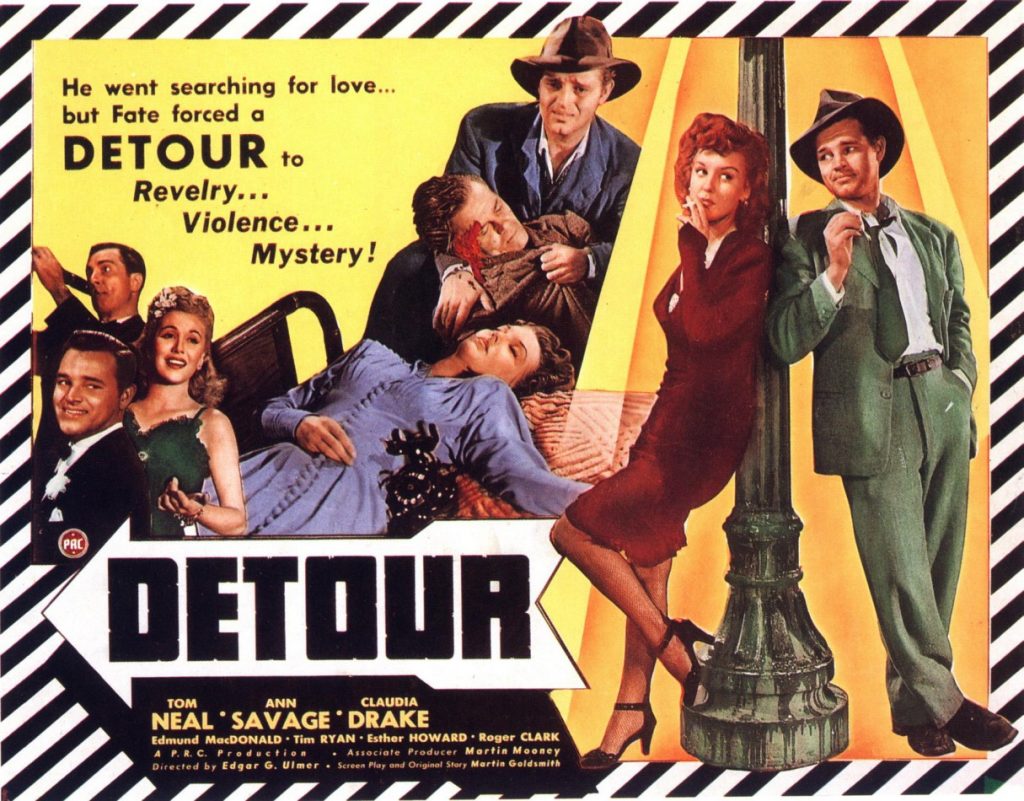
According to cinema lore, Edgar G. Ulmer’s Detour, a slapdash, unprofessional $20,000 melodrama shot in a mere mistake-filled six days, has somehow, over the past 66 years, accrued a sizable and appreciative following among film noir enthusiasts. Except it turns out that, in reality, its budget probably ran to some $117,000. And those six days might have actually been three six-day weeks. And the Austrian-born Ulmer, who had not only worked for such European luminaries as F.W. Murnau, Billy Wilder, and (so he claimed) Fritz Lang, but even made The Black Cat for Universal Pictures, hardly lacked professional bona fides. And the film’s careful use of sound and striking use of light set it apart even from its brethren in the genre.
And speaking of that genre, a hearty critical agreement now holds that Detour distills, in its brief 68 minutes, the most vital emotional and aesthetic elements of film noir in a way that none of its other exemplars have managed. And mistakes? What mistakes? As Roger Ebert wrote on ushering the film into his Great Movies canon, “Placing style above common sense is completely consistent with Ulmer’s approach throughout the film.”
To recount Detour’s story here — a piano-player down on his luck; a sudden death; a scheming, venomous dame — would be to miss the point. To cite out its many, er, unconventional production choices — nonexistent backgrounds concealed with fog, shots simply flipped over and re-used, stock footage meant to pad the runtime almost to feature length, unconvincing rear projection even by 1945’s standards — would be to miss the point from another direction. The film has fallen into the public domain, so watch it free online and experience for yourself the way that, for all its apparent bluntness, it stealthily lodges itself in your sense memory. To call a movie “dreamlike” reeks of cliché, but Detour presents the elements of film noir in such a pure, naked state that you have little choice but to accept them directly, the way you would accept the “facts” of a dream. Though seemingly incompetent on all the levels subject to conscious analysis, the film operates effectively on all the levels beneath, hence the lasting inspiration it offers to certain filmmakers today. Make Detour, if you can, a double-feature with David Lynch’s Lost Highway, which plays almost like a straight tribute to Ulmer’s picture. As a dedicated transcendental meditator with a fascination for the dark side of Los Angeles and a tendency to bend archetypal characters toward his often oblique but always vivid stylistic will, Lynch has internalized Detour’s legacy — intended or otherwise — more deeply than any other filmmaker alive today.
More noir classics can be found in our collection of 60+ Free Noir Films.
Colin Marshall hosts and produces Notebook on Cities and Culture. Follow him on Twitter at @colinmarshall.
Read More...In Search of Mœbius: A Documentary Introduction to the Inscrutable Imagination of the Late Comic Artist Mœbius
“I’ll die in some truly banal manner, the way I live,” says the subject of BBC Four’s In Search of Mœbius. I don’t know what would constitute a non-banal manner of death — or, for that matter, a banal one — but nobody familiar with modern comic art could believe that Jean Giraud, also known as Mœbius, could possibly have lived a banal life. If you haven’t read a comic since your childhood Sunday funnies, you need only watch this program to understand why the artist’s passing on Saturday brought forth so many breathless tributes. You’ll also catch a glimpse of the vast possibilities offered by comic art as a form. The inscrutable workings of Mœbius’ peculiar imagination drove him far into this territory, and many creators (in comics and elsewhere) still struggle to follow him.
Aside from Mœbius himself, the program interviews the coterie from his early years in France at Métal Hurlant, the magazine that would open the space for his distinctively subconscious-fueled, near-psychedelic yet richly textural science-fiction sensibility. It goes on to talk with well-known admirers who, feeling the resonance of those particular (and particularly difficult to describe) qualities of Mœbius’ vision that cross so many national and artistic boundaries, found ways to work with him.
These high-profile collaborators range from Marvel Comics founder Stan Lee, who enlisted Mœbius to take Silver Surfer in new aesthetic and intellectual directions, to screenwriter Dan O’Bannon, biomechanical surrealist H.R. Giger, and filmmaker/mystic Alejandro Jodorowsky, who worked with him on an unrealized (but still tantalizing) film adaptation of Dune.
In Search of Mœbius also explores the real landscapes that must have worked their way into Mœbius’ imagination, contributing to the strikingly unreal landscapes that worked their way out of it. We see the deserts of Mexico, traces of which appear in his Western series Blueberry, where he visited his mother in the 1950s. We see the Los Angeles he considered “really an amazing city,” where his work on Silver Surfer took him. We even see him in his native land, standing before the harshly iconic Bibliothèque nationale de France. Mœbius may be gone, but the world inside his head remains forever open for us on the page to explore. H/T @EscapeIntoLife
Colin Marshall hosts and produces Notebook on Cities and Culture. Follow him on Twitter at @colinmarshall.
Read More...How Bertrand Russell Turned The Beatles Against the Vietnam War
The Beatles were so much a part of the youth movement that blossomed in the 1960s that it’s amusing to think that one of the main issues that energized the movement–peace–came to the Beatles through a 92-year-old man.
As Paul McCartney explains in this clip from a January 14, 2009 interview on The View, it happened when he decided to pay a visit to philosopher Bertrand Russell. A co-founder of analytic philosophy, Russell had been a life-long social and political activist. During World War I, he was not allowed to travel freely in Britain due to his anti-war views. He lost his fellowship at Trinity College, Cambridge, and was eventually jailed for six months for supposedly interfering with British Foreign Policy. After World War II, Russell lobbied strenuously for the abolition of nuclear weapons. In the 1960s, he opposed the Vietnam War.
After the Beatles became big in 1963 and 1964, McCartney began taking advantage of his celebrity status by calling on people he admired. In an interview with Barry Miles for the book Paul McCartney: Many Years From Now, McCartney describes his meeting with Russell:
Somehow I got his number and called him up. I figured him as a good speaker, I’d seen him on television, I’d read various bits and pieces and was very impressed by his dignity and the clarity of this thinking, so when I got a chance I went down and met him. Bertrand Russell lived in Chelsea in one of those little terrace houses, I think it was Flood Street. He had the archetypal American assistant who seemed always to be at everyone’s door that you wanted to meet. I sat round waiting, then went in and had a great little talk with him. Nothing earth-shattering. He just clued me in to the fact that Vietnam was a very bad war, it was an imperialist war and American vested interests were really all it was all about. It was a bad war and we should be against it. That was all. It was pretty good from the mouth of the great philosopher. “Slip it to me, Bert.”
McCartney reported his experience to the other members of the Beatles, and it was John Lennon who really took the anti-war message and ran with it. For a reminder of those days, watch the video below of Lennon and Yoko Ono at their “Bed-In” for peace in 1969:
If you would like to support the mission of Open Culture, consider making a donation to our site. It’s hard to rely 100% on ads, and your contributions will help us continue providing the best free cultural and educational materials to learners everywhere. You can contribute through PayPal, Patreon, and Venmo (@openculture). Thanks!
Read More...Five Free Courses from Stanford Start This Month
 Stanford’s big open course initiative keeps rolling along. On March 12, three new courses will get underway:
Then, starting on March 19, two more will take flight:
The courses generally feature interactive video clips; short quizzes that provide instant feedback; the ability to pose high value questions to Stanford instructors; feedback on your overall performance in the class; and a statement of accomplishment at the end of the course.
And, yes, the courses are free and now open for enrollment.
As always, don’t miss our big list of 425 Free Online Courses. It may just be the single most awesome page on the web.
Story via Stanford University News. Algorithm image courtesy of BigStock.
Read More...Support Us
We're hoping to rely on loyal readers, rather than erratic ads. Please click the Donate button and support Open Culture. You can use Paypal, Venmo, Patreon, even Crypto! We thank you!

About Us

Open Culture scours the web for the best educational media. We find the free courses and audio books you need, the language lessons & educational videos you want, and plenty of enlightenment in between.
Advertise With Us
FREE UPDATES!
GET OUR DAILY EMAIL
Get the best cultural and educational resources on the web curated for you in a daily email. We never spam. Unsubscribe at any time.
FOLLOW ON SOCIAL MEDIA
Open Culture editor Dan Colman scours the web for the best educational media. He finds the free courses and audio books you need, the language lessons & movies you want, and plenty of enlightenment in between.
Advertise With Us

