Discover DALL‑E, the Artificial Intelligence Artist That Lets You Create Surreal Artwork

DALL‑E, an artificial intelligence system that generates viable-looking art in a variety of styles in response to user supplied text prompts, has been garnering a lot of interest since it debuted this spring.
It has yet to be released to the general public, but while we’re waiting, you could have a go at DALL‑E Mini, an open source AI model that generates a grid of images inspired by any phrase you care to type into its search box.
Co-creator Boris Dayma explains how DALL‑E Mini learns by viewing millions of captioned online images:
Some of the concepts are learnt (sic) from memory as it may have seen similar images. However, it can also learn how to create unique images that don’t exist such as “the Eiffel tower is landing on the moon” by combining multiple concepts together.
Several models are combined together to achieve these results:
• an image encoder that turns raw images into a sequence of numbers with its associated decoder
• a model that turns a text prompt into an encoded image
• a model that judges the quality of the images generated for better filtering

My first attempt to generate some art using DALL‑E mini failed to yield the hoped for weirdness. I blame the blandness of my search term — “tomato soup.”
Perhaps I’d have better luck “Andy Warhol eating a bowl of tomato soup as a child in Pittsburgh.”

Ah, there we go!
I was curious to know how DALL‑E Mini would riff on its namesake artist’s handle (an honor Dali shares with the titular AI hero of Pixar’s 2018 animated feature, WALL‑E.)
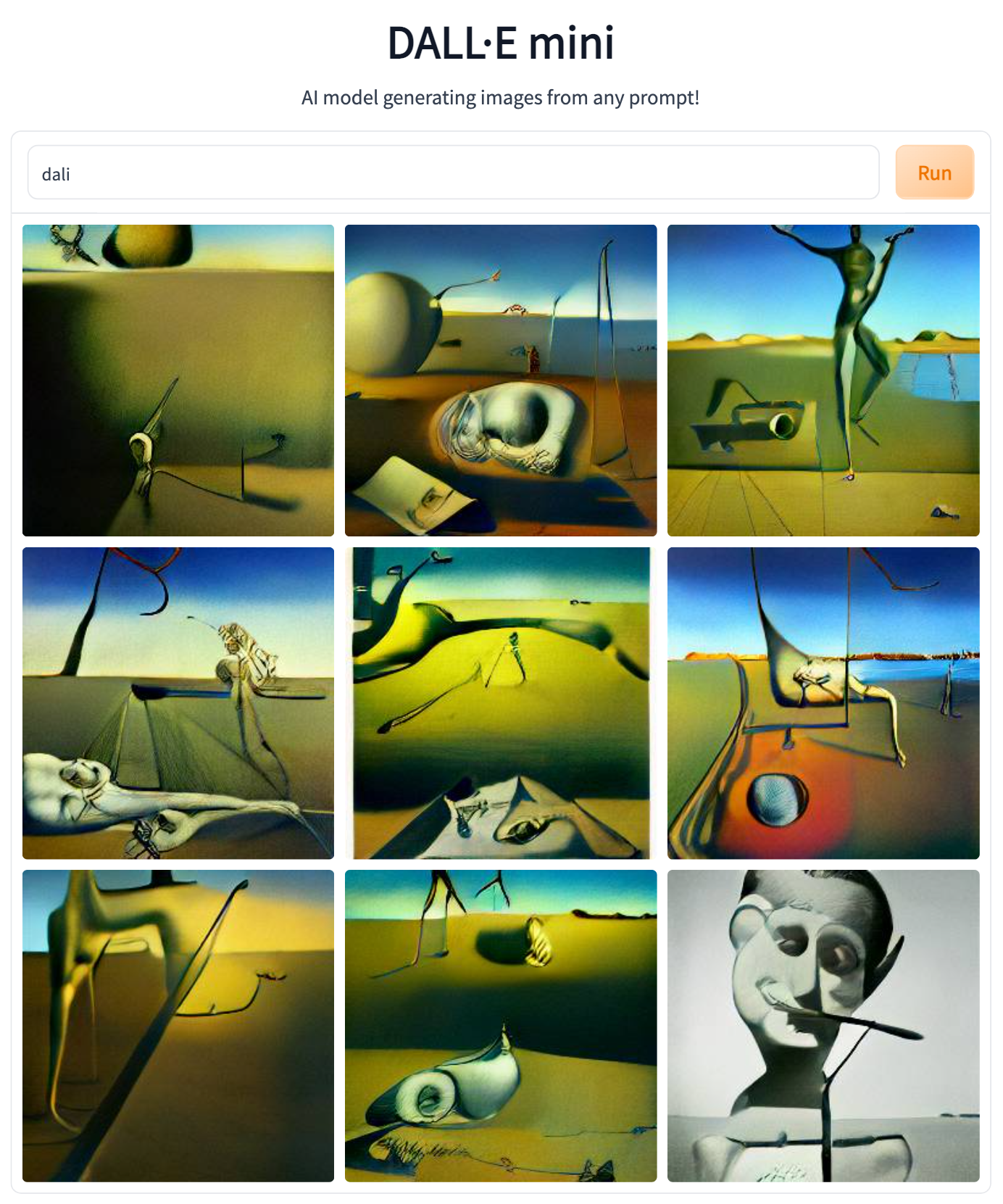
Hmm… seems like we’re backsliding a bit.
Let me try “Andy Warhol eating a bowl of tomato soup as a child in Pittsburgh with Salvador Dali.”

Ye gods! That’s the stuff of nightmares, but it also strikes me as pretty legit modern art. Love the sparing use of red. Well done, DALL‑E mini.
At this point, vanity got the better of me and I did the AI art-generating equivalent of googling my own name, adding “in a tutu” because who among us hasn’t dreamed of being a ballerina at some point?

Let that be a lesson to you, Pandora…
Hopefully we’re all planning to use this playful open AI tool for good, not evil.
Hyperallergic’s Sarah Rose Sharp raised some valid concerns in relation to the original, more sophisticated DALL‑E:
It’s all fun and games when you’re generating “robot playing chess” in the style of Matisse, but dropping machine-generated imagery on a public that seems less capable than ever of distinguishing fact from fiction feels like a dangerous trend.
Additionally, DALL‑E’s neural network can yield sexist and racist images, a recurring issue with AI technology. For instance, a reporter at Vice found that prompts including search terms like “CEO” exclusively generated images of White men in business attire. The company acknowledges that DALL‑E “inherits various biases from its training data, and its outputs sometimes reinforce societal stereotypes.”
Co-creator Dayma does not duck the troubling implications and biases his baby could unleash:
While the capabilities of image generation models are impressive, they may also reinforce or exacerbate societal biases. While the extent and nature of the biases of the DALL·E mini model have yet to be fully documented, given the fact that the model was trained on unfiltered data from the Internet, it may generate images that contain stereotypes against minority groups. Work to analyze the nature and extent of these limitations is ongoing, and will be documented in more detail in the DALL·E mini model card.
The New Yorker cartoonists Ellis Rosen and Jason Adam Katzenstein conjure another way in which DALL‑E mini could break with the social contract:

And a Twitter user who goes by St. Rev. Dr. Rev blows minds and opens multiple cans of worms, using panels from cartoonist Joshua Barkman’s beloved webcomic, False Knees:

Proceed with caution, and play around with DALL‑E mini here.
Get on the waitlist for original flavor DALL‑E access here.
Related Content
- Ayun Halliday is the Chief Primatologist of the East Village Inky zine and author, most recently, of Creative, Not Famous: The Small Potato Manifesto. Follow her @AyunHalliday.
Read More...Revisit Vintage Issues of Astounding Stories, the 1930s Magazine that Gave Rise to Science Fiction as We Know It
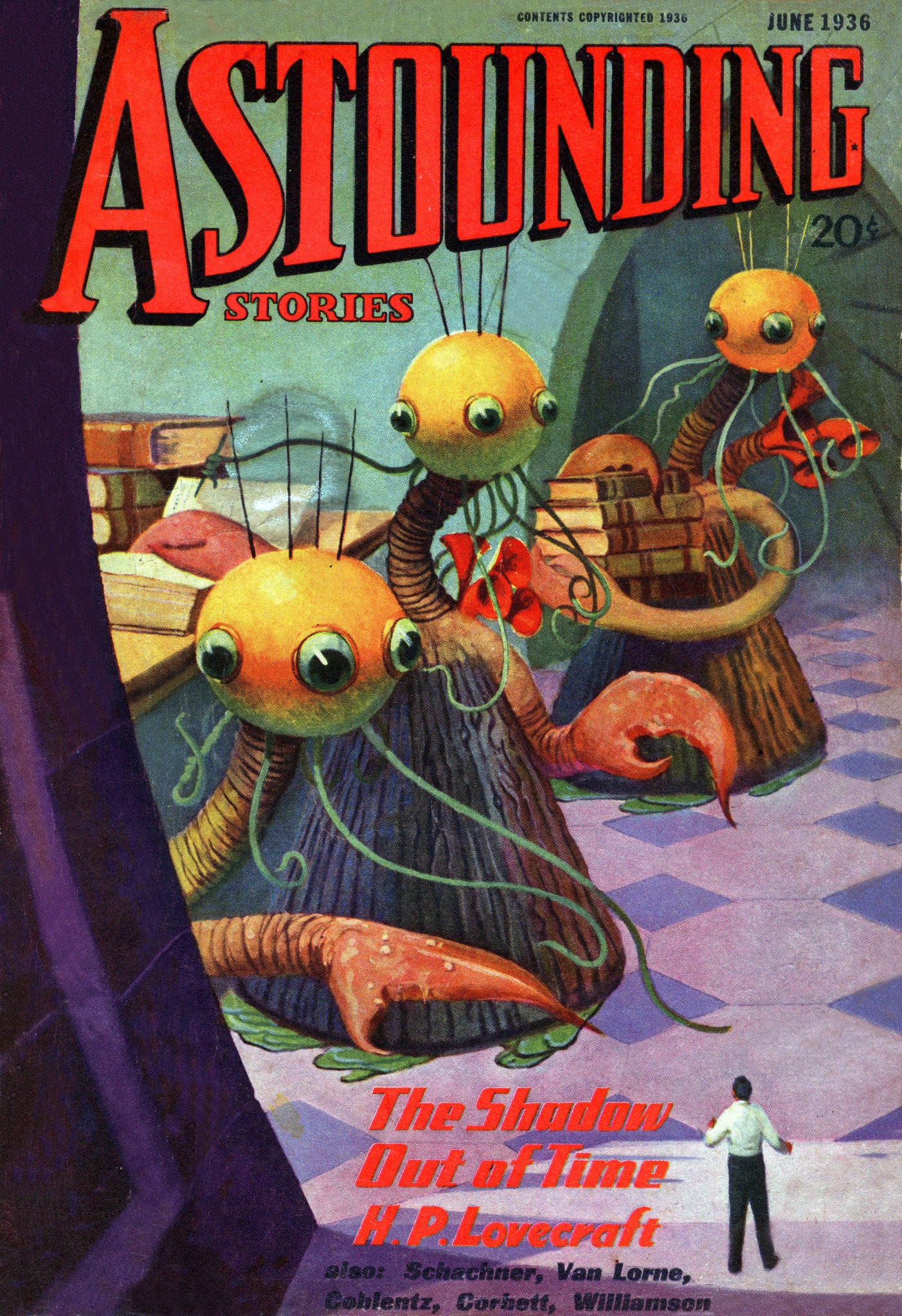
Having been putting out issues for 92 years now, Analog Science Fiction and Fact stands as the longest continuously published magazine of its genre. It also lays claim to having developed or at least popularized that genre in the form we know it today. When it originally launched in December of 1929, it did so under the much more whiz-bang title of Astounding Stories of Super-Science. But only three years later, after a change of ownership and the installation as editor of F. Orlin Tremaine, did the magazine begin publishing work by writers remembered today as the defining minds of science fiction.
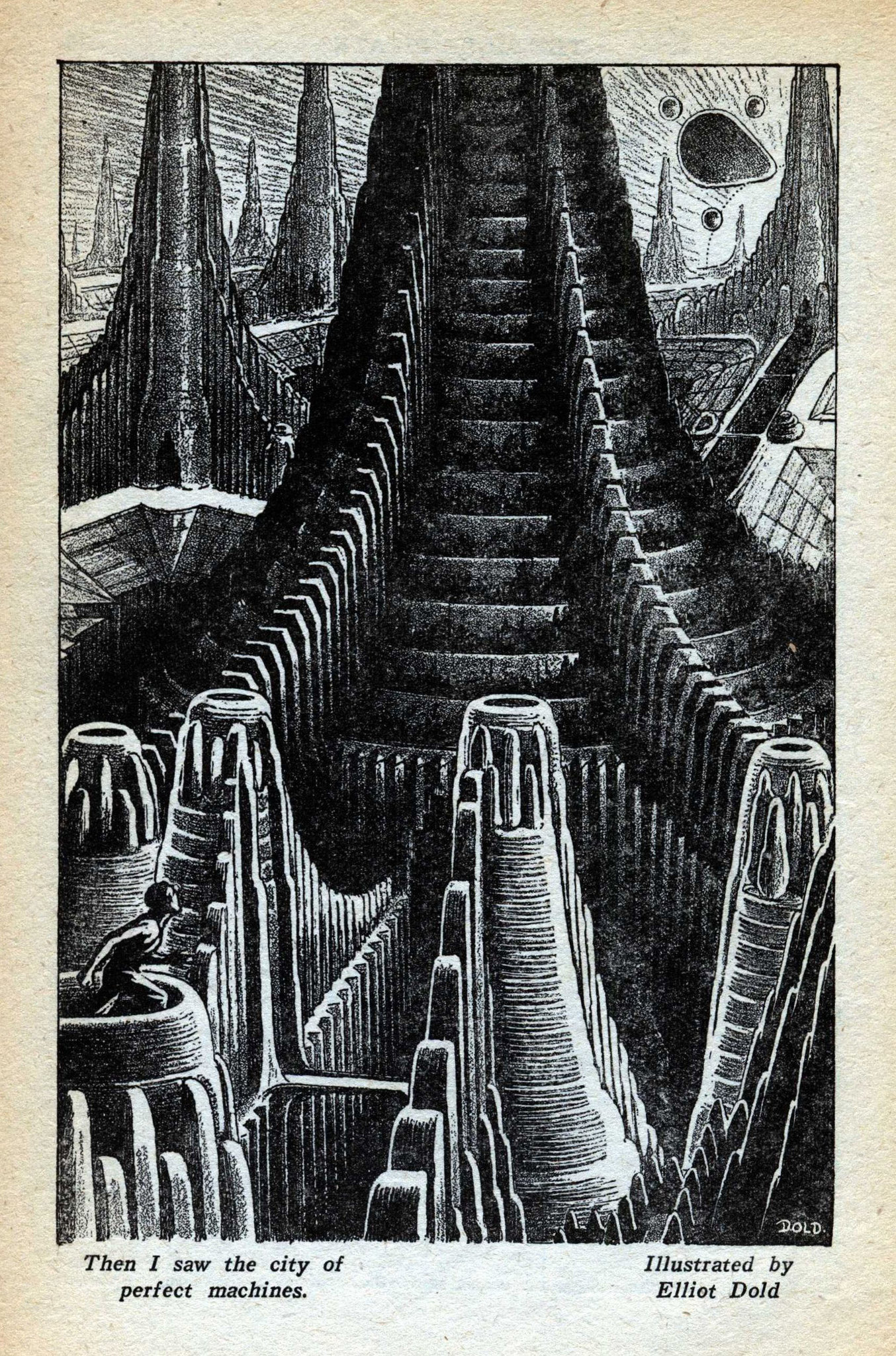
Under Tremaine’s editorship, Astounding Stories pulled itself above its pulp-fiction origins with stories like Jack Williamson’s “Legion of Space” and John W. Campbell’s “Twilight.” The latter inspired the striking illustration above by artist Elliott Dold. “Dold’s work was deeply influenced by Art Deco, which lends its geometric forms to the city of machines in ‘Twilight,’ ” writes the New York Times’ Alec Nevala-Lee, which “inaugurated the modern era of science fiction.”
In the case of a golden-age science-fiction magazine like Astounding Stories, Nevala-Lee argues, “its most immediate impact came through its illustrations,” which “may turn out to be the genre’s most lasting contribution to our collective vision of the future.”
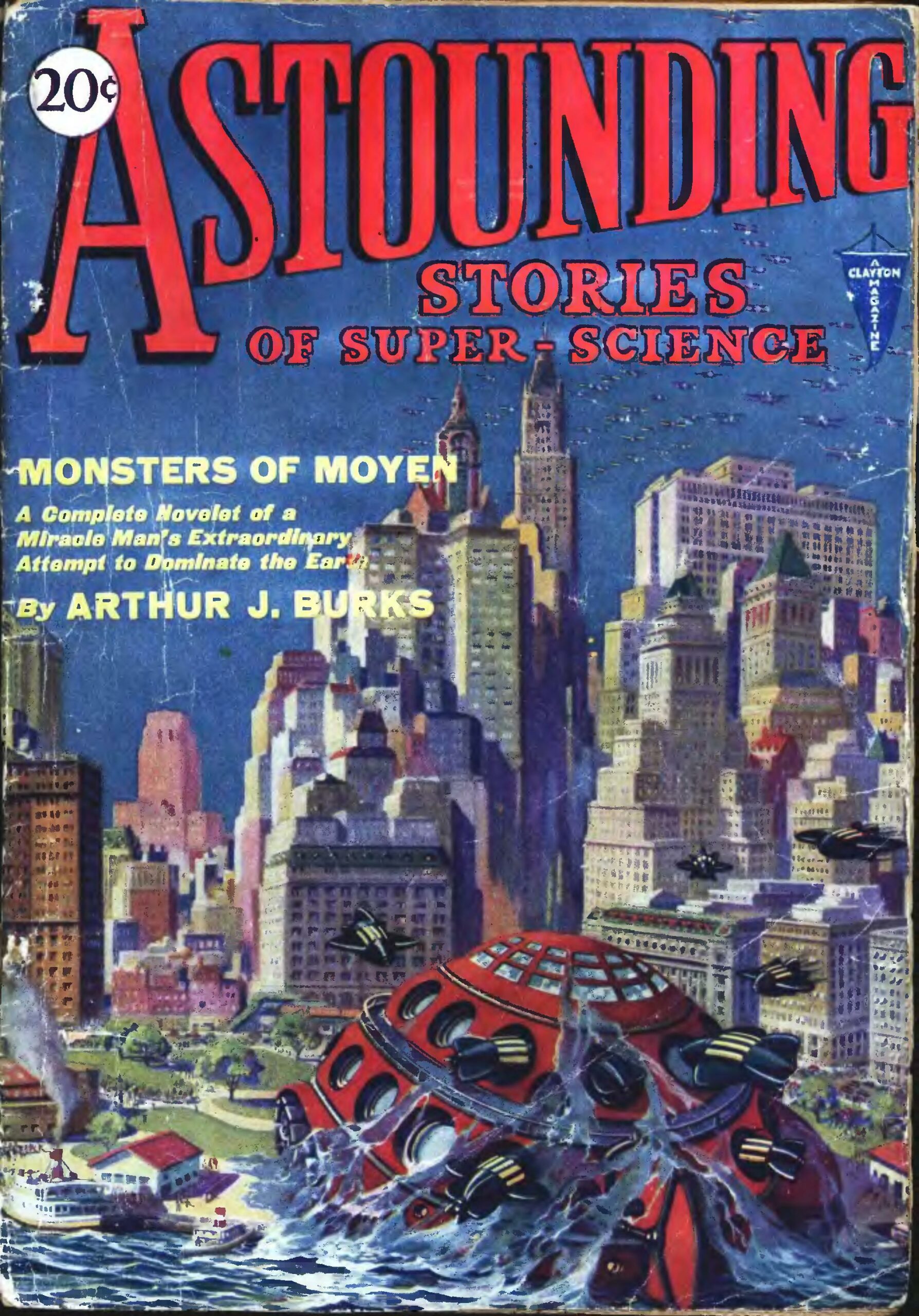
None of the imagery printed inside Astounding Stories was as striking as its covers, full-color productions on which “artists could let their imaginations run wild.” Sometimes they adhered closely to the visual descriptions in a story’s text — perhaps too closely, in the case the June 1936’s issue with H. P. Lovecraft’s “The Shadow Out of Time” — and sometimes they departed from and even competed with the magazine’s actual content. But after Campbell took over as editor in 1937, that content became even stronger: featured writers included Robert Heinlein, A. E. van Vogt, and Isaac Asimov.
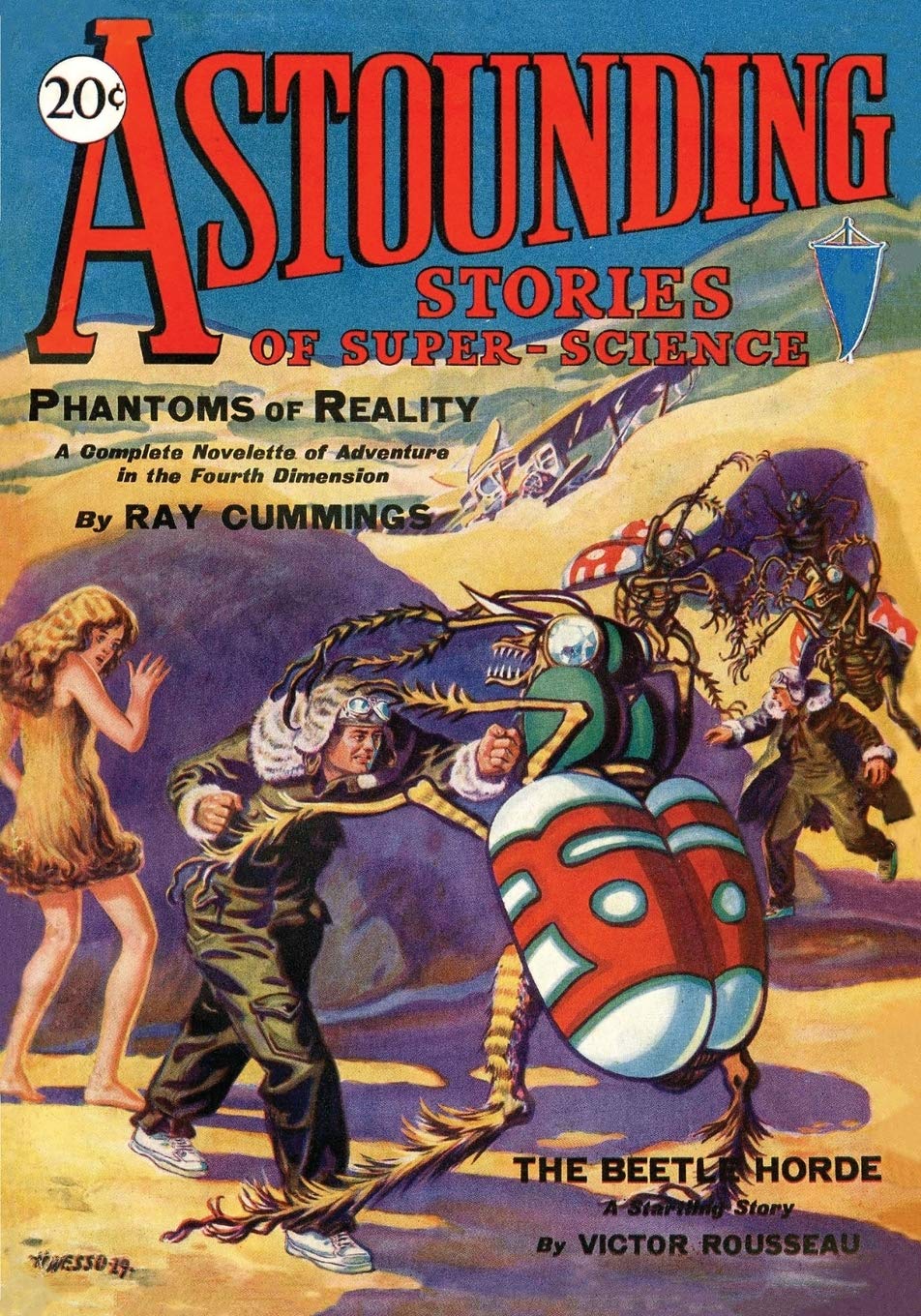
Now, here in the once science-fictional-sounding twenty-first century, you can not only behold the covers but read the pages of hundreds of issues of Astounding Stories from the thirties, forties, and fifties online. The earliest volumes are available to download at the University of Pennsylvania’s web site, by way of Project Gutenberg, and there are even more of them free to read at the Internet Archive. Though it may not always have faithfully reflected the material within, Astounding Stories’ cover imagery did represent the publication as a whole. It could be thought-provoking and haunting, but it also delivered no small amount of cheap thrills — and the golden age of science fiction still shows us how thin a line really separates the two.
Related content:
Free: 355 Issues of Galaxy, the Groundbreaking 1950s Science Fiction Magazine
The Encyclopedia of Science Fiction: 17,500 Entries on All Things Sci-Fi Are Now Free Online
Based in Seoul, Colin Marshall writes and broadcasts on cities, language, and culture. His projects include the Substack newsletter Books on Cities, the book The Stateless City: a Walk through 21st-Century Los Angeles and the video series The City in Cinema. Follow him on Twitter at @colinmarshall, on Facebook, or on Instagram.
Read More...Sun Tzu’s The Art of War: An Animated Chapter-by-Chapter Breakdown of the Ancient Chinese Treatise
Though not a long book, The Art of War is nevertheless an intimidating one. Composed in the China of the fifth century BC, it comes down to us as perhaps the definitive analysis of military strategy, applicable equally to East, West, antiquity, and modernity alike. Hence the minor but still-productive industry that puts forth adaptations, extensions, and reinterpretations of The Art of War for non-military settings, transposing its lessons into law, business, sports, and other realms besides. But if you want a handle on what its author, the general and strategist Sun Tzu, actually wrote, watch the illustrated video above.
A production of Youtube channel Eudaimonia, previously featured here on Open Culture for a similarly animated exegesis of Machiavelli’s The Prince, it runs more than two and a half hours in full. Far though it exceeds the length of the average explainer video, it does reflect the tendency of Sun Tzu’s succinct observations to expand, when seriously considered, into much wider and more complex discussions. To each of the original text’s chapters the Eudaimonia video devotes a ten-to-fifteen-minute section, conveying not just the content of its lessons but also their relevance to the history of human conflict in the roughly two and a half millennia since they were written.
In chapter two, on waging war, Sun Tzu writes that “in order to kill the enemy, our men must be roused to anger.” It was in this spirit that, during the Second World War, the United Kingdom’s Ministry of Information launched a media “anger campaign” meant to “increase resolve against the Germans, as until then, the British had little sense of real hostility towards the average German.” In the chapter on weaknesses and strengths, Sun Tzu recommends “the divine art of subtlety and secrecy” as a means of becoming invisible and inaudible to the enemy — much as Julius Caesar did in the Gallic Wars, when he sent scouting ships “painted in Venetian blue, which was a similar color to that of the sea.”
Other examples come from diverse chapters of history. These include the American Civil War, Gandhi’s negotiation of Indian independence, the Napoleonic Wars, the British defeat in Zululand, Joan of Arc’s siege of Orléans, the revolt against the Turkish led by T. E. Lawrence (better known as Lawrence of Arabia), and even Steve Jobs’ turnaround of a nearly bankrupt Apple. Most of us will never find ourselves in situations of quite these stakes. But given that none of us can entirely avoid dealing with conflict, we’d could do worse than to keep the guidance of Sun Tzu on our side.
Related content:
Machiavelli’s The Prince Explained in an Illustrated Film
10 Reasons Why Hannibal’s Military Genius Still Captures Our Imagination Today
Hear an Ancient Chinese Historian Describe The Roman Empire (and Other Voices of the Past)
How Many U.S. Marines Could Bring Down the Roman Empire?
Based in Seoul, Colin Marshall writes and broadcasts on cities, language, and culture. His projects include the Substack newsletter Books on Cities, the book The Stateless City: a Walk through 21st-Century Los Angeles and the video series The City in Cinema. Follow him on Twitter at @colinmarshall, on Facebook, or on Instagram.
Read More...When David Bowie & Brian Eno Made a Twin Peaks-Inspired Album, Outside (1995)
By any measure, David Bowie was a superstar. He first rose to fame in the nineteen-seventies, a process galvanized by his creation and assumption of the rocker-from-Mars persona Ziggy Stardust. In the following decade came Let’s Dance, on the back of which he sold out stadiums and dominated the still-new MTV. Yet through it all, and indeed up until his death in 2016, he kept at least one foot outside the mainstream. It was in the nineties, after his aesthetically cleansing stint with guitar-rock outfit Tin Machine, that Bowie made use of his stardom to explore his full spectrum of interests, which ranged from the basic to the bizarre, the mundane to the macabre.
This suggests a good deal in common between Bowie and another high-profile David of his generation: David Lynch, long one of the most famous film directors alive. “There are many obvious, surface connections and intersections between Lynch and Bowie,” write film critics Cristina Álvarez López and Adrian Martin. “Both have dabbled in film and music, as well as painting, theatre and performance art. Both are actors — Bowie slightly more conventionally so than Lynch.” Lynch would no doubt agree with Bowie’s insistence that “my interpretation of my work is really immaterial,” that “it’s the interpretation of the listener, or the viewer, which is all-important.”
These words appear in López and Martin’s analysis of Twin Peaks, the television series Lynch created in collaboration with Mark Frost, and Outside, the album Bowie created in collaboration with Brian Eno. When it premiered on ABC in the spring of 1990, Twin Peaks became a minor sensation by conjuring a familiar yet deeply strange atmosphere such as no one had never seen on television before. It also pioneered what López and Adrian Martin call “the Dead Girl/Woman genre, which traces out a labyrinthine mystery from the discovery of a young female corpse.” What brings Special Agent Dale Cooper to Twin Peaks, Washington, we recall, is the murder of homecoming queen Laura Palmer.
What brings Nathan Adler, a detective in the Art Crimes unit, to Oxford Town, New Jersey is the murder of the fourteen-year-old Baby Grace Blue. Thus begins the Twin Peaks-inspired storyline of Outside, Bowie’s own 1995 entry into the genre of the Dead Girl/Woman. Like Lynch and Frost’s show, Bowie’s album has a cast of eccentrics: Adler and Baby Grace, but also the likes of criminal “outsider” Leon Blank; Algeria Touchshriek, dealer in “art-drugs and DNA prints”; and a sinister figure known as both the Artist and the Minotaur. All are played by Bowie himself, who makes use of various accents (a technique practiced with his appearance in the 1992 Twin Peaks movie Fire Walk with Me) and voice-processing techniques.
At the time this 75-minute “non-linear Gothic Drama Hyper-Cycle,” as Bowie labeled it, gave his listeners a lot to take in, to say nothing of the major media outlets attempting to publicize it. “This new project is all about sex, violence, and death,” says the CBC’s Laurie Brown in a typical piece of television coverage. But it also deals with the merging of those human eternals with art and popular culture, a process that fascinated Bowie more and more as the nineties progressed — as did “the re-emergence of Neo-Paganism, ritual body art, and the fragmentation of society,” as he puts it in Outside’s official making-of video.
Bowie and Eno intended Outside (officially 1. Outside) as the first in a series that would ultimately constitute “a diary in music and in texture of what it felt like to be around at the end of the Millennium.” In one press conference, Bowie hinted that “the narrative might fall by the wayside,” much as Lynch and Frost originally intended to leave Laura Palmer’s death unsolved. That the second volume never appeared only underscores the tantalizing incompleteness of Outside, which López and Martin highlight as another similarity to Twin Peaks: “Both works are serial and multiple, existing in various official and unofficial forms, in spin-offs, outtakes” — not least the never-properly-released “Leon suites” Bowie and Eno recorded before the album itself — “and in numerous fan commentaries.”
A kind of circle closed in 1997 when Outside’s “I’m Deranged” soundtracked the opening credits of Lynch’s Lost Highway. But the work continued to hold out possibilities until the end of Bowie’s life: “We both liked that album a lot and felt that it had fallen through the cracks,” Eno said. “We talked about revisiting it, taking it somewhere new.” Despite his Lynchian resistance to interpretation, Bowie did acknowledge even in 1995 the thematic importance of mortality itself. Outside’s first single was called “The Heart’s Filthy Lesson,” and “the filthy lesson in question is the fact that life is finite.” For him, “knowing that I’ve got a finite time in life on Earth actually clarifies things and makes me feel quite buoyant.” Bowie knew — or learned — that life is too short not to follow your fascinations to their limits.
Related content:
Watch an Epic, 4‑Hour Video Essay on the Making & Mythology of David Lynch’s Twin Peaks
The Story of Ziggy Stardust: How David Bowie Created the Character that Made Him Famous
David Bowie & Brian Eno’s Collaboration on “Warszawa” Reimagined in a Comic Animation
Based in Seoul, Colin Marshall writes and broadcasts on cities, language, and culture. His projects include the Substack newsletter Books on Cities, the book The Stateless City: a Walk through 21st-Century Los Angeles and the video series The City in Cinema. Follow him on Twitter at @colinmarshall, on Facebook, or on Instagram.
Read More...Remembering Dave Smith (RIP), the Father of MIDI & the Creator of the 80s’ Most Beloved Synthesizer, the Prophet‑5
Some founders rest on their laurels, build industries around themselves like a cocoon, and never escape or outgrow the big achievement that made their name. Some, like Dave Smith — the so-called “father of MIDI,” and one of the most innovative synthesizer pioneers of the last several decades – don’t stop creating for long enough to collect dust. You may never have heard of Smith, but you’ve heard his technology. Before pioneering MIDI (Musical Instrument Digital Interface), the digital standard that allows hundreds of electronic instruments to play nicely with each other across computer and software makers, Smith founded Sequential Circuits and built one of the most revered synthesizers ever made, the Prophet‑5, invented in 1977 and essential to the sound of the 1980s and beyond.
Smith’s keyboards made appearances on stage, video, and albums throughout the decade. Duran Duran’s Nick Rhodes used the Prophet‑5 on the band’s first album and “virtually every record I have made since then,” he said in a statement. “Without Dave’s vision and ingenuity,” Rhodes went on, “the sound of the 1980s would have been very different, he truly changed the sonic soundscape of a generation.”
Sequential synths appeared on albums by bands as disparate as The Cure and Daryl Hall & John Oates, who demonstrate the dream-like, ethereal capabilities of the Prophet‑5 — the first fully programmable polyphonic analog synth — in “I Can’t Go for That (No Can Do).” The Prophet‑5 also drove the sound of Radiohead’s Kid A, and indie dance darlings Hot Chip wrote they would be “nothing without what [Smith] created.” Few vintage synths are as desirable as the Prophet‑5.
The original Prophet is “not immune to the dark side of vintage synths,” writes Vintage Synth Explorer, including problems such as unstable tuning and a lack of MIDI. Smith fixed that issue himself with new iterations of the Prophet and other synths featuring his most famous post-Prophet‑5 technology. “Like so many brilliant and creative people,” the MIDI Association writes, Smith “always focused on the future.” He was “not actually a big fan of being called the ‘Father of MIDI.’ ” Many people contributed to the development of the technology, especially Roland founder Ikutaro Kakehashi, who won a technical Grammy with Smith in 2013 for the protocol that made its debut as a new standard in 1983.
Smith preferred making hardware instruments and “almost begrudgingly accepted interviews about his contributions to MIDI.…. He was also not a big fan of organizations, committees and meetings.” He was a synth lover’s synth maker, a designer and engineer with a “deep understanding of what musicians wanted,” says Rhodes. Collaborations with Yamaha and Korg produced more software innovations in the 90s, but in the 2000s, Smith returned to Sequential Circuits and debuted the Prophet X, Prophet‑6, and OB‑6 with Tom Oberheim. The two designers collaborated in 2021 on the Oberheim OB-X8 and Smith introduced it just weeks before his death.
He had traveled a long way from inventing the Prophet‑5 in 1977 and presenting a paper in 1981 to the Audio Engineering Society on what he then called a Universal Synthesizer Interface. Smith himself never seemed to stop and look back, but lovers of his famous instruments are happy we still can, and that electronic instruments and computers can talk to each other easily thanks to MIDI. Few of those instruments sound as good as the original, however. See a demonstration of the Prophet-5’s range of sounds in the video just above and hear more tracks that show off the synth in the list here.
Related Content:
The Story of the SynthAxe, the Astonishing 1980s Guitar Synthesizer: Only 100 Were Ever Made
Wendy Carlos Demonstrates the Moog Synthesizer on the BBC (1970)
Thomas Dolby Explains How a Synthesizer Works on a Jim Henson Kids Show (1989)
Josh Jones is a writer and musician based in Durham, NC. Follow him at @jdmagness
Read More...Watch Ella Fitzgerald Put Her Extraordinary Vocal Agility on Display, in a Live Rendition of “Summertime” (1968)
“I never knew how good our songs were until I heard Ella Fitzgerald sing them.” — Ira Gershwin
No one ever gave Ella Fitzgerald faint praise. We could point to cuts from nearly any one of her over 200 albums as evidence for why she is the undisputed “Queen of Jazz,” a title for which she worked hard in her nearly 60-year career. But she’s better known by another name, “The First Lady of Song,” for definitive interpretations of Cole Porter, Duke Ellington, Irving Berlin, and, of course, George and Ira Gershwin. Fitzgerald’s recordings of their songs played “an essential role in the broader transformation of the Gershwin’s music from show tunes to American Songbook standards,” writes the University of Michigan’s Gershwin Initiative.
What’s fascinating about that transformation is the way in which Fitzgerald’s renditions of popular songs elevated them to eternal mainstream status by drawing on the rhythmic and melodic resources of jazz, a distinctly Black American music sometimes cast as a threat to the U.S. establishment when Fitzgerald began her career. (We need look no further than the vicious persecution of Billie Holiday by the country’s first drug czar, Henry Anslinger, as case in point.) America may not always have been eager to embrace Fitzgerald, but she was happy nonetheless to gift the country its greatest music.
Fitzgerald’s 5‑LP set of Gershwin songs, produced by Norman Granz in 1959, continues to be “the most ambitious of the celebrated song books recorded by Ella,” Jazz Messengers writes, “and one of the best vocal jazz albums ever made.” Recorded two years earlier by Granz in Los Angeles, her Porgy and Bess with Louis Armstrong “remains one of the true gems in jazz history.” Fitzgerald’s voice is unparalleled. She could do almost anything with it, from reaching down low to imitate Armstrong’s growl to breaking a glass with her high C for a Memorex ad twenty years later.
Dizzy Gillespie once said that Fitzgerald could sing back anything he played for her, and she cited horns as her primary vocal inspiration. “She sang like an instrument,” says pianist Billy Taylor, who played with her in the 1940s, “like a clarinet or like a trombone or like a whatever.” The irony, of course, is that horns and many other melodic instruments achieved their timbre by trying to imitate the human voice. Fitzgerald had the original; she needed no accompaniment — she was the music, with “impeccable timing and perfect pitch,” NPR writes. “In fact, band musicians said they would tune up to her voice.”
In the video at the top from a performance in Berlin in 1968, you can see Fitzgerald “destroy” the harmonic minor scale, as the YouTube uploader puts it, while pianist Tee Carson looks on in awe. The song, from Porgy and Bess (see the full performance further up), is just one of many written by the Gershwins that “transcends its musical theatre origins” due to Fitzgerald’s improvisatory brilliance and musical sensitivity. Just above, you can hear that live vocal track stripped of instrumentation except Ella’s voice in a Wings of Pegasus analysis video of the “depth of her expression” and vocal perfection.
Related Content:
How Marilyn Monroe Helped Break Ella Fitzgerald Into the Big Time (1955)
Women of Jazz: Stream a Playlist of 91 Recordings by Great Female Jazz Musicians
How “America’s First Drug Czar” Waged War Against Billie Holiday and Other Jazz Legends
Josh Jones is a writer and musician based in Durham, NC. Follow him at @jdmagness
Read More...Play “Artle,” an Art History Version of Wordle: A New Game from the National Gallery of Art

Are you one of the hundreds of thousands who’ve gotten themselves hooked on Wordle, the free online game that gives players six chances to guess a five-letter word of the day?
Its popularity has spawned a host of imitators, including Quordle, Crosswordle, Absurdle and Lewdle, which has carved itself a niche in the vulgar and profane.
Even the National Gallery of Art is getting in on the action with Artle, wherein players get four attempts to correctly identify an artist du jour by examining four of their pieces, drawn from its vast collection of paintings, photographs, sculptures and other works.
The Gallery provides a bit of an assist a few letters into every guess, especially helpful to those taking wild shots in the dark.

Before you commit to Georgia O’Keeffe, you may want to consider some 80 other George and Georges variants who pop up as you type, including Georges Braque, George Grosz, Georgine E. Mason, George Joji Miyasaki, George Segal, Georges Seurat, and Georg Andreas Wolfgang the Elder.
Hats off if you can readily identify all of these artists’ work on sight. That’s an impressive command of art history you’ve got there!
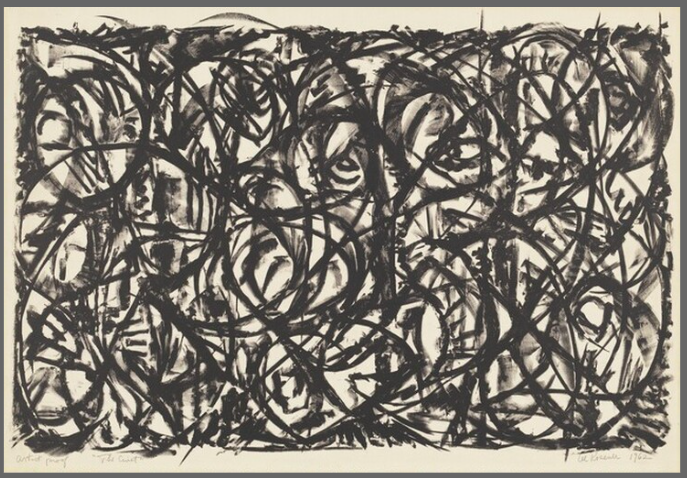

As with Wordle, a button provides a streamlined invitation to boast about your prowess on social media after you’ve completed your daily Artle. Return visitors can keep track of their stats in the upper right hand corner.
There’s no shame in failing to identify an artist in four tries, just a free opportunity to further your education a bit with titles and links to the four works you just spent time viewing.
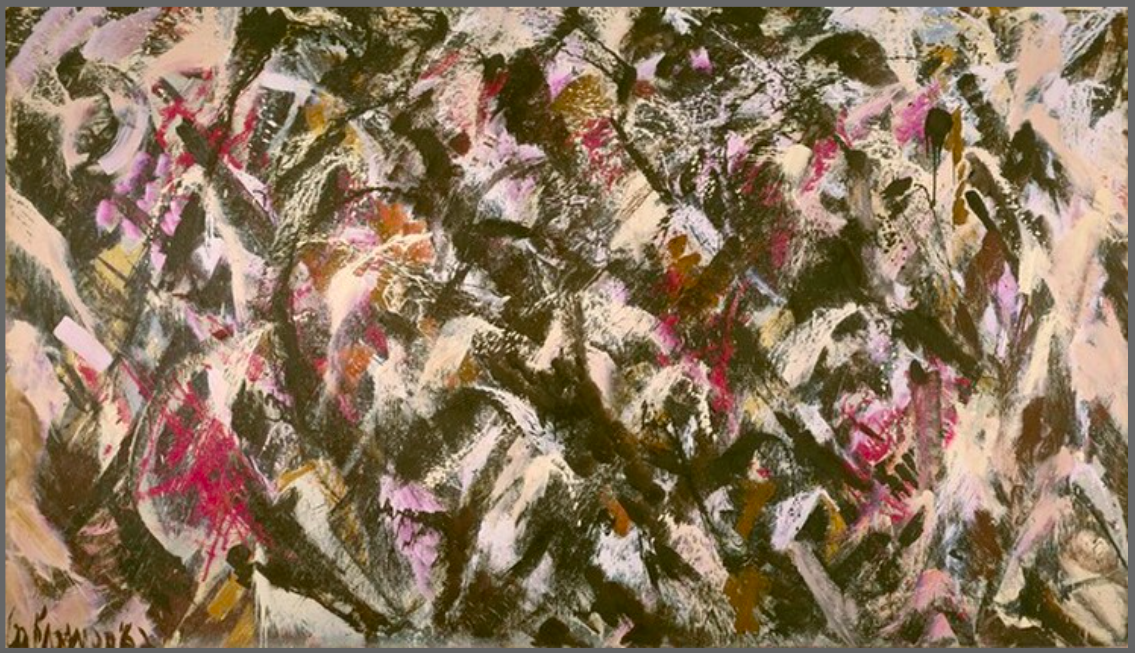
The examples we’ve included from Thursday, June 2’s puzzle are Free Space (Deluxe), pink, The Civet, Imperative, and Cobalt Night by….
Your guess?

Play Artle here — like Wordle and multivitamins, just one a day.
Related Content
Google’s Free App Analyzes Your Selfie and Then Finds Your Doppelganger in Museum Portraits
Construct Your Own Bayeux Tapestry with This Free Online App
- Ayun Halliday is the Chief Primatologist of the East Village Inky zine and author, most recently, of Creative, Not Famous: The Small Potato Manifesto. Follow her @AyunHalliday.
Read More...Machiavelli’s The Prince Explained in an Illustrated Film
Niccolò Machiavelli lived in a time before the internet, before radio and television, before drones and weapons of mass destruction. Thus one naturally questions the relevance of his political theories to the twenty-first century. Yet in discussions about the dynamics of power, no name has endured as long as Machiavelli’s. His reputation as a theorist rests mostly on his 1532 treatise Il Principe, or The Prince, in which he pioneered a way of analyzing power as it was actually wielded, not as people would have liked it to be. How, he asked, does a ruler — a prince — attain his position in a state, and even more importantly, how does he maintain it?
You can hear Machiavelli’s answers to these questions explained, and see them illustrated, in the 43-minute video above. It breaks The Prince down into seven parts summarizing as many of the book’s main points, including “Do not be neutral,” “Destroy, do not would,” and “Be feared.”
These commandments would seem to align with Machiavelli’s popular image as an apologist, even an advocate, for brutal and repressive forms of rule. But his enterprise has less to do with offering advice than with describing how real figures of power, princes and otherwise, had amassed and retained that power.
The video comes from Eudaimonia, a Youtube channel that has also featured similarly animated exegeses of Stoicism and Sun Tzu’s The Art of War. Its creator makes these ancient sources of knowledge accessible with not just his cartoonish illustrations, but also his inclusion of illuminating examples from more recent history. In the case of The Prince, these come from eras like the Russian Revolution, World War II, and even our own time of instant global communication, attention-hungry media, and a seemingly weak political class. In much of the world, we live in a time much less nasty and brutish than Machiavelli’s. But looking at the effectiveness (or lack thereof) of our own leaders, we have to admit that the principles of The Prince may not have gone out of effect.
To delve deeper into the world of Machiavelli, you can watch a BBC documentary on the Renaissance political theorist below.
Related content:
What Does “Machiavellian” Really Mean?: An Animated Lesson
Salman Rushdie: Machiavelli’s Bad Rap
Introduction to Political Philosophy: A Free Yale Course
Allan Bloom’s Lectures on Machiavelli (Boston College, 1983)
Based in Seoul, Colin Marshall writes and broadcasts on cities, language, and culture. His projects include the Substack newsletter Books on Cities, the book The Stateless City: a Walk through 21st-Century Los Angeles and the video series The City in Cinema. Follow him on Twitter at @colinmarshall, on Facebook, or on Instagram.
Read More...
Italian Advice on How to Live the Good Life: Cigarettes, Tomatoes, and Other Picturesque Small Pleasures
“I guess everybody’s got a dream and we’re all hoping to see it come true,” muses Giovanni Mimmo Mancusou, a philosophical native of Calabria, the lovely, sun-drenched region forming the toe of Italy’s boot, above. “A dream coming true is better than just a dream.”
Filmmakers Jan Vrhovnik and Ana Kerin were scouting for subjects to embody “the very essence of nostalgia” when they chanced upon Mancusou in a corner shop.
A lucky encounter! Not every non-actor — or for that matter, actor — is as comfortable on film as the laidback Mancusou.
(Vrhovnik has said that he invariably serves as his own camera operator when working with non-actors, because of the potential for intimacy and intuitive approach that such proximity affords.)
Mancusou, an advocate for simple pleasures, also appears to be quite fit, which makes us wonder why the film’s description on NOWNESS doubles down on adjectives like “aging”, “older” and most confusingly, “wisened.”
Merriam-Webster defines “wizened” with a z as “dry, shrunken, and wrinkled often as a result of aging or of failing vitality” … and “wisened” not at all.
Perhaps NOWNESS meant wise?
We find ourselves craving a lot more context.
Mancusou has clearly cultivated an ability to savor the hell out of a ripe tomato, his picturesque surroundings, and his ciggies.
“Serenity, joy, ecstasy” is embroidered across the back of his ball cap.
His manner of expressing himself does lend itself to a “poetic thought piece”, as the filmmakers note, but might that not be a symptom of struggling to communicate abstract thoughts in a foreign tongue?
We really would love to know more about this charming guy… his family situation, what he does to make ends meet, his actual age.
Home movies accompany his nostalgic reverie, but did he provide this footage to his new friends?
Did they hunt it down on ebay? It definitely fits the vibe, but is the man with the eyebrows Mancusou at an earlier age?
Our star pulls up to a small petrol station, declares, “All right, here we go,” and the next frame shows him wearing a headlamp and magnifier as he peers into the workings of a pocket watch:
Time out of mechanical. It’s magic.
Is this a hobby? A profession? Does he repair watches in a darkened gas station?
The filmmakers aren’t saying and the blurred background offers no clues either. Curse you, depth of field!
We’re not even given his home coordinates.
The film, part of the NOWNESS series Portrait of a Place, is titled Paradiso, and there is indeed a village so named adjacent to the town of Belvedere Marittimo, but according to census data we found on line, it has only 14 residents, 7 male.
If that’s where Mancusou lives, he’s either 45–49, 65–69, 70–74, or one of two fellows over age 74…and now we’re really curious about his neighbors, too.
No shade to Signor Mancuso, but we’re glad to know we’re not the only viewers left unsatisfied by this portrait’s lack of depth.
One commenter who chafed at the lack of specificity (“this video is a random portrait of basically anyone in the world that is happy with the little he has”) suggested the omissions contribute to an Italian stereotype familiar from pasta sauce commercials:
People in Italy actually work and have ambitions you know? And often are very well-educated and hard-working. The perspective of Italy that you have comes from the American media and Italian post-war neorealism. Indeed, Oscar-winning Italian people complained about the fact that what the media wants is seeing Italians wearing tank tops doing nothing if not mafia or smelling the roses.
Watch more entries in the NOWNESS Portrait of a Place series here.
Related Content
What Are the Keys to Happiness? Lessons from a 75-Year-Long Harvard Study
Positive Psychology: A Free Online Course from Harvard University
The Science of Well-Being: Take a Free Online Version of Yale University’s Most Popular Course
- Ayun Halliday is the Chief Primatologist of the East Village Inky zine and author, most recently, of Creative, Not Famous: The Small Potato Manifesto. Follow her @AyunHalliday.
Read More...
How Korean Things Are Made: Watch Mesmerizing Videos Showing the Making of Traditional Clothes, Teapots, Buddhist Instruments & More
It would be awfully clichéd to call Seoul, where I live, a place of contrasts between old and new. And yet that texture really does manifest everywhere in Korean life, most palpably on the streets of the capital. In my favorite neighborhoods, one passes through a variety of different eras walking down a single alley. “Third-wave” coffee shops and “newtro” bars coexist with family restaurants unchanged for decades and even small industrial workshops. Those workshops produce clothing, plumbing fixtures, printed matter, electronics, and much else besides, in many cases late into the night. For all its reputation as a high-tech “Asian Tiger,” this remains, clearly and presently, a country that makes things.
You can see just how Korea makes things on the Youtube channel All Process of World, which has drawn tens of millions of views with its videos of factories: factories making forks, bricks, sliced tuna, sheepskin jackets, bowling balls, humanoid robots. The scale of these Korean industrial operations ranges from the massive to the artisanal; some products are unique to twenty-first century life, and others have been in use for centuries.
On the traditional side, All Process of World has provided close-up views of the making of ceramic teapots, wooden window frames (as you would see in a classical Korean hanok), handheld percussive moktak to aid Buddhist monks in their chants, and even jeogori, the distinctive jackets worn with hanbok dresses.
Judging by the comments, All Process of World’s many viewers hail from around the globe. This shouldn’t come as a surprise, given Korea’s newfound worldwide popularity. But that so-called “Korean wave” owes less to the appeal of Korea’s traditional culture than its modern one, less to its rustic yet elegant pottery and brilliantly colorful formalwear than to BTS and “Gangnam Style,” Parasite and Squid Game — whose “robot girl” appears on a rug made in one All Process of World video. Another shows us the production of an equally modern item, the face masks seen everywhere in Korea during the past two years. Just a few weeks ago, the government gave us the okay to take those masks off outdoors. While hoping for the arrival of fully post-COVID era, we’d do well to keep in mind how the past always seems to find its way into the present.
Related content:
Watch a Korean Master Craftsman Make a Kimchi Pot by Hand, All According to Ancient Tradition
How Japanese Things Are Made in 309 Videos: Bamboo Tea Whisks, Hina Dolls, Steel Balls & More
Modern Artists Show How the Ancient Greeks & Romans Made Coins, Vases & Artisanal Glass
Based in Seoul, Colin Marshall writes and broadcasts on cities, language, and culture. His projects include the Substack newsletter Books on Cities, the book The Stateless City: a Walk through 21st-Century Los Angeles and the video series The City in Cinema. Follow him on Twitter at @colinmarshall, on Facebook, or on Instagram.
Read More...Support Us
We're hoping to rely on loyal readers, rather than erratic ads. Please click the Donate button and support Open Culture. You can use Paypal, Venmo, Patreon, even Crypto! We thank you!

About Us

Open Culture scours the web for the best educational media. We find the free courses and audio books you need, the language lessons & educational videos you want, and plenty of enlightenment in between.
Advertise With Us
FREE UPDATES!
GET OUR DAILY EMAIL
Get the best cultural and educational resources on the web curated for you in a daily email. We never spam. Unsubscribe at any time.
FOLLOW ON SOCIAL MEDIA
Open Culture editor Dan Colman scours the web for the best educational media. He finds the free courses and audio books you need, the language lessons & movies you want, and plenty of enlightenment in between.
Advertise With Us

