Quentin Tarantino & Roger Avary Rewatch Cult-Classic Movies on Their New Video Archives Podcast
Quentin Tarantino has countless fans all around the world, increasingly many of whom are too young to ever have rented a tape from a video store. But when those twenty-something cinephiles learn his origin story as a filmmaker, they must suspect they missed out on a valuable experience in the VHS era, whatever its inconveniences. When Tarantino broke out in the nineteen-nineties with Reservoir Dogs and Pulp Fiction, he was publicly celebrated not just for those films, but for his having made them as a video-store-clerk-turned-auteur.
Indeed, it really does seem true that Tarantino’s cinematic sensibility owes something to the years he’d spent exercising his movie expertise behind the counter at Video Archives in Manhattan Beach. When the store closed in 1995, the freshly ascendant Tarantino seized the opportunity to buy up its thousands of VHS tapes. Roger Avary, his fellow Archives alumnus and collaborator on the screenplay for Pulp Fiction, bought the Laserdiscs. Though much of Avary’s collection has succumbed to the “disc rot” that notoriously afflicts that format, Tarantino’s collection has held up for more than a quarter-century.
Now Tarantino’s private tape stash provides the material for his and Avary’s latest collaboration: The Video Archives Podcast, to which you can listen on platforms like Apple Podcasts and Stitcher. On it, the two of them aim to re-create the vehemently cinephile environment of Video Archives by discussing the movies from its stock — after watching them on the actual VHS tapes the store once rented out. As Tarantino explains it, each episode of The Video Archives Podcast will feature three titles. But the conversations will go well beyond the films themselves, involving details of the particular home-video releases popped into the VCR as well as the history of the distributors that put them out.
Naturally, the hosts also get into their personal histories with these movies — which in some cases go back nearly 50 years — as film-lovers and filmmakers. Owing to the need to introduce the show itself, in the first episode they discuss only two pictures, both from the nineteen-seventies: John Carpenter and Dan O’Bannon’s anti-establishment sci-fi comedy Dark Star, followed by Ulli Lommel’s rock-Mafia drama Cocaine Cowboys, which features a cameo from Andy Warhol. Representing a younger generation is Avary’s daughter Gala, producer of the podcast, who in a mid-show segment (and her own after-show) offers another perspective on the movies of the week. She clearly knows how to appreciate a cult classic, even if she’s never paid a late fee in her life.
Related content:
Quentin Tarantino Explains How to Write & Direct Movies
An Analysis of Quentin Tarantino’s Films Narrated (Mostly) by Quentin Tarantino
Based in Seoul, Colin Marshall writes and broadcasts on cities, language, and culture. His projects include the Substack newsletter Books on Cities, the book The Stateless City: a Walk through 21st-Century Los Angeles and the video series The City in Cinema. Follow him on Twitter at @colinmarshall, on Facebook, or on Instagram.
Read More...Scenes from The Wizard of Oz Remastered in Brilliant 4K Detail: Behold the Work of a Creative YouTuber
The Wizard of Oz came out more than 80 years ago, but there must still be a few among us who remember seeing it in the theater. Only they would have felt completely the power of its famous scene when Dorothy leaves black-and-white Kansas and enters the colorful land of Oz. Much of the power of art comes from contrast, and this particular contrast could hardly have been a more persuasive advertisement for the power of Technicolor. After a development history of more than twenty years, that color motion-picture process had by 1939 reached the stage of its technological evolution called “Process 4,” which enabled studios to make use of not just some but all of the spectrum.
This final form of Technicolor enraptures viewers even today, reproducing colors as it did at intense, sometimes borderline-psychedelic depths of saturation. The process found its ideal material in the fantasy of The Wizard of Oz, with its yellow brick road (choosing whose exact shade inspired about a week of deliberation at MGM), its ruby slippers (calculatedly changed from the silver shoes in L. Frank Baum’s original novel), and its host of settings and characters with great chromatic potential.
You can appreciate this un-repeatably fortuitous intersection of content and technology again in these scenes from an unofficial 4K restoration of the film posted by Youtuber Oriel Malik.
This is surely the sharpest and most-detail rich version of The Wizard of Oz most of us have seen, and, in those respects, it actually outdoes the original prints of the film. For some the image may actually be too clear, making obvious as it does certain artificial-looking aspects of the backgrounds and costumes. But in a sense this may not run counter to the intentions of the filmmakers, who knew full well what genre they were working in: even on film, a musical must retain at least some of the look and feel of the stage. Yet it’s also true that the softer visual edges of the contemporary analog printing and projection technologies would have enhanced the dreamlike atmosphere created in part by all those surreally vivid hues — which, according to die-hard Technicolor enthusiasts, only really come through on film anyway.
Related content:
The Complete Wizard of Oz Series, Available as Free eBooks and Free Audio Books
The Wizard of Oz Broken Apart and Put Back Together in Alphabetical Order
Dark Side of the Rainbow: Pink Floyd Meets The Wizard of Oz in One of the Earliest Mash-Ups
Watch the Earliest Surviving Filmed Version of The Wizard of Oz (1910)
Based in Seoul, Colin Marshall writes and broadcasts on cities, language, and culture. His projects include the Substack newsletter Books on Cities, the book The Stateless City: a Walk through 21st-Century Los Angeles and the video series The City in Cinema. Follow him on Twitter at @colinmarshall, on Facebook, or on Instagram.
Read More...Free Documentaries from Spain Let You Watch the Traditional Making of Wine, Cheese, Churros, Honey & More
The Spanish filmmaker Eugenio Monesma has dedicated his life to capturing the traditions of his homeland and its surrounding areas. He began his career by first taking up a Super‑8 camera at age 25 back in the nineteen-seventies, and in the decades since, his mission has taken him to the furthest corners of Spain and beyond in search of ever-older ways to preserve in detail. This places his work in the tradition of the anthropological or ethnographic documentary. But in a still-unconventional move in his field, he’s united the old with the new by creating his own Youtube channel on which to make his documentaries free to watch around the world.
Launched in 2020, Monesma’s channel has become a surprising hit. At the top of the post you can watch its most popular video, his short 1997 documentary on the making of combs from animal horns — which, as of this writing, has racked up nearly 8.5 million views. This happens to be one of the productions that took him beyond Spain’s borders, if only just: to the French village of Lesparrou, specifically, which maintained its small horn comb factories until the end of the twentieth century.
Their process is narrated in the immaculate Spanish diction of Monesma himself, but you can also take your pick of subtitles in more than a dozen other languages. Other of his documentaries that have become popular on Youtube include documentaries on the traditional making of cheese, silk, wine, pottery, honey and wax, knives, and leather.
Many of these videos run under twenty minutes; some reach nearly feature length. All of them satisfy a desire, which now seems widely felt among viewers of Youtube, to witness thoroughly analog processes that have been in use, changing and evolving only gradually, for long stretches of history.
And the fact that the things made so often look delicious certainly doesn’t make Monesma’s work less compelling: take, for example, the artisanal churros of Pamplona’s Churrería de la Mañueta, whose appeal is surely universal. In Korea, where I live, the past decade has a fad for churros elaborately coated and topped with colors and flavors unknown to tradition, and I’d be lying if I said I wasn’t curious what Monesma would have to say about it.
Related content:
20 Mesmerizing Videos of Japanese Artisans Creating Traditional Handicrafts
Based in Seoul, Colin Marshall writes and broadcasts on cities, language, and culture. His projects include the Substack newsletter Books on Cities, the book The Stateless City: a Walk through 21st-Century Los Angeles and the video series The City in Cinema. Follow him on Twitter at @colinmarshall, on Facebook, or on Instagram.
Read More...Never-Seen Vincent Van Gogh Self-Portrait Discovered Behind an Earlier Painting
The name of Vincent Van Gogh is one of the very best known in the history of painting, and indeed the history of art. But that doesn’t mean the man himself enjoyed any success in his short lifetime. Though he was convinced that he was creating “the art of the future,” and seemingly right to believe it, the buyers of nineteenth-century European art didn’t see it quite that way. Consequently impoverished, Van Gogh had to resort to unconventional strategies to maintain his artistic productivity. Instead of professional models, for example, he hired peasants and people from the streets. And when he couldn’t paint them, he painted himself.
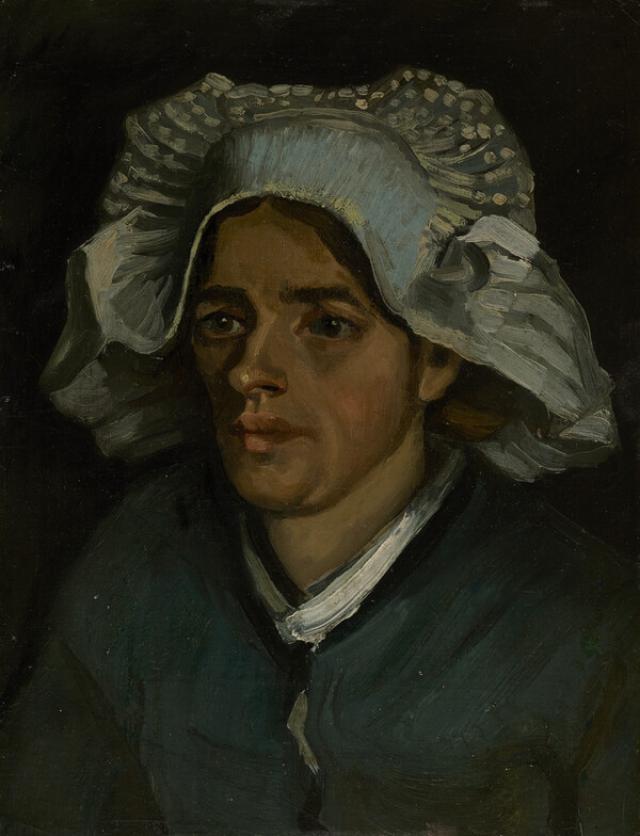
Van Gogh would also economize by re-using his canvases, a practice not unknown in his day. “However, instead of painting over earlier works,” writes Jordan Ogg at National Galleries Scotland, “he would turn the canvas around and work on the reverse.”
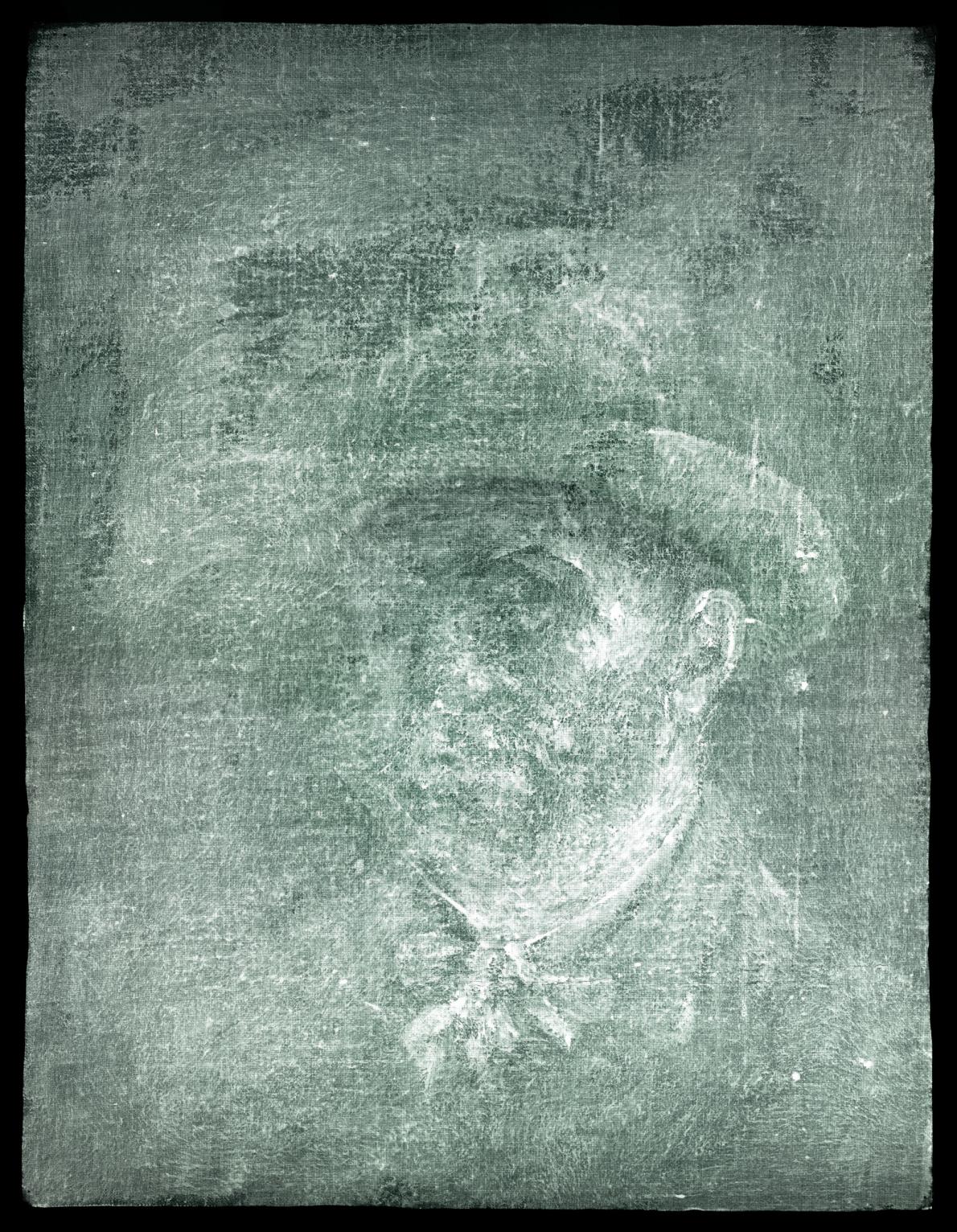
It seems he did this with the National Galleries Scotland’s own Head of a Peasant Woman, whose back side turns out to bear a hitherto unknown self-portrait hidden by “layers of glue and cardboard” for well over a century. X‑ray analysis has revealed “a bearded sitter in a brimmed hat with a neckerchief loosely tied at the throat. He fixes the viewer with an intense stare, the right side of his face in shadow and his left ear clearly visible.”
Even in its ghostly lack of detail, this face seems to be unmistakable. If it belongs to who we think it does, it will become the 36th known Van Gogh self-portrait. It would have been painted before 1884’s Head of a Peasant Woman, “during a key moment in Van Gogh’s career, when he was exposed to the work of the French impressionists after moving to Paris.” You can learn about the ongoing process of this lost self-portrait’s rediscovery in the video at the top of the post. Van Gogh expressed conviction that he was painting for later generations, but surely even he would be astounded at the excitement of twenty-first century curators about finding another of his self portraits — and one he saw fit to give the cardboard treatment at that.
Related content:
Vincent Van Gogh’s Self Portraits: Explore & Download a Collection of 17 Paintings Free Online
Behold the Newly Discovered Sketch by Vincent van Gogh Sketch, “Study for Worn Out” (1882)
Watch as Van Gogh’s Famous Self-Portrait Morphs Into a Photograph
Discovered: The Only Known Picture of Vincent Van Gogh as an Adult Artist? (Maybe, Maybe Not)
AI & X‑Rays Recover Lost Artworks Underneath Paintings by Picasso & Modigliani
A Restored Vermeer Painting Reveals a Portrait of a Cupid Hidden for Over 350 Years
Based in Seoul, Colin Marshall writes and broadcasts on cities, language, and culture. His projects include the Substack newsletter Books on Cities, the book The Stateless City: a Walk through 21st-Century Los Angeles and the video series The City in Cinema. Follow him on Twitter at @colinmarshall, on Facebook, or on Instagram.
Read More...The Metropolitan Museum of Art Restores the Original Colors to Ancient Statues
The idea that the human species can be neatly bracketed into racial groups based on superficial characteristics like skin, hair, and eye color only developed in the 18th century, and mainly took root as a pseudo-scientific justification for slavery and colonialism. Central to that idea was the Classical Ideal of Beauty, a standard supposedly set by Greek and Roman statuary from antiquity. As beliefs in regional supremacy in Western Europe transformed in the modern era into “White” supremacy, the stark whiteness of antique statuary became a specific point of pride. But ancient people did not think in terms of race, and ancient sculptors never intended their creations to stand around in public without color. “For the ancient Greeks and Romans,” Elaine Velie writes at Hyperallergic, “white marble was not considered the final product, but rather a blank canvas.”
As Metropolitan Museum of Art curator Seán Hemingway says, “White supremacists have latched onto this idea of white sculpture — it’s not true but it serves their purposes.” Art historians and conservators have known for decades that statues from antiquity were once covered in paint, silver and gilding, a process known as polychromy. Over time, the colors dulled, faded, then disappeared, leaving behind only the faintest traces.
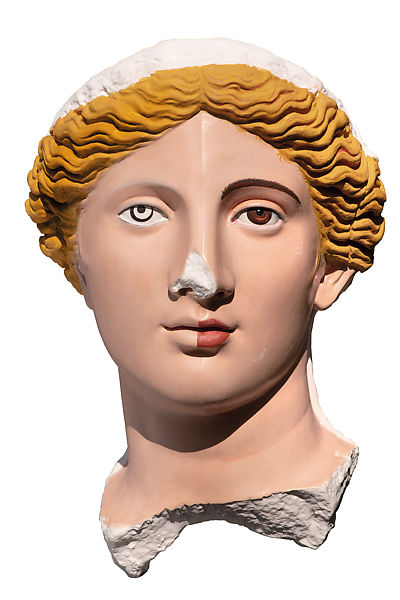
Husband-and-wife research team Vinzenz Brinkmann and Ulrich Koch-Brinkmann have spent over 40 years studying polychromy and reconstructing ancient sculptures as they would have appeared to their first viewers. “Their Gods in Color exhibition has been touring since 2003,” Velie writes, “and their replicas have been included in museums around the world.”
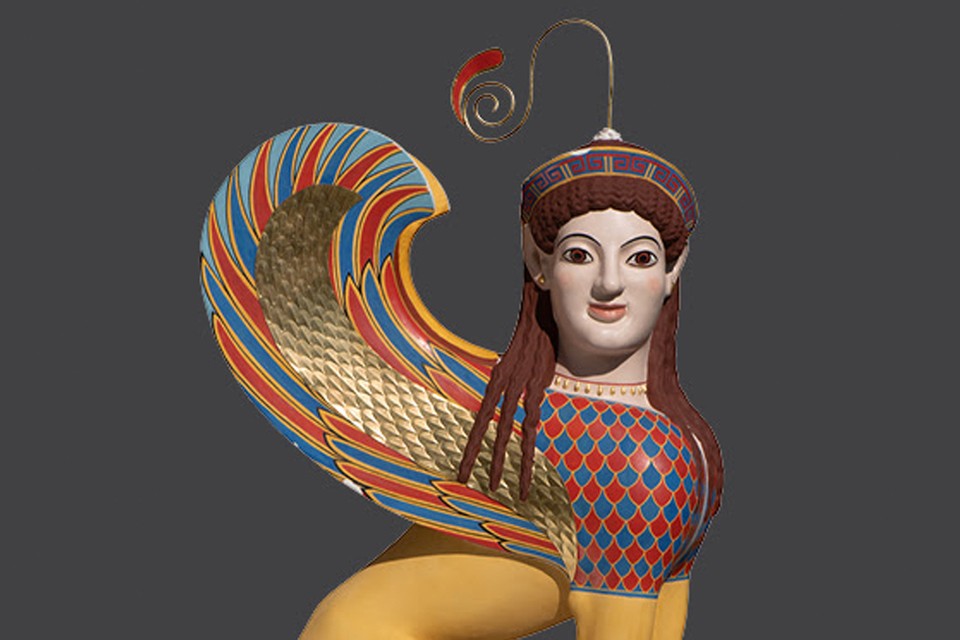
Now fourteen of those reconstructions, as well as a couple dozen more created by Met conservators, scientists, and curators, are scattered throughout the Met’s sculpture halls, with a small upstairs gallery dedicated to an exhibit. The exhibition explains how researchers determined the statues’ colors, “the result of a wide array of analytical techniques, including 3D imaging and rigorous art historical research,” writes the Met. As Artnet notes, the “richly colored version of the Met’s Archaic-period Sphinx finial,” which you can see at the top of the post, “serves as the centerpiece of the show” – one of the only pieces placed adjacent to its original so that visitors can compare the two (using an Augmented Reality app to do so; see video above).
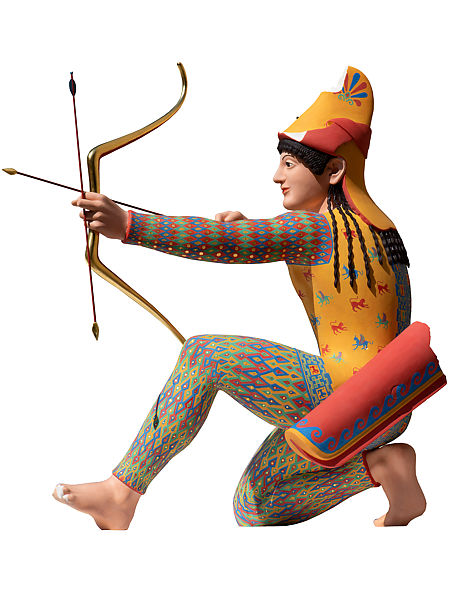
Chroma: Ancient Sculpture in Color, which opened on July 5th, disabuses us of old ideas about the blank whiteness of antiquity, but that’s hardly its only intent. As it does today, color “helped convey meaning in antiquity.” The colors of ancient statues were not simply decorative surfaces – they were integral to the presentation of these works. Now, color can again be part of how we understand and appreciate classical statuary. And the full acceptance of polychromy in major collections like the Met can begin to put to rest false notions about a classical devotion to whiteness as some ideal of perfection. Learn more about the 40 reconstructions in the exhibition at the Met here, and learn more about polychromy and ancient uses of color at the links below.
via Hyperallergic
Related Content:
Roman Statues Weren’t White; They Were Once Painted in Vivid, Bright Colors
How Ancient Greek Statues Really Looked: Research Reveals Their Bold, Bright Colors and Patterns
Josh Jones is a writer and musician based in Durham, NC. Follow him at @jdmagness
Read More...Sir Ben Kingsley Reads a Letter Written by Gandhi to Hitler (in the Voice of Mahatma Gandhi)
Several years before Indian independence as World War loomed, Mahatma Gandhi found he had little sway in international politics even as he built his movement at home. The philosophy of satyagraha did not sound noble to the British in 1939, for example, when the Indian leader wrote a letter exhorting them to let the Germans take their country, their homes, and even their lives rather than fight back. That same year, he wrote to Hitler, addressing him as “Dear Friend” and writing, “It is quite clear that you are today the one person in the world who can prevent a war which may reduce humanity to a savage state.”
Gandhi’s first 1939 letter to Hitler implies that the Führer was the only world leader who wanted such a war. The Indian leader fully understood the stakes. “My sympathies are all with the Jews,” he’d written in a 1938 article. “If there ever could be a justifiable war, in the name of and for humanity, war against Germany to prevent the wanton persecution of a whole race would be completely justified.” Still, he concluded, “I do not believe in any war.” He stuck to his principles even after Germany’s invasion of Poland in 1939.
“Not deterred by the outbreak of war,” Alexander LaCasse writes at the Christian Science Monitor, “Gandhi wrote to Hitler a second time.” Just above, you can see Sir Ben Kingsley read that letter, in character as Gandhi and perhaps sounding much like Gandhi did when reading his letters aloud. Gandhi “took correspondence very seriously,” Nick Owen writes, and he “wrote — and was written to by — almost anyone.” In this much longer letter from 1940, Gandhi extols the practical virtues of non-violence and attempts some moral reasoning:
If not the British, some other power will certainly improve upon your method and beat you with your own weapon. You are leaving no legacy to your people of which they would feel proud. They cannot take pride in a recital of a cruel deed, however skillfully planned. I, therefore, appeal to you in the name of humanity to stop the war.
“There is no evidence to suggest Hitler ever responded to,” or even read, “either of Gandhi’s letters,” writes LaCasse. And maybe little evidence that Gandhi expected a response. “I am aware that your view of life regards such spoliations as virtuous acts,” he writes. “But we have been taught from childhood to regard them as acts degrading humanity.” He continues to profess Hitler a friend, writing “I own no foes. My business in life has been for the past 33 years to enlist the friendship of the whole of humanity.”
Before his death in 1948, Gandhi called the Holocaust “the greatest crime of our time.” According to a biographer, he also added, “the Jews should have offered themselves to the butcher’s knife. They should have thrown themselves into the sea from cliffs. It would have aroused the world and the people of Germany.” Had he suggested this in a letter to Europe’s Jews, it is unlikely they would have been persuaded.
Related Content:
When Mahatma Gandhi Met Charlie Chaplin (1931)
Mahatma Gandhi’s List of the 7 Social Sins; or Tips on How to Avoid Living the Bad Life
Josh Jones is a writer and musician based in Durham, NC. Follow him at @jdmagness
Read More...Take Graphic Design Courses to Launch Your Career as a Graphic Designer, Video Game Designer, UI Designer & More

What can you do with graphic design skills? More and more, it seems, as emerging technologies drive new apps, software, and games. New design challenges are everywhere, from human-machine interfaces, to 3D modeling in video games and animated films, to re-imagining classic designs in print and on screen. In addition to traditional jobs like art director, graphic designer, production artist, and animator, the past few years have seen a sharp rise in demand for User Experience (UX) and User Interface (UI) designers, roles that require a variety of different creative and technical skill sets.
You could get a four-year degree in design to work in one of these fields, or you could take a Coursera Specialization and be one step closer. Coursera has met the demand for new job skills and tech education by partnering with top arts institutions and universities to offer online courses at low cost. All of these courses grant certificates that show potential employers you’re ready to put your learning to use. If careers in art and contemporary design, graphic design, web user experience and interface design, or video game design appeal to you, you can learn those skills in the five certificate-granting Specialization programs below.
- Graphic Design Specialization (5 courses offered by California Institute of the Arts)
- UI / UX Design Specialization (4 courses offered by California Institute of the Arts)
- Modern and Contemporary Art and Design Specialization (4 courses Museum of Modern Art)
- Game Design: Art and Concepts Specialization (4 courses offered by California Institute of the Arts)
- Graphic Design Elements for Non-Designers Specialization (4 courses offered by University of Colorado Boulder)
Graphic designers can choose to be as specialized or generalized as they like, but as in all creative fields, they need a thorough understanding of the basics. A Coursera Specialization is a series of courses intended to lead students to mastery, building on the history and foundations of the field. You can enroll for free and try out any of the Specializations for 7 days. After that, you’ll be charged between $39-$49 per month until you complete the courses in a Specialization. (Financial aid is available).
The exciting Specializations from CALARTS and the Museum of Modern Art will bring you many steps closer to a new career, or maybe even a new personal passion project.
Note: Open Culture has a partnership with Coursera. If readers enroll in certain Coursera courses and programs, it helps support Open Culture.
Related Content:
Josh Jones is a writer and musician based in Durham, NC. Follow him at @jdmagness
Read More...Why 99% Of Smithsonian’s Specimens Are Hidden In High-Security
Museums are the memory of our culture and they’re the memory of our planet. — Dr. Kirk Johnson, Director, Smithsonian National Museum of Natural History
For many of us natural history museums are emblematic of school field trips, or rainy day outings with (or as) children.
There’s always something to be gleaned from the reconstructed dinosaur skeletons, dazzling minerals, and 100-year-old specimens on display.
The educational prospects are even greater for research scientists.
The above entry in Business Insider’s Big Business series takes us behind the scenes of the Smithsonian Natural History Museum, a federally-funded institution where more than 99% of its vast collection is housed in the basement, on upper floors and employees-only wings of exhibition floors, or at an offsite facility in neighboring Maryland.
The latter is poised to provide safe space for more of these treasures as climate change-related flooding poses an increasingly dire threat. The museum’s National Mall location, which draws more than 6 million visitors annually, is now virtually at sea level, and Congress is moving at a pace formerly known as glacial to approve the expensive but necessary structural improvements that would safeguard these precious collections.
The museum currently boasts some 147 million specimens, and is continually adding more, by means of field collections, donations, and purchases made with endowments, though as a non-profit institution, it’s rarely able to outbid deep-pocketed private collectors at auctions of hot-ticket items like large dinosaur bones.
The Division of Birds’ daily mail brings samples of “snarge” — whatever’s left over when a bird makes impact with an aircraft.
Upon arrival at the Smithsonian, whatever its size or market value, every item is subjected to a process of inspection known as “accessioning”.
After that, it is meticulously cleaned.
Beetles in an offsite Osteo Prep Lab get to work on residual organic materials like skin and tissue.
Human experts use a handheld air scrape tool to incrementally separate fossils from the rocky matrix in which they were discovered
The goal is permanent storage state.
Geological specimens are classified according to Dana’s System of Mineralogy and stored in drawers. High-value items are assigned to the Blue Room or the Gem Vault.
Bones that are looking to spend the better part of eternity on a shelf are fitted for custom fiberglass and plastic cradles to protect against pests, moisture, and gravity-related stress fractures.
The Department of Entomology dries and pins incoming insects, arachnids, and myriapods, and stores them in hydraulic carriages.
Mammals, reptiles, fish and birds are stuffed or pickled in alcohol.
Many items in the museum’s collection date back to the early 20th century.
These days, staff strive to preserve as much as they can, using every tool and scientific advancement at their disposal. As ornithologist and feather identification specialist Carla Dove, states, “It’s our responsibility to do as much as we can with the specimen if we’re going to take it from the wild for research.”
These careful preparations ensure that the world’s largest natural history collection can continue to serve as a living library for thousands of visiting scientists…climate change permitting.
Access to the Museum of Natural History’s collections and databases result in the publication of hundreds of research papers and the identification of hundreds of new species every year.
In addition to providing valuable intelligence for research initiatives on such topics as disease transmission, volcanic activity, and of course, the effects of bird strikes on airplanes, museum staff is working toward a goal of preserving each item with a digital scan — 9 million and counting…
Related Content
The Smithsonian Puts 2.8 Million High-Res Images Online and Into the Public Domain
Smithsonian Digitizes & Lets You Download 40,000 Works of Asian and American Art
The Smithsonian Picks “101 Objects That Made America”
- Ayun Halliday is the Chief Primatologist of the East Village Inky zine and author, most recently, of Creative, Not Famous: The Small Potato Manifesto. Follow her @AyunHalliday.
Read More...Computer Scientist Andrew Ng Presents a New Series of Machine Learning Courses–an Updated Version of the Popular Course Taken by 5 Million Students

Back in 2017, Coursera co-founder and former Stanford computer science professor Andrew Ng launched a five-part series of courses on “Deep Learning” on the edtech platform, a series meant to “help you master Deep Learning, apply it effectively, and build a career in AI.” These courses extended his initial Machine Learning course, which has attracted almost 5 million students since 2012, in an effort, he said, to build “a new AI-powered society.”
Ng’s goals are ambitious, to “teach millions of people to use these AI tools so they can go and invent the things that no large company, or company I could build, could do.” His new Machine Learning Specialization at Coursera takes him several steps further in that direction with an “updated version of [his] pioneering Machine Learning course,” notes Coursera’s description, providing “a broad introduction to modern machine learning.” The specialization’s three courses include 1) Supervised Machine Learning: Regression and Classification, 2) Advanced Learning Algorithms, and 3) Unsupervised Learning, Recommenders, Reinforcement Learning. Collectively, the courses in the specialization will teach you to:
- Build machine learning models in Python using popular machine learning libraries NumPy and scikit-learn.
- Build and train supervised machine learning models for prediction and binary classification tasks, including linear regression and logistic regression.
- Build and train a neural network with TensorFlow to perform multi-class classification.
- Apply best practices for machine learning development so that your models generalize to data and tasks in the real world.
- Build and use decision trees and tree ensemble methods, including random forests and boosted trees.
- Use unsupervised learning techniques for unsupervised learning: including clustering and anomaly detection.
- Build recommender systems with a collaborative filtering approach and a content-based deep learning method.
- Build a deep reinforcement learning model.
The skills students learn in Ng’s specialization will bring them closer to careers in big data, machine learning, and AI engineering. Enroll in Ng’s Specialization here free for 7 days and explore the materials in all three courses. If you’re convinced the specialization is for you, you’ll pay $49 per month until you complete the three-course specialization, and you’ll earn a certificate upon completion of a hands-on project using all of your new machine learning skills. You can sign up for the Machine Learning Specialization here.
Note: Open Culture has a partnership with Coursera. If readers enroll in certain Coursera courses and programs, it helps support Open Culture.
Related Content:
Josh Jones is a writer and musician based in Durham, NC. Follow him at @jdmagness
Read More...The Biology of Bonsai Trees: The Science Behind the Traditional Japanese Art Form
The art of bonsai originated in China. As subsequently refined in Japan, its techniques produce miniature trees that give aesthetic pleasure to people all around Asia and the wider world beyond. This appreciation is reflected in the couple-on-the-street interview footage incorporated into “The Biology Behind Bonsai Trees,” the video above from Youtuber Jonny Lim, better known as The Backpacking Biologist. Not only does Lim gather positive views on bonsai around Los Angeles, he also finds in that same city a bonsai nursery run by Bob Pressler, who has spent more than half a century mastering the art.
Even Pressler admits that he doesn’t fully understand the biology of bonsai. Lim’s search for scientific answers sends him to “something called the apical meristem.” That’s the part of the tree made of “stem cells found at the tips of the shoots and roots.” Stem cells, as you may remember from their long moment in the news a few years ago, have the potential to turn into any kind of cell.
The cells of bonsai are the same size as those of regular trees, research has revealed, but thanks to the deliberate cutting of roots and resultant restriction of nutrients to the apical meristem, their leaves are made up of fewer cells in total. Lim draws an analogy with baking cookies of different sizes: “The components are exactly the same. The only difference is that bonsais have less starting material.”
Having gained his own appreciation for bonsai, Lim also waxes poetic on how these miniature trees “still grow on the face of adversity, and they do so perfectly.” But as one commenter replies, “Why recreate adversity?” Claiming that the process is “crippling trees for just aesthetics,” this individual presents one of the known cases against bonsai. But that case, according to the experts Lim consults, is based on certain common misconceptions about the processes involved: that the wires used to position limbs “torture” the trees, for example. But as others point out, do those who make these anti-bonsai arguments feel just as pained about the many lawns that get mown down each and every week?
Related content:
The Art & Philosophy of Bonsai
The Art of Creating a Bonsai: One Year Condensed Condensed Into 22 Mesmerizing Minutes
Based in Seoul, Colin Marshall writes and broadcasts on cities, language, and culture. His projects include the Substack newsletter Books on Cities, the book The Stateless City: a Walk through 21st-Century Los Angeles and the video series The City in Cinema. Follow him on Twitter at @colinmarshall, on Facebook, or on Instagram.
Read More...Support Us
We're hoping to rely on loyal readers, rather than erratic ads. Please click the Donate button and support Open Culture. You can use Paypal, Venmo, Patreon, even Crypto! We thank you!

About Us

Open Culture scours the web for the best educational media. We find the free courses and audio books you need, the language lessons & educational videos you want, and plenty of enlightenment in between.
Advertise With Us
FREE UPDATES!
GET OUR DAILY EMAIL
Get the best cultural and educational resources on the web curated for you in a daily email. We never spam. Unsubscribe at any time.
FOLLOW ON SOCIAL MEDIA
Open Culture editor Dan Colman scours the web for the best educational media. He finds the free courses and audio books you need, the language lessons & movies you want, and plenty of enlightenment in between.
Advertise With Us

