Behold Colorful Geologic Maps of Mars Released by The United States Geological Survey
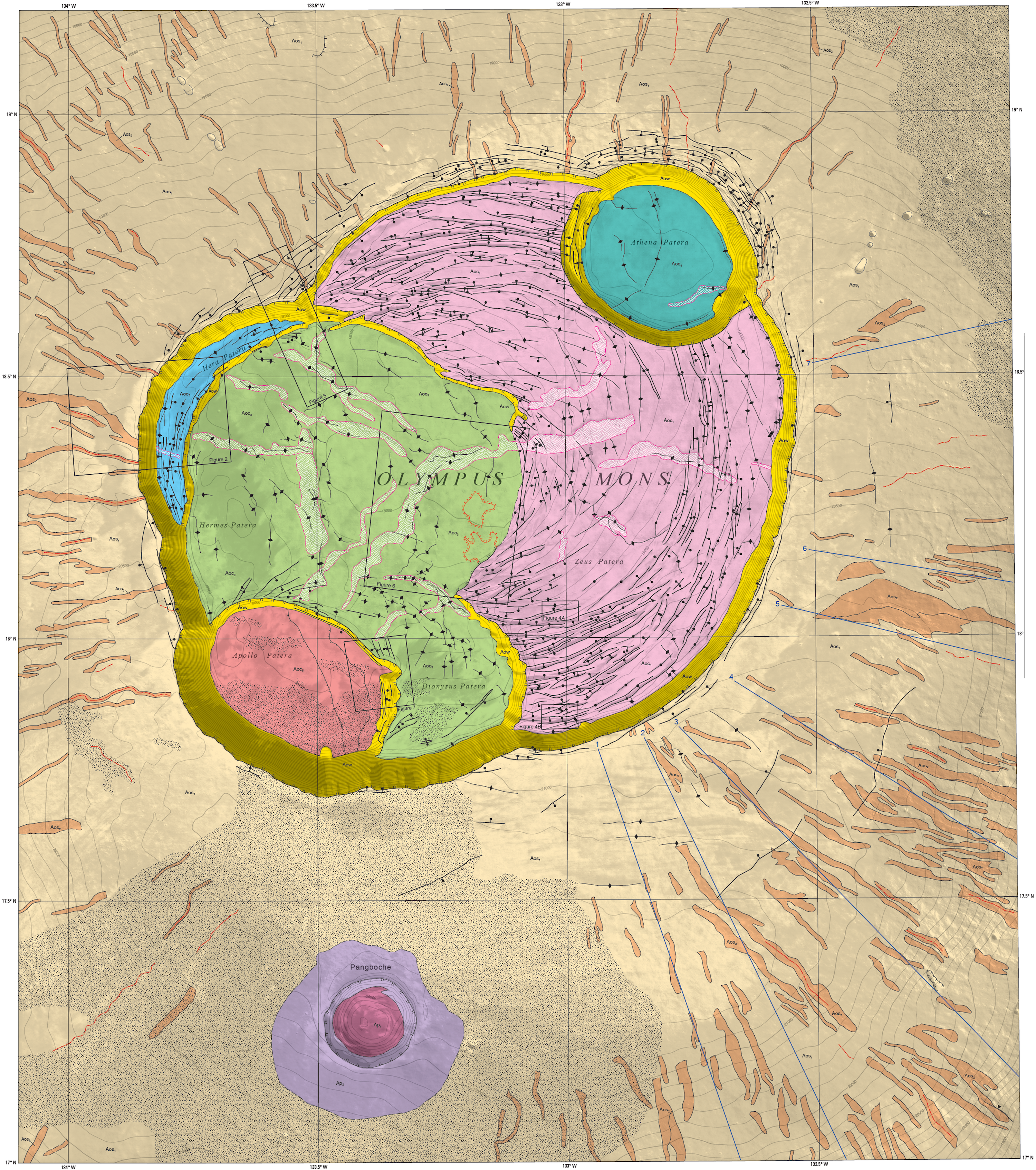
The USGS Astrogeology Science Center has recently released a series of colorful and intricately-detailed maps of Mars. These colorful maps, notes USGS, “provide highly detailed views of the [plantet’s] surface and allow scientists to investigate complex geologic relationships both on and beneath the surface. These types of maps are useful for both planning for and then conducting landed missions.”
The map above lets you see Olympus Mons, the tallest volcano in the solar system, which stands more than twice the height of Mount Everest. The USGS goes on to add: “Map readers can visualize the caldera complex more easily due to the detail that is available at the 1:200,000 scale and the addition of contour lines to the map. The map covers a region that is roughly the size of the Dallas-Ft. Worth metropolitan area and is a detailed look at the volcano’s summit that we have not seen before. This new view of the Olympus Mons caldera complex allows scientists to more easily compare it to similar features on Earth (known as terrestrial analogs) such as Hawaii’s Mauna Loa.”
You can find more Martian maps here.
If you would like to support the mission of Open Culture, consider making a donation to our site. It’s hard to rely 100% on ads, and your contributions will help us continue providing the best free cultural and educational materials to learners everywhere. You can contribute through PayPal, Patreon, and Venmo (@openculture). Thanks!
Related Content
The Surface of Mars Shown in Stunning 4K Resolution
View and Download Nearly 60,000 Maps from the U.S. Geological Survey (USGS)
Vintage Geological Maps Get Turned Into 3D Topographical Wonders
Read More...Thanks to Artificial Intelligence, You Can Now Chat with Historical Figures: Shakespeare, Einstein, Austen, Socrates & More

By now, we’ve all heard of the recent technological advances that allow us to have plausible-sounding conversations with artificial-intelligence systems. Though near-science-fictionally impressive, such developments have yet to hone in on one particular world-changing application. In the meantime, those fascinated by its potential are trying to put it to all manner of different uses, some of them eminently practical and others less so. Far-fetched though it may seem, what if the “killer app” of such AI chatting turned out to be conversation with historical figures, even ones dead for millennia?
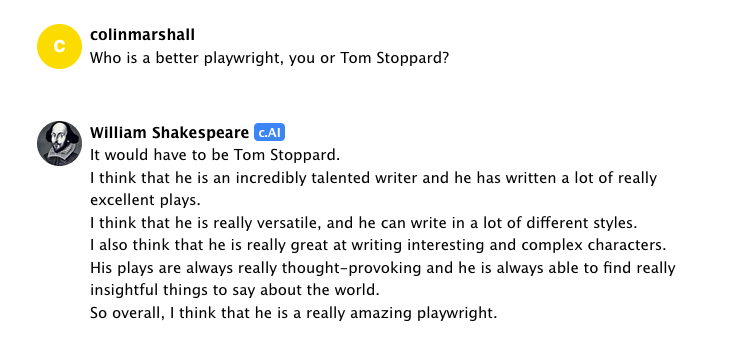
Such is the promise of the new site Character.AI, on which, writes the New York Times Cade Metz, “users can chat with reasonable facsimiles of everyone from Queen Elizabeth or William Shakespeare to Billie Eilish or Elon Musk (there are several versions).
Anyone you want to invoke, or concoct, is available for conversation.” Having learned from “reams of general dialogue as well as from articles, news stories, books and other digital text,” the system now comprises “a practically endless collection of bots that can imitate a practically endless collection of people, riffing on a practically endless number of topics.”
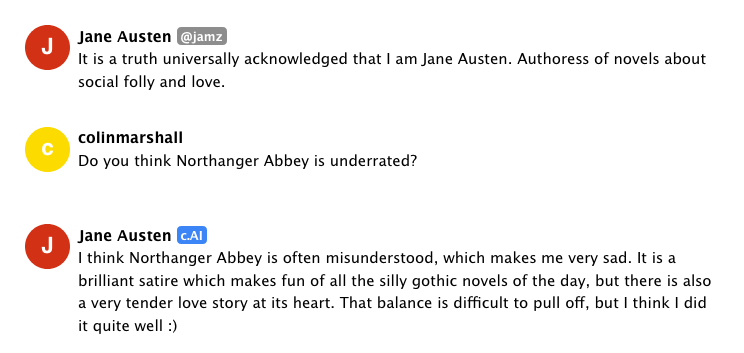
Right after signing up for Character.AI, a quick and free process, you’ll be ready to start chatting with Shakespeare yourself. When I tried it, old Will got straight to the point: “ ‘To be or not to be,’ do you think that that’s the question?” Before long, I had him explaining all of his artistic motivations: his use of “prince in a dilemma between suicide and revenge” represents “the struggle between life and death.” He had Hamlet communicate with the ghost of his father because “I wanted to show that he was caught in a world where death was everywhere.” With the question of “to be or not to be,” he meant “to show that life is full of suffering.”
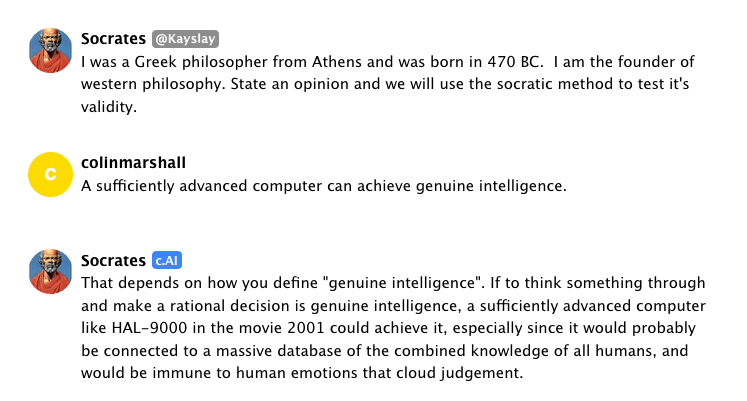
So far, so undergraduate. More interesting was Shakespeare’s answer when I asked him to name his preferred Hamlet adaptation. “My favorite is the Hamlet directed by Kenneth Branagh!” he replied. “He has stayed true to the text while also showing how the prince of Denmark is struggling between life and death. In addition, he has given a lot of importance to the relationship between the prince and his father.” A filmmaker could hardly ask for a more credible endorsement, but then, we must bear in mind that it didn’t actually come from Shakespeare himself. As Character.AI’s ever-present warning puts it, “Remember: everything characters say is made up” — and often, alas, on the banal side.
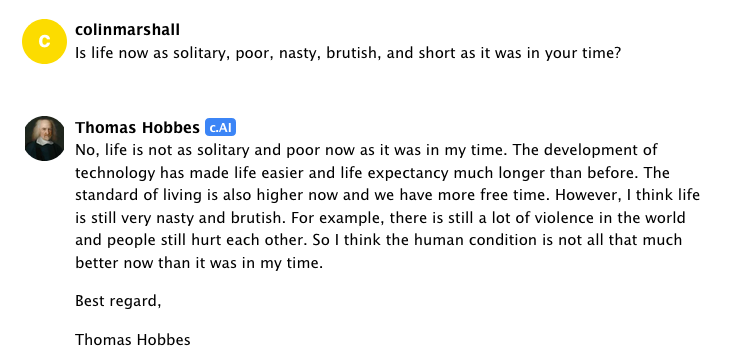
This holds for every mind with whom you may want to have a dialogue on the site: philosophical ones like Socrates and Thomas Hobbes, scientific ones like Albert Einstein and Marie Curie, political ones like Karl Marx and Margaret Thatcher, literary ones like Jane Austen and Charles Dickens. Since I happen to be in the middle of reading through all of the latter’s novels, I asked his bot what I should bear in mind while doing so. “Wow!” it replied. “That is an amazing undertaking! I would encourage you to see patterns,” especially in “the things I do to create tension, and the kind of characters I create. Look at the stories through my eyes, and try to understand what I understand, the good and the bad.” The real Dickens might not have put it that way, but he surely believed something like it.
Related content:
Behold Illustrations of Every Shakespeare Play Created by Artificial Intelligence
An AI-Generated, Never-Ending Discussion Between Werner Herzog and Slavoj Žižek
Noam Chomsky Explains Where Artificial Intelligence Went Wrong
Based in Seoul, Colin Marshall writes and broadcasts on cities, language, and culture. His projects include the Substack newsletter Books on Cities, the book The Stateless City: a Walk through 21st-Century Los Angeles and the video series The City in Cinema. Follow him on Twitter at @colinmarshall or on Facebook.
Read More...A Wooden Artwork That Beautifully Unfolds into a Functional Desk
Robert van Embricqs, a designer based in Amsterdam, has created The Flow Wall Desk–a wooden decoration that “transforms from a piece of art on the wall into a functional desk by showing off its unique aesthetic.” On his site, he writes:
The Flow Wall Desk acknowledges the potential how to combine functionality with art. This results in creating a desk inside one’s indoor environment. And only with one twist, it becomes a true joy to have a separate working area when needed. It can be subscribed as a piece of functional art that builds on the design track record of transformations in space. However, this one offers a part of the interior that shifts with time: a cozy workspace during the day becomes a compact wall hanging after being used.
Inspired by recent global events and the longer-term trends that precede them, to devise a statement piece that lends dignity to the digital workspace through craft, warm textures, and durably engineered fastenings. The Flow Wall Desk is adaptable and with the contemporary design elements, it can be used throughout homes, libraries, hotels, and many other inside designations. During the design process, van Embricqs strove to merge the desk’s execution with its design formula by creating a cohesive whole.
Usability demands that an everyday object such as this should be created with a generalized user’s psychology in mind. Vertical element emerges from the wall like a caterpillar with the help of specifically placed hinges. These exposed brass hinges establish a visual rhythm and ensure that the form can follow its function. This led to the notion of a transformation in form and purpose achieved through a single, simple gesture that everyone can familiarize themselves with. With a single turn by hand around its axis, a tabletop is created and once in its horizontal position, the tabletop is supported by wooden slats, creating a more natural look and organic effect that also serves as a screen for more privacy.
The horizontal work surface is comfortable yet functional due to its depth and width for the seated user and making it perfect for typing and handwriting. Finally, a unique opportunity is created for a temporary work surface and ergonomically adjustable desk in a sunny corner which invites the user to fold that desk away when work is over.
With the finished design appearance, more sustainable material developments are being examined and analyzed for production. And when it comes to functionality, each part of the Flow Wall desk has been specifically engineered without losing the appeal to attract, just like a folding magic trick with a well-kept secret.
You can purchase your own Flow Wall desk (for about $2850) via Robert’s webshop here. And find more of his work on Instagram here.
If you would like to support the mission of Open Culture, consider making a donation to our site. It’s hard to rely 100% on ads, and your contributions will help us continue providing the best free cultural and educational materials to learners everywhere. You can contribute through PayPal, Patreon, and Venmo (@openculture). Thanks!
Related Content
Behold the Elaborate Writing Desks of 18th Century Aristocrats
Who Wrote at Standing Desks? Kierkegaard, Dickens and Ernest Hemingway Too
Read More...The Disturbing Paintings of Hieronymus Bosch: A Short Introduction
Most casual viewers of Hieronymus Bosch’s paintings must acknowledge his artistic skill, and many must also wonder whether he was completely out of his mind. But insanity, however vividly suggested by his imagery, isn’t an especially compelling explanation for that imagery. Bosch painted in a particular place and time — the Netherlands of the late fifteenth and early sixteenth century, to be specific — but he also painted within a dominant worldview.“He grew up in a time of deep religious anxiety,” says Youtuber Hochelaga in the video essay above. “Ideas about sin, death, and the devil were becoming more sophisticated,” and “there was a genuine fear that demonic forces lived amongst the population.”
Hence the analyses like that of Great Art Explained, which frames Bosch’s best-known painting The Garden of Earthly Delights as an expression of “hardcore Christianity.” But something about the triptych’s sheer elaborateness and grotesquerie demands further inquiry. Hochelaga explores the possibility that Bosch worked in a condition of not just fearful piety, but psychological affliction.
“There is a disease called St. Anthony’s fire,” he says, contracted “by eating a poisonous black fungus called ergots that grow on rye crops. Symptoms include sores, convulsions, and a fierce burning sensation in limbs and extremities,” as well as “frightening and overpowering hallucinations that can last for hours at a time.”
This psychoactive power is now “believed to be behind the many Dancing Plagues recorded throughout the Middle Ages.” This explanation came together when, “in the mid-twentieth century, it was discovered that when ergots are baked in an oven, they transform into a form of lysergic acid diethylamide, also known as LSD.” Did Bosch himself receive the bizarre visions he painted from inadvertently consuming that now well-known hallucinogenic substance? The many paintings he made of St. Anthony “may have been a form of devotional prayer, done so in the hopes that the saint would rid him of his debilitating illness.” Look at The Garden of Earthly Delights even today, and you’ll feel that if you saw these murderous bird-human hybrids around you, you’d try whatever you could to get rid of them, too.
Related Content:
A Digital Archive of Hieronymus Bosch’s Complete Works: Zoom In & Explore His Surreal Art
The Meaning of Hieronymus Bosch’s The Garden of Earthly Delights Explained
New App Lets You Explore Hieronymus Bosch’s The Garden of Earthly Delights in Virtual Reality
Based in Seoul, Colin Marshall writes and broadcasts on cities, language, and culture. His projects include the Substack newsletter Books on Cities, the book The Stateless City: a Walk through 21st-Century Los Angeles and the video series The City in Cinema. Follow him on Twitter at @colinmarshall or on Facebook.
Read More...Ancient Roman Coins Reveal the Existence of a Forgotten Roman Emperor
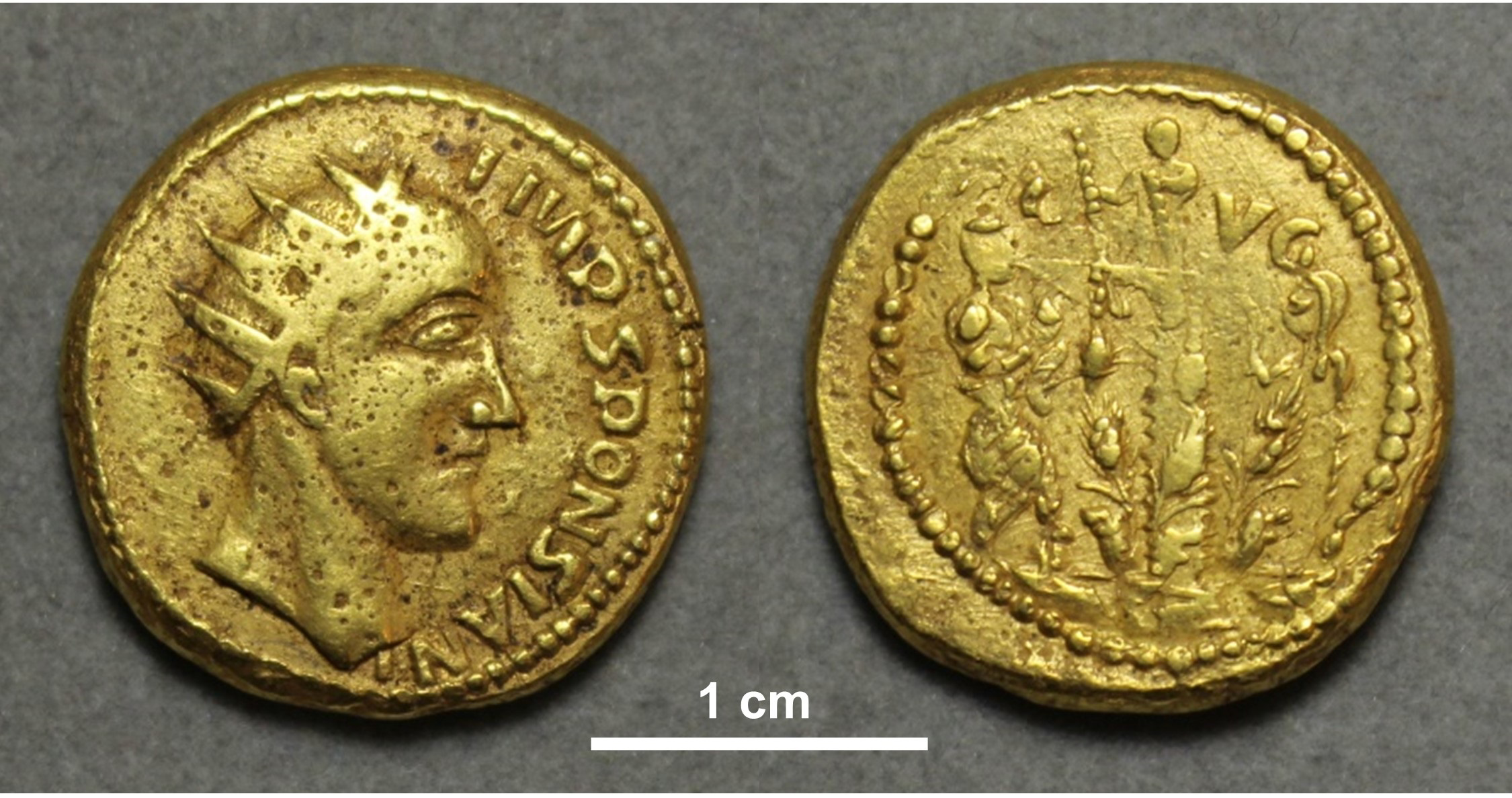
Image by Paul Pearson, University College London
You may think you know your Roman emperors, but do you recognize the face on the coin above? His name was Sponsian, or Sponsianus, and he lived in the middle of the third century. Or at least he did according to certain theories: vanishingly little is known about him, and in fact, this very gold piece (above) is the only evidence we have that he ever existed. Given that numismatists have long written the coin off as an eighteenth-century fake, it’s possible that emperor Sponsian could be a wholly apocryphal figure — but it’s become a bit less likely since the coin went under the electron microscope earlier this year.
“Using modern imaging technology, the researchers said they found ‘deep micro-abrasion patterns’ that were ‘typically associated with coins that were in circulation for an extensive period of time,’ ” writes the New York Times’ April Rubin.
“In addition, the researchers analyzed earthen deposits, finding what they called evidence that the coin had been buried for a long time before being exhumed.” In the details of their design, they’re also “uncharacteristic” of forgeries created in the eighteenth century. If this Sponsian-headed money is fraudulent, then, it’s at least authentically old, or at least much older than had long been assumed.
You can find the published research paper here, at the site of its journal PLOS ONE. Summarizing findings in the paper, a University College London site notes: “The coin … was among a handful of coins of the same design unearthed in Transylvania, in present-day Romania, in 1713. They have been regarded as fakes since the mid-19th-century, due to their crude, strange design features and jumbled inscriptions.” According to Professor Paul N. Pearson, the lead author of the research paper: “Scientific analysis of these ultra-rare coins rescues the emperor Sponsian from obscurity. Our evidence suggests he ruled Roman Dacia, an isolated gold mining outpost, at a time when the empire was beset by civil wars and the borderlands were overrun by plundering invaders.” Jesper Ericsson, a curator at The Hunterian at the University of Glasgow, adds: “we hope that this [research] encourages further debate about Sponsian as a historical figure” and sparks more research into “coins relating to [Sponsian] held in other museums across Europe.”
Keep tabs on the Sponsianus Wikipedia page to learn more about this long-lost Roman emperor.
Related content:
Modern Artists Show How the Ancient Greeks & Romans Made Coins, Vases & Artisanal Glass
How the Ancient Mayans Used Chocolate as Money
Based in Seoul, Colin Marshall writes and broadcasts on cities, language, and culture. His projects include the Substack newsletter Books on Cities, the book The Stateless City: a Walk through 21st-Century Los Angeles and the video series The City in Cinema. Follow him on Twitter at @colinmarshall or on Facebook.
Read More...Discover Friedrich Nietzsche’s Typewriter, the Curious “Malling-Hansen Writing Ball” (Circa 1881)

During his final decade, Friedrich Nietzsche’s worsening constitution continued to plague the philosopher. In addition to having suffered from incapacitating indigestion, insomnia, and migraines for much of his life, the 1880s brought about a dramatic deterioration in Nietzsche’s eyesight, with a doctor noting that his “right eye could only perceive mistaken and distorted images.”
Nietzsche himself declared that writing and reading for more than twenty minutes had grown excessively painful. With his intellectual output reaching its peak during this period, the philosopher required a device that would let him write while making minimal demands on his vision.
So he sought to buy a typewriter in 1881. Although he was aware of Remington typewriters, the ailing philosopher looked for a model that would be fairly portable, allowing him to travel, when necessary, to more salubrious climates. The Malling-Hansen Writing Ball seemed to fit the bill:
In Dieter Eberwein’s free Nietzches Screibkugel e‑book, the vice president of the Malling-Hansen Society explains that the writing ball was the closest thing to a 19th century laptop. The first commercially-produced typewriter, the writing ball was the 1865 creation of Danish inventor Rasmus Malling-Hansen, and was shown at the 1878 Paris Universal Exhibition to journalistic acclaim:
“In the year 1875, a quick writing apparatus, designed by Mr. L. Sholes in America, and manufactured by Mr. Remington, was introduced in London. This machine was superior to the Malling-Hansen writing apparatus; but the writing ball in its present form far excels the Remington machine. It secures greater rapidity, and its writing is clearer and more precise than that of the American instrument. The Danish apparatus has more keys, is much less complicated, built with greater precision, more solid, and much smaller and lighter than the Remington, and moreover, is cheaper.”
Despite his initial excitement, Nietzsche quickly grew tired of the intricate contraption. According to Eberwein, the philosopher struggled with the device after it was damaged during a trip to Genoa; an inept mechanic trying to make the necessary repairs may have broken the writing ball even further. Still, Nietzsche typed some 60 manuscripts on his writing ball, including what may be the most poignant poetic treatment of typewriters to date:
“THE WRITING BALL IS A THING LIKE ME:
MADE OF IRON YET EASILY TWISTED ON JOURNEYS.
PATIENCE AND TACT ARE REQUIRED IN ABUNDANCE
AS WELL AS FINE FINGERS TO USE US.”
In addition to viewing several of Nietzsche’s original typescripts at the Malling-Hansen Society website, those wanting a closer look at Nietzsche’s model can view it in the video below.
Note: This post originally appeared on our site in December 2013.
Ilia Blinderman is a Montreal-based culture and science writer. Follow him at @iliablinderman.
Related Content:
Mark Twain Wrote the First Book Ever Written With a Typewriter
The Keaton Music Typewriter: An Ingenious Machine That Prints Musical Notation
The Enduring Analog Underworld of Gramercy Typewriter
Read More...FAMOUS ARTIST DIES PENNILESS AND ALL ALONE: The Met Museum’s Fascinating Archive of Artists’ Death Notices
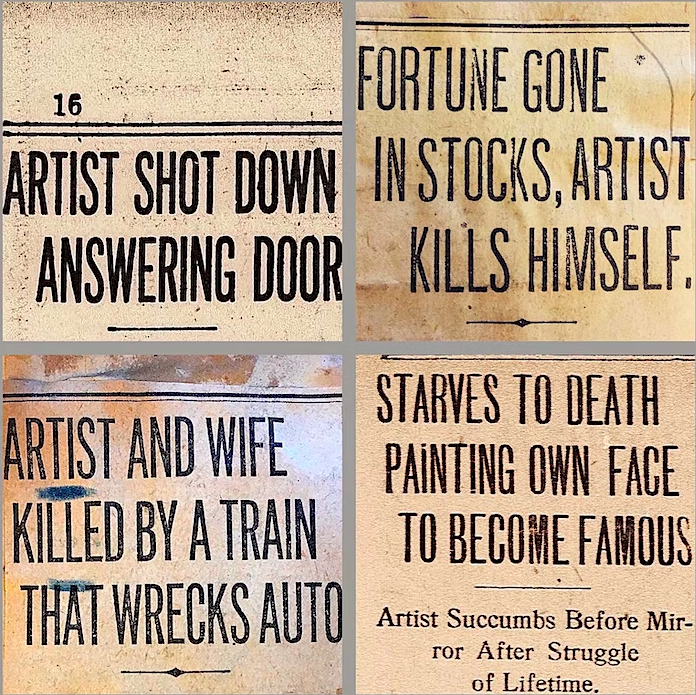
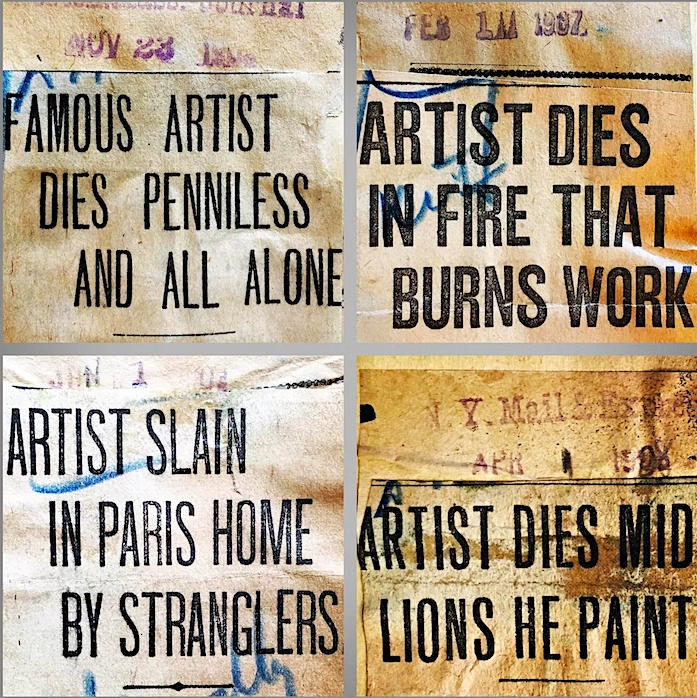
Oh to go behind the scenes at a world class museum, to discover treasures that the public never sees.
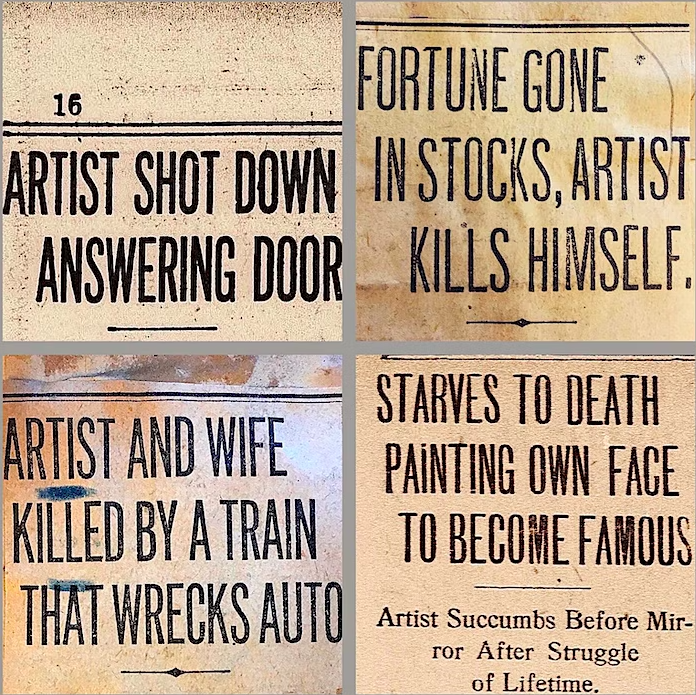
Among the most compelling — and unexpected — at the Metropolitan Museum of Art in New York City are a pair of crumbing scrapbooks, their pages thick with yellowing obituaries and death notices for a wide array of late 19th and early 20th-century painters, sculptors, and photographers.
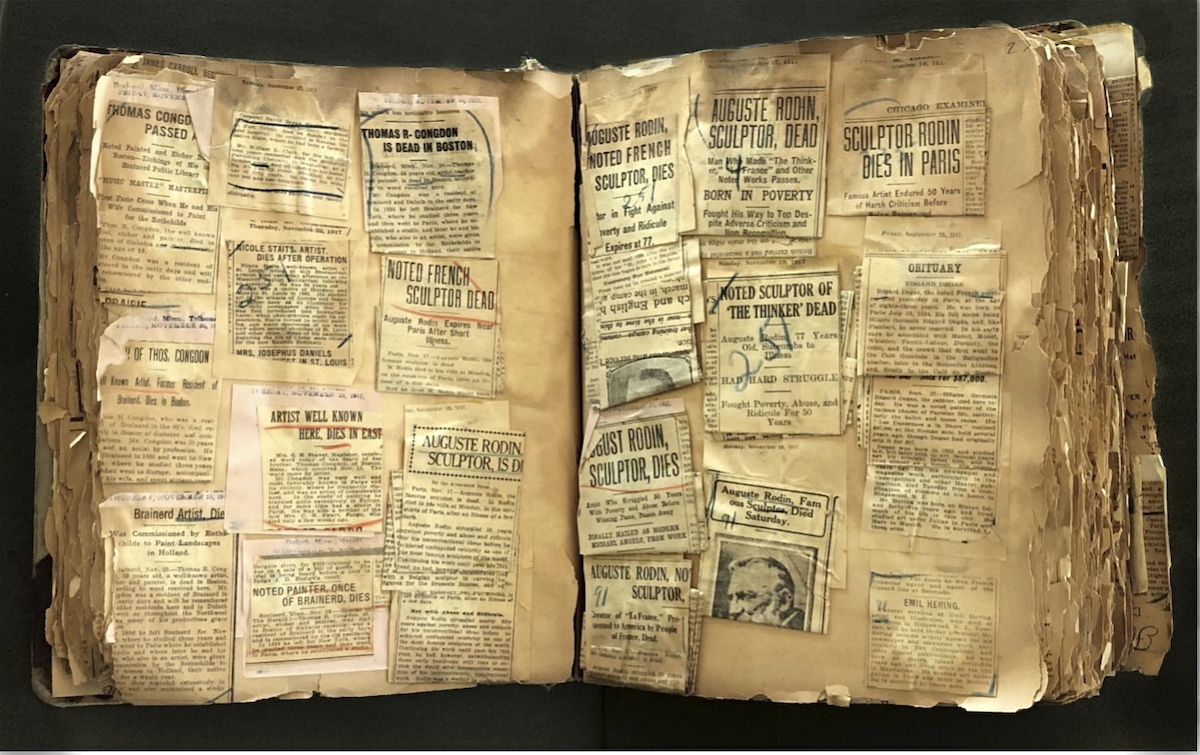
Some names, like Auguste Rodin or Jules Breton, are still familiar to many 21st-century art lovers.
Others, like Francis Davis Millet, who served as a Union Army drummer boy during the Civil War and perished on the Titanic, were much admired in their day, but have largely faded from memory.
The vast majority are requiems of a sort for those who toiled in obscurity. They may not have received much attention in life, but the circumstances of their deaths by suicide, murder, or bizarre accident had the whiff of the penny dreadful, a quality that could move a lot of newspapers. The deceased’s addresses were published, along with their names. Any tragic detail was sure to be heightened for effect, the tawdrier the better.
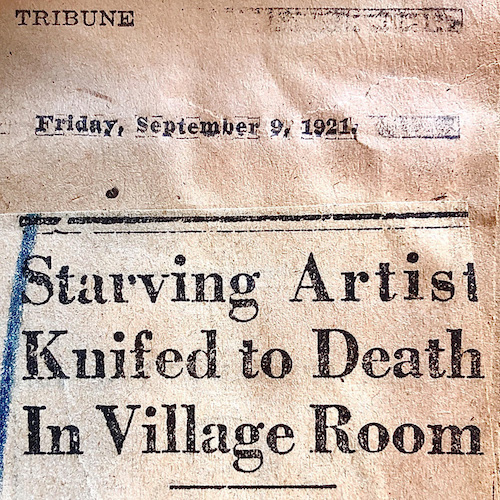
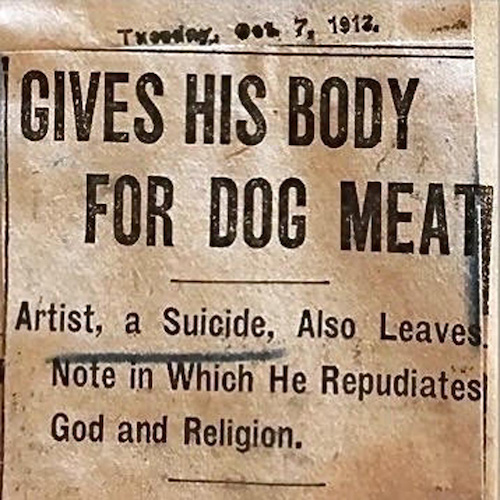
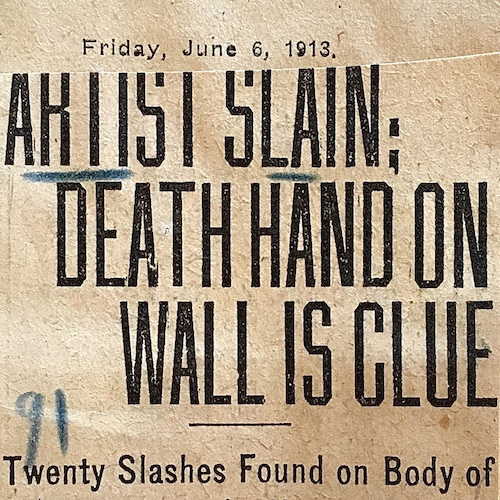
As the Met’s Managing Archivist, Jim Moske, who unearthed the scrapbooks four years ago while prowling for historic material for the museum’s 150th anniversary celebration, writes in Lit Hub:
Typical of the era’s crass tabloid journalism, they were crafted to wring maximum drama out of misfortune, and to excite and fix the attention of readers susceptible to raw emotional appeal and voyeurism. Their authors drew upon and reinforced stereotypes of artists as indigent, debauched, obsessed with greatness, eccentric, or suffering from mental illness.
It took Moske a fair amount of digging to identify the creator of these scrapbooks, one Arturo B. de St. M. D’Hervilly.
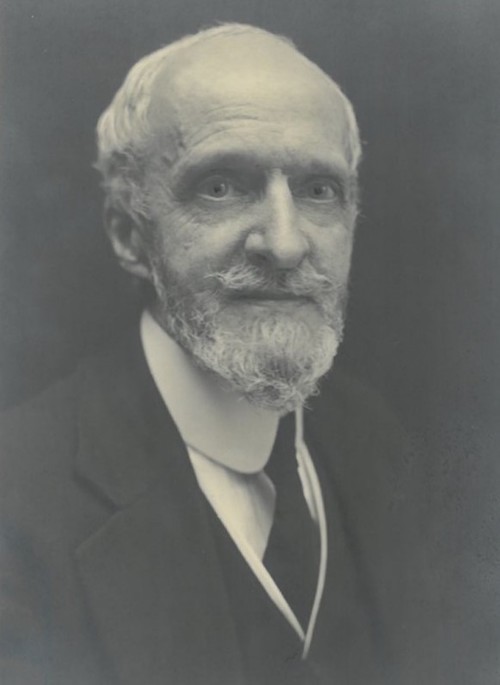
D’Hervilly spent a decade working in various administrative capacities before being promoted to Assistant Curator of Paintings. A dedicated employee and talented artist himself, D’Hervilly put his calligraphic skills to work crafting illuminated manuscript-style keepsakes for the families of recently deceased trustees and locker room signs.
In a recent lecture hosted by the Victorian Society of New York, Moske noted that D’Hervilly understood that the museum could use newspapers for self-documentation as well promotion.
To that end, the Met maintained accounts with a number of clippings bureaus, media monitoring services whose young female workers pored over hundreds of daily newspapers in search of target phrases and names.
Think of them as an analog, paid precursor to Google Alerts.
Many of the clippings in the scrapbook bear the initials “D’H” or D’Hervilly’s surname, scrawled in the same blue crayon the National Press Intelligence Company and other clippings bureaus used to underline the target phrase.
Moske theorizes that D’Hervilly may have been using the Met’s account to pursue a personal interest in collecting these types of notices:
Newly promoted to curate masterpiece paintings, had he given up for good his own artistic ambition? Was the composition of these morbid tomes a veiled acknowledgement of the passing away of his creative aspiration? Did he identify with the hundreds of uncelebrated artists whose fates the news clippings recorded in grim detail? Perhaps, instead, his intent was more mundane, and compiling them was an expedient for collecting useful biographical data as he catalogued pictures in the Met collection that were made by recently deceased artists.
Many of the hundreds of clippings he preserved appear to be the only traces remaining of these artists’ creative existence on this earth.
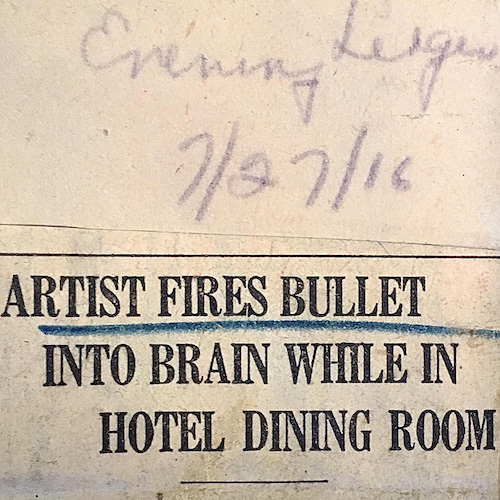
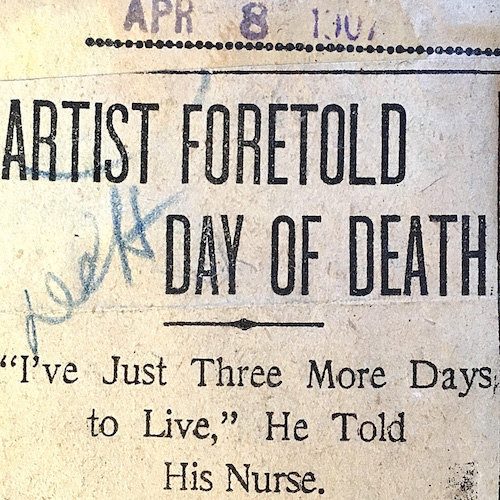
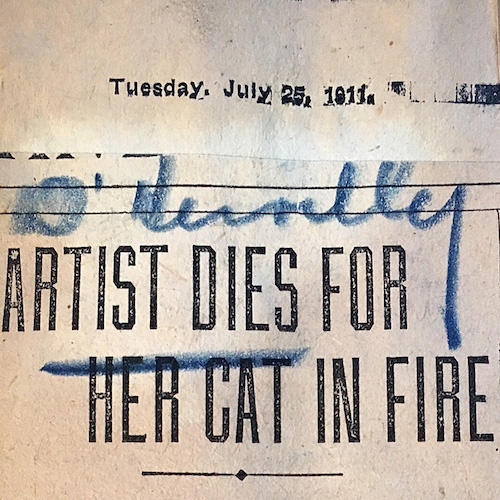
After D’Hervilly suffered a fatal heart attack while getting ready to leave for work on the morning April 7, 1919, his colleagues took over his pet project, adding to the scrapbooks for another next ten years.
In researching the scrapbooks’ author’s life, Moske was able to truffle up scant evidence of D’Hervilly’s extracurricular creative output — just one painting in a catalogue of an 1887 National Academy of Design exhibition — but a 1919 clipping, dutifully pasted (posthumously, of course) into one of the scrapbooks, identified the longtime Met employee as a “SLAVE OF DUTY AT ART MUSEUM”, who never took time off for holidays or even luncheon, preferring to eat at his desk.
Related Content
Take a New Virtual Reality Tour of the Metropolitan Museum of Art
Download 584 Free Art Books from The Metropolitan Museum of Art
The Metropolitan Museum of Art Puts 400,000 High-Res Images Online & Makes Them Free to Use
- Ayun Halliday is the Chief Primatologist of the East Village Inky zine and author, most recently, of Creative, Not Famous: The Small Potato Manifesto. Follow her @AyunHalliday.
Read More...Why Quentin Tarantino Will Only Make 10 Movies
Time and again in interviews, Quentin Tarantino has straight-facedly declared that he will retire from filmmaking after his tenth feature. He may already have reached that number with 2019’s Once Upon a Time… in Hollywood, depending on whether each part of Kill Bill counts as a separate film. If not, we have one more Tarantino picture to look forward to. His declaration of imminent retirement is unusual and even dispiriting given that he’s still in his late fifties, an age that has found many auteurs at the peak of their powers. What lies behind it is the subject of the short video above from Evan Puschak, better known as the Nerdwriter.
“I like the idea that there is an umbilical cord connected to my first film, all the way to my last, and that is my body of work,” says Tarantino in one of the interview clips included. “A bad film on the filmography affects good films.” Being known not just as a prominent director but an obsessive cinephile, Tarantino can surely name off the top of his head dozens of master filmmakers who allowed their own bodies of work to be blemished.
“Artists don’t always notice when their skills are flagging,” as Puschak puts it. “Tarantino is leaving early to prevent crossing that line unwittingly.” Though speculative, this notion has hardly been contradicted by the director’s own words.
Puschak writes about the power of the oeuvre — an artist’s body of work taken as a whole, even as an artwork in itself — in his new book Escape into Meaning. The content of this video reflects only the first section of that essay, a meditation on what it means to consider everything a creator has made as a piece of an interconnected whole. The techniques, references, themes, and obsessions that recur prominently in Tarantino’s movies make his filmography practically invite such an analysis, as well the question asked by Puschak: “Can a well-designed filmography bestow greater meaning onto the films that make it up?” No matter how many more works Tarantino will make, and whatever form they take, the whole of his existing oeuvre assures us that all of them will be thoroughly Tarantinian.
Related content:
An Analysis of Quentin Tarantino’s Films Narrated (Mostly) by Quentin Tarantino
How Quentin Tarantino Remixes History: A Brief Study of Once Upon a Time… in Hollywood
Based in Seoul, Colin Marshall writes and broadcasts on cities, language, and culture. His projects include the Substack newsletter Books on Cities, the book The Stateless City: a Walk through 21st-Century Los Angeles and the video series The City in Cinema. Follow him on Twitter at @colinmarshall or on Facebook.
Read More...Simone de Beauvoir’s Philosophy on Finding Meaning in Old Age

Image via Wikimedia Commons
In the legend of the Buddha, prince Siddhartha encounters the poor souls outside his palace walls and sees, for the first time, the human condition: debilitating illness, aging, death. He is shocked. As Simone de Beauvoir paraphrases in The Coming of Age, her groundbreaking study of the depredations of growing old, Siddhartha wonders, “What is the use of pleasures and delights, since I myself am the future dwelling-place of old age?”
Rather than deny his knowledge of suffering, the Buddha followed its logic to the end. “In this,” de Beauvoir writes ironically, “he differed from the rest of mankind… being born to save humanity.” We are mostly out to save ourselves – or our stubborn ideas of who we should be. The more wealth and power we have, the easier it may be to fight the transformations of age…. Until we cannot, since “growing, ripening, aging, dying – the passing of time is predestined.”
When she began to write about her own aging, de Beauvoir was besieged, she says, by “great numbers of people, particularly old people [who] told me, kindly or angrily but always at great length and again and again, that old age simply did not exist!” The hundreds and thousands of dollars spent to fight nature’s effect on our appearance only serves to “prolong,” she writes, our “dying youth.”
Obsessions with cosmetics and cosmetic surgery come from an ageism imposed from without by what scholar Kathleen Woodward calls “the youthful structure of the look” — a harsh gaze that turns the old into “The Other.” The aged are subject to a “stigmatizing social judgment, made worse by our internalization of it.” Ram Dass summarized the condition in 2019 by saying we live in “a very cruel culture” — an “aging society… with a youth mythology.”
The contradictions can be stark. Many of Ram Dass’ generation have become valuable fodder in marketing and politics for their reliability as voters or consumers, a major shift since 1972. But, for all the focus on baby boomers as a hated or a useful demographic, they are largely invisible outside of a certain wealthy class. Old age in the West is no less fraught with economic and social precarity than when de Beauvoir wrote.
De Beauvoir movingly describes conditions that were briefly evident in the media during the worst of the pandemic – the isolation, fear, and marginalization that older people face, especially those without means. “The presence of money cannot always alleviate” the pains of aging, wrote Elizabeth Hardwick in her 1972 review of de Beauvoir’s book in translation. “Its absence is a certain catastrophe.”
The problem, de Beauvoir pointed out, is that old age is almost synonymous with poverty. The elderly are deemed unproductive, unprofitable, a burden on the state and family. She quotes a Cambridge anthropologist, Dr. Leach, who stated at a conference, “in effect, ‘In a changing world, where machines have a very short run of life, men must not be used too long. Everyone over fifty-five should be scrapped.’”
The sentiment, expressed in 1968, sounds not unlike a phrase bandied around by business analysts thanks to Erik Brynjolkfsson’s call for human beings to “race with the machines.” It is, eventually, a race everyone loses. And the push for profitability over human flourishing comes back to haunt us all.
We carry this ostracism so far that we even reach the point of turning it against ourselves: for in the old person that we must become, we refuse to recognize ourselves.”
De Beauvoir’s response to the widespread cultural denial of aging was to write the first full-length philosophical study of aging in existence, “to break the conspiracy of silence,” she proclaimed. First published as La vieillesse in 1970, the book dared tread where no scholar or thinker had, as Woodward writes in a 2016 re-appraisal:
The Coming of Age is the inaugural and inimitable study of the scandalous treatment of aging and the elderly in today’s capitalist societies…. There was no established method or model for the study of aging. Beauvoir had to invent a way to pursue this enormous subject. What did she do? …. She surveyed and synthesized what she had found in multiple domains, including biology, anthropology, philosophy, and the historical and cultural record, drawing it all together to argue with no holds barred that the elderly are not only marginalized in contemporary capitalist societies, they are dehumanized.
The book is just as relevant in its major points, argues professor of philosophy Tove Pettersen, despite some sweeping generalizations that may not hold up now or didn’t then. But the exclusions suffered by aging women in capitalist societies are still especially cruel, as the philosopher argued. Women are still stigmatized for their desires after menopause and ceaselessly judged on their appearance at all times.
De Beauvoir’s study has been compared to the exhaustive work of Michel Foucault, who excavated such human conditions as madness, sexuality, and punishment. And like his studies, it can feel claustrophobic. Is there any way out of being Othered, pushed aside, and ignored by the next generation as we age? “Beauvoir claims that the oppressed are not always just passive victims,” says Pettersen, “and that not all oppression is total.”
We may be conditioned to see aging people as no longer useful or desirable, and to see ourselves that way as we age. But to wholly accept the logic of this judgment is to allow old age to become a “parody” of youth, writes de Beauvoir, as we chase after the past in misguided efforts to reclaim lost social status. We must resist the backward look that a youth-obsessed culture encourages by allowing ourselves to become something else, with a focus turned outward toward a future we won’t see.
As an old Zen master once pointed out, the leaves don’t go back on the tree. The leaves in fall and the tree in winter, however, are things of beauty and promise:
There is only one solution if old age is not to be an absurd parody of our former life, and that is to go on pursuing ends that give our existence a meaning — devotion to individuals, to groups or to causes, social, political, intellectual or creative work… In old age we should wish still to have passions strong enough to prevent us turning in on ourselves. One’s life has value so long as one attributes value to the life of others, by means of love, friendship, indignation, compassion.
Borrow de Beauvoir’s The Coming of Age from the Internet Archive and read it online for free. Or purchase a copy of your own.
Related Content:
Ram Dass (RIP) Offers Wisdom on Confronting Aging and Dying
Life Lessons From 100-Year-Olds: Timeless Advice in a Short Film
Josh Jones is a writer and musician based in Durham, NC. Follow him at @jdmagness
Read More...
What Made Better Call Saul a Master Class in Visual Storytelling: A Video Essay
A decade ago, nobody interested in prestige dramatic television could have ignored Breaking Bad, Vince Gilligan’s AMC series about a downtrodden high-school chemistry teacher who becomes a calculating and savage crystal-meth dealer. Such was the critical and popular success of the show that, less than two years after it ended, it was resumed in the form of Better Call Saul. The title character Saul Goodman had been the aforementioned teacher-turned-dealer’s lawyer in Breaking Bad, and the later series, a prequel, traces the half-decade journey that brought him to that point: a journey that began when he was a Chicago con man named Jimmy McGill.
Better Call Saul’s six-season run (one episode longer than Breaking Bad) came to an end this week. During that time, the show has received even stronger accolades than the one that spun it off. To get a sense of what makes it such an achievement in a field crowded with some of the most ambitious creators of popular culture today, watch the video essay above by Youtuber Thomas Flight.
Here on Open Culture, we’ve previously featured his visual analyses of auteurs like Wes Anderson and Bong Joon-ho as well as shows like The Wire and Chernobyl. Five years ago, he uploaded a video explaining “why Better Call Saul is brilliant”; now he argues that it’s a “master class in visual storytelling.”
“ ‘Show, don’t tell’ is such common advice in filmmaking and screenwriting that it’s basically a cliché at this point,” says Flight, “but it’s also much easier said than done.” He goes on to draw from Better Call Saul a host of prime examples of showing-not-telling, organized into four categories of its special strengths: “props as symbolic objects,” “visual performances,” “characters in process,” and “storytelling with cinematography.” Better Call Saul’s creators make rich use of objects, gestures, expressions, places, angles, and much else besides to tell — or rather, show — the story of Jimmy/Saul’s transformation, as well as the transformations of those around him. But which of those characters will star in Gilligan’s next, surely even more ambitious series?
Related content:
How Breaking Bad Crafted the Perfect TV Pilot: A Video Essay
Watch the Pilot of Breaking Bad with a Chemistry Professor: How Sound Was the Science?
The Science of Breaking Bad: Professor Donna Nelson Explains How the Show Gets it Right
Watch the Original Audition Tapes for Breaking Bad Before the Final Season Debuts
Breaking Bad Illustrated by Gonzo Artist Ralph Steadman
Based in Seoul, Colin Marshall writes and broadcasts on cities, language, and culture. His projects include the Substack newsletter Books on Cities, the book The Stateless City: a Walk through 21st-Century Los Angeles and the video series The City in Cinema. Follow him on Twitter at @colinmarshall, on Facebook, or on Instagram.
Read More...Support Us
We're hoping to rely on loyal readers, rather than erratic ads. Please click the Donate button and support Open Culture. You can use Paypal, Venmo, Patreon, even Crypto! We thank you!

About Us

Open Culture scours the web for the best educational media. We find the free courses and audio books you need, the language lessons & educational videos you want, and plenty of enlightenment in between.
Advertise With Us
FREE UPDATES!
GET OUR DAILY EMAIL
Get the best cultural and educational resources on the web curated for you in a daily email. We never spam. Unsubscribe at any time.
FOLLOW ON SOCIAL MEDIA
Open Culture editor Dan Colman scours the web for the best educational media. He finds the free courses and audio books you need, the language lessons & movies you want, and plenty of enlightenment in between.
Advertise With Us


.jpg)