How John Singer Sargent Became the Greatest Portraitist Who Ever Lived — by Painting “Outside the Lines”
Evan Puschak, better known as Youtube’s Nerdwriter, has created video essays on a host of visual artists from Goya to Picasso, de Chirico to Hopper, Leonardo to Van Gogh. And though he narrates all his analyses of their work with evident enthusiasm, one sooner or later comes to suspect that he isn’t without personal preferences in this arena. In the opening of his new video above does he name his personal favorite painter: John Singer Sargent, for whom he makes the case by telling us why — and how — the artist “painted outside the lines.”
“Sargent came of age as the Impressionist movement, led by Claude Monet, flowered,” says Puschak. But despite his close association with Monet himself, “Sargent was not usually counted among the Impressionists,” but he was an impressionist in that “the impressions of light and color were his subjects.”
By his early twenties, he had already become a master of conjuring (and even enhancing) reality on a canvas with an absolute minimum of brushstrokes or fine detail work. “High society came knocking en masse,” all wanting to commission a Sargent portrait; in fulfilling their orders, Sargent became “the greatest portraitist who ever lived.”
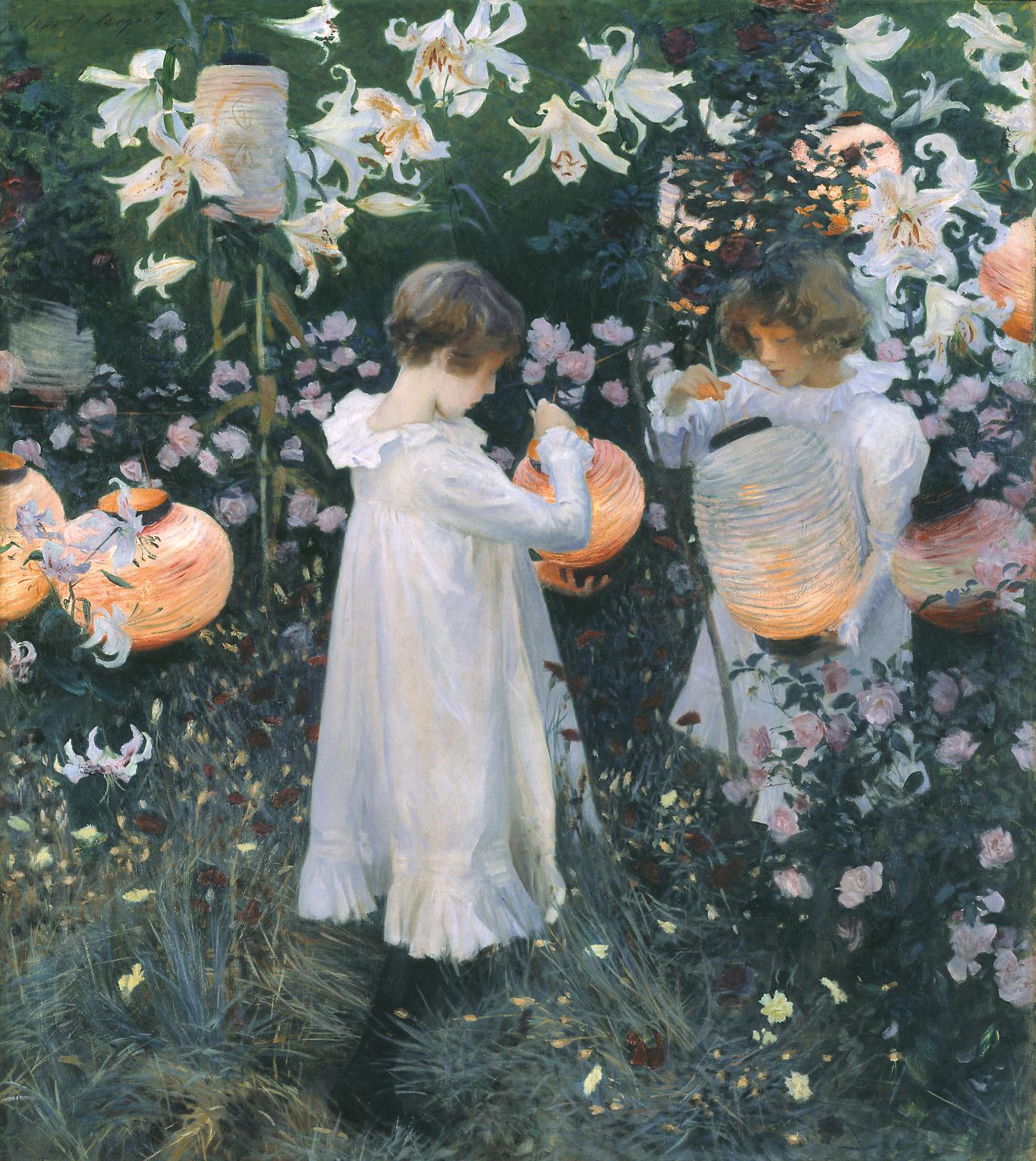
It was also portraiture that got him into trouble. After his “stunning painting of a wealthy socialite” — Madame X, as previously featured here on Open Culture — “caused a scandal in Paris for being too racy,” he move to England. There he would paint Carnation, Lily, Lily, Rose in 1885 and 1886, working only during the “golden hour” just before sunset in order to capture its distinctive light. Puschak explains that, apart from the power of the artist’s long-refined small‑i impressionist technique, “what Sargent gets here, by the accumulation of little effects, is an atmosphere, a mauve-ish coloring that gets in the air itself, which is what it really feels like to be outside on a summer evening.” We all enjoy that feeling, of course, but in this painting — Puschak’s favorite — Sargent established himself as the most masterful summer-evening appreciator of them all.
Below you can watch from the Tate “How John Singer Sargent Painted Carnation, Lily, Lily, Rose”
Related content:
When John Singer Sargent’s Madame X Scandalized the Art World in 1884
Edward Hopper’s Iconic Painting Nighthawks Explained in a 7‑Minute Video Introduction
Why Monet Painted The Same Haystacks 25 Times
How Andrew Wyeth Made a Painting: A Journey Into His Best-Known Work Christina’s World
Why Leonardo da Vinci’s Greatest Painting is Not the Mona Lisa
Based in Seoul, Colin Marshall writes and broadcasts on cities, language, and culture. His projects include the Substack newsletter Books on Cities, the book The Stateless City: a Walk through 21st-Century Los Angeles and the video series The City in Cinema. Follow him on Twitter at @colinmarshall or on Facebook.
Read More...Europe’s Oldest Map: Discover the Saint-Bélec Slab (Circa 2150–1600 BCE)
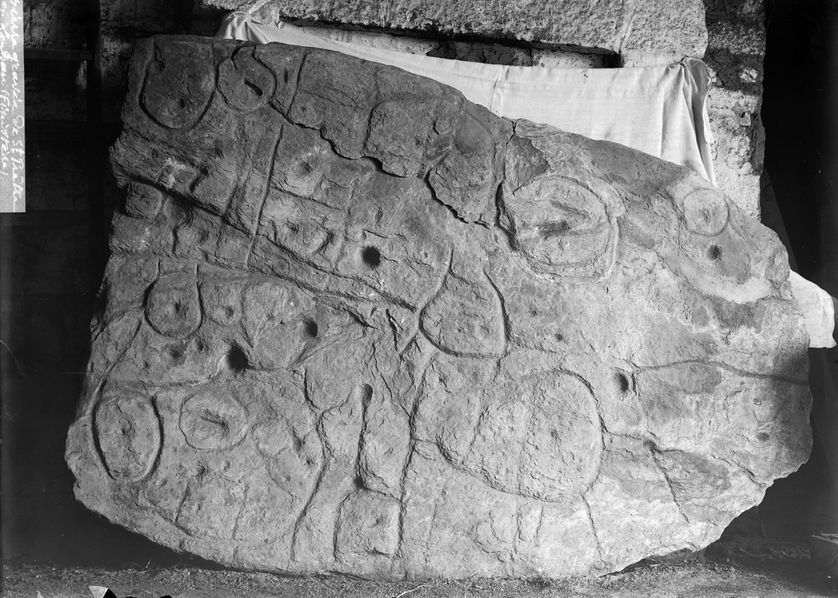
Image by Paul du Châtellier, via Wikimedia Commons
In 1900, the French prehistorian Paul du Châtellier dug up from a burial ground a fairly sizable stone, broken but covered with engraved markings. Even after he put it back together, neither he nor anyone else could work out what the markings represented. “Some see a human form, others an animal one,” he wrote in a report. “Let’s not let our imagination get the better of us and let us wait for a Champollion to tell us what it says.” Champollion, as Big Think’s Frank Jacobs explains, was “the Egyptologist who in 1822 deciphered the hieroglyphics” — which he did with the aid of a more famous inscription-bearing piece of rock, the Rosetta Stone.
Still, the Saint-Bélec slab, as Châtellier’s discovery is now known, has attained a great deal of recognition in the more than 120 years since he unearthed it. But it did so relatively recently, after a long period of relative obscurity.
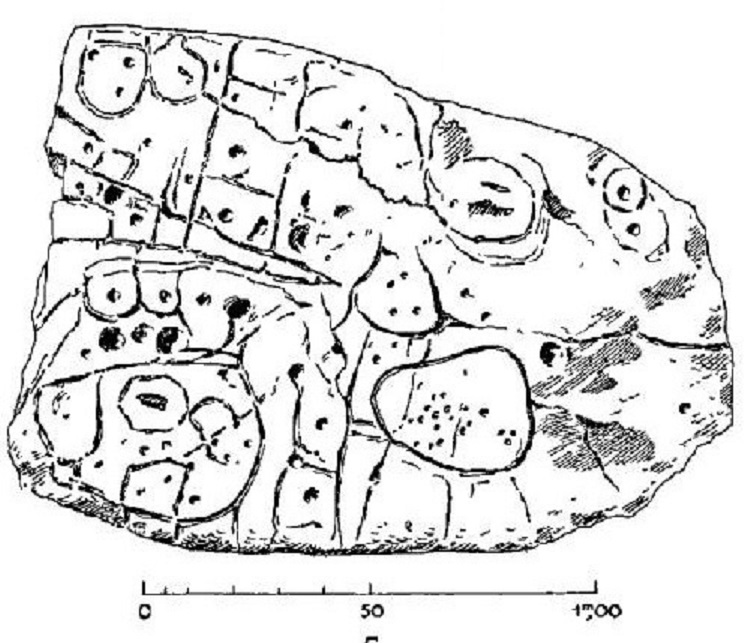
“In 1994, researchers revisiting du Châtellier’s original drawing found that the intricate markings on the stone looked a lot like a map,” writes Jacobs. “The stone itself, however, had gone missing.” Only in 2014 was it rediscovered in a cellar below the moat of the chateau in Saint-Germain-en-Laye once owned by du Châtellier, by which time it could be subjected to the kind of high-tech analysis unimagined in his lifetime.
Operating on the theory that the artifact was indeed created as a map, France’s INRAP (the National Institute for Preventive Archaeological Research) “found that the markings on the slab corresponded to the landscape of the Odet Valley” in modern-day Brittany. Then, “using geolocation technology, the researchers established that the territory represented on the slab bears an 80 percent accurate resemblance to an area around a 29-km (18-mi) stretch of the Odet river,” which seems to have been a small kingdom or principality back in the early Bronze Age, between 2150 BC and 1600 BC. This makes the Saint-Bélec slab Europe’s oldest map, and quite possibly the earliest map of any known territory — and certainly the earliest known map of a popular kayaking destination.
Drawing by Paul du Chatellier, via Wikimedia Commons
via Big Think
Related content:
Explore the Hereford Mappa Mundi, the Largest Medieval Map Still in Existence (Circa 1300)
Bronze Age Britons Turned Bones of Dead Relatives into Musical Instruments & Ornaments
What the Rosetta Stone Actually Says
Based in Seoul, Colin Marshall writes and broadcasts on cities, language, and culture. His projects include the Substack newsletter Books on Cities, the book The Stateless City: a Walk through 21st-Century Los Angeles and the video series The City in Cinema. Follow him on Twitter at @colinmarshall or on Facebook.
Read More...Discover Edo, the Historic Green/Sustainable City of Japan
When you picture modern day Tokyo, what comes to mind?
The electronic billboards of Shibuya and Shinjuku?
The teeming streets?
The maid cafes?
The robot hotel?
A 97 square foot micro apartment?
Bernard Guerrini’s documentary Naturopolis — Tokyo, from megalopolis to garden-city describes Tokyo as “a giant city, a city which never stops growing:”
It has destroyed its natural spaces. It has created its own weather. It’s too big for its own good. They say Tokyo is like an amoeba that absorbs everything in its path.
It’s a far cry from the urban space Tokugawa Ieyasu, founder of the Tokugawa Shogunate, intended when planting the seeds for Edo, as Tokyo was originally called.
As the above excerpt from Naturopolis explains, the 16th-century city was innovative in its incorporation of green space.
The daimyō, or military lords, were required by the shogunate to keep residences in Edo. Each of these homes was furnished with a gardener and a landscaper to maintain the beauty of its al fresco areas.
Meanwhile, crops were cultivated in all communal outdoor open spaces, with irrigation canals supplying the necessary water for growing rice.
These plant-rich settings provided a hospitable environment for animals both wild and domestic. The carefully curated natural zones invited quiet contemplation of flora and fauna, giving rise to the seasonal celebrations and rites that are still observed throughout Japan.
Whether admiring blossoms and fireflies in spring and summer or autumn leaves and snowy winter scenes in the colder months, Edo’s citizens revered the natural world outside their doorsteps.
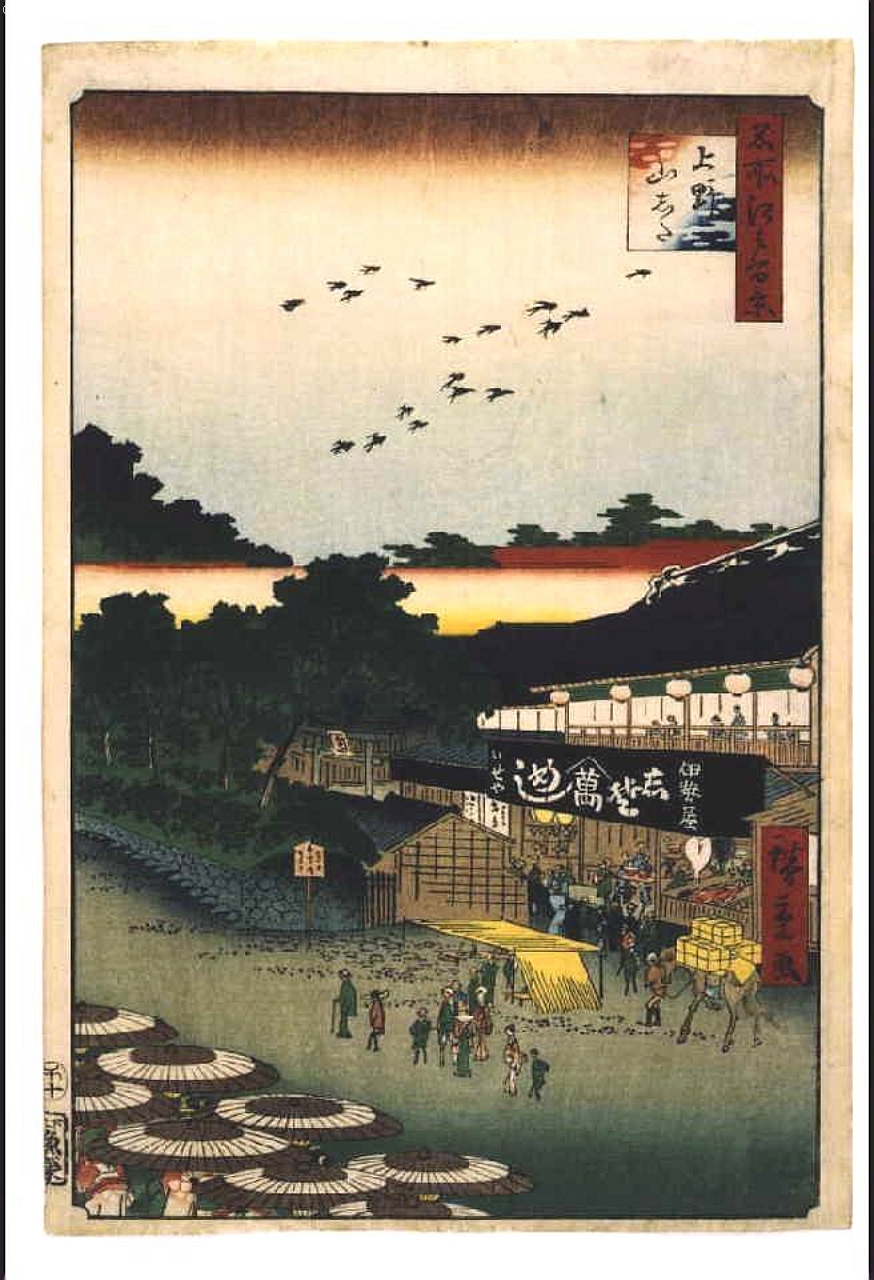
Bashō did the same in his haiku; Utagawa Hiroshige in his series of ukiyo‑e prints, One Hundred Famous Views of Edo.

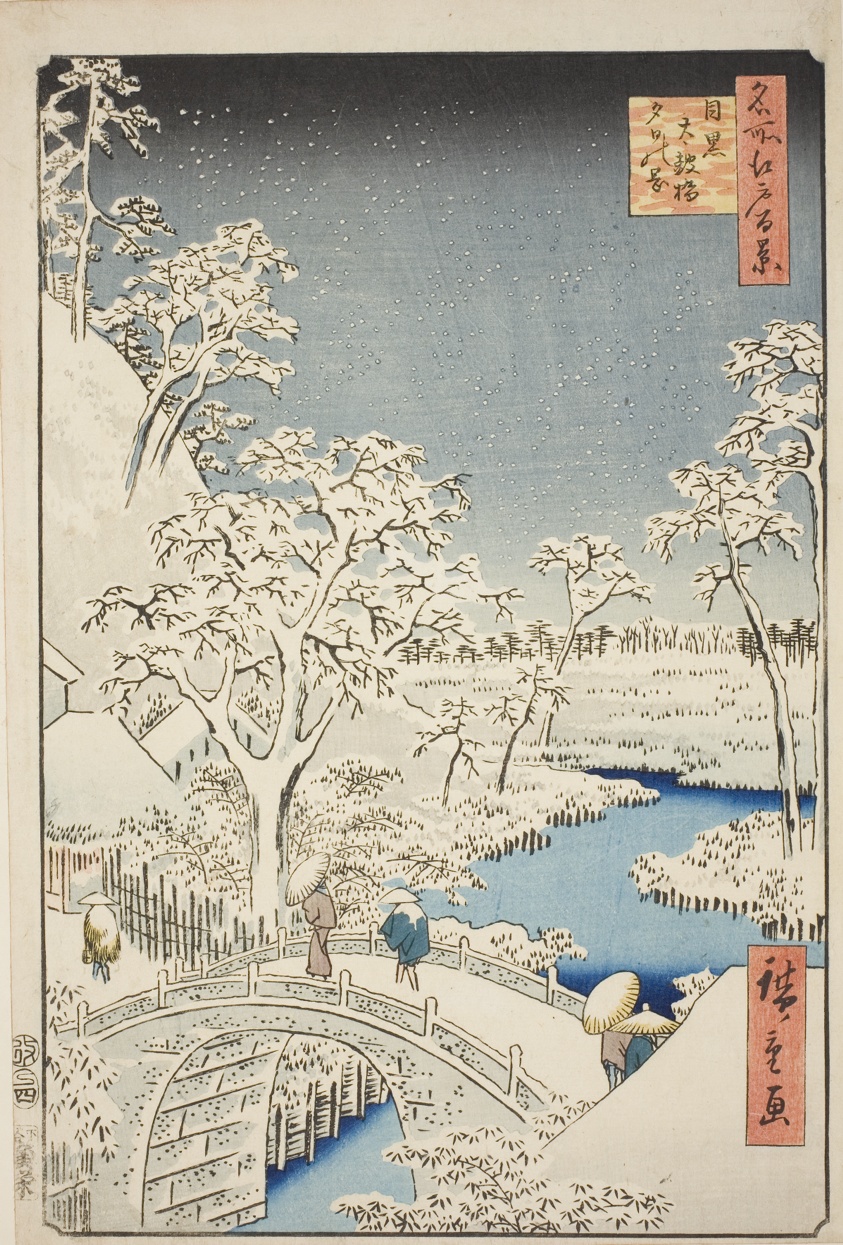
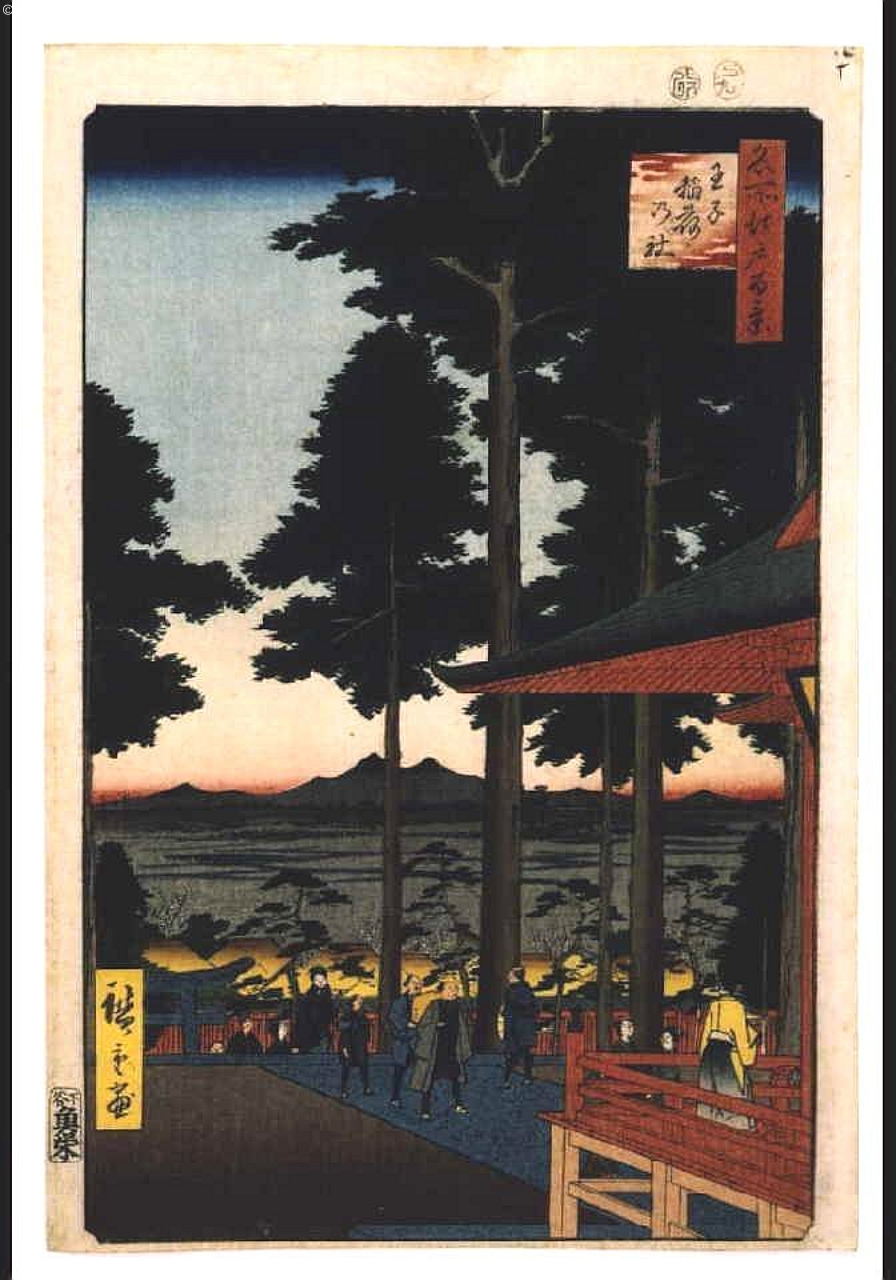
Somewhat less poetically celebrated was the importance of night soil to this biodynamic, pre-industrial shogunate capital. As environmental writer Eisuke Ishikawa delicately notes in Japan in the Edo Period — An Ecologically-Conscious Society:
A long time ago, when excrement was a precious fertilizer, it naturally belonged to the person who produced it. Farmers used to buy excrement for cash or trade it for a comparable amount of vegetables. Fertilizer shortages were a chronic problem during the Edo period. As the standard of living in cities improved, surrounding villages needed an increasing amount of fertilizer…
(Anyone who’s shouldered the surprisingly heavy interactive–not THAT interactive–night soil buckets on display in Tokyo’s Edo Museum will have a feel for just how much of this necessary element each block of the capital city generated on a daily basis.)
The Meiji Restoration of 1868 brought many changes — a new government, a new name for Edo, and a race toward Western-style industrialization. Many parks and gardens were destroyed as Tokyo rapidly expanded beyond Edo’s original footprint.
But now, the Tokyo Metropolitan Government is looking to its past in an effort to combat the effects of climate change with a push toward environmental sustainability.
The goal is net zero CO2 emissions by 2050, with 2030 serving as a benchmark.
In addition to holding the business, financial, and energy sectors to environmentally responsible standard, the zero emission plan seeks to address the average citizen’s quality of life, with a literal return to more green spaces:
Accelerating climate change measures is important to preserve biodiversity and continue to reap its bounty. In recent years, the idea of green infrastructure that utilizes the functions of the natural environment has attracted attention. It is one of the most important considerations for the future: achieving both biodiversity conservation and climate change measures.
A United Nation report* pointed out that COVID-19 is potentially a zoonotic disease derived from wildlife, such infectious diseases will increase in the future, and one of the reasons is the destruction of nature by humans.
Read Tokyo Metropolitan Government’s Zero Transmission Strategy and Update here.
Related Content
Wabi-Sabi: A Short Film on the Beauty of Traditional Japan
See How Traditional Japanese Carpenters Can Build a Whole Building Using No Nails or Screws
The Entire History of Japan in 9 Quirky Minutes
Cats in Japanese Woodblock Prints: How Japan’s Favorite Animals Came to Star in Its Popular Art
– Ayun Halliday is the Chief Primatologist of the East Village Inky zine and author, most recently, of Creative, Not Famous: The Small Potato Manifesto and Creative, Not Famous Activity Book. Follow her @AyunHalliday.
Read More...Beethoven’s Genome Has Been Sequenced for the First Time, Revealing Clues About the Great Composer’s Health & Family History
Ludwig van Beethoven died in 1827, a bit early to be subjected to the kinds of DNA analysis that have become so prevalent today. Luckily, the German-speaking world of the early nineteenth century still adhered to the custom of saving locks of hair from the deceased — particularly lucky for an archaeology student named Tristan Begg and his collaborators in the study “Genomic analyses of hair from Ludwig van Beethoven,” published just this month in Current Biology. In the video from Cambridge University just above, Begg introduces the research project and describes what new information it reveals about the composer whose life and work have been so intensively studied for so long.
“Working with an international team of scientists, I identified five genetically matching, authentic locks of hair and used them to sequence Beethoven’s genome,” Begg says. “We discovered significant genetic risk factors for liver disease and evidence that Beethoven contracted the Hepatitis B virus in, at the latest, the months before his final illness.”
And “while we couldn’t pinpoint the cause of Beethoven’s deafness or gastrointestinal problems, we did find modest genetic risk for Systemic Lupus Erythematosus,” an autoimmune disease. History remembers Beethoven as a not particularly healthy man; now we have a clearer idea of which conditions he could have suffered.
But this study’s most revelatory discoveries concern not what has to do with Beethoven, but what doesn’t. The famous lock of hair “once believed to have been cut from the dead composer’s head by the fifteen-year-old musician Ferdinand Hiller” turns out to have come from a woman. Nor was Beethoven himself “descended from the main Flemish Beethoven lineage,” which is shown by genetic evidence that “an extramarital relationship resulted in the birth of a child in Beethoven’s direct paternal line at some point between 1572 and 1770.” This news came as a shock to “the five people in Belgium whose last name is van Beethoven and who provided DNA for the study,” writes the New York Times’ Gina Kolata. But then, Beethoven’s music still belongs to them — just as it belongs to us all.
Related content:
Stream the Complete Works of Bach & Beethoven: 250 Free Hours of Music
The Story of How Beethoven Helped Make It So That CDs Could Play 74 Minutes of Music
Based in Seoul, Colin Marshall writes and broadcasts on cities, language, and culture. His projects include the Substack newsletter Books on Cities, the book The Stateless City: a Walk through 21st-Century Los Angeles and the video series The City in Cinema. Follow him on Twitter at @colinmarshall or on Facebook.
Read More...A Street Musician Plays Pink Floyd’s “Time” in Front of the 1,900-Year-Old Pantheon in Rome
To commemorate the 50th anniversary of Pink Floyd’s Dark Side of the Moon we bring you this: a busker fittingly playing “Time” in front of the nearly 2000-year-old Pantheon in Rome. That the police try to break up the show hardly matters. The busker continues, and returns on other days to play “Shine on You Crazy Diamond” and “Comfortably Numb.” If you’re a Pink Floyd fan, this scene may call to mind Pink Floyd: Live at Pompeii, the 1972 concert documentary that featured the band playing eight songs amidst the ruins of Pompeii. Rock among the rocks. You can explore that scene here.
If you would like to support the mission of Open Culture, consider making a donation to our site. It’s hard to rely 100% on ads, and your contributions will help us continue providing the best free cultural and educational materials to learners everywhere. You can contribute through PayPal, Patreon, and Venmo (@openculture). Thanks!
Related Content
Related Content
Read More...
How One Man Keeps Showing Films in a Japanese Cinema That Closed 58 Years Ago: A Moving, Short Documentary
Since at least the nineteen-fifties, when television ownership began spreading rapidly across the developed world, movie theaters have been laboring under one kind of existential threat or another. Yet despite their apparent vulnerability to a variety of disruptive developments — home video, streaming, COVID-19 — many, if not most, of them have found ways to soldier on. In some cases this owes to the dedication of small groups of supporters, or even to the efforts of individuals like Shuji Tamura, who operates the century-old Motomiya Movie Theater in Japan’s Fukushima prefecture single-handedly.
You can see Tamura in action in My Theater, the five-minute documentary short above. “The Japanese director Kazuya Ashizawa’s charming observational portrait captures Tamura as he screens old movies for an audience of students and cinephiles, and gives behind-the-scenes tours of the cinema,” says Aeon. Those tours include an up-close look at the thoroughly analog film projector of whose operation Tamura, 81 years old at the time of filming, has retained all the know-how. Though he officially closed the theater in the nineteen-sixties, it seems he keeps his threading skills sharp by holding screenings for tour groups young and old.
Though lighthearted, a portrait like this could hardly avoid an elegiac undertone. Already suffering from the depopulation that has afflicted many regions of Japan, Fukushima was also badly afflicted by the 2011 Tōhoku earthquake and tsunami and their associated nuclear disaster. In 2020, the year after Ashizawa shot My Theater, a typhoon “caused the Abukumagawa river and its tributaries to flood,” as the Asahi Shimbun’s Shoko Rikimaru writes. “The Motomiya city center was inundated, seven people died, and more than 2,000 houses and buildings were damaged.” Both Tamura’s theater and his home were flooded, and “half of the 400 film cans on shelves on the first floor of his house were drenched in muddy water.”
In response, help came from near and far. “A manufacturer in Kanagawa Prefecture sent 10 boxes of film cans to the theater, while a movie theater in Morioka, Iwate Prefecture, delivered a film-editing machine. About 30 people affiliated with the film industry in Tokyo showed up at the theater to help clean and dry the film. The effort led to the restoration of about 100 films.” Alas, Tamura’s planned re-opening event happened to coincide with the spread of the coronavirus across Japan, resulting in its indefinite postponement. But now that Japan has re-opened for international tourism, perhaps the Motomiya Movie Theater can become a destination for not just domestic visitors but foreign ones as well. Having been charmed by My Theater, who wouldn’t want to make the trip?
via Aeon
Related content:
Why Japan Has the Oldest Businesses in the World?: Hōshi, a 1300-Year-Old Hotel, Offers Clues
Based in Seoul, Colin Marshall writes and broadcasts on cities, language, and culture. His projects include the Substack newsletter Books on Cities, the book The Stateless City: a Walk through 21st-Century Los Angeles and the video series The City in Cinema. Follow him on Twitter at @colinmarshall or on Facebook.
Read More...When a UFO Came to Japan in 1803: Discover the Legend of Utsuro-bune

For the enthusiast of unidentified flying objects, we live in interesting times indeed. Back in 2021, as we previously featured here on Open Culture, the CIA declassified and published thousands of pages of UFO-related documents. In just the past few weeks, three UFOs were shot down over North America. In the span of time between those events, much else has also occurred to stimulate the imagination of those who’ve kept watching the skies. Fascination with UFOs may have strong cultural associations with twentieth-century America — and the subject can now feel a bit passé for that reason — but it knows fewer cultural or temporal boundaries than we may think: witness, for example, the Japanese folktale of Utsuro-bune.
“In 1803, a round vessel drifted ashore on the Japanese coast and a beautiful woman emerged, wearing strange clothing and carrying a box. She was unable to communicate with the locals, and her craft was marked with mysterious writing.” Such is the premise of the legend as retold at Nippon.com, which also offers an analysis by Gifu University professor emeritus Tanaka Kazuo.
“Long before the American UFO stories, the craft depicted in Edo-period Japanese documents for some reason looked like a flying saucer,” he says. Nor have scholars traced Utsuro-bune (虚舟, which means “hollow ship”) back to only one source: to date, Tanaka “has found eleven documents relating to the Hitachi Utsuro-bune legend, of which the most interesting are thought to date from 1803, the same year that the craft was said to have come to shore.”

What exactly happened in Hitachi, a small city on Japan’s east coast, in 1803? Why do near contemporary depictions of the Utsuro-bune itself (especially in the 1835 Hyōryū kishū or “records of castaways,” as seen at the top of the post) so closely resemble modern-day visions of flying saucers? Given that the incident is held to have taken place during the country’s 265-year-long sakoku period of national isolation, no foreigner is likely to have crossed over to Japanese shores without causing a major incident. Unable to communicate with this mysterious woman, the fishermen of Hitachi are said simply to have returned her — box and all — to the hollow ship, which drifted back out to sea, never to be seen again. It was her good luck, some ufologists might say, to have turned up on Earth a century and a half before the opening of Area 51.
Related content:
The First Museum Dedicated to Japanese Folklore Monsters Is Now Open
The Appeal of UFO Narratives: Investigative Journalist Paul Beban Visits Pretty Much Pop #14
Based in Seoul, Colin Marshall writes and broadcasts on cities, language, and culture. His projects include the Substack newsletter Books on Cities, the book The Stateless City: a Walk through 21st-Century Los Angeles and the video series The City in Cinema. Follow him on Twitter at @colinmarshall or on Facebook.
Read More...A 3D Computer Animation of the Panopticon, Jeremy Bentham’s 18th Century Design for an All-Controlling Prison
Nearly two centuries after his death, the eighteenth-century utilitarian philosopher and social reformer Jeremy Bentham — or most of him, anyway — still sits in state in the main building of University College London. For a time in the mid-twenty-tens, he was equipped with the PanoptiCam, “an online camera that streams what Bentham sees while sitting in his cabinet at UCL.” That most everyone gets the joke behind its name speaks to the enduring relevance of one of Bentham’s ideas in particular: the Panopticon, “a prison designed so that a prison guard could look into all cells at any time, and ensure that prisoners modified their behavior for the better.”
In Bentham’s Panopticon, many prisoners could be monitored effectively by just a few unseen guards. This accords, as Michel Foucault writes in 1975’s Discipline and Punish, with the principle that “power should be visible and unverifiable. Visible: the inmate will constantly have before his eyes the tall outline of the central tower from which he is spied upon. Unverifiable: the inmate must never know whether he is being looked at any one moment; but he must be sure that he may always be so.” Foucault drew connections between the Panopticon and the complex, large-scale societies that had developed since Bentham’s day. Imagine if he’d lived to see the rise of social media.
In a series of posts by Philosophy for Change, Tim Rayner takes up just such an exercise. “By making our actions and shares visible to a crowd, social media exposes us to a kind of virtual Panopticon,” he writes. “This is not just because our activities are monitored and recorded by the social media service for the purposes of producing market analysis or generating targeted advertising.” But “the surveillance that directly affects us and impacts on our behavior comes from the people with whom we share.” In the online Panopticon, “we are both guards and prisoners, watching and implicitly judging one another as we share content.” Rayner wrote these words more than a decade ago, but anyone who has experienced life on social media then can hardly deny the parallels with Bentham’s vision.
Far from improving our behavior, however, this constant online surveillance has in a fair few cases made it considerably less appealing. Whatever the nature of its actual effects on those who inhabit it, the Panopticon is an undeniably powerful structure, at least metaphorically speaking. But we should remember that Bentham intended it to be a real, physical structure, one that could contain not just prisons but other types of institutions as well. Whether a Panopticon has ever been wholly built to his specifications seems to be a matter of debate, but we can see what one would look like in the 3D rendering by Myles Zhang at the top of the post: an appropriate medium, after all, in which to perceive an idea most fully realized in the digital realm.
Related content:
Jeremy Bentham’s Mummified Body Is Still on Display – Much Like Other Aging British Rock Stars
What Would Michel Foucault Think of Social Media, Fake News & Our Post Truth World?
Michel Foucault: Free Lectures on Truth, Discourse & The Self (UC Berkeley, 1980–1983)
On the Power of Teaching Philosophy in Prisons
Based in Seoul, Colin Marshall writes and broadcasts on cities, language, and culture. His projects include the Substack newsletter Books on Cities, the book The Stateless City: a Walk through 21st-Century Los Angeles and the video series The City in Cinema. Follow him on Twitter at @colinmarshall or on Facebook.
Read More...Archaeologists May Have Discovered a Secret Language in Lascaux & Chauvet Cave Paintings, Perhaps Revealing a 20,000-Year-Old “Proto-Writing” System
Care to take a guess what your smart phone has in common with Paleolithic cave paintings of Lascaux, Chauvet and Altamira?
Both can be used to track fertility.
Admittedly, you’re probably not using your phone to stay atop the reproductive cycles of reindeer, salmon, and birds, but such information was of critical interest to our hunter-gatherer ancestors.
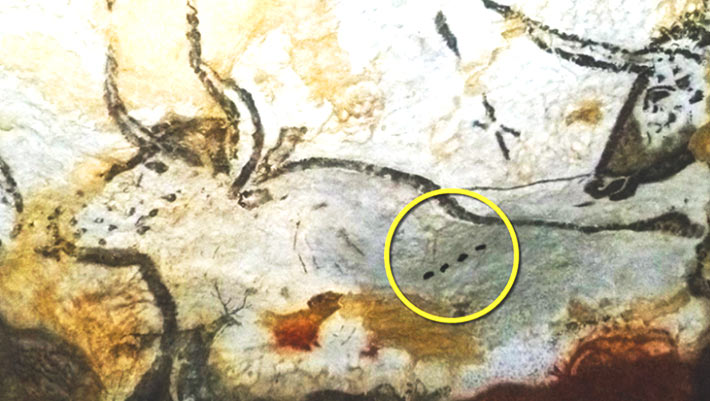
Knowing how crucial an understanding of animal behavior would have been to early humans led London-based furniture conservator Ben Bacon to reconsider what purpose might have been served by non-figurative markings — slashes, dots, and Y‑shapes — on the cave walls’ 20,000-year-old images.
Their meaning had long eluded esteemed professionals. The marks seemed likely to be numeric, but to what end?
Bacon put forward that they documented animal lives, using a lunar calendar.
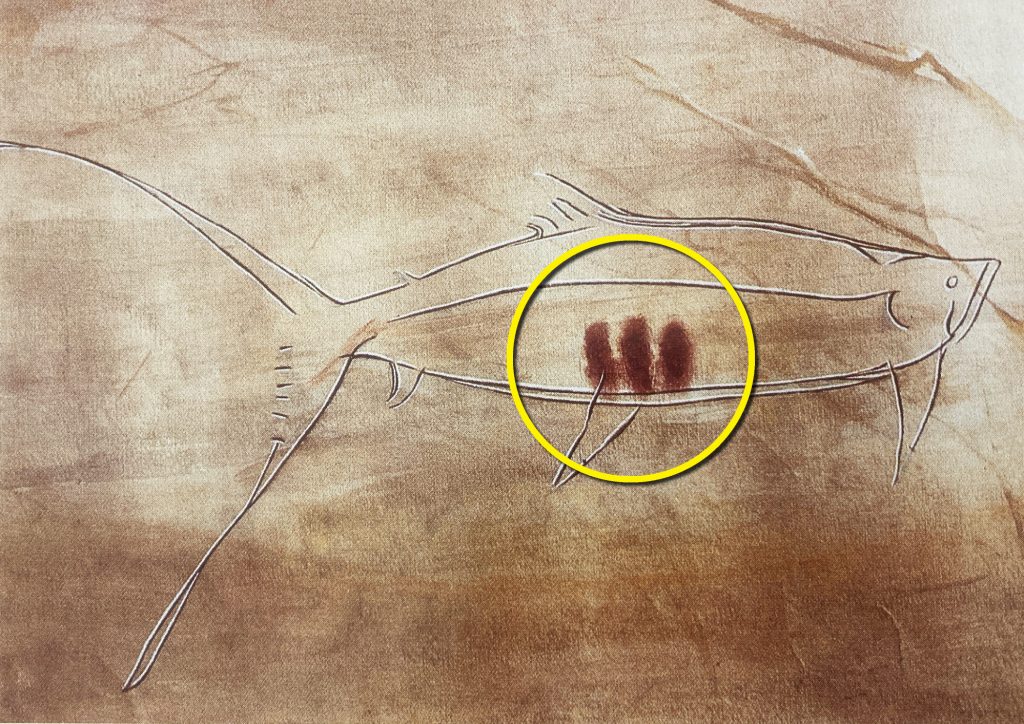
The amateur researcher assembled a team that included experts from the fields of mathematics, archeology, and psychology, who analyzed the data, compared it to the seasonal behaviors of modern animals, and agreed that the numbers represented by the dots and slashes are not cardinal, but rather an ordinal representation of months.
As Bacon told All Things Considered his fellow self-taught anthropological researcher, science journalist Alexander Marshack, came close to cracking the code in the 1970s:
… but he wasn’t actually able to demonstrate the system because he thought that these individual lines were days. What we did is we said, actually, they’re months because a hunter-gatherer doesn’t need to know what day a reindeer migrates. They need to know what month the reindeer migrates. And once you use these months units, this whole system responds very, very well to that.
As to the frequently occurring symbol that resembles a Y, it indicates the months in which various female animal birthed their young. Bacon and his team theorize in the Cambridge Archeological Journal that this mark may even constitute “the first known example of an ‘action‘ word, i.e. a verb (‘to give birth’).
Taken together, the cave paintings and non-figurative markings tell an age-old circular tale of the migration, birthing and mating of aurochs, birds, bison, caprids, cervids, fish, horses, mammoths, and rhinos … and like snakes and wolverines, too, though they were excluded from the study on basis of “exceptionally low numbers.”

Early humans were able to log months by observing the moon, but how could they tell when a new year had begun, essential information for anyone seeking to arrange their lives around their prey’s previously documented activities?
Bacon and his peers, like so many poets and farmers, look to the rites of spring:
The obvious event is the so-called ‘bonne saison’, a French zooarchaeological term for the time at the end of winter when rivers unfreeze, the snow melts, and the landscape begins to green.
Read the conclusions of their study here.
Related Content
Algerian Cave Paintings Suggest Humans Did Magic Mushrooms 9,000 Years Ago
Was a 32,000-Year-Old Cave Painting the Earliest Form of Cinema?
40,000-Year-Old Symbols Found in Caves Worldwide May Be the Earliest Written Language
- Ayun Halliday is the Chief Primatologist of the East Village Inky zine and author, most recently, of Creative, Not Famous: The Small Potato Manifesto and Creative, Not Famous Activity Book. Follow her @AyunHalliday.
Read More...
When Leonard Bernstein Turned Voltaire’s Candide into an Opera (with Help from Lillian Hellman, Dorothy Parker & Stephen Sondheim)
The seventeen-fifties found Western civilization in the middle of its Age of Enlightenment. That long era introduced on a large scale the notion that, through the use of rationality and scientific knowledge, humanity could make progress. For the Enlightenment’s true believers, it would have eventually become quite easy indeed to assume that we had nowhere to go but up, and would sooner or later attain a state of perfection. No such fantasies, of course, for Jean-Marie Arouet, better known as Voltaire. Despite being an Enlightenment icon, he pulled no punches in attacking what he saw as its delusions, most lastingly in his 1759 satirical novel Candide, ou l’Optimisme.
Two centuries later, Western civilization, and especially the freshly formed civilization of the United States of America, had entered a new age of reason. Or rather, it had entered an age of technical, industrial, and organizational “know-how.”
The conviction that America could be perfected through engineered systems played its part in generating a degree of prosperity the world had never known (and would have scarcely been imaginable in Voltaire’s day). But it also had grimmer manifestations, such as McCarthyism and the House Un-American Activities Committee, whose procedures ground away at the core of the anti-Communist “red scare.”
In Candide, Voltaire takes to task a variety of not just beliefs but institutions, including the Portuguese Inquisition. The playwright Lillian Hellman, who’d been blacklisted after appearing before the HUAC in 1947, “observed a sinister parallel between the Inquisition’s church-sponsored purges and the ‘Washington Witch Trials,’ fueled by anti-Communist hysteria.” So says the web site of Leonard Bernstein, Hellman’s collaborator on what would become a comic-operetta adaptation of Candide. With contributions from lyricist John LaTouche, poet Richard Wilbur, and Algonquin Round Table wit Dorothy Parker, their production was ready to open in the fall of 1956.
Stripped in the eleventh hour of Hellman’s most direct topical attacks, and even then criticized for over-seriousness, the original Broadway production of Candide ended after 73 performances. (Recordings of the original production can be purchased online.) Nevertheless, there was cause for optimism about its future: the show would be revived in London with a revised book two years later, with further new versions to follow in the nineteen-seventies and eighties, its lyrics supplemented by no less a Broadway master than Stephen Sondheim. The two-and-a-half hour video above combines highlights of two consecutive performances in 1989, conducted by Bernstein himself in the year before his death. “Like its hero, Candide is perhaps destined never to find its perfect form and function,” notes Bernstein’s site. “In the final analysis, however, that may prove philosophically appropriate.”
Related content:
An Animated Introduction to Voltaire: Enlightenment Philosopher of Pluralism & Tolerance
Based in Seoul, Colin Marshall writes and broadcasts on cities, language, and culture. His projects include the Substack newsletter Books on Cities, the book The Stateless City: a Walk through 21st-Century Los Angeles and the video series The City in Cinema. Follow him on Twitter at @colinmarshall or on Facebook.
Read More...Support Us
We're hoping to rely on loyal readers, rather than erratic ads. Please click the Donate button and support Open Culture. You can use Paypal, Venmo, Patreon, even Crypto! We thank you!

About Us

Open Culture scours the web for the best educational media. We find the free courses and audio books you need, the language lessons & educational videos you want, and plenty of enlightenment in between.
Advertise With Us
FREE UPDATES!
GET OUR DAILY EMAIL
Get the best cultural and educational resources on the web curated for you in a daily email. We never spam. Unsubscribe at any time.
FOLLOW ON SOCIAL MEDIA
Open Culture editor Dan Colman scours the web for the best educational media. He finds the free courses and audio books you need, the language lessons & movies you want, and plenty of enlightenment in between.
Advertise With Us



