Watch Footage of Claude Monet Painting in His Famous Garden at Giverny (1915)
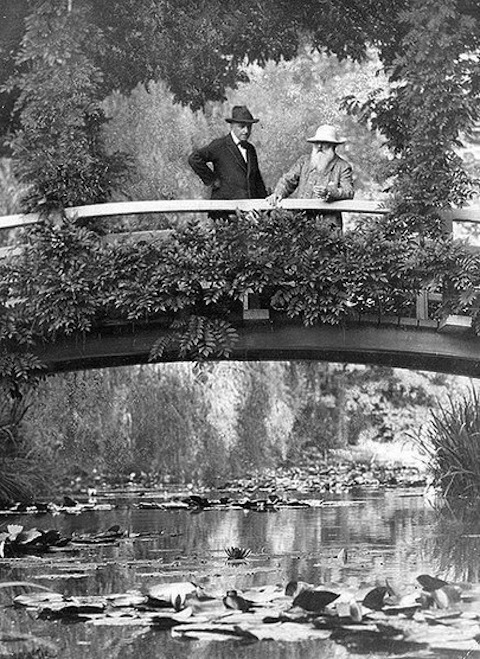
What could be more charmingly idyllic than a glimpse of snowy-bearded Impressionist Claude Monet calmly painting en plein-air in his garden at Giverny?
A wide-brimmed hat and two luxuriously large patio-type umbrellas provide shade, while the artist stays cool in a pristine white suit.
His canvas is off camera for the most part, but given the coordinates, it seems safe to assume the subject’s got something to do with the famous Japanese footbridge spanning Monet’s equally famous lily pond.
The sun’s still high when he puts down his cat’s tongue brush and heads back to the house with his little dog at his heels, no doubt anticipating a delicious, relaxed luncheon.
Even in black-and-white, it’s an irresistible pastoral vision!
And quite a contrast to the recent scene some 300 km away in Ypres, where German troops weaponized chlorine gas for the first time, releasing it in the Allied trenches the same year the above footage of Monet was shot.
Lendon Payne, a British sapper, was an eyewitness to some of the mayhem:
When the gas attack was over and the all clear was sounded I decided to go out for a breath of fresh air and see what was happening. But I could hardly believe my eyes when I looked along the bank. The bank was absolutely covered with bodies of gassed men. Must have been over 1,000 of them. And down in the stream, a little bit further along the canal bank, the stream there was also full of bodies as well. They were gradually gathered up and all put in a huge pile after being identified in a place called Hospital Farm on the left of Ypres. And whilst they were in there the ADMS came along to make his report and whilst he was sizing up the situation a shell burst and killed him.
The early days of the Great War are what spurred director Sacha Guitry, seen chatting with Monet above, to visit the 82-year-old artist as part of his 22-minute silent documentary, Ceux de Chez Nous (Those of Our Land).
The entire project was an act of resistance.
With German intellectuals trumpeting the superiority of Germanic culture, the Russian-born Guitry, a successful actor and playwright, sought out audiences with aging French luminaries, to preserve for future generations.
In addition to Monet, these include appearances by painters Pierre-Auguste Renoir and Edgar Degas, sculptor Auguste Rodin, writer Anatole France, composer Camille Saint-Saens, and actor Sarah Bernhardt.
Although Ceux de Chez Nous was silent, Guitry carefully documented the content of each interview, revisiting them in 1952 for the expanded version with commentary, below.
Beneath his placid exterior, Monet, too, was quite consumed by the horrors unfolding nearby.
James Payne, creator of the web series Great Art Explained, views Monet’s final eight water lily paintings as a “direct response to the most savage and apocalyptic period of modern history…a war memorial to the millions of lives tragically lost in the First World War.”
In 1914, Monet wrote that while painting helped take his mind off “these sad times” he also felt “ashamed to think about my little researches into form and colour while so many people are suffering and dying for us.”
As curator Ann Dumas notes in RA Magazine:
The peace of his garden was sometimes shattered by the sound of gunfire from the battlefields only 50 kilometres away. His stepson was fighting at the front and his own son Michel was called up in 1915. Many of the inhabitants of Giverny fled to safety but Monet stayed behind: “…if those savages must kill me, it will be in the middle of my canvases, in front of all my life’s work.” Painting was what he did and he saw it, in a way, as his patriotic contribution. A group of paintings of the weeping willow, a traditional symbol of mourning, was Monet’s most immediate response to the war, the tree’s long, sweeping branches hanging over the water, an eloquent expression of grief and loss.
Related Content
1540 Monet Paintings in a Two Hour Video
Why Monet Painted The Same Haystacks 25 Times
– Ayun Halliday is the Chief Primatologist of the East Village Inky zine and author, most recently, of Creative, Not Famous: The Small Potato Manifesto and Creative, Not Famous Activity Book. Follow her @AyunHalliday.
Read More...How to Bake Ancient Roman Bread from 79 AD: A Video Introduction
Ecce panis—try your hand at the kind of loaf that Mel Brooks’ 2000-year-old man might have sunk his teeth into. Literally.
In 1930 a loaf of bread dating to AD 79 (the year Vesuvius claimed two prosperous Roman towns) was excavated from the site of a bakery in Herculaneum.
Eighty-three years later, the British Museum invited London chef Giorgio Locatelli, above, to take a stab at creating an edible facsimile for its Pompeii Live exhibition.
The assignment wasn’t as easy as he’d anticipated, the telegenic chef confesses before whipping up a lovely brown miche that appears far more mouth-watering than the carbonized round found in the Herculaneum oven.
His recipe could be mistaken for modern sourdough, but he also has a go at several details that speak to bread’s role in ancient Roman life:
Its perimeter has a cord baked in to provide for easy transport home. Most Roman homes were without ovens. Those who didn’t buy direct from a bakery took their dough to community ovens, where it was baked for them overnight.
The loaf was scored into eight wedges. This is true of the 80 loaves found in the ovens of the unfortunate baker, Modestus. Locatelli speculates that the wedges could be used as monetary units, but I suspect it’s more a business practice on par with pizza-by-the-slice.
(Nowadays, Roman pizza is sold by weight, but I digress.)
The crust bears a telltale stamp. Locatelli takes the opportunity to brand his with the logo of his Michelin-starred restaurant, Locanda Locatelli. His inspiration is stamped ‘Property of Celer, Slave of Q. Granius Verus.’ To me, this suggests the possibility that the bread was found in a communal oven.
Locatelli also introduces a Flintstonian vision when he alludes to specially-devised labor-saving machines to which Roman bakers yoked “animals,” presumably donkeys…or knowing the Romans and their class system, slaves.
His published recipe is below. Here is a conversion chart for those unfamiliar with metric measurements.
INGREDIENTS
400g biga acida (sourdough)
12g yeast
18g gluten
24g salt
532g water
405g spelt flour
405g wholemeal flour
Melt the yeast into the water and add it into the biga. Mix and sieve the flours together with the gluten and add to the water mix. Mix for two minutes, add the salt, and keep mixing for another three minutes. Make a round shape with it and leave to rest for one hour. Put some string around it to keep its shape during cooking. Make some cuts on top before cooking to help the bread rise in the oven and cook for 30–45 minutes at 200 degrees.
For an even more artisanal attempt (and extremely detailed instructions) check out the Artisan Pompeii Miche recipe on the Fresh Loaf bread enthusiast community.
True Roman bread for true Romans!
Note: An earlier version of this post appeared on our site in 2015.
Related Content:
Explore the Roman Cookbook, De Re Coquinaria, the Oldest Known Cookbook in Existence
Cook Real Recipes from Ancient Rome: Ostrich Ragoût, Roast Wild Boar, Nut Tarts & More
Ayun Halliday is an author, illustrator, and Chief Primatologist of the East Village Inky zine. Follow her @AyunHalliday
Read More...Charlie Chaplin’s Final Speech in The Great Dictator: A Statement Against Greed, Hate, Intolerance & Fascism (1940)
The narrow “toothbrush mustache” caught on in the late nineteenth century, first in the United States and soon thereafter across the Atlantic. When Charlie Chaplin put one on for a film in 1914, he became its most famous wearer — at least until Adolf Hitler rose to prominence a couple of decades later. By that point Chaplin had become the most famous comedy star in the world, which may have inspired the Nazi Party leader, a known fan of Chaplin’s work, to adopt the same mustache as a kind of tool of self-advancement. Chaplin himself could hardly have approved of his new doppelgänger, and it troubled him to discover their other shared qualities: their births in April of 1889, their poor childhoods, their love of Wagner.
Still, as an inveterate entertainer, Chaplin grasped the comedic potential of his and Hitler’s parallel iconic status. The result, released in 1940, was The Great Dictator, his first genuine sound film. Chaplin had continued making silent pictures, and refining his signature visual humor, well into the era of “talkies.”
But he could only have done so much to ridicule Hitler, who had come to power in large part through speeches broadcast over the radio, without being able to use his voice as well. Yet he delivers his most memorable lines not in the role of Hitler surrogate Adenoid Hynkel, but that of the unnamed Jewish barber who — through, of course, several absurd turns of events — ends up mistaken for Hynkel and made to address the nation.
“I’m sorry, but I don’t want to be an emperor,” says Chaplin-as-the-Barber-as-Hynkel. “That’s not my business. I don’t want to rule or conquer anyone. I should like to help everyone — if possible — Jew, Gentile, black man, white. We all want to help one another. Human beings are like that. We want to live by each other’s happiness, not by each other’s misery.” Throughout the three-and-a-half-minute monologue, he speaks against “greed,” “cleverness,” “national barriers,” and “the hate of men”; he advocates for “kindness and gentleness,” “universal brotherhood,” “a world of reason,” and “the love of humanity.” These may not be especially precise terms, but, knowing his public well — much better, indeed, than Hitler ever knew his — Chaplin also knew just when to go broad.
Related content:
When Mahatma Gandhi Met Charlie Chaplin (1931)
When Charlie Chaplin Entered a Chaplin Look-Alike Contest & Came in 20th Place
The Famous Downfall Scene Explained: What Really Happened in Hitler’s Bunker at the End?
Based in Seoul, Colin Marshall writes and broadcasts on cities, language, and culture. His projects include the Substack newsletter Books on Cities, the book The Stateless City: a Walk through 21st-Century Los Angeles and the video series The City in Cinema. Follow him on Twitter at @colinmarshall or on Facebook.
Read More...
Why Movies Don’t Feel Like Movies Anymore: The Rise of Metamodernist Films, and How They Grew Out of Modernism & Postmodernism
Say what you will about Joker; it did, at least, feel like a real movie, which is hardly true of many, if not most, of the influential feature films that have come out since. Yes, they run between 80 and 180 minutes, and yes, they were screened in theaters (though increasingly many viewers have opted to stream them at home), but despite their often considerable entertainment value, they somehow never quite satisfy. If they feel weightless to us, even trivial — shot through with not just irony and self-reference, but also jarring lapses into emotional kitsch — that must owe in large part to the impression that their creators don’t quite take their own art form seriously. Filmmakers surely still want to believe in film, but can’t be seen believing in it too strongly: this is the dilemma of our meta-modern age.
“Just in the year 2022, we saw Nope, which criticizes spectacle even as it tries to be one; The Banshees of Insherin, which is in dialogue with itself about the value of art; we saw Steven Spielberg looking back at his own life in The Fabelmans, and examining the role cinema has played in it for both good and bad — through cinema.” Thomas Flight names these pictures as examples in his new video essay on meta-modernity, a term of recent enough coinage to require definition from a variety of angles. “It seems like there’s very little straightforward storytelling in film anymore,” he says. “Movies are either part of a multidimensional franchise or are satirical, surreal, or absurd. They might contain a multiverse or twists on a classic trope, break storytelling convention, or some combination of all these things.”
No single production pulls as many of these tricks as last year’s Academy Awards-dominating Everything Everywhere All at Once (the subject of a previous Thomas Flight video essay). As much a zeitgeist picture of the early twenty-twenties as Joker was of the late twenty-tens, it shows us where cinema has arrived — for better or for worse — after its nearly century-and-a-half long journey through modernism, post-modernism, and now meta-modernism. Modernism, as Flight defines it, promotes “an objective view of reality” and “displays specific values, and then unapologetically seems to argue for those values as good and beneficial.” When those values were eventually called into question, post-modernism arose “to question the value of narrative itself.” Here Flight quotes films like Apocalypse Now, F For Fake, Blade Runner, Blue Velvet, Barton Fink, Pulp Fiction, suggesting that post-modernism was very good indeed for cinema, at least at first.
But “irony, pastiche, surrealism, and self-reflexivity” inevitably hit the saturation point; “you can only subvert expectations so many times before the new expectation becomes that expectations will be subverted, and it all starts to get a little bit old.” As post-modernism responded to modernism, so meta-modernism responds to post-modernism, attempting to lay claim to the power of both cultural periods at once. We see this in Quentin Tarantino’s Once Upon a Time… in Hollywood, as well as most of the oeuvre of Wes Anderson — but also in a lot of “swinging wildly back and forth between modernist sincerity and postmodern deconstruction,” little of it more convincing than the latest CGI extravaganza extruded by any given superhero franchise. Still, it’s early day in our era of meta-modernity; when its arts reach maturity, perhaps we’ll wonder how we ever saw the world before them.
Related Content:
David Foster Wallace on What’s Wrong with Postmodernism: A Video Essay
Quentin Tarantino’s Once Upon a Time… in Hollywood Examined on Pretty Much Pop #12
How Ridley Scott’s Blade Runner Illuminates the Central Problem of Modernity
Nietzsche and the Postmodern Condition: A Free Philosophy Course by Rick Roderick
Based in Seoul, Colin Marshall writes and broadcasts on cities, language, and culture. His projects include the Substack newsletter Books on Cities, the book The Stateless City: a Walk through 21st-Century Los Angeles and the video series The City in Cinema. Follow him on Twitter at @colinmarshall or on Facebook.
Read More...Behold the Bridges in India Made of Living Tree Roots
Living green walls and upcycled building materials are welcome environmentally-conscious design trends, but when it comes to sustainable architecture, the living root bridges made by indigenous Khasi and Jaintia people in the north-eastern Indian state of Meghalaya have them beat by centuries.
These traditional plant-based suspension bridges make it much easier for villagers to travel to neighboring communities, markets and outlying farms by spanning the dense tropical rainforest’s many gorges and rivers.
Their construction requires patience, as builders train the aerial roots of well-situated, mature rubber fig trees into position using bamboo, old tree trunks, and wire for support, weaving more roots in as they become available.
This multi-generational construction project can take up to 30 years to complete. The carefully-tended bridges become sturdier with age, as the roots that form the deck and handrails thicken.
The village of Nongriat has one bridge that has been in place for 200-some years. An upper bridge, suspended directly overhead, is a hundred years younger.
As village head and lifelong resident Wiston Miwa told Great Big Story, above, when he was a child, people were leery of using the newer bridge, worried that it was not yet strong enough to be safe. Six decades later, villagers (and tourists) traverse it regularly.
Architect Sanjeev Shankar, in a study of 11 living root bridges, learned that new structures are loaded with stones, planks, and soil to test their weight bearing capacity. Some of the oldest can handle 50 pedestrians at once.
Humans are not the only creatures making the crossing. Bark deer and clouded leopards are also known travelers. Squirrels, birds, and insects settle in for permanent stays.
The Khasi people follow an oral tradition, and have little written documentation regarding their history and customs, including the construction of living root bridges.
Architect Ferdinand Ludwig, a champion of Baubotanik — or living plant construction — notes that there is no set design being followed. Both nature and the villagers tending to the growing structures can be considered the architects here:
When we construct a bridge or a building, we have a plan – we know what it’s going to look like. But this isn’t possible with living architecture. Khasi people know this; they are extremely clever in how they constantly analyze and interact with tree growth, and accordingly adapt to the conditions…How these roots are pulled, tied and woven together differ from builder to builder. None of the bridges looks similar.
The bridges, while remote, are becoming a bucket list destination for adventurers and ecotourists, Nongriat’s double bridge in particular.
The BBC’s Zinara Rathnayake reports that such outside interest has provided villagers with an additional source of income, as well as some predictable headaches — litter, inappropriate behavior, and overcrowding:
Some root bridges see crowds of hundreds at a time as tourists clamber for selfies, potentially overburdening the trees.
The Living Bridge Foundation, which works to preserve the living root bridges while promoting responsible ecotourism is seeking to have the area designated as a UNESCO World Heritage Site.
Related Content
1,100 Delicate Drawings of Root Systems Reveals the Hidden World of Plants
The Tree of Languages Illustrated in a Big, Beautiful Infographic
– Ayun Halliday is the Chief Primatologist of the East Village Inky zine and author, most recently, of Creative, Not Famous: The Small Potato Manifesto and Creative, Not Famous Activity Book. Follow her @AyunHalliday.
Read More...A Brief History of the Concept Album: From Woody Guthrie, to the Beatles and Pink Floyd, to Taylor Swift
Though Sgt. Pepper’s Lonely Hearts Club Band holds something of an honorary cultural position as “the first concept album,” the Beatles themselves didn’t hear it that way. The term “concept album,” as defined by Polyphonic host Noah Lefevre in his new video above, denotes “a set of tracks which hold a larger meaning when together than apart, usually achieved through adherence to a central theme.” Despite being one of the finest collections of songs committed to a single vinyl disc in the nineteen-sixties, Sgt. Pepper’s does — apart from its opening and closing tracks — reflect few pains taken to assure a thematic unity.
Other contenders for the first concept album, in Lefevre’s telling, include Woody Guthrie’s 1940 Dust Bowl Ballads, Frank Sinatra’s 1955 In the Wee Small Hours, Johnny Cash’s 1959 Songs of Our Soil, and The Ventures’ 1964 The Ventures in Space. Part of the question of designation has to do with technology: we associate the album with the twelve-inch long-playing record, which didn’t come on the market until 1948. (Dust Bowl Ballads had to sprawl across two 78 rpm three-disc sets.)
And even then, it was almost two decades before the LP “caught on as the default format for musical releases, allowing musicians to have more scope and vision for their albums” — that, thanks to expansive gatefold sleeves, could literally be made visible. There began what I’ve come to think of as the heroic era of the album as an art form.
This era was marked by releases like The Mothers of Invention’s Freak Out!, The Who’s Tommy, Marvin Gaye’s What’s Going On, David Bowie’s Ziggy Stardust and the Spiders from Mars, Pink Floyd’s The Dark Side of the Moon and later The Wall. “The seventies were a golden age for the concept album,” Lefevre adds. “It was a time when musicians had the space and budget to experiment, and when new technologies were pushing music into entirely unexpected places.” Partially demolished by punk and majestically revived by hip-hop, the concept album remains a viable form today, essayed by major twenty-first century pop artists from The Weeknd and Kendrick Lamar to Taylor Swift and BTS — none of whom have quite managed to capture the entire zeitgeist in the manner of Sgt. Pepper’s, granted, but certainly not for lack of trying.
Related content:
How Pink Floyd Built The Wall: The Album, Tour & Film
How Patti Smith “Saved” Rock and Roll: A New Video Makes the Case
When David Bowie & Brian Eno Made a Twin Peaks-Inspired Album, Outside (1995)
What Makes a Cover Song Great?: Our Favorites & Yours
The True Meaning of Queen’s Rock Epic “Bohemian Rhapsody”
Based in Seoul, Colin Marshall writes and broadcasts on cities, language, and culture. His projects include the Substack newsletter Books on Cities, the book The Stateless City: a Walk through 21st-Century Los Angeles and the video series The City in Cinema. Follow him on Twitter at @colinmarshall or on Facebook.
Read More...Behold the International Ink Library Created by the U.S. Secret Service: Features A Collection of 12,000 Ink Samples
Late though it may be in the age of print, we still envision ransom or other threatening notes in the same way we have for generations, with their demands incongruously spelled out with individual letters, each one a different size and font, taken from the pages of newspapers and magazines. This classic cut-and-paste method of ransom note construction presumably emerged as means of evading minds like that of Trista Ginsberg, a document analyst specializing in handwriting at the Secret Service. She appears in the Great Big Story above, which comes to focus on one facility at the Service’s headquarters in particular: the International Ink Library.
“The Secret Service has the largest ink library in the world,” says the video’s narrator. Its more than 12,000 samples of different inks include “pens, bottled ink, and printer cartridges.” These come in handy when, say, “someone writes a threatening letter to the president.”
A document analyst like Irina Geiman samples the letter’s ink, and then, by comparing it to the inks in the library, “she can figure out what kind of ink was used, and, hopefully, it can help solve the case.” Geiman also explains a less dramatic type of case that comes across her desk rather more often: at-home inkjet counterfeiting of $20 bills.
Though that may not be the highest example of the counterfeiter’s art, the art itself motivated the creation of the Secret Service in 1865 as a branch of the U.S. Treasury Department. “Following the Civil War,” says the Secret Service’s FAQ, “it was estimated that one-third to one-half of the currency in circulation was counterfeit.” It was in 1901, after the McKinley assassination, that “the Secret Service was first tasked with its second mission: the protection of the president.” Hence the cultural currency of the image of the would-be president assassin evading governmental pursuit while laboriously assembling his missives one letter at a time — surely reason enough for the Secret Service to have put together a top-secret International Glue Library.
Related content:
How Ink is Made: The Process Revealed in a Mouth-Watering Video
Books Made with Disappearing Ink Strategically Fade Away
Based in Seoul, Colin Marshall writes and broadcasts on cities, language, and culture. His projects include the Substack newsletter Books on Cities, the book The Stateless City: a Walk through 21st-Century Los Angeles and the video series The City in Cinema. Follow him on Twitter at @colinmarshall or on Facebook.
Read More...Take Carl Jung’s Word Association Test, a Quick Route Into the Subconscious (1910)
We’ve all, at one time or another, been asked to say the first thing that pops into our heads in response to a certain word or phrase. It may have happened to us in school, in a market research group, or perhaps in a job interview at a company that regards itself as somewhat outside-the-box. Most such exercises, and the theories supporting their efficacy as a tool for revealing the speaker’s inner self, originate with the work of the Swiss psychiatrist-psychoanalyst and then-protégé of Sigmund Freud Carl Jung.
Jung published his description of this “association method” in the American Journal of Psychology in 1910, and you can see the story of its creation — animated in the usual Monty Python-esque paper-cutout style — told in the new School of Life video above. In his word-association test, says narrator Alain de Botton, “doctor and patient were to sit facing one another, and the doctor would read out a list of one hundred words. On hearing each of these, the patient was to say the first thing that came into their head.” The patient must “try never to delay speaking and that they strive to be extremely honest in reporting whatever they were thinking of, however embarrassing, strange, or random it might seem.”
Trial runs convinced Jung and his colleagues that “they had hit upon an extremely simple yet highly effective method for revealing parts of the mind that were normally relegated to the unconscious. Patients who in ordinary conversation would make no allusions to certain topics or concerns would, in a word association session, quickly let slip critical aspects of their true selves.” The idea is that, under pressure to respond as quickly and “unthinkingly” as possible, the patient would deliver up contents from the instinct-driven subconscious mind rather than the more deliberate conscious mind.
Jung used 100 words in particular to provoke these deep-seated reactions, the full list of which you can see below. While some of these words may sound fairly charged — angry, abuse, dead — most could hardly seem more ordinary, even innocuous: salt, window, head. “When the experiment is finished I first look over the general course of the reaction times,” Jung writes in the original paper. “Prolonged times” mean that “the patient can only adjust himself with difficulty, that his psychological functions proceed with marked internal frictions, with resistances.” He found, as de Botton puts it, that “it was precisely where there were the longest silences that the deepest conflicts and neuroses lay.” In Jung’s worldview, there were the quick, and there were the neurotic: a drastic simplification, to be sure, but as he showed us, sometimes the simplest language goes straight to the heart of the matter.
Related content:
Carl Jung Offers an Introduction to His Psychological Thought in a 3‑Hour Interview (1957)
How Carl Jung Inspired the Creation of Alcoholics Anonymous
Carl Jung Explains His Groundbreaking Theories About Psychology in a Rare Interview (1957)
The Visionary Mystical Art of Carl Jung: See Illustrated Pages from The Red Book
Face to Face with Carl Jung: ‘Man Cannot Stand a Meaningless Life’ (1959)
Based in Seoul, Colin Marshall writes and broadcasts on cities, language, and culture. His projects include the Substack newsletter Books on Cities, the book The Stateless City: a Walk through 21st-Century Los Angeles and the video series The City in Cinema. Follow him on Twitter at @colinmarshall or on Facebook.
Read More...Why Renaissance Masters Added Egg Yolk to Their Paints: A New Study Sheds Light
Today we think of the Renaissance as one of those periods when everything changed, and if the best-known artifacts of the time are anything to go by, nothing changed quite so much as art. This is reflected in obvious aesthetic differences between the works of the Renaissance and those created before, as well as in less obvious technical ones. Egg yolk-based tempera paints, for example, had been in use since the time of the ancient Egyptians, but in the fifteenth century they were replaced by oil paints. When chemical analysis of the work of certain Renaissance masters revealed traces of egg, they were assumed to be the result of chance contamination.
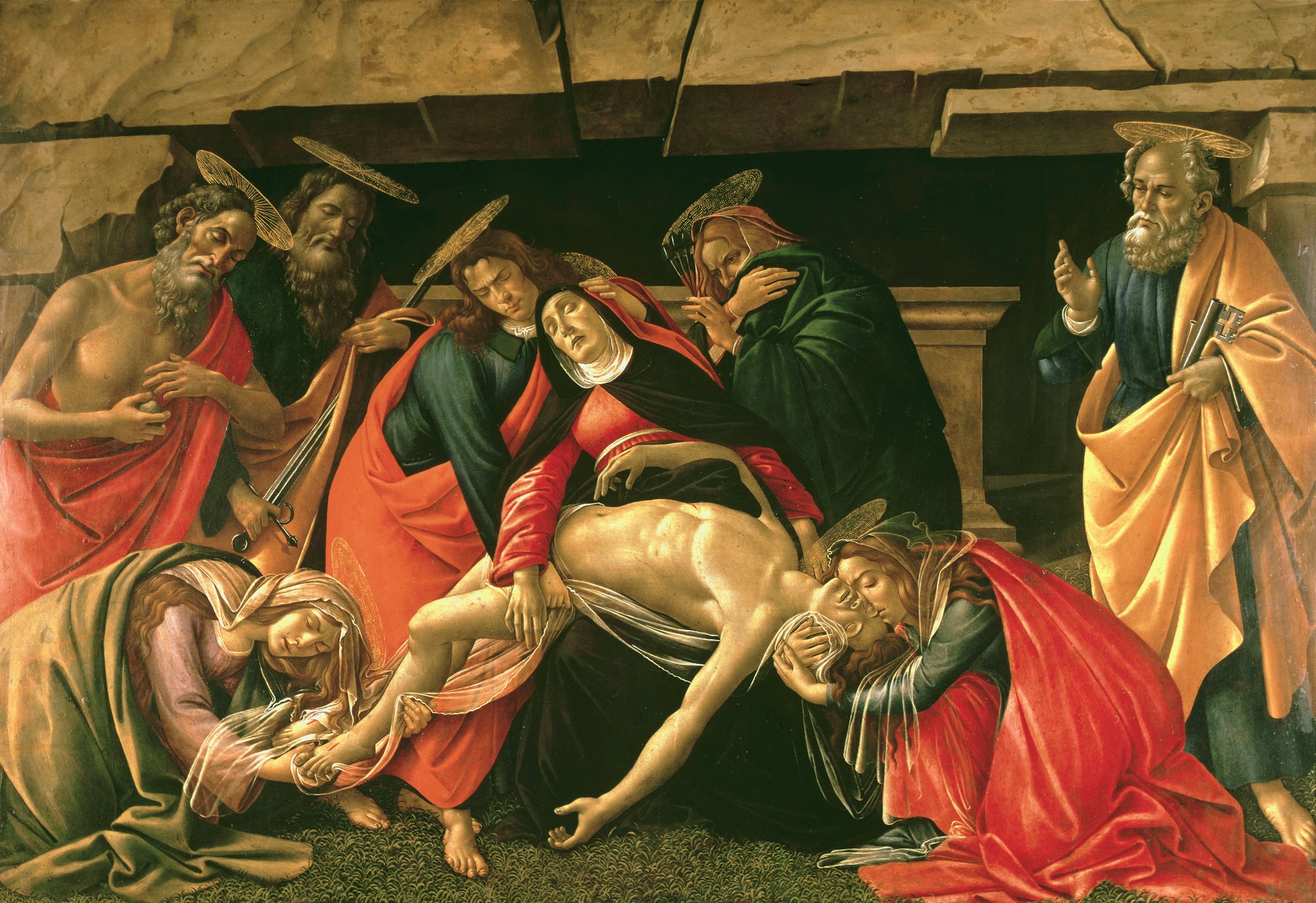
Now, thanks to a recent study led by chemical engineer Ophélie Ranquet of the Karlsruhe Institute of Technology, we have reason to believe that painters like Botticelli and Leonardo kept eggs in the mix deliberately. Oil replaced tempera because “it creates more vivid colors and smoother color transitions,” writes Smithsonian.com’s Teresa Nowakowski.
“It also dries slowly, so it can be used for longer after the initial preparation.” But “the colors darken more easily over time, and the paint is more susceptible to damage from light exposure. It also has a tendency to wrinkle as it dries,” visible in Leonardo’s Madonna of the Carnation below.
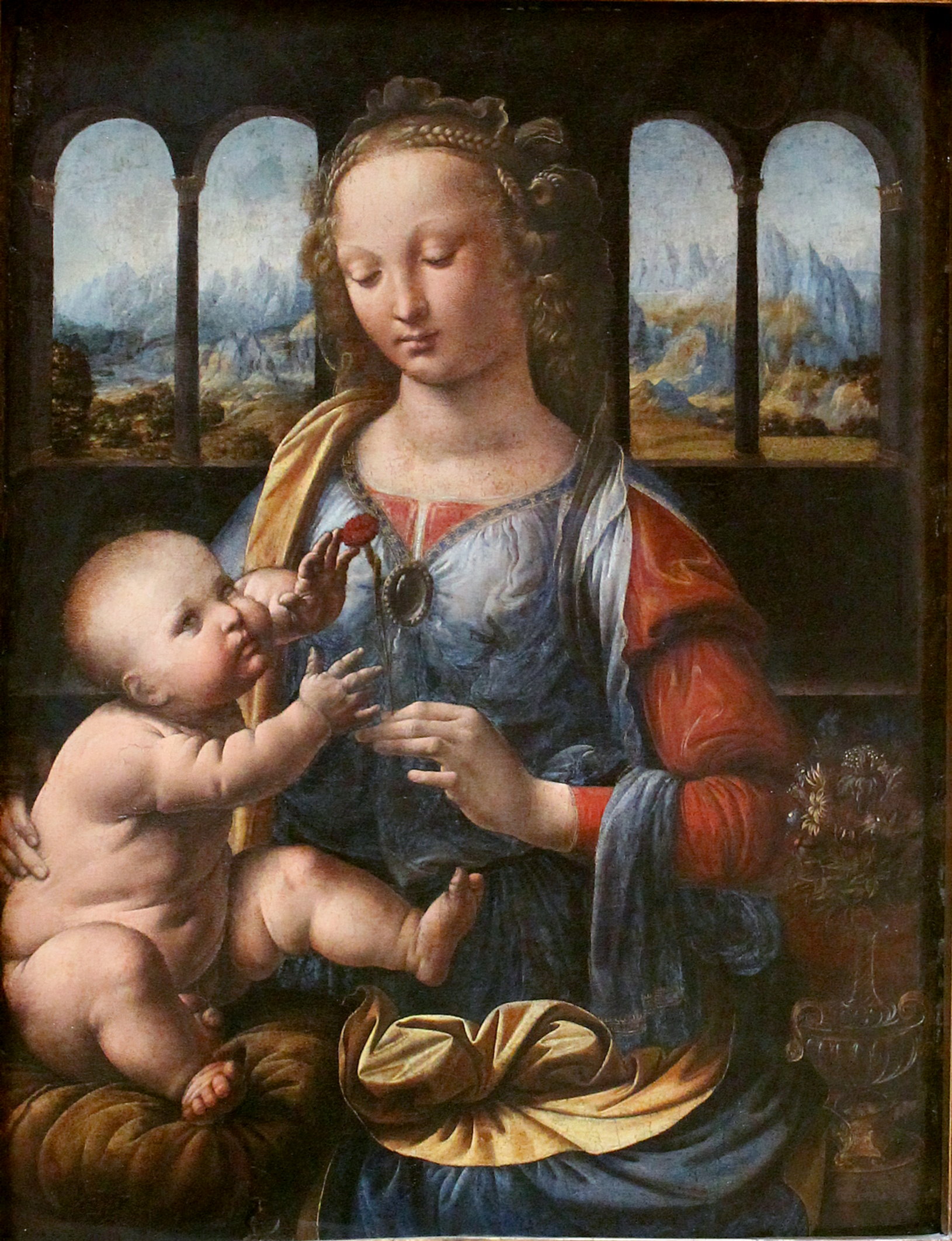
Putting in a bit of egg yolk may have been a way of using oil’s advantages while minimizing its disadvantages. Ranquet and her collaborators tested this idea by doing it themselves, re-creating two pigments used during the Renaissance, both with egg and without. “In the mayolike blend” produced by the former method, writes ScienceNews’ Jude Coleman, “the yolk created sturdy links between pigment particles, resulting in stiffer paint. Such consistency would have been ideal for techniques like impasto, a raised, thick style that adds texture to art. Egg additions also could have reduced wrinkling by creating a firmer paint consistency,” though the paint itself would take longer to dry.
In practice, Renaissance painters seem to have experimented with different proportions of oil and egg, and so discovered that each had its own strengths for rendering different elements of an image. Hyperallergic’s Taylor Michael writes that in The Lamentation Over the Dead Christ, seen up top, “Botticelli painted Christ, Mary Magdalene, and the Virgin, among others, with tempera, and the background stone and foregrounding grass with oil.” Thanks to the oxidization-slowing effects of phospholipids and antioxidants in the yolk — as scientific research has since proven — they’ve all come through the past five centuries looking hardly worse for wear.
Related content:
How Caravaggio Painted: A Re-Creation of the Great Master’s Process
A 900-Page Pre-Pantone Guide to Color from 1692: A Complete High-Resolution Digital Scan
Based in Seoul, Colin Marshall writes and broadcasts on cities, language, and culture. His projects include the Substack newsletter Books on Cities, the book The Stateless City: a Walk through 21st-Century Los Angeles and the video series The City in Cinema. Follow him on Twitter at @colinmarshall or on Facebook.
Read More...Urine Wheels in Medieval Manuscripts: Discover the Curious Diagnostic Tool Used by Medieval Doctors
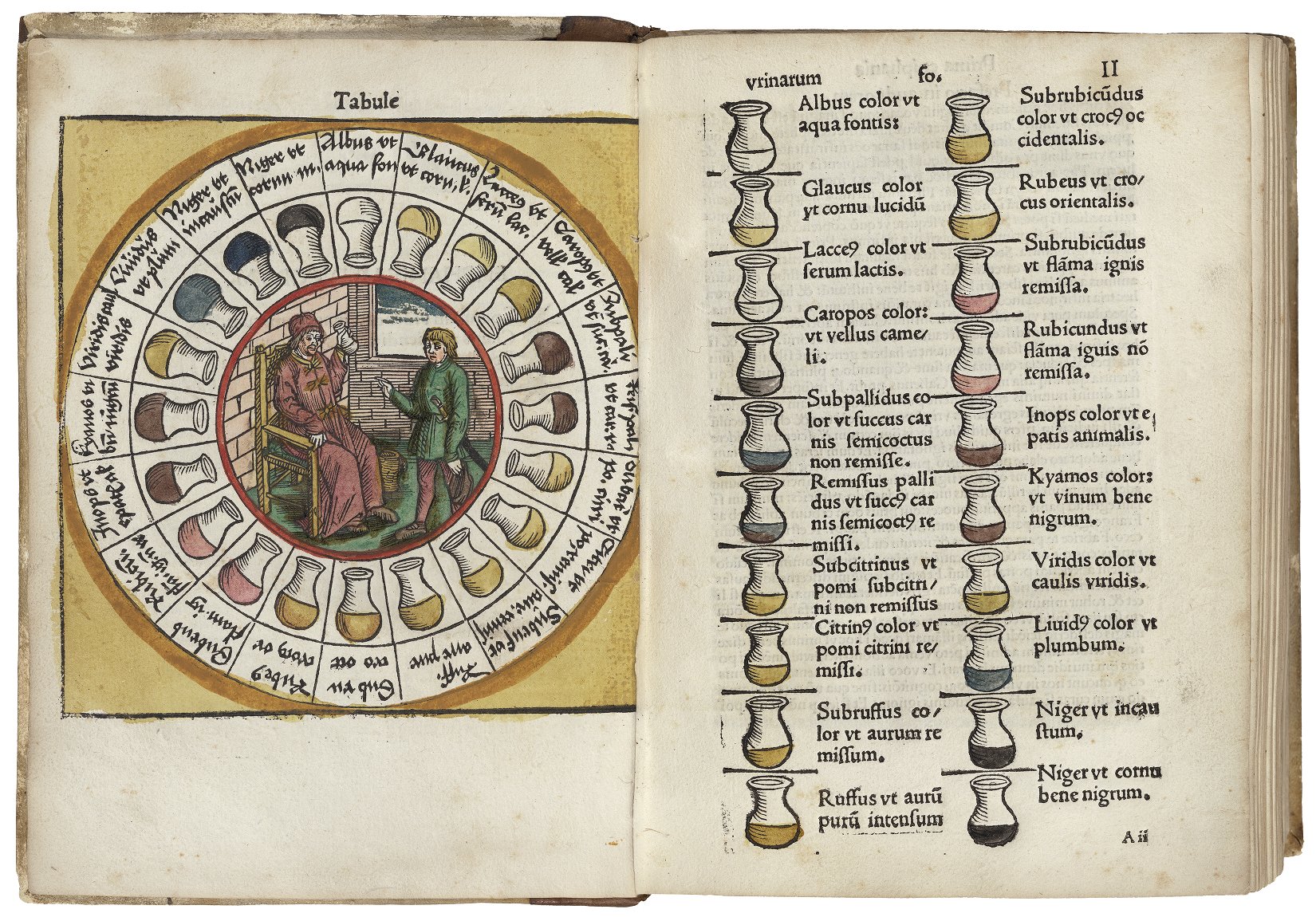
If you went to the doctor in late medieval Europe hoping to get a health complaint checked out, you could be sure of one thing: you’d have to hand over a urine sample. Though it dates back at least as far as the fourth millennium BC, the practice of uroscopy, as it’s called, seems to have been regarded as a near-universal diagnostic tool by the thirteenth century. At Medievalists.net, you can read excerpts of the then-definitive text On Urines, written about that time by French royal physician Gilles de Corbeil.
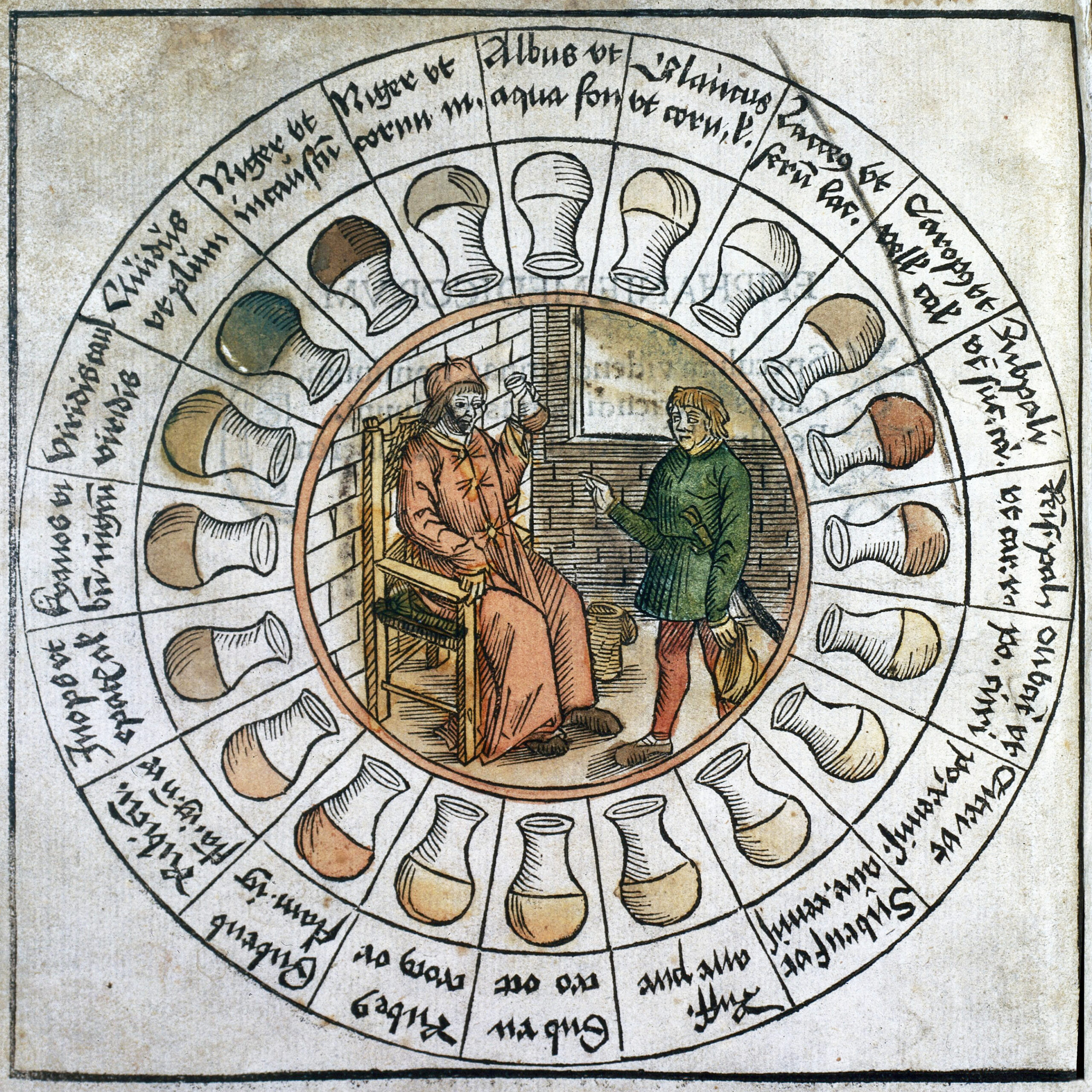
When a skilled physician examines a patient’s urine, de Corbeil explains, “health or illness, strength or debility, deficiency, excess, or balance, are determined with certainty.” Urine “darkened by a black cloudiness, and muddied with sediment, if produced on a critical day of an illness, and accompanied by poor hearing and insomnia, portends a flux of blood from the nose”; depending on other factors, “the patient will die or recover.”
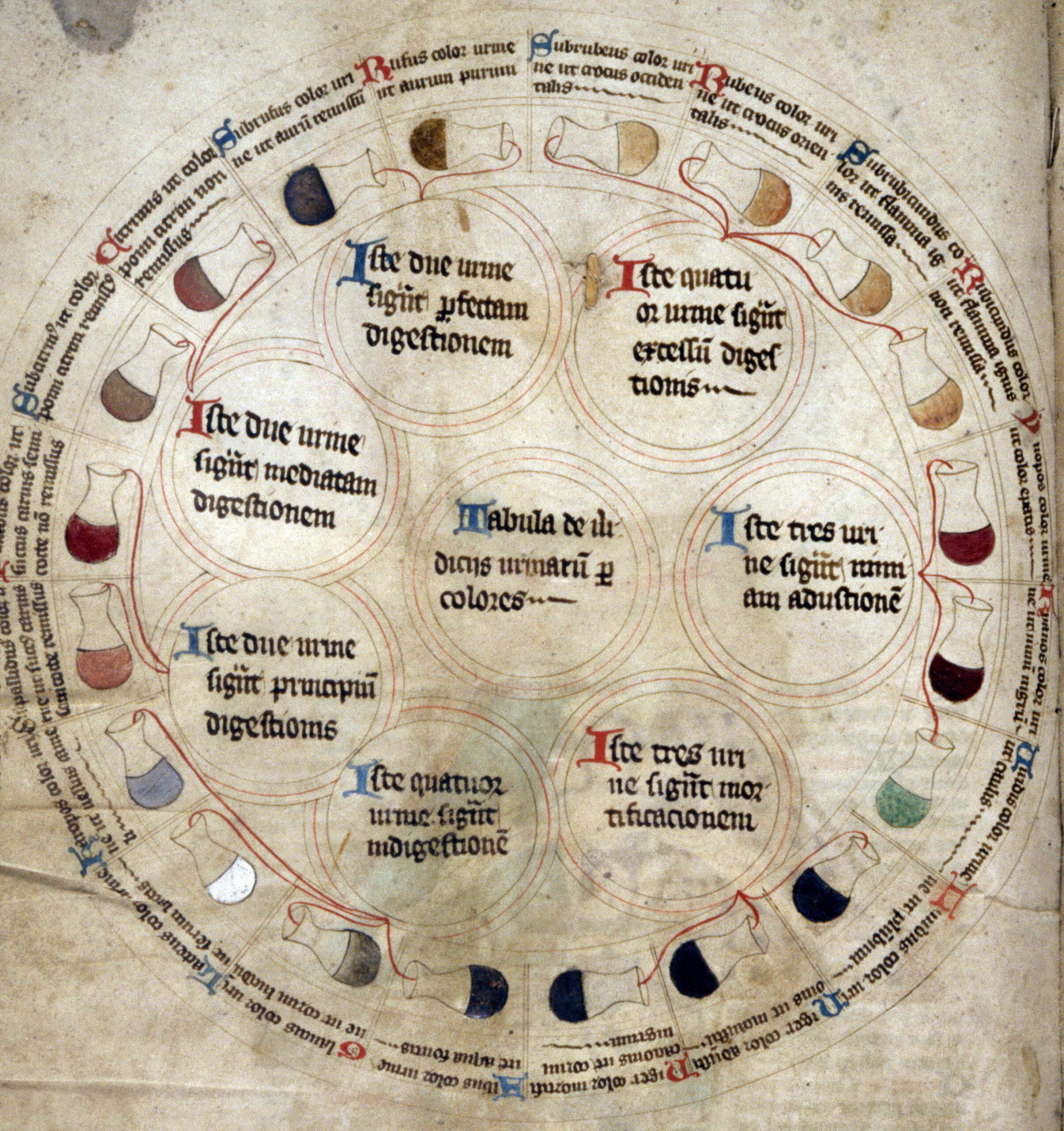
Urine that looks livid near the surface could indicate a variety of conditions: “a mild form of hemitriteus fever; falling sickness; ascites; synochal fever; the rupture of a vein; catarrh, strangury; an ailment of the womb; a flux; a defect of the lungs; pain in the joints; consumptive phithisis; the extinction of natural heat.”
White urine could be a signal of everything from dropsy to lipothymia to hemorrhoids; wine-colored urine “means danger to health when it accompanies a continued fever; it is less to be feared if there is no fever.”
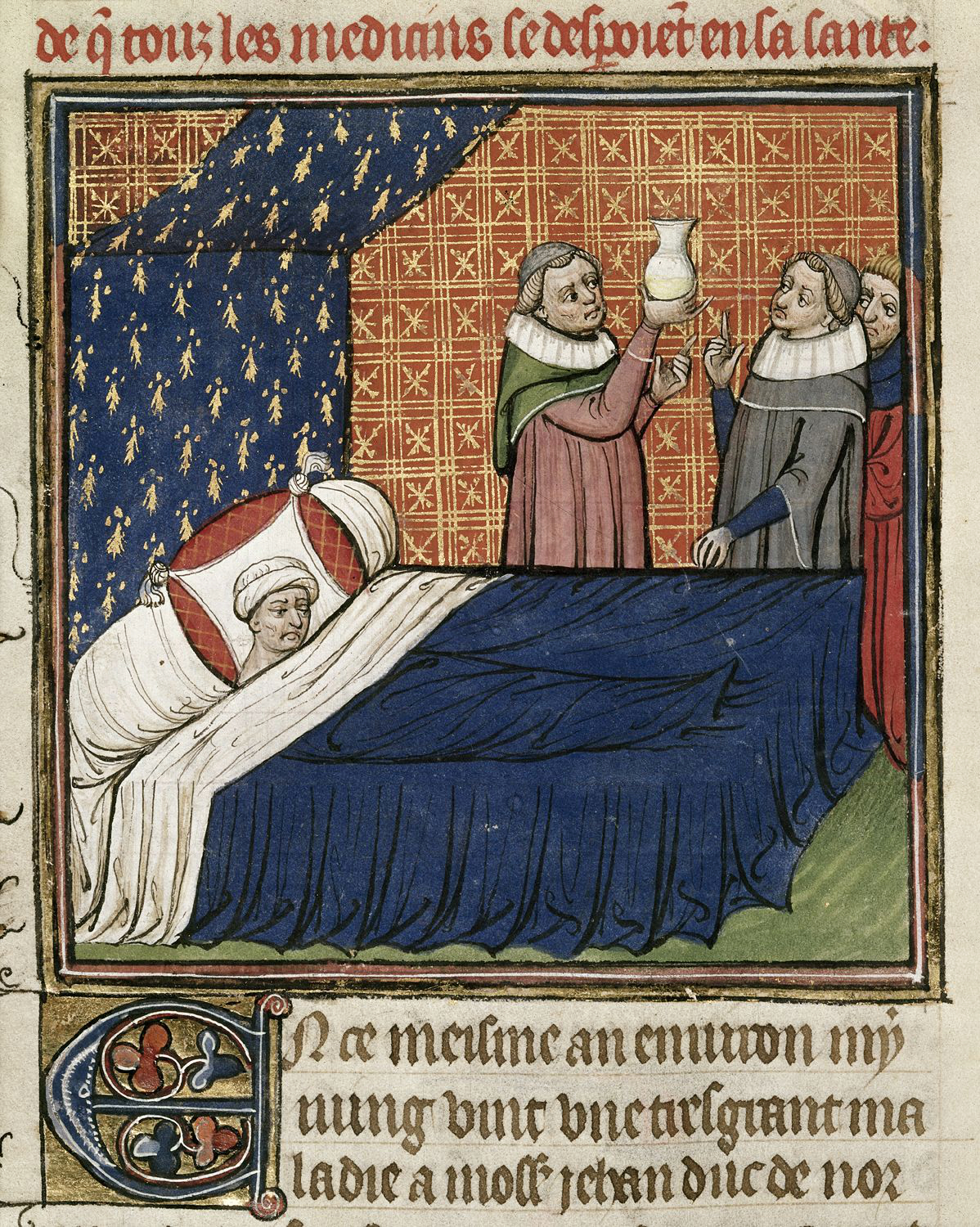
We may feel tempted, 800 years later, to discard all of this as pre-scientific nonsense. But compared with other diagnostic methods in the Middle Ages, uroscopy had a decent track record. “Urine was a particularly useful tool for diagnosing leprosy,” writes the Public Domain Review’s Katherine Harvey, “because the immediate physiological cause was thought to be a malfunctioning liver — an organ which was central to the digestive process, and thus any problems would be visible in the urine.” Indeed, “new forms of urine analysis have developed from these ancient traditions, and our present-day medical landscape is awash with urine samples.”
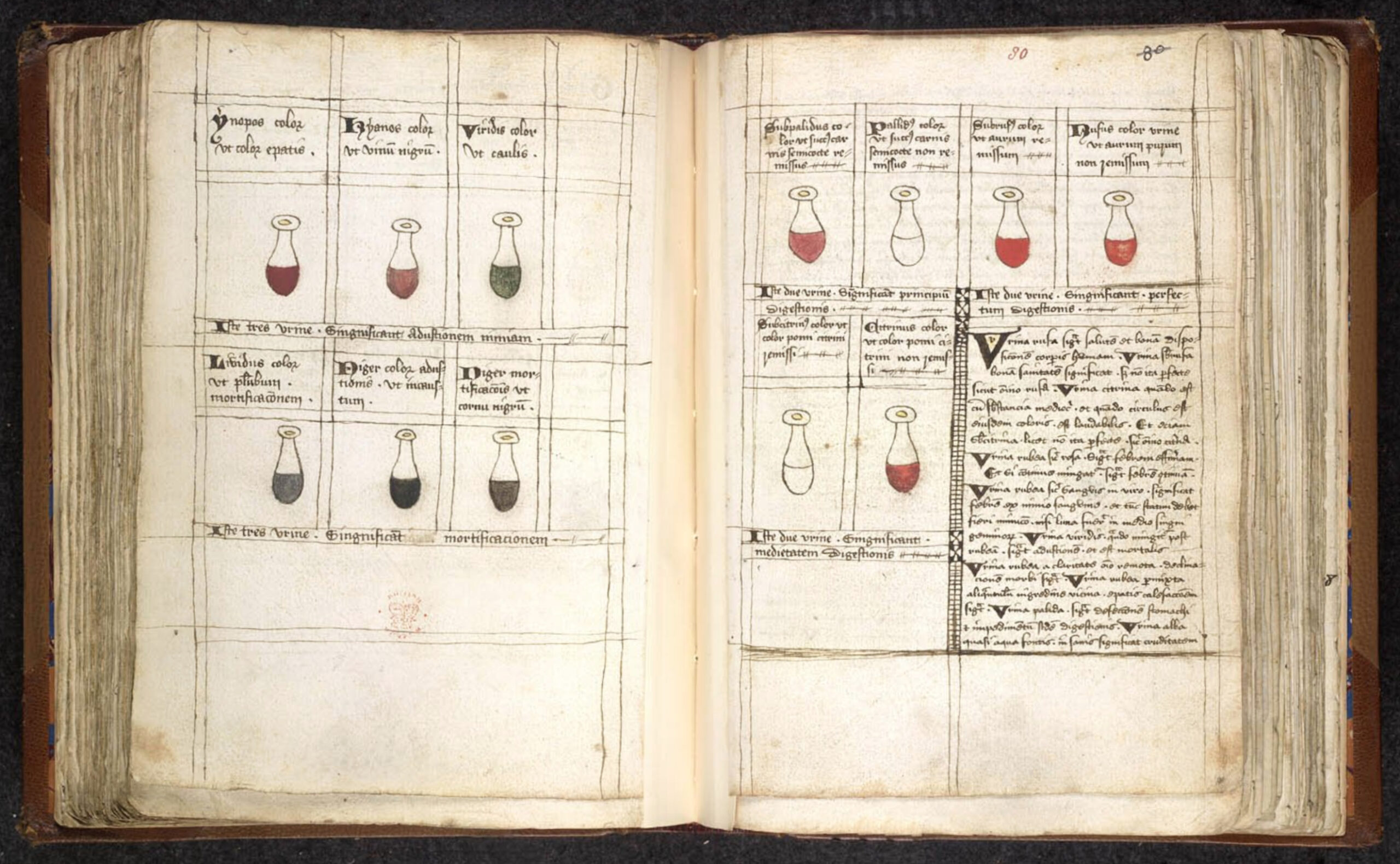
That’s certainly a vivid image, and so are the “urine wheels” that accompany Harvey’s piece: elaborate illustrations designed to help doctors identify the particular hue of a given sample, each one colored with the best pigmentation techniques of the time. But “there was no standardization,” notes Atlas Obscura’s Sarah Laskow, “and while some book publishers created detailed coloring instructions, the artisans who did the work didn’t always conform to those specifications.” As much prestige as these volumes surely exuded on the bookshelf, it was as true then as it is now that you become a good doctor not by reading manuals, but by getting your hands dirty.
Related content:
How the Brilliant Colors of Medieval Illuminated Manuscripts Were Made with Alchemy
1,000-Year-Old Illustrated Guide to the Medicinal Use of Plants Now Digitized & Put Online
Based in Seoul, Colin Marshall writes and broadcasts on cities, language, and culture. His projects include the Substack newsletter Books on Cities, the book The Stateless City: a Walk through 21st-Century Los Angeles and the video series The City in Cinema. Follow him on Twitter at @colinmarshall or on Facebook.
Read More...Support Us
We're hoping to rely on loyal readers, rather than erratic ads. Please click the Donate button and support Open Culture. You can use Paypal, Venmo, Patreon, even Crypto! We thank you!

About Us

Open Culture scours the web for the best educational media. We find the free courses and audio books you need, the language lessons & educational videos you want, and plenty of enlightenment in between.
Advertise With Us
FREE UPDATES!
GET OUR DAILY EMAIL
Get the best cultural and educational resources on the web curated for you in a daily email. We never spam. Unsubscribe at any time.
FOLLOW ON SOCIAL MEDIA
Open Culture editor Dan Colman scours the web for the best educational media. He finds the free courses and audio books you need, the language lessons & movies you want, and plenty of enlightenment in between.
Advertise With Us

