The Entire Archives of Radical Philosophy Go Online: Read Essays by Michel Foucault, Alain Badiou, Judith Butler & More (1972–2018)
On a seemingly daily basis, we see attacks against the intellectual culture of the academic humanities, which, since the 1960s, have opened up spaces for leftists to develop critical theories of all kinds. Attacks from supposedly liberal professors and centrist op-ed columnists, from well-funded conservative think tanks and white supremacists on college campus tours. All rail against the evils of feminism, post-modernism, and something called “neo-Marxism” with outsized agitation.
For students and professors, the onslaughts are exhausting, and not only because they have very real, often dangerous, consequences, but because they all attack the same straw men (or “straw people”) and refuse to engage with academic thought on its own terms. Rarely, in the exasperating proliferation of cranky, cherry-picked anti-academia op-eds do we encounter people actually reading and grappling with the ideas of their supposed ideological nemeses.
Were non-academic critics to take academic work seriously, they might notice that debates over “political correctness,” “thought policing,” “identity politics,” etc. have been going on for thirty years now, and among left intellectuals themselves. Contrary to what many seem to think, criticism of liberal ideology has not been banned in the academy. It is absolutely the case that the humanities have become increasingly hostile to irresponsible opinions that dehumanize people, like emergency room doctors become hostile to drunk driving. But it does not follow therefore that one cannot disagree with the establishment, as though the University system were still beholden to the Vatican.
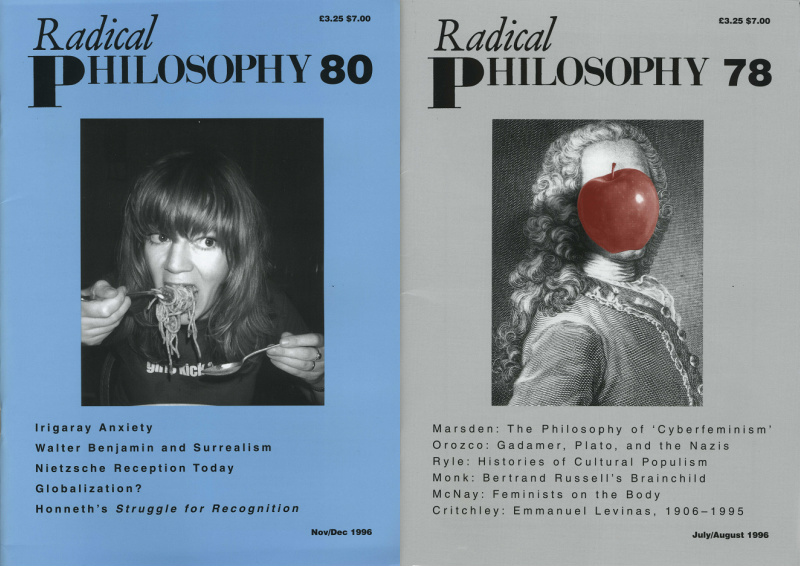
Understanding this requires work many people are unwilling to do, either because they’re busy and distracted or, perhaps more often, because they have other, bad faith agendas. Should one decide to survey the philosophical debates on the left, however, an excellent place to start would be Radical Philosophy, which describes itself as a “UK-based journal of socialist and feminist philosophy.” Founded in 1972, in response to “the widely-felt discontent with the sterility of academic philosophy at the time,” the journal was itself an act of protest against the culture of academia.
Radical Philosophy has published essays and interviews with nearly all of the big names in academic philosophy on the left—from Marxists, to post-structuralists, to post-colonialists, to phenomenologists, to critical theorists, to Lacanians, to queer theorists, to radical theologians, to the pragmatist Richard Rorty, who made arguments for national pride and made several critiques of critical theory as an illiberal enterprise. The full range of radical critical theory over the past 45 years appears here, as well as contrarian responses from philosophers on the left.
Rorty was hardly the only one in the journal’s pages to critique certain prominent trends. Sociologists Pierre Bourdieu and Loic Wacquant launched a 2001 protest against what they called “a strange Newspeak,” or “NewLiberalSpeak” that included words like “globalization,” “governance,” “employability,” “underclass,” “communitarianism,” “multiculturalism” and “their so-called postmodern cousins.” Bourdieu and Wacquant argued that this discourse obscures “the terms ‘capitalism,’ ‘class,’ ‘exploitation,’ ‘domination,’ and ‘inequality,’” as part of a “neoliberal revolution,” that intends to “remake the world by sweeping away the social and economic conquests of a century of social struggles.”
One can also find in the pages of Radical Philosophy philosopher Alain Badiou’s 2005 critique of “democratic materialism,” which he identifies as a “postmodernism” that “recognizes the objective existence of bodies alone. Who would ever speak today, other than to conform to a certain rhetoric? Of the separability of our immortal soul?” Badiou identifies the ideal of maximum tolerance as one that also, paradoxically, “guides us, irresistibly” to war. But he refuses to counter democratic materialism’s maxim that “there are only bodies and languages” with what he calls “its formal opposite… ‘aristocratic idealism.’” Instead, he adds the supplementary phrase, “except that there are truths.”
Badiou’s polemic includes an oblique swipe at Stalinism, a critique Michel Foucault makes in more depth in a 1975 interview, in which he approvingly cites phenomenologist Merleau-Ponty’s “argument against the Communism of the time… that it has destroyed the dialectic of individual and history—and hence the possibility of a humanistic society and individual freedom.” Foucault made a case for this “dialectical relationship” as that “in which the free and open human project consists.” In an interview two years later, he talks of prisons as institutions “no less perfect than school or barracks or hospital” for repressing and transforming individuals.
Foucault’s political philosophy inspired feminist and queer theorist Judith Butler, whose arguments inspired many of today’s gender theorists, and who is deeply concerned with questions of ethics, morality, and social responsibility. Her Adorno Prize Lecture, published in a 2012 issue, took up Theodor Adorno’s challenge of how it is possible to live a good life in bad circumstances (under fascism, for example)—a classical political question that she engages through the work of Orlando Patterson, Hannah Arendt, Ludwig Wittgenstein, and Hegel. Her lecture ends with a discussion of the ethical duty to actively resist and protest an intolerable status quo.
You can now read for free all of these essays and hundreds more at the Radical Philosophy archive, either on the site itself or in downloadable PDFs. The journal, run by an ‘Editorial Collective,” still appears three times a year. The most recent issue features an essay by Lars T. Lih on the Russian Revolution through the lens of Thomas Hobbes, a detailed historical account by Nathan Brown of the term “postmodern,” and its inapplicability to the present moment, and an essay by Jamila M.H. Mascat on the problem of Hegelian abstraction.
If nothing else, these essays and many others should upend facile notions of leftist academic philosophy as dominated by “postmodern” denials of truth, morality, freedom, and Enlightenment thought, as doctrinaire Stalinism, or little more than thought policing through dogmatic political correctness. For every argument in the pages of Radical Philosophy that might confirm certain readers’ biases, there are dozens more that will challenge their assumptions, bearing out Foucault’s observation that “philosophy cannot be an endless scrutiny of its own propositions.”
Enter the Radical Philosophy archive here.
Related Content:
Introducing Ergo, the New Open Philosophy Journal
History of Modern Philosophy: A Free Online Course
On the Power of Teaching Philosophy in Prisons
Josh Jones is a writer and musician based in Durham, NC. Follow him at @jdmagness
Read More...What Ancient Chinese Philosophy Can Teach Us About Living the Good Life Today: Lessons from Harvard’s Popular Professor, Michael Puett
It has at times been concerning for some Buddhist scholars and teachers to watch mindfulness become an integral part of self-help programs. A casual attitude toward the practice of mindfulness meditation can make it seem accessible by making it seem relaxing and effortless, which often results in missing the point entirely. Whatever the school, lineage, or particular tradition from which they come, the source texts and sages tend to agree: the purpose of meditation is not self improvement—but to realize that there may, indeed, be no such thing as a self.
Instead, we are all epiphenomenon arising from combinations of ever-shifting elements (the aggregates, or skandhas). The self is a conventionally useful illusion. This notion in the ancient Indian texts has its echo in Scottish enlightenment philosopher David Hume’s so-called “bundle theory,” but Hume’s thoughts about the self have mostly remained obscure footnotes in western thought, rather than central premises in its philosophies and religions. But as thinkers in India took the self apart, so too did philosophers in ancient China, before Buddhism reached the country during the Han Dynasty.
Harvard Professor Michael Puett has been lecturing on Chinese philosophy to audiences of hundreds of students—and at 21st century temples of self-actualization like TED and the School of Life. He has co-authored a book on the subject, The Path: What Chinese Philosophers Can Teach Us About the Good Life, drawn from his enormously popular university courses, in which he expounds the philosophies of Confucius, Mencius, Zhuangzi, and Xunzi. The book has found a ready audience, and Puett’s “Classical Chinese Ethical and Political Theory” is the 3rd most popular class among Harvard undergraduates, behind intro to economics and computer science. What Professor Puett offers, in his distillation of ancient Chinese wisdom, is not at all to be construed as self-help.
Rather, he says, “I think of it as sort of anti-self-help. Self-help tends to be about learning to love yourself and embrace yourself for who you are. A lot of these ideas are saying precisely the opposite—no, you overcome the self, you break the self. You should not be happy with who you are.” Lest this sound like some form of violence, we must understand, Puett tells Tim Dowling at The Guardian, that in “breaking” the self, we are only doing harm to an illusion. As in the Buddhist thought that took root in China, so too in the earlier Confucianism: there is no self, just a “a messy and potentially ugly bunch of stuff.”
While our current circumstances may seem unique in world history, Puett shows his students how Chinese philosophers 2,500 years ago also experienced rapid societal change and upheaval, as his co-author Christine Gross-Loh writes at The Atlantic; they navigated and understood “a world where human relationships are challenging, narcissism and self-centeredness are on the rise, and there is disagreement on the best way for people to live harmoniously together.” A majority of students at Harvard are driven to pursue “practical, predetermined” careers. By teaching them Confucian and Daoist philosophy, Puett tries to help them become more spontaneous and open to change.
Whatever we call it, the interacting phenomenon that give rise to the self cannot, we know, be observed in anything resembling an unchanging steady state. Yet Western culture (for several motivated reasons) has lagged far behind both intuitive and scientific observations of this fact. Puett’s students have been told, “’Find your true self, especially during these four years of college,’” and “try and be sincere and authentic to who you really are” in making choices about careers, partners, passions, and consumer products. They take to his class because “they’ve spent 20 years looking for this true self and not finding it.”
In the two lectures above—a shorter one at the top from TEDx Nashville and a longer talk above for Ivy, “The Social University”—you can get a taste of Puett’s enthusiastic style. Chinese philosophy, “in its strong form,” he says above, “can truly change one’s life.” Not by making us more empowered, personally-fulfilled agents who re-create reality to better meet our narrow specs. But rather, as he tells Dowling, by training us “to become incredibly good at dealing with this capricious world.”
Related Content:
An Introduction to Confucius’ Life & Thought Through Two Animated Videos
Josh Jones is a writer and musician based in Durham, NC. Follow him at @jdmagness
Read More...The History of Cartography, the “Most Ambitious Overview of Map Making Ever,” Is Now Free Online
Worth a quick mention: The University of Chicago Press has made available online — at no cost — the first three volumes of The History of Cartography. Or what Edward Rothstein, of The New York Times, called “the most ambitious overview of map making ever undertaken.” He continues:
People come to know the world the way they come to map it—through their perceptions of how its elements are connected and of how they should move among them. This is precisely what the series is attempting by situating the map at the heart of cultural life and revealing its relationship to society, science, and religion…. It is trying to define a new set of relationships between maps and the physical world that involve more than geometric correspondence. It is in essence a new map of human attempts to chart the world.
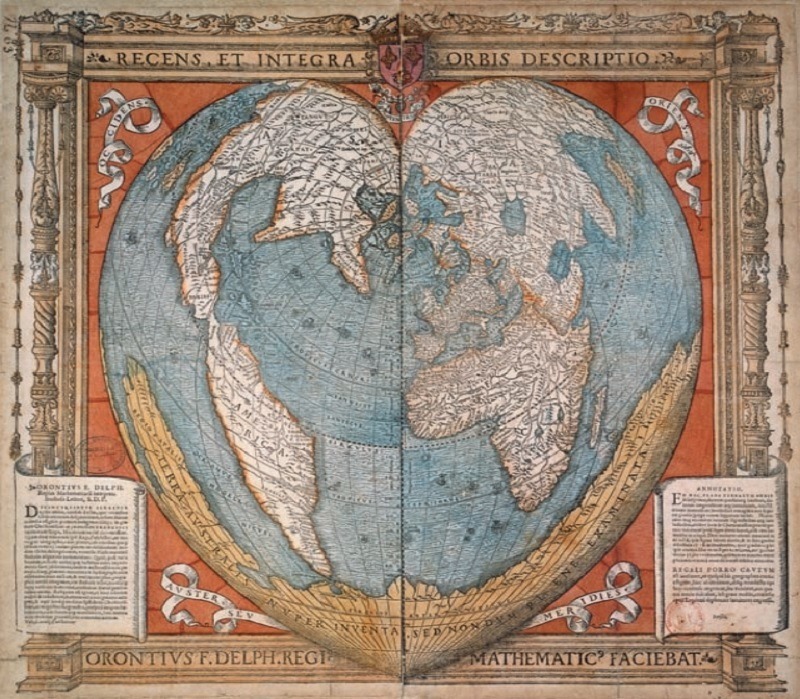
If you head over to this page, then look in the upper left, you will see links to three volumes (available in a free PDF format). My suggestion would be to look at the gallery of color illustrations for each book, links to which you’ll find below. The image above, appearing in Vol. 2, dates back to 1534. It was created by Oronce Fine, the first chair of mathematics in the Collège Royal (aka the Collège de France), and it features the world mapped in the shape of a heart. Pretty great.
Volume 1
Gallery of Color Illustrations
Volume 2: Part 1
Gallery of Color Illustrations (Plates 1–24)
Gallery of Color Illustrations (Plates 25–40)
Volume 2: Part 2
Gallery of Color Illustrations (Plates 1–16)
Gallery of Color Illustrations (Plates 17–40)
Volume 2: Part 3
Gallery of Color Illustrations (Plates 1–8)
Gallery of Color Illustrations (Plates 9 –24)
Volume 3: Part 1
Gallery of Color Illustrations (Plates 1–24)
Gallery of Color Illustrations (Plates 25–40)
Volume 3: Part 2
Gallery of Color Illustrations (Plates 41–56)
Gallery of Color Illustrations (Plates 57–80)
If you buy Vol 1. on Amazon, it will run you $248. As beautiful as the book probably is, you’ll probably appreciate this free digital offering. The series will be added to our collection, 800 Free eBooks for iPad, Kindle & Other Devices.
Note: An earlier version of this post appeared on our site in August, 2015.
If you would like to support the mission of Open Culture, consider making a donation to our site. It’s hard to rely 100% on ads, and your contributions will help us continue providing the best free cultural and educational materials to learners everywhere. You can contribute through PayPal, Patreon, and Venmo (@openculture). Thanks!
Related Content:
A Wonderful Scientific Map of the Moon from 1679: Can You Spot the Secret Moon Maiden?
Galileo’s Moon Drawings, the First Realistic Depictions of the Moon in History (1609–1610)
New York Public Library Puts 20,000 Hi-Res Maps Online & Makes Them Free to Download and Use
Read More...Google Digitizes and Puts Online a Vast Archive of Latino Artworks and Artifacts
You can’t understand human culture in the 21st century without understanding American culture, and as anyone who’s spent time in most any major U.S. city knows, you certainly can’t understand American culture without understanding Latino culture. I write this while traveling in Los Angeles, a city that makes that point with particularly impressive force, but just a few moments with an overview of Latino art will underscore the vitality it has provided America, and thus the world. You could do little better for such an overview than the Google Cultural Institute’s brand new Latino Cultures in the U.S. project, a sizable free digital archive of Latino art and artifacts of Latino history.
Forbes’ Veronica Villafañe quotes Google and Youtube Head of Hispanic Communications Jesús García as describing the archive as “a labor of love for many Googlers and partner institutions. It was a project that was more than a year in the making and took a small army to help digitize the 2,500 new artworks and curate 69 new exhibits.”
As a whole it offers “over 4,300 archives and artworks — including Diego Rivera murals — related to the Latino experience in the U.S., multimedia exhibits in English and Spanish and virtual tours of historic sites, as well as profiles of key Latino figures, such as Cesar Chavez, Dolores Huerta and Supreme Court Justice Sonia Sotomayor.”
Google Head of Latino Community Engagement Laura Marquez notes that it also allows you to “visit some of the most vibrant neighborhoods in the U.S. — the homes to and centers of Latino culture— by way of historic photographs or unmissable locations on Google Street View, all from your phone.” You’ll also find “ultra-high resolution images of iconic Latino murals, such as Diego Rivera’s Detroit Industry from the Detroit Institute of Arts.” Using the formidable exploratory platform of Google Earth, the project has also created a whole Latino Murals in the U.S. section, from Rivera’s work in Detroit to José Clemente Orozco’s Prometheus in California to the Miami Artisans’ Freedom Tower mural at Miami Dade College.
You can also browse the Latino Cultures in the U.S. Project’s offerings by form, including dance, film, music, and style. And though the designs of Oscar de la Renta, the songs of Gloria Estefan, the paintings of Frank Romero (and, of course, lowriders) have drawn the interest of many a non-Latino toward Latino culture, what has done quite so much outreach as the food? Google’s project even covers that territory with content like an editorial feature on “Fast Food, Tortillas, and the Art of Accepting Yourself” by Javier Cabral, a food critic based, and well known, in — where else? — Los Angeles.
Related Content:
Charles & Ray Eames’ Short Film on the Mexican Day of the Dead (1957)
Google Puts Online 10,000 Works of Street Art from Across the Globe
Google Lets You Take a 360-Degree Panoramic Tour of Street Art in Cities Across the World
Based in Seoul, Colin Marshall writes and broadcasts on cities and culture. His projects include the book The Stateless City: a Walk through 21st-Century Los Angeles and the video series The City in Cinema. Follow him on Twitter at @colinmarshall or on Facebook.
Read More...What the Map of the United States Would Look Like If All 50 States Had Equal Populations

In the U.S., recent electoral events with which we’re all quite familiar have prompted one particular radical re-evaluation of the political system, among many others: we find everyone from high-profile Constitutional scholars to anonymous commenters engaged in debates about the necessity, or democratic legitimacy, of the Electoral College. While the debate may not be new, it has reached an urgent intensity, and happens to occur at a time when everything seems up for grabs. When Neil Freeman proposed redrawing state borders on his presciently-named design site Fake is the New Real back in 2012, he created the map above (view it in a larger format here) to evenly distribute the country’s population. He did so with the disclaimer, “this is an art project, not a serious proposal.”
The idea might get a more serious reception these days. Nonetheless, the inertia of tradition hasn’t lessened any. Not only is it totally unlikely that states would ever be redrawn and renamed, but the Electoral College is also a founding institution, emerging at the first Constitutional Convention when James Madison first proposed it in 1787. Since then, PBS’s Kamala Kelkar wrote on November 6th, 2016, “the Electoral College system has cost four candidates the race after they received the popular vote.” Two days later that number went up to five.
Still, whether one deems it necessary, superfluous, or deeply pernicious, it’s hardly controversial to note that this electing body comes from an era so unlike our own as to be unrecognizable. A time when, as some founders argued, writes Akhil Reed Amar at Time, “ordinary Americans across a vast continent [lacked] sufficient information to choose directly and intelligently among leading presidential candidates.” This might still be the case for various reasons. But putting aside manufactured filter bubbles and vast disinformation campaigns, most Americans now have instant access, if they want it, to more information than they know what to do with.
When we look at the primary sources, we find the actual reason for the Electoral College: slavery. Madison, notes Kelkar, “now known as the ‘Father of the Constitution,’” was a slaveholding Virginian who worried vocally that Northern states would have a decided advantage, since upwards of 40% of the population in Southern states consisted of enslaved people, who, of course, would not be casting votes. Madison’s proposition included the infamous and dehumanizing “three-fifths compromise,” which historian Paul Finkelman argues enabled Thomas Jefferson to win over John Adams in 1800.
Despite this history, most people are taught that the system arose solely to “balance the interests,” Amar writes, “of high-population and low-population states.” This sounds like a politically neutral intention. But Freeman doesn’t question the legitimacy of the Electoral College, calling it “a time-honored, logical system” that he thinks should be preserved. And yet, he writes, “it’s obvious that reforms are needed.”
“The fundamental problem of the electoral college,” Freeman writes, “is that the states of the United States are too disparate in size and influence. The largest state is 66 times as populous as the smallest and has 18 times as many electoral votes. This increases the chance for Electoral College results that don’t match the popular vote.” This is hardly the only issue. But is Freeman’s proposal a more stable solution to major flaws in U.S. national elections than simply scrapping the Electoral College altogether? He makes the following argument, in a series of bullet-pointed advantages. His map:
- Preserves the historic structure and function of the Electoral College.
- Ends the over-representation of small states and under-representation of large states in presidential voting and in the US Senate by eliminating small and large states.
- Political boundaries more closely follow economic patterns, since many states are more centered on one or two metro areas.
- Ends varying representation in the House. Currently, the population of House districts ranges from 528,000 to 924,000. After this reform, every House seat would represent districts of the same size. (Since the current size of the House isn’t divisible by 50, the numbers of seats should be increased to 450 or 500.)
- States could be redistricted after each census — just like House seats are distributed now.
Freeman based the map–featuring new states like “Mesabi,” “Ogallala,” “Big Thicket,” “Chinati,” and “King”–on data from the 2010 Census, which, incidentally, actually did change the distribution of electors in 2012. The Census “records a population of 308,745,538 for the United States,” he notes, “which this map divides into 50 states, each with a population of about 6,175,000.”
He does seem to downplay the disadvantages, listing only two concerns about duplicated county names and a “shift in state laws and procedures.” Freeman doesn’t mention the high likelihood of civil war or widespread social unrest if such a massive redistribution of the country’s state populations were ever attempted. Given the examples of pitched legal battle fought daily over congressional redistricting of gerrymandered states, it’s also probable nothing like this plan would ever make it through the courts. Considered as an “art project” or thought experiment in civics, however, who knows? It just might work….
via Mental Floss
Related Content:
Sal Khan & the Muppets’ Grover Explain the Electoral College
Josh Jones is a writer and musician based in Durham, NC. Follow him at @jdmagness
Read More...Ditching the Lecture Hall for the Recording Studio: One Historian Is Using the Power of Podcasting to Inspire a Whole New Audience
History is dying at U.S. colleges and universities. Enrollment in undergraduate history courses is way down since 2010, and the number of history degrees awarded annually has likewise been falling faster and faster. The most recent data show a 9% nationwide drop in history degrees awarded in 2014 compared to 2013, with an even sharper 13% decline at the nation’s top universities, including Yale, Harvard, and Stanford. (1,2,3,4) So, is history just getting old?
On the contrary. At least outside of academia, history has never been more popular. Cultural icons including Barack Obama and Bill Gates have cited history books such as Yuval Noah Harari’s Sapiens: A Brief History of Mankind and Steven Pinker’s Enlightenment Now: The Case for Reason, Science, Humanism and Progress as among their favorite books of all time. The History Channel has enjoyed a resurgence in viewership since 2013, and judging by the reception of more epic productions, from Steven Spielberg’s Oscar-winning movie Lincoln in 2012 to Lin-Manuel Miranda’s smash hit musical Hamilton in 2015, it’s clear that public hunger for history is only growing. What, then, accounts for lackluster lecture hall attendance?
“Part of the problem is that much of academic history has become too esoteric,” says podcaster Brad Harris, who holds a PhD from Stanford in the history of science and technology. “Course content has been shifting away from big ideas like the rise of modern science and democracy to narrower studies of things like the politics of emotion and cultural constructions, which many students find less relevant to their interests.” Moreover, Harris contends that college history courses have never been more cynical. “Too many professors dwell on what humanity has done wrong–who we’ve oppressed, what we’ve destroyed–and not enough on what humanity has done right–who we’ve liberated, what we’ve invented. Where’s the inspiration? It’s no wonder people are ditching history lectures.” And now, so has Brad Harris.
Since leaving academia in 2015, Harris has been working full-time to offer an attractive alternative for people who want to learn history, providing content that is as informative as a college lecture but as entertaining as a cinematic production: a podcast called How It Began: A History of the Modern World. Available everywhere podcasts are found, and also from his website, howitbegan.com, How It Began interprets a broad array of the most important scientific, technological, and cultural advancements in history, from dog domestication to the Scientific Revolution. Here is an excerpt from the show’s introductory episode:
In each episode, we will fly through the centuries to follow the seeds of an innovation or discovery as it blossoms into one of the many fruits of modernity. Far from a catalog of dead men and dates, How It Began offers a cinematic-like immersion into the stories behind some of our species’ greatest achievements. The overall theme? Celebration! We are fortunate to be descended from men and women who dared to dream big and even die for the cause of progress. Their work is unfinished, and some parts of modernity are even worse than before. But most are better, much better. And we have more tools than ever to fix what’s still broken.
Brad Harris hopes his show’s focus on modern progress will captivate people who crave more inspiring explorations of history, and judging by How It Began’s reception so far, he seems well on his way to achieving exactly that.
Episodes are between 30 and 60 minutes long and released every month or so. The podcast explores a wide range of topics, from the rise of modern surgery and computers to the development of the English language and the theory of evolution. “Wolves to Dogs: The Origin of our Alliance” was one of the most popular episodes of Season One. In a more recent episode, Harris reveals the surprising correlations between the spread of coffee consumption and the establishment of modern institutions:
This is a guest post by Morgan Stewart, an educational consultant and founder of Within Reach Educational Consultants.
Read More...Is Charles Bukowski a Self-Help Guru? Hear Five of His Brutally Honest, Yet Oddly Inspiring, Poems and Decide for Yourself
I don’t know if he’s been replaced as a major influence on young, restless (and almost exclusively male) aspiring writers, but once upon a time—if you weren’t into the romantic wanderlust of Kerouac but still considered yourself a fringe character—it might be to the hard-boiled shit-talking of wise old man Charles Bukowski that you turned. Upon first learning this, and being a busy college student, I decided to take a crash course and checked out a documentary.
I did not find myself charmed all at once. But one can fall in love with an author’s persona yet loathe them on the page. Bukowski’s crudeness and bad humor on film could not hide the deep wells of sadness in which he seemed to swim, as if—like some ancient cynic philosopher—he knew something profound and terrible and spared us the telling of it by posing as a drunken, half-mad street-corner raconteur. I had to go and read him.
In his idiom—that of an eloquent streetwise barfly—Bukowski can be every bit as passionate and profound as his hero Dostoevsky. His unforgettable mixing of comic seediness and casual abuse with a deeply tragic mourning over the human condition, while not to everyone’s taste, make his decades-long struggle out of penury and obscurity a feat worthy of the telling in his semi-autobiographical prose and poetry.
But does it make him a role model? For anyone but certain young, mostly male, aspiring writers maybe spending more time drinking than writing, that is?
A fair number of people seem to think so, and I leave it to you to decide, first by listening to the Bukowski poems read here, posted on YouTube with heavy, inspirational background music. Some are given new titles to sound more like self-help seminars—such as “Reinvent Your Life” at the top (originally “No Leaders, Please”). The video reading called “Go all the way,” second from top, changes the title of “Roll the Dice,” a classic picture of Bukowski’s uncompromising commitment to “going all the way,” even if it means “freezing on a park bench” and “losing girlfriends, wives, relatives, jobs and maybe your mind.”
Solidly middle-class parents might approve of the first poem’s sentiments, which could be wedged into a suitably vague, yet bold-sounding commencement speech or a job recruiter’s pep talk. But “Roll the Dice” simply goes too far. “It could mean jail, it could mean derision, mockery, isolation”? This won’t do at all. Hear another reading of “Roll the Dice” by inspirational rock star Bono further up, just after the more Bukowski-like Tom Waits reads “The Laughing Heart,” frequently referenced for its intensity of feeling. Like Thomas Hardy or Leonard Cohen, the bard of the barstools could look life straight in the eye, see all of its bleakness and violence, and still manage at times to catch a divine glimmer.
And for the many aspirants to whom Bukowski has appealed, we have, further up, “So, You Want to Be a Writer?” Before you hear, or read, this poem, be advised: these are not warm words of encouragement or helpful life-coaching in verse. It is the kind of raw talk no respectable writing teacher will give you, and maybe they’re right not to, who’s to say? Except a man who went all the way, froze on park benches, went to jail, lost girlfriends, wives, relatives, jobs and maybe his mind? Read an excerpt of Bukowski’s writing advice below, and just above, hear the author himself read “Friendly Advice to a Lot of Young Men,” which urges them to do virtually anything they like, “But don’t write poetry.”
don’t be like so many writers,
don’t be like so many thousands of
people who call themselves writers,
don’t be dull and boring and
pretentious, don’t be consumed with self-
love.
the libraries of the world have
yawned themselves to
sleep
over your kind.
don’t add to that.
don’t do it.
unless it comes out of
your soul like a rocket,
unless being still would
drive you to madness or
suicide or murder,
don’t do it.
unless the sun inside you is
burning your gut,
don’t do it.
Related Content:
Harry Dean Stanton (RIP) Reads Poems by Charles Bukowski
Charles Bukowski Reads His Poem “The Secret of My Endurance”
Josh Jones is a writer and musician based in Durham, NC. Follow him at @jdmagness
Read More...Tim Minchin Presents “9 Rules to Live By” in a Funny and Wise Commencement Speech (2013)
Tim Minchin isn’t much of a role model in the hair brushing department, but in every other way the prolific comedian/actor/writer/musician/director inspires.
He’s unabashedly enthusiastic about science, a lifelong learner who’s a strong believer in the power of exercise, travel, and thank you notes….
He uses his stardom and talent for penning controversial lyrics to raise awareness and money for such causes as the UK’s National Autistic Society and a local charity formed to send adults who, as children, were sexually abused by Catholic clergy, to Rome.
His creative output is prodigious.
And he’s one helluva commencement speaker.
In 2013, his alma mater, the University of Western Australia, awarded him an Honorary Degree of Doctor of Letters and invited him to address the graduating class.
The speaker insisted up front that an “inflated sense of self importance” born of addressing large crowds was the only thing that positioned him to give such an address, then went on to share a funny 9‑point guide to life that stressed the importance of gratitude, education, intellectual rigor, and kindness toward others.
If you haven’t the time to watch the entire 12-minute speech, above, be sure to circle back later. His advice is hilarious, heartwarming, and memorable.
In extrapolating the essence of each of his nine “life lessons” below, we discovered many bonus lessons contained therein (one of which we include below.)
Tim Minchin’s 9 Rules To Live By
- You don’t have to have a dream. Be micro-ambitious and see what happens as you pursue short-term goals…
- Rather than chasing happiness for yourself, keep busy and aim to make someone else happy.
- Remember that we are lucky to be here, and that most of us — especially those of us with a college education, or those actively seeking to educate themselves to a similar degree—will achieve a level of wealth that “most humans throughout history could not have dreamed of.”
- Exercise. Among other things, it helps combat depression.
- Identify your biases, prejudices, and privileges and do not exempt your own beliefs and opinions from intellectual rigor.
- Be a teacher! Swell the ranks of this noble profession.
- Define yourself by what you love, rather than what you despise, and lavish praise on the people and things that move you.
- Respect those with less power than yourself, and be wary of those who do not.
- Don’t be in a rush to succeed. It might come at a cost.
BONUS. Uphold the notion that art and science are not an either/or choice, but rather compliment each other. “If you need proof—Twain, Douglas Adams, Vonnegut, McEwan, Sagan and Shakespeare, Dickens for a start. …The arts and sciences need to work together to improve how knowledge is communicated. “
Read the full transcript of Minchin’s commencement speech here.
Related Content:
NPR Launches Database of Best Commencement Speeches Ever
David Lynch Gives Unconventional Advice to Graduates in an Unusual Commencement Address
Jon Stewart’s William & Mary Commencement Address: The Entire World is an Elective
Ayun Halliday is an author, illustrator, theater maker and Chief Primatologist of the East Village Inky zine. Follow her @AyunHalliday.
Read More...The Science of Well-Being: Take a Free Online Version of Yale University’s Most Popular Course
Don’t listen to people who tell you they’ve found the one true path to happiness — but do listen to people who seem seriously in search of it. One such person, Yale psychology and cognitive science professor Laurie Santos, teaches a whole course on the subject: Psych 157, also known as “Psychology and the Good Life.” And even though college students are living the best time of their lives — or so the culture keeps insisting to them — enough of them desire its insights to make it the most popular class at the university, with more than 1,180 students currently enrolled.
“The course focuses both on positive psychology — the characteristics that allow humans to flourish, according to Dr. Santos — and behavioral change, or how to live by those lessons in real life,” writes The New York Times’ David Shimer. “Students must take quizzes, complete a midterm exam and, as their final assessment, conduct what Dr. Santos calls a ‘Hack Yo’Self Project,’ a personal self-improvement project.” The body of knowledge underlying it all is hardly obvious: “Scientists didn’t realize this in the same way 10 or so years ago, that our intuitions about what will make us happy, like winning the lottery and getting a good grade — are totally wrong,” the article quotes Santos as saying.
So what, according to the up-to-date research of Santos and others, does make us happy? Now, you don’t need to go Yale to find out: you can simply take “The Science of Well-Being,” the new online version of Santos’ course, on Coursera. “The first half of the course reveals misconceptions we have about happiness and the annoying features of the mind that lead us to think the way we do,” says its description. “The second half of the course focuses on activities that have been proven to increase happiness along with strategies to build better habits.”
Now open for enrollment, “The Science of Well-Being” can be taken any time, and its number of students certainly won’t be limited by the capacity of Woolsey Hall. If you’d like to get a sense of the learning experience on offer, have a look at the course’s trailer above, in which Santos explains the origin and development of the course, which began in her own home and now, with a potentially worldwide audience, uses not just the latest science but a specially developed app to help its students develop the elements of their own good life. Will you finish the course perfectly happy? She doesn’t promise that, but nobody ever lost their way to happiness by knowing a bit about it.
Enroll in “The Science of Well-Being” here. And if there’s any confusion, select the “Audit” option to take the course for free.
Related Content:
Free Online Psychology & Neuroscience Courses, a subset of our collection, 1,700 Free Online Courses from Top Universities
What Are the Keys to Happiness? Lessons from a 75-Year-Long Harvard Study
A Guide to Happiness: Alain de Botton Shows How Six Great Philosophers Can Change Your Life
The Keys to Happiness: The Emerging Science and the Upcoming MOOC by Raj Raghunathan
Based in Seoul, Colin Marshall writes and broadcasts on cities and culture. His projects include the book The Stateless City: a Walk through 21st-Century Los Angeles and the video series The City in Cinema. Follow him on Twitter at @colinmarshall or on Facebook.
Read More...The 25 Principles for Adult Behavior: John Perry Barlow (R.I.P.) Creates a List of Wise Rules to Live By
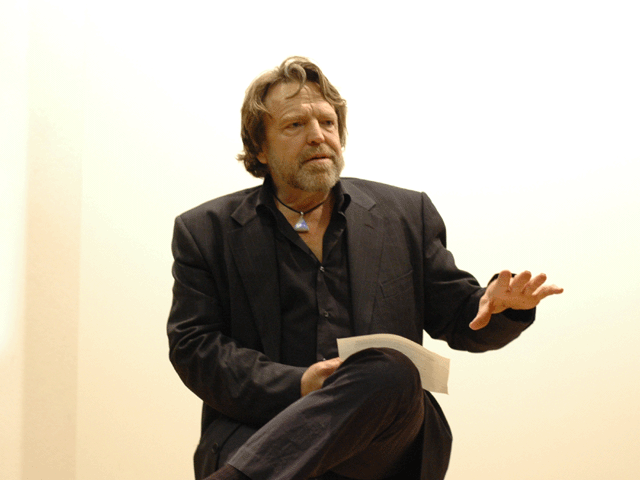
Image by the European Graduate School, via Wikimedia Commons
The most successful outlaws live by a code, and in many ways John Perry Barlow, founder of the Electronic Freedom Foundation, Wyoming rancher, and erstwhile songwriter for the Grateful Dead—who died on Wednesday at the age of 70—was an archetypal American outlaw all of his life. He might have worn a white hat, so to speak, but he had no use for the government telling him what to do. And his charismatic defense of unfettered internet liberty inspired a new generation of hackers and activists, including a 12-year-old Aaron Swartz, who saw Barlow speak at his middle school and left the classroom changed.
Few people get to leave as lasting a legacy as Barlow, even had he not pioneered early cyberculture, penning the “Declaration of Independence of the Internet,” a techo-utopian document that continues to influence proponents of open access and free information. He introduced the Grateful Dead to Dr. Timothy Leary, under whose guidance Barlow began experimenting with LSD in college. His creative and personal relationship with the Dead’s Bob Weir stretches back to their high school days in Colorado, and he became an unofficial member of the band and its “junior lyricist,” as he put it (after Robert Hunter).
“John had a way of taking life’s most difficult things and framing them as challenges, therefore adventures,” wrote Weir in a succinctly poignant Twitter eulogy for his friend. We might think of Barlow’s code, which he laid out in a list he called the “25 Principles of Adult Behavior,” as a series of instructions for turning life’s difficulties into challenges, an adventurous reframing of what it means to grow up. For Barlow, that meant defying authority when it imposed arbitrary barriers and proprietary rules on the once-wild-open spaces of the internet.
But being a grown-up also meant accepting full responsibility for one’s behavior, life’s purpose, and the ethical treatment of oneself and others. See his list below, notable not so much for its originality but for its plainspoken reminder of the simple, shared wisdom that gets drowned in the assaultive noise of modern life. Such uncomplicated idealism was at the center of Perry’s life and work.
1. Be patient. No matter what.
2. Don’t badmouth: Assign responsibility, not blame. Say nothing of another you wouldn’t say to him.
3. Never assume the motives of others are, to them, less noble than yours are to you.
4. Expand your sense of the possible.
5. Don’t trouble yourself with matters you truly cannot change.
6. Expect no more of anyone than you can deliver yourself.
7. Tolerate ambiguity.
8. Laugh at yourself frequently.
9. Concern yourself with what is right rather than who is right.
10. Never forget that, no matter how certain, you might be wrong.
11. Give up blood sports.
12. Remember that your life belongs to others as well. Don’t risk it frivolously.
13. Never lie to anyone for any reason. (Lies of omission are sometimes exempt.)
14. Learn the needs of those around you and respect them.
15. Avoid the pursuit of happiness. Seek to define your mission and pursue that.
16. Reduce your use of the first personal pronoun.
17. Praise at least as often as you disparage.
18. Admit your errors freely and soon.
19. Become less suspicious of joy.
20. Understand humility.
21. Remember that love forgives everything.
22. Foster dignity.
23. Live memorably.
24. Love yourself.
25. Endure.
Barlow the “cowboy, poet, romantic, family man, philosopher, and ultimately, the bard of the digital revolution”—as Stephen Levy describes him at Wired—“became a great explainer” of the possibilities inherent in new media. He watched the internet become a far darker place than it had ever been in the 90s, a place where governments conduct cyberwars and impose censorship and barriers to access; where bad actors of all kinds manipulate, threaten, and intimidate.
But Barlow stood by his vision, of “a world that all may enter without privilege or prejudice accorded by race, economic power, military force, or station of birth… a world where anyone, anywhere may express his or her beliefs, no matter how singular, without fear of being coerced into silence or conformity.”
This may sound naïve, yet as Cindy Cohn writes in EFF’s obituary for its founder, Barlow “knew that new technology could create and empower evil as much as it could create and empower good. He made a conscious decision to move toward the latter.” His 25-point code urges us to do the same.
via Kottke/Hacker News
Related Content:
Alejandro Jodorowsky’s 82 Commandments For Living
Josh Jones is a writer and musician based in Durham, NC. Follow him at @jdmagness
Read More...Support Us
We're hoping to rely on loyal readers, rather than erratic ads. Please click the Donate button and support Open Culture. You can use Paypal, Venmo, Patreon, even Crypto! We thank you!

About Us

Open Culture scours the web for the best educational media. We find the free courses and audio books you need, the language lessons & educational videos you want, and plenty of enlightenment in between.
Advertise With Us
FREE UPDATES!
GET OUR DAILY EMAIL
Get the best cultural and educational resources on the web curated for you in a daily email. We never spam. Unsubscribe at any time.
FOLLOW ON SOCIAL MEDIA
Open Culture editor Dan Colman scours the web for the best educational media. He finds the free courses and audio books you need, the language lessons & movies you want, and plenty of enlightenment in between.
Advertise With Us



