28 Important Philosophers List the Books That Influenced Them Most During Their College Days
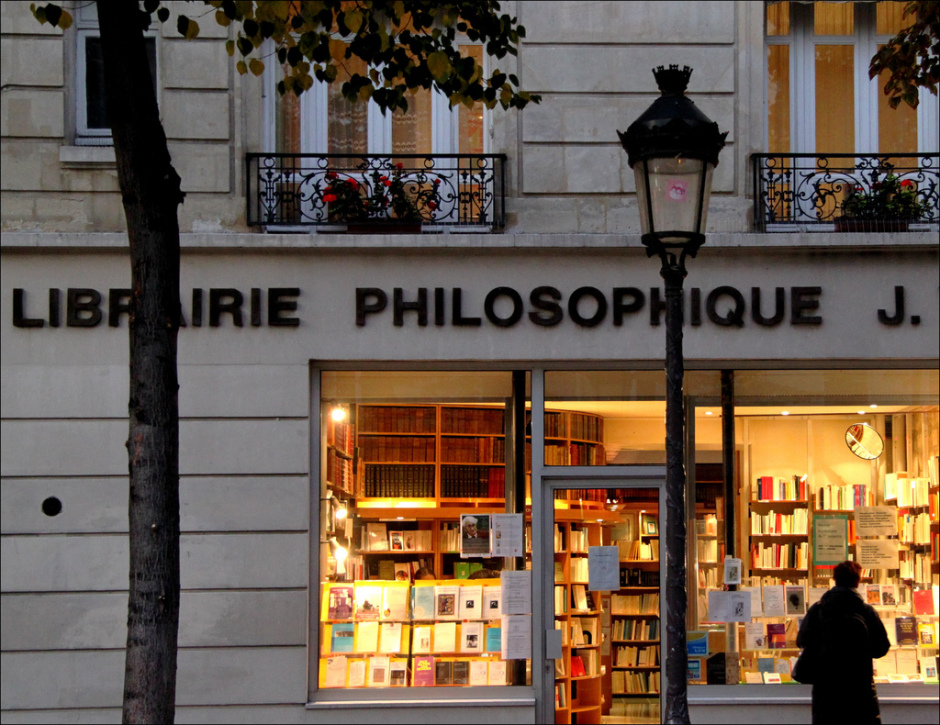
The web site Demasiado Aire recently asked “some of the world’s most important philosophers which three books influenced them the most while undergraduate students.” And, from what we can tell, they got a good response. 28 influential philosophers dutifully jotted their lists, and, for at least the past day, Demasiado Aire has been offline, seemingly overwhelmed by traffic. Thanks to the Internet Archive’s Wayback Machine, we can recover these lists and provide you with a few highlights. We have added links to the texts cited by the philosophers. The free texts have an asterisk (*) next to them.
Charles Taylor (McGill University):
–Phénoménologie de la Perception, Maurice Merleau-Ponty
–The Brothers Karamazov*, Fyodor Dostoevsky
–Jalons pour une théologie du Laïcat, Yves Congar
Daniel Dennett (Tufts University):
“That’s easy:
–Word and Object, Quine.
–The concept of mind*, Gilbert Ryle
–Philosophical Investigations, Ludwig Wittgenstein
“I got to study with Quine and Ryle, but Wittgenstein had died before I encountered his work”.
Alexander Nehamas (Princeton University):
–Apology of Socrates*, Plato
–Nicomachean Ethics*, Aristotle
–Ethics*, Spinoza
“Also, I should point out that Nietzsche’s On the Genealogy of Morality* had a huge effect on me when I was a graduate student and had a formative influence on my philosophical development”.
David Chalmers (Australian National University):
“I was an undergraduate student in mathematics rather than philosophy, but the answer is”:
–Gödel, Escher Bach, Douglas Hofstadter
–The Mind’s I, Douglas Hofstadter & Daniel Dennett
–Reasons and Persons, Derek Parfit
You can view lists by other philosophers, including Alain de Botton, Wendy Brown, Peter Millican, and more here. The image above comes via by MjYj.
If you would like to support the mission of Open Culture, consider making a donation to our site. It’s hard to rely 100% on ads, and your contributions will help us continue providing the best free cultural and educational materials to learners everywhere. You can contribute through PayPal, Patreon, and Venmo (@openculture). Thanks!
Related Content:
44 Essential Movies for the Student of Philosophy
Download 100 Free Philosophy Courses and Start Living the Examined Life
Philosopher Portraits: Famous Philosophers Painted in the Style of Influential Artists
Free Online Philosophy Courses
Read More...Listen to 21-Year-Old David Letterman’s College Radio Show (1969)
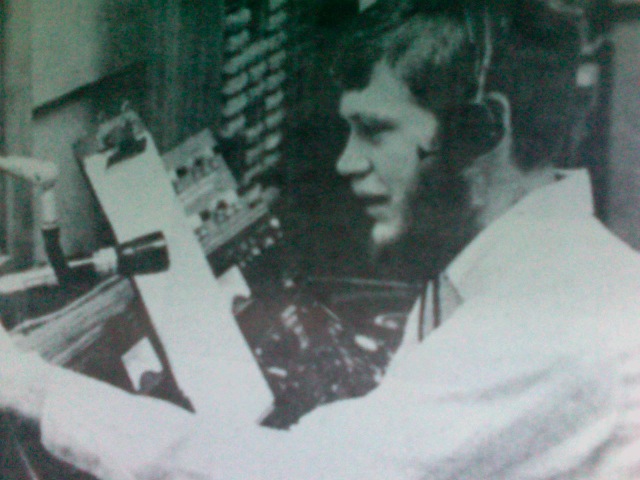
Over thirty years at the desk of his very own late-night talk show, multiple generations of fans, the respect of comedians the world over: David Letterman has had, by any measure, an awfully good run. Though they had to know it could come sooner or later, thousands of viewers, since Letterman announced last Thursday that he plans to retire in 2015, face the imminent prospect of a world without the Late Show as they know it. For the young and young-ish among them, many of whom didn’t come into the world themselves until after Letterman’s 1982 national debut (see video at bottom), this constitutes an entirely new and troublingly less absurd televisual reality. But the master comedy host didn’t simply emerge on to the scene, fully formed, those 32 years ago. Anyone who’s watched long enough to notice the frequency of Letterman’s references to Indianapolis, his hometown and the media market that granted him his first “big” chance as a weatherman, knows that he never forgot his roots.
As with many illustrious careers, Letterman’s humble early shot followed even humbler, earlier shots. Just above, you can hear the 21-year-old “Dave Letterman”’s broadcast from April Fool’s Day 1969 on WAGO-AM, the closed-circuit radio station he helped to found at his future alma mater, Ball State University. Though only a five-minute clip, this recording showcases not just Letterman’s preternatual microphone presence, but his way with the near-psychedelic walls of sound effects, seemingly free-associative speech, and pure wackiness that so came into its own in the late sixties and early seventies. (The Firesign Theater would soon perfect it.) Letterman followers who must know everything — and they certainly exist — should note that, when he calls a delirious-sounding woman in this segment, he calls none other than Michelle Cook, the very first Mrs. Letterman. Though we have yet to learn the identity of Letterman’s Late Show replacement, I feel certain, after this listening experience, that the Letterman of twenty years from now will rise from the ranks of podcasting. Listen out for him; he may not drop colorful phrases just like “horse dentures falling into a rusted howitzer artillery shell,” but you’ll know him when you hear him. Or her.
Below you can watch Bill Murray’s appearance on Letterman’s first 1982 show.
via WFMU’s Beware of the Blog
Related content:
Tom Waits and David Letterman: An American Television Tradition
Colin Marshall hosts and produces Notebook on Cities and Culture and writes essays on cities, language, Asia, and men’s style. He’s at work on a book about Los Angeles, A Los Angeles Primer. Follow him on Twitter at @colinmarshall or on Facebook.
Read More...Dissident Poet Joseph Brodsky Gives Six Life Tips to College Grads (1988)
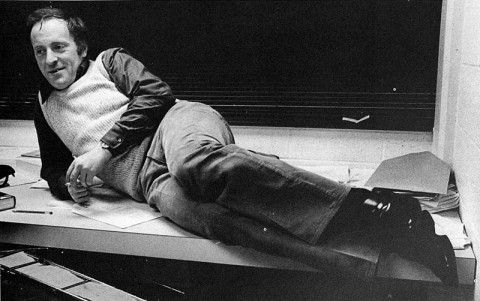
Image from the University of Michigan Yearbook, via Wikimedia Commons
Although Joseph Brodsky was one of the most celebrated Soviet dissidents of the 20th century, the Nobel Prize-winning poet had been unerringly hounded by the repressive Soviet government, which had labeled his poetry as “pornographic and anti-Soviet.” Refusing to abandon his writing, Brodsky was repeatedly brought to court, and once sentenced to 18 months of labor in the Arctic region of Arkhangelsk. During one of his courtroom appearances, the young poet displayed an admirable level of testicular fortitude when the judge asked him, “Who has recognized you as a poet? Who has enrolled you in the ranks of poets?” Brodsky, defiant, replied “No one. Who enrolled me in the ranks of the human race?”
In 1972, Brodsky left the USSR for America, where he was widely sought as a lecturer (his academic bedpost included notches from Cambridge, Columbia, the University of Massachusetts, and Mount Holyoke). On the heels of his winning the 1986 National Book Critics’ award for criticism for Less Than One and receiving the Nobel Prize for Literature in 1987 (pornographic writing, it seems, does quite well with the critics), Brodsky was invited to give the 1988 commencement address at the University of Michigan.
Brodsky’s remarks are far from the galvanizing dose of inspiration that many commencement addresses impart, and certainly not what Michigan graduates were expecting. Rather than uplift, the poet’s words soberly ground the audience; instead of wrapping them in a warm self-assuredness, the life tips are jarring, like an ice bath. Brodsky’s address is a mix of wry humour, acknowledgement of our absurdist existential dilemma, and bold, honest compassion. Reading Brodsky’s advice, one can’t help but feel that the poet valued his flawed humanity even more than his art; likely, they were inseparable.
Here’s a boiled-down version of the poet’s remarks:
1) “Treat your vocabulary the way you would your checking account.” Expression often lags behind experience, and one should learn to articulate what would otherwise get pent up psychologically. Learn to express yourself. Get a dictionary.
2) “Parents are too close a target… The range is such that you can’t miss.” Be generous with your family. Even if your convictions clash with theirs, don’t reject them—your skepticism of your infallibility can only benefit you. It will also save you a good deal of grief when they are gone.
3) “You ought to rely on your own home cooking.” Do not expect society to arrange itself to your benefit—there are too many people whose desires conflict for that to happen. Learn to rely on yourself, and help those who cannot.
4) “Try to not to stand out.” Do not covet money or fame for their own sake. It is best to be modest. There is comfort joining the ranks of those who follow their own discreet paths.
5) “A paralyzed will is no dainty for angels.” Do not indulge in victimhood. By blaming others, you undermine your determination to change your circumstances. When life confronts you with hardships, remember that they are no less an intrinsic part of existence. If you must struggle, do so with dignity.
6) “To be social is to be forgiving.” Do not let those who have hurt you live on in your complaints. Forget them.
The full text—irrevocably more pithy and eloquent—may be found here.
Related Content:
‘This Is Water’: Complete Audio of David Foster Wallace’s Kenyon Graduation Speech (2005)
George Saunders Extols the Virtues of Kindness in 2013 Speech to Syracuse University Grads
Neil Gaiman Gives Graduates 10 Essential Tips for Working in the Arts
Read More...The “Most Amazing [Borrowed] College Welcome Speech Ever”
Georgia Tech sophomore and Mechanical Engineering major Nick Selby gave a rousing welcome speech at the 2013 Freshman Convocation. It didn’t take long for the speech to go viral. Or for Gawker to realize that the speech had been borrowed from a 2008 speech given by Andy Stone, once the debate team champion at Arizona State. (Click here and then skip to the 8:40 mark to see the similar part of Stone’s speech.) But here’s perhaps the most straightforward explanation. It turns out that Selby was once coached by Stone, and on his Facebook page, Selby writes: “I had an awesome speech coach in high school by the name of Andy Stone, and was absolutely thrilled when he agreed to let me use the end of his award-winning speech as the foundation for my own.”
Read More...Allan Bloom’s Lectures on Socrates (Boston College, 1983)
According to Archive.org: “Allan Bloom delivered this talk as part of the series entitled “Philosophic Perspectives” at Boston College in 1983. The series was intended to help teachers of undergraduates in their teaching of those great works that are essential to a liberal education. The series addressed the decline of liberal learning in the Universities, in America especially. In this lecture Bloom discusses the founding of the idea of liberal education, and the meaning of the philosophic life expressed in the example of Socrates. The conflict between Philosophy and the City, or Philosophy and Political Life is explored by way of an interpretation of Plato’s Apology of Socrates.”
Lecture 1:
Lecture 2:
Lecture 3:
Lecture 4:
This course has been added to our collection of 750 Free Courses Online.
Read More...Allan Bloom’s Lectures on Machiavelli (Boston College, 1983)
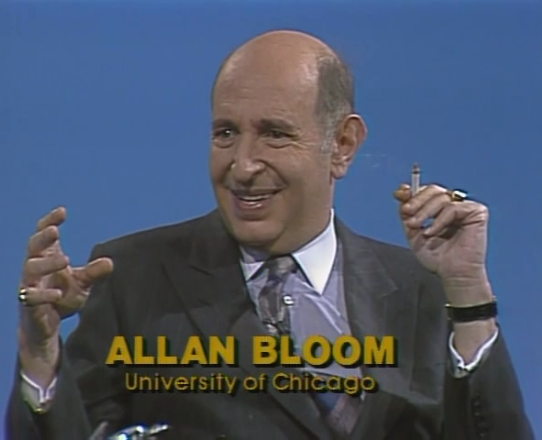
According to Archive.org: “Allan Bloom delivered this talk as part of the series entitled “Philosophic Perspectives” at Boston College in 1983. The series was intended to help teachers of undergraduates in their teaching of those great works that are essential to a liberal education. The series addressed the decline of liberal learning in the Universities, in America especially. This lecture presents an interpretation of Machiavelli’s “Prince” and teaches one how to understand Machiavelli’s art of writing. An interpretation of the “Prince” is given chapter by chapter.”
You can stream the five audio lectures below.
Lecture 1:
Lecture 2:
Lecture 3:
Lecture 4:
Lecture 5:
See our collection, 1,700 Free Online Courses from Top Universities.
Read More...Princeton v. Yale, 1903: The Oldest College Football Game on Film
You can thank Thomas Edison and his motion picture camera for many things: Bike Tricks Caught on Film in 1899; Footage of Mark Twain from 1909; The World’s First (and Slightly Scandalous) Hand-Tinted Motion Picture (1895); The First Kiss in Cinema, 1896; and now this — footage of the 1903 Princeton v. Yale football game. The two teams were undefeated, and 50,000 spectators were on hand. The video starts with the players taking the field (Princeton first, Yale second) and some panoramic views of Yale’s stadium. Then (around the 2:00 mark) we get to the highlights of the game.
The clip above is apparently the oldest collegiate football footage surviving today. And, in case you’re keeping score, Princeton won the game 11–6.
But if you’re counting the number of Free Courses provided by the two universities, we have the score at 38–1, with Yale coming out way on top.
via Retronaut and the Reel Mudd
Read More...How to Find Cheaper College Textbooks
A quick fyi for any college student looking to save some money on textbooks this year. Last week, The New York Times published a helpful guide to lowering textbook costs. The comprehensive list tells you where you can find free ebooks and cheap electronic textbooks online, while highlighting e‑commerce vendors that rent traditional textbooks at a reduced cost. (Take Chegg for example.) In total, the guide lists 20 different resources. If you’re heading to college soon, it’s well worth a look.
Don’t miss Open Culture on Twitter and Facebook!
Read More...The College Dorm Window Show
Students at Poland’s Wroclaw University of Technology got a little techie (or is it techno?) this week, turning their dorm windows into a full color light show. Happily, we can report that all lights were controlled wirelessly. Thanks Bartosz for sending this our way.
Read More...Is The College Bubble Next?
From The Chronicle of Higher Education:
Is it possible that higher education might be the next bubble to burst? Some early warnings suggest that it could be.
With tuitions, fees, and room and board at dozens of colleges now reaching $50,000 a year, the ability to sustain private higher education for all but the very well-heeled is questionable. According to the National Center for Public Policy and Higher Education, over the past 25 years, average college tuition and fees have risen by 440 percent — more than four times the rate of inflation and almost twice the rate of medical care. Patrick M. Callan, the center’s president, has warned that low-income students will find college unaffordable.
Meanwhile, the middle class, which has paid for higher education in the past mainly by taking out loans, may now be precluded from doing so as the private student-loan market has all but dried up. In addition, endowment cushions that allowed colleges to engage in steep tuition discounting are gone. Declines in housing valuations are making it difficult for families to rely on home-equity loans for college financing. Even when the equity is there, parents are reluctant to further leverage themselves into a future where job security is uncertain.
Is this more doom and glooming? Or is this something to worry about? Your thoughts?
via Andrew Sullivan’s Daily Dish
Support Us
We're hoping to rely on loyal readers, rather than erratic ads. Please click the Donate button and support Open Culture. You can use Paypal, Venmo, Patreon, even Crypto! We thank you!

About Us

Open Culture scours the web for the best educational media. We find the free courses and audio books you need, the language lessons & educational videos you want, and plenty of enlightenment in between.
Advertise With Us
FREE UPDATES!
GET OUR DAILY EMAIL
Get the best cultural and educational resources on the web curated for you in a daily email. We never spam. Unsubscribe at any time.
FOLLOW ON SOCIAL MEDIA
Open Culture editor Dan Colman scours the web for the best educational media. He finds the free courses and audio books you need, the language lessons & movies you want, and plenty of enlightenment in between.
Advertise With Us


