College Bans Wikipedia
A History Department Bans Citing Wikipedia as a Research Source
“…the Middlebury history department notified its students this month that Wikipedia could not be cited in papers or exams, and that students could not “point to Wikipedia or any similar source that may appear in the future to escape the consequences of errors.
With the move, Middlebury, in Vermont, jumped into a growing debate within journalism, the law and academia over what respect, if any, to give Wikipedia articles, written by hundreds of volunteers and subject to mistakes and sometimes deliberate falsehoods.“
See full article from The New York Times
See Open Culture’s podcast collections:
Arts & Culture — Audio Books — Foreign Language Lessons — News & Information — Technology — University (General) — University (B‑School)
The Names of Nearly 4 Million Enslaved People in Former British Colonies Are Now Searchable Online, Helping Descendants Find Lost Ancestors
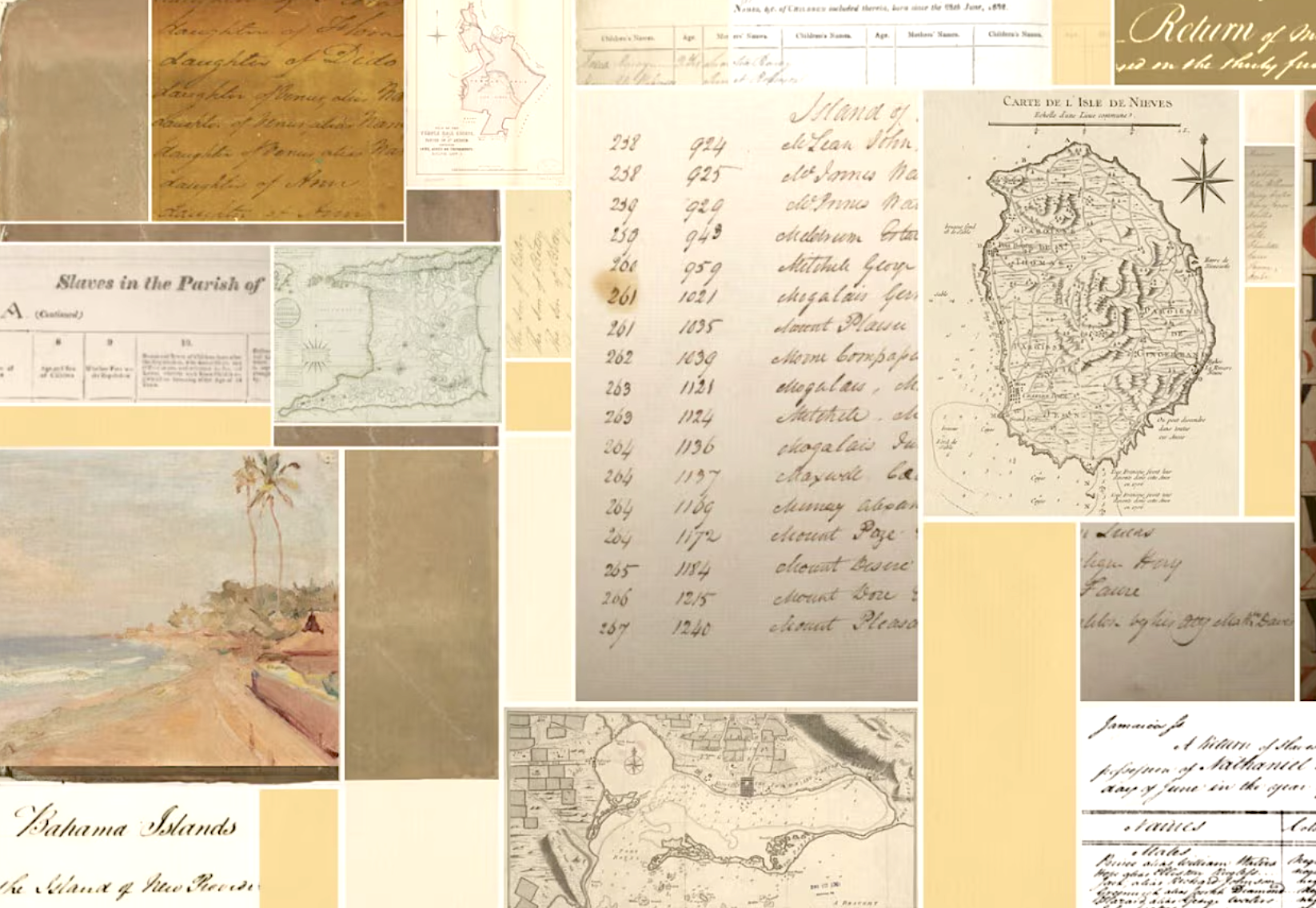
A few years ago, we featured here on Open Culture the Freedmen’s Bureau Project database, which contains searchable information on formerly enslaved people in the United States after its Civil War. With nearly 1.8 million men, women, and children registered there when it first opened to the public, it has remained a valuable resource for many Americans researching their own heritage, not just descendants of former slaves but of other Civil War refugees as well. But of course, the U.S. was hardly the only country where slavery existed. Countless people here in the twenty-first century have ancestors who were enslaved in other former British colonies, and now they’ve got a portal through which to do genealogical searches of their own.
Launched by a partnership between the genealogy company Ancestry and the Centre for the Study of the Legacies of British Slavery at University College London, the online Former British Colonies Enslavement Registers makes available records on nearly four million individuals enslaved between 1813 and 1840 in a host of countries from the Bahamas to Mauritius to South Africa.
First created by the British government during the process of abolishing the transatlantic slave trade in 1807 — much as the Freedmen’s Bureau organized its registry of former slaves during Reconstruction under Abraham Lincoln — the original papers contain not just their names and ages, but also maternal family connections, physical descriptions, and sometimes details about their place of African origin.
In the video above, genealogist and Ancestry Senior Story Producer Nicka Sewell-Smith provides an introduction to the Former British Colonies Enslavement Registers, which you can access here. If you’re curious about whether your own ancestors may appear in its records, you can search by details like name, approximate date, or location to narrow down the potential matches. The modern descendants of people enslaved in the 20 countries covered by the database by no means live exclusively, or even primarily, in those countries or in Great Britain itself. More than two centuries later, their descendants live all over the world, including in Latin America and the United States, leading lives very different from those of their enslaved ancestors — but the reconstruction of their family stories has only just begun. Enter the database here.
Related content:
Based in Seoul, Colin Marshall writes and broadcasts on cities, language, and culture. He’s the author of the newsletter Books on Cities as well as the books 한국 요약 금지 (No Summarizing Korea) and Korean Newtro. Follow him on the social network formerly known as Twitter at @colinmarshall.
Read More...Rage Against the Machines: From the Luddites to the AI Data Center Backlash
One often-repeated anecdote about Milton Friedman has the famous economist visiting a canal under construction in nineteen-sixties China. Noticing the sheer number of human laborers digging away with shovels, he asked the official in charge why they weren’t getting the work done faster with excavators and other modern machines. The bureaucrat explained to him that doing it by hand created more jobs. Friedman’s reply: “If it’s jobs you want, you should give those men spoons instead.” Whether or not this exchange ever actually happened, it illustrates a conflict that’s arisen more than once in the history of civilization, possibly since the dawn of industrialization — and at least since the heyday of the Luddites.
According to the University of Cambridge, that heyday came in 1812, the year of “an assault by some 150 armed laborers on a Huddersfield mill, in which soldiers opened fire on the mob to stop them breaking into the premises, fatally wounding two attackers.” This was the culmination of a series of protests across England, all of them inspired by anger at “new technologies, like automated looms, which were being used in the textile industry in place of the skilled work of artisans, threatening their livelihoods as a result.” These desperately infuriated protesters, whose documented actions include the murder of a Yorkshire mill owner, loudly expressed allegiance to one Ned Ludd, a weaver said to have taken the bold step of smashing a couple of newfangled stocking frames some 25 years before.
The story of Ludd’s early stand against mechanization may be even more questionable than the one about Milton Friedman and the spoons, but his name survives today nevertheless. In fact, it’s undergone somewhat of a revival thanks to the artificial-intelligence boom of recent years, during which even the modern “knowledge workers” have come to fear the trampling of their livelihoods under technology’s inexorable march. Their calls for restrictions on the development and deployment of AI are, in one side’s framing of the argument, merely the latest public spasm of Luddism, a movement explained in the video above from The History Guy. How many here in the twenty-first century, after all, would argue that the mass production of socks ultimately constituted a real loss for humanity?
Luddism never did count a large proportion of the English labor force as its own. Rather, the movement appealed to “a relatively ‘elite’ group” of legally protected workers only allowed into their professions after years of apprenticeship, at which point “they tended to feel that they were owed a living.” Nor did the conditions, hours, and compensation at the factories then springing up seem favorable compared to the way of life enjoyed by their predecessors. Similar sentiments may underlie the “Luddite clubs” forming on college campuses, on which NPR has reported, or this year’s social media-free “Summer of Ludd” at the New School, to say nothing of ongoing protests against data-center construction. It would be fascinating to hear what genuine nineteenth-century Luddites would make of our situation. Perhaps, one day, we can use AI to resurrect them.
Related content:
Hear Alan Watts’s 1960s Prediction That Automation Will Necessitate a Universal Basic Income
How Qatar Built Stadiums with Forced Labor
Based in Seoul, Colin Marshall writes and broadcasts on cities, language, and culture. He’s the author of the newsletter Books on Cities as well as the books 한국 요약 금지 (No Summarizing Korea) and Korean Newtro. Follow him on the social network formerly known as Twitter at @colinmarshall.
Read More...The Radical Ideas of Plato’s Republic: An In-Depth Introduction
We no longer live in a time when college freshmen get shocked by much of the reading material assigned to them. Counterintuitively, the texts that do retain their power to disturb young minds (presuming they can read texts in the first place) tend to skew old — and in one prominent case, about 2,400 years old. Even the most superficial interpretations of Plato’s Republic challenge the political assumptions held by almost every student today, at least in the developed West. Many of them hold those assumptions so deeply that they’ve never articulated them. Encountering the arguments made by Plato’s Socrates in favor of a society ruled by an enlightened upper class, tightly controlled from above in everything from the division of its labor to the content of its art, prompts them to do so.
Or rather, it prompts them to do so in an ideal educational setting, but then, Plato was dedicated to nothing so much as the ideal. When he casts Socrates as making the case for the best possible relationships between ruler, state, and individual, he creates less a how-to manual (as Machiavelli did nineteen centuries later, in a brutally quasi-satirical spirit) than a means of better understanding extant societies by bringing their characteristics into relief through comparison.
We may reflexively quote Churchill’s remark about modern democracy, vulnerable as it is to manipulation by all manner of unsavory actors, being “the worst form of Government except for all those other forms that have been tried from time to time,” but we nevertheless flinch from holding it up too closely against any kind of ideal system.
It’s tempting to declare that we wouldn’t want to live in the republic of the Republic. (Some of us may have succumbed to that temptation in the political-philosophy lecture hall.) But a more reflective reading reveals a good deal about Plato’s time as well as our own. In the 78-minute video above, Jared Henderson takes us through the Socratic dialogues that propose and refine this Utopia, with its philosopher-kings, noble lies, spiritual aristocrats, breeding festivals, and guardians trained from the cradle. He arrives at certain unfashionable ideas, such as the ultimate task of refining one’s own soul and the necessity of persuading those impervious to philosophy with myth. Even those of us who regard ourselves as sophisticated thinkers, impervious to the crude rhetoric of ideologies and demagogues, would do well to ask ourselves: how much of that thinking has been shaped by the stories we’ve heard all our lives?
Related Content:
Plato’s Dialogue Gorgias Gets Adapted into a Short Avant-Garde Film
Seven Philosophy Books for Beginners: Where to Start
Based in Seoul, Colin Marshall writes and broadcasts on cities, language, and culture. He’s the author of the newsletter Books on Cities as well as the books 한국 요약 금지 (No Summarizing Korea) and Korean Newtro. Follow him on the social network formerly known as Twitter at @colinmarshall.
Read More...The Very First Film Adaptation of Mary Shelley’s Frankenstein, a Thomas Edison Production (1910)
The story of humans creating monstrous beings in their image may have perennial relevance, even if it seems specific to our contemporary cultural moment. What, after all, is Oscar Isaac’s AI inventor in Ex Machina but a 21st-century update of Victor Frankenstein? (Before Isaac went on to portray Victor himself in Guillermo del Toro’s 2025 film adaptation.) And what is Frankenstein’s monster but a Gothic recreation of the Golem, or any number of folkloric automatons in cultures far and wide? It’s an age-old archetypal story that seems to get an update every year.
People have imagined making artificial people, perhaps for as long as people have told stories. But each iteration of that story emerges from a historical matrix of particular technological, philosophical, and metaphysical anxieties. In the case of Ex Machina, we have not only a thinking, feeling humanoid, but one created out of mass data collection and designed to serve the prurient interests of a Nietzschean venture capitalist engineer.
In the original Frankenstein, a novel written by a woman, Mary Shelley, we have a very different kind of monster, born out of a Romantic convergence of interest in alchemy and the occult—the original domains of early modern scientists like Isaac Newton—and more modern, industrial scientific methods (hence the novel’s subtitle, The Modern Prometheus). Many critics have called the novel the first work of science fiction, and many, like Maurice Hindle in the introduction to the Penguin Classics edition, have described its main theme as “the aspiration of modern masculinist scientists to be technically creative divinities.”
And yet, writes Ruth Franklin at the New Republic—drawing convincingly on Shelley’s own traumatic experiences with birth—Frankenstein might “also be a story about pregnancy.” Intriguing as this possibility may be, most interpretations of the novel have seen it as “a fable of masculine reproduction, in which a man creates life asexually.” That tradition continues in the movies with the first film adaptation of Frankenstein, made by Edison studios just over 100 years after the novel’s 1818 publication.
The 1910 short silent film, which you can watch above, bills itself as “a liberal adaptation from Mrs. Shelley’s famous story,” and opens in its first scene with Victor Frankenstein leaving home for college. Two years later, the Faustian mad scientist discovers the mystery of life, uses the knowledge to make his “creature”—a surprisingly grotesque scene—and, appalled at the sight of it, rejects the thing in horror. The rest of the story proceeds along the usual lines, as the monster, in rags and fright wig, seeks recognition from his creator/parent and wreaks havoc when he does not receive it.
This first Frankenstein film, directed by J. Searle Dawley, arrived two years after Edison’s Bronx, New York studios began full and very lucrative operations, and, by this time, writes Rich Drees, motion pictures had begun to receive unwelcome attention from “moral crusaders and reform groups, who decried the new medium as being dangerous and encouraging of immorality.” Edison responded quickly, fearing “a serious threat to his bottom line,” and ordered that his films’ production quality and “moral tone” be improved.
Frankenstein, writes Drees, “was the perfect choice to kick off production under this new moral banner. It’s a story that deals with the extremes of the human condition, life and death, and the dangers of tampering in God’s realm.” Edison released the film with the following disclaimer:
To those familiar with Mrs. Shelley’s story it will be evident that we have carefully omitted anything which might be any possibility shock any portion of the audience. In making the film the Edison Co. has carefully tried to eliminate all actual repulsive situations and to concentrate its endeavors upon the mystic and psychological problems that are to be found in this weird tale. Wherever, therefore, the film differs from the original story it is purely with the idea of eliminating what would be repulsive to a moving picture audience.
Five years after the Edison studio’s short, another silent adaptation, Life Without Soul, appeared. Made by the Ocean Film Corporation, this film is now lost to history, but it qualifies as the first feature-length adaptation at 70 minutes. A review of the film, writes the blog Frankensteinia, “reveals a story that hews fairly close to Mary Shelley’s novel,” making a “bold attempt at capturing the world-spanning sweep of the tale.”
Several dozen film adaptations in the ensuing years have tracked more or less closely to Shelley’s narrative—giving Frankenstein’s monster a bride and having Victor Frankenstein reanimate his dead lover with the mind of a wrongly executed man. But none of these films, so far as I know, has drawn out the subtext of Frankenstein as a novel about pregnancy and childbirth. Such an adaptation remains to be made—although Maggie Gyllenhaal’s 2026 film The Bride! has become the first adaptation by a woman.
You can find Mary Shelley’s Frankenstein in our collections of Free eBooks and Free Audio Books.
The film above will be added to our collection, 4,000+ Free Movies Online: Great Classics, Indies, Noir, Westerns, Documentaries & More.
Note: An earlier version of this post appeared on our site in 2016.
Related Content:
The First Horror Film, George Méliès’ The Manor of the Devil (1896)
Frankenweenie: Tim Burton Turns Frankenstein Tale into Disney Kids Film (1984)
Mary Shelley’s Handwritten Manuscripts of Frankenstein Now Online for the First Time
Josh Jones is a writer and musician based in Durham, NC.
Read More...The Women of the Bauhaus: See Hip, Avant-Garde Photographs of Female Students & Instructors at the Famous Art School

Take a look at photos of Bush Tetras — a three-girl-one-guy No Wave/Post-Punk band from the early 1980s downtown Manhattan scene. Now, look at the photograph above, “Marcel Breuer and His Harem,” by Bauhaus photographer Erich Consemüller, taken sometime around 1927. Except for the fact that Breuer looks more like Ron Mael of Sparks sans mustache than drummer Dee Pop, one might mistake this for a photo of the punk band. This raises a few questions: did art students Bush Tetras look to the women of the Bauhaus for their style? Or did the women of the Bauhaus look to the future and see punk? The second scenario seems more likely since the women of the Bauhaus have not, until recently, been terribly well-known.
I personally feel cheated after studying art and art history in college many years ago and only now getting introduced to several significant artists of the radical German art school founded by Walter Gropius. All of its famous exponents and art stars are men, but it seems the gender ratio of the Bauhaus was closer to that of the general population (as was, in many cases, that of the early punk and post-punk scenes).
But we don’t tend to learn the names or see the work of these artists, and, in some cases, their work has been posthumously attributed to their male colleagues. Nor are we familiar with their progressive personal style, essential in the Bauhaus’s total approach to revolutionizing the arts, including fashion, as a way to liberate humanity from the dogmas of the past.
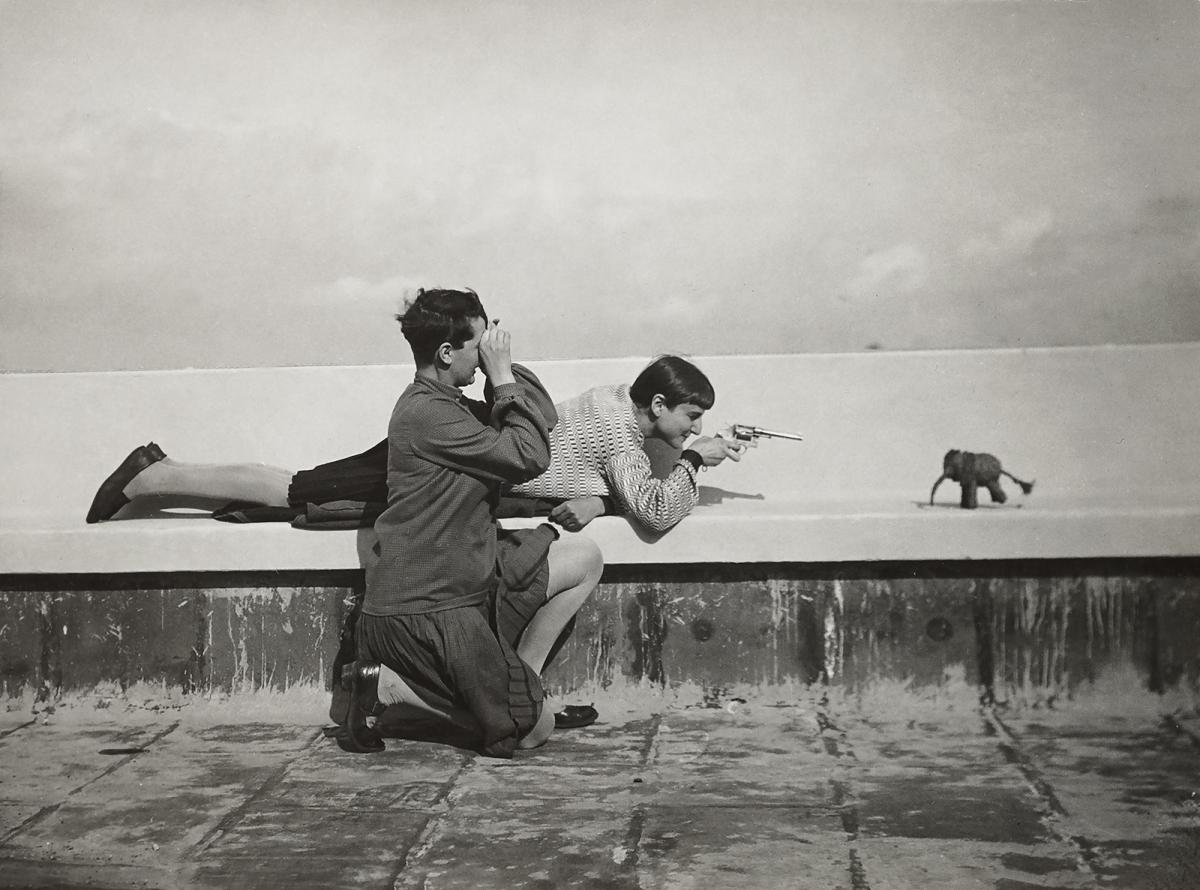
How unfortunate that the memory of the Bauhaus, like the memory of punk, replicated the same old rules its artists broke. The school’s gender equality was radical, hence the photograph’s satirical title, which “expresses the precise opposite of what the photo itself shows,” notes the site Bauhaus Kooperation: “the modernity, emancipation, equality, or even superiority, of the women in it.” The “junior master” of the carpentry workshop, Breuer looks at the three artists to his left “skeptically, with his arms crossed,” as if to say, “ ‘These are ‘my’ women?!’ ” The artists of the “harem,” from left to right, are Breuer’s wife Martha Erps, Katt Both, and the photographer’s wife, Ruth Hollós, who “seems to be suppressing laughter as she looks towards the photographer (her husband).”

Erich Consemüller, who taught architecture at the Bauhaus, had been tasked by Gropius with documenting the school and its life. Gropius partnered him with photographer Lucia Moholy, wife of László Moholy-Nagy (see a photo of her above, taken by her husband sometime between 1924 and 28). Moholy took mostly exterior shots like the photograph by her further up of Erps and Hollós on the roof of the Atelierhaus in Dessau in the mid-1920s. Consemüller mainly focused on interiors in his work, with experimental exceptions like the “Mechanical Fantasy” series seen here, which uses clothing, poses, and double exposures to visually emphasize a kind of uniformity of purpose, placing and joining male and female Bauhaus artists in almost typological arrangements.
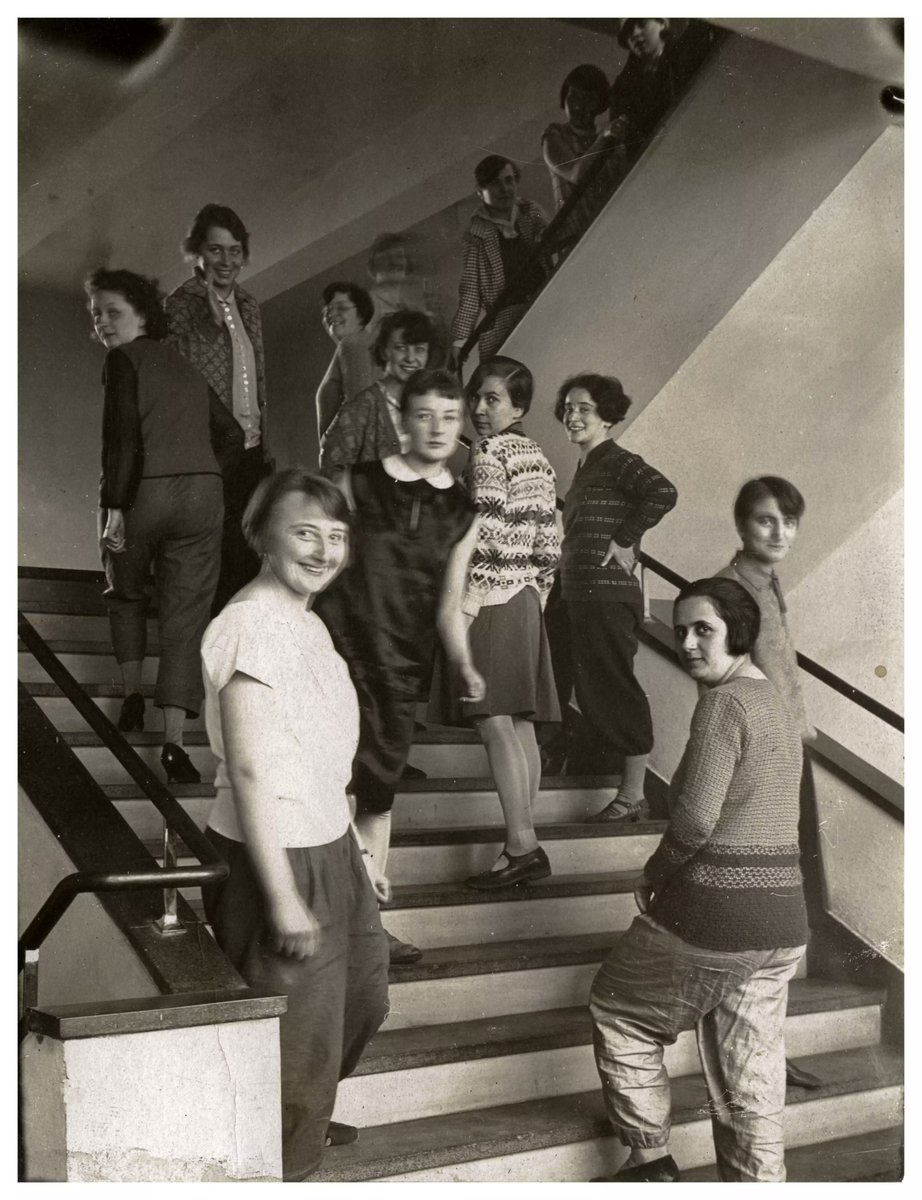
Indeed, nearly all of the artists of the Bauhaus — as was the school’s practice — tried their hand at photography, and many used the medium to document, in ways both casual and deliberate, the Bauhaus’s commitment to gender equity and the full inclusion of women artists in its programs, a statement painter and photographer T. Lux Feininger seems to underline in the group photograph below of the school’s weavers on the steps of the new Bauhaus building in 1927. (Artists in the shot: Léna Bergner, Gunta Stölzl, Ljuba Monastirsky, Otti Berger, Lis Beyer, Elisabeth Mueller, Rosa Berger, Ruth Hollós, and Lisbeth Oestreicher.)
Bauhaus artists, both men and women, were very much like early punks in some ways, inventing new ways to shake up the establishment and break out of prescribed roles. But instead of a downtown alternative to the status quo, they offered a recipe for its full transformation through art. Who can say how far that movement would have progressed had it not been splintered by the Nazis? “Together,” as Gropius wrote, “let us call for, devise, and create the construction of the future, comprising everything in one form, architecture, sculpture and painting,” and most everything else in the built and visual environments, he might have added.
An earlier version of this post appeared on our site in 2022.
Related Content:
The Politics & Philosophy of the Bauhaus Design Movement: A Short Introduction
Josh Jones is a writer and musician based in Durham, NC.
Read More...Why Americans Stopped Reading Books
The kids can’t read. Such has been the implication, even the declaration, made by a wave of articles in recent years. But the statement needs some qualification: the kids in question are American; what they can’t read is entire books, especially literary fiction; and it isn’t just the kids in the first place. It would be the rare reader, especially of a site like Open Culture, who could resist feeling any despair when confronted with, say, a study finding that only five percent of college English majors tested could understand the opening of Bleak House. But the real problem is broader, as reflected by the framing of the Jared Henderson video above, “Why Everyone Stopped Reading.”
Henderson points to several explanatory factors. The first is the way many American schools teach reading: for a time, they abandoned the method of phonics, which starts with basic individual sounds and builds from there, and went all in on something called “whole language learning,” which was based on teaching students to “infer the meanings of words from context.” The idea was that, rather than relying on rote drilling, the new system could cultivate a natural love for reading in young students. “The only problem is that whole language learning didn’t work,” and the resulting drop in literacy rates surely has something to do with the dramatic falloff of reading in general.
Other U.S. educational reforms, such as the nationwide push toward short informational texts and standardized testing, which prioritized information extraction over textual engagement, must also share the blame. This has produced an abundance of, to borrow the headline of Rose Horowitch’s much-circulated Atlantic piece from 2024, “Elite College Students Who Can’t Read Books.” Those same students, of course, have all come of age in the time of the smartphone, which does provide us with an “endless stream of text,” albeit of low-to-nonexistent literary merit — to say nothing of the infinite scroll of hyper-stimulating short-form videos absorbing ever-greater proportions of daily life, and not just that of the young.
“Americans, once members of a proudly literate society, read much less than they used to,” writes Horowitch in a new, in-depth piece on the country’s “post-literacy.” “Fewer than half of all adults reported having read a book of any kind in 2022. Only 38 percent read a novel or short story.” At the same time, “gambling has become a more common leisure activity than reading a book: Last year, 57 percent of Americans placed a bet.” The now-mainstream notion that America (and, in time, the world) is reverting from a textual to an oral culture was first foreseen by the likes of Marshall McLuhan, Neil Postman, and Walter J. Ong. But many here in the twenty-first century might hear their condition described in a more relatable fashion by David Bowie, in his Tin Machine period, nearly forty years ago.
Related content:
The Virtue of Owning Books You Haven’t Read: Why Umberto Eco Kept an “Antilibrary”
Based in Seoul, Colin Marshall writes and broadcasts on cities, language, and culture. He’s the author of the newsletter Books on Cities as well as the books 한국 요약 금지 (No Summarizing Korea) and Korean Newtro. Follow him on the social network formerly known as Twitter at @colinmarshall.
Read More...When the US Mail Was Delivered Underground at 35 MPH Through a Network of Pneumatic Tubes (1893–1953)
Twenty years ago, United States senator Ted Stevens drew long-lasting online ridicule by describing the internet as “a series of tubes.” While some commentators noted that the analogy wasn’t quite as outlandish as it seemed, most reacted with nothing more than amused bafflement. Where had Stevens come up with that image? Given that he was born in 1923, perhaps he was drawing on memories of a technological wonder of his childhood: the underground pneumatic systems through which mail was delivered in major American cities from the eighteen-nineties until the early nineteen-fifties, whose story is told in the It’s History video above.
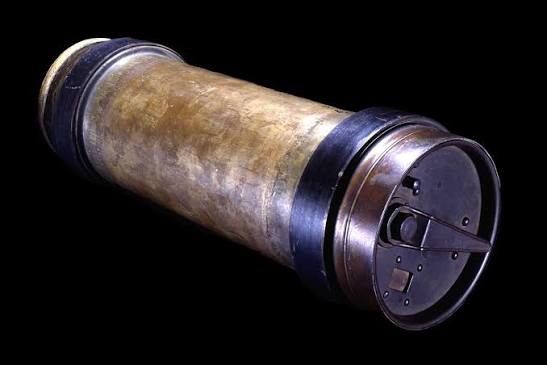
Such series of tubes entered service in London, Paris, and Berlin in the mid-nineteenth century. In 1893, Philadelphia became the first American city to get one, thanks to the advocacy of technologically minded department store magnate-turned-Postmaster General John Wanamaker. At the inauguration, writes Hidden City’s Harry Kyriakodis, Wanamaker “placed a Bible wrapped in an American flag into a canister that went flying (underground) to the Central Post Office with a loud ‘whish’.” Philadelphia’s network expanded apace, eventually including nearly twenty miles of tunnels, and “New York City, Boston, Chicago, and St. Louis adopted similar delivery systems by 1898, all operated by the Post Office Department.”
Operated at a serious loss, that is: when the U.S. got involved in World War I, the Post Office suspended pneumatic service to conserve resources. Only in the twenties did the tubes start whishing again in parts of New York and Boston, whose high volumes of mail could potentially justify the operation. In fact, the sheer amount of mail eventually got to be too much for the steel capsules and the cast-iron tunnels through which compressed air pushed them. As retired U.S. Postal Inspector Robert A. Cohen explains it in his history of these systems, “It takes a certain amount of time for a gallon of liquid to travel through a funnel. Two gallons take twice as long to pass through. The value of the Pneumatic Tube Service decreased as mail volume increased.”
The proliferation of automobiles and the expansion of their supporting infrastructure dealt an even more serious blow: after World War II, delivering mail on the roads had clearly become more efficient than doing it underground. Some “rocketeers,” as the system’s operators were called, stuck it out until December 12, 1953, when pneumatic mail service was officially suspended all across the country.
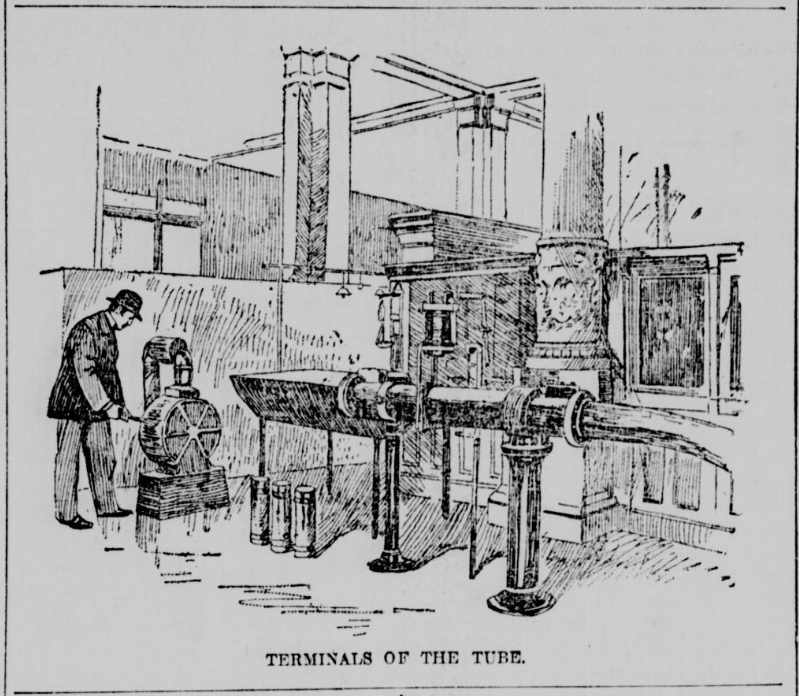
This marked the end of an era, especially for the rocketeers said to have used the network to surreptitiously receive orders from their favorite sandwich shops. Remembering Ted Stevens’ notorious remark, it’s tempting to describe the series of tubes that were pneumatic mail delivery systems as an early version of the internet — and even more so it was already getting people hooked on food delivery.
] 
Related Content:
What’s Under London? Discover London’s Forbidden Underworld
An Architect Breaks Down the Design of New York City Subway Stations, from the Oldest to Newest
Based in Seoul, Colin Marshall writes and broadcasts on cities, language, and culture. He’s the author of the newsletter Books on Cities as well as the books 한국 요약 금지 (No Summarizing Korea) and Korean Newtro. Follow him on the social network formerly known as Twitter at @colinmarshall.
Read More...
Hear the Earliest Known Piece of Polyphonic Music: This Composition, Dating Back to 900 AD, Changed Western Music
Like digging for fossils or panning for gold, the research process can be a tedious affair. But for any researcher, long days of searching and reading will eventually result in discovery. These are the moments scholars cherish. It’s the chance discovery, however rare, that makes the long hours and bleary late nights worthwhile. And some finds can change an entire field. Such was the discovery of St. John’s College PhD student, and now Associate Professor of Musicology at the University of Pavia, Giovanni Varelli, who, in 2014, found what is believed to be, writes Cambridge University, “the earliest known practical example of polyphonic music,” that is, music consisting of two or more melodic lines working together simultaneously.
You can hear the short composition—written in praise of the patron saint of Germany, Saint Boniface—performed above by St. John’s undergraduates Quintin Beer and John Clapham. Prior to Varelli’s discovery of this piece of music, the earliest polyphonic music was thought to date to the year 1000, from a collection called The Winchester Troper. Varelli’s discovery may date to 100 years earlier, around the year 900, and was found at the end of a manuscript of the Life of Bishop Maternianus of Reims. One reason musicologists have so far overlooked the piece, Varelli says, is that “we are not seeing what we expected.”
Typically, polyphonic music is seen as having developed from a set of fixed rules and almost mechanical practice. This changes how we understand that development precisely because whoever wrote it was breaking those rules. It shows that music at this time was in a state of flux and development.
Varelli’s specialization in early music notation also provided him with the training needed to recognize the piece, which was written using “an early form of notation that predates the invention of the stave” (see the piece below). According to former British Library curator Nicolas Bell, “when this manuscript was first catalogued in the 18th century, nobody was able to understand these unusual symbols.” Varelli’s discovery shows a deviation from “the convention laid out in treatises at the time” and points toward the development of a musical technique that “defined most European music up until the 20th century.”
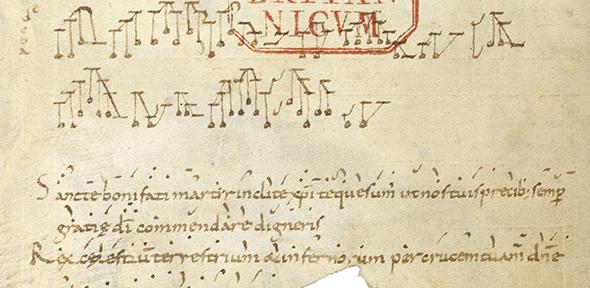
Varelli gives us a sense of how important this discovery is to scholars of early music: “the rules being applied here laid the foundations for those that developed and governed the majority of western music history for the next thousand years. This discovery shows how they were evolving, and how they existed in a constant state of transformation, around the year 900.”
So there you have it. If you’re stuck in the doldrums of a research project, waiting for the wind to pick up, don’t despair. The next rare artifact, treatise, or manuscript may be waiting for someone with exactly your specialized insights to decipher its secrets.
Note: An earlier version of this post appeared on our site in 2017.
Related Content:
Hear a 9,000 Year Old Flute—the World’s Oldest Playable Instrument—Get Played Again
Listen to the Oldest Song in the World: A Sumerian Hymn Written 3,400 Years Ago
Hear the World’s Oldest Instrument, the “Neanderthal Flute,” Dating Back Over 43,000 Years
Josh Jones is a writer and musician based in Durham, NC.
Read More...Where Did the Monk’s Haircut Come From? A Look at the Rich and Contentious History of the Tonsure
One might assume from a modern viewpoint that the hairstyles worn by monks arose to deal with male pattern baldness anxiety. As in the school uniform approach, you can’t single out one person’s baldness when everyone is bald. But this, again, would be a modern view, full of the vanity the tonsured—those with religiously shaven heads—ostensibly vowed to renounce. According to the Catholic Encyclopedia, the tonsure (from the Latin verb for “to shear”) began as a “badge of slavery” among Greeks and Romans. It was adopted “on this very account” by early monastic orders, to mark the total surrender of the will.
Would it surprise you, then, to learn that there were tonsure wars? Probably not if you know anything about church history. Every article of clothing and of faith has sparked some major controversy at one time or another. So too with the tonsure, of which—we learn in the Vox video above—there were three styles. The first, the coronal (or Roman or Petrine) tonsure, is the one we see in countless Medieval and Renaissance paintings: a bald pate at the crown surrounded by a fringe of hair, possibly meant to evoke the crown of thorns. Next is the Pauline, a fully shaved head, seen much less in Western art since it was “used more commonly in Eastern Orthodoxy.”
The third style of tonsure caused all the trouble. Or rather, it was this style that served as a visible sign of religious differences between the Roman Catholic Church and the churches in Britain and Ireland. “Celtic Catholicism was ‘out of sync’ with the Roman Catholic Church,” notes Vox. “Roman Catholics would use the differences between them to portray Celtic Catholicism as pagan, or even as an offshoot, celebrating the power-hungry magician, Simon Magus.” The Celtic tonsure fell under a cloud, but how exactly did it differ from the others? Since it disappeared in the early Middle Ages and few images seem to have survived, no one seems sure.
Daniel McCarthy, fellow emeritus at Trinity College, Dublin set out to solve the mystery. He speculates that the Celtic tonsure, as you’ll see on a computer-simulated monk’s head, was a triangular shape, with the apex at the front. When the Roman Catholics took over Ireland, all of the vestments, dates, and haircuts were slowly brought into line with the dominant view. The practice of tonsure officially ended in 1972, and fell out of favor in English-speaking countries centuries earlier, according to the Catholic Encyclopedia. But in any case, McCarthy sees the tonsure not as a spurning of fashion, but as a cult-like devotion to style. In that sense, we can see people who adopt similar haircuts around the world as still visually signaling their membership in some kind of order, religious or otherwise.
Note: An earlier version of this post appeared on our site in 2018.
Related Content:
How a Baltimore Hairdresser Became a World-Renowned “Hair Archaeologist” of Ancient Rome
Animated: Stephen Fry & Ann Widdecombe Debate the Catholic Church
50 Years of Changing David Bowie Hair Styles in One Animated GIF
Josh Jones is a writer and musician based in Durham, NC.
Read More...Support Us
We're hoping to rely on loyal readers, rather than erratic ads. Please click the Donate button and support Open Culture. You can use Paypal, Venmo, Patreon, even Crypto! We thank you!

About Us

Open Culture scours the web for the best educational media. We find the free courses and audio books you need, the language lessons & educational videos you want, and plenty of enlightenment in between.
Advertise With Us
FREE UPDATES!
GET OUR DAILY EMAIL
Get the best cultural and educational resources on the web curated for you in a daily email. We never spam. Unsubscribe at any time.
FOLLOW ON SOCIAL MEDIA
Open Culture editor Dan Colman scours the web for the best educational media. He finds the free courses and audio books you need, the language lessons & movies you want, and plenty of enlightenment in between.
Advertise With Us

