How Nashville Became Home to a Full-Scale Replica of the Parthenon
Asked to identify “the Athens of the South,” many Americans might well point to Athens, Georgia, especially if they happen to be fans of REM, the B‑52s, or Of Montreal. In fact, that title was claimed by Nashville, Tennessee as early as the eighteen-fifties, when the city put into action its ambitious plans for a public education system. By the end of that century, Nashville boasted not just more than 20 colleges and universities (Vanderbilt being the best known today), but also a full-scale replica of the Parthenon, the ancient temple to the goddess Athena. It was built for the state’s Centennial Exhibition in 1897, when no display of local grandeur was too much.
Nearly 130 years later, the Nashville Parthenon remains a major local attraction alongside the likes of the Grand Ole Opry, the Country Music Hall of Fame, and the Honky Tonk Highway. The structure currently situated in Centennial Park (also the home of that modern site of pilgrimage, the Taylor Swift Bench) isn’t the same one at which visitors marveled in 1897.
After a couple of decades of deterioration, writes Artsy’s Isaac Kaplan, “massive renovations were undertaken in 1920, overseen by an architect named Russell Hart, who committed to making the building both enduring and as historically true to the original Parthenon as possible,” an extensive rebuild that even entailed making casts of the original marbles.
Unlike the bombed-out ruin in the Athens of Greece, the Nashville Parthenon stands proudly intact. But does it pass muster with serious enthusiasts of classical civilization? In the video at the top of the post, Garrett Ryan of ancient-history YouTube channel Told in Stone makes the trip. He notes that, though it does contain a gold-plated (or rather, gold-leaf plated) statue of Athena much like the one originally sculpted by Phidias, the building is “not an exact replica. It’s made of concrete, not marble, it has no frieze, the colors are all wrong, and the interior is very different from the original. But it gives a sense of the scale of the Parthenon,” and “captures the experience of visiting a temple of this size.” The parking lot right alongside it does some harm to the illusion, granted, but it does encourage the visitor to reflect upon the nature of civilization: American civilization, that is.
Related content:
A Tour of Athens’ Acropolis, Explained with 3D Reconstructions
A 3D Model Reveals What the Parthenon and Its Interior Looked Like 2,500 Years Ago
How the Ancient Greeks Built Their Magnificent Temples: The Art of Ancient Engineering
A Virtual Tour of Ancient Athens: Fly Over Classical Greek Civilization in All Its Glory
How the Parthenon Marbles Ended Up In The British Museum
Based in Seoul, Colin Marshall writes and broadcasts on cities, language, and culture. He’s the author of the newsletter Books on Cities as well as the books 한국 요약 금지 (No Summarizing Korea) and Korean Newtro. Follow him on the social network formerly known as Twitter at @colinmarshall.
Read More...Meet the Syntopicon: The Ambitious Index That Tried to Organize All of Western Thought (1952)
Mortimer J. Adler rose to cultural prominence in the mid-twentieth-century United States, not that a figure like him could have done so in any other place or time. A haphazard professional and intellectual path involving copy-boy work at the New York Sun, night school, and an incomplete Columbia degree eventually led to a faculty position teaching philosophy of law at the University of Chicago. In 1945, he commenced work on what would become the Great Books of the Western World, a 54-volume set published by Encyclopædia Britannica including the works of everyone from Homer to Virgil to Darwin to Hemingway. Sold door-to-door, it became an unlikely success by the early nineteen-sixties, and for a time it was a fairly common, if bookshelf-dominating, sight in the aspirational homes of suburban America.
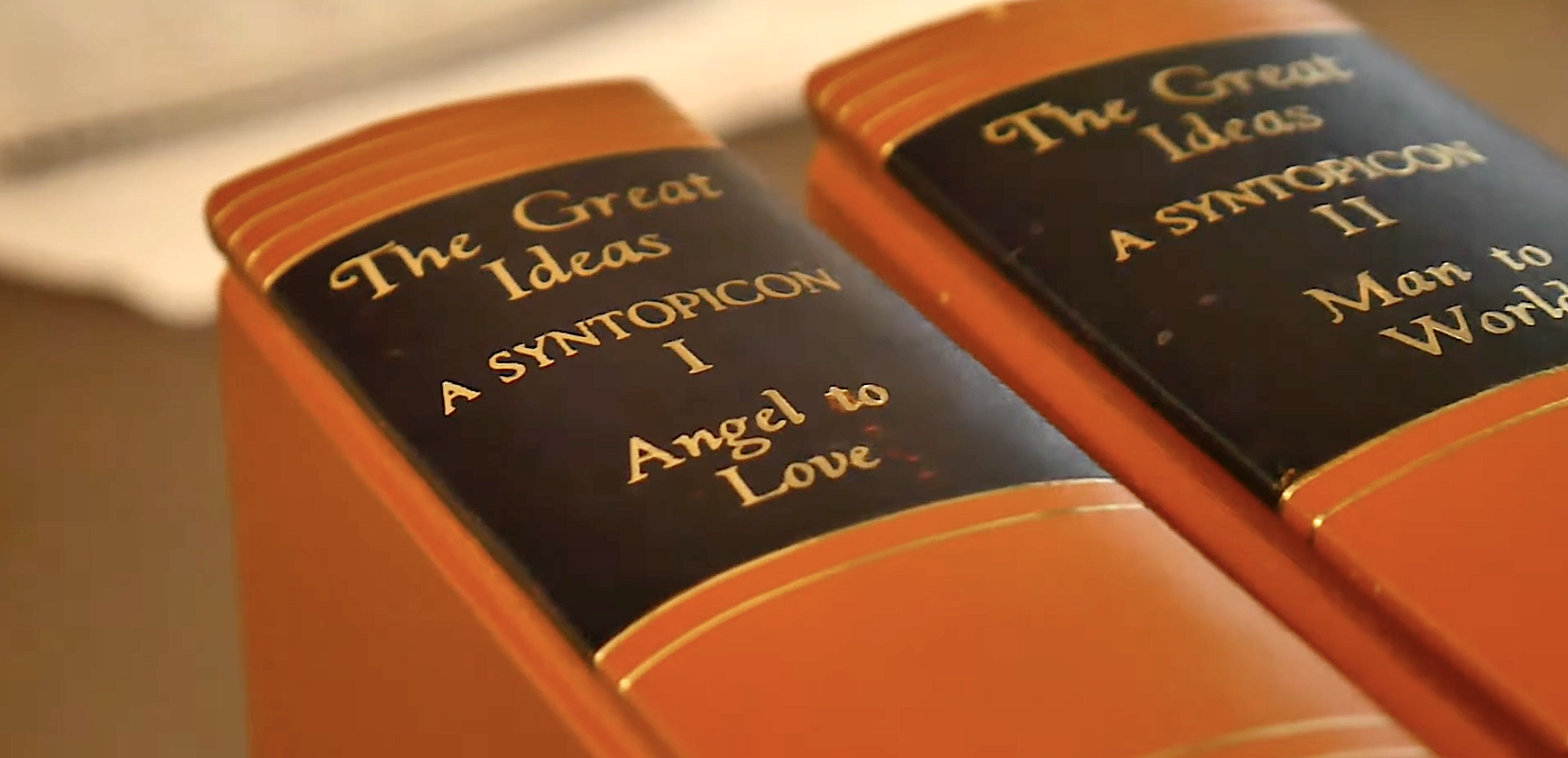
How many of those families regularly pulled their Great Books off the shelf is another matter. Despite having come through an intensive process of curation, they could still look rather imposing as the wall of knowledge they formed all together. To this problem, Adler offered a characteristically ambitious and idiosyncratic solution: a concept-oriented index called the Syntopicon — or rather, “A Syntopicon.”
“He believed these two volumes to be just the ‘assistance’ that the average man needed to dig into the books that formed Western Civilization,” writes Jonathan White, an alumnus of the similarly Western canon-based St. John’s College. They “comprised an exhaustive catalogue of each time one of the 102 ‘Great Ideas of Western Civilization’ was mentioned in the 431 ‘Great Books’ enshrined in Britannica’s collection.”
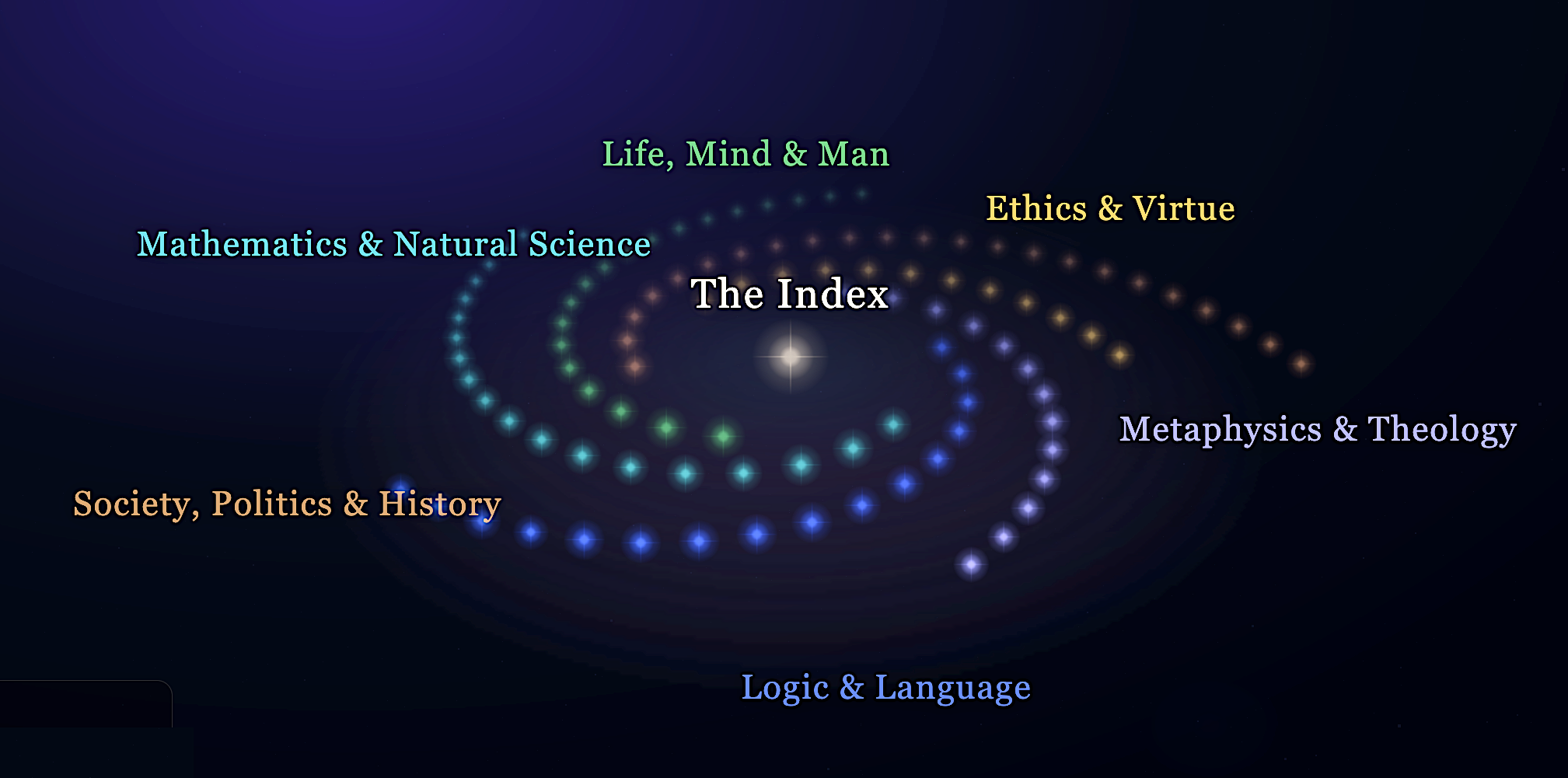
Good and evil, logic and love, pleasure and pain, universal and particular: all the big ideas, at least as Adler defined them, were there in A Syntopicon. Customers reportedly found it unwieldy, but the notion behind it holds out a certain appeal still today. It’s even inspired the launch of Syntopi.com, a digital successor that enables you to navigate “the Great Conversation” in a variety of ways including a 3D visualization and a personal curriculum-creation tool. The Great Books of the Western World’s mid-century readers — professionals and businessmen looking to fill the gaps in their general knowledge, veterans ready to learn more after their G.I. Bill-funded college education, housewives hoping to get a handle on what intelligent people were supposed to know about — could have had fun with it. And we could benefit, no doubt, from rediscovering a little of their earnestly self-improving spirit ourselves. You can view an edition of A Syntopicon on the Internet Archive, or this site.
Related Content:
The Western Canon: From Homer to Milton (Free Course)
The Western Tradition by Eugen Weber: 52 Video Lectures
48 Animated Videos Explain the History of Ideas: From Aristotle to Sartre
The 10 Greatest Books Ever, According to 125 Top Authors (Download Them for Free)
Based in Seoul, Colin Marshall writes and broadcasts on cities, language, and culture. He’s the author of the newsletter Books on Cities as well as the books 한국 요약 금지 (No Summarizing Korea) and Korean Newtro. Follow him on the social network formerly known as Twitter at @colinmarshall.
Read More...Before Bill Nye, There Was Julius Sumner Miller: Watch Complete Episodes of His Classic Science Show, Why Is It So?, Free Online (1962–73)
“We are approaching a darkness in the land. Boys and girls are emerging from every level of school with certificates and degrees, but they can’t read, write or calculate. We don’t have academic honesty or intellectual rigor.” That quote may sound like a familiar lament today, but it’s actually drawn from an interview conducted about half a century ago with the physicist and television host Julius Sumner Miller. If that name sounds familiar to you, there’s a fair chance you’re an Australian who grew up between the sixties and the eighties — and it’s hardly impossible that, thanks to his program Why Is It So?, you went on to pursue a career in science or engineering.
Generations of young viewers down under and elsewhere learned from Why Is It So? that physics and its principles could be fun. Even if you weren’t among them at the time, you can now watch full episodes of the show uploaded to YouTube by ABC, the Australian Broadcasting Corporation.
As you may notice after just a few seconds of listening to him, Miller himself was American. The Massachusetts-born son of immigrants from Latvia and Lithuania, he studied physics at Boston University and thereafter taught and performed research at various institutions (befriending Albert Einstein along the way) before taking a long-term position at El Camino College in Torrance, California in 1952.
Miller’s popularity at El Camino, the school’s proximity to Hollywood, and television’s rapid expansion into a mass medium led to his launching Why Is It So? on KNXT in Los Angeles in 1959. By the mid-sixties, he was also explaining scientific phenomena on Disney’s Mickey Mouse Club, Great Moments in Science, and Science and Its Magic, as well as on Steve Allen’s late-night talk show. He made his debut on Australian television when the University of Sydney brought him out as a visiting lecturer. The appearance went wrong when he couldn’t perform his standard trick of driving a drinking straw through a potato, but what it nevertheless got him — apart from an office filled with the domestic straws he’d jokingly criticized on-air — was a new home for Why Is It So? on ABC.
ABC has so far made available seven full broadcasts originally aired between the early sixties and the early seventies. Despite their black-and-white production and lack of visual effects, they hold up well today in both educational and entertainment value. However engaging his personality as what we would now call a science communicator, it seems that “Miller could be a terror in the classroom,” according to his Los Angeles Times obituary from 1987, “intolerant of misspelled words or misplaced punctuation” and insistent that “most faculty were not rigid enough and that students were not learning enough.” He’d hardly be pleased with what’s happened to intellectual standards in the nearly four decades since his death, but he’d surely appreciate that his teaching continues to reach “everybody ages four to 94,” as he liked to describe his audience. Age, nationality, and even credentials didn’t matter; what counted was genuine curiosity and the willingness to pursue it, whether in the classroom or the living room.
Related Content:
Watch a Young Carl Sagan Appear in His First TV Documentary, The Violent Universe (1969)
Based in Seoul, Colin Marshall writes and broadcasts on cities, language, and culture. He’s the author of the newsletter Books on Cities as well as the books 한국 요약 금지 (No Summarizing Korea) and Korean Newtro. Follow him on the social network formerly known as Twitter at @colinmarshall.
Read More...Harvard’s 1869 Entrance Exam: Could You Answer Tough Questions About Latin, Greek, Ancient History, Plane Geometry & More
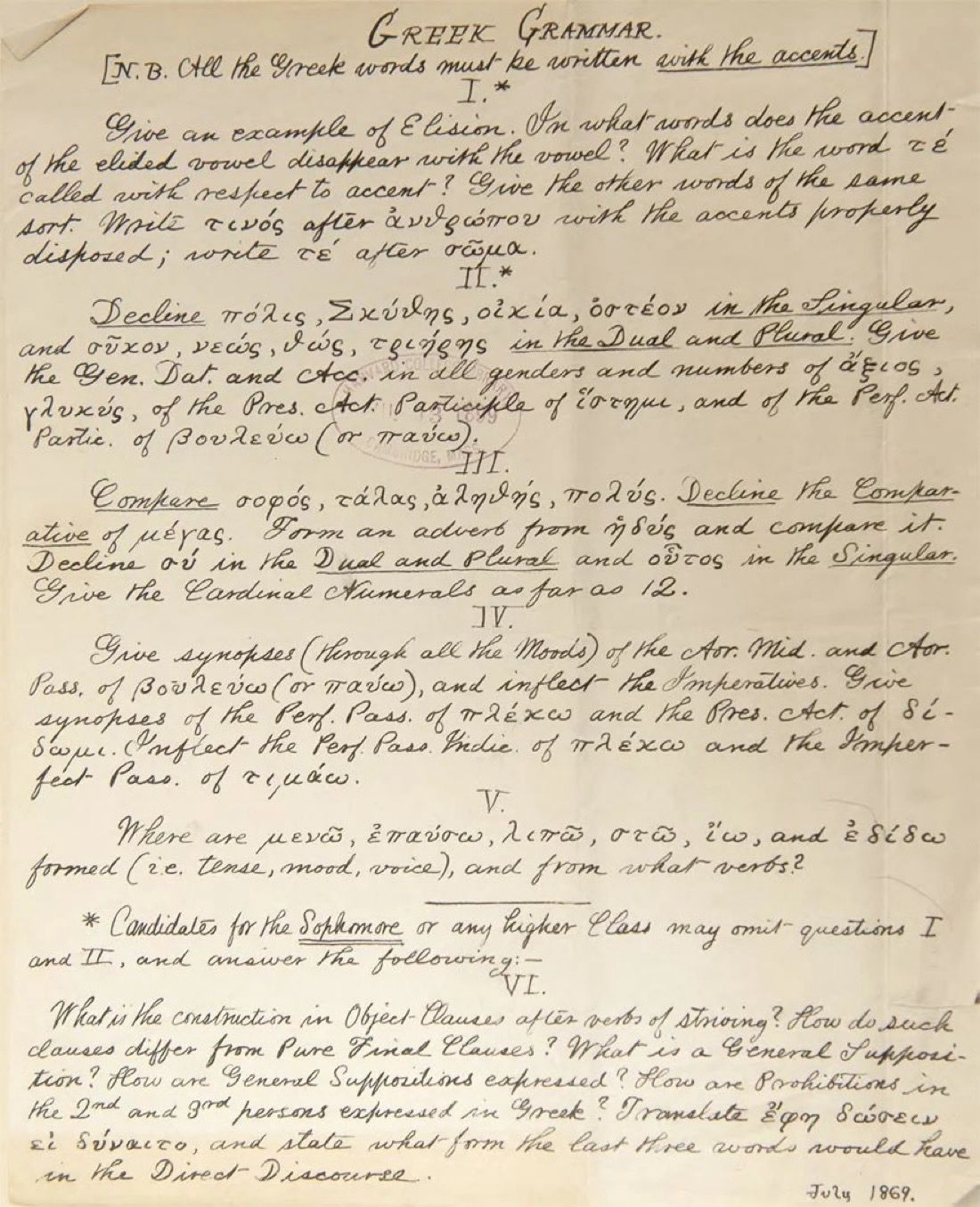
In 2025, Harvard once again began asking applicants to submit an SAT or ACT score. This was a reversal of the no-test-necessary policy that it and quite a few other American colleges and universities adopted during the COVID-19 pandemic. To some observers of higher education, the disappearance of the standardized-test requirement came as a shock, though in a sense, it wasn’t without precedent. Until the mid-nineteen-tens, Harvard had applicants take its own entrance exam, since no standardized test existed. One example from 1869, which you can see here, evaluated students on their proficiency in Latin, Greek, history and geography, arithmetic, algebra, and plane geometry.
The idea wasn’t so much to evaluate the test-taker’s reasoning abilities as to make sure he’d already undergone the expected education for his class. Even so, as the New York Times’ Alison Leigh Cowan notes, “colleges occasionally allowed prospects to correct deficiencies as a condition of admission.”
This reflects the very different role higher education played in American life a century and a half ago than it does today: back then, Harvard admitted 185 out of 210 applicants; last year, it admitted 1,968 out of 57,435. As the country industrialized, colleges and universities changed accordingly: existing ones grew, many new ones appeared, and a greater and greater percentage of students submitted to a process surrounding tertiary education that eventually came to seem machine-like itself.
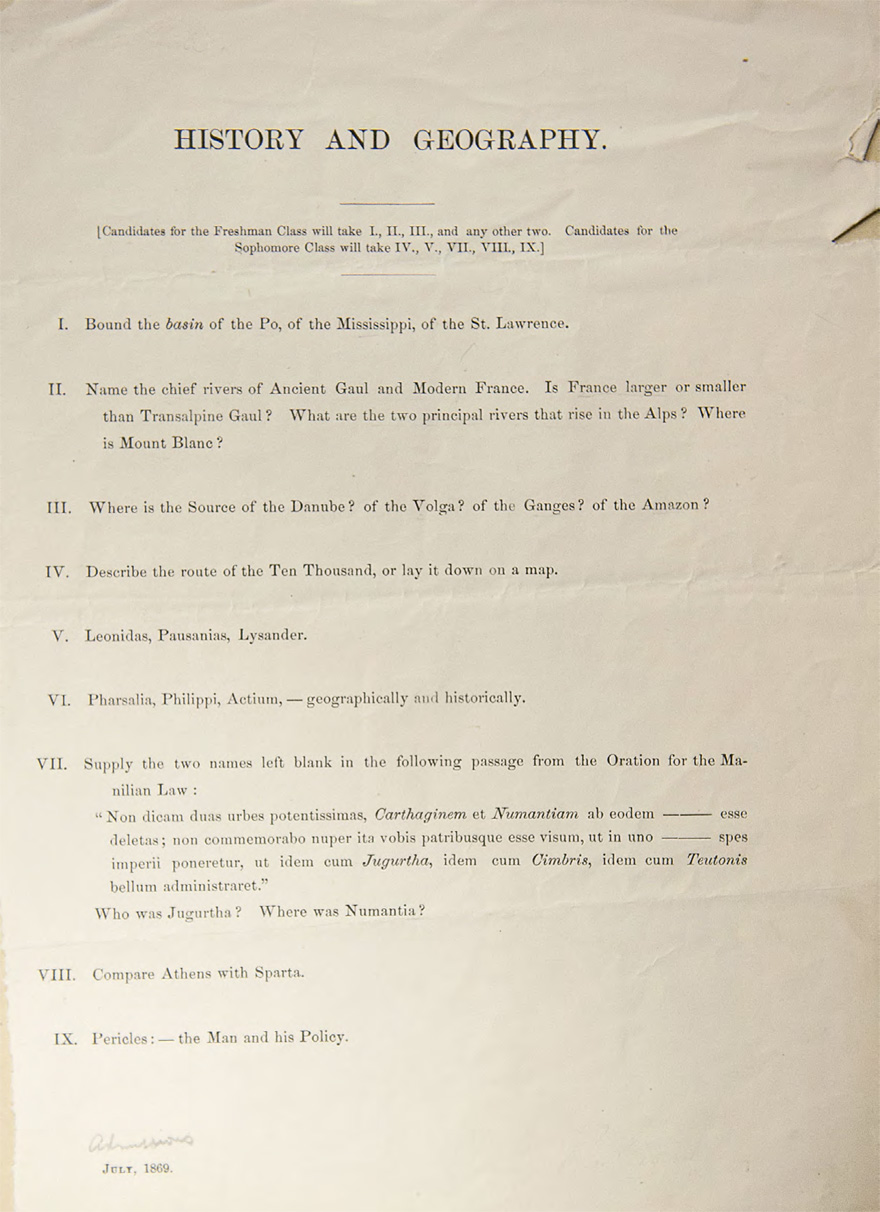
To college-applying students today, the 1869 entrance exam may not look entirely unfamiliar, at least to the extent that it asks questions about mathematics. Chances are, however, that no current Harvard hopeful, no matter how intelligent, could actually pass the test, given the weight it places on classical languages. Throughout the nineteenth century and up until World War I, all young gentlemen got an education in Latin and ancient Greek. But when both started to vanish from college-admissions exams, especially after the SAT grew dominant in the nineteen-forties, so did the immediate incentive to learn them. Reflect though that does the exigencies of a rapidly changing technological society, it also makes one wonder how much someone with no grasp of Latin or Greek really understands English: a question to which the college students of recent decades provide dispiriting answers.
Related Content:
This Is What an 1869 MIT Entrance Exam Looks Like: Could You Have Passed the Test?
Can You Pass This Test Originally Given to 8th Graders Living in Kentucky in 1912?
W.H. Auden’s 1941 Syllabus Asked Students to Read 32 Great Literary Works, Totaling 6,000 Pages
Carl Sagan’s Syllabus & Final Exam for His Course on Critical Thinking (Cornell, 1986)
Based in Seoul, Colin Marshall writes and broadcasts on cities, language, and culture. He’s the author of the newsletter Books on Cities as well as the books 한국 요약 금지 (No Summarizing Korea) and Korean Newtro. Follow him on the social network formerly known as Twitter at @colinmarshall.
Read More...The Largest Bookshelf Tour Ever Filmed: Inside a Classicist’s 20,000-Volume Library
If you grew up in the last few generations, chances are you didn’t get much of an education, if any, in Latin or ancient Greek. One long-made argument for phasing them out of curricula in English-speaking countries holds that room must be made for Spanish, Mandarin, and other languages actually used at scale in the modern world. Nowadays, when even those classes face the pressure of extinction, advocacy for classical languages exudes an ever stronger contrarian appeal. “Dead” though they may be, they also live on through not just the Romance languages, but also the mighty hegemon known as English. Indeed, it makes sense to ask whether an Anglophone without knowledge of Latin or Greek truly understands his own native tongue.
Nor, according to classicist David Butterfield, can one learn Latin without having any Greek. Getting a handle on both of those languages and their surviving body of texts isn’t just the work of a lifetime; it also fills a house, as evidenced by the two-and-a-half-hour video tour of Butterfield’s personal library above. (The subsequent two hours contain Butterfield’s introductions to a selection of particular volumes from his many shelves.) Youtuber Timothy Kenny has previously uploaded quite a few such videos on the collections of serious bibliophiles, but this one he describes as the largest ever attempted, including the complete Loeb Classical Library, I Tatti Renaissance Library, and Pauly-Wissowa encyclopedias.
Yet according to Butterfield himself, a young man by the standards of his profession and specialty, he’s still got a lot of collecting to do. He’s only about 80 percent of the way to a full set of Oxford University Press’ Very Short Introductions, a series through which I’ve been gradually making my own way in recent years. Having found that its books offer “a really good view of whatever the topic or person is,” he decided to “collect all the volumes that interested me. And that emerged to be more than I thought, because I am interested in almost everything.” But with all of us, no matter how broadly curious, some of his interests are stronger than others, as one might expect from a man with the patience to amass a great amount of manuals for writing Greek and Latin prose and verse made for schoolboys (and, often, containing their doodles).
After spending a couple of decades at Cambridge, Butterfield crossed the Atlantic to go from one of the oldest institutions of higher education to one of the very newest. He’s now Provost of and Professor of Latin at Ralston College in Savannah, Georgia, which received its first cohort of students in 2022. With its master’s degree program closely focused on ancient, medieval and modern literature and art considered foundational to Western civilization, it seems like the kind of institution designed to attract someone like Butterfield, who was already winning prizes for his library in or shortly after his college days. “I can’t see myself relaxing until I have accumulated around 10,000 books,” he said in a 2008 interview. His home, as captured in Kenny’s video, now contains double that amount, but the thumos clearly hasn’t deserted him just yet.
Related content:
Watch Umberto Eco Walk Through His Immense Private Library: It Goes On, and On, and On!
Jorge Luis Borges Selects 74 Books for Your Personal Library
Take a Virtual Tour of Jane Austen’s Library
Based in Seoul, Colin Marshall writes and broadcasts on cities, language, and culture. He’s the author of the newsletter Books on Cities as well as the books 한국 요약 금지 (No Summarizing Korea) and Korean Newtro. Follow him on the social network formerly known as Twitter at @colinmarshall.
Read More...Hip 1960s Latin Teacher Translated Beatles Songs into Latin for His Students: Read Lyrics for “O Teneum Manum,” “Diei Duri Nox” & More
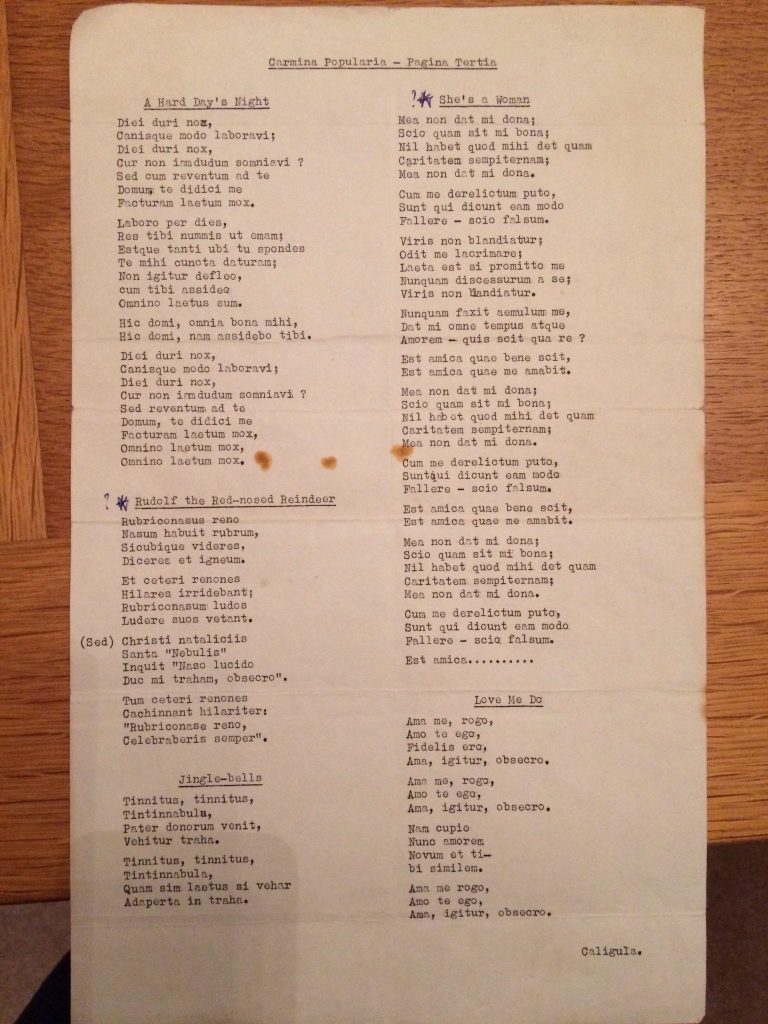
I’ve interacted with many entertaining language-learning resources in various classes—from miniseries in Spanish to comic books in French—all geared toward making the unfamiliar language relevant to daily life. Learning counterintuitive pronunciations, parsing a new system of grammar, or memorizing the genders of word after word can be laborious and intimidating in the classroom. Doing so in everyday pop cultural settings, not as much.
When it comes to the teaching of dead languages, the resources can seem less approachable. I certainly appreciate the literary and rhetorical genius of Virgil, Ovid, Horace, Cicero, and Julius Caesar. But during my high school years, I did not always find their work easy to read in English, much less in formal classical Latin. The elation I felt after successfully translating a passage was sometimes dampened as I puzzled over historical notes and glosses that often left me with more questions than answers.
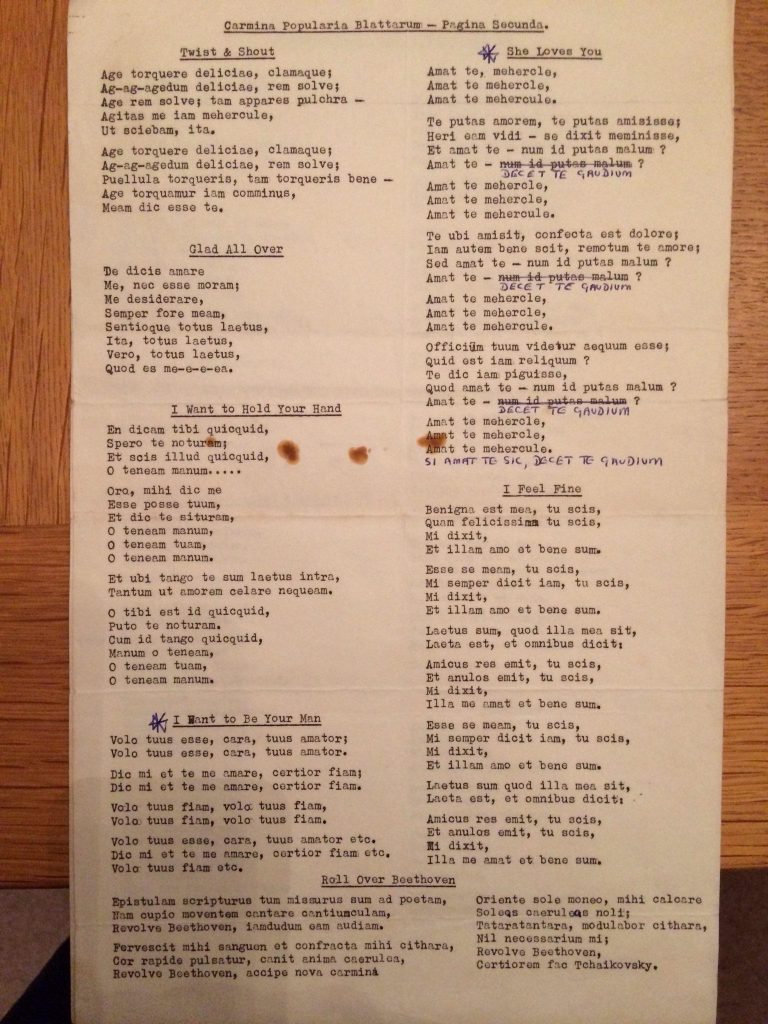
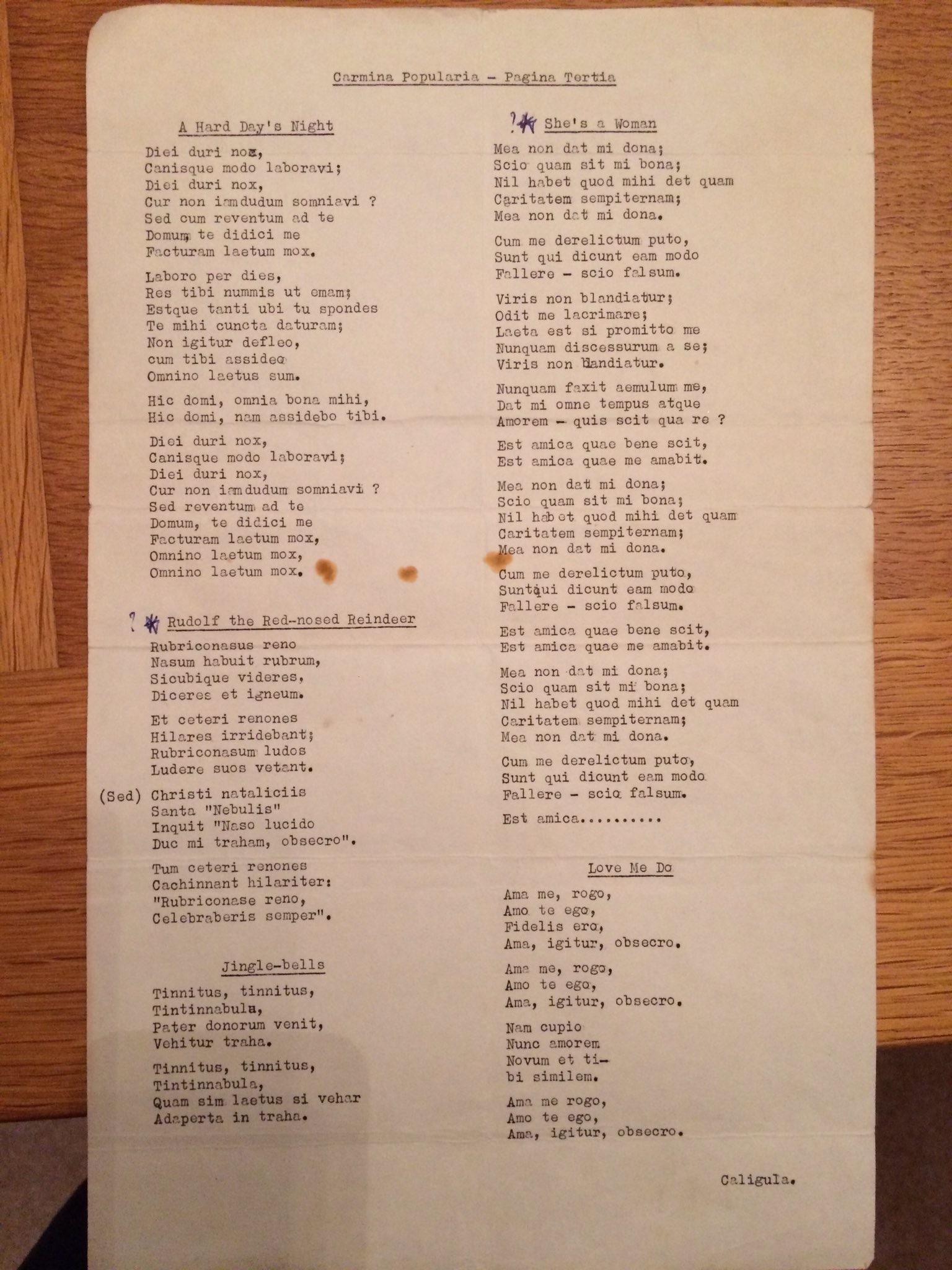
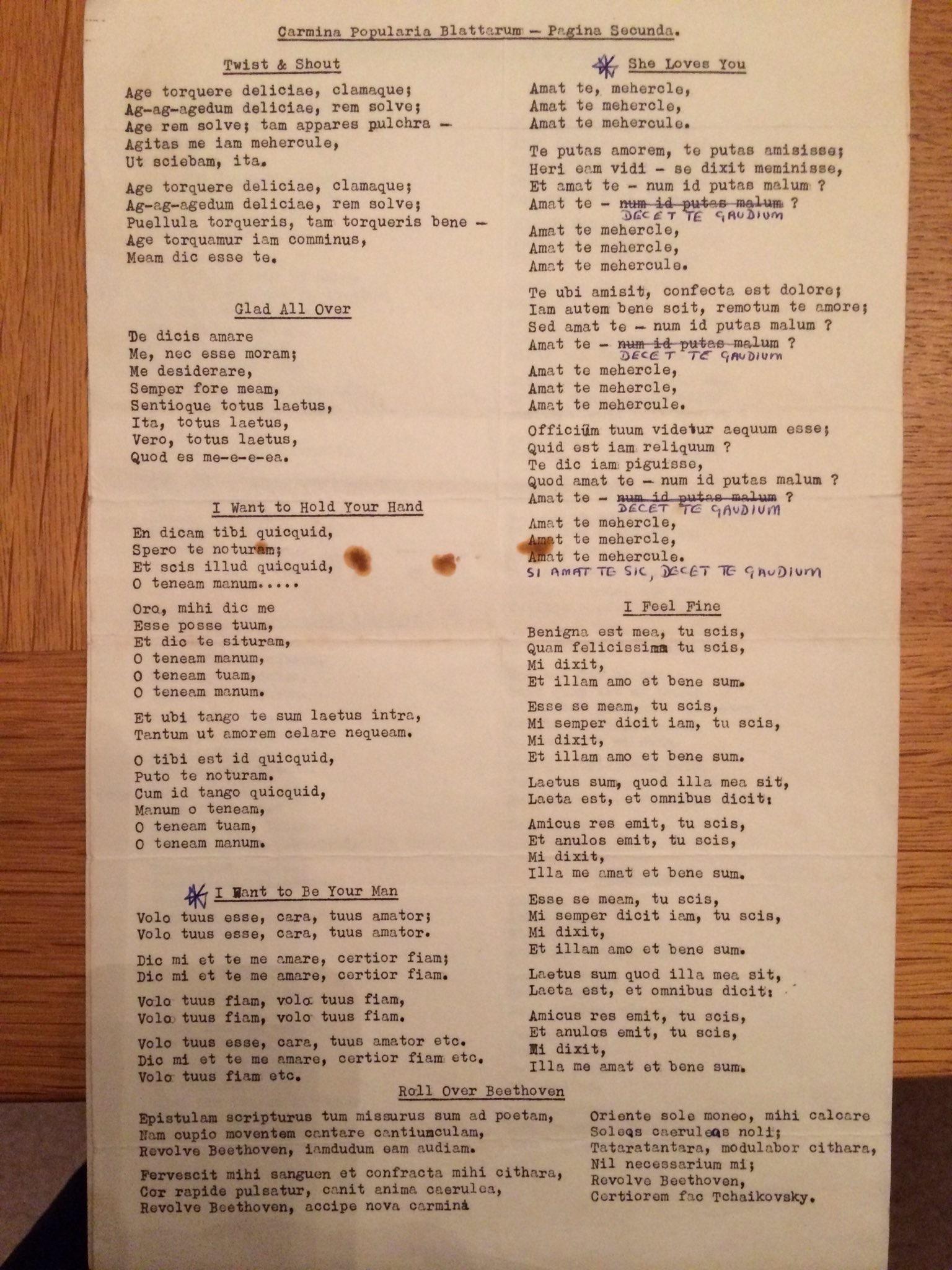
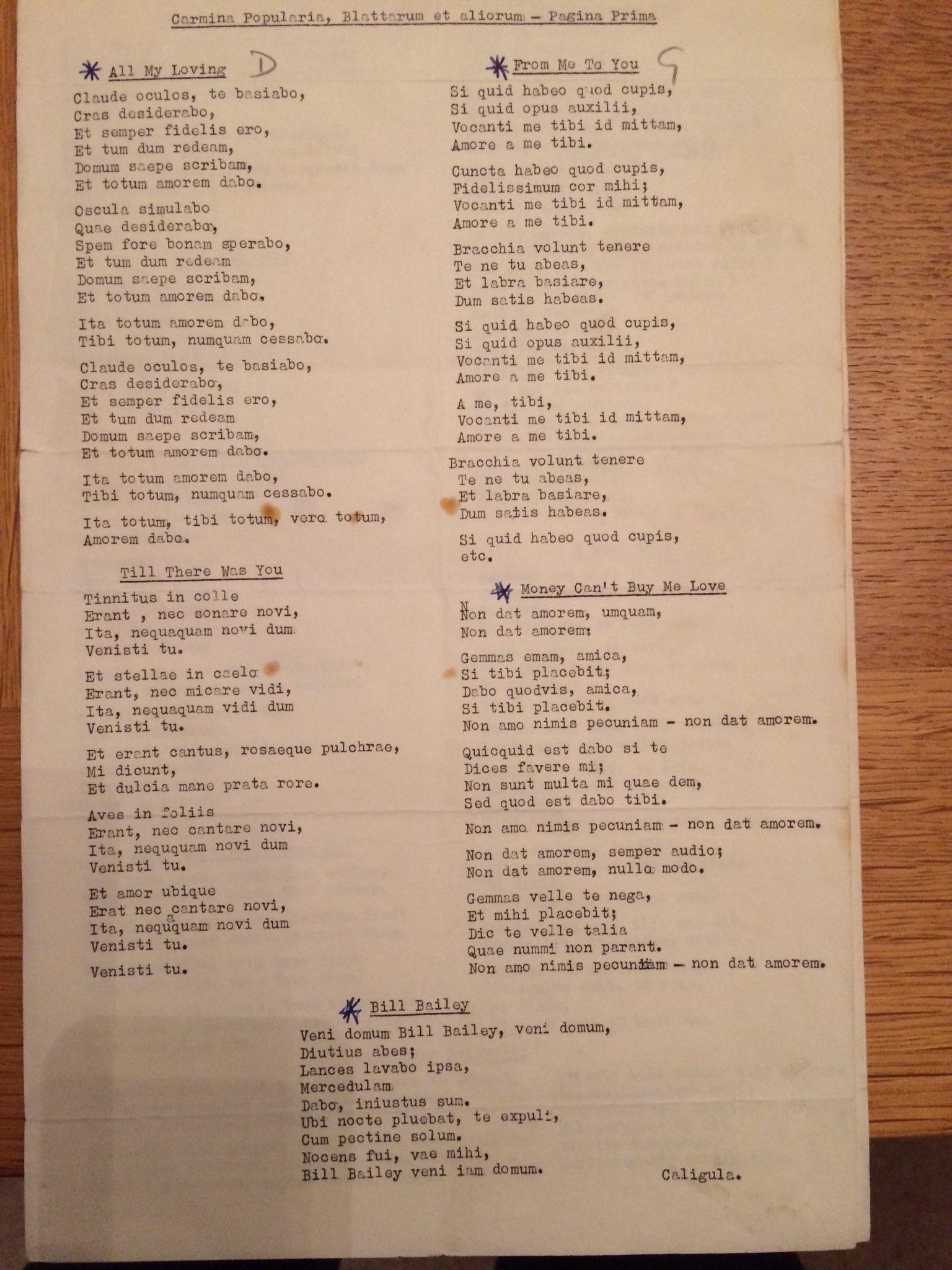
That’s not at all to say that students of Latin shouldn’t be exposed to cultural and historical context or read the finest exemplars of the written language. Only that a break from the heavy stuff now and then goes a long way. Might I submit to Latin instructors one ingenious tool from Eddie O’Hara, former British Labour Party MP and classics teacher? O’Hara passed away in May 2016, and not long after his death, his son Terry O’Hara tweeted these translations of Beatles songs (including two Christmas tunes) his father made in the 60s for his students. At the time, these were the height of pop culture relevance, and, while a far cry from the complexities of the Aeneid, a fun way for Latin learners to relate to a language that can seem cold and imposing.
I will admit, my Latin has fallen into such a state that I can’t immediately vouch for the accuracy or elegance of these translations (“cue fierce arguments among Latin grammarians,” replies one Twitter user), but there’s no reason to doubt Mr. O’Hara knew his stuff. ““He was a born educator,” his son remembers, “He was a teacher and classicist by background and he had a strong interest in educational matters and Greek cultural heritage.” Educated himself at Magdalen College, Oxford, O’Hara taught at Perse School, Cambridge, Birkenhead School, and in the early 70s, C.F. Mott College in the Beatles’ own Liverpool.
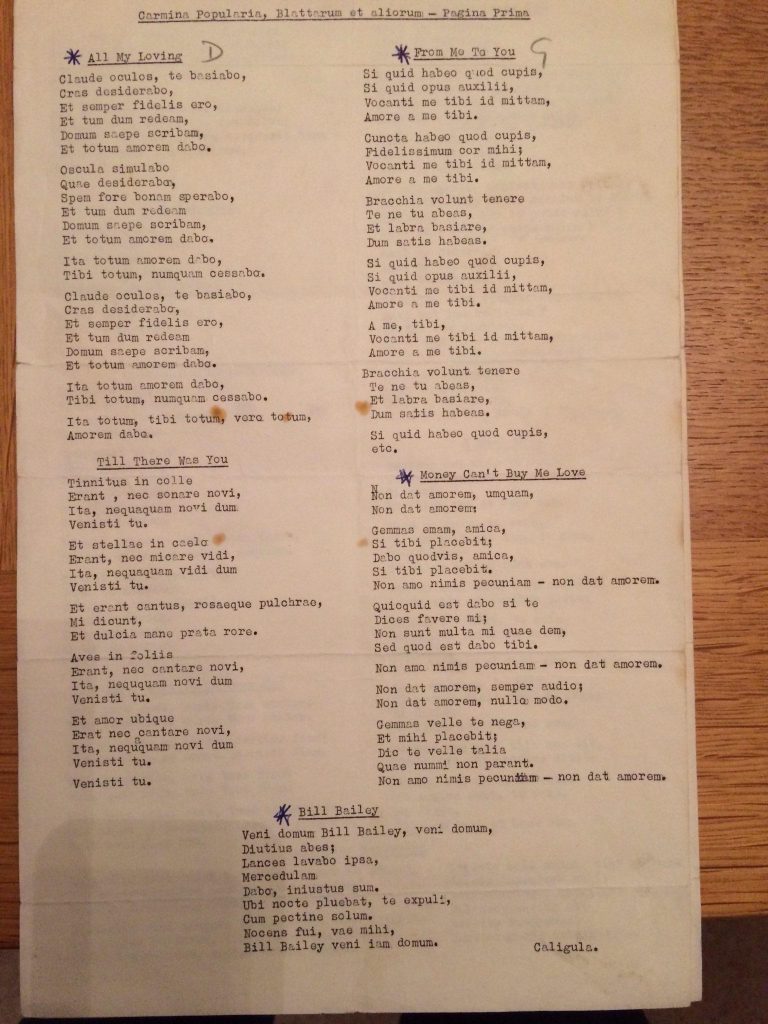
In addition to his role as a statesman, the Liverpool Echo remembers O’Hara’s many decades as “a popular teacher who brought classes to life translating Beatles lyrics into Latin.” We do not have any indication of whether he actually tried to sing the lyrics, though his students surely must have attempted it. What must the chorus of “All My Loving” sound like as “Ita totum amorem dabo, Tibi totum, numquam cessaba”? Or “She Loves You” as “Amat te, mehercle”? Singing them to myself, I can see that O’Hara was sensitive to the meter of the original English in his Latin renderings. But I’d really love to see someone set these to music and make a video. Any of our readers up to the challenge?
Finally, since early sixties Beatles lyrics aren’t as likely to engage students in 2017, what pop cultural material would you translate today—classics teachers out there—to reach the bemused, bewildered, and the bored? If you’re already hard at work using hip resources in the classroom, please do share them with us in the comments!
Note: To view the images in a larger format, please click on the links to these individual images: Image 1 - Image 2 — Image 3. When the image opens, click on it again to zoom in.
Note 2: An earlier version of this post appeared on our site in 2017.
Related Content:
Hear Nirvana’s “Smells Like Teen Spirit” Performed in Classical Latin
Can Modern-Day Italians Understand Latin? A YouTuber Puts It to the Test on the Streets of Rome
They Might Be Giants’ John Linnell Releases an EP of Songs in Latin
The Story of Lorem Ipsum: How Scrambled Text by Cicero Became Used by Typesetters Everywhere
Josh Jones is a writer and musician based in Durham, NC.
Read More...The Most Influential Philosophers Explained in 26 Minutes: From Socrates to Wittgenstein
The question of who are the fifteen most influential philosophers of all time may not arise at every conversation down at the pub — not outside the circle of Open Culture readers, in any case. But even among non-specialists, it could spark a livelier debate than you might imagine. Names like Socrates, Aristotle, Descartes, and Marx are known, after all, even among the general public who’ve never read a page of philosophical text. All of them appear in the million-viewed video from Jaydone History above, which takes its own crack at naming a top fifteen. Its 26 minutes also provide a brief biographical sketch of each one, informative if littered with odd mispronunciations, plus a capsulized sense of these philosophers’ lasting ideas.
In pursuit of truth, Socrates created the questioning method of dialogue that bears his name. Plato, Socrates’ student, advocated for rule by the enlightened and the pursuit of knowledge through the contemplation of pure forms. Rejecting Plato’s method, Aristotle dedicated himself to systematic empirical observation. On the other side of the world, Confucius spread teachings about the cultivation of moral virtue to maintain the social relationships he saw as the basic building blocks of civilizational order, which China eventually adopted as its state philosophy. Back in Europe, Augustine synthesized Christian theology and classical philosophy, laying the groundwork for medieval thought. Thomas Aquinas, too, dedicated himself to a combination of faith and reason, making a suite of oft-cited arguments for the existence of God.
Seeking a foundation of absolutely certain knowledge, René Descartes arrived at self-awareness, famously declaring, “I think, therefore I am” and articulating his eponymous dualistic worldview. Even apart from his work on the nature of knowledge, John Locke’s thoughts on social organization and government live on in Enlightenment-influenced modern democracies even today. David Hume mounted fundamental challenges to established ideas of empiricism, questioning our very notion that future events will mirror past experience. Jean-Jacques Rousseau introduced the conception of legitimate political authority as arising from the “general will,” a social agreement among free and equal individuals, which turned out to be central to the justifications of the French Revolution. Immanuel Kant worked to bridge the gap between rationalism and empiricism, reconciling the role of both experience and the mind’s physical structure to the formation of knowledge.
Among other concepts, Georg Wilhelm Friedrich Hegel defined that of dasein, which encapsulates the human mode of being (and which requires a lifetime spent with his writings to grasp, if even then). A professional journalist and historian, Karl Marx described human history through economic structures and class struggle, and his vision of a perfectly equal society ahead still remains compelling to many. Friedrich Nietzsche declared that “God is dead,” placing the burden of defining morality on man, and specifically a figure he called the Übermensch. Ludwig Wittgenstein took it upon himself to explain the relationship between language and reality with the highest rigor. In the comments, the video’s creator teases a part two, which makes one wonder which philosophers will be included: Spinoza? Heidegger? Sartre? The year and a half it’s taken so far is surely long enough for the narrator to have learned to pronounce them.
Related content:
Free Online Philosophy Courses
Bryan Magee’s In-Depth, Uncut TV Conversations With Famous Philosophers (1978–87)
28 Important Philosophers List the Books That Influenced Them Most During Their College Days
The Daily Habits of Highly Productive Philosophers: Nietzsche, Marx & Immanuel Kant
The 20 Most Influential Academic Books of All Time: No Spoilers
Based in Seoul, Colin Marshall writes and broadcasts on cities, language, and culture. He’s the author of the newsletter Books on Cities as well as the books 한국 요약 금지 (No Summarizing Korea) and Korean Newtro. Follow him on the social network formerly known as Twitter at @colinmarshall.
Read More...9 Things a Woman Couldn’t Do in 1971
More than a century after women’s suffrage in the United States, it’s not enough to bone up on the platforms of female primary candidates (though that’s an excellent start).
A Twitter user and self-described Old Crone named Robyn urged her fellow Americans to take a good long gander at a list of nine freedoms that women in the United States were not universally granted in 1971, the year Helen Reddy released the soon-to-be anthem, “I Am Woman,” above.
Even those of us who remember singing along as children may experience some shock that these facts check out on Snopes.
- CREDIT CARDS: Prior to the Equal Credit Opportunity Act of 1974, married women couldn’t get credit cards without their husbands’ signatures. Single women, divorcees, and widows were often required to have a man co-sign. The double standard also meant female applicants were frequently issued card limits up to 50% lower than that of males who earned identical wages.
- PREGNANT WORKERS: The Pregnancy Discrimination Act of 1978 protected pregnant women from being fired because of their impending maternity. But it came with a major loophole that’s still in need of closing. The language of the law stipulates that employers must accommodate pregnant workers only if concessions are being made for other employees who are “similar in their ability or inability to work.”
- JURY DUTY: In 1975, the Supreme Court declared it constitutionally unacceptable for states to deny women the opportunity to serve on juries. This is an arena where we’ve all come a long way, baby. It’s now completely normal for men to be excused from jury duty as the primary caregivers of their young children.
- MILITARY COMBAT: In 2013, former Secretary of Defense Leon Panetta and former Chairman of the Joint Chiefs of Staff, General Martin Dempsey announced that the Pentagon was rescinding the direct combat exclusion rule that barred women from serving in artillery, armor, infantry and other such battle roles. At the time of the announcement, the military had already seen more than 130 female soldiers killed, and 800 wounded on the front lines in Iraq and Afghanistan.
- IVY LEAGUE ADMISSIONS: Those who conceive of elite colleges as breeding grounds for sexual assault protests and Title IX activism would do well to remember that Columbia College didn’t admit women until 1983, following in the marginally deeper footsteps of others in the Ivy League—Harvard (1977), Dartmouth (1972), Brown (1971), Yale (1969), and Princeton (1969). These days, single-sex higher education options for women far outnumber those for men, but the networking power and increased earning potential an Ivy League degree confers remain the same.
- WORKPLACE HARASSMENT: In 1977, women who’d been sexually harassed in the workplace received confirmation in three separate trials that they could sue their employers under Title VII of the 1964 Civil Rights Act. In 1998, the Supreme Court ruled that same-sex harassment was also unlawful. In between was the television event of 1991, Anita Hill’s shocking testimony against her former boss, U.S. Supreme Court justice (then nominee) Clarence Thomas.
- SPOUSAL CONSENT: In 1993, spousal rape was officially outlawed in all 50 states. Not tonight honey, or you’ll have a headache in the form of your wife’s legal backup.
- HEALTH INSURANCE: In 2010, the Patient Protection and Affordable Care Act decreed that any health insurance plan established after March of that year could not charge women higher premiums than men for identical benefits. This was bad news for women who got their health insurance through their jobs, and whose employers were grandfathered into discriminatory plans established prior to 2010. Of course, that’s all ancient history now.
- CONTRACEPTIVES: In 1972, the Supreme Court made it legal for all citizens to possess birth control, irrespective of marital status, stating “if the right of privacy means anything, it is the right of the individual, married or single, to be free from unwarranted governmental intrusion into matters so fundamentally affecting a person as the decision whether to bear or beget a child.” (It’s worth noting, however, that in 1972, states could still constitutionally prohibit and punish sex outside of marriage.)
Feminism is NOT just for other women.
Note: An earlier version of this post appeared on our site in 2019.
Related Content:
No Women Need Apply: A Disheartening 1938 Rejection Letter from Disney Animation
How the Bicycle Accelerated the Women’s Rights Movement (Circa 1890)
Odd Vintage Postcards Document the Propaganda Against Women’s Rights 100 Years Ago
Ayun Halliday is an author, illustrator, and theater maker in NYC.
Read More...Discover the Retirement Home for Elderly Musicians Created by Giuseppe Verdi: Created in 1899, It Still Lives On Today
Among my works, the one I like best is the Home that I have had built in Milan for accommodating old singers not favored by fortune, or who, when they were young did not possess the virtue of saving. Poor and dear companions of my life!
—Giuseppe Verdi
Is there a remedy for the isolation of old age?
What about the jolly fraternity and competitiveness of an art college dorm, as envisioned by opera composer Giuseppe Verdi?
Shortly before his death, the composer donated all royalties from his operas to the construction and administration of a luxurious retreat for retired musicians, designed by his librettist’s brother, architect Camillo Boito.
Completed in 1899, Casa Verdi still serves elderly musicians today—up to 60 at a time. Residents of Casa Verdi include alumnae of the Metropolitan Opera and the Royal Opera House. Guests have worked alongside such notables as Chet Baker and Maria Callas.
Competition for residential slots is stiff. To qualify, one must have been a professional musician or music teacher. Those selected enjoy room, board, and medical treatment in addition to, writes The New York Times, “access to concerts, music rooms, 15 pianos, a large organ, harps, drum sets and the company of their peers.” Musical programming is as constant as the fine view of Verdi’s grave.
Dining tables are named in honor of Verdi’s works. Those inclined to worship do so in a chapel named for Santa Cecilia, the patron saint of musicians.
Practice rooms are alive with the sound of music and criticism. As Casa Verdi’s music therapist told the Financial Times, “They are very competitive: they are all prima donnas.”
When memory fails, residents can tune in to such documentaries as actor Dustin Hoffman’s Tosca’s Kiss, below
Get a peek inside Verdi’s retirement home for artists, compliments of Urban Sketchers here.
Note: An earlier version of this post appeared on our site in 2018.
Related Content:
How a Dutch “Dementia Village” Improves Quality of Life with Intentional Design
How Music Can Awaken Patients with Alzheimer’s and Dementia
Ayun Halliday is an author, illustrator, and theater maker in NYC.
Read More...An Introduction to Brutalism: The Iconic Postwar Architectural Style That Combined Utopianism and Concrete
The artificial language of Esperanto was conceived with high ideals in mind. In the eighteen-eighties, its creator L. L. Zamenhof envisioned it as the universal second language of humanity, and if it hasn’t achieved that status by now, it at least remains the world’s most widely spoken constructed auxiliary language. One factor complicating its spread is that no language, even one guided by internationalism, can remain the same for long enough in two different cultures. As in spoken and written languages, so in the concrete one of architecture — and in the case of the style known as Brutalism, that would be literal concrete. Meant to make humanity whole again after the Second World War, its buildings ended up being rather more particular, and less utopian, than their architects intended.
Examples aplenty appear in the new video above from Built Narrative, which offers what amounts to a postcard tour of Brutalist (and Brutalism-adjacent) buildings from around the world. Named for its main material béton brut, or raw concrete, the style came into its own during the rebuilding of war-ruined sections of British and continental European cities — and, over in the U.S., the rapid proliferation and expansion of college campuses — which had to be done quickly and under less-than-extravagant budgets.
Libraries, research facilities, city halls, administrative buildings, courthouses, housing projects: these are the sorts of structures that most often took Brutalist form in the nineteen-fifties, sixties, and seventies, resulting in the institutional, bureaucratic, and in some places totalitarian associations it still has today.
Some publicly loathed Brutalist buildings, like the Tricorn Centre in Portsmouth and the Third Church of Christ, Scientist in Washington, D.C. have been torn down, often after decades of negligent maintenance. Others, like the Barbican Estate in London or Habitat 67 in Montreal, are now beloved sites of pilgrimage. Widely acknowledged masters of Brutalism include Le Corbusier, who pioneered it with buildings like the Unité d’Habitation in Marseille (not Berlin, contra the caption in the video) and Kenzo Tange (pronounced “tawn-gay,” not “tang” as the narrator says it), whose work steered the Japanese version of the movement in its own subtle, sometimes playful directions. Now, thanks in part to the rapid diffusion of architectural photography made possible by social media, a new enthusiast of Brutalism seems to be born every minute. Even if they don’t believe that architecture can bring a new world into being, they still feel the pull of a future that never came — or, at any rate, hasn’t come yet.
Related Content:
Why People Hate Brutalist Buildings on American College Campuses
Why Do People Hate Modern Architecture?: A Video Essay
Goodbye to the Nakagin Capsule Tower, Tokyo’s Strangest and Most Utopian Apartment Building
Based in Seoul, Colin Marshall writes and broadcasts on cities, language, and culture. He’s the author of the newsletter Books on Cities as well as the books 한국 요약 금지 (No Summarizing Korea) and Korean Newtro. Follow him on the social network formerly known as Twitter at @colinmarshall.
Read More...Support Us
We're hoping to rely on loyal readers, rather than erratic ads. Please click the Donate button and support Open Culture. You can use Paypal, Venmo, Patreon, even Crypto! We thank you!

About Us

Open Culture scours the web for the best educational media. We find the free courses and audio books you need, the language lessons & educational videos you want, and plenty of enlightenment in between.
Advertise With Us
FREE UPDATES!
GET OUR DAILY EMAIL
Get the best cultural and educational resources on the web curated for you in a daily email. We never spam. Unsubscribe at any time.
FOLLOW ON SOCIAL MEDIA
Open Culture editor Dan Colman scours the web for the best educational media. He finds the free courses and audio books you need, the language lessons & movies you want, and plenty of enlightenment in between.
Advertise With Us