Rare Recordings of Burroughs, Bukowski, Ginsberg & More Now Available in a Digital Archive Created by the Maryland Institute College of Art (MICA)
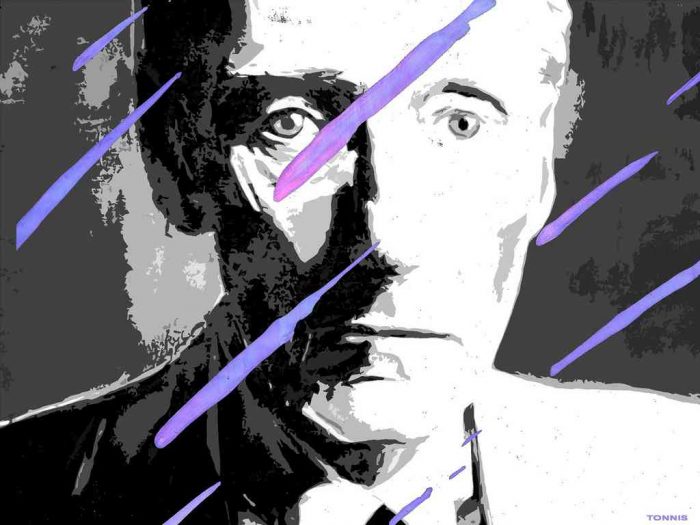
Image via Christiaan Tonnis
Americans can be quite ignorant of the richness of our country’s cultural history. Part of this ignorance, I suspect, comes down to prejudice. Innovative American artists throughout history have come from groups often demonized and marginalized by the wider society. The dominance of corporate commerce also impoverishes the cultural landscape. Poetry and experimental art don’t sell much, so some people think they have little value.
Imagine if we were to invert these attitudes in public opinion: American poetry and art allow us to gain new perspectives from people and parts of the country we don’t know well; to enlarge and challenge our religious and political understanding; to experience a very different kind of economy, built on aesthetic invention and free intellectual enterprise rather than supply, demand, and profit. Creativity and finance are not, of course, mutually exclusive. But to consistently favor one at the expense of the other seems to me a great loss to everyone.
We find ourselves now in such a situation, as public universities, the National Endowment for the Arts, the National Endowment for the Humanities, and the Corporation for Public Broadcasting face severe cuts or possible de-funding.
Such a political move would devastate many of the institutions that foster and preserve the country’s art and culture, and relegate the arts to the private sphere, where only sums of private money determine whose voices get heard. We can, however, be very appreciative of private institutions who make their collections public through open access libraries like the Internet Archive.
One such collection comes from the Digital Initiatives Unit of Decker Library at the Maryland Institute College of Art (MICA), one of the oldest art colleges in the U.S., and one of the most highly regarded. They have digitally donated to Archive.org “a number of rare and previously unreleased audio recordings,” they write in a press release, “spanning the 1960s through the late 1990s” and consisting of “over 700 audiocassette tapes” documenting “literature and poetry readings, fine art and design lectures, race and culture discussions” and college events.
These include (enter the archive here) a two hour poetry reading from Allen Ginsberg in 1978, at the top, with several other readings and talks from Ginsberg in the archive, the reading below it from Eileen Myles in 1992, and readings and talks above and below from Amiri Baraka, Anne Waldman, and William S. Burroughs. The collection represents a “strong focus on literature and poetry,” and features “a symposium on the Black Mountain poets.” Given the school’s mission, you’ll also find in the archive “a large selection of talks and lectures by visual artists, such as Elaine de Kooning, Alice Neel, Gordon Parks, Ad Rhinehart and Ben Shahn.”
Collections like this one from MICA and the Internet Archive allow anyone with internet access to experience in some part the breadth and range of American art and poetry, no matter their level of access to private institutions and sources of wealth. But the internet cannot fully replace or supplant the need for publicly funded arts initiatives in communities nationwide.
Related Content:
An 18-Hour Playlist of Readings by the Beats: Kerouac, Ginsberg & Even Bukowski Too
13 Lectures from Allen Ginsberg’s “History of Poetry” Course (1975)
Josh Jones is a writer and musician based in Durham, NC. Follow him at @jdmagness
Read More...“Calling Bullshit”: See the Syllabus for a College Course Designed to Identify & Combat Bullshit
Two professors at the University of Washington, Carl Bergstrom and Jevin West, have created a website meant to accompany a potential college seminar entitled “Calling Bullshit.” Here’s how Bergstrom and West explain the premise of their course. It’s worth quoting them at length.
The world is awash in bullshit. Politicians are unconstrained by facts. Science is conducted by press release. Higher education rewards bullshit over analytic thought. Startup culture elevates bullshit to high art. Advertisers wink conspiratorially and invite us to join them in seeing through all the bullshit — and take advantage of our lowered guard to bombard us with bullshit of the second order. The majority of administrative activity, whether in private business or the public sphere, seems to be little more than a sophisticated exercise in the combinatorial reassembly of bullshit.
We’re sick of it. It’s time to do something, and as educators, one constructive thing we know how to do is to teach people. So, the aim of this course is to help students navigate the bullshit-rich modern environment by identifying bullshit, seeing through it, and combating it with effective analysis and argument.
What do we mean, exactly, by the term bullshit? As a first approximation, bullshit is language, statistical figures, data graphics, and other forms of presentation intended to persuade by impressing and overwhelming a reader or listener, with a blatant disregard for truth and logical coherence.
While bullshit may reach its apogee in the political domain, this is not a course on political bullshit. Instead, we will focus on bullshit that comes clad in the trappings of scholarly discourse. Traditionally, such highbrow nonsense has come couched in big words and fancy rhetoric, but more and more we see it presented instead in the guise of big data and fancy algorithms — and these quantitative, statistical, and computational forms of bullshit are those that we will be addressing in the present course.…
Our aim in this course is to teach you how to think critically about the data and models that constitute evidence in the social and natural sciences.
The “Calling Bullshit” course would sit nicely alongside the work of Princeton philosopher Harry Frankfurt, the author of the fairly recent book, On Bullshit. (In fact, On Bullshit would be read during Week 1 of the “Calling Bullshit“course. See the syllabus here.) There’s a lot of bullshit freely flowing through our world, and it may well take a cross-disciplinary team to help us cut through the crap.
To learn more about the envisioned Calling Bullshit course, visit Bergstrom and West’s website, where they have an FAQ that explains what a study of bullshit might look like.
Update: You can now view the lectures for the course here.
Note: You can download Harry Frankfurt’s “On Bullshit” as a free audiobook (or any other two free audiobooks) if you sign up for Audible.com’s free trial program. Learn more about Audible’s free trial program here.
If you would like to support the mission of Open Culture, consider making a donation to our site. It’s hard to rely 100% on ads, and your contributions will help us continue providing the best free cultural and educational materials to learners everywhere. You can contribute through PayPal, Patreon, and Venmo (@openculture). Thanks!
Related Content:
How to Spot Bullshit: A Primer by Princeton Philosopher Harry Frankfurt
1,700 Free Online Courses from Top Universities
Read More...Carl Sagan’s Ambitious College Reading List: Plato, Shakespeare, Gide, and Plenty of Philosophy, Math & Physics (1954)
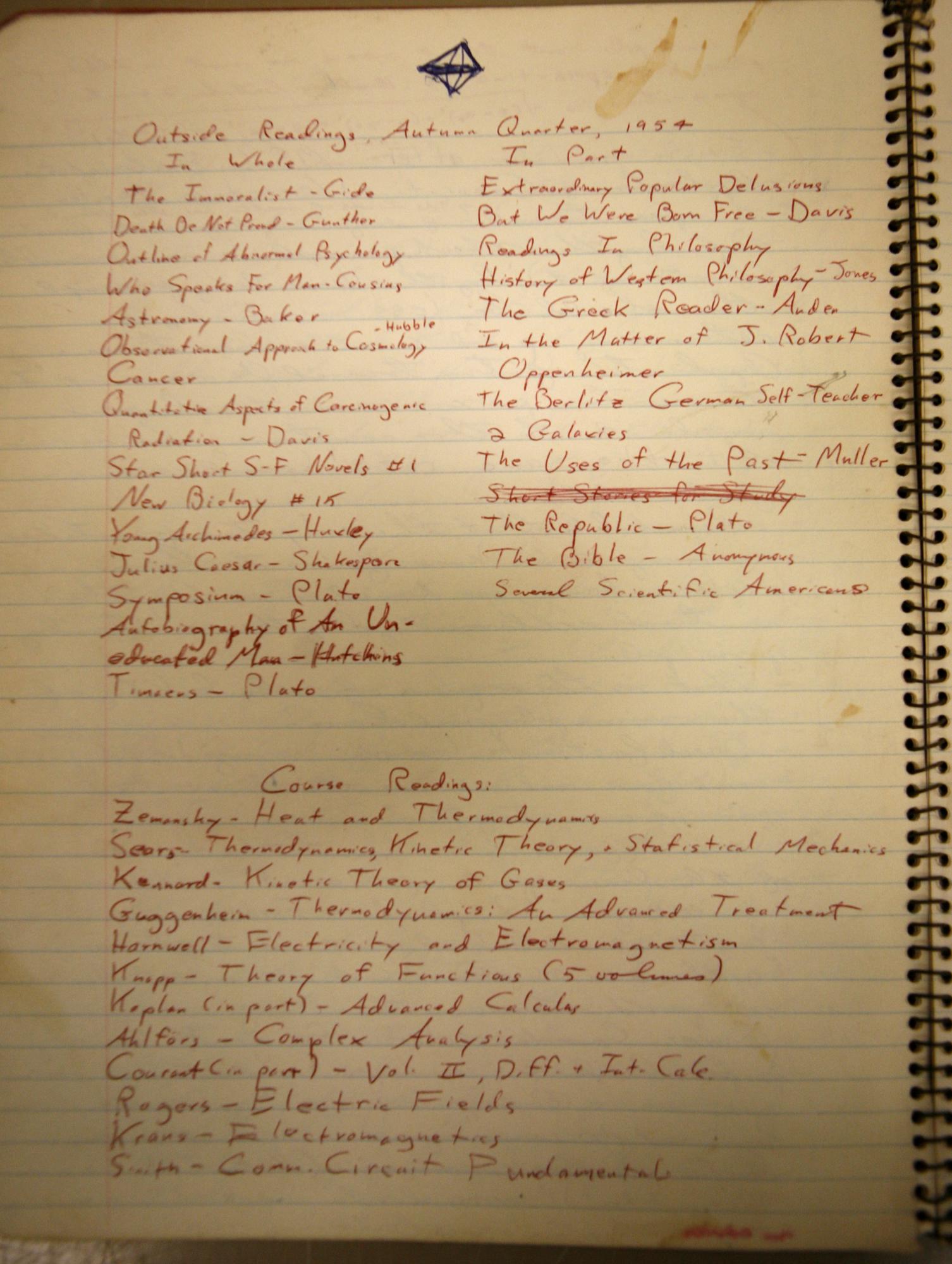
Carl Sagan may have passed away almost twenty years ago, but he continues to influence minds of all generations through intellectual heirs like Neil DeGrasse Tyson (host of the remake of Sagan’s beloved 1980 TV series Cosmos) as well as through the books he wrote in his lifetime. But what books influenced Sagan, launching him on the journey toward astronomy, cosmology, astrophysics, astrobiology, and global celebrity? Thanks to the Library of Congress’ Carl Sagan Archive, we now know at least forty titles from the no doubt voluminous amount of reading material he digested during his youth and education.
Sagan wrote this reading list (which a fan has transcribed with links and posted to Reddit) in 1954, as an undergraduate at the University of Chicago. On it he identifies the books, as a young Charles Darwin once wrote on his own list, to be read, whether wholly, partially, or as a part of his coursework:
In Whole
- The Immoralist — Andre Gide
- Death, Be Not Proud — John Gunther
- Outline of Abnormal Psychology - Gardner Murphy
- Who Speaks For Man — Norman Cousins
- Astronomy — Robert Baker
- Observational Approach to Cosmology — Robert Hubble
- Cancer
- Quantitative Aspects of Carcinogenic Radiation — Harold Thayer Davis
- Star Short Science Fiction Novels #1
- New Biology #15
- Young Archimedes — Aldous Huxley
- Julius Caesar — Shakespeare
- Symposium — Plato
- Autobiography of An Uneducated Man — Hutchins
- Timaeus — Plato
In Part
- Extraordinary Popular Delusions — Charles MacKay
- But We Were Born Free — Elmer Davis
- Readings In Philosophy
- History of Western Philosophy — W.T. Jones
- The Greek Reader — W.H. Auden
- In the Matter of J. Robert Oppenheimer
- The Berlitz German Self-Teacher
- Sigma Galaxies
- The Uses of the Past — Herbert J. Muller
- Short Stories for Study
- The Republic — Plato
- The Bible — Anonymous
- Several Scientific Americans
Course Readings:
- Heat and Thermodynamics - Mark Waldo Zemansky
- Thermodynamics, Kinetic Theory, Statistical Theory - Francis W. Sears
- Kinetic Theory of Gases — E.H. Kennard
- Thermodynamics: An Advanced Treatment — E.A. Guggenheim
- Electricity and Electromagnetism — Hornwell
- Theory of Functions (5 Volumes) — Konrad Knopp
- Advanced Calculus (in part) — Wilfred Kaplan
- Complex Analysis — Lars Ahlfors
- Vol. II, Differential and Integral Calculus — Richard Courant (Author)
- Electric Fields — Rugers
- Electromagnetics — John Daniel Kraus
- Communication Circuit Fundamentals — Carl Edwin Smith
Pretty ambitious material for a twenty-year-old, but remember: we’re talking about someone who, around a decade earlier, had already sketched out his ideas for humanity’s spacefaring future. It makes sense that such a child would grow up to read science fiction — and with the publication of Contact thirty years after that, write it — and even that he would take up mathematics and physics as a course of academic study.
But it takes a mind like Sagan’s not to lose sight of the importance of communicating with the nonspecialist public, as evidenced by the presence on his list of Scientific American and Extraordinary Popular Delusions. Nor did he neglect, even before his career began, the need to contextualize scientific discoveries in the realm of human thought and feeling, which extends from Plato and the Bible to Shakespeare, André Gide, and John Gunther — that last writer’s work, and certain other volumes on his list, also showing an advanced consciousness of human limitations and mortality. All of it placed Sagan well, despite his truncated time on Earth, to do work that will outlast us all.
Related Content:
See Carl Sagan’s Childhood Sketches of The Future of Space Travel
Carl Sagan Presents His “Baloney Detection Kit”: 8 Tools for Skeptical Thinking
Carl Sagan on the Virtues of Marijuana (1969)
Neil deGrasse Tyson Lists 8 (Free) Books Every Intelligent Person Should Read
Based in Seoul, Colin Marshall writes and broadcasts on cities and culture. He’s at work on a book about Los Angeles, A Los Angeles Primer, the video series The City in Cinema, the crowdfunded journalism project Where Is the City of the Future?, and the Los Angeles Review of Books’ Korea Blog. Follow him on Twitter at @colinmarshall or on Facebook.
Read More...Sal Khan & the Muppets’ Grover Explain the Electoral College
Grover, the more intellectually-aspirant of Sesame Street’s two blue monsters, is a self-appointed expert on anatomy (“the head is covered with this long stringy stuff”), hygiene, and Spanish, but the workings of the United States Electoral College eluded him, until Salman Khan, founder of the Khan Academy wandered into the frame.
The pairing’s not as odd as you might think. The Khan Academy’s mission is in many ways quite similar to that of Sesame Street—free education for the people, distributed on a global scale. Both are non-profit. The Khan Academy uses whiteboard screencasting where Sesame Street uses Muppets, but the goal is the same.
The energetic and highly distractible Grover would be a challenging pupil in any setting. Khan, whose teacher-student interactions are rarely so face-to-face, handles him like a pro, wisely paring down a standard issue Khan Academy lesson on the Electoral College to an easily digestible three-and-a-half minutes.
The takeaway?
The United States is an indirect democracy.
Each state awards its electoral votes to the candidate who wins the popular vote in that state.
The number of electoral votes in any given state is equal to its number of congresspeople plus its two Senators.
There are a total of 538 electoral votes. In order to win the presidential election, a candidate must win at least 270 of those votes.
Simple enough, but this measured explanation does not compute with Grover.
So Khan employs an educational Ninja technique. “How can I explain it in a way that you might understand?” he asks.
It turns out Grover is something of a visual learner, who’s not at all shy about the workings of his own personal brain. He’s probably not ready for 8th grade algebra, but the Khan Academy substitution method provides a watershed moment, when Khan replaces electoral votes with chickens.
(If your fragile grasp of the Electoral College process would be muddled by the introduction of chickens, stop watching at the two minute mark. As the proliferating comments on the Khan Academy’s fifth American Civics lesson prove, sometimes the simple approach creates more questions than it answers.)
Related Content:
Free Online Political Science Courses
Morgan Freeman Teaches Kids to Read in Vintage Electric Company Footage from 1971
Election 2012: Your Free Ticket to a Popular Stanford Course
Ayun Halliday is an author, illustrator, theater maker and Chief Primatologist of the East Village Inky zine. Her play Zamboni Godot is opening in New York City in March 2017. Follow her @AyunHalliday.
Read More...Take a Free Online Course on Making Comic Books, Compliments of the California College of the Arts
Gather round, children and listen to Grandma reminiscin’ ‘bout the days when studying comics meant changing out of your pajamas and showing up at the bursar’s office, check in hand.
Actually, Grandma’s full of it. Graphic novels are enjoying unprecedented popularity and educators are turning to comics to reach reluctant readers, but as of this writing, there still aren’t that many programs for those interested in making a career of this art form.
The California College of the Arts is a notable exception. You can get your MFA in Comics there.
Even better, you need not enroll to sample the 5 week course, Comics: Art in Relationship, led by Comics MFA chair and Eisner Award-nominated author of The Homeless Channel, Matt Silady.
You might write the next Scott Pilgrim.
Or ink the next Fun Home.
At the very least, you’ll learn a thing or two about layout, the relationship of art to text, and using compression to denote the passage of time.
It’s the sort of nitty gritty training that would benefit both veterans and newbies alike.
Ready to sign up? The free course, which starts in February, will require approximately 10 hours per week. The syllabus is below.
Session 1: Defining Comics
Identify key relationships in sample texts & demonstrate the use of various camera angles on a comics page
Session 2: Comics Relationships
Create Text-Image and Image-Image Panels
Session 3: Time And Space
One Second, One Hour, One Day Comics Challenge
Session 4: Layout And Grid Design
Apply multiple panel grids to provided script
Session 5: Thumbnails
Create thumbnail sketches of a multipage scene
Related Content:
Kapow! Stan Lee Is Co-Teaching a Free Comic Book MOOC, and You Can Enroll for Free
Download 15,000+ Free Golden Age Comics from the Digital Comic Museum
1,700 Free Online Courses from Top Universities
Ayun Halliday is an author, illustrator, and Chief Primatologist of the East Village Inky zine. Follow her @AyunHalliday
Read More...David Bowie Gives Graduation Speech At Berklee College of Music: “Music Has Been My Doorway of Perception” (1999)
I have little to add to the tidal wave of remembrances and tributes in the wake of David Bowie’s death. Seems nearly everyone has a story about how his music, his persistence, his generosity, his genius, his unabashed weirdness changed their lives. What he taught me as a young teenager was that the phrase “just be yourself” can just as well mean “be whoever you can dream up,” and damn the predetermined roles and meaningless stigma. Harder than it sounds, but Bowie pulled it off like no one before or since.
Bowie was, writes Sara Benincasa, the “patron saint of… weirdos of all stripes, and that most dangerous creature of all: the artist.” He did not shy away from pretense; he embraced it as his special métier. In 1999, Bowie delivered the commencement address at Boston’s Berklee College of Music, where he received an honorary doctorate along with Wayne Shorter. In his speech, he says, he learned early on that “authenticity and the natural form of expression wasn’t going to be my forte.”
In fact, what I found that I was good at doing, and what I really enjoyed the most, was the game of “what if?” What if you combined Brecht-Weill musical drama with rhythm and blues? What happens if you transplant the French chanson with the Philly sound? Will Schoenberg lie comfortably with Little Richard? Can you put haggis and snails on the same plate? Well, no, but some of the ideas did work out very well.
Thus began his experiments with identity that first took shape in the fantastic creature, Ziggy Stardust, his “crusade,” as he calls it, “to change the kind of information that rock music contained.” Speaking of Ziggy, Bowie tells a story about playing “grotty… workingman’s clubs” in “full, battle finery of Tokyo-spaceboy and a pair of shoes high enough that it induced nose bleeds.”
Informed by the promoter at one such bar that the only bathroom was a filthy sink at the end of the hall, Bowie balked. “Listen son,” said the promoter, “If its good enough for Shirley Bassey, it’s good enough for you.” From this experience, he says, he learned that “mixing elements of bad taste with good would often produce the most interesting results.”
The speech is packed with witty anecdotes like this and self-deprecating asides. Most of the stories, as you can hear in the video excerpt at the top of the post, are about Bowie’s “greatest mentor,” John Lennon. Lennon, says Bowie, “defined for me, at any rate, how one could twist and turn the fabric of pop and imbue it with elements from other artforms, often producing something extremely beautiful, very powerful and imbued with strangeness.” Indulging his love for high and low culture, Bowie undercuts his elevated talk of art-pop by describing his and Lennon’s conversations as “Beavis and Butthead on ‘Crossfire.’”
Bowie ends his speech with a heartfelt, and dare I say, authentic summary of his life in music. His only piece of advice, writes Boston.com: he urges the Berklee graduates to “pursue their musical passion as if it were a sickness.”
Music has given me over 40 years of extraordinary experiences. I can’t say that life’s pains or more tragic episodes have been diminished because of it. But it’s allowed me so many moments of companionship when I’ve been lonely and a sublime means of communication when I wanted to touch people. It’s been both my doorway of perception and the house that I live in.
I only hope that it embraces you with the same lusty life force that it graciously offered me. Thank you very much and remember, if it itches, play it.
Read the full transcript of the speech here, or below the jump:
Read More...NBC University Theater Adapted Great Novels to Radio & Gives Listeners College Credit : Hear 110 Episodes from a 1940s eLearning Experiment

Creative Commons image by Joe Haupt
Before the internet became our primary source of information and entertainment—before it became for many companies a primary revenue stream—it promised to revolutionize education. We would see a democratic spread of knowledge, old hierarchies would crumble, ancient divisions would cease to matter in the new primordial cyber-soup where anyone with entry-level consumer hardware and the patience to learn basic HTML could create a platform and a community. And even as that imagined utopia became just another economy, with its own winners and losers, large—and free—educational projects still seemed perfectly feasible.
These days, that potential hasn’t exactly evaporated, but we’ve had an increasing number of reasons—the threatened status of net neutrality prominent among them—to curb our enthusiasm. Yet as we remind you daily here at Open Culture, free educational resources still abound online, even if the online world isn’t as radical as some radicals had hoped. Frequently, those resources reside in online libraries like the Internet Archive, who store some of the best educational material from pre-internet times—such as the NBC University Theater, a program that comes from another transitional time for another form of mass media: radio.
Before payola and television took over in the fifties, radio also showed great potential for democratizing education. In 1942, at the height of the Golden Age of Radio, NBC “reinaugurated” a previous concept for what it called the NBC University of the Air. “Throughout the mid-1940s,” writes the Digital Deli, an online museum of golden age radio, “NBC produced some twenty-five productions specifically designed to both educate and entertain. Indeed, many of those programs were incorporated into the curricula of high schools, colleges and universities throughout the U.S. and Canada.”
After 1948, the program was retooled as NBC University Theater, then simply NBC Theater. “Irrespective of the title change,” however, the program “continued to maintain the same high standards and continued to expand the number of colleges offering college credit for listening to and studying the programs’s offerings.” Digital Deli has the full details of this proto-MOOC’s curriculum. It consists of listening to adaptations of “great American stories,” great “world” stories–from Voltaire, Swift, and others–and adaptations of modern American and British fiction and “Great Works of World Literature.”
In short, the NBC University Theater adaptations might substitute for a college-level literary education for those unable to attend a college or university. In the playlist above, you can hear every episode from the show’s final run from 1948 to 1951. We begin with an adaptation of Sinclair Lewis’s Main Street and end with Thomas Hardy’s “The Withered Arm.” In-between hear classic radio drama adaptations of everything from Austen to Faulkner and Hemingway to Ibsen. There are 110 episodes in total.
Each episode features commentary from distinguished authors and critics, including Robert Penn Warren, E.M. Forster, and Katherine Anne Porter. “Apart from the obvious academic value” of the series, writes Digital Deli, “it’s clear that considerable thought—and daring—went into the selections as well.” Despite the tremendous increase in college attendance through the G.I. Bill, this was a period of “rising hostility towards academics, purely intellectual pursuits, and the free exchange of philosophies in general.”
The ensuing decade of the fifties might be characterized culturally, writes Digital Deli, as an “intellectual vacuum”—anti-intellectual attitudes swept the country, fueled by Cold War political repression. And radio became primarily a means of entertainment and advertising, competing with television for an audience. Quality radio dramas continued—most notably of excellent science fiction. But never again would an educational program of NBC University Theater’s scope, ambition, and radical potential appear on U.S. radio waves.
Related Content:
Free: Listen to 298 Episodes of the Vintage Crime Radio Series, Dragnet
Josh Jones is a writer and musician based in Durham, NC. Follow him at @jdmagness
Read More...Sylvia Plath, Girl Detective Offers a Hilariously Cheery Take on the Poet’s College Years
Conventional wisdom has it that one’s college years are the best of one’s life, a maxim Sylvia Plath: Girl Detective, above, seems to embrace.
The real Plath experienced deep depression and attempted suicide while a student at Smith College. Her fictional counterpart—-played by writer-director Mike Simses’ sister and co-producer, Kate—exudes a pert Nancy Drew spirit.
She juggles multiple admirers, glows with self-satisfaction when her poem, “I Thought That I Could Not Be Hurt,” receives an A+, and cooly holds her ground against statuesque and seemingly better-heeled classmate, Jane.
It doesn’t matter that it’s never particularly clear what mystery this girl detective is solving… the Case of the Missing Tuition Check perhaps.
(Eager to stay on the good side of her benefactress, Now, Voyager author Olive Higgins Prouty, she brightly acquiesces to a shot of insulin from a giant metal syringe.)
I love how she quotes from her own poetry with an intensity that should feel familiar to anyone who’s ever been called upon to read aloud from “Daddy” or “Lady Lazarus” in an undergraduate Women’s Studies class.
(Speaking of Daddy, Plath’s gets a notable cameo. Shades of Hamlet’s father, but funny!)
This Writers Guild Association New Media award winner is supported by high production values that range from tony locations and antique cars to Simses’ sheitel.
Find Sylvia Plath, Girl Detective added to our collection, 4,000+ Free Movies Online: Great Classics, Indies, Noir, Westerns, Documentaries & More.
Related Content:
Hear Sylvia Plath Read Fifteen Poems From Her Final Collection, Ariel, in 1962 Recording
Sylvia Plath’s 10 Back to School Commandments (1953)
The Mirrors of Ingmar Bergman, Narrated with the Poetry of Sylvia Plath
Ayun Halliday is an author, illustrator, and Chief Primatologist of the East Village Inky zine. Her play, Fawnbook, opens in New York City later this fall. Follow her @AyunHalliday
Read More...Teacher Calls Jacques Derrida’s College Admission Essay on Shakespeare “Quite Incomprehensible” (1951)
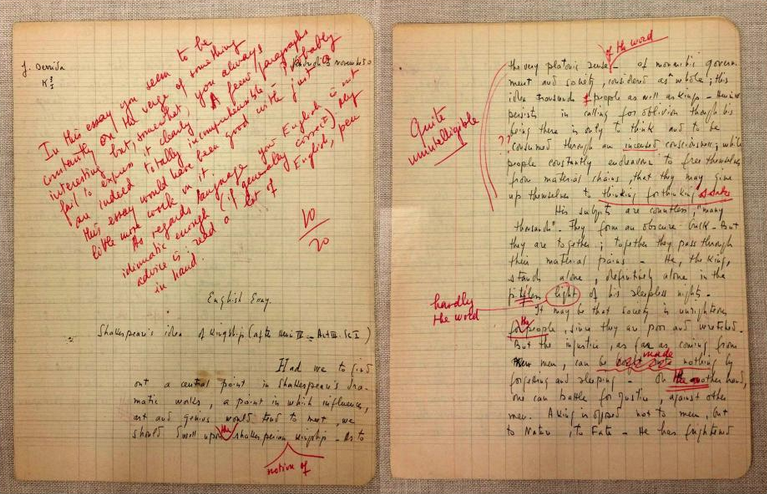
Click here for larger image, then click again to zoom in.
Backstories of famously accomplished people seem incomplete without some past difficulty or failure to be overcome. In narrative terms, these incidents provide biographies with their dramatic tension. We see Abraham Lincoln rise to the highest office in the land despite the humblest of origins; Albert Einstein rewrites theoretical physics against all academic odds, given his supposed early childhood handicaps. In many cases, these stories are apocryphal, or exaggerated for effect. But whatever their accuracy, they always seem to reflect undeniable character traits of the person in question.
In the case of influential philosopher Jacques Derrida, progenitor of the both beloved and reviled critical theory known as “Deconstruction,” the stories of academic struggle and great mental suffering are well-documented. Furthermore, their details accord perfectly well with the mature thinker who, remarks the site Critical Theory, “can’t answer a simple god-damned question.” The good-natured snark on display in this description more or less sums up the feedback Derrida received during some formative years of schooling while he prepared for his entrance exams to France’s university system in 1951 at the age of 20.
Derrida may have “left as big a mark on humanities departments as any single thinker of the past forty years,” writes The New York Review of Books, but during this period of his life, he failed his exams twice before finally gaining admittance. Once, he “choked and turned in a blank sheet of paper. The same month, he was awarded a dismal 5 out of 20 on his qualifying exam for a license in philosophy.” One essay he submitted on Shakespeare, written in English (above), received a 10 out of 20. The feedback from Derrida’s instructor will sound very familiar to perplexed readers of his work. “Quite unintelligible,” writes the evaluator in one marginal comment. The main comment at the top of the paper reads in part:
In this essay you seem to be constantly on the verge of something interesting but, somewhat, you always fail to explain it clearly. A few paragraphs are indeed totally incomprehensible.
Another examiner—points out the NYRB—left a comment on his work “that has since become a commonplace”:
An exercise in virtuosity, with undeniable intelligence, but with no particular relation to the history of philosophy… Can come back when he is prepared to accept the rules and not invent where he needs to be better informed.
As it turns out, Derrida was not particularly interested in the rules, but in inventing a new method. Even if his “apostasy” caused him great mental anguish—“nausea, insomnia, exhaustion, and despair” (all normal features of any higher educational experience)—it’s probably fair to say he could not do otherwise. Although his intellectual biography, like the history of any revered figure, is unlikely to offer a blueprint for success, there is perhaps at least one lesson we may draw: Whatever the difficulties, you’re probably better off just being yourself.
Related Content:
130+ Free Online Philosophy Courses
8‑Bit Philosophy: Plato, Sartre, Derrida & Other Thinkers Explained With Vintage Video Games
Jacques Derrida Deconstructs American Attitudes
Josh Jones is a writer and musician based in Durham, NC. Follow him at @jdmagness
Read More...How the “Paul McCartney is Dead” Hoax Started at an American College Newspaper and Went Viral (1969)
Next time you see the still-youthful and musically prolific Paul McCartney, take a good hard look and ask yourself, “is it really him?” Can you be sure? Because maybe, just maybe, the conspiracy theorists are right—maybe Paul did die in a car accident in 1966 and was replaced by a double who looks, sounds, acts, and writes almost exactly like him. Almost. It’s possible. Entirely implausible, wholly improbable, but within the realm of physical possibility.
In fact, the rumor of Paul’s death and replacement by some kind of pod person imposter cropped up not once, but twice during the sixties. First, in January, 1967, immediately after an accident involving McCartney’s Mini Cooper that month. The car, driven by Moroccan student Mohammad Hadjij, crashed on the M1 after leaving McCartney’s house en route to Keith Richard’s Sussex Mansion. Hadjij was hospitalized, but not killed, and Paul, riding in Mick Jagger’s car, arrived at the destination safely.
The following month, the Beatles Book Monthly magazine quashed rumors that Paul had been driving the Mini and had died, writing, “there was absolutely no truth in it at all, as the Beatles’ Press Officer found out when he telephoned Paul’s St. John’s Wood home and was answered by Paul himself who had been at home all day with his black Mini Cooper Safely locked up in the garage.” “The magazine,” writes the Beatles Bible, “downplayed the incident, and claimed the car was in McCartney’s possession.”
In 1969, rumors of Paul’s death and a conspiracy to cover it up began circulating again, this time with an impressive apparatus that included publications in college and local newspapers, discussions on several radio shows, a university research team, and enough esoteric clues to keep highly suspicious, stoned, and/or paranoid, minds guessing for decades afterward. The formless gossip first officially took shape in print in the article “Is Beatle Paul McCartney Dead?” in Iowa’s Drake University student newspaper, the Times-Delphic. Cataloguing “an amazing series of photos and lyrics on the group’s albums” that pointed to “a distinct possibility that McCartney may indeed be insane, freaked out, even dead,” the piece dives headfirst into the kind of bizarre analysis of disparate symbols and tenuous coincidences worthy of the most dogged of today’s conspiracy-mongers.
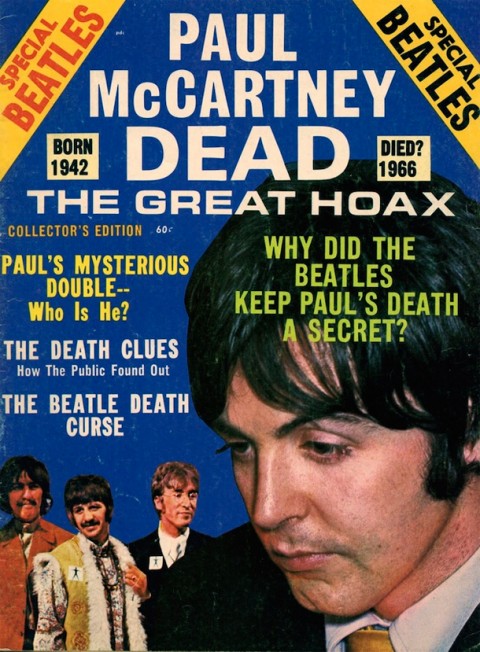
Invoked are ephemera like “a mysterious hand” raised over Paul’s head on the Sgt. Pepper’s cover—“an ancient death symbol of either the Greeks or the American Indians”—and Paul’s bass, lying “on the grave at the group’s feet.” The lyric “blew his mind out in a car” from “A Day in the Life” comes up, and more photographic evidence from the album’s back cover and centerfold photo. Evidence is produced from Magical Mystery Tour and The White Album. Of the latter, you’ve surely heard, or heard of, the voice seeming to intone, “Turn me on, dead man,” and “Cherish the dead,” when “Revolution No. 9” is played backwards. Only a college dorm room could have nurtured such a discovery.
The article reads like a parody—similar to the subversive, half-serious satirical weirdness common to the mid-sixties hippie scene. But whether or not its author, Tim Harper, meant to pull off a hoax, the Paul is dead meme went viral when it hit the airwaves the following month. First, a caller to Detroit radio station WKNR transmitted the theory to DJ Russ Gibb. Their hour-long conversation lead to a review of Abbey Road in The Michigan Daily titled “McCartney Dead; New Evidence Brought to Light.” With tongue in cheek, writer Fred LaBour called the death and replacement of Paul “the greatest hoax of our time and the subsequent founding of a new religion based upon Paul as Messiah.” In the mode of paranoid conspiracy theory so common to the time—a genre mastered by Thomas Pynchon as a literary art—LaBour invented even more clues, inadvertently feeding a public hungry for this kind of thing. “Although clearly intended as a joke,” writes the Beatles Bible, “it had an impact far wider than the writer and his editor expected.”
Part of the aftermath came in two more radio shows that October of 1969. First, in two parts at the top, New York City DJ Roby Yonge makes the case for McCartney’s death on radio station WABC-AM. Recycling many of the “clues” from the previous sources, he also contends that a research team of 30 students at Indiana University has been put on the case. Yonge plainly states that some of the clues only emerge “if you really get really, really high… on some, you know, like, mind-bending drug,” but this proviso doesn’t seem to undermine his confidence in the shaky web of connections.
Was Yonge’s broadcast just an attention grabbing act? Maybe. The next Paul is Dead radio show, just above, is most certainly an Orson Welles-like publicity stunt. Broadcast on Halloween night, 1969, on Buffalo, NY’s WKBW, the show employs several of the station’s DJs, who construct a detailed and dramatic narrative of Paul’s death. The broadcast indulges the same album-cover and lyric divination of the earlier Paul is Dead media, but by this time, it’s grown pretty hoary. But for a small contingent of die-hards, the rumor was mostly put to rest just a few days later when Life magazine published a cover photograph of Paul—who had been out of the public eye after the Beatles’ breakup—with his wife Linda and their kids. Paraphrasing Mark Twain, McCartney famously remarked in the interview inside, “Rumors of my death have been greatly exaggerated,” and added, “If I was dead, I’m sure I’d be the last to know.”
In later interviews, the Beatles denied having anything to do with the hoax. Lennon told Rolling Stone in 1970 that the idea of them intentionally planting obscure clues in their albums “was bullshit, the whole thing was made up.” The hoax did make for some interesting publicity—even featuring in the storyline of a Batman comics issue—but the band mostly found it baffling and annoying. Certain fans, however, refused to let it die, and there are those who still swear that Paul’s imposter, allegedly named Billy Shears and sometimes called “Faul,” still walks the earth. Paul is Dead websites proliferate on the internet—some more, some less convincing; all of them outlandish, and all offering a fascinating descent into the seemingly bottomless rabbit hole of conspiracy theory. If that’s your kind of trip, you can easily get lost—as did pop culture briefly in 1969—in endless “Paul is Dead” speculation.
Related Content:
Paul McCartney’s Conceptual Drawings For the Abbey Road Cover and Magical Mystery Tour Film
Chaos & Creation at Abbey Road: Paul McCartney Revisits The Beatles’ Fabled Recording Studio
Hear Isolated Tracks From Five Great Rock Bassists: McCartney, Sting, Deacon, Jones & Lee
Josh Jones is a writer and musician based in Durham, NC. Follow him at @jdmagness
Read More...Support Us
We're hoping to rely on loyal readers, rather than erratic ads. Please click the Donate button and support Open Culture. You can use Paypal, Venmo, Patreon, even Crypto! We thank you!

About Us

Open Culture scours the web for the best educational media. We find the free courses and audio books you need, the language lessons & educational videos you want, and plenty of enlightenment in between.
Advertise With Us
FREE UPDATES!
GET OUR DAILY EMAIL
Get the best cultural and educational resources on the web curated for you in a daily email. We never spam. Unsubscribe at any time.
FOLLOW ON SOCIAL MEDIA
Open Culture editor Dan Colman scours the web for the best educational media. He finds the free courses and audio books you need, the language lessons & movies you want, and plenty of enlightenment in between.
Advertise With Us



