Creative Thinking: A Free Online Course from Imperial College London
From Peter Childs (Head of the Dyson School of Design Engineering at Imperial College London) comes a free course that explores creative thinking techniques, and how to apply them to everyday problems and global challenges. The course description for Creative Thinking: Techniques and Tools for Success reads:
In today’s ever-growing and changing world, being able to think creatively and innovatively are essential skills. It can sometimes be challenging to step back and reflect in an environment which is fast paced or when you are required to assimilate large amounts of information. Making sense of or communicating new ideas in an innovative and engaging way, approaching problems from fresh angles, and producing novel solutions are all traits which are highly sought after by employers.
The greatest innovators aren’t necessarily the people who have the most original idea. Often, they are people- or teams- that have harnessed their creativity to develop a new perspective or more effective way of communicating an idea. You can train your imagination to seize opportunities, break away from routine and habit, and tap into your natural creativity.
This course will equip you with a ‘tool-box’, introducing you to a selection of behaviours and techniques that will augment your innate creativity. Some of the tools are suited to use on your own and others work well for a group, enabling you to leverage the power of several minds.
You can take Creative Thinking: Techniques and Tools for Success for free by selecting the audit option upon enrolling. If you want to take the course for a certificate, you will need to pay a fee.
Creative Thinking will be added to our list, 1,700 Free Online Courses from Top Universities.
Related Content:
David Lynch Explains How Simple Daily Habits Enhance His Creativity
Read More...The Open Syllabus Project Visualizes the 1,000,000+ Books Most Frequently Assigned in College Courses

The Prince, The Canterbury Tales, The Communist Manifesto, The Souls of Black Folk, The Elements of Style: we’ve read all these, of course. Or at least we’ve read most of them (one or two for sure), if our ever-dimmer memories of high school or college are to be trusted. But we can rest assured that students are reading — or in any case, being assigned — these very same works today, thanks to the Open Syllabus project, which as of this writing has assembled a database of 7,292,573 different college course syllabi. Greatly expanded since we previously featured it here on Open Culture, its “Galaxy” now visualizes the 1,138,841 most frequently assigned texts in that database, presenting them in a Google Maps-like interface for your intellectual exploration.
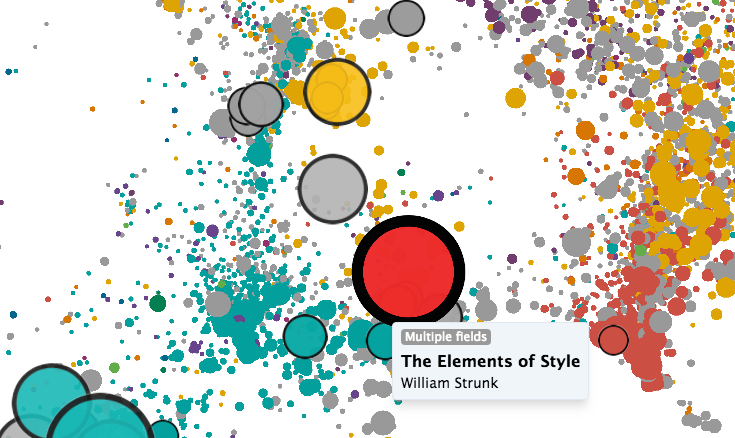
If you click on the search window in the upper-left corner of that interface, a scrollable ranking of the top 100 most frequently assigned texts opens immediately below. Number one, appearing on more than 15,000 of the syllabi collected so far, is Strunk and White’s classic writing-style guide.
Click on its title and you’ll find yourself in its corner of the map, and you’ll see highlighted other popular readings that tend to be assigned together with it: Diana Hacker’s A Writer’s Reference (at the moment the second-most assigned text), Aristotle’s Rhetoric, Martin Luther King Jr.‘s “Letter from the Birmingham Jail,” Jürgen Habermas’ The Structural Transformation of the Public Sphere.
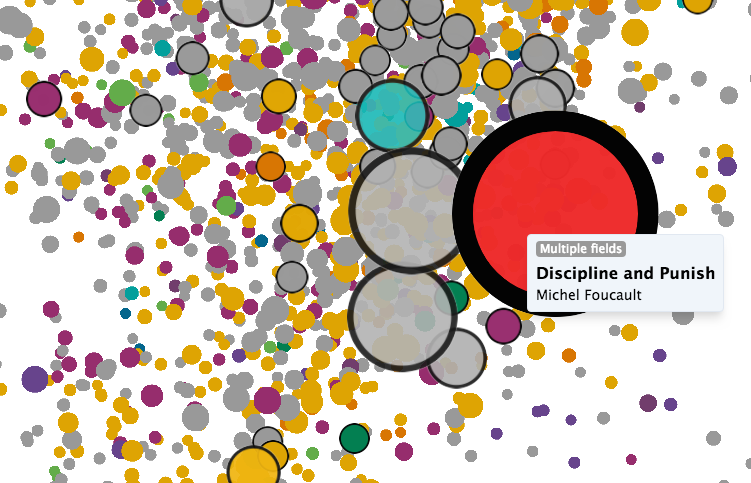
Michel Foucault holds by some measures the record for the greatest number of citations in the humanities. If you’ve read only one of his books, you’ve probably read Discipline and Punish, his 1975 study of the penal system — and current holder of sixteenth place on the Open Syllabus rankings. But zoom in on it and you’ll find plenty of relevant books and articles you might not have read: Alan Elsner’s Gates of Injustice, William Ian Miller’s The Anatomy of Disgust, Soledad Brother: The Prison Letters of George Jackson. Similarly, an excursion in the neighborhood of Benedict Anderson’s Imagined Communities brings encounters with other investigations of country and citizenship like Ernest Renan’s What Is a Nation? and Duncan S.A. Bell’s Mythscapes: Memory, Mythology, and National Identity.
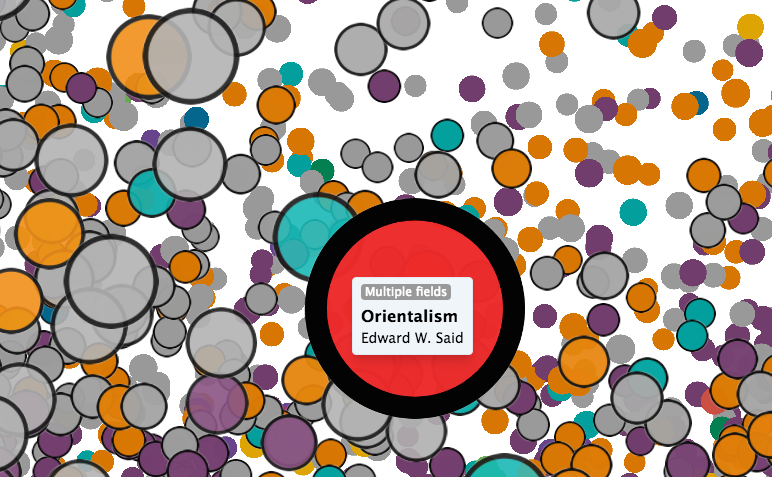
In every sense, the results to be found in the Open Syllabus Galaxy are more interesting than those offered up by the standard you-may-also-like algorithms. Back in college you may have enjoyed, say, Edward Said’s Orientalism, but the range of texts that could accompany it would have been limited by the theme of the class and the intent of your instructor. Here you’ll find Noam Chomsky’s Failed States on one side, John R. Bowen’s Why the French Don’t Like Headscarves on another, Hans Wehr’s Dictionary of Modern Written Arabic on another, and even Messages to the World: The Statements of Osama bin Laden on another still. If we want to understand a subject, after all, we must read not just about it but around it. In college or elsewhere, you might well have heard that idea; here, you can see it. Enter the Open Syllabus Galaxy here.
Related Content:
David Foster Wallace’s 1994 Syllabus: How to Teach Serious Literature with Lightweight Books
Donald Barthelme’s Syllabus Highlights 81 Books Essential for a Literary Education
Junot Díaz’s Syllabi for His MIT Writing Classes, and the Novels on His Reading List
Based in Seoul, Colin Marshall writes and broadcasts on cities, language, and culture. His projects include the Substack newsletter Books on Cities, the book The Stateless City: a Walk through 21st-Century Los Angeles and the video series The City in Cinema. Follow him on Twitter at @colinmarshall or on Facebook.
Read More...Futurist from 1901 Describes the World of 2001: Opera by Telephone, Free College & Pneumatic Tubes Aplenty
Just shy of 120 years ago, “the wisest and most careful men in our greatest institutions of science and learning” told America what would change by the far-flung dawn of 2001. C, X and Q gone from the alphabet; “Air-Ships” in the skies, strictly for military purposes (passenger traffic being handled by “fast electric ships”); strawberries as large as apples; university education “free to every man and woman”: these are just a few of the details of life in the coming 21st century. We for whom the year 2001 is now firmly in the past will get a laugh out of all this. But as with any set of predictions, amid the misses come partial hits. We don’t get our “hot and cold air from spigots,” but we do get it from air-conditioning and heating systems. We don’t send photographs across the world by telegraph, but the device we all keep in our pockets does the job well enough.
Written by a civil engineer named John Elfreth Watkins, Jr. (presumably the son of Smithsonian Curator of Mechanical Technology John Elfreth Watkins, Sr.), “What May Happen in the Next Hundred Years” ran in the December 1900 issue of that renowned futurological organ Ladies’ Home Journal. You can hear it read aloud, and see it accompanied by historical film clips, in the Voices of the Past video above.
A few years ago the piece came back into circulation on the internet (which goes unmentioned by its experts, more concerned as they were with proliferation of telephone lines and pneumatic tubes) and its predictions were put to the test. At the Saturday Evening Post, Jeff Nilsson gives Watkins (once a Post contributor himself) points for less outlandish prophecies, such as a rise in humanity’s life expectancy and average height.
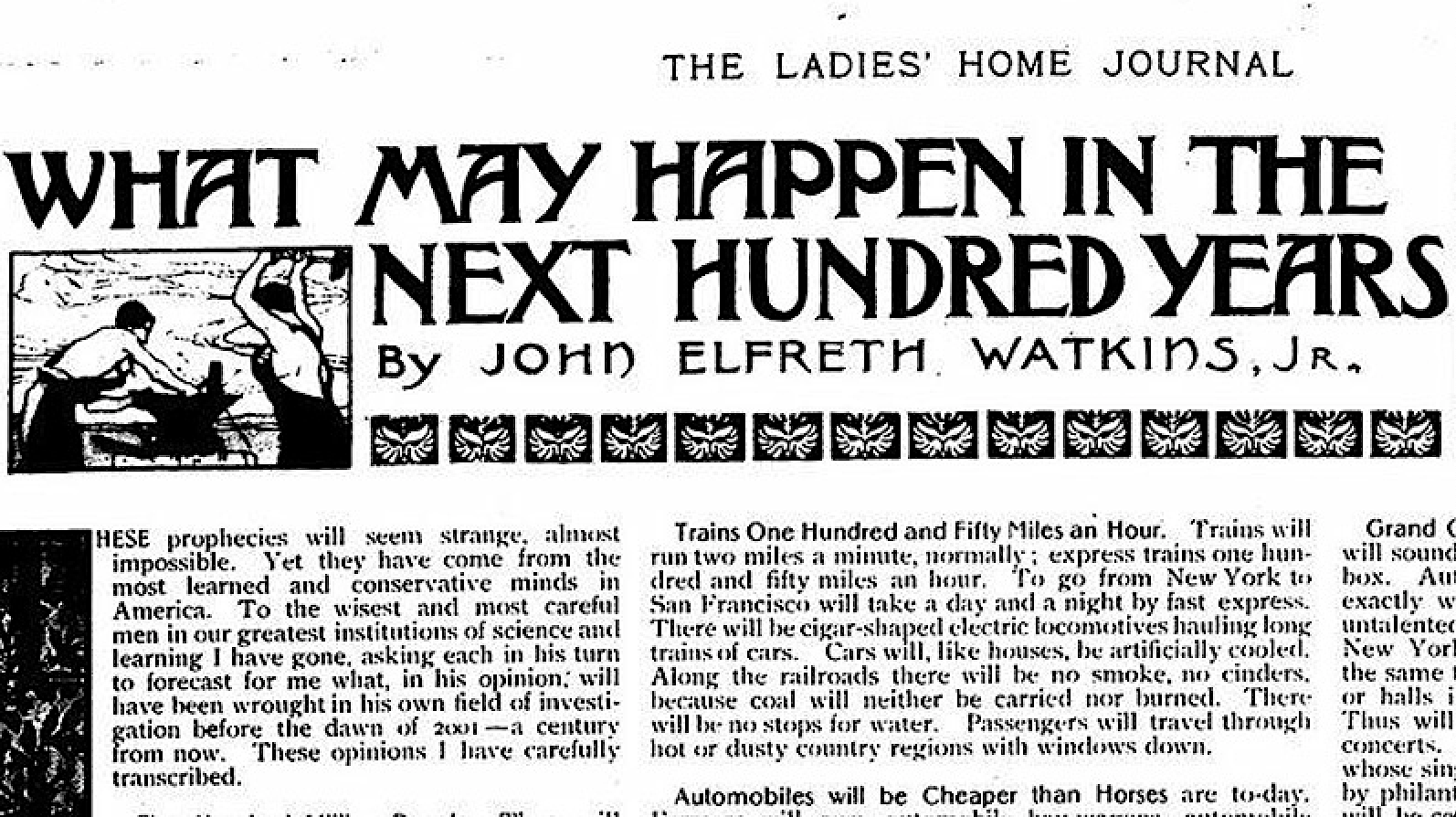
Watkins describes his sources as “the most learned and conservative minds in America.” In some areas they were too conservative: they foresee “Trains One Hundred and Fifty Miles an Hour,” but as Nilsson notes, today’s “high-speed trains are traveling over 300 mph. Just not in the United States.” Americans did lose their streetcars as predicted, but not due to their replacement by subways and moving sidewalks — and what would these experts make of the streetcar’s 21st-century renaissance? When Watkins writes that “grand opera will be telephoned to private homes,” we may think of the Met’s current COVID-prompted streaming, a scenario that would have occurred to few in a world yet to experience even the Spanish flu pandemic of 1918. But then, the future’s defining quality has always been its very unknowability: consider how much has come to pass since we last posted about these predictions here on Open Culture — not least the end of Ladies Home Journal itself.
Related Content:
In 1900, Ladies’ Home Journal Publishes 28 Predictions for the Year 2000
1902 French Trading Cards Imagine “Women of the Future”
How French Artists in 1899 Envisioned Life in the Year 2000: Drawing the Future
Based in Seoul, Colin Marshall writes and broadcasts on cities, language, and culture. His projects include the Substack newsletter Books on Cities, the book The Stateless City: a Walk through 21st-Century Los Angeles and the video series The City in Cinema. Follow him on Twitter at @colinmarshall, on Facebook, or on Instagram.
Read More...Malcolm Gladwell Rebuts the Terrible Advice Given to Students: Don’t Go to “the Best College You Can,” Go to Where You Can Have “Deeply Interesting Conversations with People” at Night
Malcolm Gladwell is a writer of many contrarian opinions. His readers love the way he illustrates his ideas with rhetorical ease, in story after interesting story. Maybe he has too many opinions, say his critics, “who’d prefer it if Gladwell made smaller, more cautious, less dazzling claims,” Oliver Burkeman writes at The Guardian.
But we should take some of his arguments, like his defense of Lance Armstrong and doping in sports, less seriously than others, he says himself. “When you write about sports,” Gladwell tells Burkeman, “you’re allowed to engage in mischief! Nothing is at stake. It’s a bicycle race!” This in itself is a highly contrarian claim for fans, athletes, and their vested sponsors.
But the mischief in hyper-competitive, high dollar pressure of professional cycling is far removed from the cheating, bribing, and fraud scandals in U.S. college admissions, it may seem. The stakes are so much higher, after all. Gladwell offers his take on the situation in the audio interview above on the Tim Ferriss show. (He starts this discussion around the 57:25 mark.)
It’s true, he says, there is a gamesmanship that drives the college admissions process. But here is a case where winning isn’t worth the cost. He doesn’t say this is because the game is rigged, but because it’s oriented in the wrong direction. Students should be taught to find “interestingness” by interacting with “flawed” and “interesting people.”
Instead “we terrify high school students about their college choices,” making achievement and prestige the highest aims.
To my mind, you could not have conceived of a worse system. So any advice that has to do with you need to work hard and get into I’m sorry, it’s just bullshit. It’s just terrible. You should not try to go to the best college you can, particularly if best is defined by US News and World Report. The sole test of what a good college is is it a place where I find myself late at night having deeply interesting conversations with people that I like and find interesting? You go where you can do that. That’s all that matters.
With his tendency to speak in an oracular “we,” Gladwell defines another problem: an elitist disdain for the “interesting” people.
There are interesting kids everywhere. And it’s only in our snobbery that we have decided that interestingness is defined by your test scores. This is just such an outrageous lie.
Test scores, sure they matter in some way, but I’m talking about college now. What makes for a powerful college experience is can I find someone interesting to have an interesting discussion with? And you can do that if you’re curious and you’re interesting. That’s it. Not that you’re interesting, you’re interested. That’s all that matters.
There are, of course, still those who seek out places and people of interest over the highest-ranked schools, which are inaccessible to a majority of students in any case. Gladwell may tend to generalize from his own experience, although college, he has said, “was not a particularly fruitful time for me.” (Maybe ask your doctor before you take his advice about breakfast at the very beginning of the show.)
Different students have different experiences and expectations of college, but overall pressures are high, tuitions are rising, politics are inflamed, and student debt becomes more burdensome by the year.… Gladwell might have used another metaphor, but he’ll likely find wide agreement that in some sense or another, at least figuratively, “the American college system needs to be blown up and they need to start over.” Now that is a subject on which nearly everyone might have an opinion.
Related Content:
Malcolm Gladwell Explains Where His Ideas Come From
Malcolm Gladwell Admits His Insatiable Love for Thriller Novels and Recommends His Favorites
Josh Jones is a writer and musician based in Durham, NC. Follow him at @jdmagness
Read More...A New Interactive Visualization of the 165,000 Most-Frequently Assigned Texts in College Courses
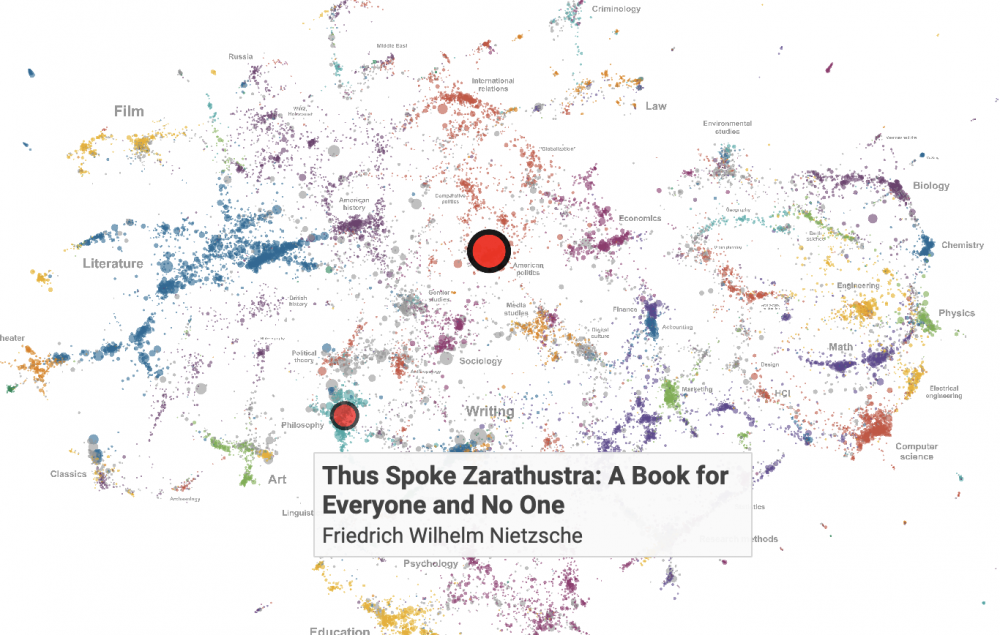
For some of us, it’s been a little while since college days. For others of us, it’s been a little while longer. We might find ourselves asking, if we hear news of on-campus activism and unrest (surely unheard of in our day)—
“Do they still read the classics down at old Alma Mater U.?”
Maybe that’s the problem, eh? Too much Marxist theory, not enough Plato? Well, you may be pleased, or not, to learn that classics still regularly—routinely, even—appear on college syllabi, including both The Republic and the Communist Manifesto, in courses taught all over the world, from San Antonio to Tokyo to Karlskrona, Sweden.
As we informed Open Culture readers in 2016, Columbia University’s Open Syllabus Project culled data from over 1,000,000 syllabi from university websites worldwide, to find out which books have been most frequently taught over the past decade or so. Since then, that number has risen to 6,000,000 syllabi. Still, the most-taught books at the top of the list remain largely unchanged.
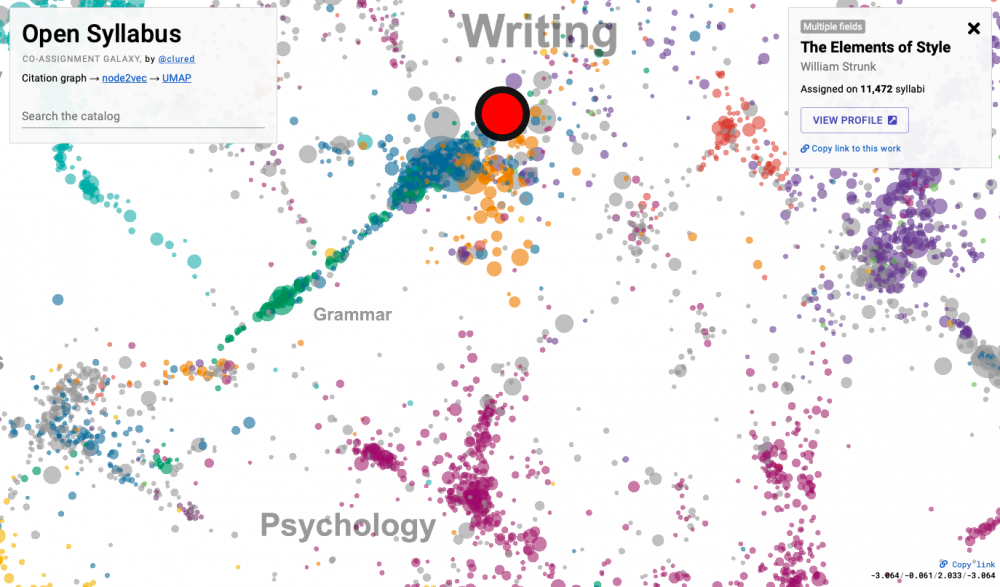
As two of the project’s directors pointed out soon after the site’s launch, “traditional Western canon dominates the top 100, with Plato’s Republic at No. 2, The Communist Manifesto at No. 3, and Frankenstein at No. 5, followed by Aristotle’s Ethics, Hobbes’s Leviathan, Machiavelli’s The Prince, [Sophocles’] Oedipus and [Shakespeare’s] Hamlet.” These numbers have moved a little, edged downward by writing and research guides, but not by very much.
William Strunk’s classic writing guide Elements of Style sits at number one. Other top titles include calculus and anatomy textbooks, other works of Enlightenment philosophy, and texts now central to the Western critical tradition like Martin Luther King, Jr.’s “Letter from Birmingham Jail,” Michel Foucault’s Discipline and Punish, and Edward Said’s Orientalism.
The top 50 is almost totally dominated by male writers, though some of the most frequently-taught novelists include Jane Austen, Toni Morrison, Anne Moody, Leslie Marmon Silko, and Alice Walker. The most-taught books tend to fall into either philosophy, literature, textbook, or guidebook, but the overall range in this list of 165,000 texts encompasses the entire scope of academia around the globe, with more contemporary study areas like gender studies, media studies, digital culture, and environmental studies prominent alongside traditional departments like physics and psychology.
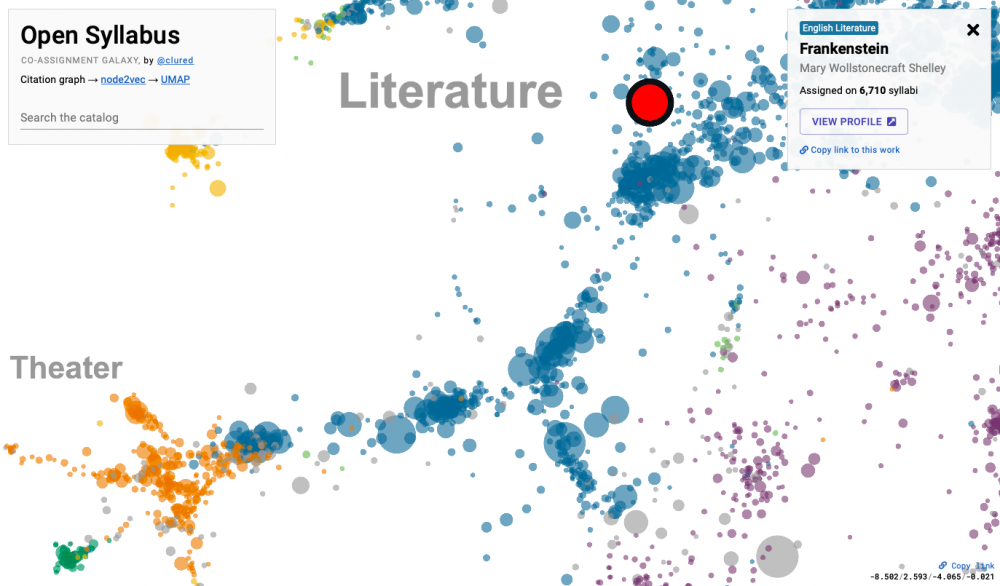
A new interactive visualization from Open Syllabus turns this trove of data into a color-coded stippling of different-sized dots, each one representing a particular text. Float over each dot and a box appears in the corner of the screen, showing the number of syllabi that have assigned the text, and a link to a profile page with more detailed analysis. Called the “Co-Assignment Galaxy,” the infographic does what a list cannot: draws connections between all these works and their respective fields of study.
The Open Syllabus Project was already an impressive achievement, a huge aggregation of freely accessible data for scholars and curious laypeople alike. The addition of this user-friendly cluster map makes the site an even more indispensable resource for the study of how higher education has changed over the past decade or so, and how it has, in some respects, remained the same. Enter the Open Syllabus Project’s Co-Assignment Galaxy map here.
Related Content:
The 20 Most Influential Academic Books of All Time: No Spoilers
Josh Jones is a writer and musician based in Durham, NC. Follow him at @jdmagness
Read More...Meet Berea College, the Innovative College That Charges No Tuition & Gives Students a Chance to Graduate Debt-Free
“The looming student loan default crisis is worse than we thought,” writes Professor of Economics Judith Scott-Clayton at Brookings. I’ll leave it to you to parse the report, but to sum up… it looks bad. Subprime mortgage crisis bad. Maybe… there’s another way? Working models of fully subsidized higher ed systems in other countries—like fully subsidized healthcare systems—strongly suggest as much. Some high-end programs in the U.S., like NYU’s newly free medical school, have taken an early lead, hoping to solve the problem of doctor shortages.
But there’s an earlier, humbler, more progressive model of free college in the States, Kentucky’s little-known Berea College, founded in 1855 by an abolitionist Presbyterian minister John Gregg Fee as the first integrated, co-educational college in the American South. “It has not charged students tuition since 1892,” Adam Harris reports at The Atlantic. “Every student on campus works, and its labor program is like work-study on steroids. The work includes everyday tasks such as janitorial services, but older students are often assigned jobs aligned to their volunteer programs.”
Rather than working to pay off tuition, “students receive a physical check for their labor that can go toward housing and living expenses.” Nearly half of the school’s graduates leave with no debt, with the remaining carrying an average of less than $7,000 from room and board expenses. Compare that to a national average of $37,172 in loan debt per student for the class of 2016. How does Berea do it? It funds tuition with its large endowment of 1.2 billion dollars.
Through a perverse historical irony, as Harris describes, the same racist hatred that ran Berea’s founder out of town in 1859, and forced the school to segregate in 1904, made certain that its funding model would sustain it far into its (re)integrated future. After Kentucky’s passage of the so-called “Day Law,” barring black students from attending, money began to pour in.
The prospect of educating poor white people from Appalachia for no tuition was something that the community could get behind. And nearly 100 years ago, on October 20, 1920, the board made sure that the college would be able to do so for a long time. According to Jeff Amburgey, the school’s chief financial officer, “The board essentially said, for Berea to sustain its funding model,” any unrestricted bequests—essentially money that someone leaves the institution after they have passed away, that is not tagged for a specific purpose—could not be spent right away. Instead, he says, the money was expected to be treated as part of the endowment, and only the return on that investment could be spent.
Berea could not, as some other schools do, spend millions on football stadiums instead of investing in its students. In the 50s, the school reintegrated, but the process was very slow, as it was everywhere in the country. “The community was gone,” says Berea history professor Alicestyne Turley, referring to the Reconstruction-era community that had a student body mix of 50–50 black and white students.
The school had to relearn its founding principles, as expressed in its founder’s chosen motto, from the Book of Acts: “God has made of one blood all peoples of the earth.” Now most of the enrollees, low-income white and black students mostly from Appalachia, qualify for Pell grants. 10 percent of the budget comes from charitable gifts. But the school pays the bulk of the tuition, $39,400 per student, from its endowment.
Is this sustainable? Time will tell. Though a 1937 promotional film, above, from the college’s segregated past decries “the false glitter of easy prosperity,” its current president tells Harris “we’re not the kind of institution that holds the world of finance in disdain. We are dependent on it.” A stock market crash could bankrupt Berea, and no bailouts would be forthcoming. But for now, the college thrives, with very impressive ranking numbers in the U.S. News Best Colleges report (it comes in a #4 in Best Undergraduate Teaching and #3 in Most Innovative Schools).
The school hosts bell hooks as a professor in residence and boasts as an alumnus Carter G. Woodson, the “father of black history,” with a center named for him whose mission is “to assert the kinship of all people and provide interracial education with a particular emphasis on understanding and equality among blacks and whites as a foundation for building community among all peoples of the earth.”
Maybe if there were a way to, say, fund Berea, and colleges and universities nationwide, through some kind of, say, taxation on, say, the most profitable companies on the planet, or some such… just imagine.…
Related Content:
In Japanese Schools, Lunch Is As Much About Learning As It’s About Eating
Josh Jones is a writer and musician based in Durham, NC. Follow him at @jdmagness
Read More...175+ College Admissions Offices Promise Not to Penalize High School Students Who Get Suspended for Protesting Peacefully Against Gun Violence

Image by Lorie Shaull, via Flickr Commons
“Will my admission get rescinded if I get suspended for engaging in a school walk-out meant to bring attention to the school shooting issue?” That’s a question many high school students have posed to college admissions offices around the country, especially after some high school officials threatened to suspend students taking part in anti-gun demonstrations.
Many leading universities have since issued policy statements and given these students their blessing and support. In a post called “In Support of Student Protests,” Hannah Mendlowitz, from Yale’s Admissions Office, writes:
[W]e continue to get the question: will Yale look unfavorably upon discipline resulting from peaceful demonstrations?
The answer is simple: Of course not.
To the students who have reached out to us with these concerns, we have made clear that they should feel free to participate in walk-out events to bring attention to this issue without fear of repercussion. Yale will NOT be rescinding anyone’s admission decision for participating in peaceful walkouts for this or other causes, regardless of any high school’s disciplinary policy. I, for one, will be cheering these students on from New Haven.
And on the official Twitter feed for the Brown University, a tweet reads:
Applicants to Brown: Expect a socially conscious, intellectually independent campus where freedom of expression is fundamentally important. You can be assured that peaceful, responsible protests against gun violence will not negatively impact decisions on admission to Brown.
And that’s just the tip of the iceberg. Below, find a list of 175+ universities that have granted similar assurances, along with links to their statements. The list comes from Alex Garcia, who is maintaining a regularly-updated Google Doc. Access it online here.
- Agnes Scott
- Alfred University
- American
- Amherst
- Baldwin Wallace
- Bard
- Bates
- Bellarmine
- Bennington
- Berkeley
- Berkshire CC
- Binghamton
- Boston College
- Bowdoin
- Brandeis
- Bridgewater State
- Brown
- Bryn Mawr
- BU
- Bucknell
- Cal State U System
- CalTech
- Case Western
- Catholic
- Chapman
- Clark
- CMU
- Colby
- Colgate
- Coll. of the Atlantic
- College of NJ
- College of Wooster
- Colorado College
- Colorado State
- Columbia U.
- Conn. College
- Cornell University
- CU Boulder
- CU Denver
- Dartmouth
- Davidson
- Denison
- DePaul
- Dickinson
- Dominican U of Cal
- Drew
- Duke
- Eastern CT State
- Elmira
- Emerson
- Emory
- Florida
- Fordham
- Georgetown
- Gettysburg
- GMU
- Gonzaga
- Goucher
- Grinnell
- Guilford
- GW
- Hamilton College
- Hamline
- Hampshire
- Hanover
- Harvard
- Harvey Mudd
- Haverford
- Hofstra
- Holy Cross
- Illinois State
- Indiana University
- Johns Hopkins
- Juniata
- Kalamazoo
- Kenyon College
- Knox
- Lafayette
- LawrenceU
- Lebanon Valley College
- Lehigh
- Lewis & Clark
- Lindenwood
- Loyola Marymount
- Macalester
- Manchester
- Miami of Ohio
- Middlebury
- MIT
- Mt Holyoke
- Muhlenberg College
- NCSU
- New School
- Northeastern
- Northwestern
- NYU
- Oberlin
- Occidental
- Ohio Wesleyan
- Pace
- Pacific Lutheran
- Penn
- Penn State
- Pitzer College
- Plymouth State
- Pomona
- Providence College
- Randolph
- Reed
- Rhodes College
- Rice
- RIT
- Saint Mary’s
- Salve Regina
- Sarah Lawrence
- Seattle University
- Simon’s Rock
- Skidmore
- Smith
- St. Johns
- St. Lawrence
- Stanford
- Stetson
- Stevens
- Suffolk
- Swarthmore
- Sweet Briar
- Syracuse
- Temple
- Transylvania
- Trinity College
- Trinity Washington
- Tufts
- Tulane
- U. Dayton
- U. Maryland
- U. New England
- U. Puget Sound
- U. Richmond
- U. South Carolina
- U. Southern California
- UCDavis
- UCLA
- UConn
- UIUC
- UMass-Amherst
- UMass Lowell
- UMBC
- UNH
- UPitt
- UVA
- UVM
- UWashington
- Vassar
- Villanova
- Virginia Tech
- W&M
- Wake Forest
- Wellesley
- Wesleyan
- Western Mich. U.
- Western Washington
- Wheaton
- Whitman college
- Widener
- Willamette
- Williams
- Winthrop University
- Wisconsin
- Wittenberg
- Worcester State
- WPI
- WUSTL
- WVU
- Yale
Again, you can refer to this Google Doc for more updates.
If you would like to support the mission of Open Culture, consider making a donation to our site. It’s hard to rely 100% on ads, and your contributions will help us continue providing the best free cultural and educational materials to learners everywhere. You can contribute through PayPal, Patreon, and Venmo (@openculture). Thanks!
Read More...MIT’s New Master’s Program Admits Students Without College and High School Degrees … and Helps Solve the World’s Most Pressing Problems
One of the central problems of inequality is that it perpetuates itself by nature. The inherent social capital of those born in certain places and classes grants access to even more social capital. Questions of merit can seem marginal when the credentials required by elite institutions prove inaccessible to most people. In an admirable effort to break this cycle globally, MIT is now admitting students to a graduate program in economics, without GRE scores, without letters of recommendation, and without a college degree.
Instead students begin with something called a “MicroMasters” program, which is like “a method used in medicine… randomized control trials,” reports WBUR. This entryway removes many of the usual barriers to access by allowing students to first “take rigorous courses online for credit, and if they perform well on exams, to apply for a master’s degree program on campus”—a degree in data, economics and development policy (DEDP), which focuses on methods for reducing global inequality.

Enrollment in the online MicroMasters courses began in February of last year (the next round starts on February 6, 2018), and the DEDP master’s program will start in 2019. “The world of development policy has become more and more evidence-based over the past 10–15 years,” explains MIT professor of economics Ben Olken, who co-created the program with economics professors Esther Duflo and Abhijit Banerjee. “Development practitioners need to understand not just development issues, but how to analyze them rigorously using data. This program is designed to help fill that gap.”
Duflo, co-founder of MIT’s Abdul Latif Jameel Poverty Action Lab (J‑PAL), explains the innovation of MicroMasters’ radically open admissions. (For anyone with access to the internet, that is, still a huge barrier for millions worldwide): “Anybody could do that. At this point, you don’t need to have gone to college. For that matter, you don’t need to have gone to high school.” Students who are accepted after their initial online course work will move into a “blended” program that combines their prior work with a semester on MIT’s campus.
MicroMasters courses are priced on a sliding scale (from $100 to $1,000), according to what students can afford, and costs are nowhere near what traditional students pay—after having already paid, or taken loans, for a four-year degree, various testing regimens, admissions costs, living expenses, etc. The current program might feasibly be scaled up to include other fields in the future. Thus far, over 8,000 students in the world have enrolled in the MicroMasters program. “In total,” Duflo says, “there are 182 countries represented,” including ten percent from China, a large group from India, and “even some from the U.S.”
Students enrolled in these courses design their own evaluations of initiatives around the globe that address disparities in healthcare, education, and other areas. Co-designed by the Poverty Action Lab and the Department of Economics, MicroMasters asks students to “grapple with some of the world’s most pressing problems,” including the problem of access to higher education. You can view the requirements and enroll at the MITx MicroMasters’ site. Read frequently asked questions and learn about the instructors here. And here, listen to WBUR’s short segment on this fascinating educational experiment.
Find more MicroMasters subjects in our collection: Online Degrees & Mini Degrees: Explore Masters, Mini Masters, Bachelors & Mini Bachelors from Top Universities
Related Content:
Artificial Intelligence: A Free Online Course from MIT
Introduction to Computer Science and Programming: A Free Course from MIT
Josh Jones is a writer and musician based in Durham, NC. Follow him at @jdmagness
Read More...Martin Luther King, Jr.‘s Handwritten Syllabus & Final Exam for the Philosophy Course He Taught at Morehouse College (1962)
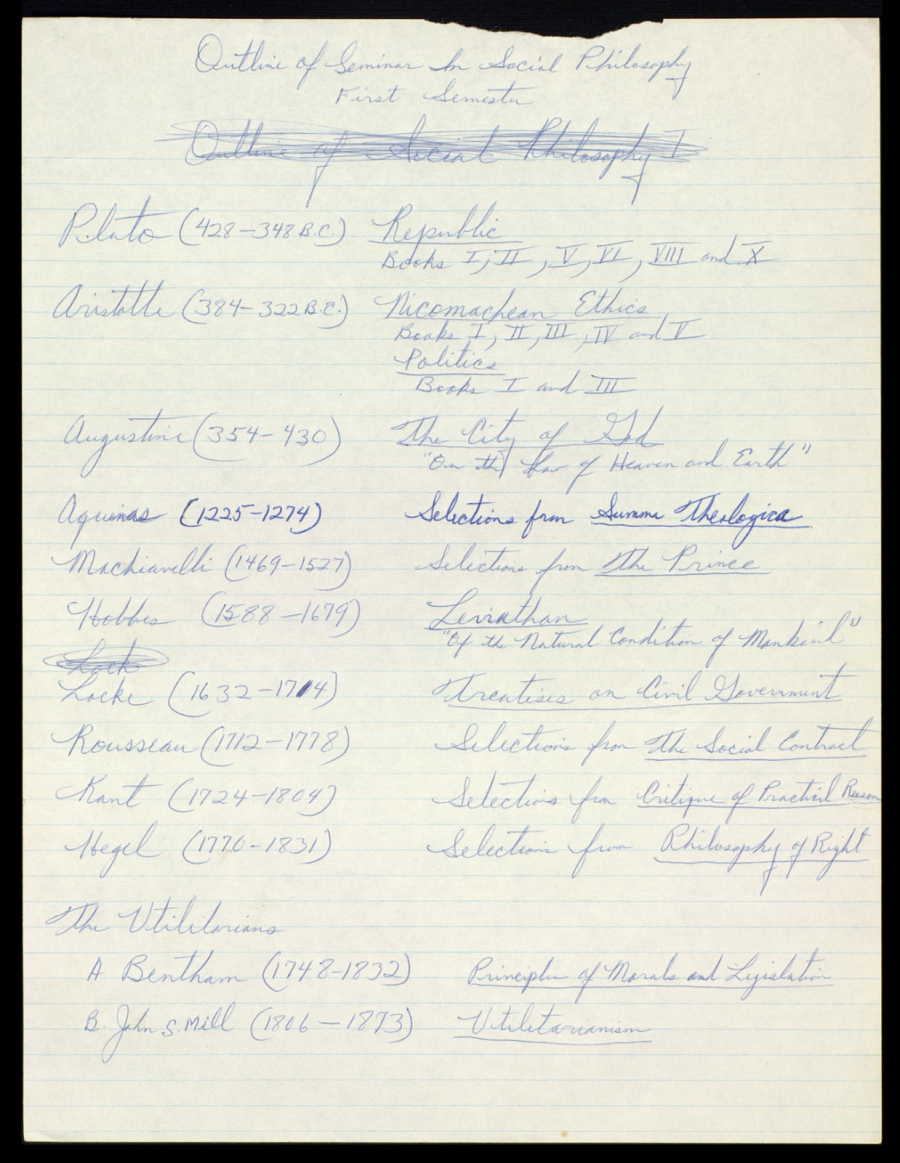
On his way to sainthood as an avatar of love and justice, Martin Luther King, Jr. lost too much of his complexity. Whether deliberately sanitized or just drawn in broad strokes for easy consumption, the Civil Rights leader we think we know, we may not know well at all. King himself ruefully noted the tendency of his audiences to box him in when he began publicly and forcefully to challenge U.S. involvement in the Vietnam War and the perpetuation of widespread poverty in the wealthiest country on earth. “I am nevertheless greatly saddened,” he remarked in 1967, “that the inquirers have not really known me, my commitment, or my calling.”
As WBUR notes in its introduction to a discussion on King’s political philosophy, the “specifics of his radical politics often go unexamined when celebrating his legacy…. His political and economic ideas are clear in his speeches against the Vietnam War and his call to work toward economic equality.”
His radical stances did not sit well with the FBI, nor with many of his former supporters, but their roots are evident in his most-published work, the 1963 “Letter from Birmingham Jail,” in which he coined the famous phrase, “injustice anywhere is a threat to justice everywhere.”
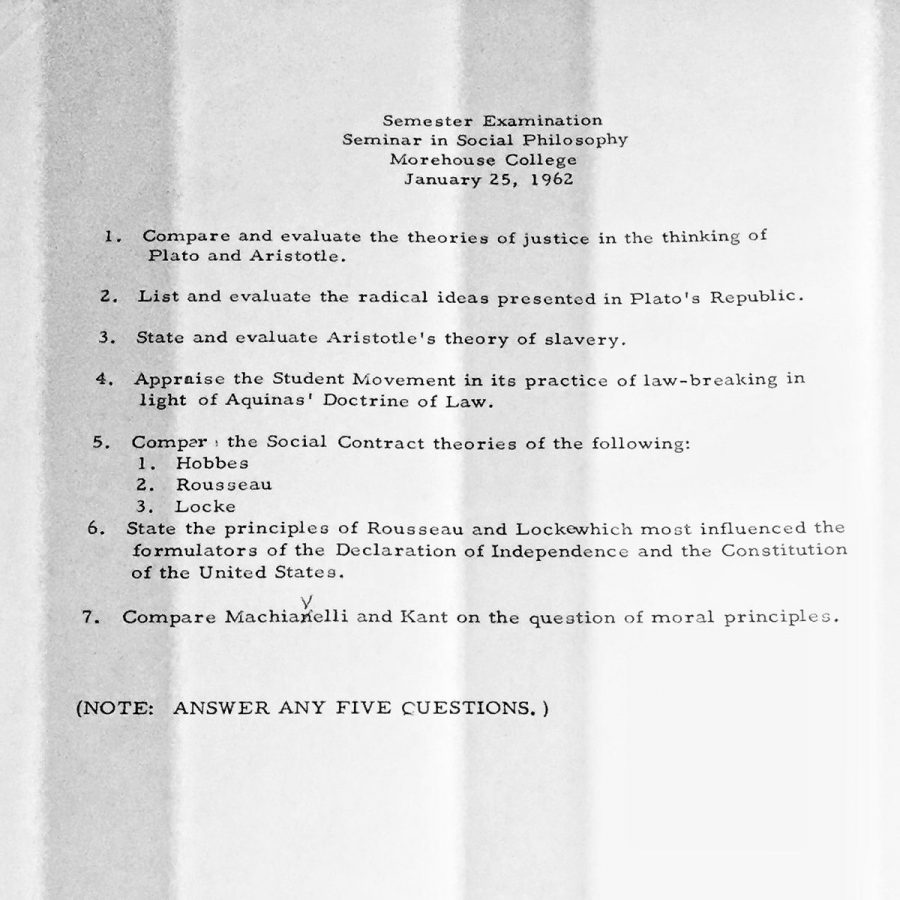
We know of King’s indebtedness to the thought of Mahatma Gandhi and Henry David Thoreau, and of his theological education. He was also steeped in the political philosophy of the West, from Plato to John Stuart Mill. In his graduate work at Boston University and Harvard in the 50s, he read and wrote on Hegel, Kant, Marx, and other philosophers. And as a visiting professor at Morehouse College—one year before his arrest in Birmingham and the composition of his letter—King taught a seminar in “Social Philosophy,” examining the ideas of Plato, Aristotle, Augustine, Aquinas, Machiavelli, Hobbes, Locke, Rousseau, Kant, Hegel, Bentham, and Mill.
At the top of the post, you can see his handwritten syllabus (view in a larger format here), a sweeping survey of the European tradition in political philosophy. Further up (or here in a larger format) see a typewritten exam with seven questions from the reading (students were to answer any five). King not only asked his students to connect these thinkers in the abstract to present concerns for justice, but, in question 3, he specifically asks them to “appraise the Student Movement in its practice of law-breaking in light of Aquinas’ Doctrine of Law” (referring to the Catholic theologian/philosopher’s distinctions between human and natural law).
The syllabus and exam give us a sense of how King situated his own radical politics both within and against a long tradition of philosophical thought. For more on King’s political philosophy, listen to Harvard professors Tommie Shelby and Brandon Terry discuss their new collection of essays—To Shape a New World: Essays on the Political Philosophy of Martin Luther King, Jr.—in the WBUR interview above.
via Daily Nous/The King Center
Related Content:
Free Online Philosophy Courses
How Martin Luther King, Jr. Used Nietzsche, Hegel & Kant to Overturn Segregation in America
‘You Are Done’: The Chilling “Suicide Letter” Sent to Martin Luther King by the F.B.I.
On the Power of Teaching Philosophy in Prisons
Josh Jones is a writer and musician based in Durham, NC. Follow him at @jdmagness
Read More...“Calling Bullshit”: Watch Lectures for the College Course Designed to Combat the BS in our Information Age
This past January, we highlighted a syllabus for a tentative course called “Calling Bullshit,” designed by two professors at the University of Washington, Carl Bergstrom and Jevin West.
The course–also sometimes called “Calling Bullshit in the Age of Big Data”–ended up being offered this spring. And now you can see how it unfolded in the classroom. The 10 video lectures from the class are available online. Watch them above, or at this YouTube playlist. Also find them housed in our collection, 1,700 Free Online Courses from Top Universities.
According to The Seattle Times, the course “achieved the academic version of a chart-topping pop single: At the UW [University of Washington], it reached its 160-student capacity shortly after registration opened this spring.” And now colleges “in Canada, France, Portugal, England and Australia have contacted the professors about teaching a version of the course this fall.”
The course itself was premised on this basic idea: “Bullshit is everywhere, and we’ve had enough. We want to teach people to detect and defuse bullshit wherever it may arise.”
A longer overview of the course appears below. It was cited in our original post. And it’s worth highlighting again:
The world is awash in bullshit. Politicians are unconstrained by facts. Science is conducted by press release. Higher education rewards bullshit over analytic thought. Startup culture elevates bullshit to high art. Advertisers wink conspiratorially and invite us to join them in seeing through all the bullshit — and take advantage of our lowered guard to bombard us with bullshit of the second order. The majority of administrative activity, whether in private business or the public sphere, seems to be little more than a sophisticated exercise in the combinatorial reassembly of bullshit.
We’re sick of it. It’s time to do something, and as educators, one constructive thing we know how to do is to teach people. So, the aim of this course is to help students navigate the bullshit-rich modern environment by identifying bullshit, seeing through it, and combating it with effective analysis and argument.
What do we mean, exactly, by the term bullshit? As a first approximation, bullshit is language, statistical figures, data graphics, and other forms of presentation intended to persuade by impressing and overwhelming a reader or listener, with a blatant disregard for truth and logical coherence.
While bullshit may reach its apogee in the political domain, this is not a course on political bullshit. Instead, we will focus on bullshit that comes clad in the trappings of scholarly discourse. Traditionally, such highbrow nonsense has come couched in big words and fancy rhetoric, but more and more we see it presented instead in the guise of big data and fancy algorithms — and these quantitative, statistical, and computational forms of bullshit are those that we will be addressing in the present course….
Our aim in this course is to teach you how to think critically about the data and models that constitute evidence in the social and natural sciences.
If you’re interested in watching the course, get started with Lecture 1: Introduction to Bullshit.
To learn more about the course, please visit this website.
If you would like to support the mission of Open Culture, consider making a donation to our site. It’s hard to rely 100% on ads, and your contributions will help us continue providing the best free cultural and educational materials to learners everywhere. You can contribute through PayPal, Patreon, and Venmo (@openculture). Thanks!
Related Content:
How to Spot Bullshit: A Primer by Princeton Philosopher Harry Frankfurt
Read More...Support Us
We're hoping to rely on loyal readers, rather than erratic ads. Please click the Donate button and support Open Culture. You can use Paypal, Venmo, Patreon, even Crypto! We thank you!

About Us

Open Culture scours the web for the best educational media. We find the free courses and audio books you need, the language lessons & educational videos you want, and plenty of enlightenment in between.
Advertise With Us
FREE UPDATES!
GET OUR DAILY EMAIL
Get the best cultural and educational resources on the web curated for you in a daily email. We never spam. Unsubscribe at any time.
FOLLOW ON SOCIAL MEDIA
Open Culture editor Dan Colman scours the web for the best educational media. He finds the free courses and audio books you need, the language lessons & movies you want, and plenty of enlightenment in between.
Advertise With Us

