Inside the Creepy, “Abandoned” Wizard of Oz Theme Park: Scenes of Beautiful Decay
The romantic allure of the ghostly, abandoned theme park is difficult to resist. Case in point: The Land of Oz, above, a not-entirely-defunct attraction nestled atop North Carolina’s Beech Mountain.
Debbie Reynolds, accompanied by her 13-year-old daughter, Carrie Fisher, cut the ribbon on the park’s opening day in 1970.
Its road was far from smooth, even before urban explorers began filching its 44,000 custom-glazed yellow bricks, eventually forcing management to repave with painted stand issue models.
One of its two founders died of cancer six months before opening, and later a fire destroyed the Emerald City and a collection of memorabilia from the 1939 MGM film.
Crippled by the gas crisis and insurmountable competition from Disney World and its ilk, the Land of Oz closed in 1980, thus sparing it the indignities of Yelp reviews and discerning child visitors whose expectations have been formed by CGI.
Its shuttering attracted another kind of tourist: the camera-toting, fence hopping connoisseurs of what is now known as “ruin porn.”
An isolated, abandoned theme park based on the Wizard of Oz? Could there be a holier grail?
Only trouble is…the Land of Oz didn’t stay shuttered. Local real estate developers cleaned it up a bit, luring overnight visitors with rentals of Dorothy’s house. They started a tradition of reopening the whole park for one weekend every October, and demand was such that June is now Land of Oz Family Fun Month. The International Wizard of Oz Club held its annual convention there in 2011. How abandoned can it be?
And yet, unofficial visitors, sneaking onto the grounds off-season, insist that it is. I get it. The quest of adventure, the desire for beautiful decay, the bragging rights… After photographing the invariably leaf strewn Yellow Brick Road, they turn their lenses to the lumpy-faced trees of the Enchanted Forest.
Yes, they’re creepy, but it’s less from “abandonment” than a low-budget approximation by the hands of artists less expert than those of the original.
It’s safe to presume that any leaves and weeds littering the premises are merely evidence of changing seasons, rather than total neglect.
What I want to know is, where’s the sex, drugs & rock’n’roll evidence of local teens’ off-season blowouts—no spray painted f‑bombs? No dead soldiers? Security must be pretty tight.
If creepy’s what the perpetuators of the abandonment myth crave, they could content themselves with the amateur footage above, shot by a visiting dad in 1970.
Those costumes! The scarecrow and the tin man in particular… Buzzfeed would love ’em, but it’s hard to imagine a millennial tot going for that mess. Their Halloween costumes were 1000 times more accurate.
(In interviews, the one generation who can remember the Land of Oz in its prime is a loyal bunch, recalling only their long ago sense of wonder and excitement. Ah, life before Betamax…)
The documentary video below should settle the abandonment myth once and for all. It opens not in Kansas, but New York City, as a carload of young performers heads off for their annual gig at the Land of Oz. They’re conversant in jazz hands and certain Friends of Dorothy tropes, surely more so than the local players who originally staffed the park. Clearly, these ringers were hired to turn in credible impersonations of the characters immortalized by Ray Bolger, Burt Lahr, and Judy Garland. Presumably, their updated costumes also passed muster with Autumn at Oz’s savvy child attendees.
Still craving that ruin porn? Business Insider published Seph Lawless’ photos of “the crumbling park” here.
If you’d prefer to rubberneck at a truly abandoned theme park, check out the Carpetbagger’s video tour of Cave City, Kentucky’s Funtown Mountain. (Though be forewarned. It was sold at auction in April 2016 and plans are afoot to reengineer it as as “an epic playground of wonder, imagination, and dreams.”)
Related Content:
Disneyland 1957: A Little Stroll Down Memory Lane
Jurassic Park Tells You Everything You Need to Know About the Dangers of Global Capitalism
Ayun Halliday is an author, illustrator, theater maker and Chief Primatologist of the East Village Inky zine. Her play Zamboni Godot is opening in New York City in March 2017. Follow her @AyunHalliday.
Read More...Opposition Letter to Teach to One Signed by 180 Parents
December 7, 2016
Updated with additional signatures — December 16, 2016
Superintendent Ayindé Rudolph
Assistant Superintendent Cathy Baur
Mountain View Whisman School District
750‑A San Pierre Way
Mountain View, CA 94043–3133
Dear Superintendent Rudolph and Assistant Superintendent Baur:
We are the parents of current and incoming Graham and Crittenden sixth graders. After one trimester of the Teach to One (TTO) pilot, we have significant concerns with the program and its impact on our children as they prepare to enter the competitive high school environment. We recognize and praise the district for considering innovative ways to supplement student learning (Membeam, Lexia, Khan Academy). However, TTO does not appear to be serving our students as well as the traditional teacher-directed method.
We have found the TTO pilot to be ineffective in inspiring and encouraging our children. Living in Silicon Valley, we appreciate taking chances, examining impact and changing course if things are not working. After 3+ months of TTO, we feel that TTO is not the right solution for our students.
Overall, although laudable for its innovation, the TTO program is still under development and the kinks have not been worked out. Continuing to require the program, now that we have first-hand experience with the problems, would be a disservice to our children. We have fabulous, qualified and committed math teachers at Graham and Crittenden, and they should be permitted to teach our children, as they are trained to do. Online learning can be productive for extended learning, such as homework. But at this point, nothing matches the efficacy of a face-to-face student-teacher relationship in communicating complex and important materials. Students are not getting this from TTO in its current form. Some parents’ frustration has reached the point where they are now looking into other school options for seventh grade, which would be very unfortunate.
We understand that the district is currently evaluating TTO. With this letter, we respectfully ask that:
- TTO be discontinued for the spring 2017 trimester and thereafter.
- If the district wishes to continue with TTO, either:
- Make it optional for all students and provide a traditional teacher-led option for those who don’t wish to participate, or
- With the involvement of the parent community, restructure the program so that TTO is substantially minimized or limited to a subpopulation where it has proven to be beneficial.
- The district solicit parent feedback prior to implementing major curriculum changes going forward.
Below please find a list of items that summarize many parent concerns regarding the TTO program:
- The TTO curriculum does not follow a logical pathway, enabling students to build a strong math foundation. TTO removes the thoughtfulness behind math curriculum development, by presenting topics in an illogical and incoherent order. By jumping around among concepts, students fail to make connections between subject areas. Students may “pass” an Exit Slip without the opportunity to build mastery in core middle school math concepts. When topics jump around illogically, parents find themselves forced to teach earlier concepts to which the student was never exposed in order to assist with understanding the concepts at hand.
- Much of the instruction is quite shallow, in some cases even misleading and factually incorrect. Topics which would normally take days or even weeks of classroom instruction are sometimes completed in a single day. Further, this superficial exposure to math concepts will disadvantage all students. This will be especially evident when they join neighboring Los Altos middle school students in high school.
- With TTO, students are often tested on materials that they have never been taught, causing anxiety, frustration and dislike for math. In a time where we want to encourage students to build foundational skills for cutting edge STEM fields, TTO seems to be affecting student attitudes toward math and problem solving. Many parents report a striking change in their child’s attitude toward math this year. The students generally have very positive feedback about math teachers at Graham and Crittenden, but many students hate TTO and now dislike math.
- TTO does not support the Common Core curriculum, where student understanding is based on how the student arrived at a solution, not the final answer alone. With TTO, students choose a multiple choice answer without ever showing their work. This will not prepare them for high school math or advanced math classes, where the final answer just represents a fraction of the overall process.
- One benefit of the TTO program touted by the district is that “The program will reduce the time teachers dedicate to student assessments and allow more direct instructional time with students.” In fact, the students have little contact with teachers. With the Emotional Intelligence aspect of learning, students benefit from positive reinforcement of a teacher, especially in math where they have to push a little harder to get to a solution. Assigning more growth mindset videos is not a solution to overcoming frustration and encouraging perseverance. Furthermore, teachers appear to serve an administrative function, affording little instruction time. The few teacher-led sessions are degraded, as teachers must figure out their lessons with little advanced notice based on what TTO provides.
- The program doesn’t educate students or parents about what level of math skills the students are working on, so we have no idea if they are working at a fifth grade level or an eighth grade level.
- Parents and staff have identified multiple and pervasive errors throughout the TTO materials including: mistakes in answers, illogical questions, link errors, etc. The instructional material is often confusing and of poor quality. This is further complicated by the fact that there is no textbook, so when a student struggles with concept in the homework, they are left to looking for answers online.
- The TTO homework algorithm seems to be flawed. Sometimes students receive homework that is misaligned with their playlist. Other times the homework either too advanced or too simplistic for the student.
- While we are prepared to support our students in math, TTO requires too much parent involvement. Many parents spend significant time at home providing math instruction because there is no textbook and because there are few in-class teaching sessions by math teachers. Many parents have hired tutors to make up for the lack of teacher-student interaction. This is unfair to both the parents and teachers. Many families lack the academic or financial means to provide this extracurricular support to their students. Graham and Crittenden have excellent math teachers who are passionate about teaching math. Further, performance results may be flawed in favor of TTO as a result of parents providing daily direct instruction and/or tutoring to supplement TTO’s deficiencies.
- The lack of textbook and complete dependence on the internet interferes with math study in the classroom. Glitches in the system/Internet mean that students often miss instructional time, are unable to complete their Exit Slip, or are late to their next class. Not only does this compromise time in math class, but this affects learning in other subject areas. Unfortunately this has happened quite a few times to many of our children.
- Small group collaboration seems to be ineffective at this stage. One child likened this to practicing a complex piano piece without an instructor–you practice and practice, and when you meet your teacher, you realize you learned it incorrectly and must now unlearn what you taught yourself. Without the foundational skills, it is inefficient for a group of students to work out a problem without teacher guidance or foundation. Further, at this age, some students goof off and interfere with others’ ability to learn. The lack of teacher support makes this a constant problem.
Thank you very much for your consideration.
Sincerely,
Signature of 180 parents
Read More...Hear a Great 4‑Hour Radio Documentary on the Life & Music of Jimi Hendrix: Features Rare Recordings & Interviews
The legacy of Jimi Hendrix’s estate has been in conflict in recent years. Since his father’s death in 2002, his siblings have squabbled over his money and battled unlicensed and bootleg venders. But Hendrix’s musical legacy continues to amaze and inspire, as Janie Hendrix—his stepsister and CEO of the company that manages his music—has released album after album of rarities over the last couple decades. Not all of these releases have pleased Hendrix fans, who have called some of them mercenary and thoughtless. But it is always a joy to discover an unheard recording, whether a live performance, wobbly studio outtake, or semi-polished demo, so many of which reveal the territory Hendrix intended to chart before he died.
In 1982, some of that unreleased material made it into a four-hour Pacifica Radio documentary, which you can hear in four parts here. Produced by what the station calls “some of Pacifica’s finest” at its Berkeley “flagship station 94.1 FM,” the documentary does an excellent job of placing these recordings in context.
With help from Hendrix biographer David Henderson, the producers compiled “previously unheard and rare recordings” and interviews from Hendrix, his family, Noel Redding, Ornette Coleman, Stevie Wonder, John Lee Hooker, John McLaughlin, Chas Chandler, and more. After a newly-recorded introduction and a collage of Hendrix interview soundbites, Part 1 gets right down to it with a live version of “Are You Experienced?” that pulses from the speakers in hypnotic waves (listen to it on a solid pair of headphones if you can).
“I want to have stereo where the sound goes up,” says Hendrix in a soundbite, “and behind and underneath, you know? But all you can get now is across and across.” Somehow, even in ordinary stereo, Hendrix had a way of making sound surround his listeners, enveloping them in warm fuzzy waves of feedback and reverb. But he also had an equally captivating way with language, and not only in his song lyrics. Though the received portrait of Hendrix is of a shy, retiring person who expressed himself better with music, in many of these interviews he weaves together detailed memories and whimsical dreams and fantasies, composing imaginative narratives on the spot. Several extemporaneous lines could have easily flowered into new songs.
Hendrix briefly tells the story of his rise through the R&B and soul circuit as an almost effortless glide from the ranks of struggling sidemen, to playing behind Sam Cooke, Little Richard, and Ike and Tina Turner to starting his solo career. We move through the most famous stages of Hendrix’s life, with its iconic moments and cautionary tales, and by the time we get to Part 4, we start hearing a Hendrix most people never do, a preview of where his music might have gone into the seventies—with jazzy progressions and long, winding instrumental passages powered by the shuffling beats of Buddy Miles.
As has become abundantly clear in the almost four decades since Hendrix’s death, he had a tremendous amount of new music left in him, stretching in directions he never got to pursue. But the bit of it he left behind offers proof of just how influential he was not only on rock guitarists but also on blues and jazz fusion players of the following decade. His pioneering recording style (best heard on Electric Ladyland) also drove forward, and in some cases invented, many of the studio techniques in use today. Processes that can now be automated in minutes might took hours to orchestrate in the late sixties. Watching Hendrix mix in the studio “was like watching a ballet,” says producer Elliot Mazer.
This documentary keeps its focus squarely on Hendrix’s work, phenomenal talent, and uniquely innovative creative thought, and as such it provides the perfect setting for the rare and then-unreleased recordings you may not have heard before. Pacifica re-released the documentary last year as part of its annual fundraising campaign. The station is again soliciting funds to help maintain its impressive archives and digitize many more hours of tape like the Hendrix program, so stop by and make a donation if you can.
Related Content:
Jimi Hendrix’s Final Interview on September 11, 1970: Listen to the Complete Audio
Josh Jones is a writer and musician based in Durham, NC. Follow him at @jdmagness
Read More...Hear Controversial Versions of “The Star Spangled Banner” by Igor Stravinsky, Jimi Hendrix, José Feliciano & John Philip Sousa
Debates over whether or not we should destroy or alter U.S. icons seem to turn on a critical question: are national symbols quasi-religious totems of some transcendent sacred order? The kind of imperial project likely to end up a collection of crumbling monuments with every other empire of the past? Or are they living emblems of a secular republic whose primary embodiment is its people? A country, like its people, that must reconstitute itself with each generation in order to survive?
Either way, the nation’s symbols have always withstood creative destruction, détournement, and recontextualization. Subjecting national iconography to the interventions of artists and activists restores a sense of proportion, showing us that our government and its symbols belong to the people, rather than the other way around. The idea is a powerful one. So much so that its expression never fails to excite controversy. And few expressions have provoked more ire than performances of (or responses to) the national anthem that deviate from the staid traditional arrangement.
We could point to very obvious anthem controversies, like Roseanne Barr’s irreverent 1990 rendition. But certain other interpretations have had much more serious artistic intent, like that of naturalized citizen Igor Stravinsky, whose 1944 version (top) came from his “desire to do my bit in these grievous times toward fostering and preserving the spirit of patriotism in this country.” Stravinsky’s earnest ambition was thwarted. He couldn’t help but add his signature, in this case a dominant seventh chord, to the arrangement.
If you would like to support the mission of Open Culture, consider making a donation to our site. It’s hard to rely 100% on ads, and your contributions will help us continue providing the best free cultural and educational materials to learners everywhere. You can contribute through PayPal, Patreon, and Venmo (@openculture). Thanks!
The Boston police responded by issuing him a warning, claiming, we noted in a previous post, “there was a law against tampering with the national anthem” (there wasn’t). Stravinsky “grudgingly” pulled the anthem from his Boston Symphony bill. Over twenty years later, the blind Puerto Rican folk singer José Feliciano played the anthem before the 1968 World Series in his own emotionally-charged style. And like Stravinsky, he was motivated by love of country. “I had set out to sing an anthem of gratitude to a country that had given me a chance,” he later recalled, “that had allowed me, a blind kid from Puerto Rico—a kid with a dream—to reach far above my own limitations.”
Much of the country did not respond in kind. Even during the performance, Feliciano could “feel the discontent within the waves of cheers and applause that spurred on the first pitch.” Afterwards, he learned that “a great controversy was exploding across the country because I had chosen to alter my rendition.… Veterans, I was being told, had thrown their shoes at the television as I sang; others questioned my right to stay in the United States.” Feliciano admits, “yes, it was different but I promise you,” he says, “it was sincere.” So was the most radical of “Star-Spangled Banner” interpretations, Jimi Hendrix’s feedback-laden version at Woodstock the following year.
A veteran himself, Hendrix wasn’t motivated by wartime patriotism or personal gratitude, but by a desire, perhaps, to tell the truth about what his country was doing to thousands of people in Southeast Asia—“Napalm bombs,” as he said at the time, “people getting burned up on TV.” It’s a subject he occasionally touched on lyrically; here he let the guitar tell it, “turning the music to a literal interpretation of the lyrics: bombs bursting in air, rockets lighting up the night,” writes Andy Cush at Spin, “Hendrix began to slyly use the music’s own martial bombast to reflect the violence carried out under his nation’s flag.” He was hardly the first to exploit the song’s inherent bombast.
Almost 100 years before Woodstock—before the national anthem was even the national anthem—one of the most iconic of American of composers re-arranged “The Star Spangled Banner.” John Philip Sousa (who would go on to write “Stars and Stripes Forever”) conceived the song in the “manner of Wagner’s Tannhäuser Overture,” New Yorker music critic Alex Ross tells us. (You can stream the Wagnerian adaptation of “The Star Spangled Banner” here.) He was “young and little known at that time,” Ross remarks, “and his slyly Wagnerian take on the future national anthem was eclipsed by the famously mediocre and expensive Centennial March that Wagner himself penned for the occasion.” There’s no indication Sousa’s arrangement provoked a national upset. But it did set a precedent for what we might as well call an American tradition of musicians altering the anthem, using it to speak not to Francis Scott Key’s America, but to their own.
Related Content:
Isaac Asimov: “I Am Crazy, Absolutely Nuts, About our National Anthem” (1991)
William Shatner Sings O Canada (and Happy Canada Day)
Slavoj Žižek Examines the Perverse Ideology of Beethoven’s Ode to Joy
Josh Jones is a writer and musician based in Durham, NC. Follow him at @jdmagness
Read More...British Advertisers Predict in 1935 What the World Will Look Like in 2500: Wireless TV, Atomic Cars & More
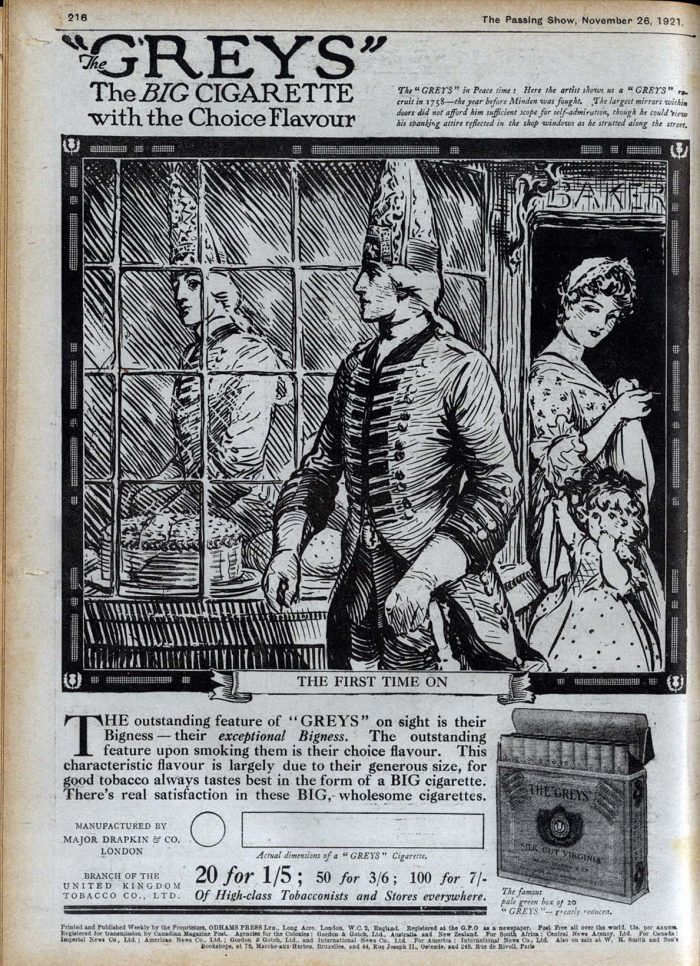
Back before the public came to terms with the grim causal relationship between cigarettes and cancer, smoking was a jolly affair, whose pleasures extended well beyond the physical act.
Smoking was sociable. Yes, there were certain situations in which three on a match could spell doom, but a far greater likelihood that lighting an attractive stranger’s coffin nail might kindle conversation, and more.
If you were at a loss for words, you might break the ice with the trading cards manufacturers slipped inside cigarette packs, such as these mid-30s beauties that came inside packs of Greys, a now-defunct British cigarette brand, and favorite of WWI vets.
The subject is unusual. Sports, cinema stars, and military scenes were common themes of the time. The “Greys Anticipations” series took creative liberties, by imagining a (cancer-free) year 2500, in which Londoners would be privy to such innovations as solar-lighting, moving sidewalks, and wireless television…
Great Scott! Were they psychic!?
Hopefully not.
Hopefully, we’ve still got 484 years to find out…
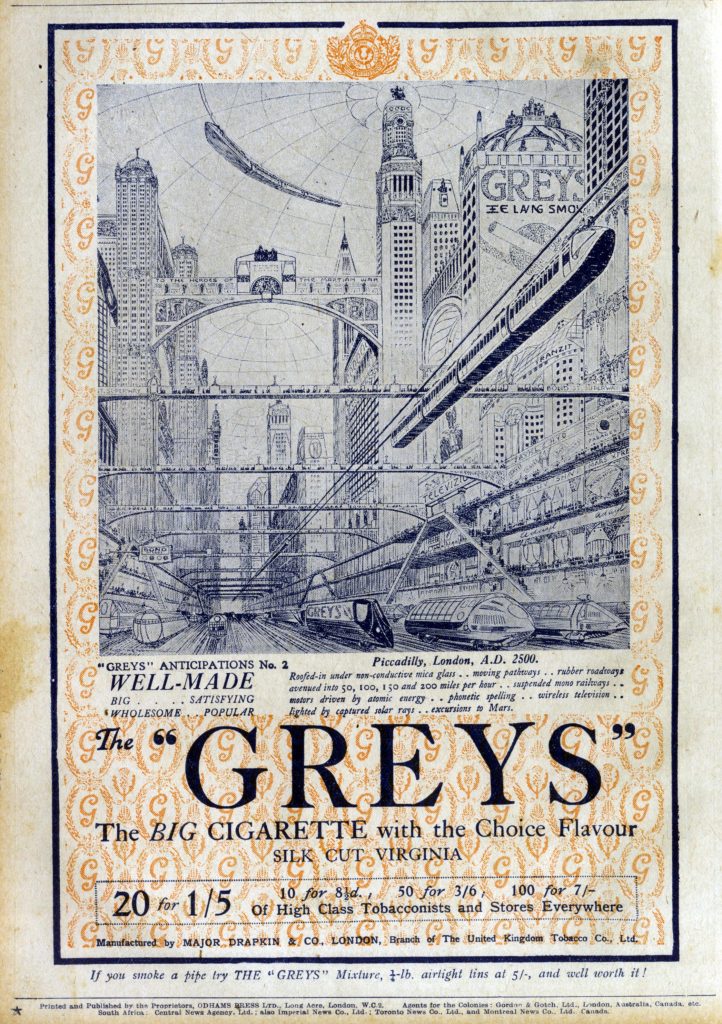
“Picadilly, London, A.D. 2500: Roofed-in under non-conductive mica glass . . moving pathways . . rubber roadways avenued into 50, 100, 150 and 200 miles per hour . . suspended mono railways . . motors driven by atomic energy . . phonetic spelling . . wireless television . . lighted by captured solar rays . . excursions to Mars.”
I’m fine with excursions to Mars and monorails but atomic energy is as problematic as the health claims once put forward by cigarette ads.
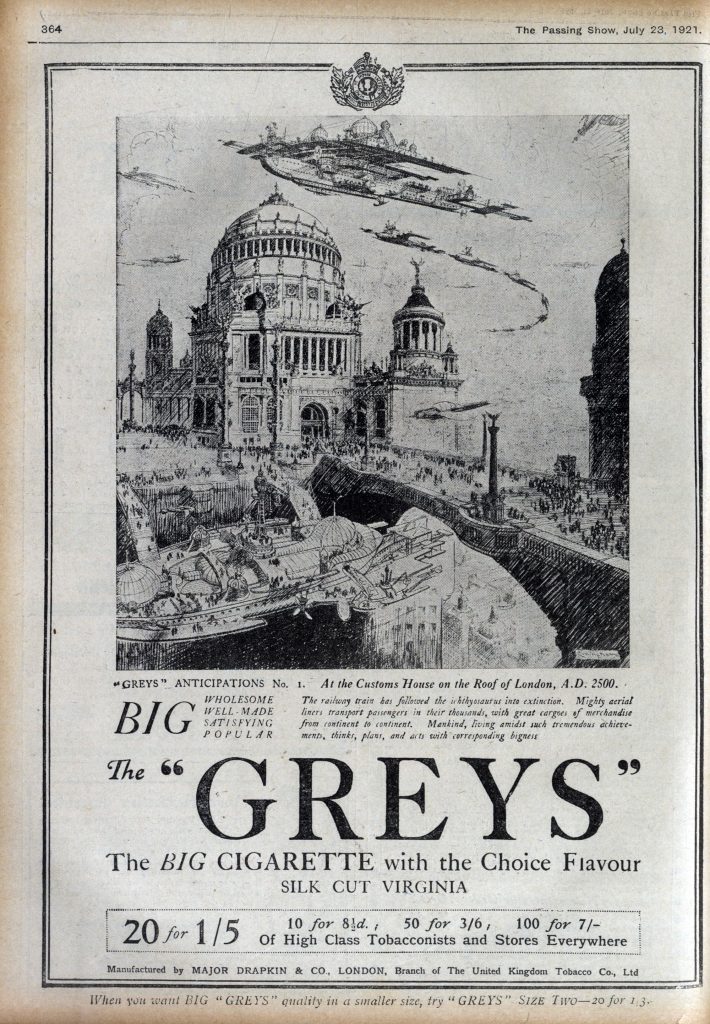
“At the Customs House on the Roof of London, A.D. 2500: The railway train has followed the ichthyosaurus into extinction. Mighty aerial liners transport passengers in their thousands, with great cargoes of merchandise from continent to continent. Mankind, living amidst such tremendous achievements, thinks, plans, and acts with corresponding bigness.”
Hmm…I was kind of rooting for train travel to make a comeback…
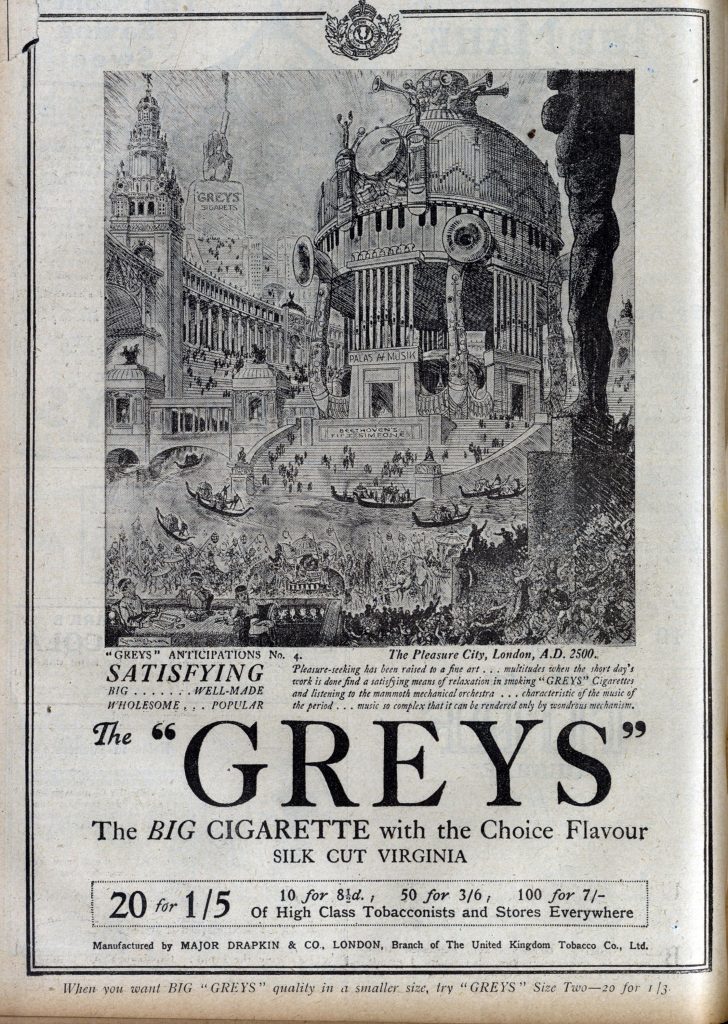
“The Pleasure City, London, A.D. 2500: Pleasure-seeking has been raised to a fine art … mutitudes when the short day’s work is done find a satisfying means of relaxation in smoking “GREYS” Cigarettes and listening to the mammoth mechanical orchestra … characteristic of the music of the period … music so complex that it can be rendered only by wonderous mechanism.”
This does sound rather fun, depending on who’s doing the programming… perhaps we should just stick with headphones and a busker on every corner.
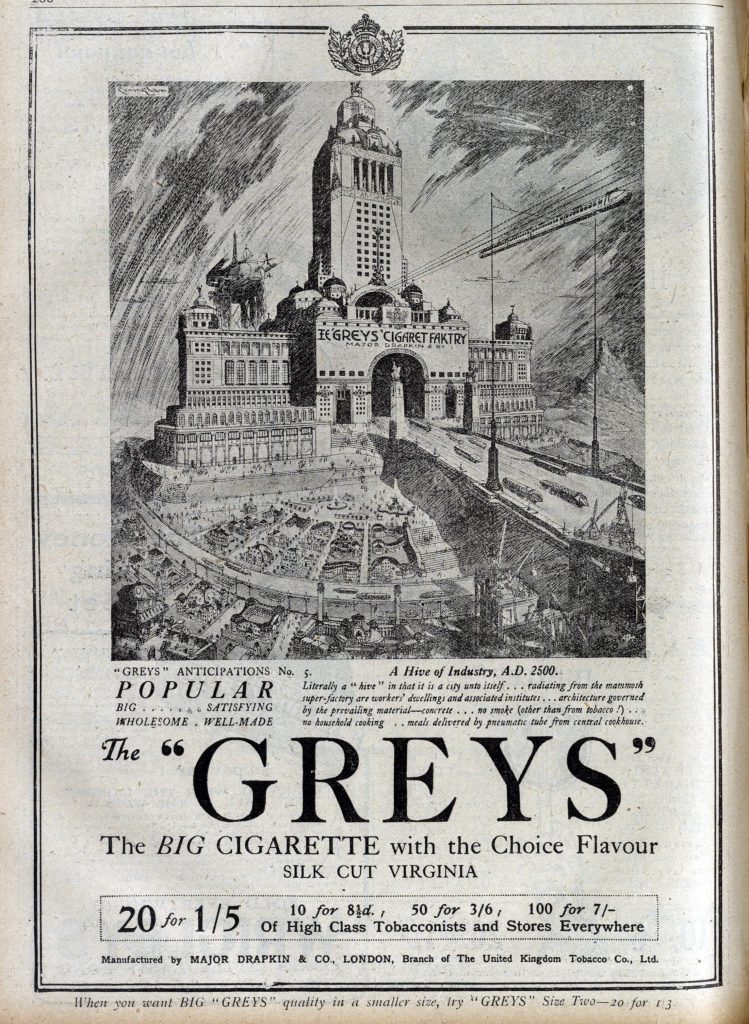
A Hive of Industry, A.D. 2500: Literally a “hive” in that it is a city unto itself … radiating from the mammoth super-factory are workers’ dwellings and associated institutes … architecture governed by the prevailing material — concrete … no smoke (other than from tobacco!) … no household cooking . . meals delivered by pneumatic tube from central cookhouse.
Um…I strongly suggest revisiting Terry Gilliam’s 1985 film, Brazil, before signing off on the whole pneumatic tube thing.
Darran Anderson, author of Imaginary Cities, took a closer look at one of the cards in the above talk about imaginary London. I share his opinion that “phonetic spelling… is the best thing that they envisaged of the future.”
He also notes that the card is about 20 years ahead of its time in promoting a mid-50s‑style vision of the future, but that it failed to predict the demise of Greys Cigarettes, by prominently advertising them on the side of a suspended monorail.
Hubris!
via Metafilter
Related Content:
In 1900, Ladies’ Home Journal Publishes 28 Predictions for the Year 2000
Cigarette Commercials from David Lynch, the Coen Brothers and Jean Luc Godard
Ayun Halliday is an author, illustrator, theater maker and Chief Primatologist of the East Village Inky zine. Her play Zamboni Godot is opening in New York City in March 2017. Follow her @AyunHalliday
Read More...Alice’s Restaurant: An Illustrated Version of Arlo Guthrie’s Thanksgiving Counterculture Classic
Alice’s Restaurant. It’s now a Thanksgiving classic, and something of a tradition around here. Recorded in 1967, the 18+ minute counterculture song recounts Arlo Guthrie’s real encounter with the law, starting on Thanksgiving Day 1965. As the long song unfolds, we hear all about how a hippie-bating police officer, by the name of William “Obie” Obanhein, arrested Arlo for littering. (Cultural footnote: Obie previously posed for several Norman Rockwell paintings, including the well-known painting, “The Runaway,” that graced a 1958 cover of The Saturday Evening Post.) In fairly short order, Arlo pleads guilty to a misdemeanor charge, pays a $25 fine, and cleans up the thrash. But the story isn’t over. Not by a long shot. Later, when Arlo (son of Woody Guthrie) gets called up for the draft, the petty crime ironically becomes a basis for disqualifying him from military service in the Vietnam War. Guthrie recounts this with some bitterness as the song builds into a satirical protest against the war: “I’m sittin’ here on the Group W bench ’cause you want to know if I’m moral enough to join the Army, burn women, kids, houses and villages after bein’ a litterbug.” And then we’re back to the cheery chorus again: “You can get anything you want, at Alice’s Restaurant.”
We have featured Guthrie’s classic during past years. But, for this Thanksgiving, we give you the illustrated version. Happy Thanksgiving to everyone who plans to celebrate the holiday today.
Follow Open Culture on Facebook and Twitter and share intelligent media with your friends. Or better yet, sign up for our daily email and get a daily dose of Open Culture in your inbox. And if you want to make sure that our posts definitely appear in your Facebook newsfeed, just follow these simple steps.
Related Content:
Bed Peace Revisits John Lennon & Yoko Ono’s Famous Anti-Vietnam War Protest
Willie Nelson, Pete Seeger, and Arlo Guthrie at Occupy Wall Street
The Alan Lomax Sound Archive Now Online: Features 17,000 Recordings
Read More...Hear a 9‑Hour Tribute to John Peel: A Collection of His Best “Peel Sessions”
If you took a job as a radio DJ at the BBC prior to 1988, you had to labor under something called “needle time,” a law promoted by the Musicians’ Union and Phonographic Performance Limited (and ultimately the major record labels) that put a cap on the amount of recorded music transmissible over the airwaves. Before 1967, the BBC could legally drop the needles of their turntables onto record albums for a mere five hours per day. This may sound positively draconian in our time when music flows freely from all directions, but it did create jobs for in-house radio-station musicians who could cover the hits of the day — and, more importantly, gave rise to DJ John Peel’s legendary Peel Sessions.
“A lot of the things that I listened to and that had a big influence on me I first heard on John Peel,” said artist and music producer Brian Eno, who describes Peel’s first playing of a Velvet Underground record nearly fifty years ago as “like a lightning bolt for me.” In an interview we featured a few years back, Eno named the “two things that really make for good records: deadlines and small budgets,” one of his many eloquent statements on not just the importance but the necessity of limitations to art. The limitation of needle time made Peel get creative as well, overcoming his inability to spin all the records he wanted by inviting the musicians he’d discovered into the radio station to lay down tracks right there in its studios.
The fruits of these Peel Sessions often came out with an energy altogether different than that of the original album, and during Peel’s 37 years on BBC Radio 1, he oversaw the recording of over 4000 of them. They and other efforts at the innovative edges of popular music made Peel a cultural force, and indeed one of British music’s most influential figures, whose broadcasts gave thousands of listeners their first taste of the likes of David Bowie, Joy Division, Bob Marley, and Nirvana. Peel died in 2004, but his legacy has lived on in several forms, including the John Peel Center for Creative Arts and the annual John Peel Lecture, delivered last year by Eno himself.
London-based online radio station NTS, in its own way very much a continuation of Peel’s project, has put together a tribute to Britain’s most astute DJ in the form of a nine-hour broadcast of some of the best Peel Sessions. Broken into four parts, it gathers performances captured at the BBC from artists like Gang of Four, The Fall, My Bloody Valentine, The Pixies, Aphex Twin, Cabaret Voltaire, and many others. “Blimey, he was really at the center of everything,” says Eno. “He was putting so many things together. He was the first person who realized pop music was serious, and that it was a place people could really meet and talk to each other. It became the center of a conversation.” A dozen years after Peel’s passing, the conversation continues.
Related Content:
Revisit the Radio Sessions and Record Collection of Groundbreaking BBC DJ John Peel
Brian Eno on Why Do We Make Art & What’s It Good For?: Download His 2015 John Peel Lecture
Based in Seoul, Colin Marshall writes and broadcasts on cities and culture. He’s at work on a book about Los Angeles, A Los Angeles Primer, the video series The City in Cinema, the crowdfunded journalism project Where Is the City of the Future?, and the Los Angeles Review of Books’ Korea Blog. Follow him on Twitter at @colinmarshall or on Facebook.
Read More...The New York Times’ First Profile of Hitler: His Anti-Semitism Is Not as “Genuine or Violent” as It Sounds (1922)
I’ve heard it again and again. The now President-elect made vicious and belittling attacks on African-Americans, Muslims, immigrants, women, the disabled, etc. during the campaign season (and for several decades before), but he didn’t mean it. And I have many questions. For example, why should anyone assume—given the history of country after country after country—that a bullying nativist autocrat doesn’t mean what he says?
We know celebrity breeds trivialization. But we also know well that in some of the most famous—but by no means only—cases of demagogues who rose to power with hate speech, the rhetoric quickly turned to many years of incomprehensible, yet calculated, brutality. At least in the U.S., hardly anyone believed that the melodramatic vitriol Hitler and Mussolini spat at scapegoats of all kinds, especially Jews, should be taken very seriously.
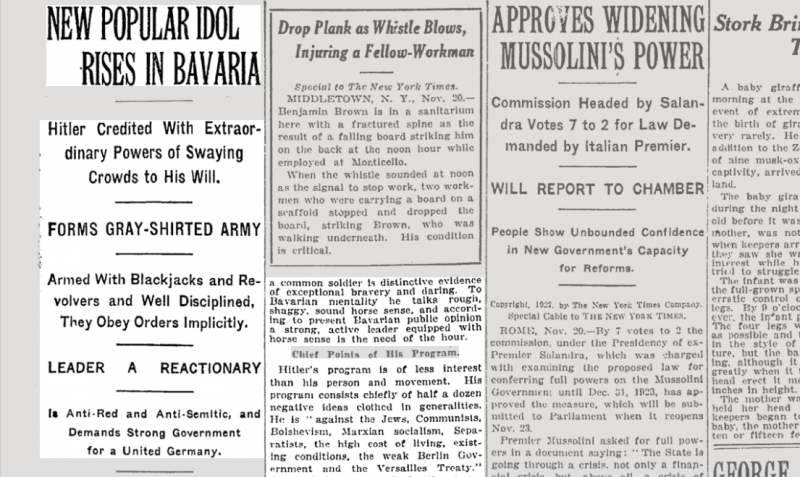
In 1922—at the dawn of Hitler’s budding nationalist movement—The New York Times published its first profile, and explained his demagoguery away. The article, titled “New Popular Idol Rises in Bavaria,” begins with several alarming subheadings: “Hitler credited with extraordinary powers of swaying crowds to his will,” “forms gray-shirted army… They obey orders implicitly,” “Leader a reactionary,” “Anti-Red and Anti-Semitic.” It then goes on to undermine these charges.
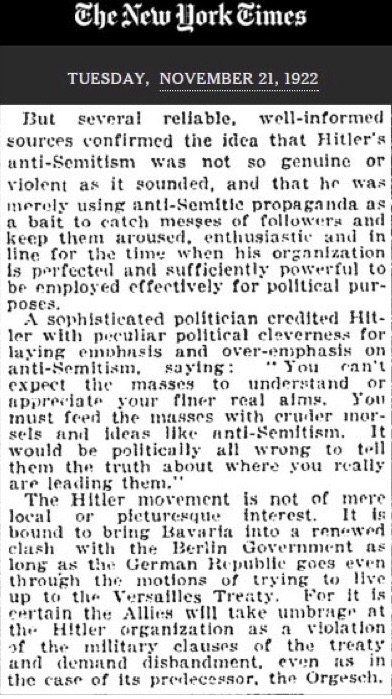
According to “several reliable, well-informed [unnamed] sources,” we’re told, “Hitler’s anti-Semitism was not so genuine or violent as it sounded,” though “the Hitler movement is not of a mere local or picturesque interest.”
He was merely using anti-Semitic propaganda as a bait to catch masses of followers and keep them aroused, enthusiastic and in line for the time when his organization is perfected and sufficiently powerful to be employed effectively for political purposes.
What purposes? The paper quotes one admiring “sophisticated politician” as saying, “You can’t expect the masses to understand or appreciate your finer real aims. You must feed the masses with cruder morsels and ideas like anti-Semitism. It would be politically all wrong to tell them the truth about where you really are leading them.” Where might this be? The shadowy source did not say. We cynically expect all politicians to lie, to feed us “cruder morsels.” But assuming that racism, bigotry, and scapegoating—whether sincere or not—will go down so easily with so many people constitutes a very dark view of “the masses.”
Ten years later, after Hitler was released from prison for treason and had begun his candidacy for president, many, even more complimentary, articles would follow—as Rafael Medoff documents in The Daily Beast—all the way up to Time magazine’s naming him “Man of the Year” for 1938. “Why did many mainstream American newspapers portray the Hitler regime positively,” asks Medoff, “especially in its early months? How could they publish warm human-interest stories about a brutal dictator? Why did they excuse or rationalize Nazi anti-Semitism? These are questions that should haunt the conscience of U.S. journalism to this day.”
One reporter in a 1933 Christian Science Monitor dispatch from Germany informed his readers that “the train arrived punctually”—indulging a trope about fascists making the “trains run on time” that has astonishingly come back in circulation via former Cincinnati mayor Ken Blackwell. “Traffic was well regulated.” The correspondent found “not the slightest sign of anything unusual afoot.” The word we often hear for what happened during the 30s is “normalization,” a process by which the most harrowing portents were blended into the landscape, rendered signs of nothing “unusual afoot.”
The normalization of Nazism in Germany involved a tremendous propaganda effort, much of it aimed at children. In the U.S., the press seemed more than willing to turn an ethno-nationalist movement with frightening—and plainly stated—objectives into an ordinary, rational state actor. Anti-Semitism was described as legitimate political resentment or reasonable anger at German Jews’ “commercial clannishness.” Somehow the victims of Nazism had to be responsible for their own murder and persecution. “There must be some reason,” wrote The Christian Century in an April, 1933 editorial, “other than race or creed—just what is that reason?” Few people, it seems, could or would allow themselves to imagine that the new German Führer actually meant what he said.
via Boing Boing
Related Content:
Free Online History Courses, a subset of our collection, 1,700 Free Online Courses from Top Universities
George Orwell Reviews Mein Kampf: “He Envisages a Horrible Brainless Empire” (1940)
Josh Jones is a writer and musician based in Durham, NC. Follow him at @jdmagness.
Read More...Hear “Weightless,” the Most Relaxing Song Ever Made, According to Researchers (You’ll Need It Today)
As I write this, it’s election night, and I do not need to tell you about the thick haze of fear in the air. I have already had a couple friends ask me about resources for meditation and relaxation. I’m no expert, but I have looked into various ways to deal with stress and hypertension. Meditation tops my list (and those of many mental health professionals). At a very close second place: Music.
We’ve brought you many meditation resources in the past (see here, here, here, and here). And we’ve pointed you toward four hours of free original meditation music to help you “not panic,” courtesy of Moby. We’ve also brought you music to help you sleep, from composer Max Richter and many others. Now, we bring you what “a team of scientists and sound therapists” claim is “the most relaxing song ever,” as Electronic Beats informs us. You can hear the track, “Weightless”—by Manchester band Marconi Union and Lyz Cooper, founder of the British Academy of Sound Therapy—above.
The song’s relaxing properties supposedly work “by using specific rhythms, tones, frequencies and intervals to relax the listener,” writes ShortList. I’ve had it on repeat for an hour and will testify to its efficacy. So can 40 women who “found it to be more effective at helping them relax than songs by Enya, Mozart and Coldplay.” In this experiment and others, says UK stress specialist Dr. David Lewis, “Brain imaging studies have shown that music works at a very deep level within the brain, stimulating not only those regions responsible for processing sound but also ones associated with emotions.”
Emotions—fear, rage, and disgust—are running wild nationwide. Justifiable or not, they can wreak havoc on our mental and physical health if we can’t find ways to relax. “Weightless,” reports The Telegraph, “induced a 65 per cent reduction in overall anxiety and brought [study participants] to a level 35 per cent lower than their usual resting rates.” That’s no small change in attitude, but if you find this atmospheric track doesn’t do it for you, maybe try out some other tunes from the research team’s top 10 list of most relaxing (hear them all in the playlist above):
- Marconi Union and Lyz Cooper – Weightless
- Airstream – Electra
- DJ Shah – Mellomaniac (Chill Out Mix)
- Enya – Watermark
- Coldplay – Strawberry Swing
- Barcelona – Please Don’t Go
- All Saints – Pure Shores
- AdelevSomeone Like You
- Mozart – Canzonetta Sull’aria
- Cafe Del Mar – We Can Fly
And then, again, there’s Moby’s four hours of ambient sounds, Max Richter’s eight-hour Sleep, the work of German ambient composer Gas, and hundreds of other supremely relaxing pieces of music to bring your stress levels down to manageable. Maybe keep some relaxing music on hand for extra-stressful moments, and as always, don’t forget to breathe.
Related Content:
How a Good Night’s Sleep — and a Bad Night’s Sleep — Can Enhance Your Creativity
Josh Jones is a writer and musician based in Durham, NC. Follow him at @jdmagness
Read More...Odd Vintage Postcards Document the Propaganda Against Women’s Rights 100 Years Ago
The vicious, vitriolic imagery and rhetoric of this election season can seem overwhelming, but as even casual students of history will know, it isn’t anything new. Each time historic social change occurs, reactionary counter-movements resort to threats, appeals to fear, and demeaning caricatures—whether it’s anti-Reconstruction propaganda of the 19th century, anti-Civil Rights campaigns 100 years later, or anti-LGBT rights efforts today.
At the turn of the century, the women’s suffrage movement faced significant levels of abuse and resistance. One photograph has circulated, for example, of a suffrage activist lying in the street as police beat her. (The woman in the photo is not Susan B. Anthony, as many claim, but a British suffragist named Ada Wright, beaten on “Black Friday” in 1910.) It’s an arresting image that captures just how violently men of the day fought against the movement for women’s suffrage. [It’s also worth noting, as many have: the early suffrage movement campaigned only for white women’s right to vote, and sometimes actively resisted civil rights for African-Americans.]
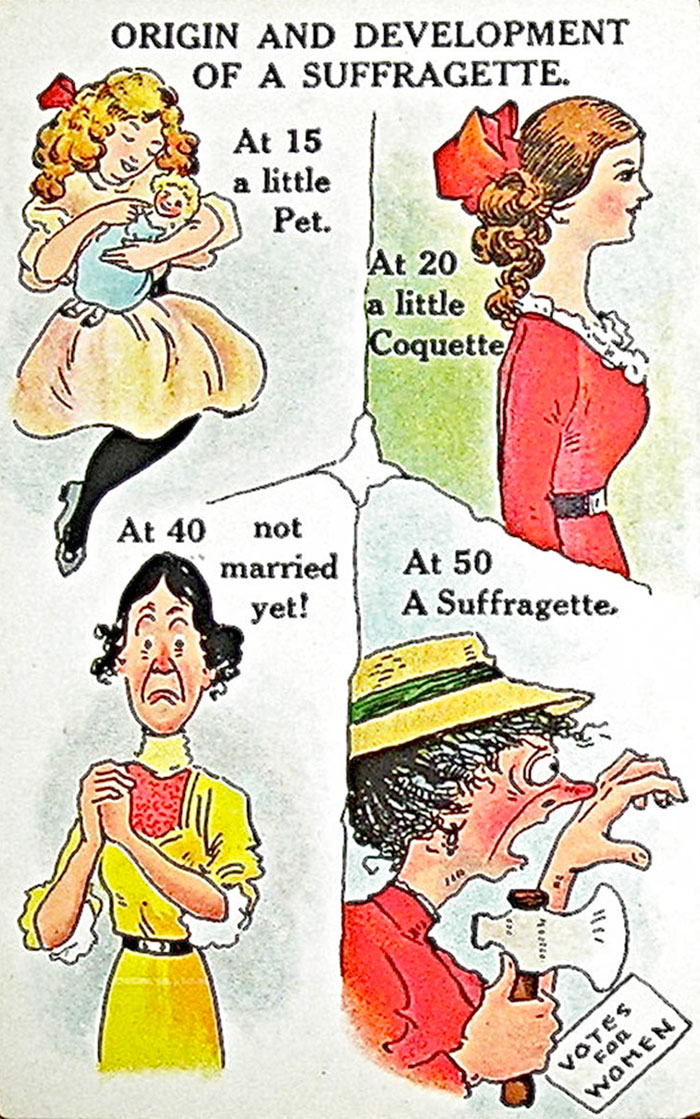
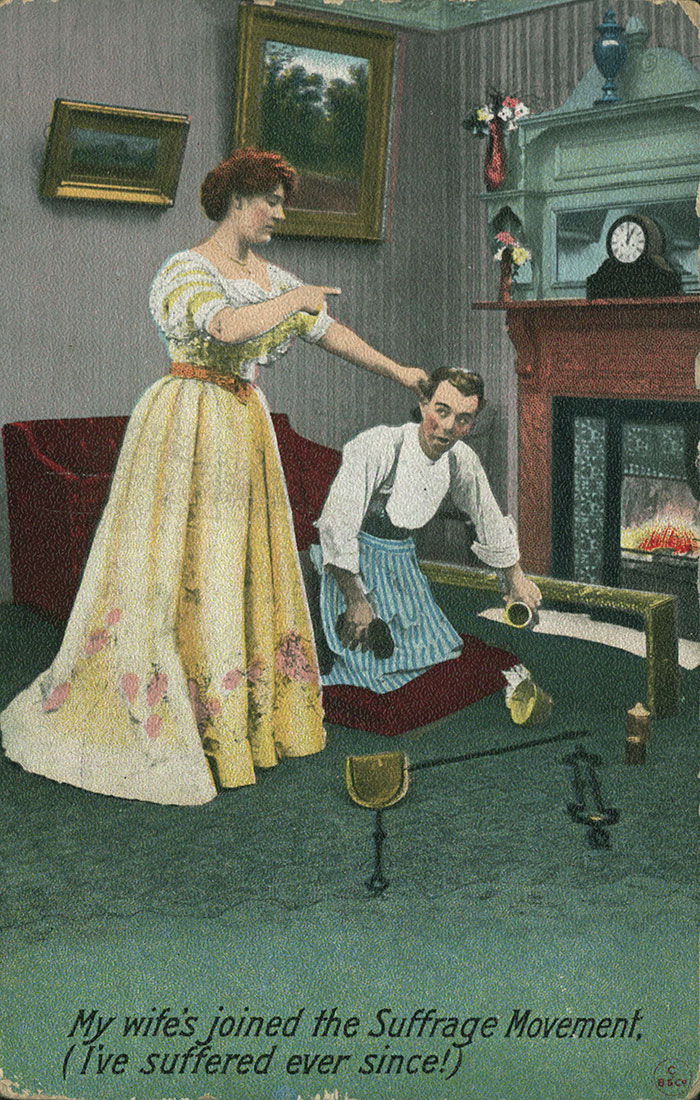
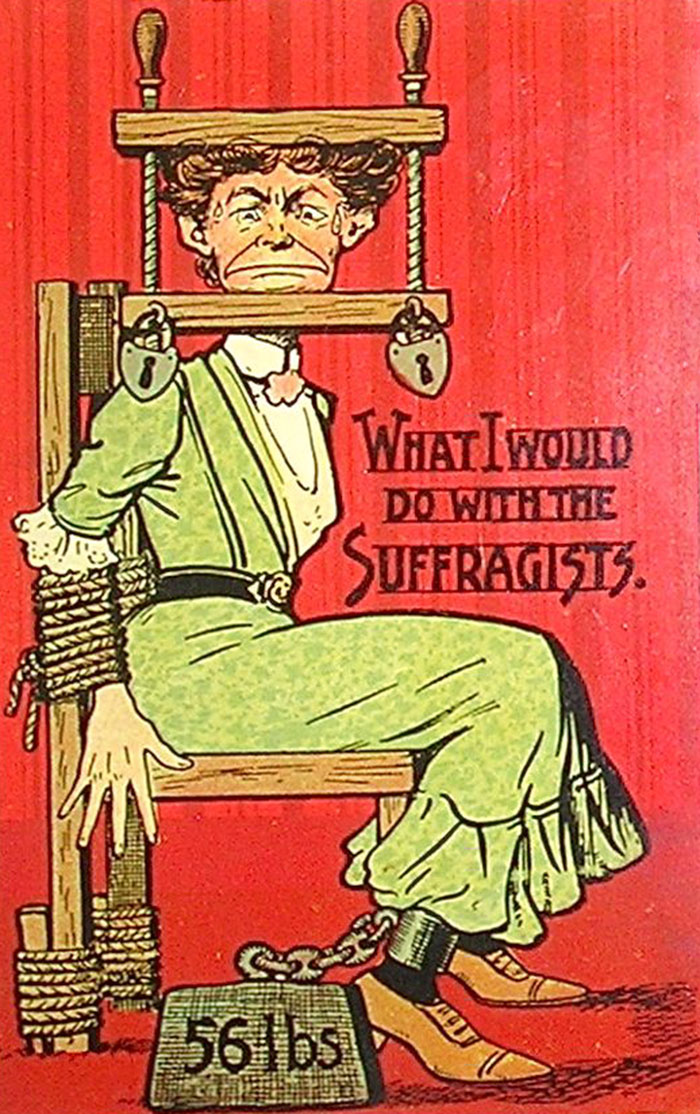
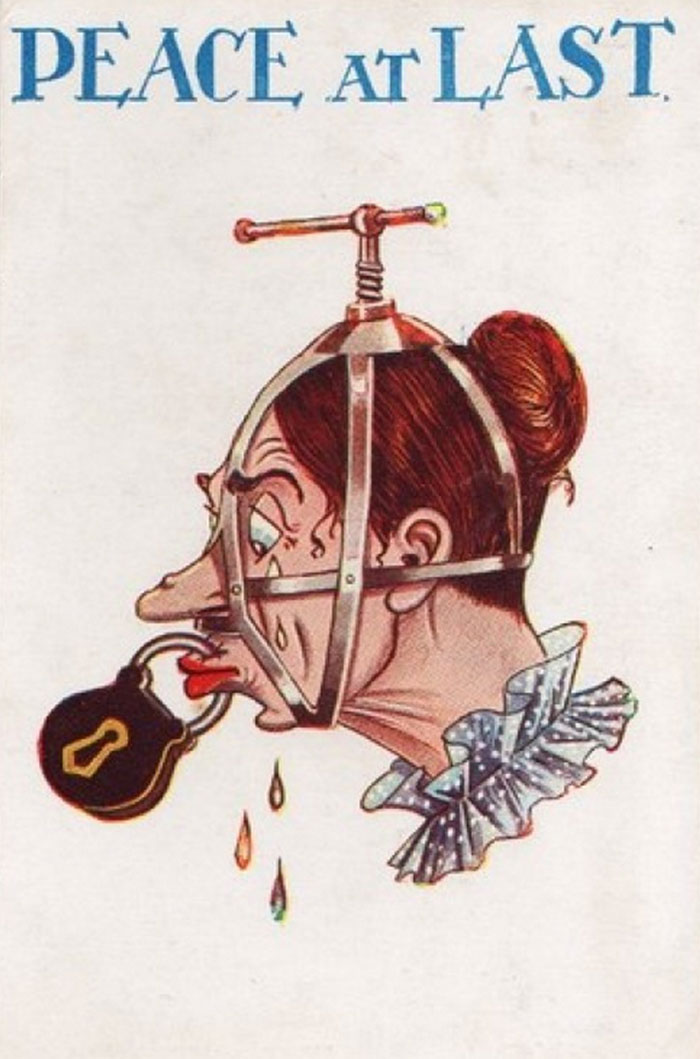
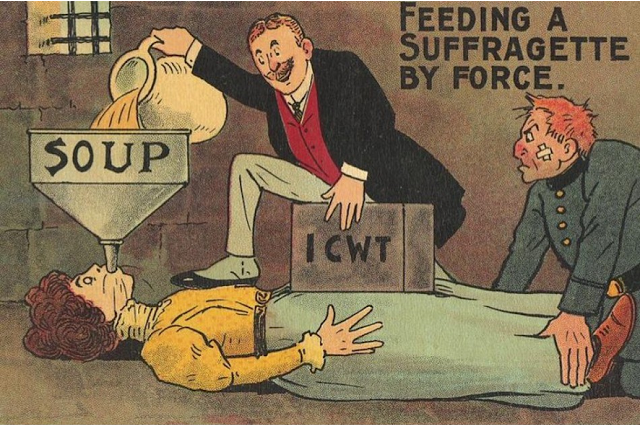
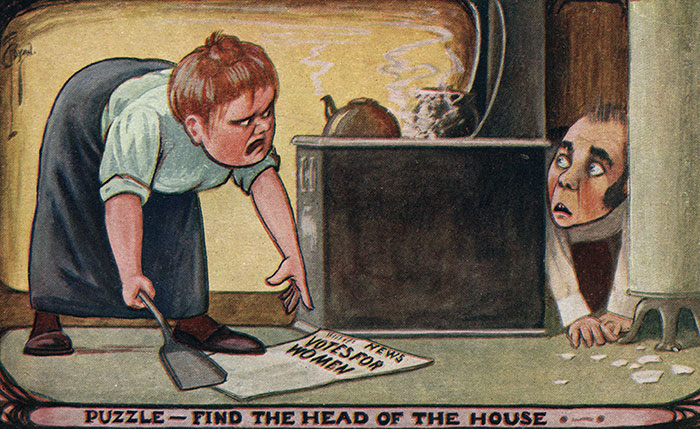
As you can see from the sample anti-suffrage postcards here—dating from the late 19th to early 20th centuries— propaganda against the women’s vote tended to fall into three broad categories: Disturbingly violent wish-fulfillment involving torture and physical silencing; characterizations of suffragists as angry, bitter old maids, hatchet-wielding harridans, or domineering, shrewish wives and neglectful mothers; and, correspondingly, depictions of neglected children, and husbands portrayed as saintly victims, emasculated by threats to traditional gender roles, and menaced by the suggestion that they may have to care for their children for even one day out of the year!
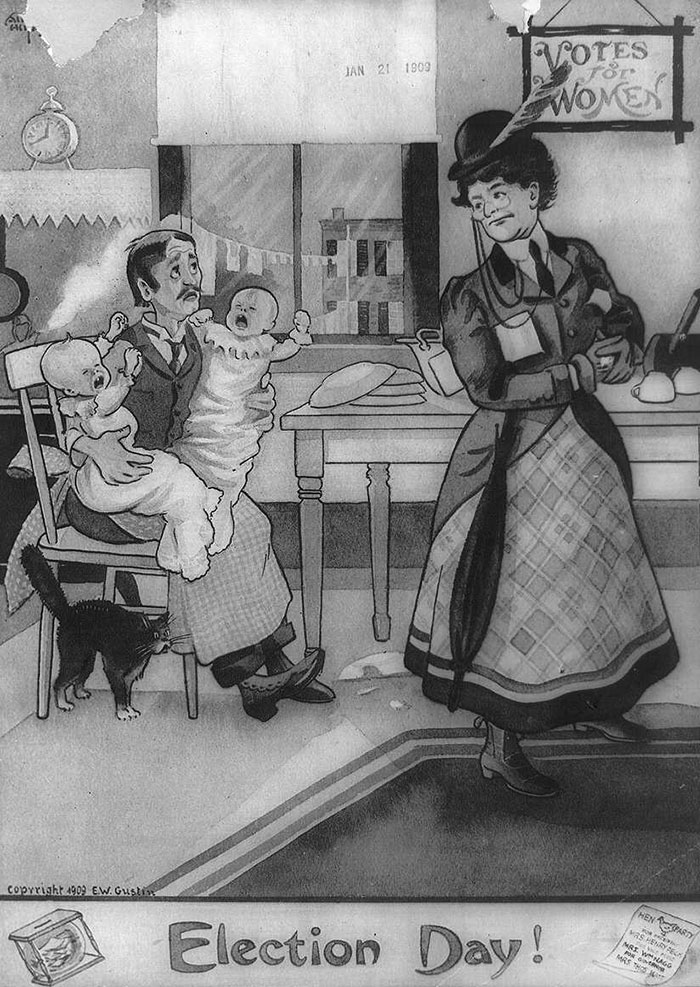
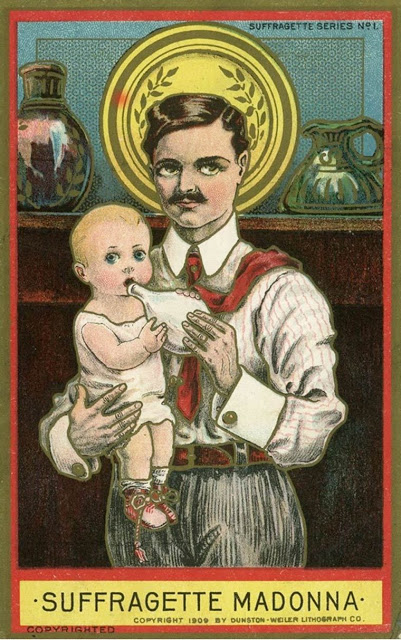
These postcards come from the collection of Catherine Palczewski, professor of women’s and gender studies at the University of Northern Iowa. She has been collecting these images, from both the U.S. and Britain, for 15 years. On her website, Palczewski quotes George Miller’s comment that postcards like these “offer a vivid chronicle of American political values and tastes.” Palczewski describes these particular images as “a fascinating intersection [that] occurred between advocacy for and against woman suffrage, images of women (and men), and postcards. Best estimates are that approximately 4,500 postcards were produced with a suffrage theme.”
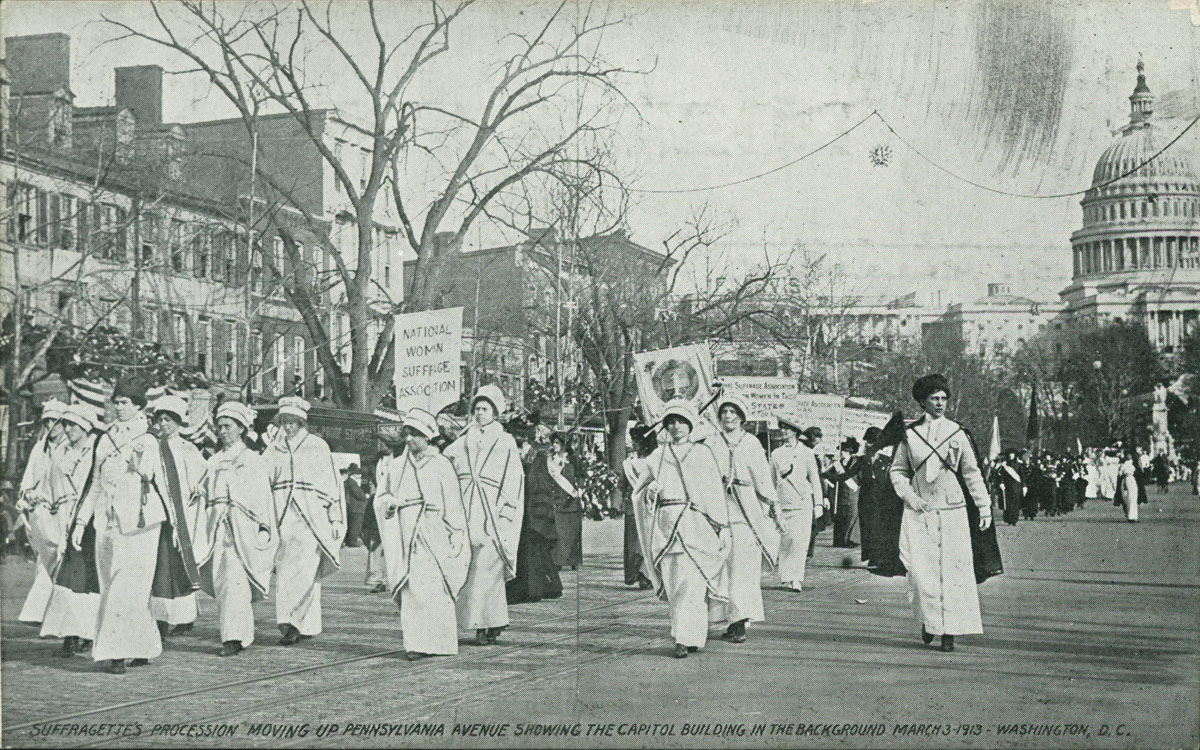
As she notes in the quote above, the postcards printed during this period did not all oppose women’s suffrage. “Suffrage advocates,” writes Palczewski, “recognized the utility of the postcard as a propaganda device” as well. Pro-suffrage postcards tended to serve a documentary purpose, with “real-photo images of the suffrage parades, verbal messages identifying the states that had approved suffrage, or quotations in support of extending the vote to women.” For all their attempts at presenting a serious, informative counterweight to incendiary anti-suffrage images like those you see here, suffrage activists often found that they could not control the narrative.
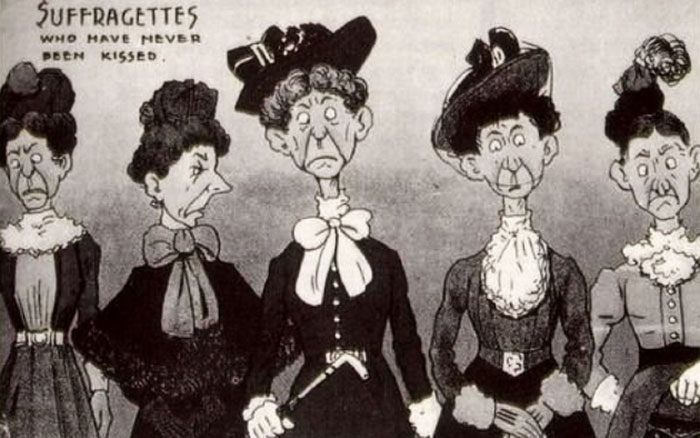
As Lisa Tickner writes in The Spectacle of Women: Imagery of the Suffrage Campaign 1907–1914, postcard producers without a clear agenda often used photos and illustrations of suffragists to represent “topical or humorous types” and “almost incidentally” undercut advocates’ attempts to present their cause in a newsworthy light. The image of the suffragette as a trivial figure of fun persisted into the mid-twentieth century (as we see in Glynis Johns’ comically neglectful Winifred Banks in Walt Disney’s 1964 Mary Poppins adaptation).
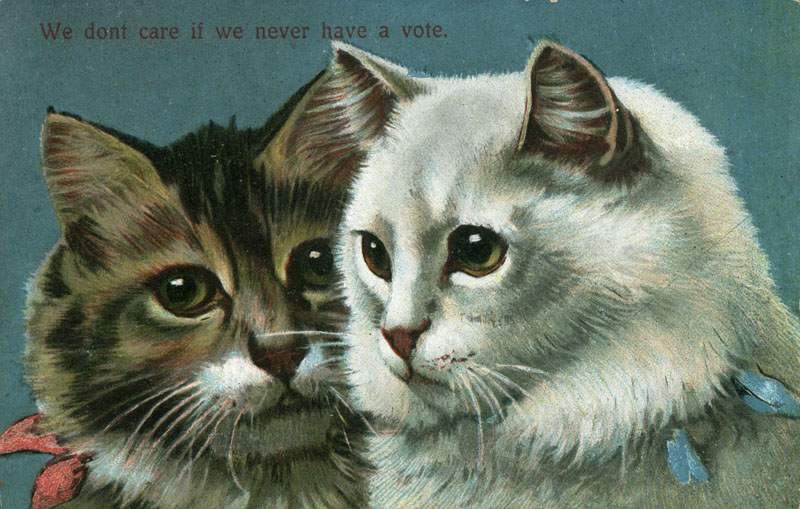
Palczewski’s site offers a brief history of the “Golden Age” (1893–1918) of political postcards and organizes the collection into categories. One variety we might find particularly charming for its use of cats and kittens actually has a pretty sinister origin in the so-called “Cat-and-Mouse Act” in the UK. Jailed suffragists had begun to stage hunger strikes, and journalists provoked public outcry by portraying force-feeding by the government as a form of torture. Instead, striking activists were released when they became weak. “If a woman died after being released,” Palczewski explains, “then the government could claim it was not to blame.” When a freed activist regained her strength, she would be rearrested. “On November 29, 1917,” Palczewski writes, “the US government announced it plans to use Britain’s cat and mouse approach.”
You can see many more historical pro- and anti-suffrage postcards at Palczewski’s website, and you are free to use them for non-commercial purposes provided you attribute the source. You are also free, of course, to draw your own comparisons to today’s hyperbolic and often violently misogynist propaganda campaigns.
Related Content:
Download All 239 Issues of Landmark UK Feminist Magazine Spare Rib Free Online
11 Essential Feminist Books: A New Reading List by The New York Public Library
Download Images From Rad American Women A‑Z: A New Picture Book on the History of Feminism
Josh Jones is a writer and musician based in Durham, NC. Follow him at @jdmagness
Read More...Support Us
We're hoping to rely on loyal readers, rather than erratic ads. Please click the Donate button and support Open Culture. You can use Paypal, Venmo, Patreon, even Crypto! We thank you!

About Us

Open Culture scours the web for the best educational media. We find the free courses and audio books you need, the language lessons & educational videos you want, and plenty of enlightenment in between.
Advertise With Us
FREE UPDATES!
GET OUR DAILY EMAIL
Get the best cultural and educational resources on the web curated for you in a daily email. We never spam. Unsubscribe at any time.
FOLLOW ON SOCIAL MEDIA
Open Culture editor Dan Colman scours the web for the best educational media. He finds the free courses and audio books you need, the language lessons & movies you want, and plenty of enlightenment in between.
Advertise With Us


