Hear the Long-Lost Chants of English Monks, Revived for the First Time in 500 Years
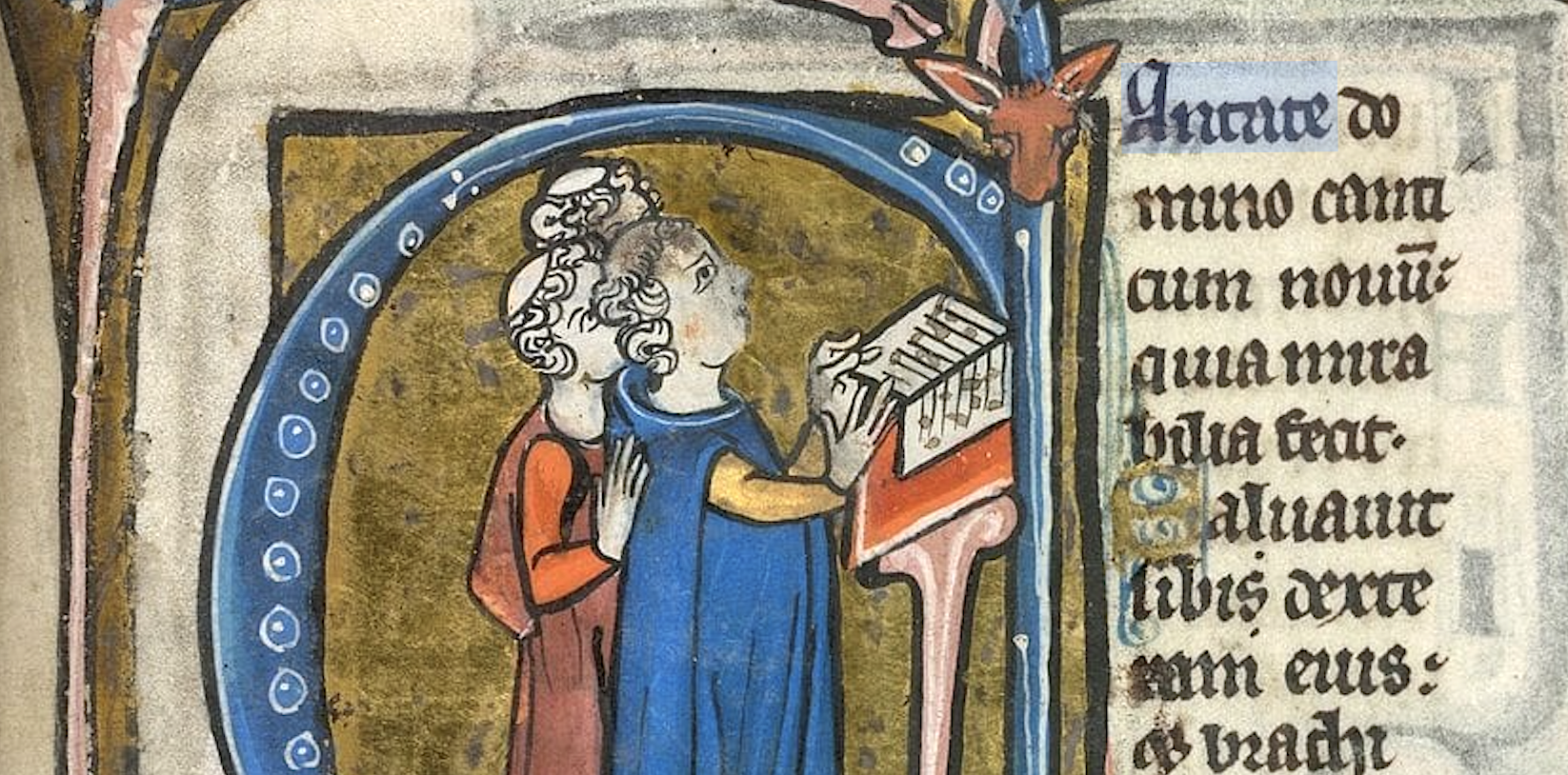
Listening to music, especially live music, can be a religious experience. These days, most of us say that figuratively, but for medieval monks, it was the literal truth. Every aspect of life in a monastery was meant to get you that much closer to God, but especially the times when everyone came together and sang. For English monks accustomed to that way of life, it would have come as quite a shock, to say the very least, when Henry VIII ordered the dissolution of the monasteries between the mid fifteen-thirties and the early fifteen-forties. Not only were the inhabitants of those refuges sent packing, their sacred music was cast to the wind.
Nearly half a millennium later, that music is still being recovered. As reported by the Guardian’s Steven Morris, University of Exeter historian James Clark found the latest example while researching the still-standing Buckland Abbey in Devon for the National Trust.
“Only one book — rather boringly setting out the customs the monks followed — was known to exist, held in the British Library.” But lo and behold, a few leaves of parchment stuck in the back happened to contain pieces of early sixteenth-century music, or rather chant, with both text and notation, a vanishingly rare sort of artifact of medieval monastic life.
Just this month, for the first time in almost five centuries, the music from the “Buckland book” resonated within the walls of Buckland Abbey once again. You can hear a clip from the University of Exeter chapel choir’s performance just above, which may or may not get across the grimness of the original work. “The themes are heavy — the threats from disease and crop failures, not to mention powerful rulers — but the polyphonic style is bright and joyful, a contrast to the sort of mournful chants most associated with monks,” writes Morris. For listeners here in the twenty-first century, these compositions offer the additional transcendental dimension of aesthetic time travel. The only way their rediscovery could be more fortuitous is if it had happened in time to benefit from the nineteen-nineties Gregorian-chant boom.
Related content:
See the Guidonian Hand, the Medieval System for Reading Music, Get Brought Back to Life
The Medieval Ban Against the “Devil’s Tritone”: Debunking a Great Myth in Music Theory
A Beatboxing Buddhist Monk Creates Music for Meditation
Based in Seoul, Colin Marshall writes and broadcasts on cities, language, and culture. His projects include the Substack newsletter Books on Cities and the book The Stateless City: a Walk through 21st-Century Los Angeles. Follow him on the social network formerly known as Twitter at @colinmarshall.
Read More...1,000+ Artworks by Vincent Van Gogh Digitized & Put Online by Dutch Museums
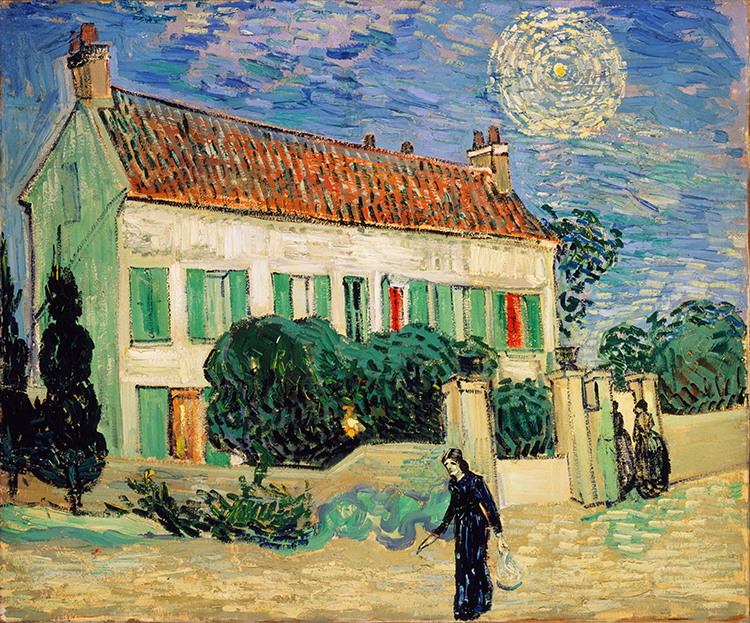
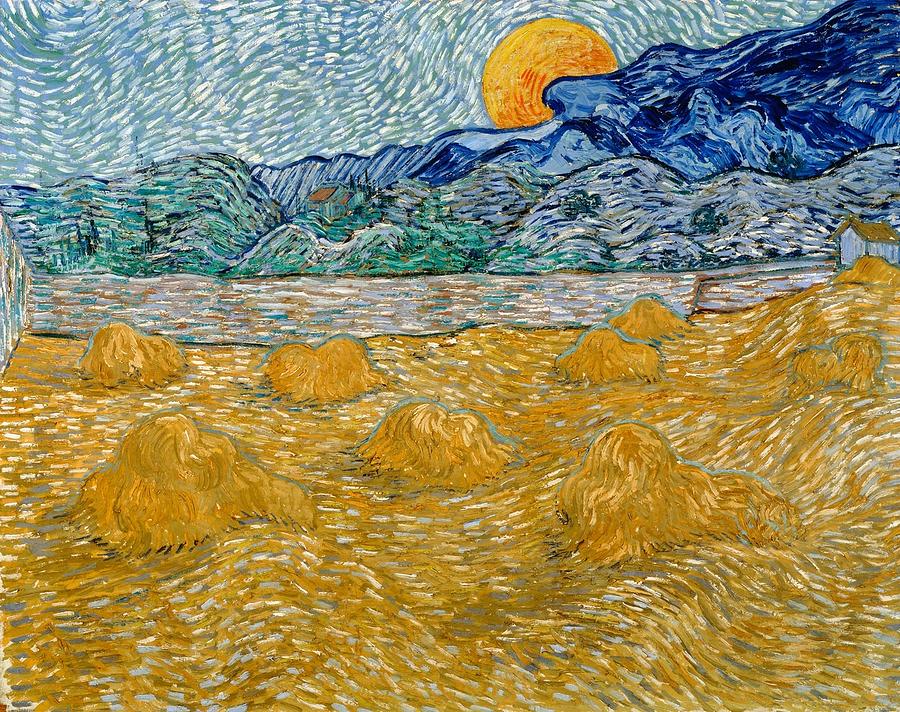
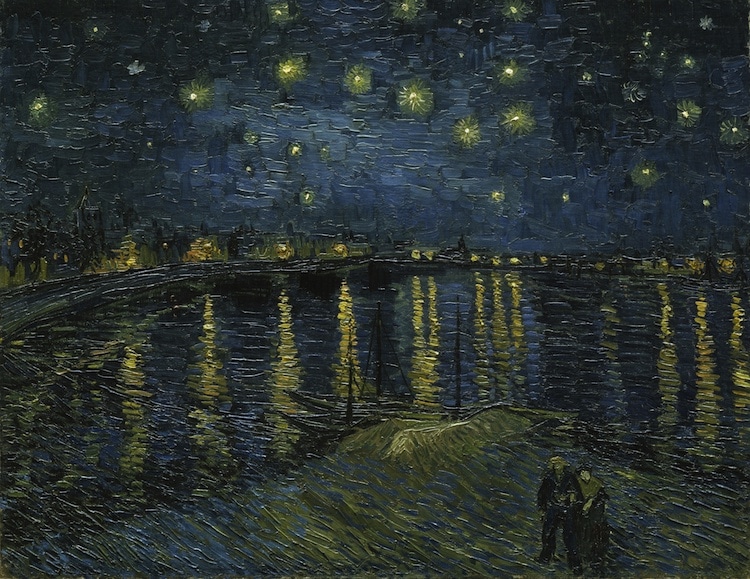
It gets dark before dinner now in my part of the world, a recipe for seasonal depression. Vincent van Gogh wrote about such low feelings with deep insight. “One feels as if one were lying bound hand and foot at the bottom of a deep dark well, utterly helpless.” Yet, when he looked up at the night sky he saw not darkness but blazing light: a full moon shines yellow from White House at Night like the sun, and peeks like a gold coin from behind blue mountains in Landscape with Wheat Sheaves and Rising Moon. The stars in Starry Night Over the Rhône appear like fireworks. We are all familiar with the blazing night sky of its sequel, The Starry Night.
It’s been suggested that Van Gogh saw halos of light because of lead poisoning from his paint, and that the Digitalis Dr. Gachet prescribed for his temporal lobe epilepsy caused him to “see in yellow,” the Van Gogh Gallery Blog writes, “or see yellow spots which could explain van Gogh’s consistent use of the color yellow in his later works.”
His most brilliant works date from this later period, during his time at the hospital at Arles, where he painted his famous bedroom. All of these paintings, and hundreds more, can be found in high-resolution scans at the new van Gogh resource, Van Gogh Worldwide, “a consortium of museums,” notes Madeleine Muzdakis at My Modern Met, “doing their part to bring the work of one of the world’s most famous artists to the global masses.”
The museums represented here are all in the Netherlands and include the Van Gogh Museum, Kröller-Müller Museum, the Rijksmuseum, the Netherlands Institute for Art History, and the Museum Boijmans Van Beuningen. Van Gogh was not only a prolific painter, of shining night scenes and otherwise, but he was “also a prolific sketch artist. His pencil and paper drawings are worth exploration; they depict landscapes as well as emotive figures from Van Gogh’s everyday life. Van Gogh Worldwide provides insight into these works of art and the artist behind them. One can also find behind-the-scenes museum information, such as details of restorations, verso (back) images, and other curatorial notes.”
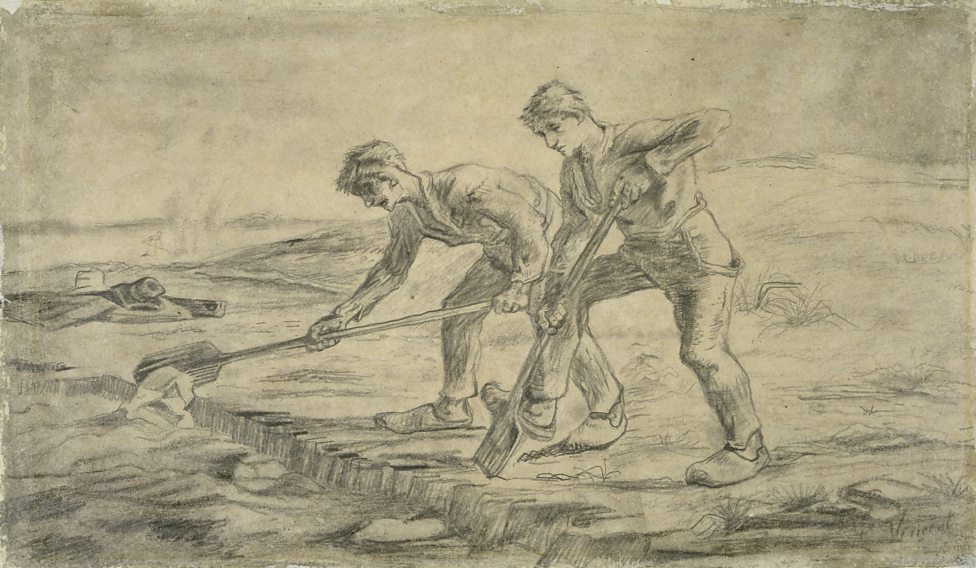
Van Gogh Worldwide expands other digital collections like the Van Gogh Museum’s almost 1,000 online works. Where that resource includes short informational articles and links to literature about the artworks, Van Gogh Worldwide does not, as yet, feature such additional materials, but it does include links to Van Gogh’s letters. In one of them, he writes to his brother, Theo, about their parents: “They’ll find it difficult to understand my state of mind, and not know what drives me when they see me do things that seem strange and peculiar to them—will blame them on dissatisfaction, indifference or nonchalance, while the cause lies elsewhere, namely the desire, at all costs, to pursue what I must have for my work.”
Note: An earlier version of this post appeared on our site in 2020.
Related Content:
Vincent Van Gogh’s “The Starry Night”: Why It’s a Great Painting in 15 Minutes
Download Hundreds of Van Gogh Paintings, Sketches & Letters in High Resolution
Discover the Only Painting Van Gogh Ever Sold During His Lifetime
Josh Jones is a writer and musician based in Durham, NC.
Read More...The 1830s Device That Created the First Animations: The Phenakistiscope

The image just above is an animated GIF, a format by now older than most people on the internet. Those of us who were surfing the World Wide Web in its earliest years will remember all those little digging, jackhammering roadworkers who flanked the permanent announcements that various sites — including, quite possibly, our own — were “under construction.” Charming though they could be at the time, they now look impossibly primitive compared to what we can see on today’s internet, where high-resolution feature films stream instantaneously. But technologically speaking, we can trace it all back to what this particular animated GIF depicts: the phenakistiscope.
Invented simultaneously and independently in late 1832 by Belgian physicist Joseph Plateau and Austrian geometry professor Simon Stampfer, the phenakistiscope was a simple wheel-shaped device that could, for the first time in the history of technology, create the illusion of a smoothly moving picture when spun and viewed in a mirror: hence the derivation of its name from the Greek phenakisticos, “to deceive,” and ops, “eye.”
When it caught on as a commercial novelty, it was also marketed under names like Phantasmascope and Fantascope, which promised buyers a glimpse of horse-riders, twirling dancers, bowing aristocrats, hopping frogs, flying ghouls, and even proto-psychedelic abstract patterns, many of which you can see re-animated as GIFs in this Wikipedia gallery.
Eventually, according to the Public Domain Review, the phenakistiscope was “supplanted in the popular imagination: firstly by the similar Zoetrope, and then — via Eadweard Muybridge’s Zoopraxiscope (which projected the animation) — by film itself.” Muybridge, previously featured here on Open Culture, did pioneering motion-photography work in the eighteen-seventies that’s now considered a precursor to cinema. Understanding what he was up to is an important part of understanding the emergence of movies as we know them. But the most instructive experience to start with is making a phenakistiscope of your own, instructions for which are available from the George Eastman Museum and artist Megan Scott on YouTube. The finished product may not hold anyone’s attention long here in the age of Netflix, but then, the age of Netflix would never have arrived had the phenakistiscope not come first.
Related content:
How Animated Cartoons Are Made: A Vintage Primer Filmed Way Back in 1919
The Trick That Made Animation Realistic: Watch a Short History of Rotoscoping
Was a 32,000-Year-Old Cave Painting the Earliest Form of Cinema?
Based in Seoul, Colin Marshall writes and broadcasts on cities, language, and culture. His projects include the Substack newsletter Books on Cities and the book The Stateless City: a Walk through 21st-Century Los Angeles. Follow him on the social network formerly known as Twitter at @colinmarshall.
Read More...Watch Momijigari, Japan’s Oldest Surviving Film (1899)
At first, film simply recorded events: a man walking across a garden, workers leaving a factory, a train pulling into a station. The medium soon matured enough to accommodate drama, which for early filmmakers meant simply shooting what amounted to stage productions from the perspective of a viewer in the audience. At that stage, we could say, film still hadn’t evolved past simple documentary purposes, having yet to incorporate editing, to say nothing of the other qualities we now regard as characteristically cinematic. This wasn’t a cultural matter, but a technical one, as evidenced by Momijigari, the oldest Japanese film in existence.
Shot in 1899, Momijigari depicts nearly four minutes of a kabuki play involving Onoe Kikugorō V and Ichikawa Danjūrō IX, two famous masters of the form at the time. The idea was to preserve a record of their presence on stage, no matter how haphazardly or for how short a time, before they shuffled off this mortal coil.
It certainly wasn’t too soon: both men would die in 1903, the year of the film’s first exhibition. No fan of Western modernity, Danjūrō had stipulated that it be shown only after his death, but in the event, it was screened for the public in his place at a performance at which he was too sick to appear, which extended to a longer run in honor of Kikugorō’s recent death.
Like its Western historical equivalents, Momijigari depicts a theatrical work. The titular sixteenth-century Noh play, also performed in kabuki and dance-oriented shosagoto versions, involves a woman and her retinue on an outing to do some maple-leaf viewing (the literal meaning of momijigari). Like all female kabuki roles, these would have been played without exception by male actors, who were in any case thought better able to convey femininity onstage. The lady entices a passing warrior to drink, and when he passes out, he’s informed in his dream that she’s actually a demon. In the following scene, she reverts to demon form and the two do battle. Pioneering Japanese filmmaker Shibata Tsunekichi fits a surprising amount of this narrative into a very brief runtime, which also includes the wholly accidental loss of a fan. Danjūrō had insisted on shooting outside, even on a windy day, and one doesn’t simply say no to a kabuki master.
Related content:
Watch the Oldest Japanese Anime Film, Jun’ichi Kōuchi’s The Dull Sword (1917)
Essential Japanese Cinema: A Journey Through 50 of Japan’s Beautiful, Often Bizarre Films
Hand-Colored 1860s Photographs Reveal the Last Days of Samurai Japan
Watch Vintage Footage of Tokyo, Circa 1910, Get Brought to Life with Artificial Intelligence
Based in Seoul, Colin Marshall writes and broadcasts on cities, language, and culture. His projects include the Substack newsletter Books on Cities and the book The Stateless City: a Walk through 21st-Century Los Angeles. Follow him on the social network formerly known as Twitter at @colinmarshall.
Read More...Take a Virtual Tour of Shakespeare’s Globe Theatre in London
The story of the Globe Theatre, the ancestral home of Shakespeare’s plays, is itself very Shakespearean, in all of the ways we use that adjective: it has deep roots in English history, a tragic backstory, and represents all of the hodgepodge of London, in the early 17th century and today, with the city’s colorful street life, mingling of international cultures, high and low, and its delight in the play and interplay of languages.
“The first public playhouses,” notes the British Library, “were built in London in the late 1500s. Theatres were not permitted within the boundaries of the City itself”—theater not being considered a respectable art—”but were tolerated in the outer districts of London, such as Southwark, where the Globe was located. Southwark was notorious for its noisy, chaotic entertainments and for its sleazy low-life: its theatres, brothels, bear baiting pits, pickpockets and the like.”
The Globe began its life in 1599, in a story that “might be worthy,” writes the Shakespeare Resource Center, “of a Shakespearean play of its own.” Built from the timbers of the city’s first permanent theater, the Burbage, which opened in 1576, the Globe burned down in 1613 “when a cannon shot during a performance of Henry VIII ignited the thatched roof in the gallery.” Within the year, it was rebuilt on the same foundations (with a tiled roof) and operated until the Puritans shut it down in 1642, demolishing the famed open-air theater two years later.
In a twist to this so far very English tale, it took the tireless efforts of an expatriate American, actor-director Sam Wanamaker, to bring the Globe back to London. After more than two decades of advocacy, Wanamaker’s Globe Playhouse Trust succeeded in recreating the Globe, just a short distance from the original location. Opening in 1997, three-hundred and fifty-five years after the first Globe closed, the new Globe Theatre recreated all of the original’s architectural elements.
The stage projects into the circular courtyard, designed for standing spectators and surrounded by three tiers of seats. While the stage itself has an elaborate painted roof, and the seating is protected from the weather by the only thatched roof in London since the 1666 Great Fire, the theater’s courtyard is open to the sky. However, where the original Globe held about 2,000 standing and 1,000 seated playgoers, the recreation, notes Time Out London, holds only about half that number.
Still, theater-goers can “get a rich feel for what it was like to be a ‘groundling’ (the standing rabble at the front of the stage) in the circular, open-air theatre.” Short of that, we can tour the Globe in the virtual recreation at the top of the post. Move around in any direction and look up at the sky. As you do, click on the tiny circles to reveal facts such as “Probably the first Shakespeare play to be performed at the Globe was Julius Caesar, in 1599.”
If you don’t have the luxury of visiting the new Globe, taking a tour, or seeing a performance lovingly-recreated with all of the costuming (and even pronunciation) from Jacobean England, you can get the flavor of this wondrous achievement in bringing cultural history into the present with the virtual tour, also available as an app for iPhone and iPad users. This interactive tour supersedes a previous version we featured a few years back.
If you would like to support the mission of Open Culture, consider making a donation to our site. It’s hard to rely 100% on ads, and your contributions will help us continue providing the best free cultural and educational materials to learners everywhere. You can contribute through PayPal, Patreon, and Venmo (@openculture). Thanks!
Note: An earlier version of this post appeared on our site in 2018.
Related Content:
Hear What Shakespeare Sounded Like in the Original Pronunciation
Read All of Shakespeare’s Plays Free Online, Courtesy of the Folger Shakespeare Library
A Playlist of 45 Shakespeare Film Trailers, from 1935 — 2021
Josh Jones is a writer and musician based in Durham, NC.
Read More...Hear Joey Ramone Sing a Piece by John Cage Adapted from James Joyce’s Finnegans Wake
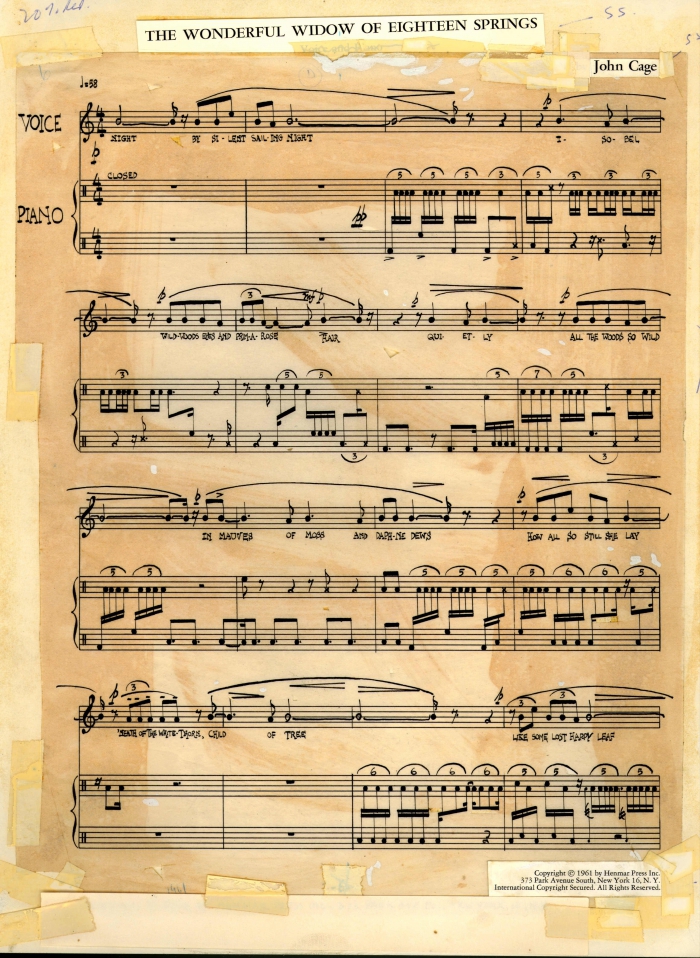
In 1942, John Cage composed a short piece of music adapted from the text of James Joyce’s Finnegans Wake. Titled “The Wonderful Widow of Eighteen Springs,” the piece was originally commissioned and performed by amateur soprano and socialite Justine Fairbank, and while we don’t have a recording of her performance, we do have Cage’s sheet music (see first page above, or view the entire book here). It is—as one might expect—an unusual piece. It sounds like song, yet isn’t. As the Library of Congress description of the piece has it:
This essentially rhythmic speech set against a patterned percussive accompaniment cannot be considered a song in the usual sense. Cage, however, is such an innovator that one often loses sight of the fact that if one does not expect conventional sounds, his music is often very well constructed. Here, for example, the composer weaves a hypnotically compelling pattern of rhythmic tension and relaxation, akin to certain non-Western music, which is very appropriate for Joyce’s moody prose.
Cage’s own instructions “for the singer” state: “sing without vibrato, as in folk-singing. Make any transposition necessary in order to employ a low and comfortable range.”
This flexible arrangement allows anyone to pick up the piece, and so we have, directly below, an unlikely interpreter of Cage’s experimental art, the late Ramones singer Joey Ramone. Ramone’s interpretation of the piece is enthralling simply as a piece of recorded music. But it’s also a fascinating piece of cultural history, representing a confluence of the foremost figures in early twentieth century modernist literature, mid-century avant-garde music, and late century punk rock.
The recording comes from a whole album of Cage interpretations by New York punk and new- and no-wave art-rockers, including David Byrne, Arto Lindsay, John Zorn, Debbie Harry, and Lou Reed. The album, entitled Caged/Uncaged—A Rock/Experimental Homage to John Cage, was recorded in Italy in 1993 and produced by John Cale. You can listen to tracks at Ubuweb.
It’s more than just a tribute record; it’s a serious engagement with the music of a composer whose work—like the fluid prose-poetry of Finnegans Wake—seems infinitely malleable and adaptable to the present. Forty years after composing the song Joey Ramone performs, Cage said, “we live, in a very deep sense, in the time of Finnegans Wake.” Perhaps we still live in the time of Joyce, and also of John Cage.
Note: An earlier version of this post appeared on our site in 2013.
Related Content:
James Joyce Reads From Ulysses and Finnegans Wake In His Only Two Recordings (1924/1929)
James Joyce’s Crayon Covered Manuscript Pages for Ulysses and Finnegans Wake
Hear All of Finnegans Wake Read Aloud: A 35 Hour Reading
Josh Jones is a writer and musician based in Durham, NC.
Read More...Yuval Noah Harari Explains How to Protect Your Mind in the Age of AI
You could say that we live in the age of artificial intelligence, although it feels truer about no aspect of our lives than it does of advertising. “If you want to sell something to people today, you call it AI,” says Yuval Noah Harari in the new Big Think video above, even if the product has only the vaguest technological association with that label. To determine whether something should actually be called artificially intelligent, ask whether it can “learn and change by itself and come up with decisions and ideas that we don’t anticipate,” indeed can’t anticipate. That AI-enabled waffle iron being pitched to you probably doesn’t make the cut, but you may already be interacting with numerous systems that do.
As the author of the global bestseller Sapiens and other books concerned with the long arc of human civilization, Harari has given a good deal of thought to how technology and society interact. “In the twentieth century, the rise of mass media and mass information technology, like the telegraph and radio and television” formed “the basis for large-scale democratic systems,” but also for “large-scale totalitarian systems.”
Unlike in the ancient world, governments could at least begin to “micromanage the social and economic and cultural lives of every individual in the country.” Even the vast surveillance apparatus and bureaucracy of the Soviet Union “could not surveil everybody all the time.” Alas, Harari anticipates, things will be different in the AI age.
Human-operated organic networks are being displaced by AI-operated inorganic ones, which “are always on, and therefore they might force us to be always on, always being watched, always being monitored.” As they gain dominance, “the whole of life is becoming like one long job interview.” At the same time, even if you were already feeling inundated by information before, you’ve more than likely felt the waters rise around you due to the infinite production capacities of AI. One individual-level strategy Harari recommends to counteract the flood is going on an “information diet,” restricting the flow of that “food of the mind,” which only sometimes has anything to do with the truth. If we binge on “all this junk information, full of greed and hate and fear, we will have sick minds; perhaps a period of abstinence can restore a certain degree of mental health. You might consider spending the rest of the day taking in as little new information as possible — just as soon as you finish catching up on Open Culture, of course.
Related content:
Stephen Fry Explains Why Artificial Intelligence Has a “70% Risk of Killing Us All”
Yuval Noah Harari and Fareed Zakaria Break Down What’s Happening in the Middle East
Based in Seoul, Colin Marshall writes and broadcasts on cities, language, and culture. His projects include the Substack newsletter Books on Cities and the book The Stateless City: a Walk through 21st-Century Los Angeles. Follow him on the social network formerly known as Twitter at @colinmarshall.
Read More...Watch Joan Baez Endearingly Imitate Bob Dylan (1972)
Joan Baez was already heralded as the “Queen of Folk” by the time Robert Zimmerman aka Bob Dylan arrived in New York City. Many things brought him to the burgeoning folk scene there, but Baez was the siren who called to a young Dylan through his television set long before he met her. He was smitten. He would write much later in Chronicles, Vol. 1, that she had “A voice that drove out bad spirits… she sang in a voice straight to God… Nothing she did didn’t work.”
And for a couple of years they became collaborators, partners, lovers, and folk royalty. It was Baez who introduced a then-unknown Dylan to the crowds at the 1963 Newport Folk Festival. But soon, fortunes changed: Dylan became an unstoppable cultural force and Baez would be on the receiving end of several betrayals, artistic and otherwise.
An excerpt from an Earl Scruggs documentary, the cute video above, shot by David Hoffman and posted on his YouTube channel, shows Baez imitating Dylan after she sings a verse of “It Ain’t Me Babe”. (She does this while holding her baby and trying to get it to drink from a pitcher, too.) A 16-year-old Ricky Skaggs—not looking anything like a teenager—accompanies her on guitar.
For one thing she does a crackin’ good Dylan impression. The other is watching the emotion behind that impression—there’s a lot of history there, a bit of sadness, a bit of nostalgia, nothing bitter or mean, but evidence of a shared life together that once existed.
By this time in 1972, Dylan’s voice had matured. The crooner on Nashville Skyline was a different person from the man on Blonde on Blonde, all those rough corners sanded off and the register deepened. Yet when anyone imitates Dylan, they head on back to those mid-‘60s albums, the “braying beatnik” as writer Rob Jones calls him. (Jones posits that Dylan has had eight particular voices during his career.)
Remember, as Slate’s Carl Wilson points out, when Dylan first started out, he was commended for his voice, and was considered “one of the most compelling white blues singers ever recorded,” by Robert Shelton, who wrote the copy on the back cover of Dylan’s 1962 debut album. He came from a tradition of both Woody Guthrie and Howlin’ Wolf, and several other idiosyncratic singers who didn’t sound like Frank Sinatra. (Although Dylan’s last few projects have been covers from the Great American Songbook.)
Dylan himself, in a 2015 award acceptance speech, turned his ire towards critics of his voice:
Critics have been giving me a hard time since Day One. Critics say I can’t sing. I croak. Sound like a frog. Why don’t critics say that same thing about Tom Waits? Critics say my voice is shot. That I have no voice. [Why] don’t they say those things about Leonard Cohen? Why do I get special treatment? Critics say I can’t carry a tune and I talk my way through a song. Really? I’ve never heard that said about Lou Reed. Why does he get to go scot-free? … Slur my words, got no diction. Have you people ever listened to Charley Patton or Robert Johnson, Muddy Waters? … “Why me, Lord?” I would say that to myself.
Fast forward to the present and Dylan’s voice shows the wear of years of performing and years of indulgence. It’s gravelly and phlegmatic, smoky and whiskey-soaked, but Wilson points out: “Even the rasp and burr of his late voice, several keen listeners have noticed, is very much like a more genuine copy of the old-bluesman timbre he pretentiously affected as a young man. It’s almost like this is what he’s been aiming toward.”
Note: An earlier version of this post appeared on our site in 2018.
Related Content:
Joan Baez Live in 1965: Full Concert
Bob Dylan Explains Why Music Has Been Getting Worse
17-Year-Old Joan Baez Performs at Famous “Club 47” in Cambridge, MA (1958)
Bob Dylan’s Famous Televised Press Conference After He Went Electric (1965)
Ted Mills is a freelance writer on the arts.
Read More...What Is Kabbalah? An Introduction to the Jewish Mystical Tradition
Though the pop-cultural moment that gave rise to the association has passed, when many of us hear about Kabbalah, we still think of Madonna. Her study of that Jewish-mystic school of thought in the nineteen-nineties has been credited, at least in part, with the sonic transformation that led to her hit album Ray of Light. A few years later, when she recorded the theme song for the 2002 James Bond movie Die Another Day, she managed to include in its music video such Kabbalistic imagery as the Hebrew letters lamed, aleph, and vav — which come, as Religion for Breakfast creator Andrew M. Henry says in the video above, from one of the 72 names of God according to Jewish tradition.
But what, exactly, is Kabbalah? That’s the question Henry takes it upon himself to answer, attempting to separate the real thing from the pop-cultural ephemera that’s come to surround it.
This entails first going back to the earliest Kabbalists, “Jewish teachers, theologians, and philosophers” among “the educated elite of medieval Europe, living in Spain and France, writing new and innovative studies on Jewish texts and concepts about mystical contemplation of the divine realms, the nature of God, the purpose of humanity, and the creation of the universe.” They searched, and their successors have continued to search, for secret divine wisdom originally vouchsafed to Moses at Mount Sinai.
The word kabbalah can be translated as “that which has been received,” but that may make the enterprise sound simpler than it is. Henry frames Kabbalah as a series of traditions “encompassing several modes of reading, a library of texts, a series of concepts, and a range of practices within Judaism that is concerned with mystical contemplation.” But whatever their differences, most Kabbalists revere concepts like Ein Sof, “an infinite impersonal god or supreme entity or supreme entity that we cannot describe with our own human faculties,” and vast works like the novelistic Zohar, or “The Book of Radiance,” in which “even the search for mystical knowledge becomes sexualized”: an aspect that, given the skill with which she’s crafted her provocative pop-icon image, Madonna could hardly fail to appreciate.
Related content:
The Talmud Is Finally Now Available Online
Walter Benjamin’s Philosophical Thought Presented by Two Experimental Films
The Ancient Greeks Who Converted to Buddhism
The Ark Before Noah: Discover the Ancient Flood Myths That Came Before the Bible
Based in Seoul, Colin Marshall writes and broadcasts on cities, language, and culture. His projects include the Substack newsletter Books on Cities and the book The Stateless City: a Walk through 21st-Century Los Angeles. Follow him on the social network formerly known as Twitter at @colinmarshall.
Read More...The Only Time Prince & Miles Davis Jammed Together Onstage: Watch the New Year’s Eve, 1987 Concert
A too-precious genre of internet meme depicts departed public figures who did not know each other in life meeting in heaven with hugs, high-fives, and wincingly earnest exchanges. These sentimental vignettes are almost too easy to parody, a kitschy version of the “what if” game, as in: what if two creative geniuses could collaborate in ways they never did before they died?
What if John Lennon had formed a band with Eric Clapton—as Lennon himself had once proposed? Or what if a Jimi Hendrix/Miles Davis collaboration had come off, as Hendrix envisioned the year before his death? More than just fantasy baseball, the exercise lets us speculate about how musicians who influenced each other might evolve if given the chance to jam indefinitely.
When it comes to Miles, there are few who haven’t been influenced by the jazz great, whether they know it or not. Prince Rogers Nelson knew it well. The son of a jazz pianist, Prince grew up with Miles’ music. Although he “gravitated to the worlds of rock, pop, and R&B,” writes pianist Ron Drotos, Prince “seems to have seen jazz as a way to express himself in a broader way than he could through more commercial styles alone.”
Prince was so interested in exploring jazz—and Davis’ particular form of jazz—in the 80s that he formed a band anonymously, called Madhouse (actually just him and horn player Eric Leeds), and released two albums of fusion instrumentals. The influence went both ways. “Miles considered Prince to have the potential to become another Duke Ellington and even modeled his own 1980s music partly on Prince’s style,” with 1986’s Tutu standing out as an example. What if the two musicians had worked together? Can you imagine it?
They did not—to our knowledge, although Prince’s vault is vast—collaborate on an album, but they did create one studio track together, “Can I Play With U?” And the two virtuoso composers and musicians jammed together onstage, once, at Paisley Park, on New Year’s Eve, 1987. The concert was a benefit for the Minnesota Coalition for the Homeless and the last time Prince performed the Sign O’ the Times stage show. At the tail end of the concert, Davis steps onstage for “an ice-cold appearance,” Okayplayer notes. “As a companion to the release of a deluxe edition” of the album, “the late icon’s estate has relinquished the full two-hour-plus set.”
Watch the concert at the top (trust me, don’t just skip ahead to see Davis at 1:43:50). Just above, you can see an hourlong “pre-show” taped with Maya Rudolph, “lifelong Prince devotee,” Emmy-winning comedian, and daughter of Minnie Riperton. Other guests include Prince’s longtime sideman and collaborator on his jazz project, Eric Leeds. “If you’re here, then you’re cool, like me,” Rudolph jokes, “and you know a lot about Prince.” Or maybe you don’t. Let Rudolph and her guests fill you in, and imagine Prince and Davis making celestial jazz-funk forever, between high-fives, in the Great Beyond.
If you would like to support the mission of Open Culture, consider making a donation to our site. It’s hard to rely 100% on ads, and your contributions will help us continue providing the best free cultural and educational materials to learners everywhere. You can contribute through PayPal, Patreon, and Venmo (@openculture). Thanks!
Related Content:
In 1969 Telegram, Jimi Hendrix Invites Paul McCartney to Join a Super Group with Miles Davis
When Miles Davis Discovered and Then Channeled the Musical Spirit of Jimi Hendrix
The Night When Miles Davis Opened for the Grateful Dead (1970)
Josh Jones is a writer and musician based in Durham, NC. Follow him at @jdmagness
Read More...Support Us
We're hoping to rely on loyal readers, rather than erratic ads. Please click the Donate button and support Open Culture. You can use Paypal, Venmo, Patreon, even Crypto! We thank you!

About Us

Open Culture scours the web for the best educational media. We find the free courses and audio books you need, the language lessons & educational videos you want, and plenty of enlightenment in between.
Advertise With Us
FREE UPDATES!
GET OUR DAILY EMAIL
Get the best cultural and educational resources on the web curated for you in a daily email. We never spam. Unsubscribe at any time.
FOLLOW ON SOCIAL MEDIA
Open Culture editor Dan Colman scours the web for the best educational media. He finds the free courses and audio books you need, the language lessons & movies you want, and plenty of enlightenment in between.
Advertise With Us

