The Writer Who Directed, The Director Who Wrote: Every Frame a Painting Explores the Genius of Billy Wilder
When the acclaimed cinema video-essay channel Every Frame a Painting made its comeback this past summer, its creators Tony Zhou and Taylor Ramos took a close look at the “sustained two-shot,” which captures a stretch of dialogue between two characters without the interference of a cut. Though it’s become something of a rarity under today’s shoot-everything-and-figure-it-out-in-editing ethos, it was used often in classic Hollywood pictures. Take, for example, the work of Polish-born writer-director Billy Wilder, who began his film career in prewar Germany, then went to Hollywood and “embarked on a series of ostensibly daring, disenchanted movies, against the grain of American cheerfulness.”
So writes David Thomson in The New Biographical Dictionary of Film. “Double Indemnity was a thriller based on the principle that crime springs from human greed and depravity; The Lost Weekend was the cinema’s most graphic account of alcoholism; A Foreign Affair has shots of a ruined Berlin accompanied by the tune ‘Isn’t It Romantic?’; Sunset Boulevard mocks the maddening glamour within Hollywood; Ace in the Hole exposes the unscrupulousness of the sensational press; Stalag 17 is a prisoner-of-war film that undercuts camaraderie.” And the finely honed comedy of The Apartment or Some Like It Hot has only grown more entertaining — because rarer — over the decades.
But was straightforward comedy really Wilder’s forte? His pictures are funny, but often in a highly particular way. His “characters do not mean what they say, and they do not say what they mean,” Zhou explains: this is verbal irony. But it comes along with two additional flavors of irony: dramatic, which arises “when the audience knows more information than the characters,” creating suspense over whether those characters find out the truth “and what happens as a result”; and situational, which arises “when a character makes choices that lead to an unexpected and yet inevitable conclusion.” In his scripts, Wilder could “weave all these types of ironies together while maintaining a strong emotional core.”
Even so, no great filmmaker is merely a storyteller. Despite being famous primarily as a dialogue writer, Wilder “insisted that his films should work as images first.” Among other techniques, “he put the camera where the subtext was, which allowed the audience to follow the emotions of the scene and not just the literal meaning.” He also “used as few camera setups as possible,” shooting pages of his script without a cut. (Instructively, the video compares a scene from Wilder’s original Sabrina with its hopelessly awkward equivalent in Sydney Pollack’s 1995 remake.) Nor is it incidental to his filmography’s endurance that he embodied that old-fashioned combination of respect and contempt for the viewer. “Let the audience add up two plus two,” he once advised younger filmmakers, and “they’ll love you forever.”
Related content:
10 Tips From Billy Wilder on How to Write a Good Screenplay
The Essential Elements of Film Noir Explained in One Grand Infographic
Based in Seoul, Colin Marshall writes and broadcasts on cities, language, and culture. His projects include the Substack newsletter Books on Cities and the book The Stateless City: a Walk through 21st-Century Los Angeles. Follow him on Twitter at @colinmarshall or on Facebook.
Read More...Private Snafu: The World War II Propaganda Cartoons Created by Dr. Seuss, Frank Capra & Mel Blanc
Private Snafu was the U.S. Army’s worst soldier. He was sloppy, lazy and prone to shooting off his mouth to Nazi agents. And he was hugely popular with his fellow GIs.
Private Snafu was, of course, an animated cartoon character designed for the military recruits. He was an adorable dolt who sounded like Bugs Bunny and looked a bit like Elmer Fudd. And in every episode, he taught soldiers what not to do, from blabbing about troop movements to not taking malaria medication.
The idea for the series reportedly came from Frank Capra — the Oscar-winning director of It’s a Wonderful Life and Mr. Smith Goes to Washington and, during WWII, the chairman of the U.S. Army Air Force First Motion Picture Unit. He wanted to create a cartoon series for new recruits, many of whom were young, unworldly and in some cases illiterate. Capra gave Disney first shot at developing the idea but Warner Bros’ Leon Schlesinger, a man who was as famous for his hard-driving business acumen as he was for wearing excessive cologne, offered a bid that was 2/3rds below that of Disney.
The talent behind this series was impressive, featuring a veritable who’s who of non-Disney animating talent, including Chuck Jones, Bob Clampett, and Friz Freleng. Snafu was voiced by Mel Blanc, who famously did Bunny Bugs, Daffy Duck and later Marvin the Martian. And one of the main writers was none other than Theodor “Dr. Seuss” Geisel.
As you can see in the first Snafu short Coming!! (1943), directed by Chuck Jones (see above), the movie displays a salty sensibility intended for an army camp rather than a Sunday matinee. The movie opens with a deadpan voiceover explaining that, in informal military parlance, SNAFU means “Situation Normal All…All Fouled Up,” hinting that the usual translation of the acronym includes a popular Anglo-Saxon word. Later, it shows Private Snafu daydreaming about a burlesque show – complete with a shapely exotic dancer doffing her duds – as he obliviously wrecks a plane.
Though there were no writing credits for each individual episode, just listen to the voiceover for Gripes (1943), directed by Friz Freleng. Dr. Seuss’s trademark singsong cadence is unmistakable including lines like:
“The moral, Snafu, is that the harder you work, the sooner we’re gonna beat Hitler, that jerk.”
Gas! (1944), directed by Chuck Jones, features a cameo from Bugs Bunny.
And finally, Going Home, directed by Chuck Jones, was slated to come out in 1944 but the War Department kiboshed it. The rationale was never explained but some think that the film’s reference to a massive, top-secret weapon that was to be deployed over Japan was just a little too close to the Manhattan Project.
You can watch a long list of Private Snafu episodes here.
Related Content:
Donald Duck’s Bad Nazi Dream and Four Other Disney Propaganda Cartoons from World War II
Dr. Seuss’ World War II Propaganda Films: Your Job in Germany (1945) and Our Job in Japan (1946)
Education for Death: The Making of the Nazi–Walt Disney’s 1943 Film Shows How Fascists Are Made
Dr. Seuss Draws Anti-Japanese Cartoons During WWII, Then Atones with Horton Hears a Who!
Jonathan Crow is a Los Angeles-based writer and filmmaker whose work has appeared in Yahoo!, The Hollywood Reporter, and other publications. You can follow him at @jonccrow.
Read More...The Greatest Shot in Television: Science Historian James Burke Had One Chance to Nail This Scene … and Nailed It
The 80-second clip above captures a rocket launch, something of which we’ve all seen footage at one time or another. What makes its viewers call it “the greatest shot in television” still today, 45 years after it first aired, may take more than one viewing to notice. In it, science historian James Burke speaks about how “certain gases ignite, and that the thermos flask permits you to store vast quantities of those gases safely, in their frozen liquid form, until you want to ignite them.” Use a sufficiently large flask filled with hydrogen and oxygen, design it to mix the gases and set light to them, and “you get that” — that is, you get the rocket that launches behind Burke just as soon as he points to it.
One can only admire Burke’s composure in discussing such technical matters in a shot that had to be perfectly timed on the first and only take. What you wouldn’t know unless you saw it in context is that it also comes as the final, culminating moment of a 50-minute explanatory journey that begins with credit cards, then makes its way through the invention of everything from a knight’s armor to canned food to air conditioning to the Saturn V rocket, which put man on the moon.
Formally speaking, this was a typical episode of Connections, Burke’s 1978 television series that traces the most important and surprising moves in the evolution of science and technology throughout human history.
Though not as widely remembered as Carl Sagan’s slightly later Cosmos, Connections bears repeat viewing here in the twenty-first century, not least for the intellectual and visual bravado typified by this “greatest shot in television,” now viewed nearly 18 million times on Youtube. Watch it enough times yourself, and you’ll notice that it also pulls off some minor sleight of hand by having Burke walk from a non-time-sensitive shot into another with the already-framed rocket ready for liftoff. But that hardly lessens the feeling of achievement when the launch comes off. “Destination: the moon, or Moscow,” says Burke, “the planets, or Peking” — a closing line that sounded considerably more dated a few years ago than it does today.
Related Content:
Endeavour’s Launch Viewed from Booster Cameras
The 100 Most Memorable Shots in Cinema Over the Past 100 Years
The Most Beautiful Shots in Cinema History: Scenes from 100+ Films
125 Great Science Videos: From Astronomy to Physics & Psychology
Based in Seoul, Colin Marshall writes and broadcasts on cities, language, and culture. His projects include the Substack newsletter Books on Cities and the book The Stateless City: a Walk through 21st-Century Los Angeles. Follow him on Twitter at @colinmarshall or on Facebook.
Read More...When Kris Kristofferson (RIP) Stood by Sinéad O’Connor at the Height of Her Controversy
One would have imagined Sinéad O’Connor impervious to any reaction from a hostile audience, no matter how vitriolic. But even for a public figure as outspoken and unapologetic as her, it could all get to be a bit much at times. Take the 1992 concert Columbia Records put on for the 30th anniversary of Bob Dylan’s first album. “Available on pay-per-view,” writes the New York Times’ Marc Tracy, it “featured performances by Dylan along with some of the biggest stars of his era, among them Stevie Wonder, George Harrison, Johnny Cash and Eric Clapton,” as well as the late outlaw-country icon Kris Kristofferson.
The young O’Connor also performed, despite being “at the center of a firestorm. Just two weeks earlier, the Irish singer was the musical guest on Saturday Night Live when, at the conclusion of her second and final performance of the evening, she ripped up a picture of Pope John Paul II and exhorted, ‘Fight the real enemy,’ a defiant act of protest against sexual abuse in the Catholic Church.” It fell to Kristofferson to introduce her, whereupon she “took the stage to a cascade of applause and boos, which did not let up as O’Connor stood silently at the microphone with her hands behind her back.”
As you can see in the video at the top of the post, Kristofferson didn’t stay offstage. After a minute he “re-emerged from stage left, put his arm around O’Connor and whispered something in her ear.” The show then went on, albeit not as planned: instead of doing Dylan’s “I Believe in You,” she did Bob Marley’s “War,” the very same song she’d sung on SNL before the notorious Pope-ripping. Rather than leaving his message as a Lost in Translation moment, Kristofferson later revealed the words he’d summoned to encourage her: “ ‘Don’t let the bastards get you down.’ To which, he said, she responded: ‘I’m not down.’ ”
That response was characteristic of O’Connor, as was her 2021 autobiography’s note that she was thinking, “I don’t need a man to rescue me, thanks.” Whatever her feelings in the moment, her friendship with Kristofferson seems to have lasted until her death last year. “Kristofferson appeared with her in the 1997 music video for the song ‘This Is to Mother You,’ ” writes Tracy. “In 2010, the two performed a duet of Kristofferson’s ‘Help Me Make It Through the Night’ on an Irish talk show. It was a year after Kristofferson had released a song about the 1992 incident, ‘Sister Sinead.’ ” Outwardly, the two could hardly have had less in common, but inwardly, they must have recognized each other as kindred spirits — the likes of which we’ll surely not see again.
Related content:
Sinéad O’Connor’s Raw Isolated Vocals for “Nothing Compares 2 U”
A Choir with 1,000 Singers Pays Tribute to Sinéad O’Connor & Performs “Nothing Compares 2 U”
5 Musical Guests Banned From Saturday Night Live: From Elvis Costello to Frank Zappa
Based in Seoul, Colin Marshall writes and broadcasts on cities, language, and culture. His projects include the Substack newsletter Books on Cities and the book The Stateless City: a Walk through 21st-Century Los Angeles. Follow him on Twitter at @colinmarshall or on Facebook.
Read More...Joan Jett and the Blackhearts Perform a Rollicking Cover of the Mary Tyler Moore Theme Song (1996)
?si=Pblv5Tzpi_F-a6cu
Originally written by Sonny Curtis and released in 1970, “Love Is All Around”–otherwise known as the Mary Tyler Moore theme song–has been covered by many acts: Sammy Davis Jr, Hüsker Dü, and Joan Jett & the Blackhearts, to name a few. After releasing a studio version in 1996, Jett performed the song live on the Late Show with David Letterman that same year. If you’re old enough, this performance will give you a double dose of nostalgia. It lets you recall the spirit of 1970s second-wave-feminist television, and it recaptures the sheer playfulness of Letterman’s freewheeling 90s late night show. Enjoy!
Related Content
How Joan Jett Started the Runaways at 15 and Faced Down Every Barrier for Women in Rock and Roll
Isaac Asimov Predicts the Future on The David Letterman Show (1980)
What Makes a Cover Song Great?: Our Favorites & Yours
Frank Zappa’s 1980s Appearances on The David Letterman Show
Read More...Revisit Episodes of Liquid Television, MTV’s 90s Showcase of Funny, Irreverent & Bizarre Animation
MTV stands for Music Television, and when the network launched in 1981, its almost entirely music video-based programming was true to its name. Within a decade, however, its mandate had widened to the point that it had become the natural home for practically any exciting development in American youth culture. And for many MTV viewers in the early nineteen-nineties, youthful or otherwise, nothing was quite so exciting as Liquid Television, whose every broadcast constituted a veritable festival of animation that pushed the medium’s boundaries of possibility — as well, every so often, as its boundaries of taste.
Liquid Television’s original three-season run began in the summer of 1991 and ended in early 1995. All throughout, its format remained consistent, rounding up ten or so shorts, each created by different artists. Their themes could vary wildly, and so could their aesthetics: any given broadcast might contain more or less conventional-looking cartoons, but also stickmen, puppets, early computer graphics, subverted nineteen-fifties imagery (that mainstay of the Gen‑X sensibility), Japanese anime, and even live action, as in the recurring drag-show sitcom “Art School Girls of Doom” or the multi-part adaptation of Charles Burns’ Dogboy.
Burns’ is hardly the the only name associated with Liquid Television that comics and animation fans will recognize. Others who gained exposure through it include Bill Plympton, John R. Dilworth, Richard Sala, and Mike Judge, whose series Beavis and Butthead and feature film Office Space both began as shorts seen on Liquid Television.
But no discussion of the show can exclude Peter Chung’s futuristic, quasi-mystical, dialogue-free Æon Flux, whose eponymous acrobatic assassin became a cultural phenomenon unto herself. The Æon Flux episodes have been cut out of this 22-video Liquid Television playlist, but you can also find a collection of uncut broadcasts at the Internet Archive.
The Tongal video above credits the show’s influence to the insight of the show’s creator Japhet Asher, who saw that “the attention span of your average TV viewer, particularly young people, was getting shorter and shorter.” Hence Liquid Television’s model: “If you didn’t like the current short, another one, which would be totally different, would be along in a few minutes. Furthermore, if a segment was so inexplicably bizarre and brain-tickling, perhaps an even more compelling one would come next.” At the time, this would have been taken by some observers — much like MTV itself — as a disturbing reflection of an addled, over-stimulated younger generation. But with Youtube still about a decade and a half away, it’s fair to say they hadn’t seen anything yet.
Related content:
Watch the First Two Hours of MTV’s Inaugural Broadcast (August 1, 1981)
All the Music Played on MTV’s 120 Minutes: A 2,500-Video Youtube Playlist
When a Young Sofia Coppola & Zoe Cassavetes Made Their Own TV Show: Revisit Hi-Octane (1994)
Based in Seoul, Colin Marshall writes and broadcasts on cities, language, and culture. His projects include the Substack newsletter Books on Cities and the book The Stateless City: a Walk through 21st-Century Los Angeles. Follow him on Twitter at @colinmarshall or on Facebook.
Read More...David Bowie’s Fashionable Mug Shot From His 1976 Marijuana Bust
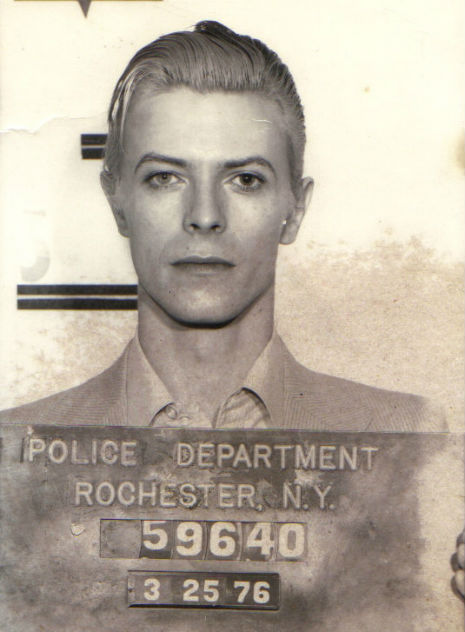
David Bowie always managed to look cool, even when he was being booked for a felony.
In early 1976, Bowie was on his “Isolar” tour, performing as the Thin White Duke, a persona he would describe as “a very Aryan fascist type — a would-be romantic with no emotions at all.” Bowie invited his friend and sometime creative collaborator Iggy Pop to travel with him.
In the early morning hours of March 21, after a concert at the Community War Memorial arena in Rochester, New York, four local vice squad detectives and a state police investigator searched Bowie’s three-room suite at the Americana Rochester Hotel. According to reports in the Rochester Democrat and Chronicle, the cops found 182 grams (a little over 6.4 ounces) of marijuana there. Bowie and three others — Pop, a bodyguard named Dwain Voughns, and a young Rochester woman named Chiwah Soo — were charged with fifth-degree criminal possession of marijuana, a class C felony, punishable by up to 15 years in prison.
Bowie and Pop were booked under their real names, David Jones and James Osterberg Jr. The group spent the rest of the night in the Monroe County Jail and were released at about 7 a.m. on $2,000 bond each. They were supposed to be arraigned the next day, but Bowie left town to go to his next concert in Springfield, Massachusetts. His lawyer appeared and asked for the court’s indulgence, explaining the heavy penalties for breaking concert engagements. He promised the judge that Bowie would appear the following morning, March 23.
Bowie showed up for his arraignment looking dapper in his Thin White Duke clothing. It was then that his mug shot was taken — so we’ll never actually know what Bowie looked like when he was unexpectedly dragged into jail at 3 a.m. The police escorted the rock star in and out of the courtroom mostly through back corridors, shielding him from a crowd of fans who showed up at the courthouse. Reporter John Stewart describes the scene in the next day’s Democrat and Chronicle:
Bowie and his group ignored reporters’ shouted questions and fans’ yells as he walked in — except for one teenager who got his autograph as he stepped off the escalator.
His biggest greeting was the screams of about a half-dozen suspected prostitutes awaiting arraignment in the rear of the corridor outside the courtroom.
Asked for a plea by City Court Judge Alphonse Cassetti to the charge of fifth-degree criminal possession of a controlled substance, Bowie said, “not guilty, sir.” The court used his real name — David Jones.
He stood demurely in front of the bench with his attorneys. He wore a gray three-piece leisure suit and a pale brown shirt. He was holding a matching hat. His two companions were arraigned on the same charge.
The defense lawyer told the judge that Bowie and the others had never been arrested before. The judge allowed them to remain free on bond until a grand jury convened. Bowie and his entourage went on with their tour, and the grand jury eventually decided not to indict anyone. The incident was largely forgotten until an auction house employee named Gary Hess stumbled on Bowie’s mug shot while sorting through the estate of a retired Rochester police officer. Hess rescued the photo from the trash bin, according to an article in Rochester Subway, and in late 2007 his brother sold it on eBay for $2,700.
Related Content:
The Thin White Duke: A Close Study of David Bowie’s Darkest Character
John Coltrane’s Naval Reserve Enlistment Mugshot (1945)
Read More...The Medieval Masterpiece, the Book of Kells, Is Now Digitized and Available Online

If you know nothing else about medieval European illuminated manuscripts, you surely know the Book of Kells. “One of Ireland’s greatest cultural treasures” comments Medievalists.net, “it is set apart from other manuscripts of the same period by the quality of its artwork and the sheer number of illustrations that run throughout the 680 pages of the book.” The work not only attracts scholars, but almost a million visitors to Dublin every year. “You simply can’t travel to the capital of Ireland,” writes Book Riot’s Erika Harlitz-Kern, “without the Book of Kells being mentioned. And rightfully so.”
The ancient masterpiece is a stunning example of Hiberno-Saxon style, thought to have been composed on the Scottish island of Iona in 806, then transferred to the monastery of Kells in County Meath after a Viking raid (a story told in the marvelous animated film The Secret of Kells). Consisting mainly of copies of the four gospels, as well as indexes called “canon tables,” the manuscript is believed to have been made primarily for display, not reading aloud, which is why “the images are elaborate and detailed while the text is carelessly copied with entire words missing or long passages being repeated.”
Its exquisite illuminations mark it as a ceremonial object, and its “intricacies,” argue Trinity College Dublin professors Rachel Moss and Fáinche Ryan, “lead the mind along pathways of the imagination…. You haven’t been to Ireland unless you’ve seen the Book of Kells.” This may be so, but thankfully, in our digital age, you need not go to Dublin to see this fabulous historical artifact, or a digitization of it at least, entirely viewable at the online collections of the Trinity College Library. (When you click on the previous link, make sure you scroll down the page.) The pages, originally captured in 1990, “have recently been rescanned,” Trinity College Library writes, using state-of-the-art imaging technology. These new digital images offer the most accurate high-resolution images to date, providing an experience second only to viewing the book in person.”
What makes the Book of Kells so special, reproduced “in such varied places as Irish national coinage and tattoos?” asks Professors Moss and Ryan. “There is no one answer to these questions.” In their free online course on the manuscript, these two scholars of art history and theology, respectively, do not attempt to “provide definitive answers to the many questions that surround it.” Instead, they illuminate its history and many meanings to different communities of people, including, of course, the people of Ireland. “For Irish people,” they explain in the course trailer above, “it represents a sense of pride, a tangible link to a positive time in Ireland’s past, reflected through its unique art.”
But while the Book of Kells is still a modern “symbol of Irishness,” it was made with materials and techniques that fell out of use several hundred years ago, and that were once spread far and wide across Europe, the Middle East, and North Africa. In the video above, Trinity College Library conservator John Gillis shows us how the manuscript was made using methods that date back to the “development of the codex, or the book form.” This includes the use of parchment, in this case calf skin, a material that remembers the anatomical features of the animals from which it came, with markings where tails, spines, and legs used to be.
The Book of Kells has weathered the centuries fairly well, thanks to careful preservation, but it’s also had perhaps five rebindings in its lifetime. “In its original form,” notes Harlitz-Kern, the manuscript “was both thicker and larger. Thirty folios of the original manuscript have been lost through the centuries and the edges of the existing manuscript were severely trimmed during a rebinding in the nineteenth century.” It remains, nonetheless, one of the most impressive artifacts to come from the age of the illuminated manuscript, “described by some,” says Moss and Ryan, “as the most famous manuscript in the world.” Find out why by seeing it (virtually) for yourself and learning about it from the experts above.
For anyone interested in getting a copy of The Book of Kells in a nice print format, see The Book of Kells: Reproductions from the manuscript in Trinity College, Dublin.
Related Content:
Take a Free Online Course on the Great Medieval Manuscript, the Book of Kells
Josh Jones is a writer and musician based in Durham, NC. Follow him at @jdmagness
Read More...Moebius Gives 18 Wisdom-Filled Tips to Aspiring Artists

Jean Giraud, aka Moebius, was a comic book artist who combined blinding speed with boundless imagination. He shaped the look of Alien, Empire Strikes Back and The Fifth Element. He reimagined the Silver Surfer for Stan Lee. And he is an acknowledged influence on everyone from Japanese animating great Hayao Miyazaki to sci-fi writer William Gibson.
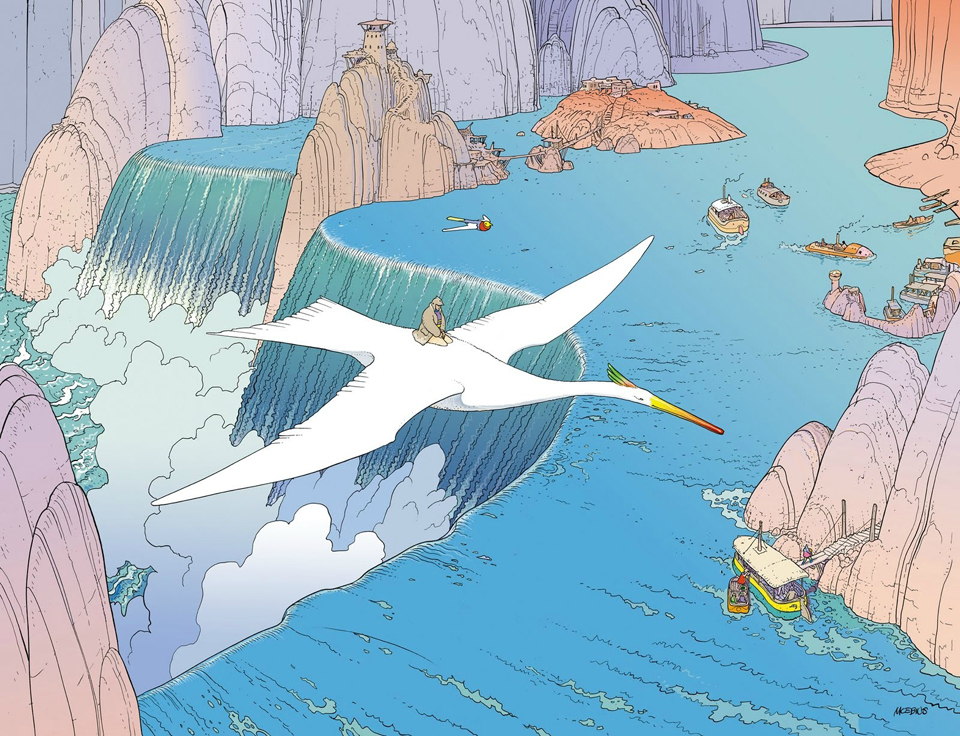
In 1996, the Mexican newspaper La Jornada published a lecture given by Moebius called “Breve manual para historietistas” – a brief manual for cartoonists – which consists of 18 tips for aspiring artists. If your Spanish isn’t up to snuff – mine certainly isn’t – then there are a couple translations out there. Someone called Xurxo g Penalta cranked out a direct version in English, but to get the true nuances of Moebius’ wise words, famed illustrator William Stout’s excellent annotated version is best.
For instance, Moebius’s first tip is “When you draw, you must first cleanse yourself of deep feelings, like hate, happiness, ambition, etc.”
Stout amplifies this with the following:
These feelings are typically emotional prejudices that function as a block to creativity.
This was something I learned from drawing and hanging out with another Frenchman, the brilliant cartoonist-illustrator (and regular Atlantic Monthly contributor) Guy Billout, when we were traveling together in Antarctica and Patagonia back in 1989. Until I spent time with Guy, I had no idea how many pre-conceived notions and assumptions I held within me regarding people and situations and what a block they were to the flow of my creativity.
Divorcing yourself from such emotionally blinding pre-conceptions allows you to see things with fresh eyes. Solutions and ideas then flow with much greater ease. I have noticed with all the creative geniuses I have met that they all share a childlike delight with whatever or whomever they encounter in life (they can even find amusement in life’s villains). For them, all creative barriers are down; life and creative problem solving for them is like constantly playing. They gush great ideas all day long like a fountain.
All of Stout’s annotations are like this. It should be required reading for anyone even vaguely interested in visual storytelling. Below are Moebius’ original observations. Stout’s thoughts on Moebius can be found here.
1) When you draw, you must first cleanse yourself of deep feelings, like hate, happiness, ambition, etc.
2) It’s very important to educate your hand. Make it achieve a level of high obedience so that it will be able to properly and fully express your ideas. But be very careful of trying to obtain too much perfection, as well as too much speed as an artist. Perfection and speed are dangerous — as are their opposites. When you produce drawings that are too quick or too loose, besides making mistakes, you run the risk of creating an entity without soul or spirit.
3) Knowledge of perspective is of supreme importance. Its laws provide a good, positive way to manipulate or hypnotize your readers.
4) Another thing to embrace with affection is the study of [the] human body — it’s anatomy, positions, body types, expressions, construction, and the differences between people.
Drawing a man is very different from drawing a woman. With males, you can be looser and less precise in their depiction; small imperfections can often add character. Your drawing of a woman, however, must be perfect; a single ill-placed line can dramatically age her or make her seem annoying or ugly. Then, no one buys your comic!
For the reader to believe your story, your characters must feel as if they have a life and personality of their own.
Their physical gestures should seem to emanate from their character’s strengths, weaknesses and infirmities. The body becomes transformed when it is brought to life; there is a message in its structure, in the distribution of its fat, in each muscle and in every wrinkle, crease or fold of the face and body. It becomes a study of life.
5) When you create a story, you can begin it without knowing everything, but you should make notes as you go along regarding the particulars of the world depicted in your story. Such detail will provide your readers with recognizable characteristics that will pique their interest.
When a character dies in a story, unless the character has had his personal story expressed some way in the drawing of his face, body and attire, the reader will not care; your reader won’t have any emotional connection.
Your publisher might say, “Your story has no value; there’s only one dead guy — I need twenty or thirty dead guys for this to work.” But that is not true; if the reader feels the dead guy or wounded guys or hurt guys or whomever you have in trouble have a real personality resulting from your own deep studies of human nature — with an artist’s capacity for such observation — emotions will surge.
By such studies you will develop and gain attention from others, as well as a compassion and a love for humanity.
This is very important for the development of an artist. If he wants to function as a mirror of society and humanity, this mirror of his must contain the consciousness of the entire world; it must be a mirror that sees everything.
6) Alejandro Jodorowsky says I don’t like drawing dead horses. Well, it is very difficult.
It’s also very difficult to draw a sleeping body or someone who has been abandoned, because in most comics it’s always action that is being studied. It’s much easier to draw people fighting — that’s why Americans nearly always draw superheroes. It’s much more difficult to draw people that are talking, because that’s a series of very small movements — small, yet with real significance.
His counts for more because of our human need for love or the attention of others. It’s these little things that speak of personality, of life. Most superheroes don’t have any personality; they all use the same gestures and movements.
7) Equally important is the clothing of your characters and the state of the material from which it was made.
These textures create a vision of your characters’ experiences, their lives, and their role in your adventure in a way where much can be said without words. In a dress there are a thousand folds; you need to choose just two or three — don’t draw them all. Just make sure you choose the two or three good ones.
8) The style, stylistic continuity of an artist and its public presentation are full of symbols; they can be read just like a Tarot deck. I chose my name “Moebius” as a joke when I was twenty-two years old — but, in truth, the name came to resonate with meaning. If you arrive wearing a T‑shirt of Don Quixote, that tells me who you are. In my case, making a drawing of relative simplicity and subtle indications is important to me.
9) When an artist, a real working artist, goes out on the street, he does not see things the same way as “normal” people. His unique vision is crucial to documenting a way of life and the people who live it.
10) Another important element is composition. The compositions in our stories should be studied because a page or a painting or a panel is a face that looks at the reader and speaks to him. A page is not just a succession of insignificant panels. There are panels that are full. Some that are empty. Others are vertical. Some horizontal. All are indications of the artist’s intentions. Vertical panels excite the reader. Horizontals calm him. For us in the Western world, motion in a panel that goes from left to right represents action heading toward the future. Moving from right to left directs action toward the past. The directions we indicate represent a dispersion of energy. An object or character placed in the center of a panel focuses and concentrates energy and attention. These are basic reading symbols and forms that evoke in the reader a fascination, a kind of hypnosis. You must be conscious of rhythm and set traps for the reader to fall into so that, when he falls, he gets lost, allowing you to manipulate and move him inside your world with greater ease and pleasure. That’s because what you have created is a sense of life. You must study the great painters, especially those who speak with their paintings. Their individual painting schools or genres or time periods should not matter. Their preoccupation with physical as well as emotional composition must be studied so that you learn how their combination of lines works to touch us directly within our hearts.
11) The narration must harmonize with the drawings. There must be a visual rhythm created by the placement of your text. The rhythm of your plot should be reflected in your visual cadence and the way you compress or expand time. Like a filmmaker, you must be very careful in how you cast your characters and in how you direct them. Use your characters or “actors” like a director, studying and then selecting from all of your characters’ different takes.
12) Beware of the devastating influence of North American comic books. The artists in Mexico seem to only study their surface effects: a little bit of anatomy mixed with dynamic compositions, monsters, fights, screaming and teeth. I like some of that stuff too, but there are many other possibilities and expressions that are also worthy of exploration.
13) There is a connection between music and drawing. The size of that connection depends upon your personality and what’s going on at that moment. For the last ten years I’ve been working in silence; for me, there is music in the rhythm of my lines. Drawing at times is a search for discoveries. A precise, beautifully executed line is like an orgasm!
14) Color is a language that the graphic artist uses to manipulate his reader’s attention as well as to create beauty. There is objective and subjective color. The emotional states of the characters can change or influence the color from one panel to the next, as can place and time of day. Special study and attention must be paid to the language of color.
15) At the beginning of an artist’s career, he should principally involve himself in the creation of very high quality short stories. He has a better chance (than with long format stories) of successfully completing them, while maintaining a high standard of quality. It will also be easier to place them in a book or sell them to a publisher.
16) There are times when we knowingly head down a path of failure, choosing the wrong theme or subject for our capabilities, or choosing a project that is too large, or an unsuitable technique. If this happens, you must not complain later.
17) When new work has been sent to an editor and it receives a rejection, you should always ask for and try to discover the reasons for the rejection. By studying the reasons for our failure, only then can we begin to learn. It is not about struggle with our limitations, with the public or with the publishers. One should treat it with more of an aikido approach. It is the very strength and power of our adversary that is used as the key to his defeat.
18) Now it is possible to expose our works to readers in every part of the planet. We must always keep aware of this. To begin with, drawing is a form of personal communication — but this does not mean that the artist should close himself off inside a bubble. His communication should be for those aesthetically, philosophically and geographically close to him, as well as for himself — but also for complete strangers. Drawing is a medium of communication for the great family we have not met, for the public and for the world.
Note: An earlier version of this post appeared on our site in March 2015.
If you would like to support the mission of Open Culture, consider making a donation to our site. It’s hard to rely 100% on ads, and your contributions will help us continue providing the best free cultural and educational materials to learners everywhere. You can contribute through PayPal, Patreon, and Venmo (@openculture). Thanks!
Related Content:
Behold Moebius’ Many Psychedelic Illustrations of Jimi Hendrix
Watch Groundbreaking Comic Artist Mœbius Draw His Characters in Real Time
Jonathan Crow is a writer and filmmaker whose work has appeared in Yahoo!, The Hollywood Reporter, and other publications. You can follow him at @jonccrow.
Read More...Stanford Continuing Studies Offering an Online Course Exploring the Music of the Grateful Dead
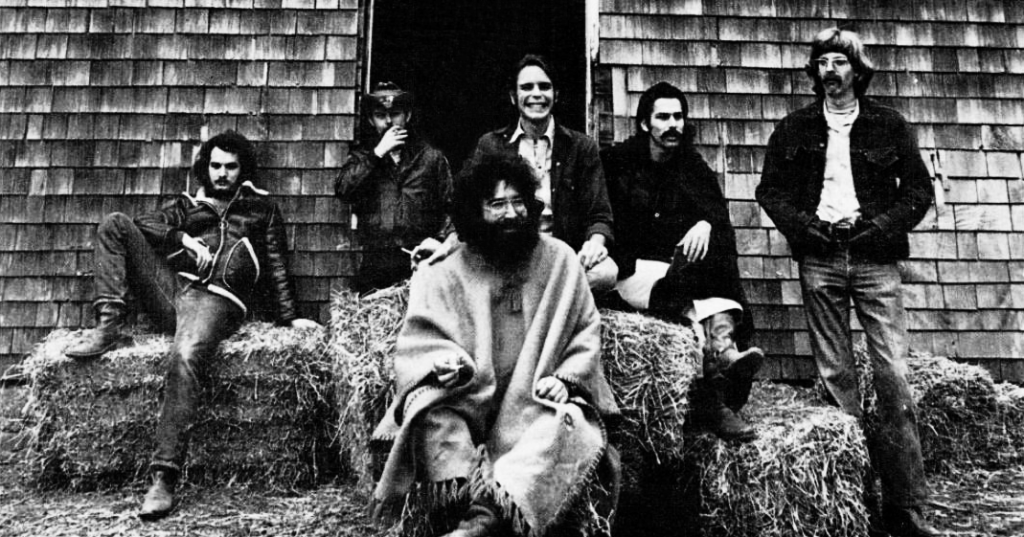
Image via Wikimedia Commons
A quick heads up: On October 3rd, Stanford Continuing Studies will kick off an 8‑week online course called Did It Matter? Does It Now? The Music and Culture of the Grateful Dead. Led by David Gans (author of Playing in the Band: An Oral and Visual Portrait of the Grateful Dead), the course will feature a number of special guests, including Jesse Jarnow (host of The Good Ol’ Grateful Deadcast), Dennis McNally (author of A Long Strange Trip: The Inside History of the Grateful Dead) and David Lemieux (Grateful Dead Archivist). Open to any adult, the course description reads:
The Grateful Dead’s groundbreaking fusion of music, counterculture, and community engagement forged an enduring legacy that transcends generations while shaping the evolution of music and cultural expression. Nearly 30 years after the band played its last show, Grateful Dead music is more popular than ever—in both live and recorded form. This course invites students to delve into the phenomenon that is the Grateful Dead through a captivating exploration of the band’s history, music, and cultural impact.
The course will feature a collection of stories and conversations with scholars and historians, each offering facts and personal perspectives illuminating every aspect of the Grateful Dead culture. Together, we will take a guided tour of the music in the form of focused excerpts from live and studio performances to learn what makes the Dead’s music-making unique and explore the broad musical universe the band created in its 30-year history.
Finally, we’ll examine the Dead’s impact on society, diving into the band’s influence on art, literature, and social change, as well as its unique fan culture and the phenomenon of the Deadhead. By the end of the course, students will have a well-rounded appreciation for the roots, struggles, and milestones that shaped the Grateful Dead’s trajectory, an understanding of their profound impact on music and culture, and insight into a legacy that still resonates deeply today.
Again, the course starts on Thursday, October 3rd. Tuition is $465. You can enroll here.
Stanford Continuing Studies also offers many other courses online, across many disciplines, at a reasonable price. Check out the catalogue here.
Related Content
Stream a Massive Archive of Grateful Dead Concerts from 1965–1995
When the Grateful Dead Played at the Egyptian Pyramids, in the Shadow of the Sphinx (1978)
The Grateful Dead Movie: Watch It Free Online
Read More...Support Us
We're hoping to rely on loyal readers, rather than erratic ads. Please click the Donate button and support Open Culture. You can use Paypal, Venmo, Patreon, even Crypto! We thank you!

About Us

Open Culture scours the web for the best educational media. We find the free courses and audio books you need, the language lessons & educational videos you want, and plenty of enlightenment in between.
Advertise With Us
FREE UPDATES!
GET OUR DAILY EMAIL
Get the best cultural and educational resources on the web curated for you in a daily email. We never spam. Unsubscribe at any time.
FOLLOW ON SOCIAL MEDIA
Open Culture editor Dan Colman scours the web for the best educational media. He finds the free courses and audio books you need, the language lessons & movies you want, and plenty of enlightenment in between.
Advertise With Us


.png)