How Car Chase Scenes Have Evolved Over 100 Years
For many a classic action-movie enthusiast, no car chase will ever top the one in Bullitt. The narrator of the Insider video above describes it as “the scene that set the standard for all modern car chases,” one made “iconic partly because of the characters, but also because of their cars.” The pursuer drives a Dodge Charger, a muscle car that “exploded in popularity during the late sixties in the U.S.,” with a V‑8 engine and rear-wheel drive that made it “basically built for informal drag racing.” The pursued, Steve McQueen’s detective protagonist Frank Bullitt, drives an instantly recognizable Highland Green Ford Mustang, “the first major pony car, a more compact, sporty take on the muscle car.”
Bullitt could change the game, as they say, thanks not just to the cars but also the cameras available at the time, not least the Arriflex 35 II. “Smaller and more rugged” than the bulky rigs of earlier generations, it made it possible to shoot on actual city streets rather than just studio sets and rear-projection setups. (To get a sense of the difference in feel that resulted, simply compare the Bullitt chase to the one in Dr. No, the first James Bond picture, from six years before.)
This threw down the gauntlet before all action filmmakers, who over the subsequent decades would take advantage of every technological development that could possibly heighten the thrills of their own car chases.
The video also includes vehicular action movies from The French Connection and Vanishing Point to Ronin and Drive. But the most important development in recent decades actually owes to the horse-racing movie Seabiscuit, whose production necessitated a rig, now known as “the biscuit,” that “makes it look like an actor is doing the driving, while a stunt person actually steers from the driver’s pod.” Gone are the days when a star like Steve McQueen, a genuine racer of both motorcycles and cars, could handle some of the stunt driving himself; gone, too, is the era of the muscle car not programmed to shut down automatically when it goes into a drift. But for viewers in constant need of ever more spectacular, technically complex, and expensive car chases, it seems the Fast and the Furious series will always come through.
Related content:
The Dark Knight: Anatomy of a Flawed Action Scene
Take a Drive Through 1940s, 50s & 60s Los Angeles with Vintage Through-the-Car-Window Films
Some of Buster Keaton’s Great, Death-Defying Stunts Captured in Animated Gifs
Based in Seoul, Colin Marshall writes and broadcasts on cities, language, and culture. His projects include the Substack newsletter Books on Cities and the book The Stateless City: a Walk through 21st-Century Los Angeles. Follow him on Twitter at @colinmarshall or on Facebook.
Read More...Carl Jung Psychoanalyzes Hitler: “He’s the Unconscious of 78 Million Germans.” “Without the German People He’d Be Nothing” (1938)
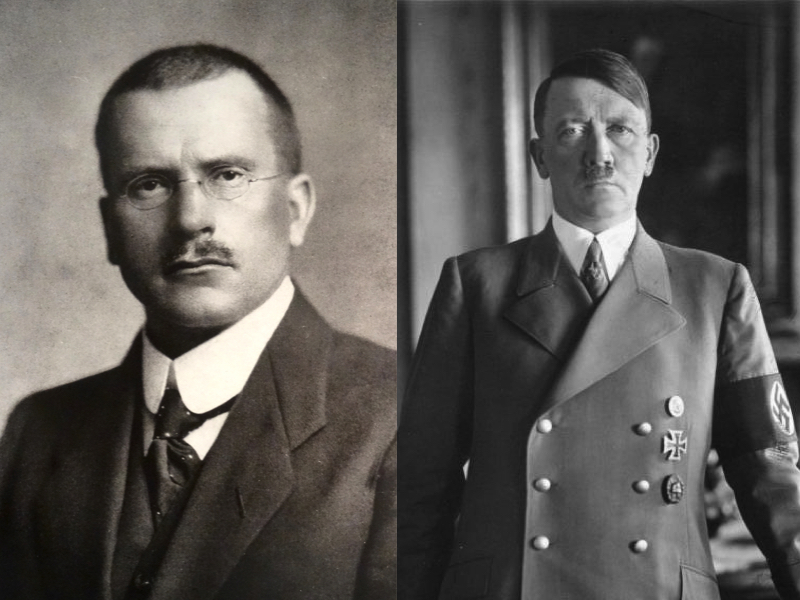
Were you to google “Carl Jung and Nazism”—and I’m not suggesting that you do—you would find yourself hip-deep in the charges that Jung was an anti-Semite and a Nazi sympathizer. Many sites condemn or exonerate him; many others celebrate him as a blood and soil Aryan hero. It can be nauseatingly difficult at times to tell these accounts apart. What to make of this controversy? What is the evidence brought against the famed Swiss psychiatrist and onetime close friend, student, and colleague of Sigmund Freud?
Truth be told, it does not look good for Jung. Unlike Nietzsche, whose work was deliberately bastardized by Nazis, beginning with his own sister, Jung need not be taken out of context to be read as anti-Semitic. There is no irony at work in his 1934 paper The State of Psychotherapy Today, in which he marvels at National Socialism as a “formidable phenomenon,” and writes, “the ‘Aryan’ unconscious has a higher potential than the Jewish.” This is only one of the least objectionable of such statements, as historian Andrew Samuels demonstrates.
One Jungian defender admits in an essay collection called Lingering Shadows that Jung had been “unconsciously infected by Nazi ideas.” In response, psychologist John Conger asks, “Why not then say that he was unconsciously infected by anti-Semitic ideas as well?”—well before the Nazis came to power. He had expressed such thoughts as far back as 1918. Like the philosopher Martin Heidegger, Jung was accused of trading on his professional associations during the 30s to maintain his status, and turning on his Jewish colleagues while they were purged.
Yet his biographer Deirdre Bair claims Jung’s name was used to endorse persecution without his consent. Jung was incensed, “not least,” Mark Vernon writes at The Guardian, “because he was actually fighting to keep German psychotherapy open to Jewish individuals.” Bair also reveals that Jung was “involved in two plots to oust Hitler, essentially by having a leading physician declare the Führer mad. Both came to nothing.” And unlike Heidegger, Jung strongly denounced anti-Semitic views during the war. He “protected Jewish analysts,” writes Conger, “and helped refugees.” He also worked for the OSS, precursor to the CIA, during the war.
His recruiter Allen Dulles wrote of Jung’s “deep antipathy to what Nazism and Fascism stood for.” Dulles also cryptically remarked, “Nobody will probably ever know how much Prof. Jung contributed to the allied cause during the war.” These contradictions in Jung’s words, character, and actions are puzzling, to say the least. I would not presume to draw any hard and fast conclusions from them. They do, however, serve as the necessary context for Jung’s observations of Adolf Hitler. Nazis of today who praise Jung most often do so for his supposed characterization of Hitler as “Wotan,” or Odin, a comparison that thrills neo-pagans who, like the Germans did, use ancient European belief systems as clothes hangers for modern racist nationalism.
In his 1936 essay, “Wotan,” Jung describes the old god as a force all its own, a “personification of psychic forces” that moved through the German people “towards the end of the Weimar Republic”—through the “thousands of unemployed,” who by 1933 “marched in their hundreds of thousands.” Wotan, Jung writes, “is the god of storm and frenzy, the unleasher of passions and the lust of battle; moreover he is a superlative magician and artist in illusion who is versed in all secrets of an occult nature.” In personifying the “German psyche” as a furious god, Jung goes so far as to write, “We who stand outside judge the Germans far too much as if they were responsible agents, but perhaps it would be nearer the truth to regard them also as victims.”
“One hopes,” writes Per Brask, “evidently against hope, that Jung did not intend” his statements “as an argument of redemption for the Germans.” Whatever his intentions, his mystical racialization of the unconscious in “Wotan” accorded perfectly well with the theories of Alfred Rosenberg, “Hitler’s chief ideologist.” Like everything about Jung, the situation is complicated. In a 1938 interview, published by Omnibook Magazine in 1942, Jung repeated many of these disturbing ideas, comparing the German worship of Hitler to the Jewish desire for a Messiah, a “characteristic of people with an inferiority complex.” He describes Hitler’s power as a form of “magic.” But that power only exists, he says, because “Hitler listens and obeys….”
His Voice is nothing other than his own unconscious, into which the German people have projected their own selves; that is, the unconscious of seventy-eight million Germans. That is what makes him powerful. Without the German people he would be nothing.
Jung’s observations are bombastic, but they are not flattering. The people may be possessed, but it is their will, he says, that the Nazi leader enacts, not his own. “The true leader,” says Jung, “is always led.” He goes on to paint an even darker picture, having closely observed Hitler and Mussolini together in Berlin:
In comparison with Mussolini, Hitler made upon me the impression of a sort of scaffolding of wood covered with cloth, an automaton with a mask, like a robot or a mask of a robot. During the whole performance he never laughed; it was as though he were in a bad humor, sulking. He showed no human sign.
His expression was that of an inhumanly single-minded purposiveness, with no sense of humor. He seemed as if he might be a double of a real person, and that Hitler the man might perhaps be hiding inside like an appendix, and deliberately so hiding in order not to disturb the mechanism.
With Hitler you do not feel that you are with a man. You are with a medicine man, a form of spiritual vessel, a demi-deity, or even better, a myth. With Hitler you are scared. You know you would never be able to talk to that man; because there is nobody there. He is not a man, but a collective. He is not an individual, but a whole nation. I take it to be literally true that he has no personal friend. How can you talk intimately with a nation?
Read the full interview here. Jung goes on to further discuss the German resurgence of the cult of Wotan, the “parallel between the Biblical triad… and the Third Reich,” and other peculiarly Jungian formulations. Of Jung’s analysis, interviewer H.R. Knickerbocker concludes, “this psychiatric explanation of the Nazi names and symbols may sound to a layman fantastic, but can anything be as fantastic as the bare facts about the Nazi Party and its Fuehrer? Be sure there is much more to be explained in them than can be explained by merely calling them gangsters.”
Note: An earlier version of this post appeared on our site in 2017.
Related Content:
George Orwell Reviews Mein Kampf: “He Envisages a Horrible Brainless Empire” (1940)
Carl Jung Offers an Introduction to His Psychological Thought in a 3‑Hour Interview (1957)
How Carl Jung Inspired the Creation of Alcoholics Anonymous
Josh Jones is a writer and musician based in Durham, NC. Follow him at @jdmagness
Read More...Marcus Aurelius’ 9 Rules for Living a Stoic Life
This week, the Guardian’s Zoe Williams profiled Ryan Holiday, a one-time public-relations whiz-kid who’s reinvented himself over the past decade as a speaker for the dead: specifically Epictetus, Seneca, and above all Marcus Aurelius, the figureheads of the ancient school of philosophy we now know as Stoicism. It “centers on four virtues: courage, temperance, justice and wisdom,” Williams writes. “Marshaling these will give you complete self-control, enabling you to react with equanimity to all outside stimuli, and not whine about stuff.” Wealth “should mean nothing to the stoic, which makes it ironic that some of the richest people on Earth claim to live by stoicism.”
That last line comes as an obvious jab at Holiday’s popularity among not just sports stars and celebrities but big money-makers in Silicon Valley as well. But then, Stoicism was meant to work for anyone, no matter their socioeconomic status: Epictetus was a slave, after all, while Marcus Aurelius ruled over the Roman Empire. And it is Marcus’ collected writings the Meditations (available free as an eBook or audiobook) that inspired Holiday’s video above from his Youtube channel Daily Stoic. In it, he presents “nine Stoic rules for a better life,” opening with an exhortation that “life is short: do everything as if it was the thought or action of a dying person.”
The rules begin with “put people first,” which Marcus once demonstrated as a leader by selling off the imperial palace’s finery during the economic hardships of the Antonine Plague. Second, “another path is always open” — or, as expressed in the title of Holiday’s first book about Stoicism, “the obstacle is the way.” Even if you feel stuck, “you always have the opportunity to practice virtue, practice excellence, to change in some form or another based on what’s happening.” Third, “take it step by step”: familiar advice, perhaps, but a welcome reminder that what stops us from beginning a project or process of change is never a lack of information, but a simple lack of action.
Fourth, “discard your anxiety,” which may feel caused by outside circumstances, but in Marcus’ view, comes wholly from inside ourselves; Holiday speaks of Marcus’ declaration that he “discarded anxiety because it was within me.” Fifth, “well begun is half done” — or as they put it in Korea, where I live, “the start is half.” No matter where in the world you happen to be, you can put into practice Holiday’s practical interpretation of this rule: get up early in the morning so as to “own the day from the beginning,” just as Marcus did. Sixth, “be strict with yourself,” even as you remain tolerant with others: “leave everyone else and their mistakes and their way of doing things to them.”
Seventh, “don’t resent people,” even if, like Marcus, you don’t particularly like them. Your enemies offer you a hidden opportunity to “be good in spite of other people, to be just in the face of injustice, to be temperate in the face of intemperance that’s being rewarded. Eighth, “ask yourself, ‘Is this essential?’ ” Whether you’re a Roman emperor or a twenty-first century “knowledge worker,” life tends to fill up with pressing but not ultimately important tasks, at least without constant vigilance about how much they really matter. Ninth, keep these three mantras in mind: “Amor fati,” or “embrace your fate”; “It’s about what you do for other people”; and “Memento mori,” or “remember that death is inevitable.” The original Stoics have been gone for coming on two millennia now, but they still set an example for us today. How many of us can foresee the same for ourselves?
Related content:
The Stoic Wisdom of Roman Emperor Marcus Aurelius: An Introduction in Six Short Videos
How to Be a Stoic in Your Everyday Life: Philosophy Professor Massimo Pigliucci Explains
Three Huge Volumes of Stoic Writings by Seneca Now Free Online, Thanks to Tim Ferriss
Based in Seoul, Colin Marshall writes and broadcasts on cities, language, and culture. His projects include the Substack newsletter Books on Cities and the book The Stateless City: a Walk through 21st-Century Los Angeles. Follow him on Twitter at @colinmarshall or on Facebook.
Read More...The Isolated Bass Grooves of The Grateful Dead’s Phil Lesh (RIP)
This past Friday, the bassist of The Grateful Dead, Phil Lesh, passed away at age 84. Almost immediately the tributes poured in, most recognizing that Lesh wasn’t your ordinary bassist. As Jon Pareles wrote in the New York Times, Phil Lesh held songs “aloft.” His “bass lines hopped and bubbled and constantly conversed with the guitars of Jerry Garcia and Bob Weir. His tone was rounded and unassertive while he eased his way into the counterpoint, almost as if he were thinking aloud. [His] playing was essential to the Dead’s particular gravity-defying lilt, sharing a collective mode of rock momentum that was teasing and probing, never bluntly coercive.”
My first encounter with the Grateful Dead came when I was 16 years old. I vividly remember the guy who played bongos on my friend’s head when we arrived at the show. I also remember the spinners tripping on acid, dancing down the halls and short-circuiting my little mind. But the concert itself remains only a hazy memory. And certainly the artistry of Lesh, Garcia, Weir, and the drummers was lost on me. Only years later, did it all start to click. That’s when I dialed into the Barton Hall concert at Cornell (May 8, 1977) and encountered Lesh’s bass lines at the start of “Scarlet Begonias.” Once you hear them, they’re hard to shake. The video above zooms into that performance, exploring the development of Lesh’s bass playing throughout the spring of ’77. The next video down lets you hear the complete Barton Hall performance of “Scarlet Begonias” in all of its glory.
When others try to capture what made Phil, Phil, they’ll feature another beloved show–Veneta, OR (6/27/72). Below, you can hear isolated tracks of Phil’s bass work on “Bertha” and “China Cat Sunflower/I Know You Rider.” (Click the links in the prior sentence to hear Lesh and the band performing the songs together–so you can hear how the bass ties in.) Trained in free jazz and avant-garde classical music, Lesh infused rock with the influences of Coltrane, Mingus, and Stravinsky–not to mention others. And, with that, the bass was never the same.
For anyone wanting to get further into the Phil Zone, read his excellent memoir Searching for the Sound: My Life with the Grateful Dead.
Bertha
China Cat Sunflower/I Know You Rider
Related Content
When the Grateful Dead Played at the Egyptian Pyramids, in the Shadow of the Sphinx (1978)
Read More...
B.B. King Changes a Broken Guitar String Mid-Song at Farm Aid, and Doesn’t Miss a Beat (1985)
The scene is Farm Aid, 1985, attended by a crowd of 80,000 people. The song is “How Blue Can You Get.” And the key moment comes at the 3:10 mark, when the blues legend B.B. King breaks a guitar string, then manages to replace it before the song finishes minutes later. All the while, he keeps the song going, never missing a beat and singing the blues. Enjoy.
If you would like to support the mission of Open Culture, consider making a donation to our site. It’s hard to rely 100% on ads, and your contributions will help us continue providing the best free cultural and educational materials to learners everywhere. You can contribute through PayPal, Patreon, and Venmo (@openculture). Thanks!
Related Content:
B.B. King Plays Live at Sing Sing Prison in One of His Greatest Performances (1972)
The Thrill is Gone: See B.B. King Play in Two Electric Live Performances
Chuck Berry Takes Keith Richards to School, Shows Him How to Rock (1987)
B.B. King Plays “The Thrill is Gone” with Slash, Ron Wood & Other Legends
Read More...
Spin the 17th-Century Death Roulette Wheel & Find Out What Would Have Killed You in 1665
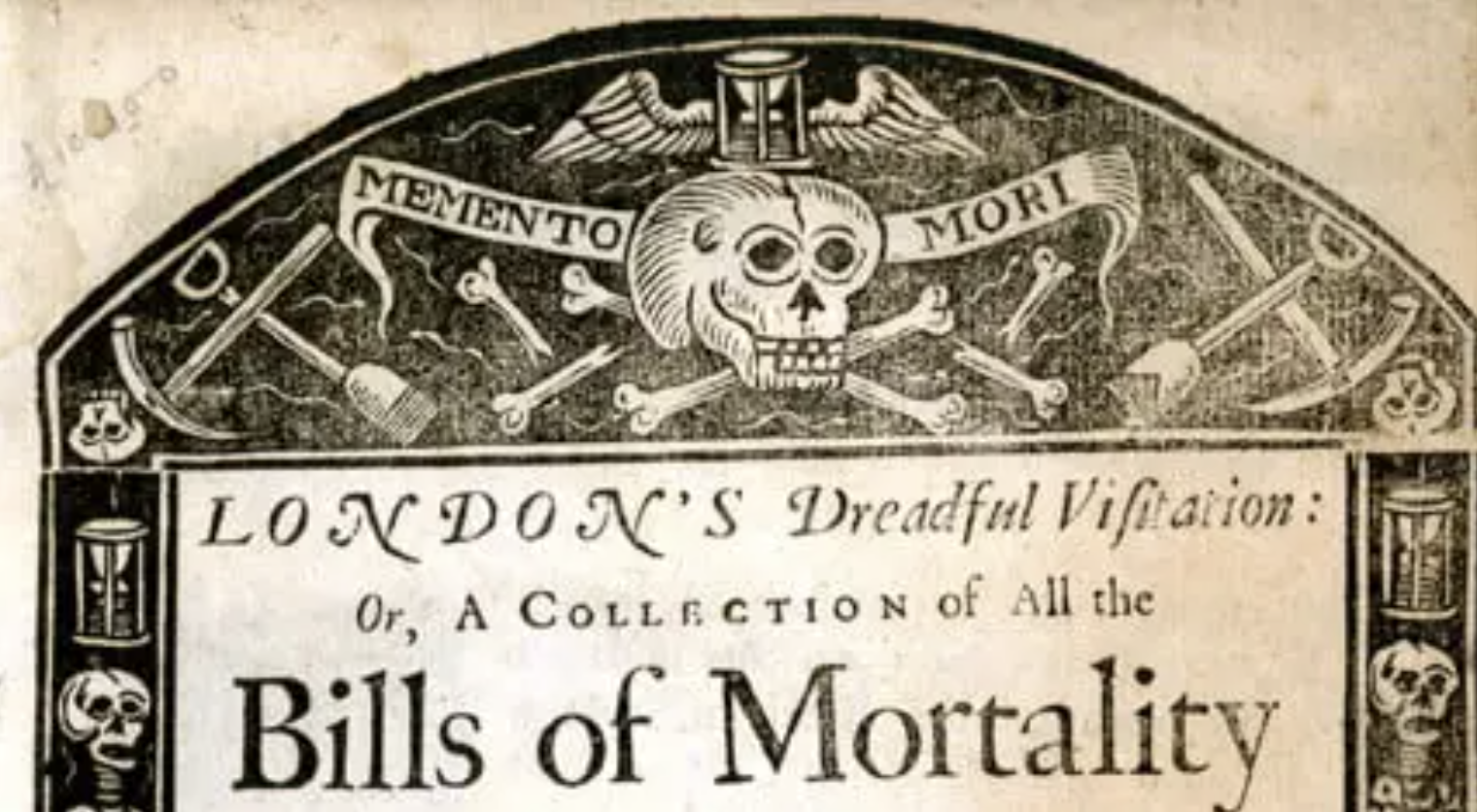
A common historical misconception holds that, up until a few centuries ago, everyone died when they were about 40. In fact, even in antiquity, one could well make it to what would be considered an advanced age today — assuming one survived the great mortal peril of childhood, and then all the dangers that could befall one in all the stages of life thereafter. In the mid-seventeenth century, with the Dark Ages past and the Industrial Revolution just ahead, these threats to life included consumption, dropsy, “griping in the guts,” sciatica, “stopping of the stomach,” and of course, plague.
This information comes from the London “mortality bill” seen below, which “represents the death tally of all city parishes for the week of Aug. 15–22, 1665, when the plague had infected 96 of the 130 parishes reporting.”
So writes Rebecca Onion at Slate, who cites Shakespeare’s Restless World author Neil MacGregor as saying that “the bills cost about a penny, and were published in large print runs.” But “if medicine was still somewhat uncertain about the causes of death, those in charge of toting up deaths for the bills of mortality were even more so,” resulting in vague categorizations like “bedridden,” “frightened,” “lethargy,” and “surfeit.”
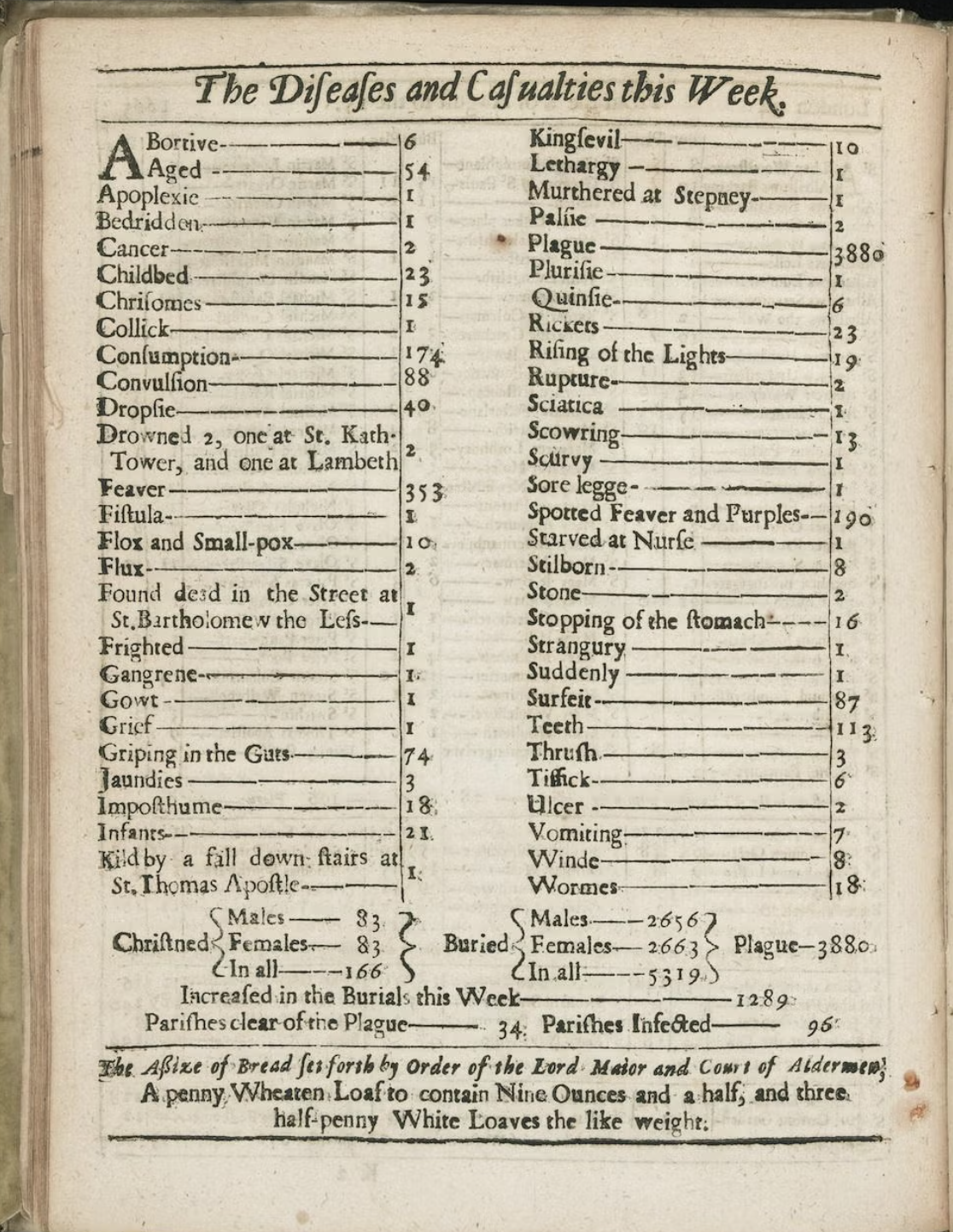
You may receive one of those fates when you spin the wheel of 17th-Century Death Roulette, a web application that cycles rapidly through mortality bills and the types of death listed therein. “In the week of July 11th, 1665 you died from Palsie.” “In the week of February 14th, 1665 you died from Kild accidentally with a Carbine, at St. Michael Wood Street.” “In the week of December 12th, 1665 you died from Winde.” Your results may not reflect the actuarial probability of what might have killed a given Londoner in that year, but all this death does, perhaps ironically, give a vivid impression of life at the time. Personally, I’m curious how dangerous those stairs at St Thomas the Apostle really were, but given that the whole church burned down in the Great Fire of the very next year, I suppose we’ll never know. Play the 17th-Century Death Roulette here.
via Metafilter
Related content:
The History of the Plague: Every Major Epidemic in an Animated Map
A 1665 Advertisement Promises a “Famous and Effectual” Cure for the Great Plague
Isaac Newton Conceived of His Most Groundbreaking Ideas During the Great Plague of 1665
Based in Seoul, Colin Marshall writes and broadcasts on cities, language, and culture. His projects include the Substack newsletter Books on Cities and the book The Stateless City: a Walk through 21st-Century Los Angeles. Follow him on Twitter at @colinmarshall or on Facebook.
Read More...How Man Ray Reinvented Himself & Created One of the Most Iconic Works of Surrealist Photography
It would surprise none of us to encounter a young artist looking to cast off his past and make his mark on the culture in a place like Williamsburg. But in the case of Man Ray, Williamsburg was his past. One must remember that the Brooklyn of today bears little resemblance to the Brooklyn of the early twentieth century in which the famed avant-gardist grew up. Back then, he was known as Emmanuel Radnitzky, the son of immigrant garment workers. It was after he took up the art life in Manhattan that he met the gallerist Alfred Stieglitz, forming an association that would begin his transformation from aspiring painter into form-changing photographer.
Inspired by Marcel Duchamp’s Nude Descending a Staircase, No. 2 after seeing it at the epoch-making 1913 Armory Show, Ray befriended the artist himself. Despite its considerable language barrier, this relationship gave him a way into the liberating realms of surrealism in general and Dada in particular. “The movement’s refusal to be defined or codified gave Ray the rationale to leave his former life and head to Paris, where he could complete his reinvention unfettered by his past,” says James Payne in the new Great Art Explained video above. It was this relocation — almost as dramatic, in those days, as going from Brooklyn to Manhattan — that offered him the chance to become a major artistic figure.
Soon after settling in Montparnasse, Ray “made an accidental rediscovery of the camera-less photogram, which he called ‘Rayographs.’ ” This technique, which involved placing objects on photosensitive paper and then exposing the arrangement to light, produced images that were “dubbed pure Dada creations” and “played a significant role in redefining photography as a medium capable of abstraction and conceptual depth.” It was in that same part of town that he entered into an artistic and romantic partnership with Alice Prin, more widely known as Kiki de Montparnasse — and even more widely known, a century later, as Le Violon d’Ingres, which in 2022 became the most expensive photograph ever sold.
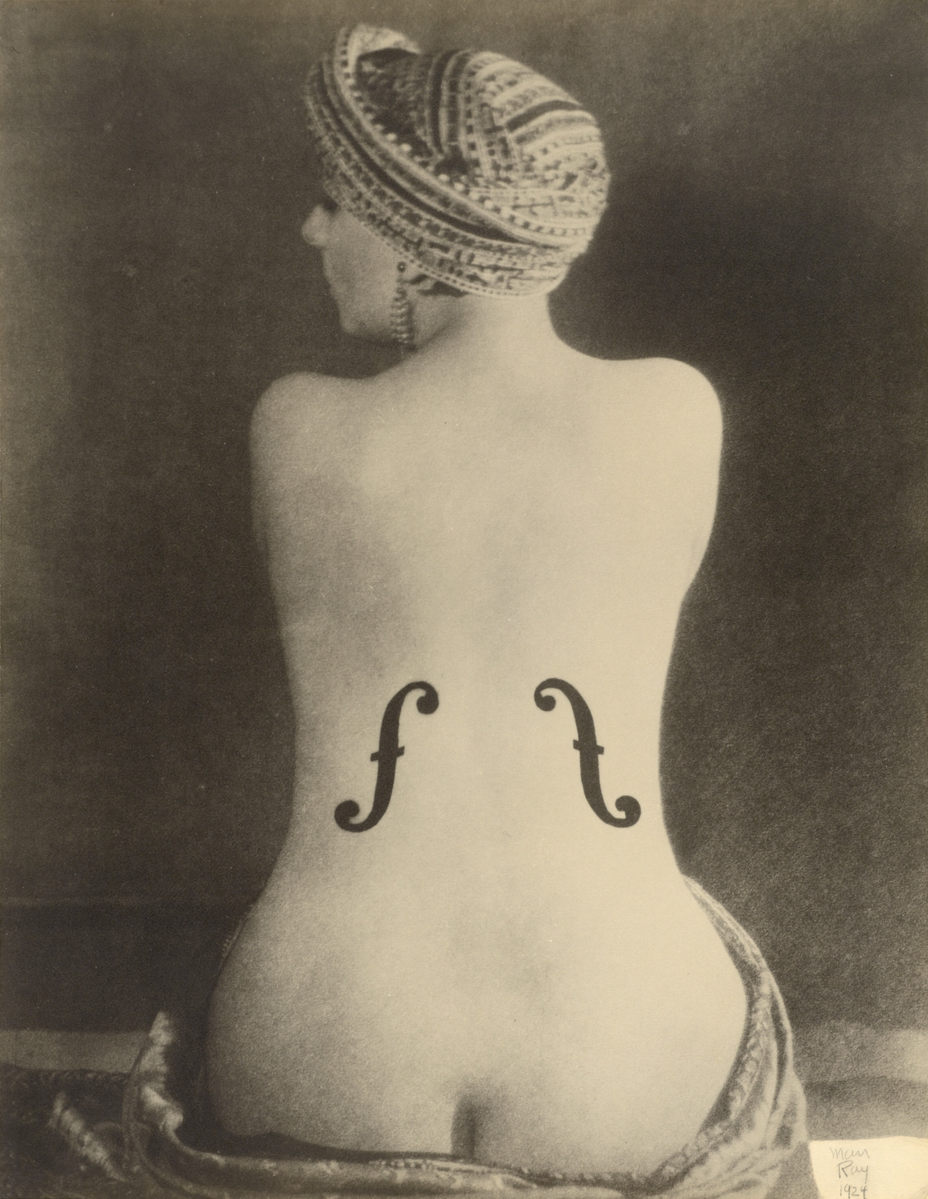
The $12.4 million sale price of Le Violon d’Ingres is rather less interesting than the story behind it, which involves not just Ray and Kiki’s life together, but also a process of technical experimentation whose result “perfectly embodies the surrealist interest in challenging traditional representations and blending everyday objects with the human form.” Tame though it may look in the era of Photoshop (to say nothing of AI-generated imagery), the picture’s convincing placement of violin-style sound holes on Kiki’s classically presented body suggested to its viewers that photography had non-documentary possibilities never before imagined — certainly not in Williamsburg, anyway.
Related content:
Man Ray and the Cinéma Pur: Watch Four Groundbreaking Surrealist Films From the 1920s
Man Ray’s Portraits of Ernest Hemingway, Ezra Pound, Marcel Duchamp & Many Other 1920s Icons
The Home Movies of Two Surrealists: Look Inside the Lives of Man Ray & René Magritte
Alfred Stieglitz: The Eloquent Eye, a Revealing Look at “The Father of Modern Photography”
Based in Seoul, Colin Marshall writes and broadcasts on cities, language, and culture. His projects include the Substack newsletter Books on Cities and the book The Stateless City: a Walk through 21st-Century Los Angeles. Follow him on Twitter at @colinmarshall or on Facebook.
Read More...The Night When Luciano Pavarotti & James Brown Sang “It’s a Man’s World” Together (2002)
Luciano Pavarotti and James Brown are remembered as larger-than-life performers with an almost mythical-seeming presence and distinctiveness. But it wasn’t so very long ago that both of them were active — and even active onstage together. In the video above, the King of the High Cs and the Godfather of Soul get together on “It’s a Man’s World” in 2002. It happened at the penultimate Pavarotti & Friends concert, one of a series of yearly benefit shows that ran between 1992 and 2003, and also featured the likes of Andrea Bocelli, Grace Jones, Sting, and Lou Reed.
“It’s a remarkable performance on so many levels,” writes Tom Teicholz at Forbes.com. “James Brown is in top form, his voice strong and pure. He commands the stage, and he dominates — he is in every sense an equal to Pavarotti, who sings in Italian with great subtlety, finesse, and emotion. The video is filled with moments of grace — such as when Brown, with a magisterial wave of his arm cedes the stage to Pavarotti to sing his solo, or when Brown says ‘my Bible says Noah made the Ark’ as if it was truly HIS Bible.”
What’s more, this is hardly the James Brown only slightly exaggerated by Eddie Murphy in those Saturday Night Live hot tub sketches a couple of decades earlier. “Brown’s performance is not about his staged theatrics, not about his dancing, not even really about Brown’s trademark grunts and growls,” Teicholz writes. “This is about singing and getting the song across,” a mission certainly not hindered by the kind of of orchestral backing they have. “It’s a Man’s World” might seem like the kind of song you “couldn’t sing today,” at least if you take its title at face value. But in any case, how many singers today would want to be subject to comparison with this particular rendition if they did so?
Related content:
Pavarotti Sings with Lou Reed, Sting, James Brown and Other Friends
Two Legends: Weird Al Yankovic “Interviews” James Brown (1986)
The Best Commercial Ever? James Brown Sells Miso Soup (1992)
Is Opera Part of Pop Culture? Pretty Much Pop #15 with Sean Spyres
Based in Seoul, Colin Marshall writes and broadcasts on cities, language, and culture. His projects include the Substack newsletter Books on Cities and the book The Stateless City: a Walk through 21st-Century Los Angeles. Follow him on Twitter at @colinmarshall or on Facebook.
Read More...George Harrison Explains Why Everyone Should Play the Ukulele
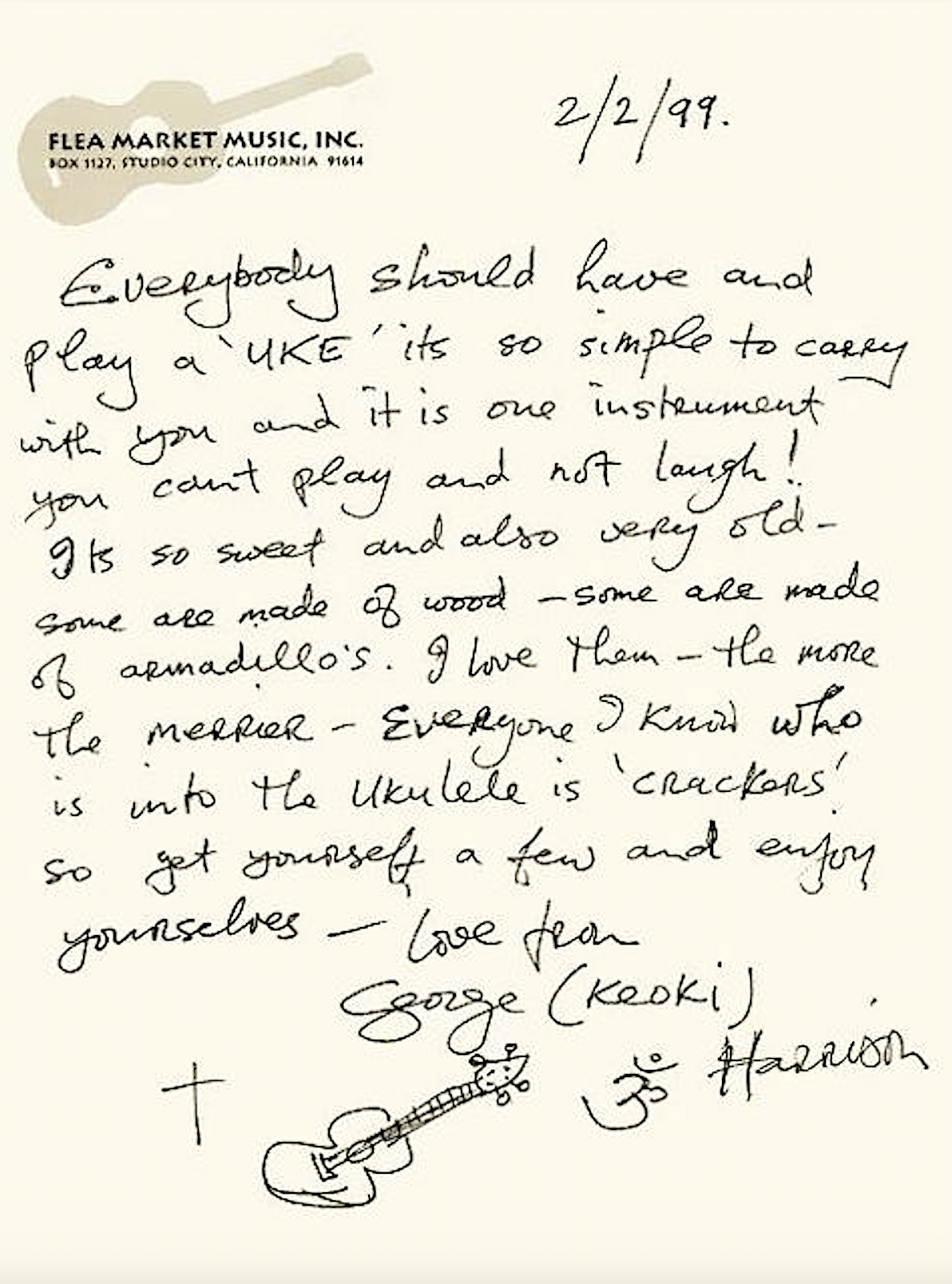
George Harrison loved the ukulele, and really, what’s not to love? For its dainty size, the uke can make a powerfully cheerful sound, and it’s an instrument both beginners and expert players can learn and easily carry around. As Harrison’s old friend Joe Brown remarked, “You can pick up a ukulele and anybody can learn to play a couple of tunes in a day or even a few hours. And if you want to get good at it, there’s no end to what you can do.” Brown, once a star in his own right, met Harrison and the Beatles in 1962 and remembers being impressed with the fellow uke-lover Harrison’s range of musical tastes: “He loved music, not just rock and roll…. He’d go crackers, he’d phone me up and say ‘I’ve got this great record!’ and it would be Hoagy Carmichael and all this Hawaiian stuff he used to like. George was not a musical snob.”
“Crackers” may be the perfect word for Harrison’s uke-philia; he used it himself in the adorable note above from 1999. “Everyone I know who is into the ukulele is ‘crackers,’” writes George, “you can’t play it and not laugh!” Harrison remained upbeat, even during his first cancer scare in 1997, the knife attack at his home in 1999, and the cancer relapse that eventually took his life in 2001. The ukulele seemed a sweetly genuine expression of his hopeful attitude. And after Harrison’s death, it seemed to his friends the perfect way to memorialize him. Joe Brown closed the Harrison tribute concert at Royal Albert Hall with a uke version of “I’ll See You In My Dreams,” and Paul McCartney remembered his friend in 2009 by strumming “Something” on a ukulele at New York’s Citi Field.
In his remarks, McCartney fondly reminisced: “Whenever you went round George’s house, after dinner the ukuleles would come out and you’d inevitably find yourself singing all these old numbers.” Just above, see Harrison and an old-time acoustic jazz ensemble (including Jools Holland on piano) play one of those “old numbers”—“Between The Devil and Deep Blue Sea”—in 1988. The song eventually wound up on his last album, the posthumously released Brainwashed. Just below, see Harrison, McCartney, and Ringo Starr sing a casually harmonious rendition of the 1927 tune “Ain’t She Sweet” while lounging picnic-style in a park.
In Hawaii, where Harrison owned a 150-acre retreat, and where he was known as Keoki, it’s said he bought ukuleles in batches and gave them away. The story may be legend, but it certainly sounds in character. He was a generous soul to the end. Just below, see Harrison strumming and whistling away in a home video made shortly before his death. You can hear the hoarseness in his voice from his throat cancer, but you won’t hear much sadness there, I think.
And for good measure:
Related Content:
Musicians Re-Imagine the Complete Songbook of the Beatles on the Ukulele
Watch George Harrison’s Final Interview and Performance (1997)
George Harrison’s Mystical, Fisheye Self-Portraits Taken in India (1966)
The Ukulele Orchestra of Great Britain Performs The Clash’s “Should I Stay Or Should I Go”
Josh Jones is a writer and musician based in Durham, NC. Follow him at @jdmagness
Read More...The Amazing Recording History of The Beatles’ “Here Comes the Sun”
The most streamed Beatles song isn’t “She Loves You,” “Hey Jude,” or “All You Need Is Love.” It isn’t even “Yesterday.” If you were about to guess “Something,” you’re on the right track, at least as far as the source album and songwriter. In fact, it’s George Harrison’s other signature song “Here Comes the Sun,” which has racked up 1,433,830,334 Spotify streams as of this writing, nearly a million more than “In My Life” right below it. The You Can’t Unhear This video above breaks down what makes “Here Comes the Sun” stand out even amid the formidable Beatles catalog, from its conception through its recording process.
Though it comes off as a simple song — whose inviting quality may well have something to do with its outsized popularity — “Here Comes the Sun” turns out to be the result of a technically complex and unconventional process fairly characteristic of the late Beatles. Starting with a melody crafted while playing an acoustic guitar in Eric Clapton’s garden (having recused himself from yet another business meeting), Harrison enriched it with such techniques as running his guitar through a revolving Leslie speaker meant for an organ and having his hulking Moog synthesizer transported to Abbey Road so he could add a layer of electronic sublimity.
At this point in the life of the Beatles, everyone involved could surely feel that the band’s end was near. Regardless, none of the Fab Four was quite working in isolation, and indeed, the “Here Comes the Sun” sessions — which, of course, ended up on Abbey Road, the final album they recorded — represent some of their last work as a unit. It’s not surprising that such a context would produce, say, John Lennon’s grimly descending “I Want You (She’s So Heavy),” which ends side one; what startles no matter how many times you hear it is the gentle optimism with which Harrison’s side two opens immediately thereafter, especially if you’re not turning an LP over in between.
Even in isolation, “Here Comes the Sun” has made such a cultural impact that Carl Sagan lobbied for its inclusion on the Voyager “Golden Records,” which were launched into outer space with the intent to give other forms of intelligent life a glimpse of human civilization. The Beatles also liked the idea, but they didn’t own the necessary rights; those belonged to the label EMI, who in the recollection of Sagan’s widow Ann Druyan demanded a prohibitive fee for the song’s use. Had it been included, perhaps it could’ve ended up the first intergalactic hit song — one enjoyed in the orbit of another sun entirely.
Related content:
The Beatles Release the First Ever Video for “Here Comes the Sun”
Hear The Beatles’ “Here Comes the Sun” With a Re-Discovered George Harrison Solo
Flashmob Performs The Beatles’ “Here Comes the Sun” in Madrid Unemployment Office
Watch George Harrison’s Final Interview and Performance (1997)
Based in Seoul, Colin Marshall writes and broadcasts on cities, language, and culture. His projects include the Substack newsletter Books on Cities and the book The Stateless City: a Walk through 21st-Century Los Angeles. Follow him on Twitter at @colinmarshall or on Facebook.
Read More...
Support Us
We're hoping to rely on loyal readers, rather than erratic ads. Please click the Donate button and support Open Culture. You can use Paypal, Venmo, Patreon, even Crypto! We thank you!

About Us

Open Culture scours the web for the best educational media. We find the free courses and audio books you need, the language lessons & educational videos you want, and plenty of enlightenment in between.
Advertise With Us
FREE UPDATES!
GET OUR DAILY EMAIL
Get the best cultural and educational resources on the web curated for you in a daily email. We never spam. Unsubscribe at any time.
FOLLOW ON SOCIAL MEDIA
Open Culture editor Dan Colman scours the web for the best educational media. He finds the free courses and audio books you need, the language lessons & movies you want, and plenty of enlightenment in between.
Advertise With Us

