How Audrey Hepburn Risked Death to Help the Dutch Resistance in World War II
Audrey Hepburn may not have had the most prolific Hollywood career, but a fair few of her characters still feel today like roles she was born to play. Perhaps the same could have been true of the part of Anne Frank, had she not refused to take it up. When Anne’s father Otto Frank inquired about it, one might imagine that Hepburn felt like she didn’t have the right experience to play that young woman, now long regarded as the embodiment of the victims of the Holocaust. In fact, for the actress who would be remembered as Princess Ann and Holly Golightly, it was too close to home: Hepburn could remember all too well her own harrowing wartime experience in the Netherlands, coming to the point of starvation while hiding from the Nazis.
Born in Belgium, the young Hepburn went to boarding school in England in the mid-nineteen-thirties. At the end of that decade, with the outbreak of the war, she went with her mother to live in the Netherlands. A student of ballet, she danced for audiences that included Nazi party members — an unavoidable fact of which much has been made — but she also danced, secretly, for the resistance. As biographer Robert Matzen writes, “Audrey’s celebrity as a ballerina for nearly four years at the Arnhem city theater made her talents valuable to Dr. Visser ’t Hooft,” one of that movement’s leaders, who put on “illegal musical performances at various by-invitation-only locations” meant to earn artists money “after they had been forced out of the Dutch mainstream by the Nazi union of artists, the Kultuurkamer.”
Hepburn herself discusses this period in the interview clip at the top of the post. As time went on, Matzen writes, “Dr. Visser ’t Hooft sent her at one point during this period to take a message, and perhaps food, to one of the downed fliers. Her qualifications were simple: She spoke English fluently whereas other young people within easy reach in the village did not.”
In the autumn of 1944, “she and her family kept a British paratrooper in their basement, the latest act in a series of defiances,” writes Den of Geek’s David Crow. “By the following winter, they too would be living down there, wary to even crawl out of ‘bed’ as the bombs fell on their small Dutch village of Velp.” Eventually, “after what was left of their food was depleted, they ate tulip bulbs. When those were gone, they ate the weeds.”
Endured at such a young age, this ordeal had lasting effects. “The deprivations would haunt Audrey the rest of her days, informing her svelte frame and, Matzen argues, possibly her early death from appendiceal cancer.” No wonder, then, that she remained fairly taciturn about her war even after becoming an internationally famous actress (an alternative to her first dream of dancing). Hence the formidable challenge laid before Matzen in the research that went into what became Dutch Girl: Audrey Hepburn and World War II, which you can hear him discuss in the Storytellers’ Studio video just above. Her story turned out differently from Anne Frank’s — which itself, as Matzen argues, beset her with a kind of “survivor’s guilt” — but now, both of them live on as icons of the twentieth century at its lightest and darkest.
Related content:
Audrey Hepburn’s Moving Screen Test for Roman Holiday (1953)
Color Footage of the Liberation of Paris, Shot by Hollywood Director George Stevens (1944)
Charade, the Best Hitchcock Film Hitchcock Never Made. Stars Cary Grant & Audrey Hepburn
Based in Seoul, Colin Marshall writes and broadcasts on cities, language, and culture. His projects include the Substack newsletter Books on Cities and the book The Stateless City: a Walk through 21st-Century Los Angeles. Follow him on Twitter at @colinmarshall or on Facebook.
Read More...Why You Can Never Tune a Piano
Grab a cup of coffee, put on your thinking cap, and start working through this video from Minute Physics, which explains why guitars, violins and other instruments can be tuned to a tee. But when it comes to pianos, it’s an entirely different story, a mathematical impossibility. Pianos are slightly but necessarily out of tune.
If you would like to support the mission of Open Culture, consider making a donation to our site. It’s hard to rely 100% on ads, and your contributions will help us continue providing the best free cultural and educational materials to learners everywhere. You can contribute through PayPal, Patreon, and Venmo (@openculture). Thanks!
Related Content
The Making of a Steinway Grand Piano, From Start to Finish
Read More...Death: A Free Online Philosophy Course from Yale Helps You Grapple with the Inescapable
It pays to think intelligently about the inevitable. And this course taught by Yale professor Shelly Kagan does just that, taking a rich, philosophical look at death. Here’s how the course description reads:
There is one thing I can be sure of: I am going to die. But what am I to make of that fact? This course will examine a number of issues that arise once we begin to reflect on our mortality. The possibility that death may not actually be the end is considered. Are we, in some sense, immortal? Would immortality be desirable? Also a clearer notion of what it is to die is examined. What does it mean to say that a person has died? What kind of fact is that? And, finally, different attitudes to death are evaluated. Is death an evil? How? Why? Is suicide morally permissible? Is it rational? How should the knowledge that I am going to die affect the way I live my life?
Major texts used in this course include Plato’s Phaedo, Tolstoy’s The Death of Ivan Ilych, and John Perry’sA Dialogue on Personal Identity and Immortality. Kagan also later published a companion book–simply called Death–which can be purchased online.
You can watch the 26 lectures above. Or find them on YouTube and iTunes in video and audio formats. For more information on this course, including the syllabus, please visit this Yale site.
This course has been added to our list of Free Online Philosophy courses, a subset of our meta collection, 1,700 Free Online Courses from Top Universities.
If you would like to support the mission of Open Culture, consider making a donation to our site. It’s hard to rely 100% on ads, and your contributions will help us continue providing the best free cultural and educational materials to learners everywhere. You can contribute through PayPal, Patreon, and Venmo (@openculture). Thanks!
Related Content:
Aldous Huxley, Dying of Cancer, Left This World Tripping on LSD (1963)
Alan Watts Explains Why Death is an Art, Adventure and Creative Act
Zen Master Alan Watts Discovers the Secrets of Aldous Huxley and His Art of Dying
Free Online Philosophy Courses
Read More...James Earl Jones (RIP) Reads Edgar Allan Poe’s “The Raven” and Walt Whitman’s “Song of Myself”
Note: With the sad passing of James Earl Jones, at age 93, we’re bringing back a post from our archive–one featuring Jones reading two great American poets, Edgar Allan Poe and Walt Whitman. These readings first appeared on our site in 2014.
For all its many flaws the original Star Wars trilogy never strayed too far afield because of the deep well of gravitas in James Earl Jones’ voice. The ominous breathing, the echo effect, and that arresting baritone—no amount of dancing Ewoks could take away from his vocal performance. And though Jones’ expressive face has also carried many a film, his unmistakable voice can give even the silliest of material the weight of an oil tanker’s anchor. So then imagine the effect when Jones reads from already weighty literature by Edgar Allan Poe and Walt Whitman? “Chills” only begins to describe it. Just above, hear him read Poe’s “The Raven,” a poem whose rhymes and sing-song cadences conjure up the mad obsession that materializes as that most portentous and intelligent of all the winged creatures.
While Vader and Poe seem like natural companions, the reading by Jones above of selections from Whitman’s “Song of Myself” also makes perfect sense. As comfortable on the stage as he is before the cameras, Jones has an excellent ear for the Shakespearean line, clearly good preparation for the Whitmanian, an “operatic line,” writes The Broken Tower, “due to its brea(d)th.” In the truth Whitman sings in his expansive transcendental poem, “the body, the body politic, and the nation’s body, are all literally the stuff of the universe, stardust smattered and strewn from the unifying explosion of our shared origin.” There are few readers, I aver, who could hold such “stuff” together with the strength and depth of voice as James Earl Jones. The recording above, of sections 6–7 and 17–19, comes from a reading Jones gave in October of 1973 at the 92nd St. Y. Below, hear the complete recording, with several more stanzas. Jones begins at the beginning, rumbling and bellowing out those lines that transmute egotism into magisterial, selfless inclusivity:
Related Content:
Darth Vader’s Voice: The Original Voice Versus the Vocals of James Earl Jones
James Earl Jones Reads Othello at White House Poetry Jam
Watch Stars Read Classic Children’s Books: Betty White, James Earl Jones, Rita Moreno & Many More
Josh Jones is a writer and musician based in Durham, NC. Follow him at @jdmagness
Read More...The Big Map of Who Lived When Shows Which Cultural Figures Walked the Earth at the Same Time: From 1200 to Present
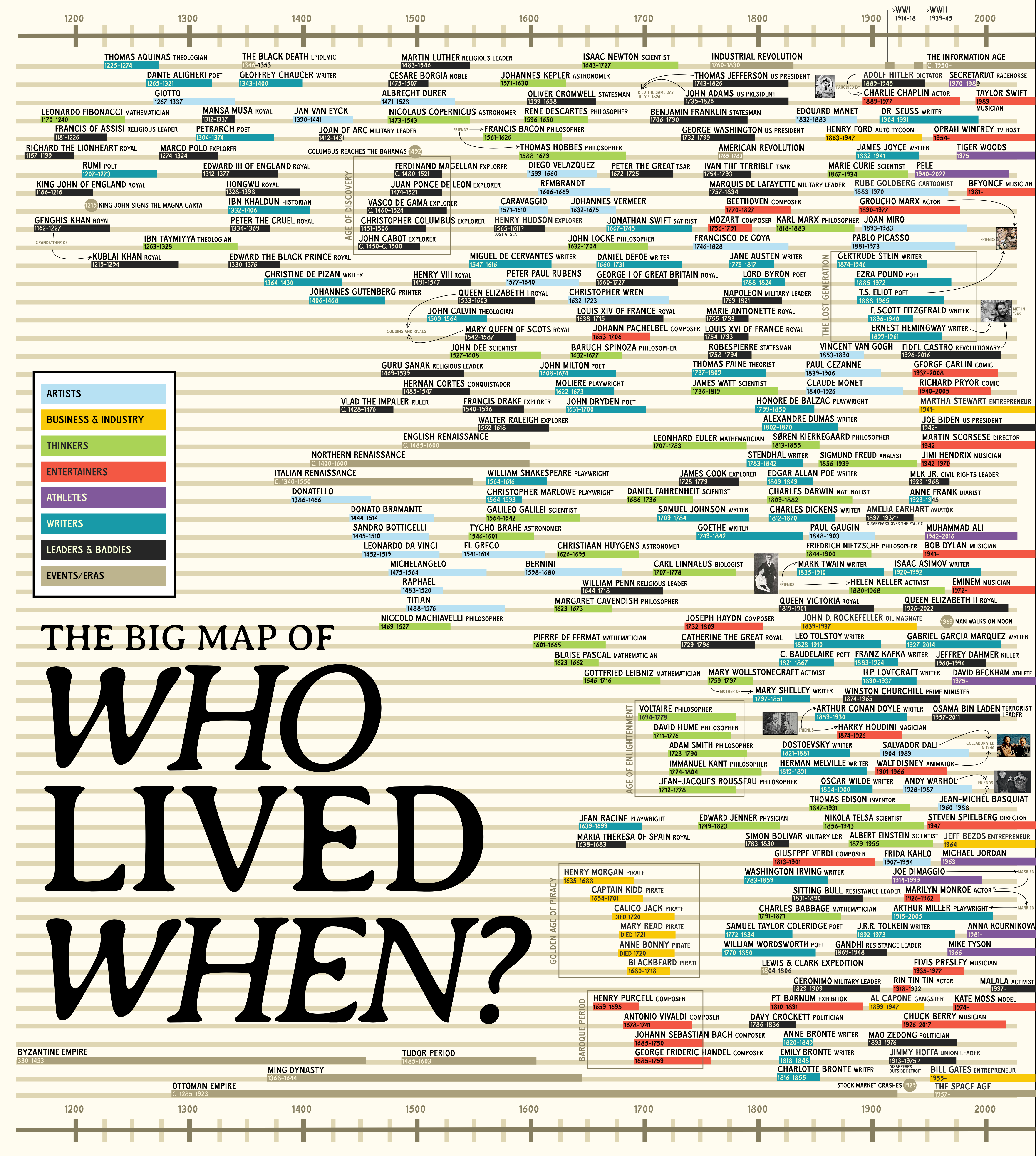
We could call the time in which we live the “Information Age.” Or we could describe it more vividly as the era of Bill Gates and Jeff Bezos, Martin Scorsese and Steven Spielberg, Oprah Winfrey and Martha Stewart, Beyoncé and Bob Dylan. Whatever you think of the work of any of these figures in particular, you can hardly deny the impact they’ve had on our culture. Were we living a century ago, we might have said the same of Henry Ford and John D. Rockefeller, James Joyce and F. Scott Fitzgerald (though he hadn’t quite published The Great Gatsby yet), Pablo Picasso and Charlie Chaplin, Marie Curie and Sigmund Freud.
Were we living in the year 1225, our lives would’ve overlapped with those of Leonardo Fibonacci, Francis of Assisi, Rumi, and Thomas Aquinas, as well as both Genghis Khan and his grandson Kublai Khan.
All this is laid out visually in The Big Map of Who Lived When, created earlier this year by a Reddit user called Profound_Whatever. As Big Think’s Frank Jacobs writes, the map reveals surprising instances of contemporaneousness, such as that current U.S. President Joe Biden “for about a year was alive at the same time as Nikola Tesla (1854–1943), the Serbian-American inventor who developed the alternating current (AC) system that is used for distributing electricity.”
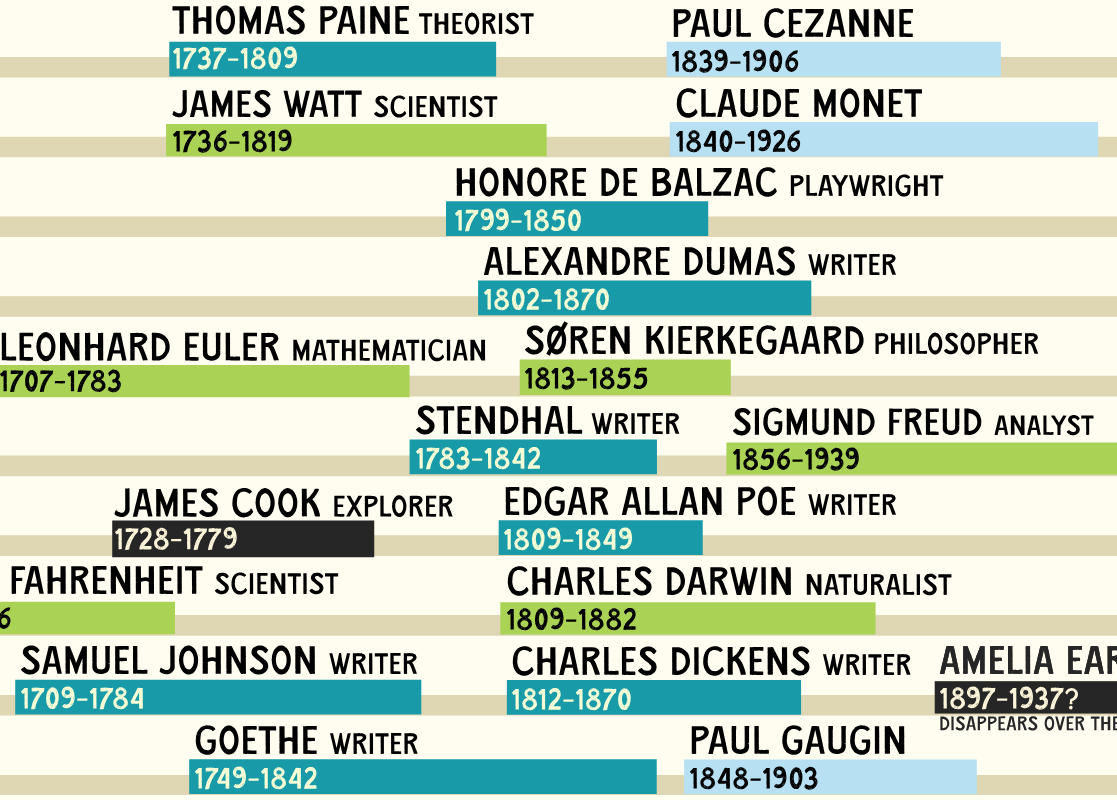
For “another, more recent (and more baffling) overlap: The life of J.R.R. Tolkien (1892–1973), who wrote The Lord of the Rings, coincided ever so slightly with that of Eminem.” Going farther into the past, how many of us were fully aware that “Christopher Columbus (1451–1506), Leonardo da Vinci (1452–1519), and Martin Luther (1483–1546) were contemporaries of each other”? Or that “the lives of Oliver Cromwell (1599–1658) and René Descartes (1596–1650) synced almost perfectly with each other, despite the one being the dogmatically Puritan figurehead of the English Civil War, and the other the father of modern, rationalist philosophy by giving doubt to a central role in the pursuit of truth”?
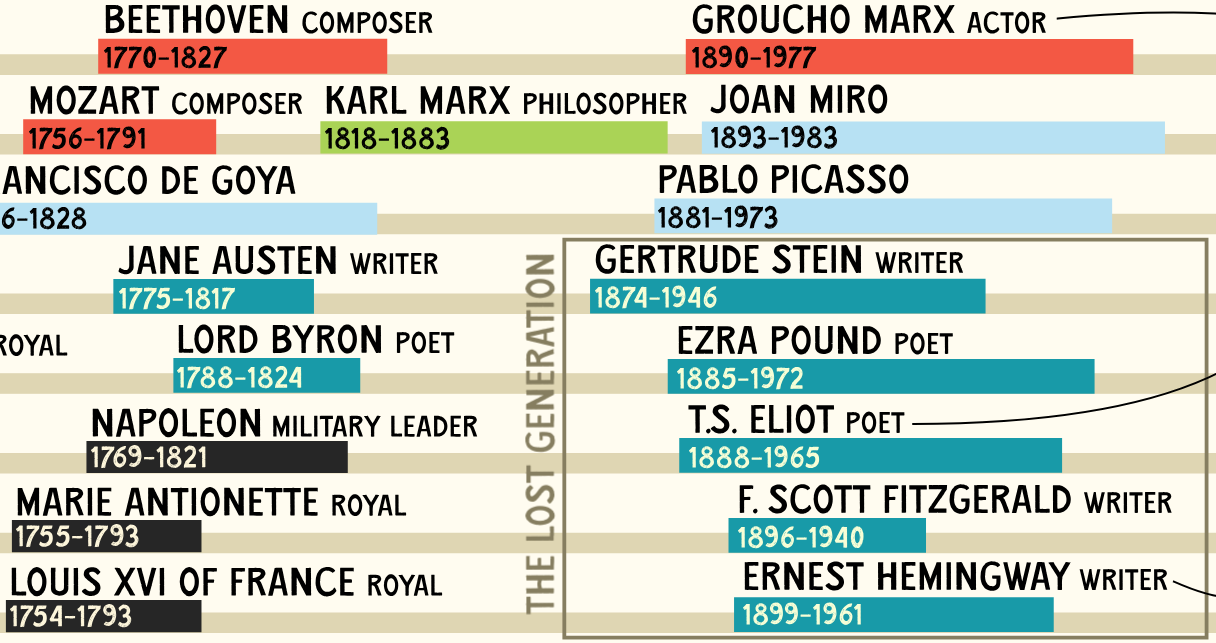
The Big Map of Who Lived When uses a color-coding system to divide the figures whose lifespans it charts into eight categories, including artists (Leonardo da Vinci, Rube Goldberg), thinkers (John Locke, Charles Darwin), “business & industry” (including famed pirates from Henry Morgan to Blackbeard), and “leaders & baddies” (Napoleon, Adolf Hitler). It all reminds us that we’d give anything for a chance to meet some of them, or to stay out of the path of others. Of course, the individuals we think of as having defined a particular historical era weren’t always regarded that way by everyone else who lived at the same time: something it wouldn’t hurt to bear in mind when considering our own place in history.
Related content:
5‑Minute Animation Maps 2,600 Years of Western Cultural History
4000 Years of History Displayed in a 5‑Foot-Long “Histomap” (Early Infographic) From 1931
180,000 Years of Religion Charted on a “Histomap” in 1943
10 Million Years of Evolution Visualized in an Elegant, 5‑Foot Long Infographic from 1931
The History of the World in One Video: Every Year from 200,000 BCE to Today
Based in Seoul, Colin Marshall writes and broadcasts on cities, language, and culture. His projects include the Substack newsletter Books on Cities and the book The Stateless City: a Walk through 21st-Century Los Angeles. Follow him on Twitter at @colinmarshall or on Facebook.
Read More...A Digital Archive Features Hundreds of Audio Cassette Tape Designs, from the 1960s to the 1990s
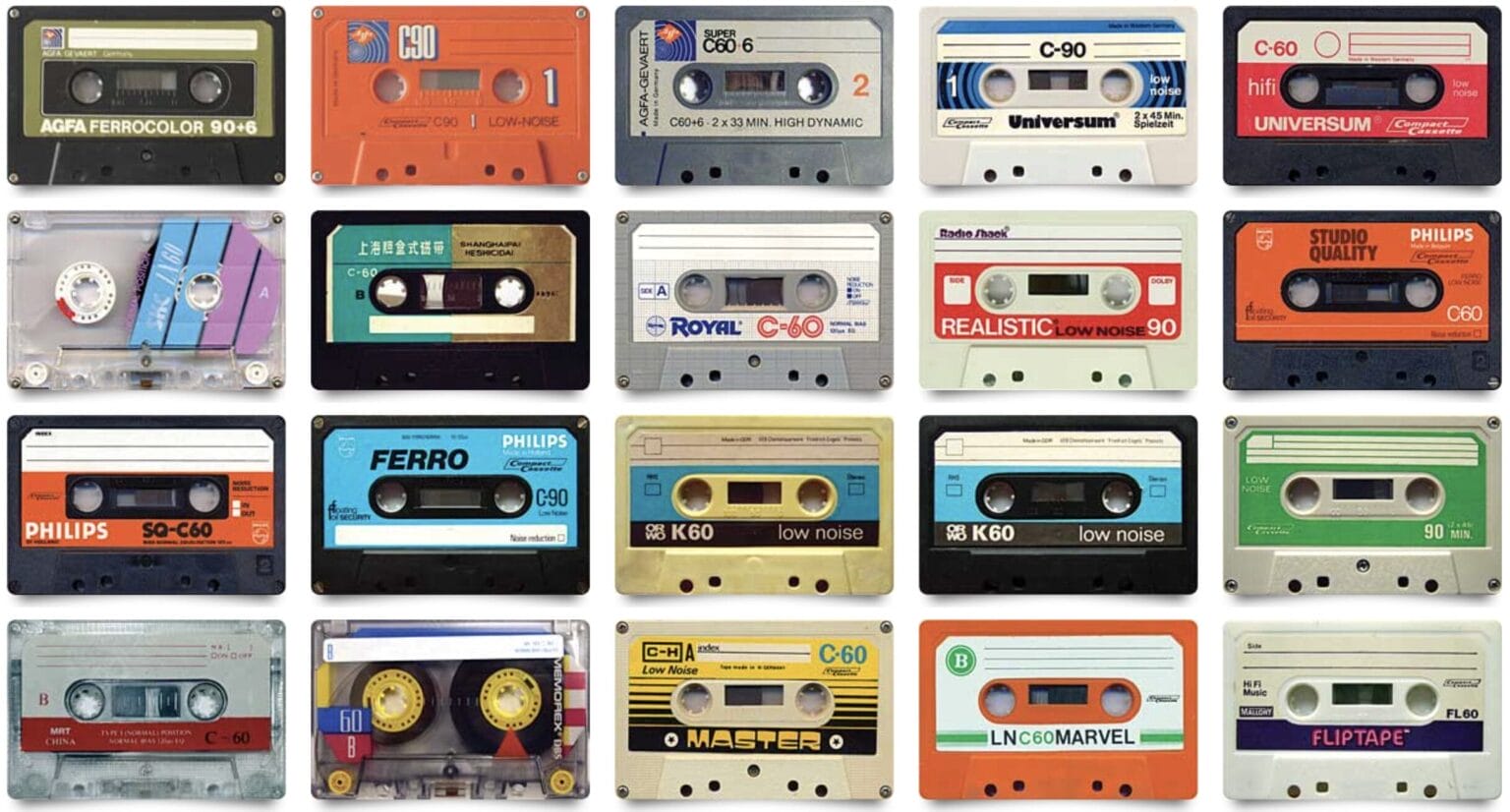
Audio cassette tapes first appeared on the market in the early nineteen-sixties, but it would take about a decade before they came to dominate it. And when they did, they’d changed the lives of many a music-lover by having made it possible not just to listen to their albums of choice on the go, but also to collect and trade their own custom-assembled listening experiences. By the eighties, blank tapes had become a household necessity on the order of batteries or toilet paper for such consumers — and just as with those frequently replenished products, everyone seemed to have their favorite brand.

Some preferred tapes from Philips, which developed the format of the Compact Cassette in the first place. Others had their pick from Fuji, BASF, Sony, Radio Shack, Scotch (which also made tape of the sticky variety), and a host of other brands besides.
Even some members of post-cassette generations recognize the old tagline “Is it live or is it Memorex?” or Maxell’s “Blown Away Guy” in his scarf and LC2. If you’re old enough to have done taping of your own, you don’t need a logo to recognize your brand; you’ll know it as soon as you spot the design of the cassette itself in the online archive at tapedeck.org.
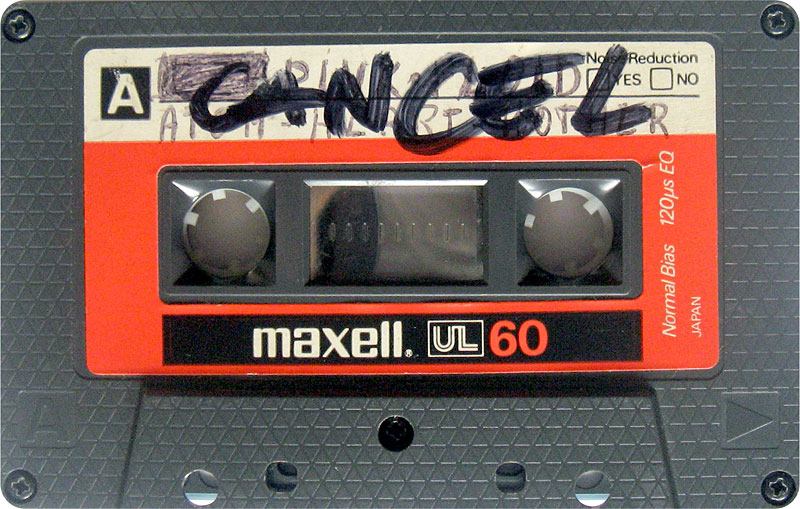
“I built tapedeck.org to showcase the amazing beauty and (sometimes) weirdness found in the designs of the common audio tape cassette,” writes the site’s creator Oliver Gelbrich. “There’s an amazing range of designs, starting from the early 60’s functional cassette designs, moving through the colorful playfulness of the 70’s audio tapes to amazing shape variations during the 80s and 90s.” You can browse the ever-expanding collection by brand, running time, color, and even tape coating: chrome, ferro, ferrochrome, and metal, by whose differences audiophiles set great store.
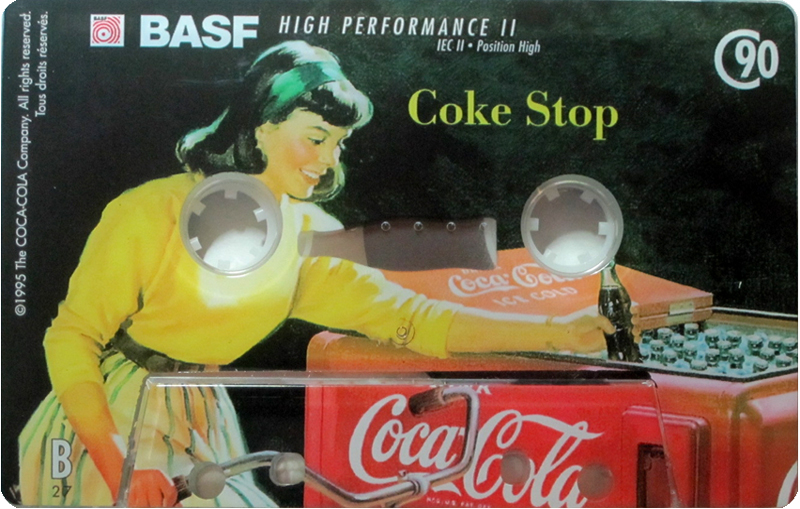
Somewhat improbably, in this age where even home CD-burning has been displaced by near-instantaneous streaming and downloading of digital music, the cassette tape has made something of a comeback. The near-mythological allure of the mixtape has only grown in recent years, during which artists both minor and major have put out cassette releases — and in some cases, cassette-only releases. This seems to be happening around the world: a few weeks ago, while strolling an art-school neighborhood in Seoul, where I live, I passed a coffee shop that offered its young customers rentals of both tapes and Walkman-style players on which to listen to them. As another generation-transcending slogan has it, everything old is new again.
via Colossal
Related content:
Based in Seoul, Colin Marshall writes and broadcasts on cities, language, and culture. His projects include the Substack newsletter Books on Cities and the book The Stateless City: a Walk through 21st-Century Los Angeles. Follow him on Twitter at @colinmarshall or on Facebook.
Read More...The Night Frank Zappa Jammed With Pink Floyd … and Captain Beefheart Too (Belgium, 1969)
Recently an older musician acquaintance told me he never “got into ‘Interstellar Overdrive’ and all that,” referring to the “first major space jam” of Pink Floyd’s career and the subsequent explosion of space rock bands. I found myself a little taken aback. Though I was born too late to be there, I’ve come to see “’Interstellar Overdrive’ and all that” as one of the most interesting things about the end of the sixties—the coming of Captain Beefheart and the Magic Band, of The Soft Machine, of Hawkwind and other psychedelic warriors.
Too oft overlooked in the popular Woodstock/Altamont binary shorthand for fin-de-sixties rock and roll, these bands’ brand of prog/jazz/blues/psych-rock experimentalism got its due in Amougies, Belgium, in a 1969 festival meant as Europe’s answer to the three-day “Aquarian exposition” staged in upstate New York that same year.
Sponsored by Paris magazine Actuel, “The Actuel Rock Festival” featured all of the bands mentioned above (except Hawkwind), along with Yes, Pharoah Sanders, Don Cherry, and many more. MC’ing the event, and serving as Beefheart’s manager, was none other than impresario of weird himself, Frank Zappa, who sat in with Floyd on “Interstellar Overdrive,” bringing his considerable lead guitar prowess to their dark, descending instrumental.
Just above, hear that Zappa/Floyd performance of the song. The live audio recording is fuzzy and a bit hollow, but the playing comes through perfectly clear. Zappa, in fact, jammed with nearly all the artists on the roster, though only a few recordings have surfaced, like this one from an audience member. Of their collaboration, Pink Floyd drummer Nick Mason said in 1973, “Frank Zappa is really one of those rare musicians that can play with us. The little he did in Amougies was terribly correct.” I think you’ll agree.
Dangerous Minds records many of Zappa’s recollections of the event, including a characteristically sardonic account he gave in an interview with The Simpsons’ Matt Groening in which he complains of feeling “like Linda McCartney” and about the scourge of “slumbering euro-hippies.” Zappa apparently did not remember jamming with Floyd but “the photos don’t lie and neither does the recording.” He does recall playing with Captain Beefheart, who says he himself “enjoyed it.” You can hear Beefheart’s set with Zappa above.
According to a biography of founding Pink Floyd singer and guitarist Syd Barrett—gone by the time of the festival—footage of the Zappa/Floyd jam exists, part of an unreleased documentary of the event by Gerome Laperrousaz. That film has yet to surface, it seems, but we do have the film above—slipping between black-and-white and color—of Pink Floyd playing “Green is the Colour,” “Careful With That Axe, Eugene,” and “Set the Controls For the Heart of the Sun.” It’s a must-watch if only for Roger Waters’ bone-chilling screams in the second song.
The festival is notable not only for these early performances of the newly Gilmour-fronted Pink Floyd, but also for the appearance of Aynsley Dunbar, future Zappa drummer and journeyman musician extraordinaire. Allegedly Zappa met Dunbar at the festival and was quite impressed with the latter’s jazz chops (though Dunbar first joined Zappa’s band on guitar before moving to drums). You can hear Zappa jam with his eventual star drummer’s band, Aynsley Dunbar’s Retaliation, above.
Related Content:
Watch Frank Zappa Play Michael Nesmith (RIP) on The Monkees–and Vice Versa (1967)
Psychedelic Scenes of Pink Floyd’s Early Days with Syd Barrett, 1967
Josh Jones is a writer and musician based in Durham, NC. Follow him at @jdmagness.
Read More...
The 11 Censored Looney Tunes and Merrie Melodies Cartoons That Haven’t Been Aired Since 1968
For decades and decades, Warner Bros.’ Looney Tunes and Merrie Melodies cartoons have served as a kind of default children’s entertainment. Originally conceived for theatrical exhibition in the nineteen-thirties, they were animated to a standard that held its own against the subsequent generations of television productions alongside which they would later be broadcast. Even their classical music-laden soundtracks seemed to signal higher aspirations. But when scrutinized closely enough, they turned out not to be as timeless and inoffensive as everyone had assumed. In fact, eleven Looney Tunes and Merrie Melodies cartoons have been withheld from syndication since the nineteen-sixties due to their content.
The LSuperSonicQ video above takes a look at the “Censored Eleven,” all of which have been suppressed for qualities like “exaggerated features, racist tones, and outdated references.” Produced between 1931 and 1944, these cartoons have been described as reflecting perceptions widely held by viewers at the time that have since become unacceptable. Take, for example, the black proto-Elmer Fudd in “All This and Rabbit Stew,” from 1941, a collection of “ethnic stereotypes including oversized clothing, a shuffle to his movement, and mumbling sentences.” In other productions, like “Jungle Jitters” and “The Isle of Pingo Pongo,” the offense is against native islanders, depicted therein as hard-partying cannibals.
At first glance, “Coal Black and de Sebben Dwarfs,” from 1943, may resemble a grotesque carnival of stereotypes. But as director Bob Clampett later explained, it originated when he “was approached in Hollywood by the cast of an all-black musical off-broadway production called Jump For Joy while they were doing some special performances in Los Angeles. They asked me why there weren’t any Warner’s cartoons with black characters and I didn’t have any good answer for that question. So we sat down together and came up with a parody of Disney’s Snow White, and ‘Coal Black’ was the result.” These performers provided the voices (credited, out of contractual obligation, to Mel Blanc), and Clampett paid tribute in the character designs to real jazz musicians he knew from Central Avenue.
However admirable the intentions of “Coal Black” — and however masterful its animation, which has come in for great praise from historians of the medium — it remains relegated to the banned-cartoons netherworld. Of course, this doesn’t mean you can’t see it today: like most of the “Censored Eleven,” it’s long been bootlegged, and it even underwent restoration for the first annual Turner Classic Movies Film Festival in 2010. Some of these controversial shorts appear on the Looney Tunes Gold Collection Volume: 3 DVDs, introduced by Whoopi Goldberg, who makes the sensible point that “removing these inexcusable images and jokes from this collection would be the same as saying they never existed.” Grown-ups may be okay with that, but kids — always the most discerning audience for Warner Bros. cartoons — know when they’re being lied to.
Related Content:
Conspiracy Theory Rock: The Schoolhouse Rock Parody Saturday Night Live May Have Censored
Donald Duck’s Bad Nazi Dream and Four Other Disney Propaganda Cartoons from World War II
Dr. Seuss Draws Anti-Japanese Cartoons During WWII, Then Atones with Horton Hears a Who!
Based in Seoul, Colin Marshall writes and broadcasts on cities, language, and culture. His projects include the Substack newsletter Books on Cities and the book The Stateless City: a Walk through 21st-Century Los Angeles. Follow him on Twitter at @colinmarshall or on Facebook.
Read More...Jimi Hendrix Arrives in London in 1966, Asks to Get Onstage with Cream, and Blows Eric Clapton Away: “You Never Told Me He Was That F‑ing Good”
Jimi Hendrix arrived on the London scene like a ton of bricks in 1966, smashing every British blues guitarist to pieces the instant they saw him play. As vocalist Terry Reid tells it, when Hendrix played his first showcase at the Bag O’Nails, arranged by Animals’ bassist Chas Chandler, “there were guitar players weeping. They had to mop the floor up. He was piling it on, solo after solo. I could see everyone’s fillings falling out. When he finished, it was silence. Nobody knew what to do. Everybody was dumbstruck, completely in shock.”
He only exaggerates a little, by all accounts, and when Reid says “everybody,” he means everybody: Keith Richards, Mick Jagger, Brian Jones, Jeff Beck, Paul McCartney, The Who, Eric Burdon, John Mayall, and maybe Jimmy Page, though he denies it. Mayall recalls, “the buzz was out before Jimi had even been seen here, so people were anticipating his performance, and he more than lived up to what we were expecting.” In fact, even before this legendary event sent nearly every star classic rock guitarist back to the woodshed, Jimi had arrived unannounced at the Regent Street Polytechnic, and asked to sit in and jam with Cream, where he proceeded to dethrone the reigning British guitar god, Eric Clapton.
Nobody knew who he was, but “in those days anybody could get up with anybody,” Clapton says in a recent interview, “if you were convincing enough that you could play. He got up and blew everyone’s mind.” As Hendrix biographer Charles Cross tells it, “no one had ever asked to jam” with Cream before. “Most would have been too intimidated by their reputation as the best band in Britain.” To hear the story as it’s told in the clip above from the BBC documentary Seven Ages of Rock, no one else would have ever dared to get onstage with Eric Clapton. Clapton, as the famed graffiti in London announced, was God. “It was a very brave person who would do that,” says Jack Bruce.
Actually, it was Chandler who asked the band, and who also tried to prepare Clapton. Jimi got onstage, plugged into Bruce’s bass amp, and played a version of Howlin’ Wolf’s “Killin’ Floor.” Everyone was “completely gobsmacked,” Clapton writes in his autobiography. “I remember thinking that here was a force to be reckoned with. It scared me, because he was clearly going to be a huge star, and just as we are finding our own speed, here was the real thing.” Fear, envy, awe… all reasonable emotions when standing next to Jimi Hendrix as he tears through “Killin’ Floor” three times faster than anyone else played it (as you can see him play it in Stockholm above)—while doing the splits, lying on the floor, playing with his teeth and behind his head…
“It was amazing,” writes Clapton, “and it was musically great, too, not just pyrotechnics.” There’s no telling how Jimi might have remembered the event had he lived to write his memoirs, but he would have been pretty modest, as was his way. No one else who saw him felt any need to hold back. “It must have been difficult for Eric to handle,” says Bruce, “because [Eric] was ‘God,’” and this unknown person comes along, and burns.” He puts it slightly differently at the top: “Eric was a guitar player. Jimi was some sort of force of nature.”
Rock journalist Keith Altham has yet a third account, as Ed Vulliamy writes at The Guardian. He remembers “Chandler going backstage after Clapton left in the middle of the song ‘which he had yet to master himself’; Clapton was furiously puffing on a cigarette and telling Chas: ‘You never told me he was that fucking good.’” Who knows if Hendrix knew Clapton had struggled with “Killin’ Floor” and decided not to try it live. But as blues guitarist Stephen Dale Petit notes, “when Chas invited Jimi to London, Jimi did not ask about money or contracts. He asked if Chas would introduce him to Beck and Clapton.”
He had come to meet, and blow away, his rock heroes. “Two weeks after The Bag O’Nails,” writes Classic Rock’s Johnny Black, “when Cream appeared at The Marquee Club, Clapton was sporting a frizzy perm and he left his guitar feeding back against the amp, just as he’d seen Jimi do.”
Related Content:
Jimi Hendrix Unplugged: Two Great Recordings of Hendrix Playing Acoustic Guitar
23-Year-Old Eric Clapton Demonstrates the Elements of His Guitar Sound (1968)
Jimi Hendrix Opens for The Monkees on a 1967 Tour; Then Flips Off the Crowd and Quits
Jimi Hendrix’s Final Interview Animated (1970)
Josh Jones is a writer and musician based in Durham, NC. Follow him at @jdmagness
Read More...Soviet Inventor Léon Theremin Shows Off the Theremin, the Early Electronic Instrument That Could Be Played Without Being Touched (1954)
You know the sound of the theremin, that weird, warbly whine that signals mystery, danger, and otherworldly portent in many classic sci-fi films. It has the distinction of being not only the very first electronic instrument but also the only instrument in history one plays without ever touching any part of it. Instead, the theremin player makes hand motions, like the conductor of an invisible choir, and the device sings. You can see this yourself above, as the instrument’s inventor, Leon Theremin, demonstrates his thereminvox, as he called it at the time, in 1954. Speaking in Russian, with English subtitles, Theremin describes how the “instrument of a singing-voice kind” works “by means of influencing an electromagnetic field.”
Theremin originally invented the instrument in 1919 and called it the Aetherphone. He demonstrated it for Vladimir Lenin in 1922, and its futuristic sound and design made quite an impression on the ailing communist leader. Theremin then brought the device to Europe (see a silent newsreel demonstration here) and to the U.S. in 1927, where he debuted it at the Plaza Hotel and where classical violinist Clara Rockmore, soon to become the most devoted proponent and player of the theremin, first heard it.
Although many people thought of Theremin’s invention as a novelty, Rockmore insisted that it would be taken seriously. She apprenticed herself to Theremin, mastered the instrument, and adapted and recorded many a classical composition, like Tchaikovsky’s “Berceuse,” above. More than anyone else, Rockmore made the theremin sing as its inventor intended.
The origin story of the theremin, like so many invention stories, involves a happy accident in the laboratory. Just above, Albert Glinsky, author of the history Theremin: Ether Music and Espionage, describes how Theremin inadvertently created his new instrument while devising an audible technique for measuring the density of gases in a chemistry lab. The first iteration of the instrument had a foot pedal, but Theremin wisely decided, Glinsky says, that “it would be so much more intriguing to have the hands purely in the air,” manipulating the sound from seemingly nowhere. Although there are no frets or strings or keys, no bow, slide, or other physical means of changing the theremin’s pitch, its operation nonetheless requires training and precision just like any other musical instrument. If you’re interested in learning the basics, check out the tutorial below with thereminist Lydia Kavina, playing a ‘thereamini’ designed by synthesizer pioneer Moog.
In his day, Theremin lived on the cutting edge of scientific and musical innovation, and he hoped to see his instrument integrated into the world of dance. While working with the American Negro Ballet Company in the 1930s, the inventor fell in love with and married a young African-American dancer named Lavinia Williams. He was subsequently ostracized from his social circle, then he either abruptly picked up and left the U.S. for the Soviet Union in 1938 or, more likely, as Lavinia alleged, he was kidnapped from his studio and whisked away. Whatever the case, Theremin ended up in a Gulag laboratory called a sharaska, designing listening devices for the Soviet Union. Thereafter, he worked for the KGB, then became a professor of physics at Moscow State University.
Theremin never gave up on his electronic instruments, inventing an electronic cello and variations on his theremin during a 10-year stint at the Moscow Conservatory of Music. He gave his final theremin demonstration in the year of his death, 1993, at age 97. (See him playing above in 1987 with his third wife Natalia.) To learn much more about the inventor’s fascinating life story, be sure to see Steven M. Martin’s 1993 documentary Theremin: An Electronic Odyssey.
And if you’re intrigued enough, you can buy your very own Theremin made by Moog.
Related Content:
Learn How to Play the Theremin: A Free Short Video Course
Josh Jones is a writer and musician based in Durham, NC. Follow him at @jdmagness
Read More...
Support Us
We're hoping to rely on loyal readers, rather than erratic ads. Please click the Donate button and support Open Culture. You can use Paypal, Venmo, Patreon, even Crypto! We thank you!

About Us

Open Culture scours the web for the best educational media. We find the free courses and audio books you need, the language lessons & educational videos you want, and plenty of enlightenment in between.
Advertise With Us
FREE UPDATES!
GET OUR DAILY EMAIL
Get the best cultural and educational resources on the web curated for you in a daily email. We never spam. Unsubscribe at any time.
FOLLOW ON SOCIAL MEDIA
Open Culture editor Dan Colman scours the web for the best educational media. He finds the free courses and audio books you need, the language lessons & movies you want, and plenty of enlightenment in between.
Advertise With Us



#/media/File:Audrey_Hepburn_Tiffany's.jpg)